Applications of linked list
Polynomial
Dynamic memory allocation
Applications
• Linked lists are very popular data structures.
• Advantages of linked list over arrays
– In array, storage in contiguous memory location
– So insertion and deletion will be time consuming.
– In insertion, the trailing elements should be shifted down
to make room for new elements.
– During deletion, all the trailing elements are shifted
upward.
 In linked list, no need of shifting the elements during
insertion or deletion. Need to change only pointers.
Applications
– Array is based on static allocation of memory
– Linked list used dynamic memory allocation scheme.
– If contiguous memory is not available, program wont be
executed in the case of array.
– But adjacent memory location is not required in the case
of linked list.
Polynomial manipulations
• An important application of linked list is to represent
polynomials and their manipulations
• The main advantage is that it can accommodate no. of
polynomials of growing sizes, so that their combined size
does not exceed the total memory available.
• Polynomial representation
– Consider the general form of a polynomial with single variable
P(x)= anxn+an-1xn-1+…+a1xn
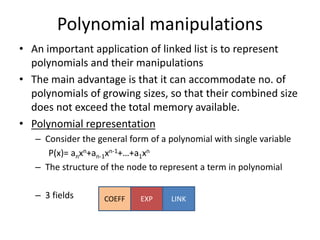
– The structure of the node to represent a term in polynomial
– 3 fields COEFF EXP LINK
Polynomial manipulations
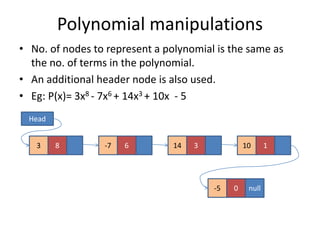
• No. of nodes to represent a polynomial is the same as
the no. of terms in the polynomial.
• An additional header node is also used.
• Eg: P(x)= 3x8 - 7x6 + 14x3 + 10x - 5
3 8 -7 6 14 3 10 1
-5 0 null
Head
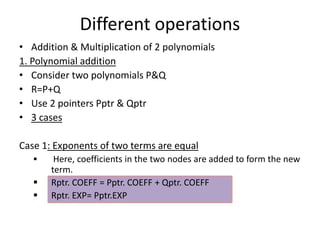
Different operations
• Addition & Multiplication of 2 polynomials
1. Polynomial addition
• Consider two polynomials P&Q
• R=P+Q
• Use 2 pointers Pptr & Qptr
• 3 cases
Case 1: Exponents of two terms are equal
 Here, coefficients in the two nodes are added to form the new
term.
 Rptr. COEFF = Pptr. COEFF + Qptr. COEFF
 Rptr. EXP= Pptr.EXP
Polynomial addition
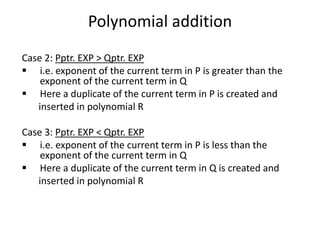
Case 2: Pptr. EXP > Qptr. EXP
 i.e. exponent of the current term in P is greater than the
exponent of the current term in Q
 Here a duplicate of the current term in P is created and
inserted in polynomial R
Case 3: Pptr. EXP < Qptr. EXP
 i.e. exponent of the current term in P is less than the
exponent of the current term in Q
 Here a duplicate of the current term in Q is created and
inserted in polynomial R
Polynomial addition
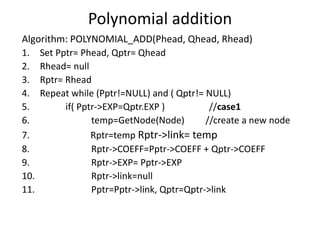
Algorithm: POLYNOMIAL_ADD(Phead, Qhead, Rhead)
1. Set Pptr= Phead, Qptr= Qhead
2. Rhead= null
3. Rptr= Rhead
4. Repeat while (Pptr!=NULL) and ( Qptr!= NULL)
5. if( Pptr->EXP=Qptr.EXP ) //case1
6. temp=GetNode(Node) //create a new node
7. Rptr=temp Rptr->link= temp
8. Rptr->COEFF=Pptr->COEFF + Qptr->COEFF
9. Rptr->EXP= Pptr->EXP
10. Rptr->link=null
11. Pptr=Pptr->link, Qptr=Qptr->link
Polynomial addition
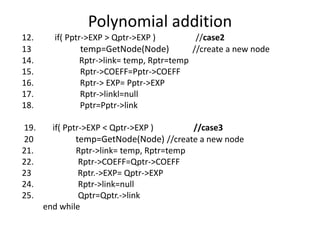
12. if( Pptr->EXP > Qptr->EXP ) //case2
13 temp=GetNode(Node) //create a new node
14. Rptr->link= temp, Rptr=temp
15. Rptr->COEFF=Pptr->COEFF
16. Rptr-> EXP= Pptr->EXP
17. Rptr->linkl=null
18. Pptr=Pptr->link
19. if( Pptr->EXP < Qptr->EXP ) //case3
20 temp=GetNode(Node) //create a new node
21. Rptr->link= temp, Rptr=temp
22. Rptr->COEFF=Qptr->COEFF
23 Rptr.->EXP= Qptr->EXP
24. Rptr->link=null
25. Qptr=Qptr.->link
end while
Polynomial addition
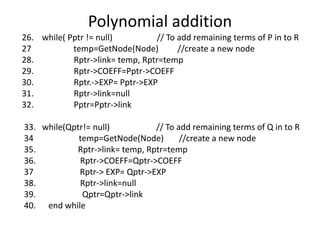
26. while( Pptr != null) // To add remaining terms of P in to R
27 temp=GetNode(Node) //create a new node
28. Rptr->link= temp, Rptr=temp
29. Rptr->COEFF=Pptr->COEFF
30. Rptr.->EXP= Pptr->EXP
31. Rptr->link=null
32. Pptr=Pptr->link
33. while(Qptr!= null) // To add remaining terms of Q in to R
34 temp=GetNode(Node) //create a new node
35. Rptr->link= temp, Rptr=temp
36. Rptr->COEFF=Qptr->COEFF
37 Rptr-> EXP= Qptr->EXP
38. Rptr->link=null
39. Qptr=Qptr->link
40. end while
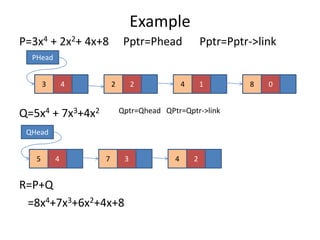
Example
P=3x4 + 2x2+ 4x+8 Pptr=Phead Pptr=Pptr->link
Q=5x4 + 7x3+4x2 Qptr=Qhead QPtr=Qptr->link
R=P+Q
=8x4+7x3+6x2+4x+8
3 4 2 2 4 1 8 0
PHead
5 4 7 3 4 2
QHead

Polynomial reppresentation using Linkedlist-Application of LL.pptx

  • 1.
    Applications of linkedlist Polynomial Dynamic memory allocation
  • 2.
    Applications • Linked listsare very popular data structures. • Advantages of linked list over arrays – In array, storage in contiguous memory location – So insertion and deletion will be time consuming. – In insertion, the trailing elements should be shifted down to make room for new elements. – During deletion, all the trailing elements are shifted upward.  In linked list, no need of shifting the elements during insertion or deletion. Need to change only pointers.
  • 3.
    Applications – Array isbased on static allocation of memory – Linked list used dynamic memory allocation scheme. – If contiguous memory is not available, program wont be executed in the case of array. – But adjacent memory location is not required in the case of linked list.
  • 4.
    Polynomial manipulations • Animportant application of linked list is to represent polynomials and their manipulations • The main advantage is that it can accommodate no. of polynomials of growing sizes, so that their combined size does not exceed the total memory available. • Polynomial representation – Consider the general form of a polynomial with single variable P(x)= anxn+an-1xn-1+…+a1xn – The structure of the node to represent a term in polynomial – 3 fields COEFF EXP LINK
  • 5.
    Polynomial manipulations • No.of nodes to represent a polynomial is the same as the no. of terms in the polynomial. • An additional header node is also used. • Eg: P(x)= 3x8 - 7x6 + 14x3 + 10x - 5 3 8 -7 6 14 3 10 1 -5 0 null Head
  • 6.
    Different operations • Addition& Multiplication of 2 polynomials 1. Polynomial addition • Consider two polynomials P&Q • R=P+Q • Use 2 pointers Pptr & Qptr • 3 cases Case 1: Exponents of two terms are equal  Here, coefficients in the two nodes are added to form the new term.  Rptr. COEFF = Pptr. COEFF + Qptr. COEFF  Rptr. EXP= Pptr.EXP
  • 7.
    Polynomial addition Case 2:Pptr. EXP > Qptr. EXP  i.e. exponent of the current term in P is greater than the exponent of the current term in Q  Here a duplicate of the current term in P is created and inserted in polynomial R Case 3: Pptr. EXP < Qptr. EXP  i.e. exponent of the current term in P is less than the exponent of the current term in Q  Here a duplicate of the current term in Q is created and inserted in polynomial R
  • 8.
    Polynomial addition Algorithm: POLYNOMIAL_ADD(Phead,Qhead, Rhead) 1. Set Pptr= Phead, Qptr= Qhead 2. Rhead= null 3. Rptr= Rhead 4. Repeat while (Pptr!=NULL) and ( Qptr!= NULL) 5. if( Pptr->EXP=Qptr.EXP ) //case1 6. temp=GetNode(Node) //create a new node 7. Rptr=temp Rptr->link= temp 8. Rptr->COEFF=Pptr->COEFF + Qptr->COEFF 9. Rptr->EXP= Pptr->EXP 10. Rptr->link=null 11. Pptr=Pptr->link, Qptr=Qptr->link
  • 9.
    Polynomial addition 12. if(Pptr->EXP > Qptr->EXP ) //case2 13 temp=GetNode(Node) //create a new node 14. Rptr->link= temp, Rptr=temp 15. Rptr->COEFF=Pptr->COEFF 16. Rptr-> EXP= Pptr->EXP 17. Rptr->linkl=null 18. Pptr=Pptr->link 19. if( Pptr->EXP < Qptr->EXP ) //case3 20 temp=GetNode(Node) //create a new node 21. Rptr->link= temp, Rptr=temp 22. Rptr->COEFF=Qptr->COEFF 23 Rptr.->EXP= Qptr->EXP 24. Rptr->link=null 25. Qptr=Qptr.->link end while
  • 10.
    Polynomial addition 26. while(Pptr != null) // To add remaining terms of P in to R 27 temp=GetNode(Node) //create a new node 28. Rptr->link= temp, Rptr=temp 29. Rptr->COEFF=Pptr->COEFF 30. Rptr.->EXP= Pptr->EXP 31. Rptr->link=null 32. Pptr=Pptr->link 33. while(Qptr!= null) // To add remaining terms of Q in to R 34 temp=GetNode(Node) //create a new node 35. Rptr->link= temp, Rptr=temp 36. Rptr->COEFF=Qptr->COEFF 37 Rptr-> EXP= Qptr->EXP 38. Rptr->link=null 39. Qptr=Qptr->link 40. end while
  • 11.
    Example P=3x4 + 2x2+4x+8 Pptr=Phead Pptr=Pptr->link Q=5x4 + 7x3+4x2 Qptr=Qhead QPtr=Qptr->link R=P+Q =8x4+7x3+6x2+4x+8 3 4 2 2 4 1 8 0 PHead 5 4 7 3 4 2 QHead