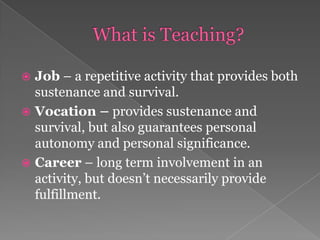
 Job – a repetitive activity that provides both
  sustenance and survival.
 Vocation – provides sustenance and
  survival, but also guarantees personal
  autonomy and personal significance.
 Career – long term involvement in an
  activity, but doesn’t necessarily provide
  fulfillment.
 Occupation – an endeavor within society’s
  economic, social and political system, but
  may not entail a sense of calling.
 Profession – emphasizes the expertise and
  social contribution to society, but not
  necessarily a calling for personal fulfillment.
   To create optimal conditions for desired
    learning to take place in as short a time as
    possible.
   Hats off to teachers for their many roles:
    › Artist and Architect
    › Scientist and Psychologist
    › Manager and Mentor
    › Controller and Counselor
    › Sage on the Stage
    › Guide on the Side
   Teachers as Passive Technicians
    › Conduit
   Teachers as Reflective Practitioners
    › Facilitator
   Teachers as Transformative Intellectuals
    › Change Agent
 Primary focus of teaching is content
  knowledge.
 Simply use “teacher-proof” packages.
 Professional experts create the knowledge
  base and teachers pass it on to students.
 Leads to disempowerment.
 Passive form of teaching.
   First proposed by John Dewey:
    › Teaching is not just a series of predetermined
      and pre-sequenced procedures.
    › Teachers are problem solvers.
    › This is a holistic approach that emphasizes the
      creativity, artistry, and context sensitivity.
   Don Schon added:
    › Teachers bring perspectives that cannot be
      matched by experts who are far removed from
      the classroom.
   There are 2 types of Reflection:
   Reflection-on-Action:
    › Reflection-on-action – can happen before and after a
      lesson as teachers plan for a lesson and then evaluate the
      effectiveness of their teaching acts afterward.

   Reflection-in-Action
    › Happens during the teaching act when teachers monitor
      their ongoing performance, locate unexpected
      problems, and adjust instantaneously.
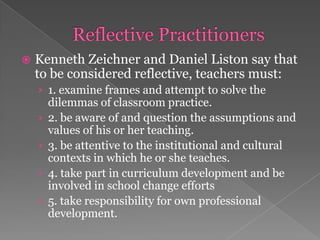
   Kenneth Zeichner and Daniel Liston say that
    to be considered reflective, teachers must:
    › 1. examine frames and attempt to solve the
        dilemmas of classroom practice.
    ›   2. be aware of and question the assumptions and
        values of his or her teaching.
    ›   3. be attentive to the institutional and cultural
        contexts in which he or she teaches.
    ›   4. take part in curriculum development and be
        involved in school change efforts
    ›   5. take responsibility for own professional
        development.
 Focuses on the teacher alone, not on
  learners, colleagues, planners, and
  administrators.
 Focuses on what teachers do in the
  classroom and not the sociopolitical factors
  that shape a teacher’s reflective practice.
 Contributes very little change to the reliance
  on established professional wisdom.
 Developed by critical pedagogists.
 Empowers teachers and learners.
 Takes seriously the lived experiences that
  teachers and learners bring and teach
  according to student needs and wants.
 Requires teachers to be sociopolitically
  conscious and to be assertive in acting on it.
 Dual Task – strives for educational
  advancement and personal transformation.
   Inquiry oriented
   Socially contextualized
   Grounded on a commitment to world making
   Dedicated to an art of improvisation
   Extended by a concern with critical self and
    social reflection
   Shaped by a commitment to democratic self-
    directed education
   Committed to action
   Concerned with the affective dimension of
    human beings
Teachers as    Teachers as     Teachers as
Transformative    Reflective       Passive
 Intellectuals   Practitioners   Technicians
Theory and Practice Should
   Inform One Another
   Professional Theory –       Professional Theory –
    created and                  unique to each
    perpetuated within the       person, developed
    professional culture.        through testing
                                 professional theories.
   Technical Level: Concerned with effective
    achievement of short-term, classroom centered
    instructional goals.
    › Passive Technicians
   Practical Level: Concerned with
    assumptions, values, and consequences of
    classroom activities.
    › Reflective Practitioners
   Critical or Emancipatory Level: Concerned with
    the wider ethical, social, historical and political
    issues.
    › Transformative Intellectuals
1. This chapter gave several different synonyms
   and definitions for the act of teaching
   (job, vocation, career, etc.). In thinking about
   yourself and your own teaching
   philosophy, which do you feel is the most
   relevant? Why?

2. What are the obstacles you may face in carrying
   out the responsibilities of a reflective teacher
   and how might you overcome them?
Kumaravadivelu, B. (2003). Chapter 1: Conceptualizing Teaching Acts (p. 5-22).
Found in: Beyond methods: Macrostrategies for Language Teaching.

Conceptualizing teaching acts

  • 3.
     Job –a repetitive activity that provides both sustenance and survival.  Vocation – provides sustenance and survival, but also guarantees personal autonomy and personal significance.  Career – long term involvement in an activity, but doesn’t necessarily provide fulfillment.
  • 4.
     Occupation –an endeavor within society’s economic, social and political system, but may not entail a sense of calling.  Profession – emphasizes the expertise and social contribution to society, but not necessarily a calling for personal fulfillment.
  • 5.
    To create optimal conditions for desired learning to take place in as short a time as possible.
  • 6.
    Hats off to teachers for their many roles: › Artist and Architect › Scientist and Psychologist › Manager and Mentor › Controller and Counselor › Sage on the Stage › Guide on the Side
  • 7.
    Teachers as Passive Technicians › Conduit  Teachers as Reflective Practitioners › Facilitator  Teachers as Transformative Intellectuals › Change Agent
  • 8.
     Primary focusof teaching is content knowledge.  Simply use “teacher-proof” packages.  Professional experts create the knowledge base and teachers pass it on to students.  Leads to disempowerment.  Passive form of teaching.
  • 9.
    First proposed by John Dewey: › Teaching is not just a series of predetermined and pre-sequenced procedures. › Teachers are problem solvers. › This is a holistic approach that emphasizes the creativity, artistry, and context sensitivity.  Don Schon added: › Teachers bring perspectives that cannot be matched by experts who are far removed from the classroom.
  • 10.
    There are 2 types of Reflection:  Reflection-on-Action: › Reflection-on-action – can happen before and after a lesson as teachers plan for a lesson and then evaluate the effectiveness of their teaching acts afterward.  Reflection-in-Action › Happens during the teaching act when teachers monitor their ongoing performance, locate unexpected problems, and adjust instantaneously.
  • 11.
    Kenneth Zeichner and Daniel Liston say that to be considered reflective, teachers must: › 1. examine frames and attempt to solve the dilemmas of classroom practice. › 2. be aware of and question the assumptions and values of his or her teaching. › 3. be attentive to the institutional and cultural contexts in which he or she teaches. › 4. take part in curriculum development and be involved in school change efforts › 5. take responsibility for own professional development.
  • 12.
     Focuses onthe teacher alone, not on learners, colleagues, planners, and administrators.  Focuses on what teachers do in the classroom and not the sociopolitical factors that shape a teacher’s reflective practice.  Contributes very little change to the reliance on established professional wisdom.
  • 13.
     Developed bycritical pedagogists.  Empowers teachers and learners.  Takes seriously the lived experiences that teachers and learners bring and teach according to student needs and wants.  Requires teachers to be sociopolitically conscious and to be assertive in acting on it.  Dual Task – strives for educational advancement and personal transformation.
  • 14.
    Inquiry oriented  Socially contextualized  Grounded on a commitment to world making  Dedicated to an art of improvisation  Extended by a concern with critical self and social reflection  Shaped by a commitment to democratic self- directed education  Committed to action  Concerned with the affective dimension of human beings
  • 15.
    Teachers as Teachers as Teachers as Transformative Reflective Passive Intellectuals Practitioners Technicians
  • 16.
    Theory and PracticeShould Inform One Another
  • 17.
    Professional Theory –  Professional Theory – created and unique to each perpetuated within the person, developed professional culture. through testing professional theories.
  • 18.
    Technical Level: Concerned with effective achievement of short-term, classroom centered instructional goals. › Passive Technicians  Practical Level: Concerned with assumptions, values, and consequences of classroom activities. › Reflective Practitioners  Critical or Emancipatory Level: Concerned with the wider ethical, social, historical and political issues. › Transformative Intellectuals
  • 19.
    1. This chaptergave several different synonyms and definitions for the act of teaching (job, vocation, career, etc.). In thinking about yourself and your own teaching philosophy, which do you feel is the most relevant? Why? 2. What are the obstacles you may face in carrying out the responsibilities of a reflective teacher and how might you overcome them?
  • 20.
    Kumaravadivelu, B. (2003).Chapter 1: Conceptualizing Teaching Acts (p. 5-22). Found in: Beyond methods: Macrostrategies for Language Teaching.