Basic Concepts of Extremity Joint Mobilization Ref: Peripheral Manipulation. 4ed. GD Maitland  Chapter I
Using the Maitland Concept Toward             Patient Treatment I. The patient -centered approach to dealing     with movement disorders: Therapist needs to develop a level concentration:  a.See each piece of info given by the patient. b. Ask relevant questions. Follow up questions  Good exam-revisit patient’s sensory,cognitive and emotional world. With regards to both subj/obj exam. Non-judgmental Therapist’s needs to developed understanding of verbal and non verbal communication skills as it relates to patient-encourage patient confidence.
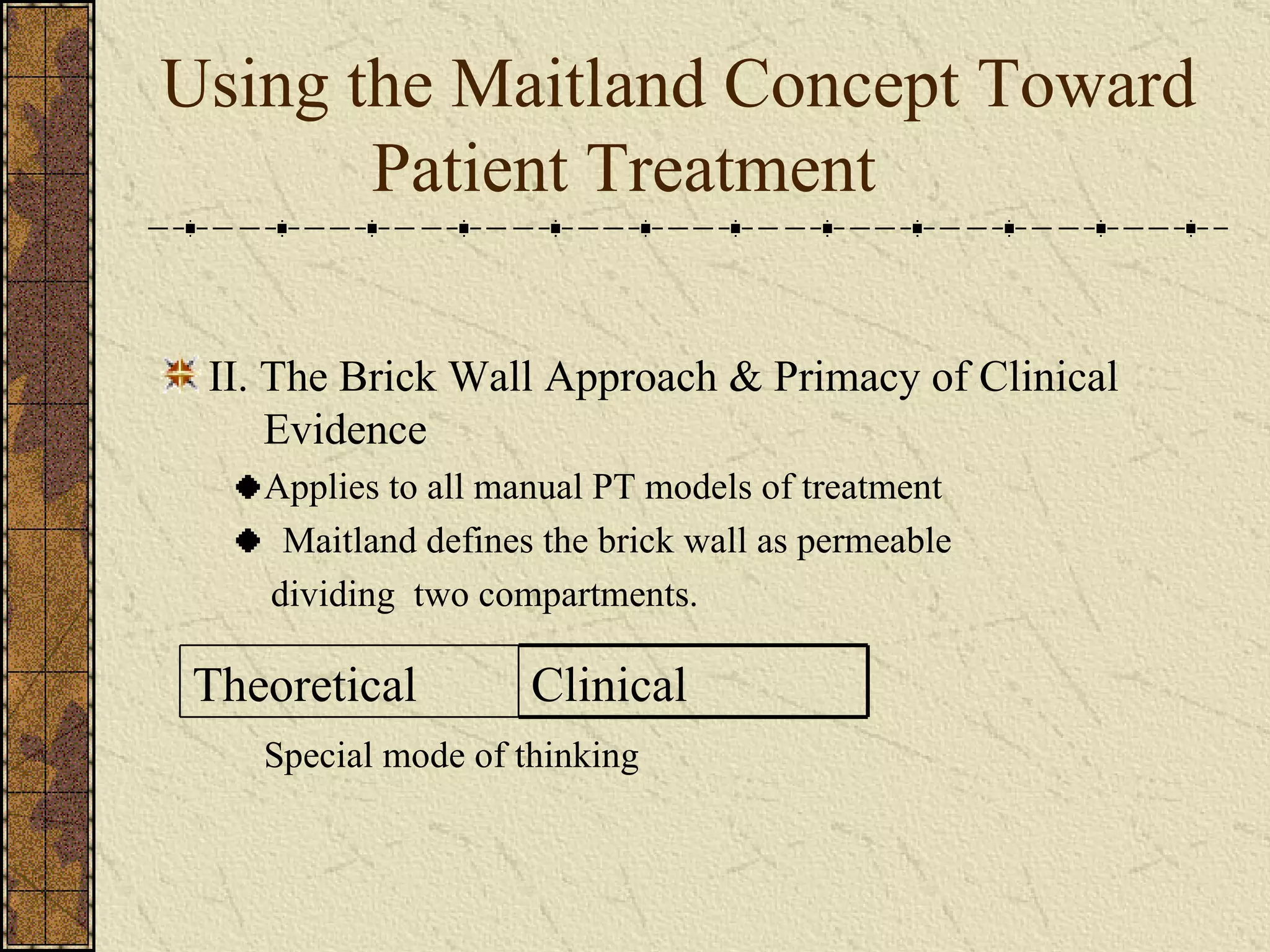
Using the Maitland Concept Toward             Patient Treatment II. The Brick Wall Approach & Primacy of Clinical      Evidence Applies to all manual PT models of treatment Maitland defines the brick wall as permeable dividing  two compartments. Special mode of thinking  Clinical Theoretical
Central Theme The central theme of Maitland’s concept thinking, the symbolic permeable brick wall and the primacy of clinical evidence. There are five requirements to assist with the brick wall approach.
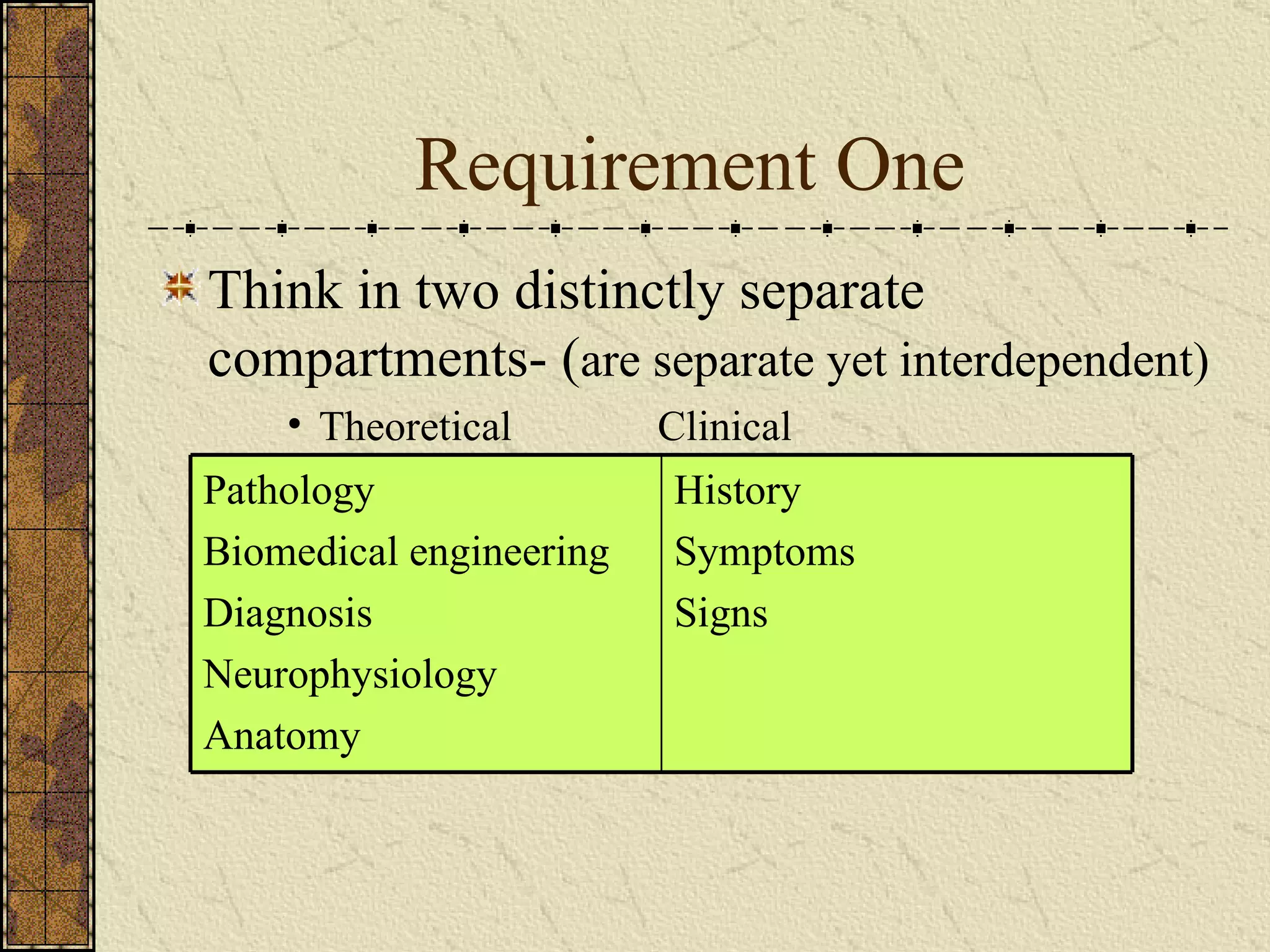
Requirement One Think in two distinctly separate compartments- ( are separate yet interdependent) Theoretical  Clinical History Symptoms Signs Pathology Biomedical engineering Diagnosis Neurophysiology Anatomy
Requirement 2 Need to know the history, signs and symptoms  while making use of the theoretical  compartment to formulate an diagnosis What does the brick wall mode of thinking caters to? Recognizable syndromes( IT band) Recognizable pathology ( MM in the knee) Clinical disorders of movement (antalgic gait with hip pain)
Requirement 2 According to Maitland the clinical compartment has priority over the theoretical compartment. What does this mean? Example:   DX of chronic tennis elbow Avoid just focusing on elbow rule out other factors that could be relevant to the problem: shoulder,  cervical and T spine neural tissue
Requirement 3 Good choice of wording  Example: “shoulder pain “may better serve the concept of separation of theory and clinical by the stating “pain in the shoulder area” thus not indicating thought that the shoulder was the specific cause of pain without ruling out other structures.
Requirement 4 The therapist should choose a treatment technique in relation to the patient’s sign & symptoms. Avoid having the theoretical compartment  influence the vigor and choice of techniques  Example: DX. Acute hip bursitis limiting hip flexion The technique of choice might be accessory passive movement in posterior glide in a gentle manner grade 1 (small amplitudes) due to server pain.
Requirement 5 The therapist be able to apply the brick wall concept to contemporary models clinical decision making
Summary The two compartmental mode of thinking allows for discussion on speculation, hypotheses and research for the cause of the patient’s condition. This concept allows for the theoretical mode, the widest thinking while knowing that, if that is correct, it must match with clinical information.
 How Can We Interrelate the                   Two  Modes? Examination Subjective Objective Accessory movements /compression test Combined movements/ special test/ Rom and pain response/over pressure/MMT Techniques Assessment

Concept Lecture 2-06

  • 1.
    Basic Concepts ofExtremity Joint Mobilization Ref: Peripheral Manipulation. 4ed. GD Maitland Chapter I
  • 2.
    Using the MaitlandConcept Toward             Patient Treatment I. The patient -centered approach to dealing     with movement disorders: Therapist needs to develop a level concentration: a.See each piece of info given by the patient. b. Ask relevant questions. Follow up questions Good exam-revisit patient’s sensory,cognitive and emotional world. With regards to both subj/obj exam. Non-judgmental Therapist’s needs to developed understanding of verbal and non verbal communication skills as it relates to patient-encourage patient confidence.
  • 3.
    Using the MaitlandConcept Toward             Patient Treatment II. The Brick Wall Approach & Primacy of Clinical      Evidence Applies to all manual PT models of treatment Maitland defines the brick wall as permeable dividing two compartments. Special mode of thinking Clinical Theoretical
  • 4.
    Central Theme Thecentral theme of Maitland’s concept thinking, the symbolic permeable brick wall and the primacy of clinical evidence. There are five requirements to assist with the brick wall approach.
  • 5.
    Requirement One Thinkin two distinctly separate compartments- ( are separate yet interdependent) Theoretical Clinical History Symptoms Signs Pathology Biomedical engineering Diagnosis Neurophysiology Anatomy
  • 6.
    Requirement 2 Needto know the history, signs and symptoms while making use of the theoretical compartment to formulate an diagnosis What does the brick wall mode of thinking caters to? Recognizable syndromes( IT band) Recognizable pathology ( MM in the knee) Clinical disorders of movement (antalgic gait with hip pain)
  • 7.
    Requirement 2 Accordingto Maitland the clinical compartment has priority over the theoretical compartment. What does this mean? Example: DX of chronic tennis elbow Avoid just focusing on elbow rule out other factors that could be relevant to the problem: shoulder, cervical and T spine neural tissue
  • 8.
    Requirement 3 Goodchoice of wording Example: “shoulder pain “may better serve the concept of separation of theory and clinical by the stating “pain in the shoulder area” thus not indicating thought that the shoulder was the specific cause of pain without ruling out other structures.
  • 9.
    Requirement 4 Thetherapist should choose a treatment technique in relation to the patient’s sign & symptoms. Avoid having the theoretical compartment influence the vigor and choice of techniques Example: DX. Acute hip bursitis limiting hip flexion The technique of choice might be accessory passive movement in posterior glide in a gentle manner grade 1 (small amplitudes) due to server pain.
  • 10.
    Requirement 5 Thetherapist be able to apply the brick wall concept to contemporary models clinical decision making
  • 11.
    Summary The twocompartmental mode of thinking allows for discussion on speculation, hypotheses and research for the cause of the patient’s condition. This concept allows for the theoretical mode, the widest thinking while knowing that, if that is correct, it must match with clinical information.
  • 12.
    How CanWe Interrelate the                  Two Modes? Examination Subjective Objective Accessory movements /compression test Combined movements/ special test/ Rom and pain response/over pressure/MMT Techniques Assessment