SPECIFIC TREATMENT OF PROBLEMS
   OF THE SPINE (STOPS) TRIALS


 Dr Jon Ford (PhD, MPhysio, BAppSciPhysio)
 Dr Andrew Hahne (PhD, BPhysio)
 Luke Surkitt (BPhysio)
 Alex Chan (BPhysio)
 Matt Richards (BPhysio)
 Sarah Slater (BPhysio)
Clinical scenario
•  Patient reports
   –  “My backs out”
   –  “The doctor says it’s a muscle strain”
   –  “The doctor says I’ll get better but its now 6 weeks”

•  Clinical questions
   –    Does it matter which treatment I provide?
   –    How do I diagnose the problem?
   –    What treatment can I provide that is specific to the diagnosis?
   –    Is there evidence to support these clinical decisions?
Clinical practice guidelines
•  Syntheses of CPGs (Dagenais et al 2010, Koes et
   al 2010)
•  High quality guidelines from last 10 years
   (average 4 years old)
Recommendations
•  Identify “flags”
What is “organic pathology”
•  Typically regarded as disc herniation with
   associated radiculopathy (DHR)
   –  Conservative trial followed by surgery if non-responsive
   –  MRI not indicated unless surgery being seriously
      considered
•  Potential counter-productive effect of attempting
   to identify pathoanatomical cause of the pain
   (beyond serious pathology including DHR)
Specific treatment
               recommendations
•  Specific treatment for organic pathology other
   than DHR not provided
•  Treatment specific to the flag identified not
   clearly stated
•  Due to low level evidence on the efficacy of
   specific treatment
   –  eg Which treatment is most effective for
      •  High fear avoidance beliefs?
      •  Disc herniation with associated radiculopathy?
Generic treatment
                recommendations
•  Advice/reassurance for acute LBP ± medication
   for short term relief
•  Chronic LBP
  –    Exercise
  –    Cognitive behavioural approach
  –    Multi-disciplinary intervention
  –    Acupuncture
  –    Opiates
•  Variable recommendations for manual therapy
   due to lack of consistent evidence
Lack of evidence
•    Diagnostic injection
•    Therapeutic blocks
•    Pilates
•    Massage therapy
•    Specific treatment (eg SIJ, O’Sullivan, McKenzie,
     motor control, etc)
And there’s more…
•  Treatment effects are small (less than 0.5) when
   compared to “minimal intervention” or “usual
   care”
  –  Borderline clinical meaningfulness
•  Non-significant treatment effects comparing one
   treatment to another
Classification issues (aka lumping
            and splitting)

•  False assumption of sample
   homogeneity
•  Application of generic
   treatment protocols
•  Dilution of the effect of
   specific treatment
Are these treatments appropriate
     for all “non-specific LBP” cases?
•    Motor control
•    Manual therapy
•    Pilates
•    McKenzie
•    Functional restoration/graded activity
•    Cognitive-behavioural approach
•    Neurophysiological education
•    Treatment of signs and symptoms
Systema(c	
  reviews	
  
•  Based	
  on	
  the	
  premise	
  of	
  uniden(fied	
  subgroups	
  
   dilu(ng	
  the	
  treatment	
  effect	
  in	
  RCTs	
  to	
  date	
  our	
  
   group	
  conducted	
  a	
  number	
  of	
  systema(c	
  reviews	
  
•  Our	
  results	
  showed	
  that	
  there	
  are	
  some	
  individual	
  
   trials	
  that	
  show	
  larger	
  effects	
  when	
  Rx	
  is	
  applied	
  to	
  
   specific	
  subgroups	
  but	
  the	
  level	
  of	
  evidence	
  was	
  
   generally	
  low	
  or	
  moderate	
  at	
  best	
  
Classification based RCTs
Classification RCTs

The effectiveness of physiotherapy functional
restoration for post-acute low back pain (Richards,
Ford et al 2012) – in press
Recent advances in classification
•  Peter O’Sullivan
   –  Movement and control impairment subgroups
   –  Exercise, motor control, cognitive-behavioural Rx
•  STaRT Back
   –  Orebro based subgroups of low, mod and high risk
   –  Advise/functional restoration/cognitive behavioural Rx
•  Tom Petersen/Mark Laslett
   –  Pathoanatomical subgroups
   –  McKenzie treatment for discogenic pain
Identified issues
•  Mixing populations
•  Reinventing the wheel – what about manual
   therapy?
•  Complexity (O’Sullivan)
•  Poorly described and non-reproducible treatment
   protocols
•  “Forcing” patients into one subgroup (O’Sullivan
   and McKenzie)
The STOPS approach
•  The right population - sub-acute, non-
   compensable
•  Well accepted/validated subgroups
   –    Reducible discogenic pain
   –    Disc herniation with associated radiculopathy
   –    Z-joint dysfunction
   –    Non-reducible discogenic pain
   –    Multi-factorial persistent pain
•  A sophisticated but well described and
   reproducible assessment and classification
   system
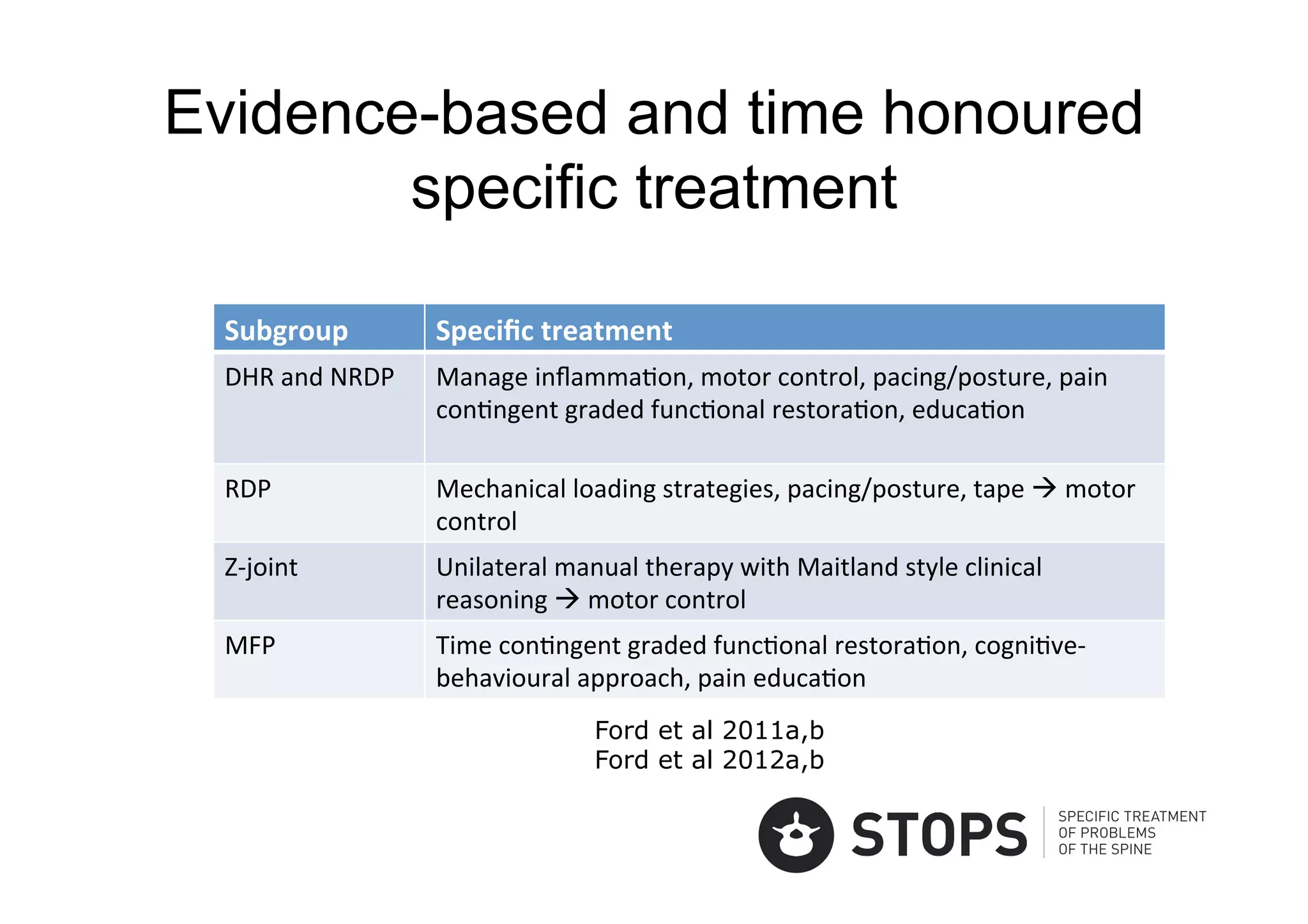
Evidence-based and time honoured
        specific treatment

 Subgroup	
               Specific	
  treatment	
  
 DHR	
  and	
  NRDP	
     Manage	
  inflamma(on,	
  motor	
  control,	
  pacing/posture,	
  pain	
  
                          con(ngent	
  graded	
  func(onal	
  restora(on,	
  educa(on	
  

 RDP	
                    Mechanical	
  loading	
  strategies,	
  pacing/posture,	
  tape	
  à	
  motor	
  
                          control	
  
 Z-­‐joint	
              Unilateral	
  manual	
  therapy	
  with	
  Maitland	
  style	
  clinical	
  
                          reasoning	
  à	
  motor	
  control	
  
 MFP	
                    Time	
  con(ngent	
  graded	
  func(onal	
  restora(on,	
  cogni(ve-­‐
                          behavioural	
  approach,	
  pain	
  educa(on	
  
                                             Ford et al 2011a,b
                                             Ford et al 2012a,b
Design
•  Specific physiotherapy treatment program for
   each subgroup vs “evidence-based advice”
•  300 participants randomly allocated
•  Follow-ups at 5-weeks, 10-weeks, 6-months, 12-
   months, 24-months
Inclusion/exclusion criteria
•  Inclusion criteria
   –  Aged 18-65
   –  New episode of lumbar related pain between 6 weeks and 6
      months
•  Exclusion criteria
   –    Compensable clients
   –    Post-surgery
   –    Epidural in the previous 6 weeks
   –    Cauda equina syndrome
Classification
Classification process
•  Full assessment (60 minutes)
•  Data entered into a purpose built excel
   spreadsheet
•  Classification subgroup automatically calculated
Z-joint subgroup
•  Unilateral symptoms
•  A regular compression pattern (Edwards 1992)
  –  Extension in standing reproducing the participant’s
     clinical pain
  –  Ipsilateral lateral flexion or quadrant in standing
     reproducing the participant’s clinical pain
•  Comparable palpatory findings
•  A positive response to assessment of the
   comparable palpatory finding
RDP
•  Positive on at least 4 of 9 subjective features of discogenic
   pain (Chan et al 2012)
•  Positive response to repeated movement or sustained
   positioning (MLS) defined as an:
   –  Increase in range of motion of the MLS during application by at
      least 50% or
   –  Increase in AMT in any movement by at least 50% after
      application or
   –  Increase in observed segmental intervertebral motion during
      AMT after application or
   –  Improvement in resting pain and/or centralisation (>1min
   –  Reduction in an observed lateral shift postural abnormality
Treatment
•    14 clinics across metropolitan Melbourne
•    10 SMC treating physiotherapists
•    10 sessions of specific Rx over 10 weeks
•    2 sessions of advice over 10 weeks (Indahl et al 1995)
•    Treatment integrity
     –    240 page treatment manual
     –    2 day training
     –    Clinical notes submitted at 3 and 7 weeks
     –    Monthly telephone hook up
Participant info sheets
•      Diagnosis	
  	
                             •  Dealing with an increase in
•      Program	
  (meframes	
                         pain
•      Treatment	
  op(ons	
                       •  Inflammation
•      Motor	
  control	
  training	
              •  Pain versus function
•      Direc(onal	
  preference	
  exercises	
     •  Pain management
•      Func(onal	
  restora(on	
  exercises	
         strategies (2)
                                                   •  Posture
•      Goal	
  seOng	
  
•      Pacing	
  and	
  graded	
  ac(vity	
        •  Relaxation
	
                                                 •  Sleep
Treatment protocols
•  Algorithmic, sophisticated yet reproducible
•  Detailed protocols published (Ford et al 2012a, b,
   c, d)
•  Adhering to the key principles of the original
   developers (Maitland 1987, McKenzie 1981,
   Mayer et al 1985, Saal and Saal 1989)
Ford et al 2012
Ford et al 2012
Outcome measures
•  Primary outcomes:
  –  Activity limitation (Oswestry)
  –  Leg pain intensity (0-10 numerical rating scale)
  –  Back pain intensity (0-10 numerical rating scale)
•  Secondary outcomes
  –    Sciatica frequency and bothersomeness scales
  –    Global rating of change (7-point scale)
  –    Satisfaction with physiotherapy treatment (and results)
  –    Psychosocial status (Orebro)
  –    Quality of life (EuroQol-5D)
  –    Number of work days missed
  –    Interference with work
•  Other measures
  –  Co-interventions
  –  Medication
Analysis
•  Between-group effects
•  Continuous outcomes
  –  Linear mixed model with baseline score as a covariate
•  Ordinal outcomes
  –  Mann Whitney U test
•  Dichotomous outcomes
  –  Relative risk, risk difference, and number needed to
     treat
Results 	
  	
  
•  See	
  IFOMPT	
  presenta(on	
  
•  12	
  month	
  results	
  will	
  be	
  published	
  mid	
  2013	
  
•  Results	
  show	
  that	
  specific	
  physiotherapy	
  
   works!	
  
Contact	
  
E: 	
   	
  stopsbackpain@gmail.com	
  
W:	
  	
   	
  www.facebook.com/STOPSbackpain	
  
T: 	
   	
  @stopsbackpain	
  
Our papers


Hahne A, Ford J. Functional restoration for a chronic lumbar disk extrusion with
associated radiculopathy. Physical Therapy. 2006;86:1668-80.
Ford J, et al. Classification systems for low back pain: a review of the methodology for
development and validation. Physical Therapy Reviews. 2007;12:33-42.
Heymans M, et al. Exploring the contribution of patient-reported and clinician based
variables for the prediction of low back work status. Journal of Occupational
Rehabilitation. 2007;17:383–97.
Wilde V, et al. Indicators of lumbar zygapophyseal joint pain: survey of an expert panel
with the Delphi Technique. Physical Therapy. 2007;87:1348–61.
Ford J, et al. The test retest reliability and concurrent validity of the Subjective
Complaints Questionnaire for low back pain. Manual Therapy. 2009;14 283-91.
Hahne A, et al. Outcomes and adverse events from physiotherapy functional
restoration for lumbar disc herniation with associated radiculopathy. Disability and
Rehabilitation. 2010;Early Online:1-11.
Hahne A, et al. Conservative management of lumbar disc herniation with associated
radiculopathy: a systematic review. Spine. 2010;35:E488-E504.
Ford J, et al. A classification and treatment protocol for low back disorders. Part 2:
directional preference management for reducible discogenic pain. Physical Therapy
Reviews. 2011;16:423-37.
Ford J, et al. A classification and treatment protocol for low back disorders. Part 1:
specific manual therapy. Physical Therapy Reviews. 2011;16:168-77.
Hahne AJ, et al. Specific treatment of problems of the spine (STOPS): design of a
randomised controlled trial comparing specific physiotherapy versus advice for people
with subacute low back disorders. BMC Musculoskeletal Disorders. 2011;12:104.
Ford J, Hahne A. Pathoanatomy and classification of low back disorders Manual
Therapy. 2012;In press.
Ford J, et al. A classification and treatment protocol for low back disorders. Part 3:
functional restoration for intervertebral disc related disorders. Physical Therapy
Reviews. 2012;17:55-75.
Ford J, et al. A classification and treatment protocol for low back disorders. Part 4:
functional restoration for low back disorders associated with multifactorial persistent
pain. Physical Therapy Reviews. 2012;In press.
Richards M, et al. The effectiveness of physiotherapy functional restoration for post-
acute low back pain: a systematic review. In press. 2012.
Slater SL, et al. The effectiveness of sub-group specific manual therapy for low back
pain: A systematic review. Manual Therapy. 2012;17:201-12.
Surkitt LD, et al. Efficacy of directional preference management for low back pain: a
systematic review. Physical Therapy. 2012;92:652-65.
Other references
Dagenais S, et al. Synthesis of recommendations for the assessment
and management of low back pain from recent clinical practice
guidelines. The Spine Journal. 2010;10:514-29.
Koes BW, et al. An updated overview of clinical guidelines for the
management of non-specific low back pain in primary care. Eur Spine
J. 2010;19:2075-94.
Petersen T, et al. The McKenzie method compared with manipulation
when used adjunctive to information and advice in low back pain
patients presenting with centralization or peripheralization. Spine.
2011.
Hill JC, et al. Comparison of stratified primary care management for
low back pain with current best practice (STarT Back). Lancet. 2011.

Classification of back pain (STOPS) 2012

  • 1.
    SPECIFIC TREATMENT OFPROBLEMS OF THE SPINE (STOPS) TRIALS Dr Jon Ford (PhD, MPhysio, BAppSciPhysio) Dr Andrew Hahne (PhD, BPhysio) Luke Surkitt (BPhysio) Alex Chan (BPhysio) Matt Richards (BPhysio) Sarah Slater (BPhysio)
  • 2.
    Clinical scenario •  Patientreports –  “My backs out” –  “The doctor says it’s a muscle strain” –  “The doctor says I’ll get better but its now 6 weeks” •  Clinical questions –  Does it matter which treatment I provide? –  How do I diagnose the problem? –  What treatment can I provide that is specific to the diagnosis? –  Is there evidence to support these clinical decisions?
  • 3.
    Clinical practice guidelines • Syntheses of CPGs (Dagenais et al 2010, Koes et al 2010) •  High quality guidelines from last 10 years (average 4 years old)
  • 4.
  • 7.
    What is “organicpathology” •  Typically regarded as disc herniation with associated radiculopathy (DHR) –  Conservative trial followed by surgery if non-responsive –  MRI not indicated unless surgery being seriously considered •  Potential counter-productive effect of attempting to identify pathoanatomical cause of the pain (beyond serious pathology including DHR)
  • 8.
    Specific treatment recommendations •  Specific treatment for organic pathology other than DHR not provided •  Treatment specific to the flag identified not clearly stated •  Due to low level evidence on the efficacy of specific treatment –  eg Which treatment is most effective for •  High fear avoidance beliefs? •  Disc herniation with associated radiculopathy?
  • 9.
    Generic treatment recommendations •  Advice/reassurance for acute LBP ± medication for short term relief •  Chronic LBP –  Exercise –  Cognitive behavioural approach –  Multi-disciplinary intervention –  Acupuncture –  Opiates •  Variable recommendations for manual therapy due to lack of consistent evidence
  • 10.
    Lack of evidence •  Diagnostic injection •  Therapeutic blocks •  Pilates •  Massage therapy •  Specific treatment (eg SIJ, O’Sullivan, McKenzie, motor control, etc)
  • 11.
    And there’s more… • Treatment effects are small (less than 0.5) when compared to “minimal intervention” or “usual care” –  Borderline clinical meaningfulness •  Non-significant treatment effects comparing one treatment to another
  • 12.
    Classification issues (akalumping and splitting) •  False assumption of sample homogeneity •  Application of generic treatment protocols •  Dilution of the effect of specific treatment
  • 13.
    Are these treatmentsappropriate for all “non-specific LBP” cases? •  Motor control •  Manual therapy •  Pilates •  McKenzie •  Functional restoration/graded activity •  Cognitive-behavioural approach •  Neurophysiological education •  Treatment of signs and symptoms
  • 14.
    Systema(c  reviews   • Based  on  the  premise  of  uniden(fied  subgroups   dilu(ng  the  treatment  effect  in  RCTs  to  date  our   group  conducted  a  number  of  systema(c  reviews   •  Our  results  showed  that  there  are  some  individual   trials  that  show  larger  effects  when  Rx  is  applied  to   specific  subgroups  but  the  level  of  evidence  was   generally  low  or  moderate  at  best  
  • 15.
  • 16.
    Classification RCTs The effectivenessof physiotherapy functional restoration for post-acute low back pain (Richards, Ford et al 2012) – in press
  • 17.
    Recent advances inclassification •  Peter O’Sullivan –  Movement and control impairment subgroups –  Exercise, motor control, cognitive-behavioural Rx •  STaRT Back –  Orebro based subgroups of low, mod and high risk –  Advise/functional restoration/cognitive behavioural Rx •  Tom Petersen/Mark Laslett –  Pathoanatomical subgroups –  McKenzie treatment for discogenic pain
  • 18.
    Identified issues •  Mixingpopulations •  Reinventing the wheel – what about manual therapy? •  Complexity (O’Sullivan) •  Poorly described and non-reproducible treatment protocols •  “Forcing” patients into one subgroup (O’Sullivan and McKenzie)
  • 19.
    The STOPS approach • The right population - sub-acute, non- compensable •  Well accepted/validated subgroups –  Reducible discogenic pain –  Disc herniation with associated radiculopathy –  Z-joint dysfunction –  Non-reducible discogenic pain –  Multi-factorial persistent pain •  A sophisticated but well described and reproducible assessment and classification system
  • 20.
    Evidence-based and timehonoured specific treatment Subgroup   Specific  treatment   DHR  and  NRDP   Manage  inflamma(on,  motor  control,  pacing/posture,  pain   con(ngent  graded  func(onal  restora(on,  educa(on   RDP   Mechanical  loading  strategies,  pacing/posture,  tape  à  motor   control   Z-­‐joint   Unilateral  manual  therapy  with  Maitland  style  clinical   reasoning  à  motor  control   MFP   Time  con(ngent  graded  func(onal  restora(on,  cogni(ve-­‐ behavioural  approach,  pain  educa(on   Ford et al 2011a,b Ford et al 2012a,b
  • 21.
    Design •  Specific physiotherapytreatment program for each subgroup vs “evidence-based advice” •  300 participants randomly allocated •  Follow-ups at 5-weeks, 10-weeks, 6-months, 12- months, 24-months
  • 22.
    Inclusion/exclusion criteria •  Inclusioncriteria –  Aged 18-65 –  New episode of lumbar related pain between 6 weeks and 6 months •  Exclusion criteria –  Compensable clients –  Post-surgery –  Epidural in the previous 6 weeks –  Cauda equina syndrome
  • 23.
  • 24.
    Classification process •  Fullassessment (60 minutes) •  Data entered into a purpose built excel spreadsheet •  Classification subgroup automatically calculated
  • 25.
    Z-joint subgroup •  Unilateralsymptoms •  A regular compression pattern (Edwards 1992) –  Extension in standing reproducing the participant’s clinical pain –  Ipsilateral lateral flexion or quadrant in standing reproducing the participant’s clinical pain •  Comparable palpatory findings •  A positive response to assessment of the comparable palpatory finding
  • 26.
    RDP •  Positive onat least 4 of 9 subjective features of discogenic pain (Chan et al 2012) •  Positive response to repeated movement or sustained positioning (MLS) defined as an: –  Increase in range of motion of the MLS during application by at least 50% or –  Increase in AMT in any movement by at least 50% after application or –  Increase in observed segmental intervertebral motion during AMT after application or –  Improvement in resting pain and/or centralisation (>1min –  Reduction in an observed lateral shift postural abnormality
  • 28.
    Treatment •  14 clinics across metropolitan Melbourne •  10 SMC treating physiotherapists •  10 sessions of specific Rx over 10 weeks •  2 sessions of advice over 10 weeks (Indahl et al 1995) •  Treatment integrity –  240 page treatment manual –  2 day training –  Clinical notes submitted at 3 and 7 weeks –  Monthly telephone hook up
  • 29.
    Participant info sheets •  Diagnosis     •  Dealing with an increase in •  Program  (meframes   pain •  Treatment  op(ons   •  Inflammation •  Motor  control  training   •  Pain versus function •  Direc(onal  preference  exercises   •  Pain management •  Func(onal  restora(on  exercises   strategies (2) •  Posture •  Goal  seOng   •  Pacing  and  graded  ac(vity   •  Relaxation   •  Sleep
  • 31.
    Treatment protocols •  Algorithmic,sophisticated yet reproducible •  Detailed protocols published (Ford et al 2012a, b, c, d) •  Adhering to the key principles of the original developers (Maitland 1987, McKenzie 1981, Mayer et al 1985, Saal and Saal 1989)
  • 32.
  • 34.
  • 35.
    Outcome measures •  Primaryoutcomes: –  Activity limitation (Oswestry) –  Leg pain intensity (0-10 numerical rating scale) –  Back pain intensity (0-10 numerical rating scale) •  Secondary outcomes –  Sciatica frequency and bothersomeness scales –  Global rating of change (7-point scale) –  Satisfaction with physiotherapy treatment (and results) –  Psychosocial status (Orebro) –  Quality of life (EuroQol-5D) –  Number of work days missed –  Interference with work •  Other measures –  Co-interventions –  Medication
  • 36.
    Analysis •  Between-group effects • Continuous outcomes –  Linear mixed model with baseline score as a covariate •  Ordinal outcomes –  Mann Whitney U test •  Dichotomous outcomes –  Relative risk, risk difference, and number needed to treat
  • 37.
    Results     •  See  IFOMPT  presenta(on   •  12  month  results  will  be  published  mid  2013   •  Results  show  that  specific  physiotherapy   works!  
  • 38.
    Contact   E:    stopsbackpain@gmail.com   W:      www.facebook.com/STOPSbackpain   T:    @stopsbackpain  
  • 39.
    Our papers Hahne A,Ford J. Functional restoration for a chronic lumbar disk extrusion with associated radiculopathy. Physical Therapy. 2006;86:1668-80. Ford J, et al. Classification systems for low back pain: a review of the methodology for development and validation. Physical Therapy Reviews. 2007;12:33-42. Heymans M, et al. Exploring the contribution of patient-reported and clinician based variables for the prediction of low back work status. Journal of Occupational Rehabilitation. 2007;17:383–97. Wilde V, et al. Indicators of lumbar zygapophyseal joint pain: survey of an expert panel with the Delphi Technique. Physical Therapy. 2007;87:1348–61. Ford J, et al. The test retest reliability and concurrent validity of the Subjective Complaints Questionnaire for low back pain. Manual Therapy. 2009;14 283-91. Hahne A, et al. Outcomes and adverse events from physiotherapy functional restoration for lumbar disc herniation with associated radiculopathy. Disability and Rehabilitation. 2010;Early Online:1-11. Hahne A, et al. Conservative management of lumbar disc herniation with associated radiculopathy: a systematic review. Spine. 2010;35:E488-E504.
  • 40.
    Ford J, etal. A classification and treatment protocol for low back disorders. Part 2: directional preference management for reducible discogenic pain. Physical Therapy Reviews. 2011;16:423-37. Ford J, et al. A classification and treatment protocol for low back disorders. Part 1: specific manual therapy. Physical Therapy Reviews. 2011;16:168-77. Hahne AJ, et al. Specific treatment of problems of the spine (STOPS): design of a randomised controlled trial comparing specific physiotherapy versus advice for people with subacute low back disorders. BMC Musculoskeletal Disorders. 2011;12:104. Ford J, Hahne A. Pathoanatomy and classification of low back disorders Manual Therapy. 2012;In press. Ford J, et al. A classification and treatment protocol for low back disorders. Part 3: functional restoration for intervertebral disc related disorders. Physical Therapy Reviews. 2012;17:55-75. Ford J, et al. A classification and treatment protocol for low back disorders. Part 4: functional restoration for low back disorders associated with multifactorial persistent pain. Physical Therapy Reviews. 2012;In press. Richards M, et al. The effectiveness of physiotherapy functional restoration for post- acute low back pain: a systematic review. In press. 2012. Slater SL, et al. The effectiveness of sub-group specific manual therapy for low back pain: A systematic review. Manual Therapy. 2012;17:201-12. Surkitt LD, et al. Efficacy of directional preference management for low back pain: a systematic review. Physical Therapy. 2012;92:652-65.
  • 41.
    Other references Dagenais S,et al. Synthesis of recommendations for the assessment and management of low back pain from recent clinical practice guidelines. The Spine Journal. 2010;10:514-29. Koes BW, et al. An updated overview of clinical guidelines for the management of non-specific low back pain in primary care. Eur Spine J. 2010;19:2075-94. Petersen T, et al. The McKenzie method compared with manipulation when used adjunctive to information and advice in low back pain patients presenting with centralization or peripheralization. Spine. 2011. Hill JC, et al. Comparison of stratified primary care management for low back pain with current best practice (STarT Back). Lancet. 2011.