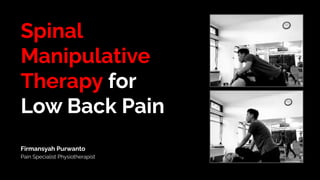
Spinal
Manipulative
Therapy for
Low Back Pain
Firmansyah Purwanto
Pain Specialist Physiotherapist
Critical point of view for spinal manipulative
therapy
● Palpation, detect the
source of pain? – No!
● Correct positional
fault? – No!
● Fix posture? – No!
● Cure disease? – No!
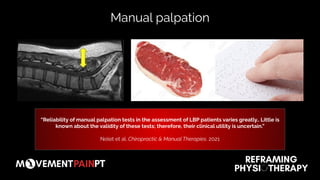
Manual palpation
“Reliability of manual palpation tests in the assessment of LBP patients varies greatly.. Little is
known about the validity of these tests; therefore, their clinical utility is uncertain.”
Nolet et al. Chiropractic & Manual Therapies. 2021
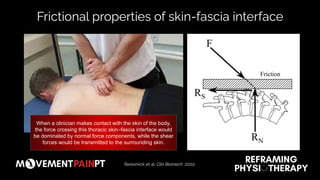
When a clinician makes contact with the skin of the body,
the force crossing this thoracic skin–fascia interface would
be dominated by normal force components, while the shear
forces would be transmitted to the surrounding skin.
Bereznick et al. Clin Biomech. 2002.
Frictional properties of skin-fascia interface
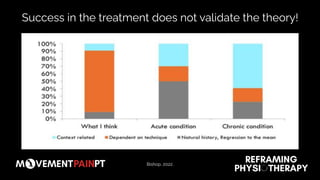
Bishop, 2022.
Success in the treatment does not validate the theory!
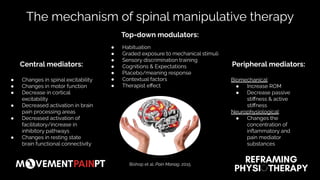
The mechanism of spinal manipulative therapy
Central mediators:
● Changes in spinal excitability
● Changes in motor function
● Decrease in cortical
excitability
● Decreased activation in brain
pain processing areas
● Decreased activation of
facilitatory/increase in
inhibitory pathways
● Changes in resting state
brain functional connectivity
Top-down modulators:
● Habituation
● Graded exposure to mechanical stimuli
● Sensory discrimination training
● Cognitions & Expectations
● Placebo/meaning response
● Contextual factors
● Therapist effect
Biomechanical:
● Increase ROM
● Decrease passive
stiffness & active
stiffness
Neurophysiological:
● Changes the
concentration of
inflammatory and
pain mediator
substances
Peripheral mediators:
Bishop et al. Pain Manag. 2015
Contextual contributing factors in clinical setting
Verbal suggestion:
- This is going to help you
move better and have
less pain
Social cues:
- Eye gaze
- Body language
Treatment cues:
- Touch
External context:
Outcome expectation:
- My pain will go
away
Emotions:
- I am less anxious
Meaning schema:
- I am being cared
for
Internal context:
Wager & Atlas. 2015
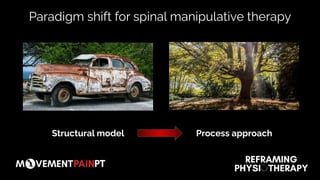
Paradigm shift for spinal manipulative therapy
Structural model Process approach
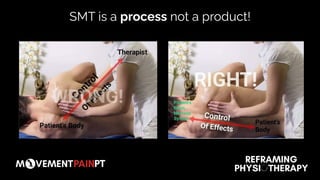
SMT is a process not a product!
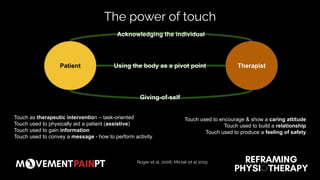
The power of touch
Roger et al, 2006; Miciak et al 2019
Patient Therapist
Acknowledging the individual
Giving-of-self
Using the body as a pivot point
Touch as therapeutic intervention – task-oriented
Touch used to physically aid a patient (assistive)
Touch used to gain information
Touch used to convey a message - how to perform activity
Touch used to encourage & show a caring attitude
Touch used to build a relationship
Touch used to produce a feeling of safety
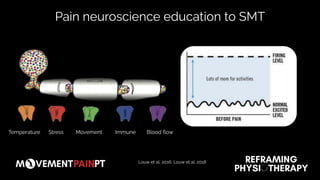
Louw et al, 2016; Louw et al. 2018
Temperature Stress Movement Immune Blood flow
Pain neuroscience education to SMT
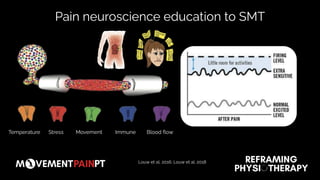
Louw et al, 2016; Louw et al. 2018
Pain neuroscience education to SMT
Stress
Temperature Movement Immune Blood flow
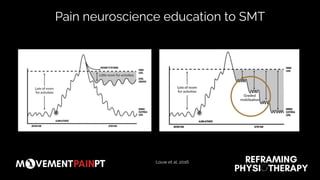
Louw et al, 2016
Pain neuroscience education to SMT
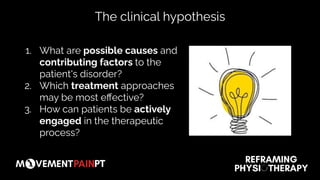
1. What are possible causes and
contributing factors to the
patient's disorder?
2. Which treatment approaches
may be most effective?
3. How can patients be actively
engaged in the therapeutic
process?
The clinical hypothesis
1. Screening for red flags
2. Screening for psychosocial contributing factors (e.g anxiety, fear of
movement, negative beliefs, work-related stress), lifestyle factors
(e.g level of physical activity, sedentary behavior) & health
comorbidities (e.g diabetes melitus, osteoarthritis, hypertension etc)
3. Assess if any functional impairment & neurological deficits
4. Assess if any specific lumbar dysfunction – use clusters of special
tests to rule in & rule out
5. Assess the patient’s expectation of recovery & the patient’s values &
goals
Principle of Assessment
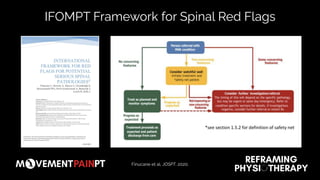
IFOMPT Framework for Spinal Red Flags
Finucane et al, JOSPT. 2020.
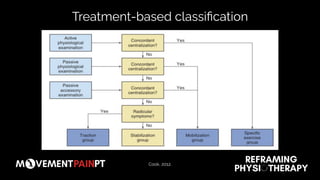
Treatment-based classification
Cook, 2012.
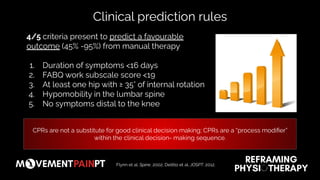
4/5 criteria present to predict a favourable
outcome (45% -95%) from manual therapy
1. Duration of symptoms <16 days
2. FABQ work subscale score <19
3. At least one hip with ≥ 35° of internal rotation
4. Hypomobility in the lumbar spine
5. No symptoms distal to the knee
Clinical prediction rules
CPRs are not a substitute for good clinical decision making; CPRs are a “process modifier”
within the clinical decision- making sequence.
Flynn et al. Spine. 2002; Delitto et al. JOSPT. 2012.
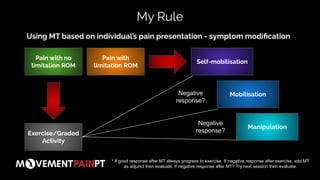
Using MT based on individual’s pain presentation - symptom modification
My Rule
Pain with no
limitation ROM
Pain with
limitation ROM
Exercise/Graded
Activity
Manipulation
Mobilisation
Self-mobilisation
* If good response after MT always progress to exercise. If negative response after exercise, add MT
as adjunct then evaluate. If negative response after MT? Try next session then evaluate.
Negative
response?
Negative
response?
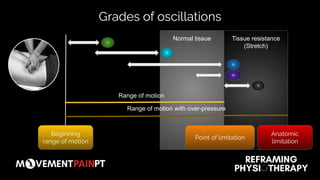
Grades of oscillations
Beginning
range of motion
Point of limitation
Anatomic
limitation
Normal tissue Tissue resistance
(Stretch)
I
II
III
IV
V
Range of motion
Range of motion with over-pressure
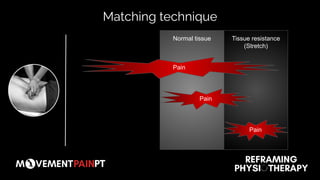
Matching technique
Normal tissue Tissue resistance
(Stretch)
Pain
Pain
Pain
Practical
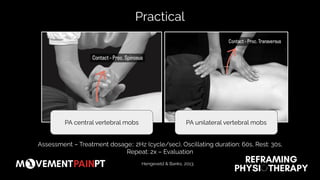
Hengeveld & Banks, 2013.
Assessment – Treatment dosage:: 2Hz (cycle/sec), Oscillating duration: 60s, Rest: 30s,
Repeat: 2x – Evaluation
PA central vertebral mobs PA unilateral vertebral mobs
Practical
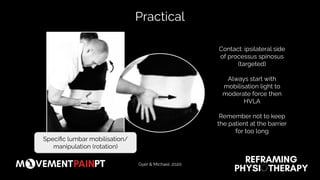
Gyer & Michael. 2020
Specific lumbar mobilisation/
manipulation (rotation)
Contact: ipsilateral side
of processus spinosus
(targeted)
Always start with
mobilisation light to
moderate force then
HVLA
Remember not to keep
the patient at the barrier
for too long
Practical
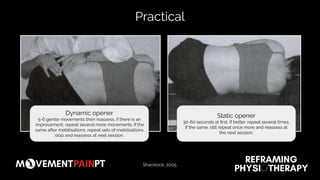
Dynamic opener
5-6 gentle movements then reassess. if there is an
improvement, repeat several more movements. If the
same after mobilisations, repeat sets of mobilisations,
stop and reassess at next session.
Static opener
30-60 seconds at first. If better, repeat several times.
If the same, still repeat once more and reassess at
the next session.
Shacklock, 2005.
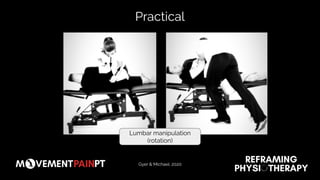
Lumbar manipulation
(rotation)
Gyer & Michael. 2020
Practical
Practical
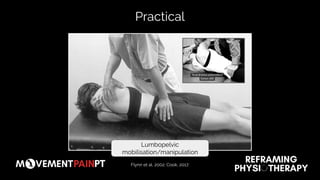
Lumbopelvic
mobilisation/manipulation
Flynn et al, 2002; Cook, 2017.
“Cracking” sound
No direct evidence for the physiological
therapeutic benefit of the audible release
associated with the spinal manipulation.
Therapeutic benefits of the audible release are
likely to be psychological, and not physiological
⚠ Repeating manipulation shortly after the
joint has cavitated without an audible release,
aiming to “get an audible”, may even cause
damage as the joint is potentially stretched
beyond its anatomical range of movement.

Bakker & Miller. J Can Chiro Assoc. 2004
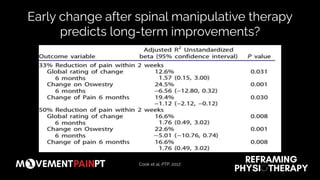
Early change after spinal manipulative therapy
predicts long-term improvements?
Cook et al. PTP. 2017.
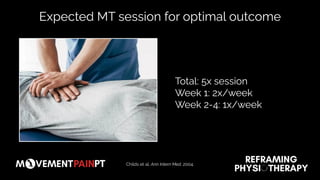
Total: 5x session
Week 1: 2x/week
Week 2-4: 1x/week
Childs et al. Ann Intern Med. 2004.
Expected MT session for optimal outcome
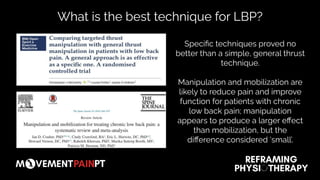
What is the best technique for LBP?
Specific techniques proved no
better than a simple, general thrust
technique.
Manipulation and mobilization are
likely to reduce pain and improve
function for patients with chronic
low back pain; manipulation
appears to produce a larger effect
than mobilization, but the
difference considered ‘small’.
Current evidence of effectiveness of MT for LBP?
Acute LBP — Strong evidence - short term (1-3
months) - pain, function & health improvements
Chronic LBP
● Moderate to strong evidence - short term
- pain, function & quality of life
● Limited evidence - long term
Hidalgo et al, 2013; Aboagye et al, 2022.
Better outcome and lower costs with
manual therapy and home exercise
(Leininger et al, 2016)
Manual therapy is more cost-effective
than usual care, spinal stabilization,
advice to stay active (Tsertsvadze et
al, 2014).
Manual therapy is less expensive than
opioid initiated care for back pain
(Whedon et al, 2021)
Evidence of cost-effectiveness of MT for LBP?
Self-reflection
When? — Clinical reasoning
Why? — Clinical reasoning
What? — Clinical reasoning
How? — Knowledge-derived skills
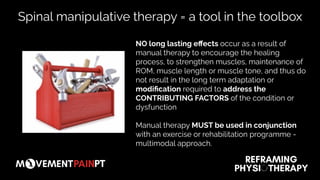
NO long lasting effects occur as a result of
manual therapy to encourage the healing
process, to strengthen muscles, maintenance of
ROM, muscle length or muscle tone, and thus do
not result in the long term adaptation or
modification required to address the
CONTRIBUTING FACTORS of the condition or
dysfunction
Manual therapy MUST be used in conjunction
with an exercise or rehabilitation programme -
multimodal approach.
Spinal manipulative therapy = a tool in the toolbox
Any questions?

Spinal Manipulation for Low Back Pain.pdf

  • 1.
    Spinal Manipulative Therapy for Low BackPain Firmansyah Purwanto Pain Specialist Physiotherapist
  • 2.
    Critical point ofview for spinal manipulative therapy ● Palpation, detect the source of pain? – No! ● Correct positional fault? – No! ● Fix posture? – No! ● Cure disease? – No!
  • 3.
    Manual palpation “Reliability ofmanual palpation tests in the assessment of LBP patients varies greatly.. Little is known about the validity of these tests; therefore, their clinical utility is uncertain.” Nolet et al. Chiropractic & Manual Therapies. 2021
  • 4.
    When a clinicianmakes contact with the skin of the body, the force crossing this thoracic skin–fascia interface would be dominated by normal force components, while the shear forces would be transmitted to the surrounding skin. Bereznick et al. Clin Biomech. 2002. Frictional properties of skin-fascia interface
  • 5.
    Bishop, 2022. Success inthe treatment does not validate the theory!
  • 6.
    The mechanism ofspinal manipulative therapy Central mediators: ● Changes in spinal excitability ● Changes in motor function ● Decrease in cortical excitability ● Decreased activation in brain pain processing areas ● Decreased activation of facilitatory/increase in inhibitory pathways ● Changes in resting state brain functional connectivity Top-down modulators: ● Habituation ● Graded exposure to mechanical stimuli ● Sensory discrimination training ● Cognitions & Expectations ● Placebo/meaning response ● Contextual factors ● Therapist effect Biomechanical: ● Increase ROM ● Decrease passive stiffness & active stiffness Neurophysiological: ● Changes the concentration of inflammatory and pain mediator substances Peripheral mediators: Bishop et al. Pain Manag. 2015
  • 7.
    Contextual contributing factorsin clinical setting Verbal suggestion: - This is going to help you move better and have less pain Social cues: - Eye gaze - Body language Treatment cues: - Touch External context: Outcome expectation: - My pain will go away Emotions: - I am less anxious Meaning schema: - I am being cared for Internal context: Wager & Atlas. 2015
  • 8.
    Paradigm shift forspinal manipulative therapy Structural model Process approach
  • 9.
    SMT is aprocess not a product!
  • 10.
    The power oftouch Roger et al, 2006; Miciak et al 2019 Patient Therapist Acknowledging the individual Giving-of-self Using the body as a pivot point Touch as therapeutic intervention – task-oriented Touch used to physically aid a patient (assistive) Touch used to gain information Touch used to convey a message - how to perform activity Touch used to encourage & show a caring attitude Touch used to build a relationship Touch used to produce a feeling of safety
  • 11.
    Louw et al,2016; Louw et al. 2018 Temperature Stress Movement Immune Blood flow Pain neuroscience education to SMT
  • 12.
    Louw et al,2016; Louw et al. 2018 Pain neuroscience education to SMT Stress Temperature Movement Immune Blood flow
  • 13.
    Louw et al,2016 Pain neuroscience education to SMT
  • 14.
    1. What arepossible causes and contributing factors to the patient's disorder? 2. Which treatment approaches may be most effective? 3. How can patients be actively engaged in the therapeutic process? The clinical hypothesis
  • 15.
    1. Screening forred flags 2. Screening for psychosocial contributing factors (e.g anxiety, fear of movement, negative beliefs, work-related stress), lifestyle factors (e.g level of physical activity, sedentary behavior) & health comorbidities (e.g diabetes melitus, osteoarthritis, hypertension etc) 3. Assess if any functional impairment & neurological deficits 4. Assess if any specific lumbar dysfunction – use clusters of special tests to rule in & rule out 5. Assess the patient’s expectation of recovery & the patient’s values & goals Principle of Assessment
  • 16.
    IFOMPT Framework forSpinal Red Flags Finucane et al, JOSPT. 2020.
  • 17.
  • 18.
    4/5 criteria presentto predict a favourable outcome (45% -95%) from manual therapy 1. Duration of symptoms <16 days 2. FABQ work subscale score <19 3. At least one hip with ≥ 35° of internal rotation 4. Hypomobility in the lumbar spine 5. No symptoms distal to the knee Clinical prediction rules CPRs are not a substitute for good clinical decision making; CPRs are a “process modifier” within the clinical decision- making sequence. Flynn et al. Spine. 2002; Delitto et al. JOSPT. 2012.
  • 19.
    Using MT basedon individual’s pain presentation - symptom modification My Rule Pain with no limitation ROM Pain with limitation ROM Exercise/Graded Activity Manipulation Mobilisation Self-mobilisation * If good response after MT always progress to exercise. If negative response after exercise, add MT as adjunct then evaluate. If negative response after MT? Try next session then evaluate. Negative response? Negative response?
  • 20.
    Grades of oscillations Beginning rangeof motion Point of limitation Anatomic limitation Normal tissue Tissue resistance (Stretch) I II III IV V Range of motion Range of motion with over-pressure
  • 21.
    Matching technique Normal tissueTissue resistance (Stretch) Pain Pain Pain
  • 22.
    Practical Hengeveld & Banks,2013. Assessment – Treatment dosage:: 2Hz (cycle/sec), Oscillating duration: 60s, Rest: 30s, Repeat: 2x – Evaluation PA central vertebral mobs PA unilateral vertebral mobs
  • 23.
    Practical Gyer & Michael.2020 Specific lumbar mobilisation/ manipulation (rotation) Contact: ipsilateral side of processus spinosus (targeted) Always start with mobilisation light to moderate force then HVLA Remember not to keep the patient at the barrier for too long
  • 24.
    Practical Dynamic opener 5-6 gentlemovements then reassess. if there is an improvement, repeat several more movements. If the same after mobilisations, repeat sets of mobilisations, stop and reassess at next session. Static opener 30-60 seconds at first. If better, repeat several times. If the same, still repeat once more and reassess at the next session. Shacklock, 2005.
  • 25.
  • 26.
  • 27.
    “Cracking” sound No directevidence for the physiological therapeutic benefit of the audible release associated with the spinal manipulation. Therapeutic benefits of the audible release are likely to be psychological, and not physiological ⚠ Repeating manipulation shortly after the joint has cavitated without an audible release, aiming to “get an audible”, may even cause damage as the joint is potentially stretched beyond its anatomical range of movement. Bakker & Miller. J Can Chiro Assoc. 2004
  • 28.
    Early change afterspinal manipulative therapy predicts long-term improvements? Cook et al. PTP. 2017.
  • 29.
    Total: 5x session Week1: 2x/week Week 2-4: 1x/week Childs et al. Ann Intern Med. 2004. Expected MT session for optimal outcome
  • 30.
    What is thebest technique for LBP? Specific techniques proved no better than a simple, general thrust technique. Manipulation and mobilization are likely to reduce pain and improve function for patients with chronic low back pain; manipulation appears to produce a larger effect than mobilization, but the difference considered ‘small’.
  • 31.
    Current evidence ofeffectiveness of MT for LBP? Acute LBP — Strong evidence - short term (1-3 months) - pain, function & health improvements Chronic LBP ● Moderate to strong evidence - short term - pain, function & quality of life ● Limited evidence - long term Hidalgo et al, 2013; Aboagye et al, 2022.
  • 32.
    Better outcome andlower costs with manual therapy and home exercise (Leininger et al, 2016) Manual therapy is more cost-effective than usual care, spinal stabilization, advice to stay active (Tsertsvadze et al, 2014). Manual therapy is less expensive than opioid initiated care for back pain (Whedon et al, 2021) Evidence of cost-effectiveness of MT for LBP?
  • 33.
    Self-reflection When? — Clinicalreasoning Why? — Clinical reasoning What? — Clinical reasoning How? — Knowledge-derived skills
  • 34.
    NO long lastingeffects occur as a result of manual therapy to encourage the healing process, to strengthen muscles, maintenance of ROM, muscle length or muscle tone, and thus do not result in the long term adaptation or modification required to address the CONTRIBUTING FACTORS of the condition or dysfunction Manual therapy MUST be used in conjunction with an exercise or rehabilitation programme - multimodal approach. Spinal manipulative therapy = a tool in the toolbox
  • 35.