Welcome to...
The
Teaching
Profession
Objectives
1. Discuss Schooling vs. Education
2. Discuss the Art & Science of Teaching
3. Discuss Teaching as a Profession
4. Identify and Describe Professional
Organizations
5. Identify and Describe the
Characteristics of Effective Teachers
6. List the Principles of Teaching &
Learning
What is Education?
How is that
different from
Schooling?
ed-u-ca-tion [ej-oo-key-shun]
noun
1. the act or process of imparting or acquiring general
knowledge, developing the powers of reasoning
and judgment, and generally of preparing oneself or
others intellectually for mature life.
2. the act or process of imparting or acquiring
particular knowledge or skills, as for a profession.
3. a degree, level, or kind of schooling: a university
education.
4. the result produced by instruction, training, or
study: to show one's education.
5. the science or art of teaching; pedagogies.
school-ing [skoo-ling]
noun
1. the process of being taught in a
school.
2. instruction, education, or training,
especially when received in a
school.
3. the act of teaching.
The Purpose of Education
Education is:
– an adventure of the self – of private
purpose and experience.
Schooling is:
– A sociopolitical invention that seeks to
design a context or contexts for
shaping many “self’s”
– Children can become educated
without schools.
•From John I Goodlad, 1997.
The Purpose of Education
For schooling:
• education should be guided and
conducted to advance not just the
maturation of self, but also some public
need or good.
• The definition of public need or good
varies widely from society to society.
• “Don’t let schooling get in the way of
your education”. Mark Twain.
The Purpose of Education
•Transmit Culture
•Self Discipline
•Teach Values
•Teach About Life
•Teach How to Learn
“Give children a desire to learn and to teach them
how to use their minds and where to go to acquire
facts when their curiosity is aroused.” ~Elanor
Roosevelt
Is teaching an
art or a science?
Teaching is a science
• Study and explanation of
learning
• Systematic process
• Body of knowledge
• An applied science based on research
• Methods of teaching and the
learning environment can be
organized on a scientific or
objective basis
- Good plans, good tests, organized
presentations
Teaching is an art
• Artistic process achieving an end
product
• Imagination, intuition, skill
• Category of artistic activity
• Improv, performance art, dynamic,
unique, what, how, & when, to do
• Trade and a craft
• The practice of your trade, is indeed an
artistic process, extreme multi-tasking
• Skills depend greatly upon
personality variables
- Enthusiasm, caring, helpful
A vision and a reality
• Teaching is the most difficult of all arts
and the profoundest of all sciences.”
– Horace Mann
• Education is an admirable thing, but it is
well to remember from time to time that
nothing that is worth knowing can be
taught.
– Oscar Wilde
• What does education often do? It makes
a straight-cut ditch of a free, meandering
brook.
– Henry David Thoreau
Is Teaching a
Profession?
Four Characteristics of
a Profession
• Defined body of knowledge
beyond the grasp of the public
• Control over licensing,
certification, and entry
requirements
• Autonomy in making decisions
• High prestige and economic status.
– From: O. Stein, 1981.
Teaching as a Profession
Doctors & Lawyers argue that a profession
involves…
• Lifelong career commitment
• Social service
• Intellectual technique
• Code of ethics
• Independent judgment relative to professional
performance
Does it possess a specialized body of
knowledge?
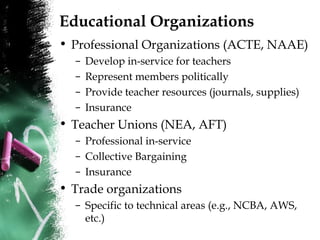
Educational Organizations
• Professional Organizations (ACTE, NAAE)
– Develop in-service for teachers
– Represent members politically
– Provide teacher resources (journals, supplies)
– Insurance
• Teacher Unions (NEA, AFT)
– Professional in-service
– Collective Bargaining
– Insurance
• Trade organizations
– Specific to technical areas (e.g., NCBA, AWS,
etc.)
Characteristics of Effective
Teachers!!
I want to be an
Effective
Teacher
Is it possible to measure
“effective teaching’?
Measures of “effective teaching”?
•Student Learning
– Gain in student knowledge is the
best indicator of teaching
effectiveness
Being an Effective Teacher!
• Research on Teacher Effectiveness
consistently finds 5 variables that
are highly correlated with student
learning
1. Clarity
2. Variability
3. Enthusiasm
4. Task-Oriented & Businesslike
Behaviors
5. Opportunity to Learn Criterion
Material (Objectives)
Rosenshien & Furst (1971)
Clarity
• Organization of the
content
• Concepts & content
clearly explained
• Gives multiple
examples
• Points out practical
application
• Repeats difficult
ideas
• Assignments &
directions are clear
Variability
• Instructional
approaches and
methods
• Instructional
materials
• Visuals
• Learning activities
and engagement
• Types of
assessment
Enthusiasm
• Movement, Gestures
& Voice
• Shows facial
expression
• Uses humor
*caution*
• Questioning
techniques
• Interaction &
Engagement
Task-oriented & Business
Like Behaviors
• Objectives
• Concerned with
learning
• Encourages hard
and creative work
• Organization
from syllabus on
first day, to
objectives of daily
lesson, to
assessment
• Timing & pacing
Opportunity to Learn
Criterion Material
(Objectives)
• Teach to
established
objectives
• Relationship
between
objectives,
instruction and
assessment
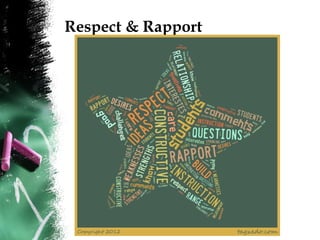
Respect & Rapport
Principles of Learning &
Teaching
1. Subject matter must possess
meaning, organization, &
structure
2. Readiness is a prerequisite for
learning, begin at the students
level
3. Students must be motivated to
learn
4. Students will rise to the level of
expectation
Principles of Learning &
Teaching
5. Success is a motivating source.
6. Students must be provided with
their learning progress.
7. Reinforced behaviors are more
likely to be learned.
8. Directed learning is more effective
than undirected learning.
Principles of Learning &
Teaching
9. Students should “Inquire into” vs.
being “instructed in” the subject
matter.
10. Students learn what they practice
and apply – in a supervised
educational setting.

teaching profession

  • 1.
  • 2.
    Objectives 1. Discuss Schoolingvs. Education 2. Discuss the Art & Science of Teaching 3. Discuss Teaching as a Profession 4. Identify and Describe Professional Organizations 5. Identify and Describe the Characteristics of Effective Teachers 6. List the Principles of Teaching & Learning
  • 3.
    What is Education? Howis that different from Schooling?
  • 4.
    ed-u-ca-tion [ej-oo-key-shun] noun 1. theact or process of imparting or acquiring general knowledge, developing the powers of reasoning and judgment, and generally of preparing oneself or others intellectually for mature life. 2. the act or process of imparting or acquiring particular knowledge or skills, as for a profession. 3. a degree, level, or kind of schooling: a university education. 4. the result produced by instruction, training, or study: to show one's education. 5. the science or art of teaching; pedagogies.
  • 5.
    school-ing [skoo-ling] noun 1. theprocess of being taught in a school. 2. instruction, education, or training, especially when received in a school. 3. the act of teaching.
  • 6.
    The Purpose ofEducation Education is: – an adventure of the self – of private purpose and experience. Schooling is: – A sociopolitical invention that seeks to design a context or contexts for shaping many “self’s” – Children can become educated without schools. •From John I Goodlad, 1997.
  • 7.
    The Purpose ofEducation For schooling: • education should be guided and conducted to advance not just the maturation of self, but also some public need or good. • The definition of public need or good varies widely from society to society. • “Don’t let schooling get in the way of your education”. Mark Twain.
  • 8.
    The Purpose ofEducation •Transmit Culture •Self Discipline •Teach Values •Teach About Life •Teach How to Learn “Give children a desire to learn and to teach them how to use their minds and where to go to acquire facts when their curiosity is aroused.” ~Elanor Roosevelt
  • 9.
    Is teaching an artor a science?
  • 10.
    Teaching is ascience • Study and explanation of learning • Systematic process • Body of knowledge • An applied science based on research • Methods of teaching and the learning environment can be organized on a scientific or objective basis - Good plans, good tests, organized presentations
  • 11.
    Teaching is anart • Artistic process achieving an end product • Imagination, intuition, skill • Category of artistic activity • Improv, performance art, dynamic, unique, what, how, & when, to do • Trade and a craft • The practice of your trade, is indeed an artistic process, extreme multi-tasking • Skills depend greatly upon personality variables - Enthusiasm, caring, helpful
  • 12.
    A vision anda reality • Teaching is the most difficult of all arts and the profoundest of all sciences.” – Horace Mann • Education is an admirable thing, but it is well to remember from time to time that nothing that is worth knowing can be taught. – Oscar Wilde • What does education often do? It makes a straight-cut ditch of a free, meandering brook. – Henry David Thoreau
  • 13.
  • 14.
    Four Characteristics of aProfession • Defined body of knowledge beyond the grasp of the public • Control over licensing, certification, and entry requirements • Autonomy in making decisions • High prestige and economic status. – From: O. Stein, 1981.
  • 15.
    Teaching as aProfession Doctors & Lawyers argue that a profession involves… • Lifelong career commitment • Social service • Intellectual technique • Code of ethics • Independent judgment relative to professional performance Does it possess a specialized body of knowledge?
  • 16.
    Educational Organizations • ProfessionalOrganizations (ACTE, NAAE) – Develop in-service for teachers – Represent members politically – Provide teacher resources (journals, supplies) – Insurance • Teacher Unions (NEA, AFT) – Professional in-service – Collective Bargaining – Insurance • Trade organizations – Specific to technical areas (e.g., NCBA, AWS, etc.)
  • 17.
    Characteristics of Effective Teachers!! Iwant to be an Effective Teacher
  • 18.
    Is it possibleto measure “effective teaching’?
  • 19.
    Measures of “effectiveteaching”? •Student Learning – Gain in student knowledge is the best indicator of teaching effectiveness
  • 20.
    Being an EffectiveTeacher! • Research on Teacher Effectiveness consistently finds 5 variables that are highly correlated with student learning 1. Clarity 2. Variability 3. Enthusiasm 4. Task-Oriented & Businesslike Behaviors 5. Opportunity to Learn Criterion Material (Objectives) Rosenshien & Furst (1971)
  • 21.
    Clarity • Organization ofthe content • Concepts & content clearly explained • Gives multiple examples • Points out practical application • Repeats difficult ideas • Assignments & directions are clear
  • 22.
    Variability • Instructional approaches and methods •Instructional materials • Visuals • Learning activities and engagement • Types of assessment
  • 23.
    Enthusiasm • Movement, Gestures &Voice • Shows facial expression • Uses humor *caution* • Questioning techniques • Interaction & Engagement
  • 24.
    Task-oriented & Business LikeBehaviors • Objectives • Concerned with learning • Encourages hard and creative work • Organization from syllabus on first day, to objectives of daily lesson, to assessment • Timing & pacing
  • 25.
    Opportunity to Learn CriterionMaterial (Objectives) • Teach to established objectives • Relationship between objectives, instruction and assessment
  • 26.
  • 27.
    Principles of Learning& Teaching 1. Subject matter must possess meaning, organization, & structure 2. Readiness is a prerequisite for learning, begin at the students level 3. Students must be motivated to learn 4. Students will rise to the level of expectation
  • 28.
    Principles of Learning& Teaching 5. Success is a motivating source. 6. Students must be provided with their learning progress. 7. Reinforced behaviors are more likely to be learned. 8. Directed learning is more effective than undirected learning.
  • 29.
    Principles of Learning& Teaching 9. Students should “Inquire into” vs. being “instructed in” the subject matter. 10. Students learn what they practice and apply – in a supervised educational setting.