12th
Five Year Plan Period
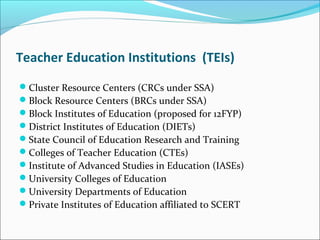
Teacher Education Institutions (TEIs)
Cluster Resource Centers (CRCs under SSA)
Block Resource Centers (BRCs under SSA)
Block Institutes of Education (proposed for 12FYP)
District Institutes of Education (DIETs)
State Council of Education Research and Training
Colleges of Teacher Education (CTEs)
Institute of Advanced Studies in Education (IASEs)
University Colleges of Education
University Departments of Education
Private Institutes of Education affiliated to SCERT
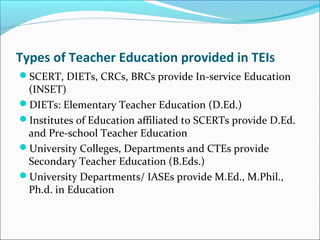
Types of Teacher Education provided in TEIs
SCERT, DIETs, CRCs, BRCs provide In-service Education
(INSET)
DIETs: Elementary Teacher Education (D.Ed.)
Institutes of Education affiliated to SCERTs provide D.Ed.
and Pre-school Teacher Education
University Colleges, Departments and CTEs provide
Secondary Teacher Education (B.Eds.)
University Departments/ IASEs provide M.Ed., M.Phil.,
Ph.d. in Education
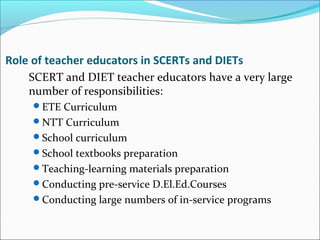
Role of teacher educators in SCERTs and DIETs
SCERT and DIET teacher educators have a very large
number of responsibilities:
ETE Curriculum
NTT Curriculum
School curriculum
School textbooks preparation
Teaching-learning materials preparation
Conducting pre-service D.El.Ed.Courses
Conducting large numbers of in-service programs
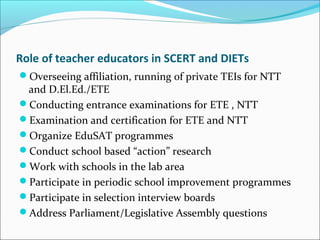
Role of teacher educators in SCERT and DIETs
Overseeing affiliation, running of private TEIs for NTT
and D.El.Ed./ETE
Conducting entrance examinations for ETE , NTT
Examination and certification for ETE and NTT
Organize EduSAT programmes
Conduct school based “action” research
Work with schools in the lab area
Participate in periodic school improvement programmes
Participate in selection interview boards
Address Parliament/Legislative Assembly questions
Role of teacher educators in SCERTs and DIETs
Training for MLL, SOPT, Joyful learning, multi-lingual
education etc.
Act as operating office and provide support to national
and state committees on education
Provide large scale teacher orientations for life skills, AIDs
awareness, literacy mission, continuing education
Variety of roles under SSA in material preparation,
training, inspection
Role of SCERTs and DIETs
Gathering data for education surveys for NCERT
Gathering data for DISE
Gathering data for state Directorates of Education
Participate in surveys of out-of-school children
Provide orientation to school management committee
members
Census data collection
Electoral rolls
Election duty: Panchayat, Zilla, State , National elections
Role of teacher educators in SCERT and DIETs
Compared to the number of posts in SCERT and DIETs
the work expected is astronomical.
The CSS scheme guidelines provides for too few posts
mostly envisaged for pre-service teacher education.
When teacher educators are called away for a variety of
tasks, pre-service training suffers greatly.
SCERT, DIETs, teacher educators perform the bulk of the
work but with little recognition or autonomy to design the
initiatives or to time it according to their choice. Little
attention is paid to expertise required, or the interest level
of teacher educators.
Work: Human power mismatch
The CCS envisioning needs to keep in mind that they are
district centers for education and training , and not just
centres of teacher education.
Clarity in terms of the tasks SCERT, DIETS are to perform
and create commensurate posts before any discussion on
quality or capacity building can be meaningful.
It is time to work out teacher educator: teacher ratio,
along the lines of teacher: pupil ratio specified in RtE. For
pre-service and in-service alone, a 1:60 ratio is required
(1:50 for in-service, 10 pre-service) and additional posts for
all other tasks.
Categorizing the work of SCERT and DIET teacher
educators
It is impossible to do this satisfactorily, but, going by
the generic capacities required, SCERT, DIET teacher
educators would be involved in:
Pre-service TE
In-service TE
Survey, research, documentation
Educational Material Resource development and
collation.
Capacity-building of SCERTs and DIETs
Cross-cutting sub-themes for capacity building :
Needs
Models
Collaborations
Materials
Needs in Numbers: Units and Context of Planning for
SCERT-DIETs
The fundamental unit for all planning in education
including teacher education is the catchment area.
Mapping all children of the 3-14 age group, both in and
out of school/pre-school provides the database for
assessing educational needs such as number of schools
classes and teachers required and their subject
specializations (Language, Mathematics-Science, Social
science).
This in turn provides basis for number of teachers
required and their specializations.
Block/District as basis of TE Planning
The number of teachers required, their
specializations, the kind of teacher education
programs needed, the curriculum and the continuous
professional needs of teachers in schools is best
undertaken preferably at the block, or at the district
level.
DIETs are mandated to work towards planning,
teacher education and quality improvement of
elementary education of the district.
Elements of Planning for TE in districts
District-wise number of teachers with required
qualifications; without required qualifications.
District-wise number of teachers without required
qualifications.
Additional teachers required in primary schools for PTR
Additional language teachers required in middle schools
Additional science-mathematics teachers required in
middle schools
Additional social science teachers required in middle
schools
Additional Head teachers required in primary and middle
schools
DIETs/Districts as basic unit of TE Planning
Elements of Planning:
Number of catchment areas.
Schools in catchment areas, children in schools,
children in catchment areas out of schools by age,
male/female, SC, ST, Minorities, mother tongue, in-
school, out-of-school, special needs.
Teacher requirement based on total number of
children of 6-14 age group and 3-6 age group.
Teachers available in the block.
Strategies for TE for additional teachers
Increasing capacity of existing TEIs with NCTE approval
Generating Faculty for increased capacity in collaboration
with IASEs/universities
Identifying institutions in the district where TE can be
conducted: senior secondary schools, KVs, NVs, district
higher and technical institutions, ITI? And generating
Faculty and resources for this.
Public-private partnerships in the district for TE.
Strategies for generating Teacher Educators
Incentives for those who enroll for teacher educator
courses such as M.Ed.
Generating M.Ed. Courses in HEIs. These could be
specialization based, with institutions having
expertise in the specializations e.g. Bose Institute,
Science Centres, Sahitya academies.
Providing study leave to school teachers to acquire
teacher educator qualifications.
Creating teacher education cadre for professional
advancement.
Strategies for capacity building of teacher educators
Infrastructure and resource strengthening
ICT
Translations and collation of materials for TE
Building/strengthening libraries
Building resource units for Languages, Mathematics,
Sciences, Social Sciences
Documenting local resources as strategy for
community engagement
District based research studies
Strategies for Teacher Educators
Forum/Network for teacher educators. This can be
inter-disciplinary as well as discipline based.
Teacher educators will need to be oriented and
assessments made part of TE curriculum
Student performance will need to be observed,
evaluated, recorded and portfolios maintained. How
to do these will have to be first addressed by teacher
educators.
Documenting district resources as a strategy to both
build capacity and provide input into school
curriculum
Capacity Building –some principles
Capacity building most effective when embedded in
the work of the teacher educator
Clear performance based outcomes linked with
rewards as part of the vision of capacity building
Adequate quality materials
Collective learning and sharing linked to institutional
goals
Best undertaken in-house with support from HEIs