

Geographic Information System
(GIS)
MD. ZAHIRUL ISLAM
Assistant Professor
Geography and Environment
Rajshahi College, Rajshahi
GEOGRAPHIC
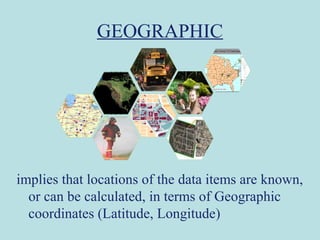
implies that locations of the data items are known,
or can be calculated, in terms of Geographic
coordinates (Latitude, Longitude)
INFORMATION
implies that the data in a GIS are organized to
yield useful knowledge, often as colored maps
and images, but also as statistical graphics,
tables, and various on-screen responses to
interactive queries.
SYSTEM
• implies that a GIS is made up from several
inter-related and linked components with
different functions. Thus, GIS have functional
capabilities for data capture, input,
manipulation, transformation, visualization,
combinations, query, analysis, modelling and
output.
Definition
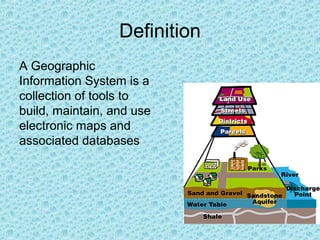
A Geographic
Information System is a
collection of tools to
build, maintain, and use
electronic maps and
associated databases
Definition
• GIS is a system for capturing, storing,
checking, integrating, manipulating,
analyzing, and displaying data which are
spatially referenced to the earth.
Definition
Geographic Information System (GIS)
is a computer system
for capturing, storing, querying,
analyzing, and displaying geospatial data.
Definition
• িজআইএস হল এমন একিট তথয্
বয্বস্থাপনা পদ্ধিত যার মাধয্েম
উপাত্ত সংগর্হ, সংরক্ষণ,
সংস্করণ, সমনব্য় সাধন, ও
িবেশ্লষেণর মাধয্েম মানব সমােজর
পর্েয়াজে নিবিভন্ন পিরকল্পনা
পর্ণয়ন করা যায়।
Geospatial Data (ভূস্থািনক উপাত্ত)
 A combination of spatial data and atribute data
 Spatial data – Location, long-lat, UTC,
cordinate, distance etc
 Atribute data – This data describes the
characteristics of spatial feature.
 Example – A road
 Firstly, it has a location
 Secondly, it has some characteristics like length, name,
speed limit, direction, width.
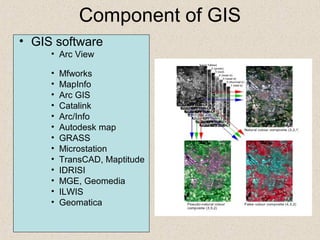
Component of GIS
• GIS software
• Arc View
• Mfworks
• MapInfo
• Arc GIS
• Catalink
• Arc/Info
• Autodesk map
• GRASS
• Microstation
• TransCAD, Maptitude
• IDRISI
• MGE, Geomedia
• ILWIS
• Geomatica
Component of GIS
• Computer system
– Computer
– Operating system to run the GIS programme
– Monitor for displaying
– Dizitizer and Scanner for spatial data input
– GPS receiver and mobile devices for field work
– Printer or plotter for hard copy map display
• Data – various kinds of inputs that the
system takes to produce information
• People – GIS professionals and users
• Infrastructure – the necessary physical,
organisational, administrative, and
cultural environments that support GIS
operations.
Components of GIS
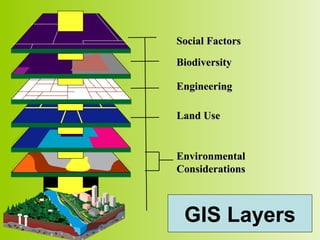
SocialSocial FactorsFactors
BiodiversityBiodiversity
EngineeringEngineering
Land UseLand Use
EnvironmentalEnvironmental
ConsiderationsConsiderations
GIS Layers
Approach:
– Explore the database:
• In conventional ways
• AND geographically
– Allows us to think about the implications of location
– Allows us to think holistically (পূর্ণার্ণাংগ)
– Should not be restricted by vendor-provided
functionality (বািণািজ্য্ণিকিকিরণাজ্িনিত কিাযর্ণকির্ণম)
– Should be used imaginatively taking into account :
• the advantages and limitations of geographical information
• the traditions of humanities scholarship
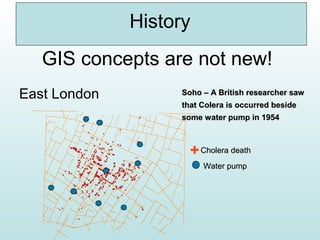
History
East London
GIS concepts are not new!
Cholera deathCholera death
Water pumpWater pump
+
Soho – A British researcher sawSoho – A British researcher saw
that Colera is occurred besidethat Colera is occurred beside
some water pump in 1954some water pump in 1954
History
• Introdction in late1960s;
• But according Goodchild (1995) it was introduced in 1964 by
CGIS (The Canadian Geographic Information System)
• Canadian Govt started to make descriptive list and
classification of land based on climate, soil, drainage, and
natural characteristics of land;
• Problem was felt to find out spatial variations;
• CGIS got help from computer;
• They did not succeeded before 1970.
• In 1970s firstly Gcomputer based GIS was used in urban
planning;
• Around 1980 ESRI made Arc/info software which is on of the
first age;
• Arc/info was produced commercially in 1986;
• In decade of 1980s GIS technology was spread in
different countries for development plannings;
• ESRI made and marketed Arc View in 1991;
• In 1992 they marketed a more developed software name
Arc/CAD (hybrid GIS)
• ESRI started Arc data online through internet to spread it
worldwide in 1998;
• After 2000 GIS was populated markedly worldwide, price
of GIS components was lowered;
• Recently Arcview marketed another developed software
named Arc GIS;
• But under developed and developing countries are still
backward in case of GIS.
History
• In Bangladesh GIS was introduced after
1990;
• In 1991 CEGIS started GIS related
activites naming FAP.
• LGED, SOB, WARPO, BWDB etc
institutes are credible to start GIS in
Bangladesh;
• After 2000 this technology is spread and
many institutes started to include GIS in
their .
History
Typical GIS ApplicationsTypical GIS Applications
o Environmental Assessments
o Land Information System
o Land Use And Thematic Mapping
o Health Care, Disease Profile
o Forestry And Wild Life Tracking
o Waste Land Development
o Ground Water Resources Management
o Urban And Town Planning
o Defence
o Business And Retails
Concept, approach, history, trend

Concept, approach, history, trend

  • 1.
    Geographic Information System (GIS) MD.ZAHIRUL ISLAM Assistant Professor Geography and Environment Rajshahi College, Rajshahi
  • 2.
    GEOGRAPHIC implies that locationsof the data items are known, or can be calculated, in terms of Geographic coordinates (Latitude, Longitude)
  • 3.
    INFORMATION implies that thedata in a GIS are organized to yield useful knowledge, often as colored maps and images, but also as statistical graphics, tables, and various on-screen responses to interactive queries.
  • 4.
    SYSTEM • implies thata GIS is made up from several inter-related and linked components with different functions. Thus, GIS have functional capabilities for data capture, input, manipulation, transformation, visualization, combinations, query, analysis, modelling and output.
  • 5.
    Definition A Geographic Information Systemis a collection of tools to build, maintain, and use electronic maps and associated databases
  • 6.
    Definition • GIS isa system for capturing, storing, checking, integrating, manipulating, analyzing, and displaying data which are spatially referenced to the earth.
  • 7.
    Definition Geographic Information System(GIS) is a computer system for capturing, storing, querying, analyzing, and displaying geospatial data.
  • 8.
    Definition • িজআইএস হলএমন একিট তথয্ বয্বস্থাপনা পদ্ধিত যার মাধয্েম উপাত্ত সংগর্হ, সংরক্ষণ, সংস্করণ, সমনব্য় সাধন, ও িবেশ্লষেণর মাধয্েম মানব সমােজর পর্েয়াজে নিবিভন্ন পিরকল্পনা পর্ণয়ন করা যায়।
  • 9.
    Geospatial Data (ভূস্থািনকউপাত্ত)  A combination of spatial data and atribute data  Spatial data – Location, long-lat, UTC, cordinate, distance etc  Atribute data – This data describes the characteristics of spatial feature.  Example – A road  Firstly, it has a location  Secondly, it has some characteristics like length, name, speed limit, direction, width.
  • 10.
    Component of GIS •GIS software • Arc View • Mfworks • MapInfo • Arc GIS • Catalink • Arc/Info • Autodesk map • GRASS • Microstation • TransCAD, Maptitude • IDRISI • MGE, Geomedia • ILWIS • Geomatica
  • 11.
    Component of GIS •Computer system – Computer – Operating system to run the GIS programme – Monitor for displaying – Dizitizer and Scanner for spatial data input – GPS receiver and mobile devices for field work – Printer or plotter for hard copy map display
  • 12.
    • Data –various kinds of inputs that the system takes to produce information • People – GIS professionals and users • Infrastructure – the necessary physical, organisational, administrative, and cultural environments that support GIS operations. Components of GIS
  • 13.
    SocialSocial FactorsFactors BiodiversityBiodiversity EngineeringEngineering Land UseLandUse EnvironmentalEnvironmental ConsiderationsConsiderations GIS Layers
  • 14.
    Approach: – Explore thedatabase: • In conventional ways • AND geographically – Allows us to think about the implications of location – Allows us to think holistically (পূর্ণার্ণাংগ) – Should not be restricted by vendor-provided functionality (বািণািজ্য্ণিকিকিরণাজ্িনিত কিাযর্ণকির্ণম) – Should be used imaginatively taking into account : • the advantages and limitations of geographical information • the traditions of humanities scholarship
  • 15.
    History East London GIS conceptsare not new! Cholera deathCholera death Water pumpWater pump + Soho – A British researcher sawSoho – A British researcher saw that Colera is occurred besidethat Colera is occurred beside some water pump in 1954some water pump in 1954
  • 16.
    History • Introdction inlate1960s; • But according Goodchild (1995) it was introduced in 1964 by CGIS (The Canadian Geographic Information System) • Canadian Govt started to make descriptive list and classification of land based on climate, soil, drainage, and natural characteristics of land; • Problem was felt to find out spatial variations; • CGIS got help from computer; • They did not succeeded before 1970. • In 1970s firstly Gcomputer based GIS was used in urban planning; • Around 1980 ESRI made Arc/info software which is on of the first age; • Arc/info was produced commercially in 1986;
  • 17.
    • In decadeof 1980s GIS technology was spread in different countries for development plannings; • ESRI made and marketed Arc View in 1991; • In 1992 they marketed a more developed software name Arc/CAD (hybrid GIS) • ESRI started Arc data online through internet to spread it worldwide in 1998; • After 2000 GIS was populated markedly worldwide, price of GIS components was lowered; • Recently Arcview marketed another developed software named Arc GIS; • But under developed and developing countries are still backward in case of GIS. History
  • 18.
    • In BangladeshGIS was introduced after 1990; • In 1991 CEGIS started GIS related activites naming FAP. • LGED, SOB, WARPO, BWDB etc institutes are credible to start GIS in Bangladesh; • After 2000 this technology is spread and many institutes started to include GIS in their . History
  • 20.
    Typical GIS ApplicationsTypicalGIS Applications o Environmental Assessments o Land Information System o Land Use And Thematic Mapping o Health Care, Disease Profile o Forestry And Wild Life Tracking o Waste Land Development o Ground Water Resources Management o Urban And Town Planning o Defence o Business And Retails