OVERVIEW OFGIS

 P.L.N.
 P L N Raju
 Geoinformatics Division
 Indian Institute of Remote Sensing
 Indian S
 I di   Space R Research O
                       h Organisation
                              i ti
 raju@iirs.gov.in
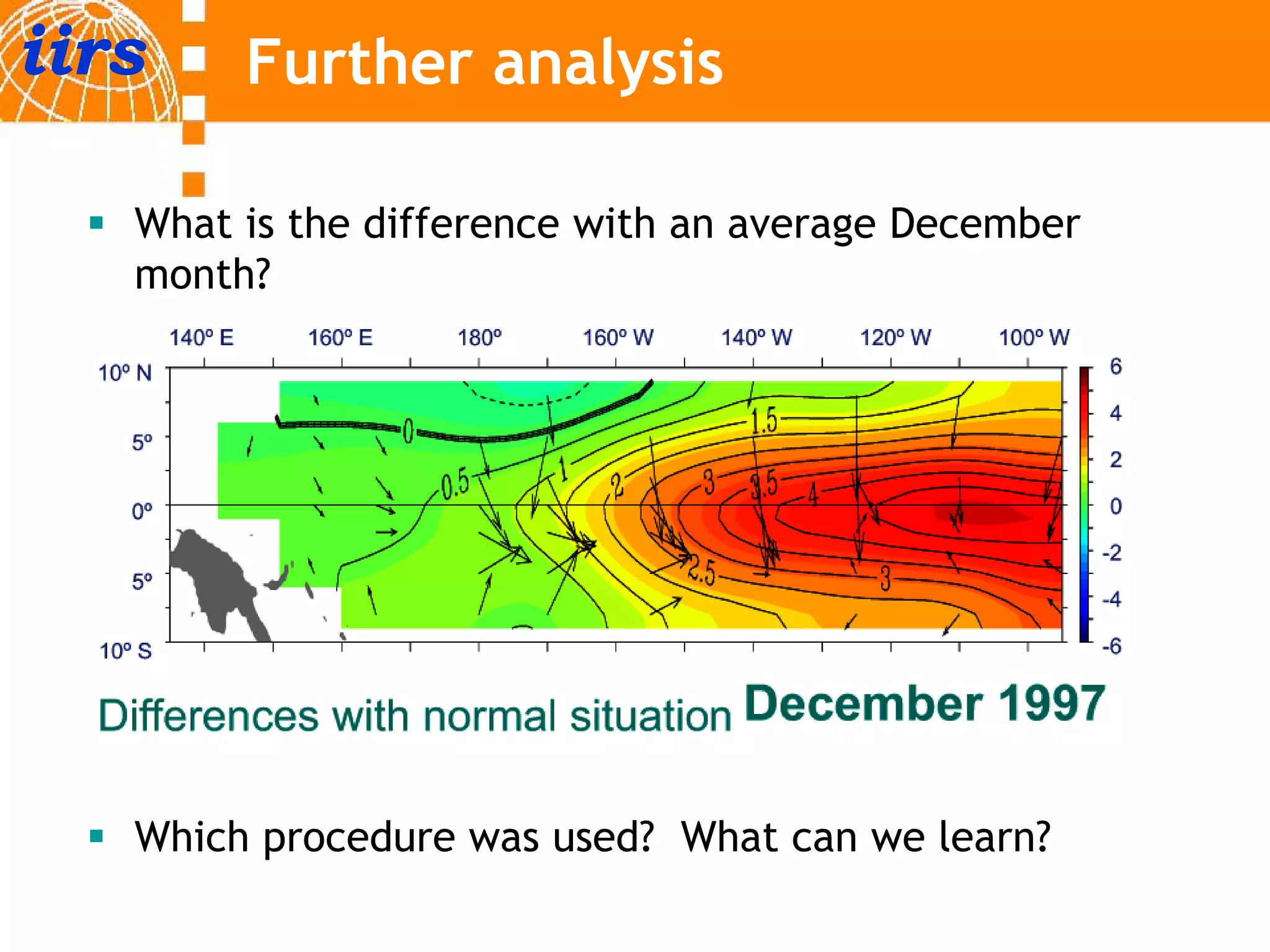
iirs    Further analysis

   What is the difference with an average December
   month?


   Which procedure was used? What can we learn?
General Understanding of GIS

Understanding GIS (1)
U d    t di
  Map reading and
  information – how it is
  related to GIS?
  ◦ What you get from the
    map?
  ◦ Can we measure and
    quantify?
  ◦ Is it possible to find the
    changes?
  ◦ How is it related to GIS?
General Understanding of GIS
Understanding GIS (2)
U d   t di
Remote Sensing data and relation
 to GIS
 What we get from satellite data?
 Can we find the changes and
 how?
 How time series helps in finding
 patterns?
 Can we quantify the information?
 How RS is related to GIS?
General Understanding of GIS
 Understanding GIS (3)
  GPS and it’s relation to GIS
  Provides positional information
  Data generated in the form of
  point / line / area theme can be
  directly brought into GIS
  Updating of GIS information
  will be easy and fast using
  GPS
General Understanding of GIS
  Understanding GIS (4)
  U d   t di
Models and GIS
◦ We ask children to make models
  about our earth, Why?
◦ Global warming and climatic
  change – how it is done?
◦ Models and it’s role in GIS
General Understanding of GIS
In S
I Summary GIS is
              i
  Integrating technology
      g     g         gy
  consisting of:
  ◦   Remote Sensing g
  ◦   Cartography and Mapping
  ◦   GPS
  ◦   Computers
  ◦   RDMS
  ◦   Information Technology
  ◦   Communication technology
  ◦   Survey and field data collection
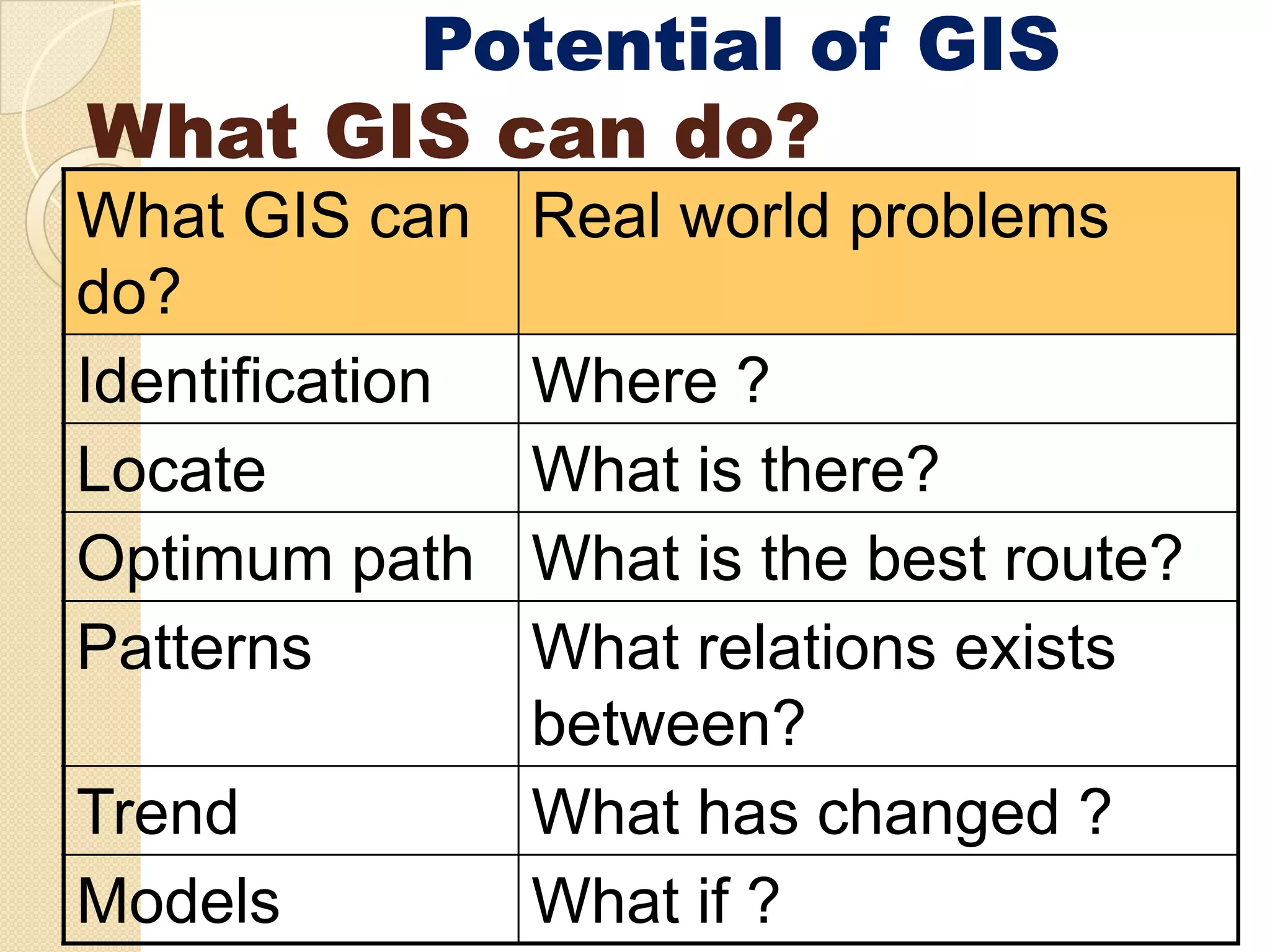
Potential of GIS
What GIS can do?
What GIS can       Real world problems
do?
d ?
Identification     Where ?
Locate             What is there?
Optimum path
O ti          th   What i th b t
                   Wh t is the best route?
                                       t ?
Patterns           What relations exists
                   between?
Trend              What has changed ?
Models             What if ?
Concepts of GIS
Types of GIS
 Desktop GIS
 Professional GIS
 Enterprise GIS
 Mobile GIS
 Internet GIS
 Embedded GIS
 4 D GIS
 Multimedia GIS
Concepts of GIS
GIS terminology
 Geographical Information System
 Geographical Information Science
 Geoinformatics
 Geomatics
 Spatial information system
 Geospatial systems
 Geospat a
 Geospatial information e g ee g
               o at o engineering
 Land information system
 …….
Concepts of GIS
What i the
Wh t is th specialty of GIS?
               i lt f
Facilitates faster process of operations
Provides solution for many real world
problems with options of many scenarios
Decision making tool with the support of
organized data
Integrating technology
Dynamic map display and interactive
query
Concepts of GIS
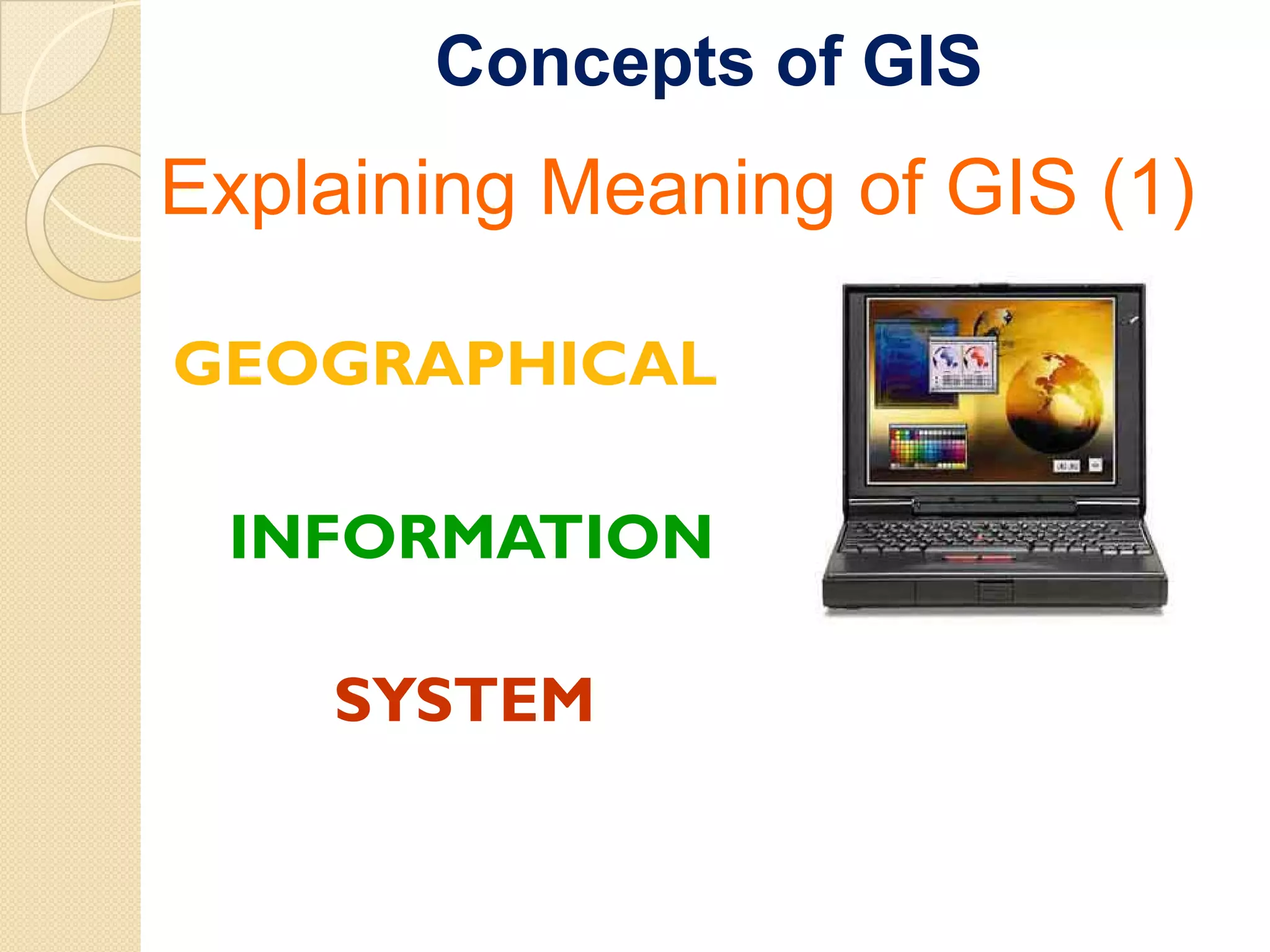
Explaining Meaning of GIS (1)

GEOGRAPHICAL

 INFORMATION

    SYSTEM
Concepts of GIS


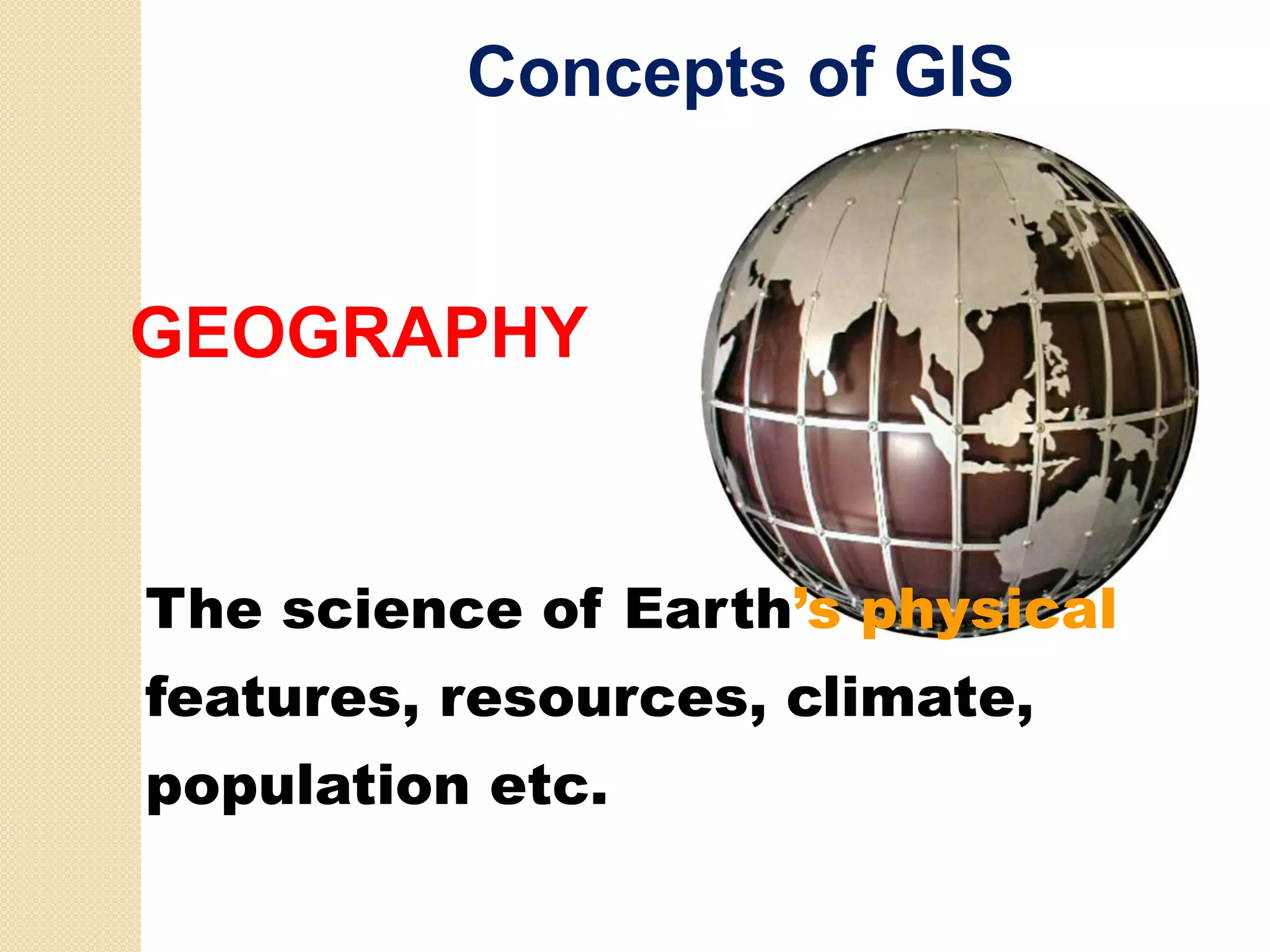
GEOGRAPHY


The science of Earth’s physical
features, resources, climate,
f t                   li  t
population etc.
Concepts of GIS
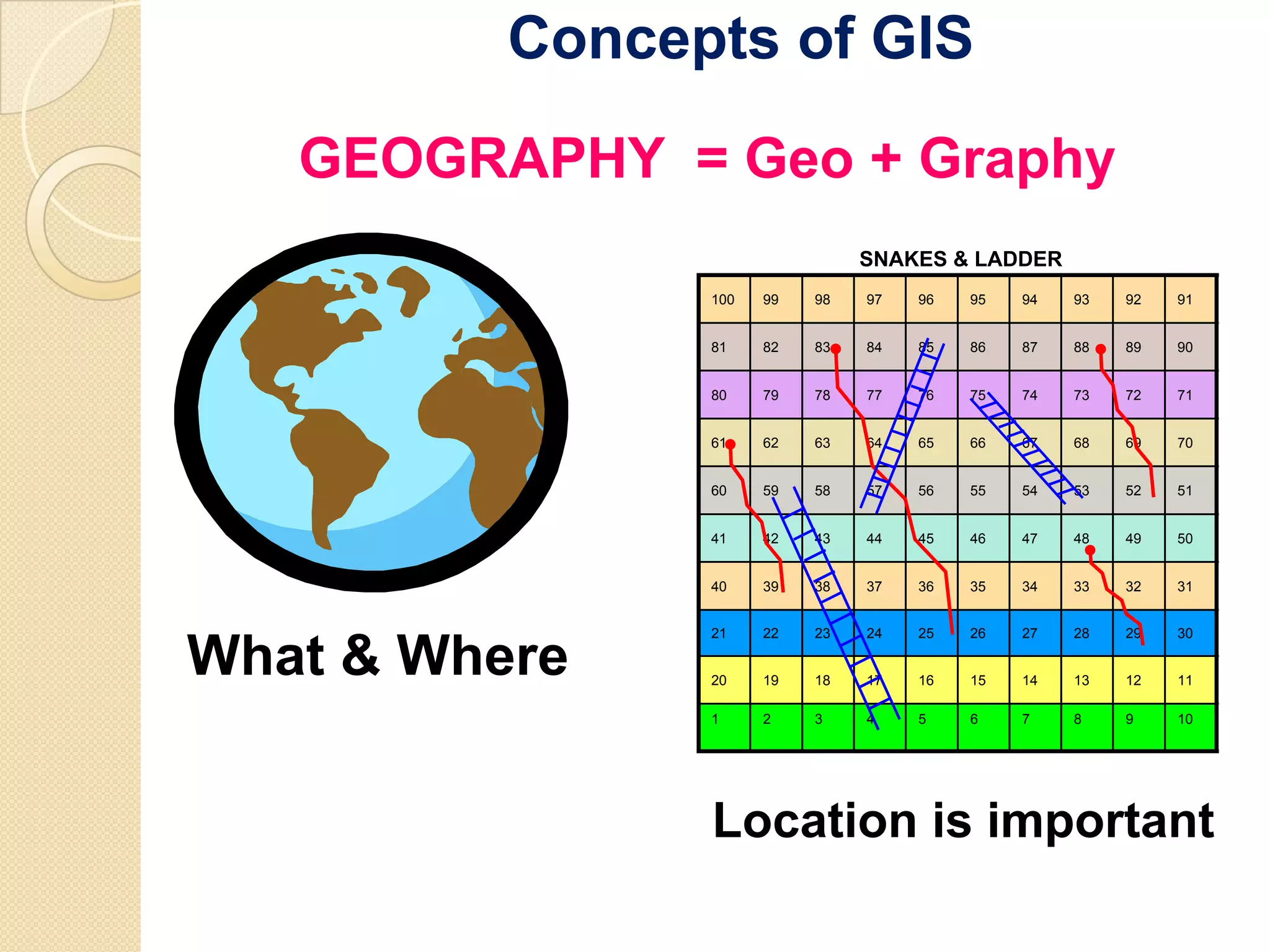
   GEOGRAPHY = Geo + Graphy
                                SNAKES & LADDER
                100   99   98   97   96   95   94   93   92   91


                81    82   83   84   85   86   87   88   89   90


                80    79   78   77   76   75   74   73   72   71


                61    62   63   64   65   66   67   68   69   70


                60    59   58   57   56   55   54   53   52   51


                41    42   43   44   45   46   47   48   49   50


                40    39   38   37   36   35   34   33   32   31


What & Where
                21    22   23   24   25   26   27   28   29   30


                20    19   18   17   16   15   14   13   12   11

                1     2    3    4    5    6    7    8    9    10


                Location is important
Concepts of GIS


INFORMATION
Concepts of GIS

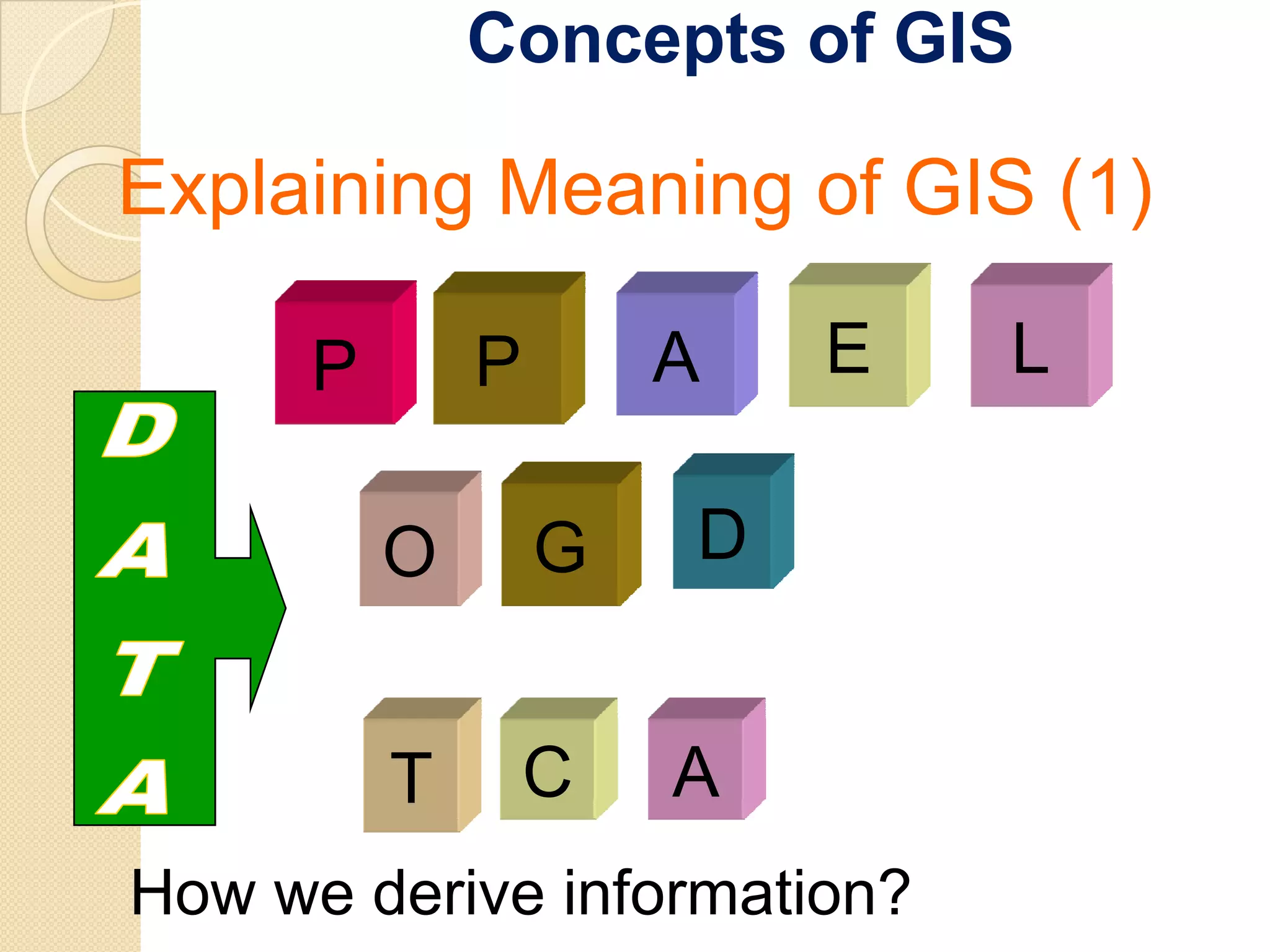
Explaining Meaning of GIS (1)

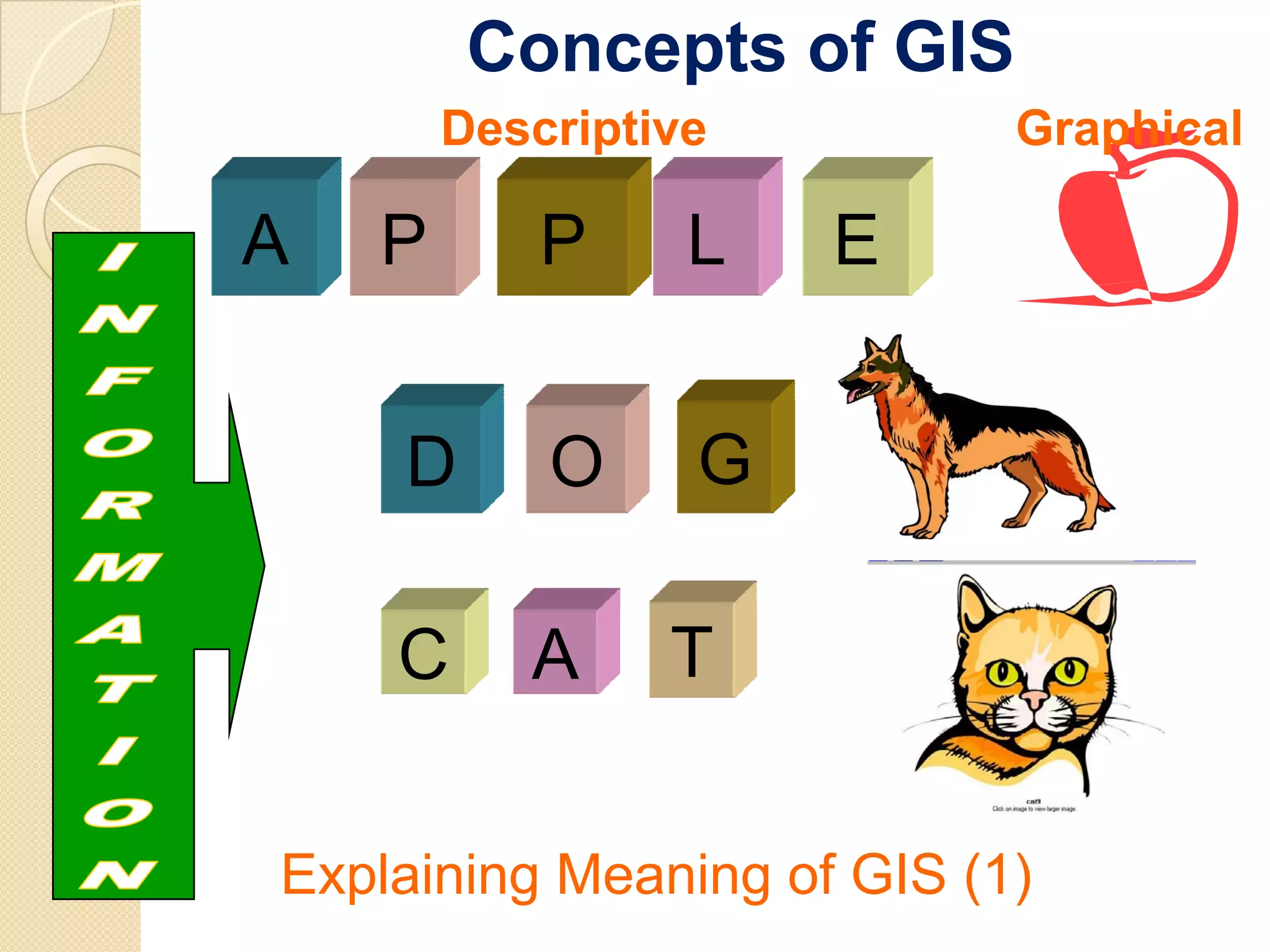
      P       P       A   E   L

          O       G   D


          T       C   A
How we derive information?
Concepts of GIS
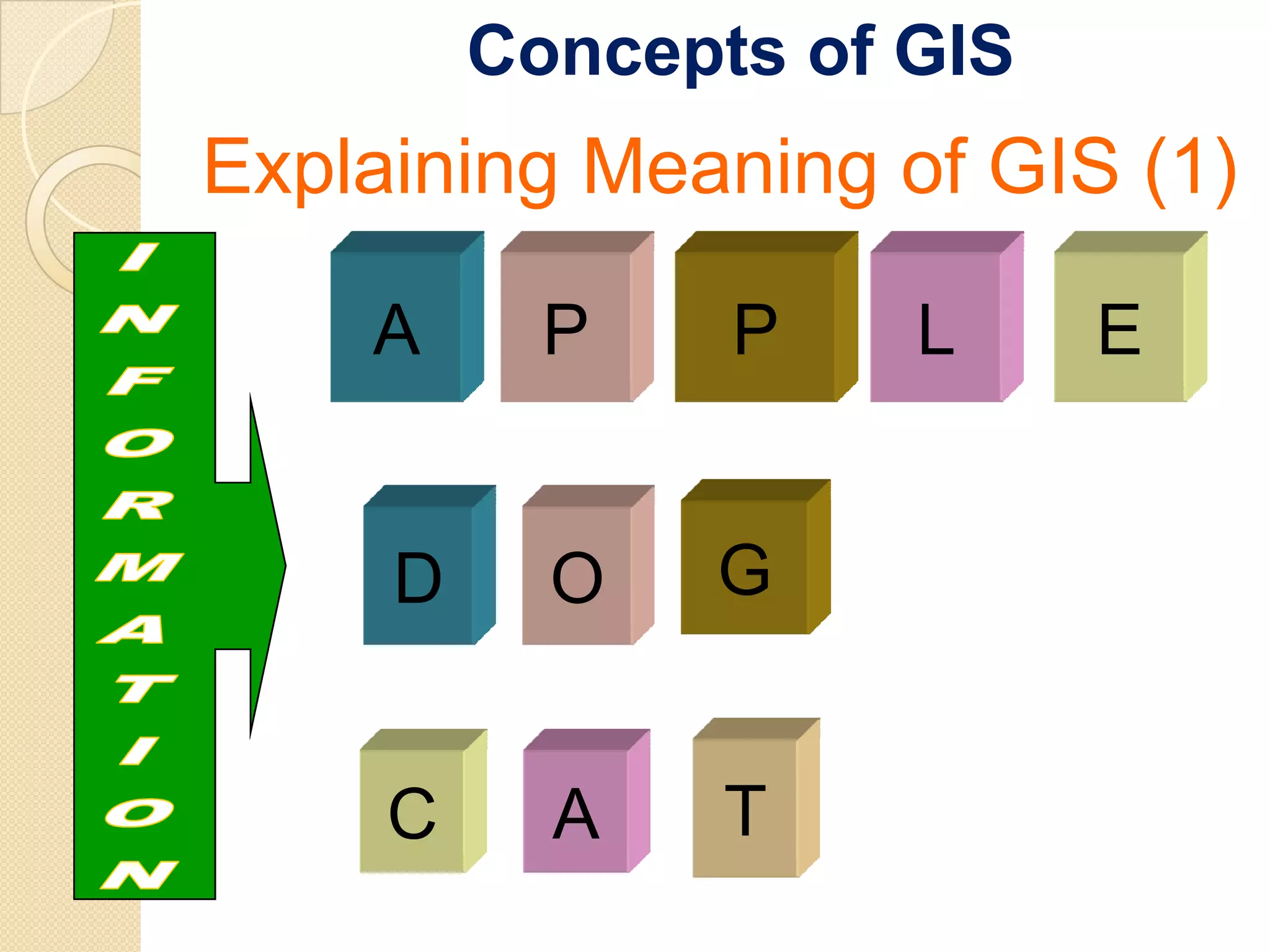
Explaining Meaning of GIS (1)

    A      P    P    L     E


     D     O   G


     C     A    T
Concepts of GIS
        Descriptive         Graphical

A   P       P     L   E


    D       O     G

    C      A     T


Explaining Meaning of GIS (1)
Concepts of GIS
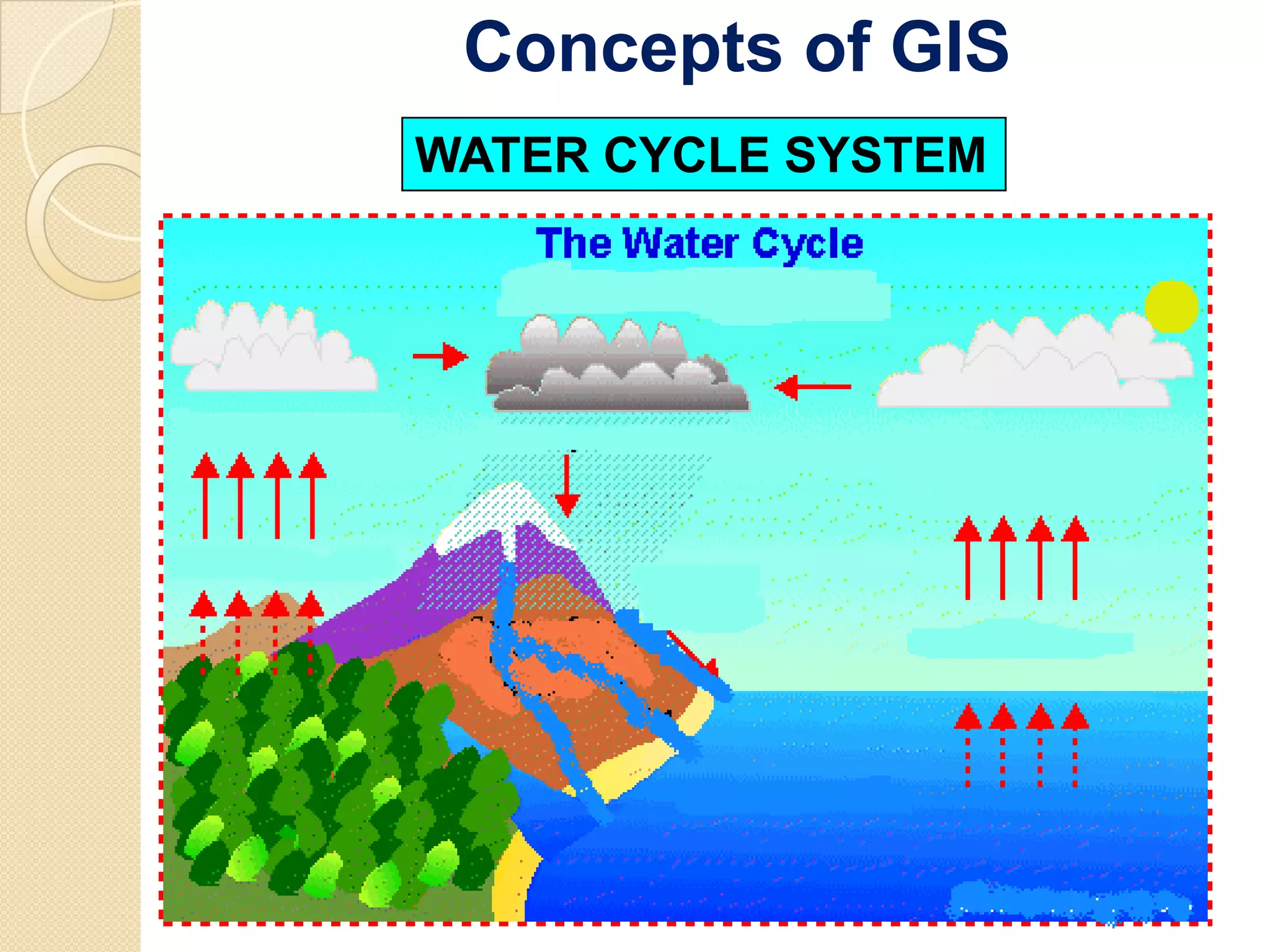
WATER CYCLE SYSTEM
Concepts of GIS
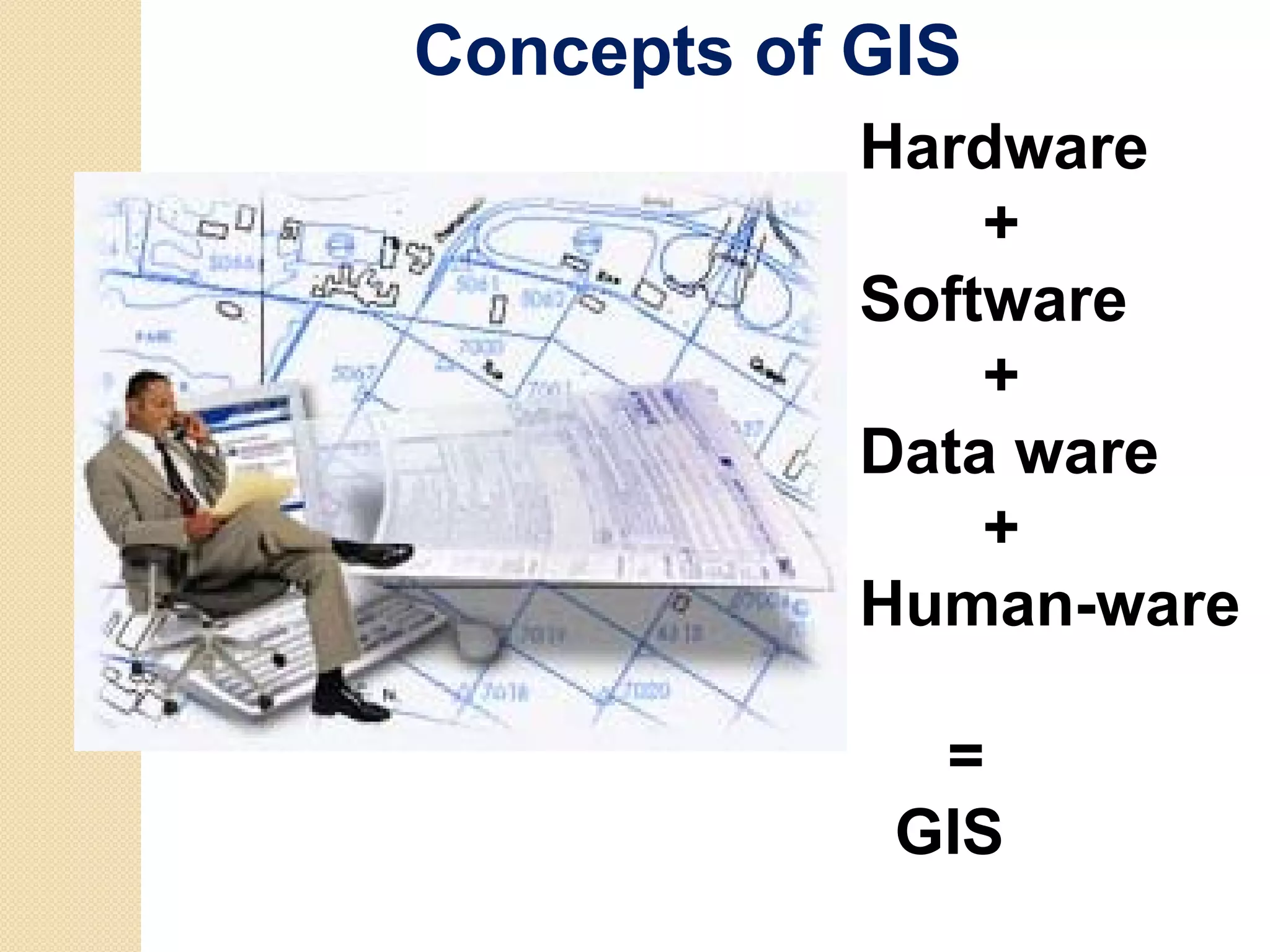
            Hardware
                +
            Software
                +
            Data ware
                +
            Human-ware

              =
             GIS
Concepts of GIS
 Defining GIS                  for capturing, storing,
Toolbox based              retrieving, analyzing and
- set of tools
    t ft l                   displaying which are
- a system                spatially referenced to earth
- an information system
Database definitions
- a database system in which most of the data are spatia
             s stem     hich
   indexed, and upon which a set of procedures are
   operated in order to answer queries about spatial
   entities in the database.
Og
Organization b sed de
          o based definitions
                          o s
- a decision support system involving the integration of
  spatially referenced data in a problem solving environm
Concepts of GIS
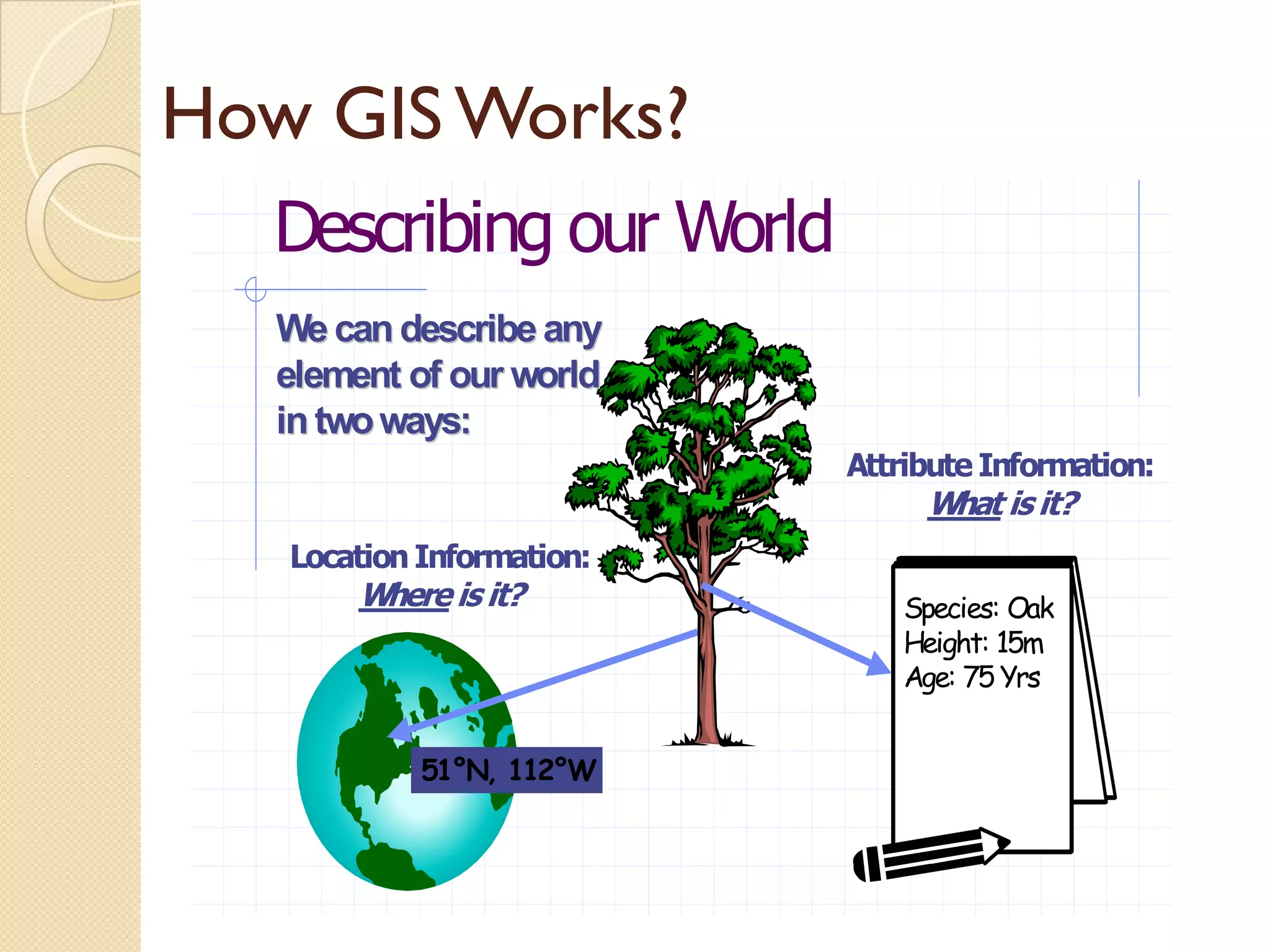
How GIS Works?
  Describing our World
  We can describe any
  element of our world
  in t
  i two ways:
                          Attribute Information:
                               What is it?
  Location Information:
       i     f     i
       Where is it?           Species: Oak
                              Height: 15m
                              Age: 75 Yrs


           51°N, 112°W
Concepts of GIS
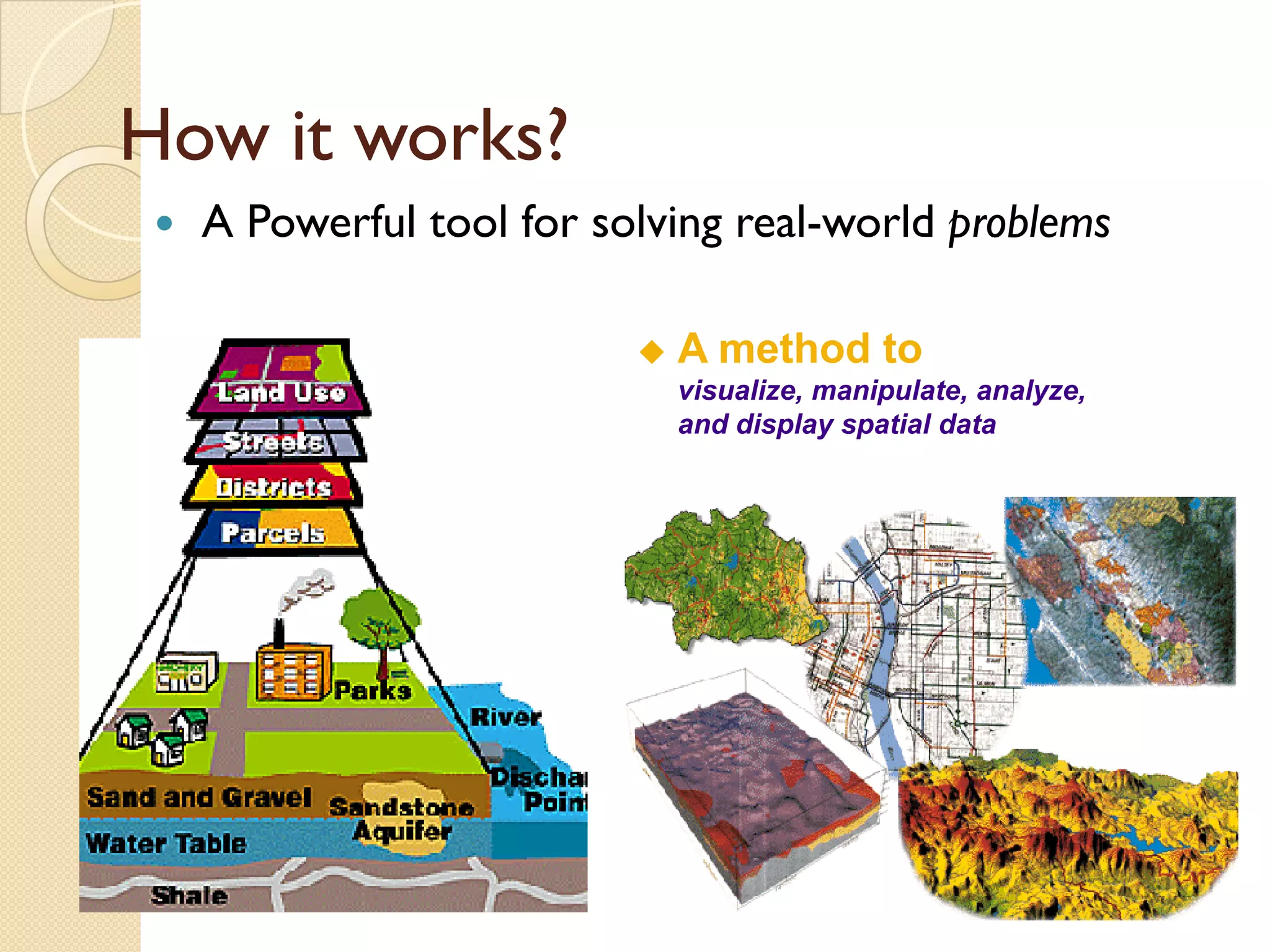
How it works?
  A Powerful tool for solving real-world problems

                          A method to
                          visualize, manipulate, analyze,
                          and display spatial data
Concepts of GIS
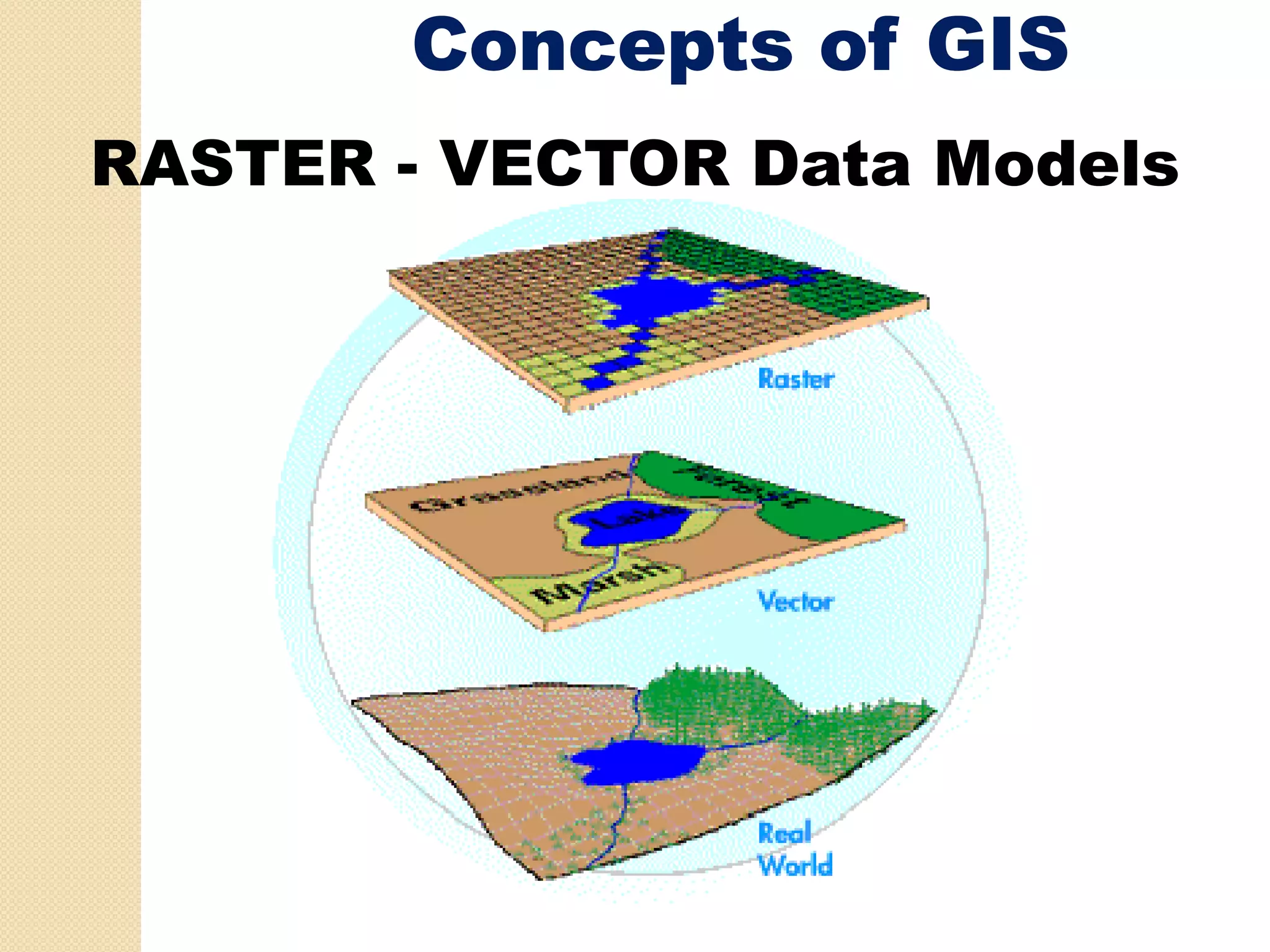
RASTER - VECTOR Data Models
iirs       Spatial data and geoinformation

   There is a degree of error in   Lineage – describes the
   all data
       data.                       history of a data set, source
                                                     set
   In the context of a GIS we      of observation or materials.
   distinguish between:            Temporal accuracy,
       Errors in source data
          o s sou ce               examples changes in
                                         p        g
       Processing errors           landownership, deforestation
   In addition the International   Completeness, for spatial
   Cartographic Association        features and attributes
   identified:                     Logical consistency,
       Lineage (history)           combination of completeness
       Temporal accuracy           and topological consistency
       Completeness
       C    l t
       Logical consistency
iirs       Spatial data and geoinformation

   In a GIS a wider view of         Most GIS analysis will
   quality is important             introduce errors.
   because:

       Errors are introduced
       when data is put into the
       GIS
       Unlike a conventional
       map, which is a single end
               hi h i    i gl   d
       product, a GIS contains
       data from various sources
       Unlike topographic or
                 p g p
       cadastral databases,
       natural resource databases
       contain “uncertain” data.
Potential of GIS
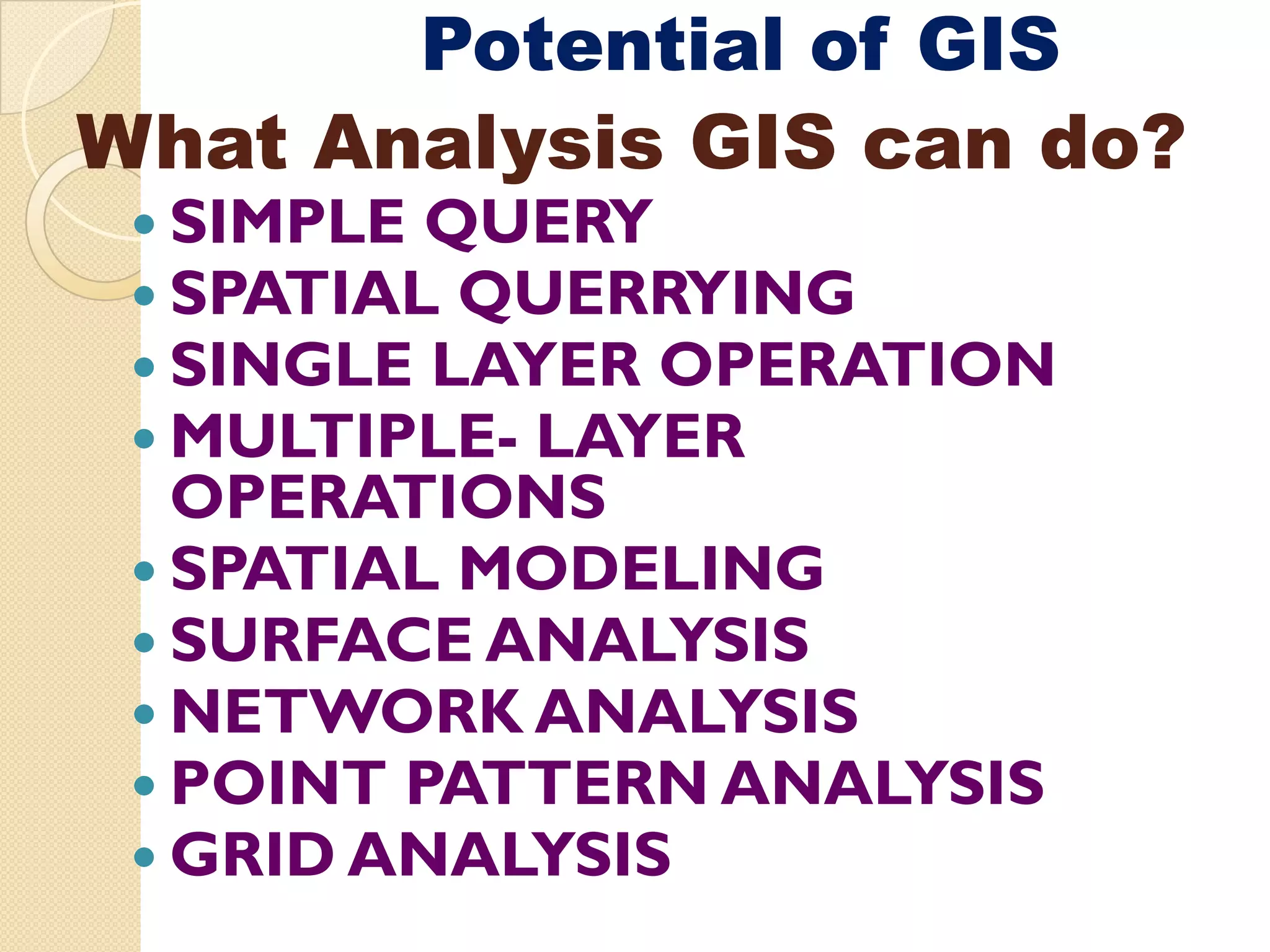
What Analysis GIS can do?
  SIMPLE QUERY
  SPATIAL QUERRYING
  SINGLE LAYER OPERATION
  MULTIPLE- LAYER
  OPERATIONS
  SPATIAL MODELING
  SURFACE ANALYSIS
  NETWORK ANALYSIS
  POINT PATTERN ANALYSIS
  GRID ANALYSIS
GIS Application potential
           Potential of GIS
Where it i used?
Wh    i is    d?
  Natural resource management
  Infrastructure development
  Utility services
  Business applications
  Investigation services
  e-governance
Potential of GIS
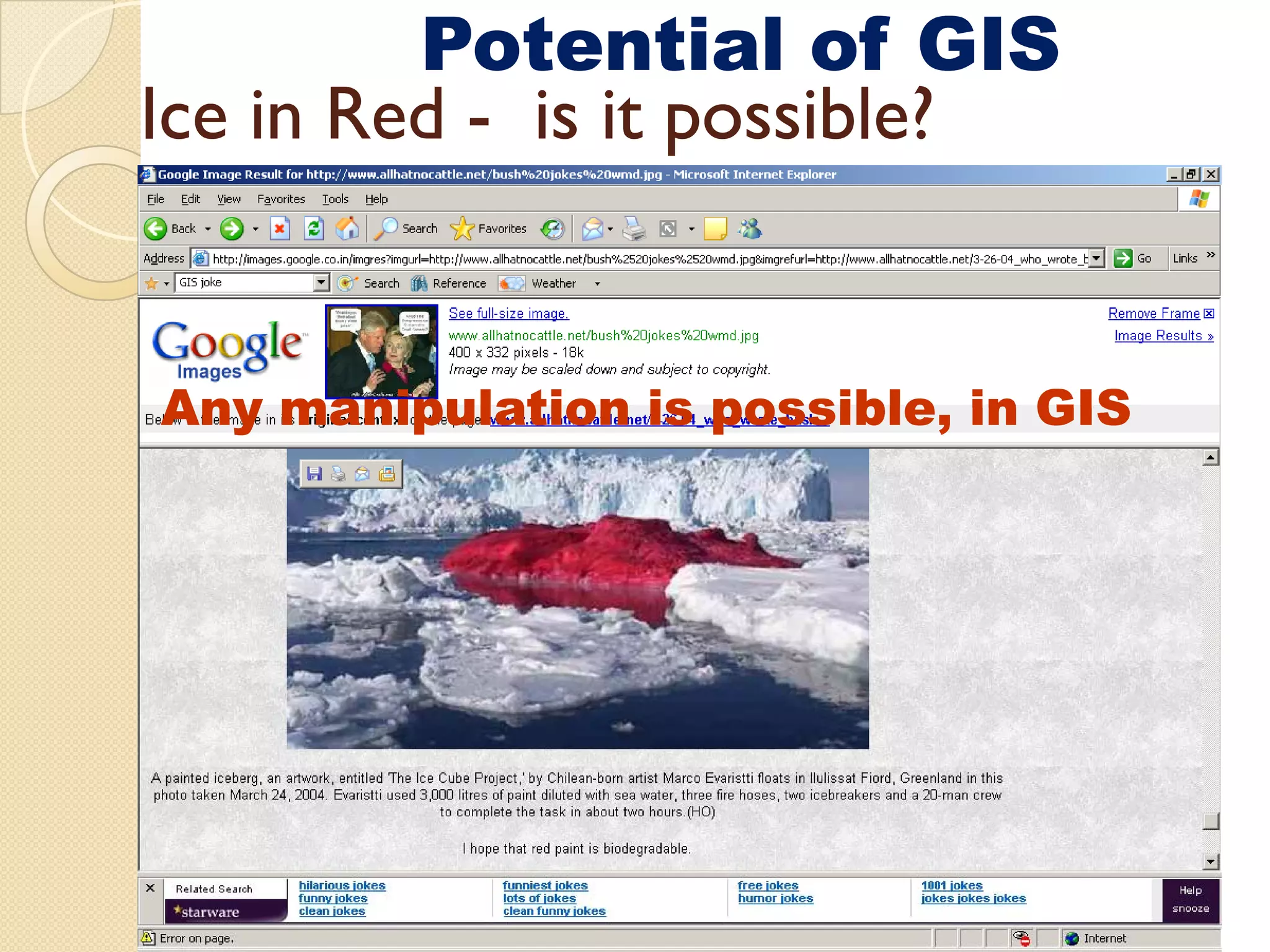
Ice in Red - is it possible?


Any manipulation is possible, in GIS
                    possible
GIS infrastructure
        Potential of GIS
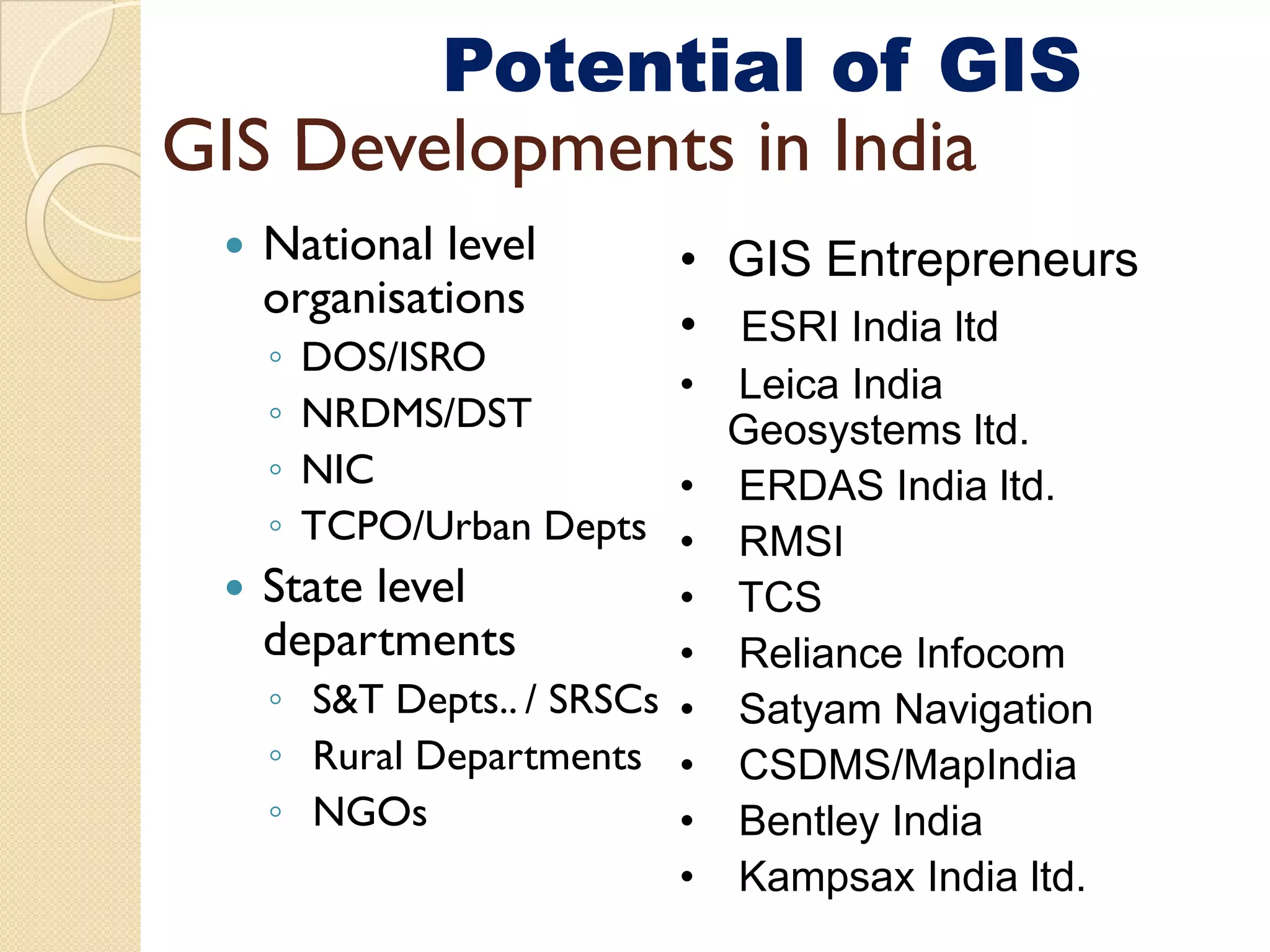
GIS De el ments in India
    Developments
  National level       • GIS Entrepreneurs
  organisations
                       • ESRI India ltd
  ◦ DOS/ISRO
                        • Leica India
  ◦ NRDMS/DST             Geosystems ltd.
  ◦ NIC                 • ERDAS India ltd.
  ◦                 p
    TCPO/Urban Depts • RMSI
  State level           • TCS
  departments           • Reliance Infocom
  ◦ S&T Depts.. / SRSCs • Satyam Navigation
  ◦ Rural Departments • CSDMS/MapIndia
  ◦ NGOs                • Bentley India
                        • Kampsax India ltd.
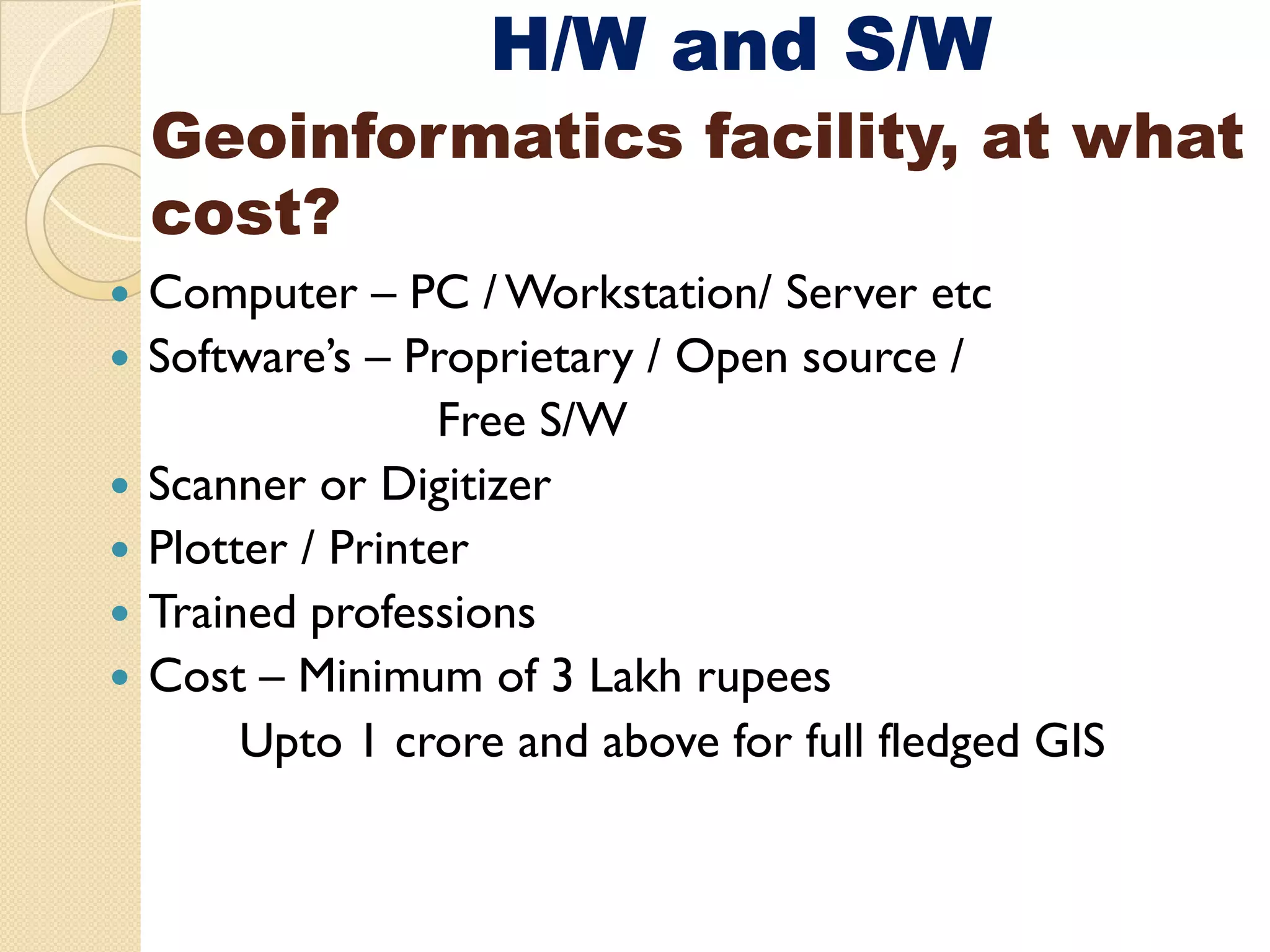
H/W and S/W
Geoinformatics facility at what
               facility,
cost?
Computer – PC / Workstation/ Server etc
Software’s – Proprietary / Open source /
               Free S/W
               F
Scanner or Digitizer
Plotter / Printer
Trained professions
Cost – Minimum of 3 Lakh rupees
     Upto 1 crore and above for full fledged GIS
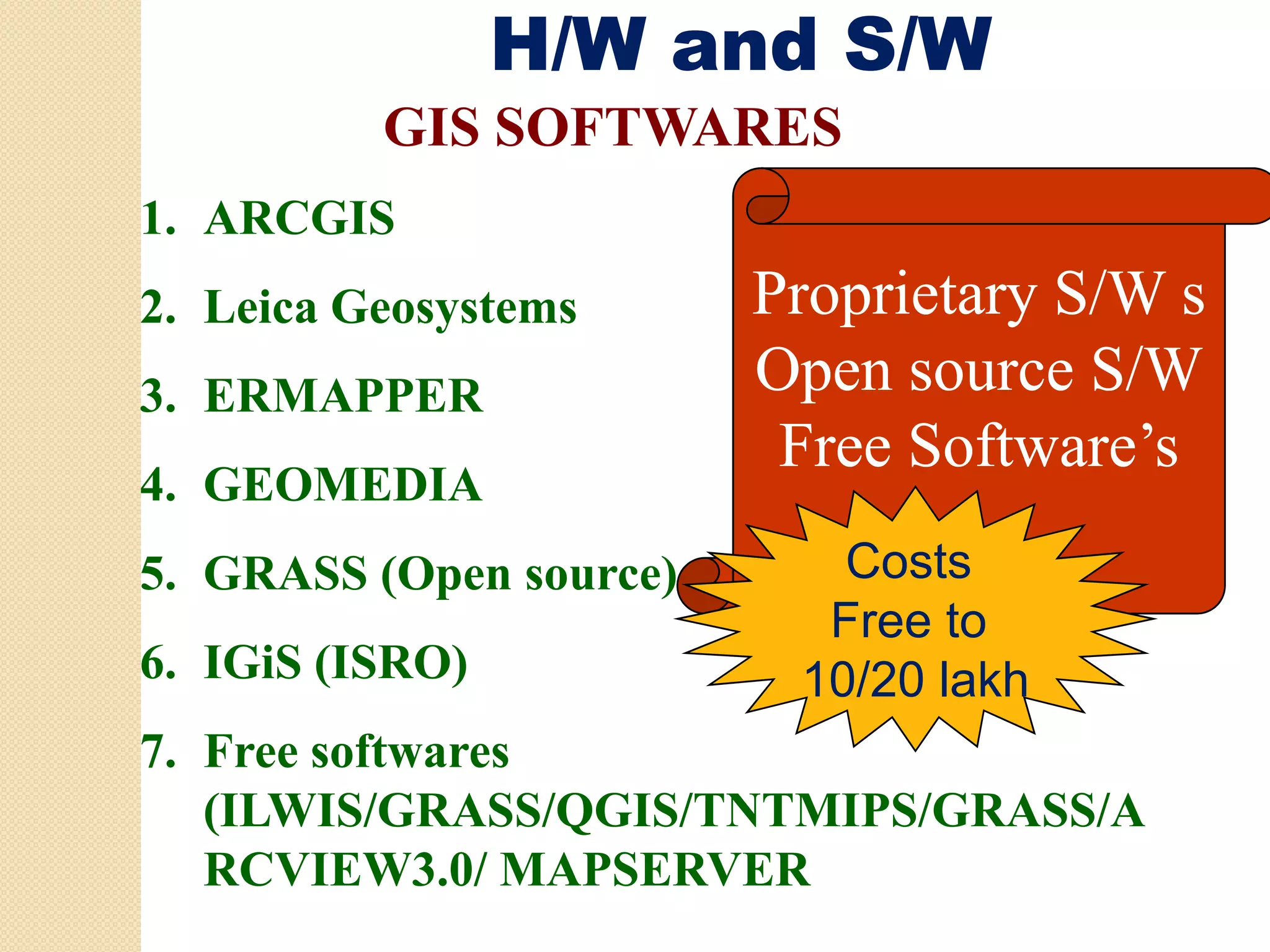
H/W and S/W
          GIS SOFTWARES
1. ARCGIS
2. Leica Geosystems      Proprietary S/W s
                         P    i
3. ERMAPPER              Open source S/W
                          Free Software’s
4. GEOMEDIA
5. GRASS (Open source)      Costs
                            C t
                           Free to
6. IGiS (ISRO)
        (    )            10/20 lakh
7. Free softwares
   (ILWIS/GRASS/QGIS/TNTMIPS/GRASS/A
   RCVIEW3.0/ MAPSERVER
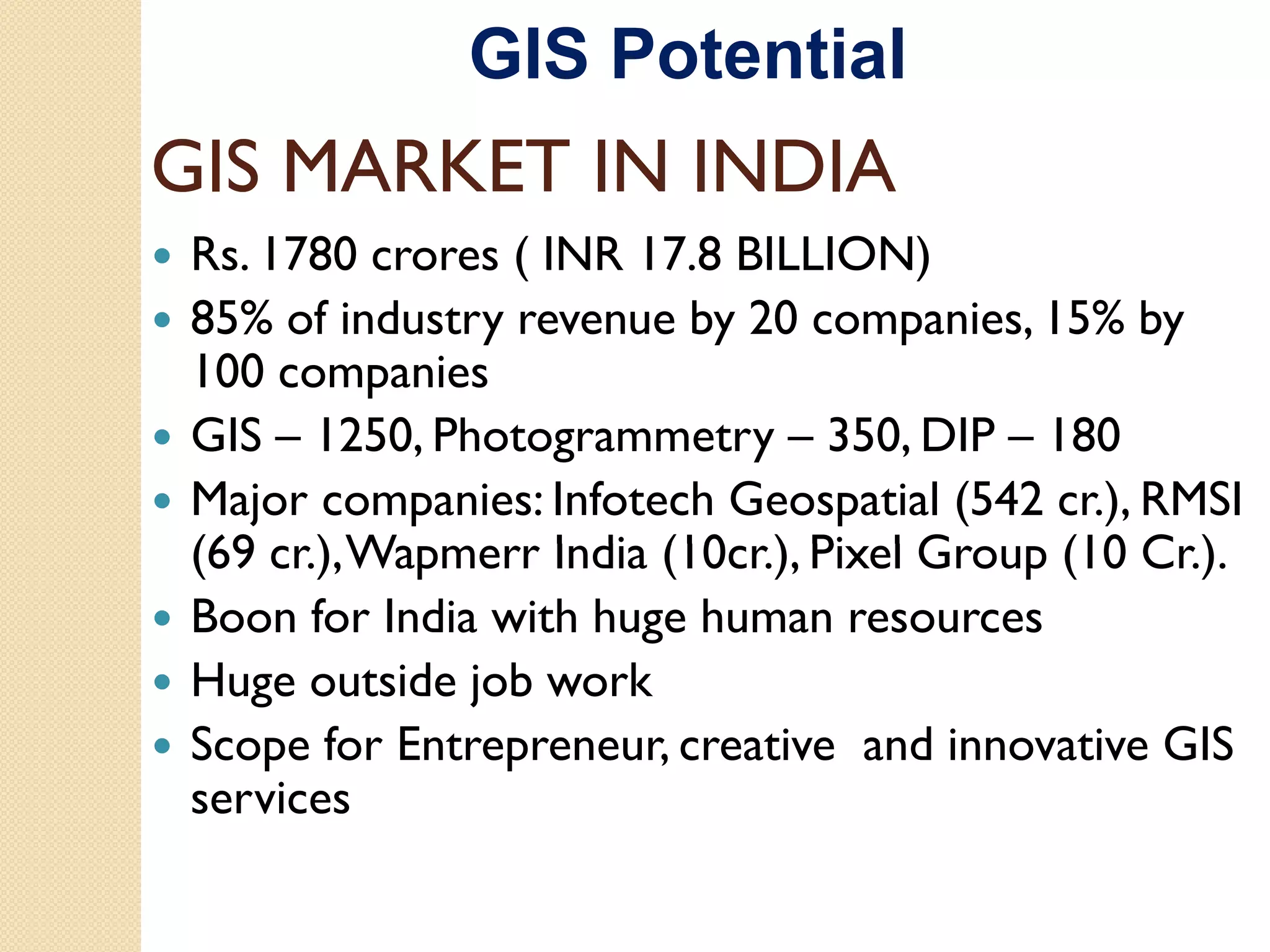
GIS Potential
GIS MARKET IN INDIA
 Rs. 1780 crores ( INR 17.8 BILLION)     )
 85% of industry revenue by 20 companies, 15% by
 100 companies
 GIS – 1250, Photogrammetry – 350, DIP – 180
 Major companies: Infotech Geospatial (542 cr.), RMSI
 (69 cr.), W
        ) Wapmerr I di (10 ) Pi l G
                    India (10cr.), Pixel Group (10 Cr.).
                                                   C )
 Boon for India with huge human resources
 Huge outside job work
 Scope for Entrepreneur, creative and innovative GIS
 services
History
Father of GIS
F h     f
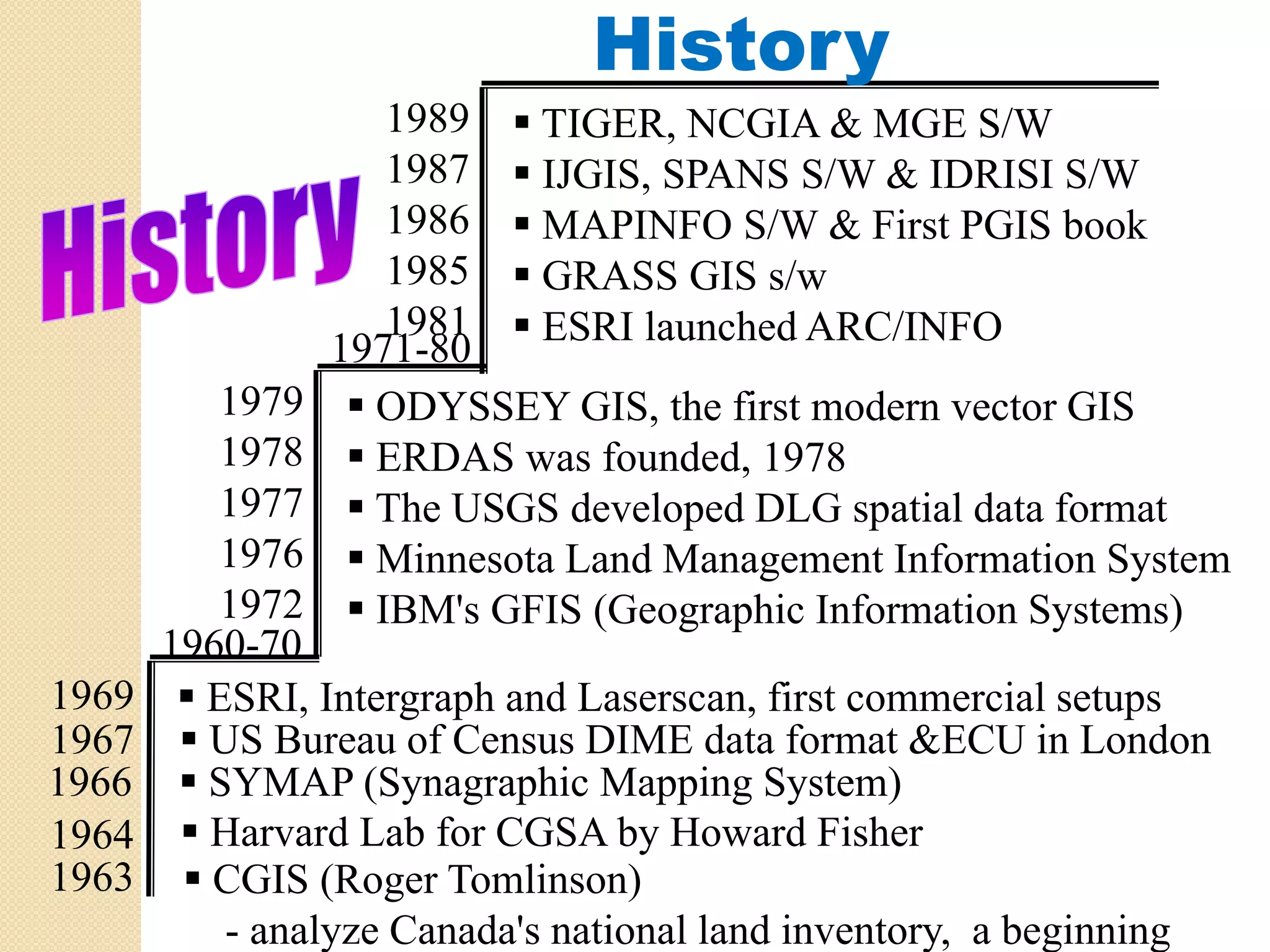
History
                   1989   TIGER, NCGIA & MGE S/W
                   1987   IJGIS, SPANS S/W & IDRISI S/W
                   1986   MAPINFO S/W & First PGIS book
                   1985   GRASS GIS s/w
                   1981   ESRI launched ARC/INFO
                1971-80
          1979    ODYSSEY GIS, the first modern vector GIS
                             GIS
          1978    ERDAS was founded, 1978
          1977    The USGS developed DLG spatial data format
          1976    Minnesota Land Management Information System
                    i          d               f      i
          1972    IBM's GFIS (Geographic Information Systems)
       1960-70
1969     ESRI, Intergraph and Laserscan, first commercial setups
1967     US Bureau of Census DIME data format &ECU in London
1966     SYMAP (Synagraphic Mapping System)
1964     Harvard Lab for CGSA by Howard Fisher
1963     CGIS (Roger Tomlinson)
          - analyze Canada's national land inventory, a beginning
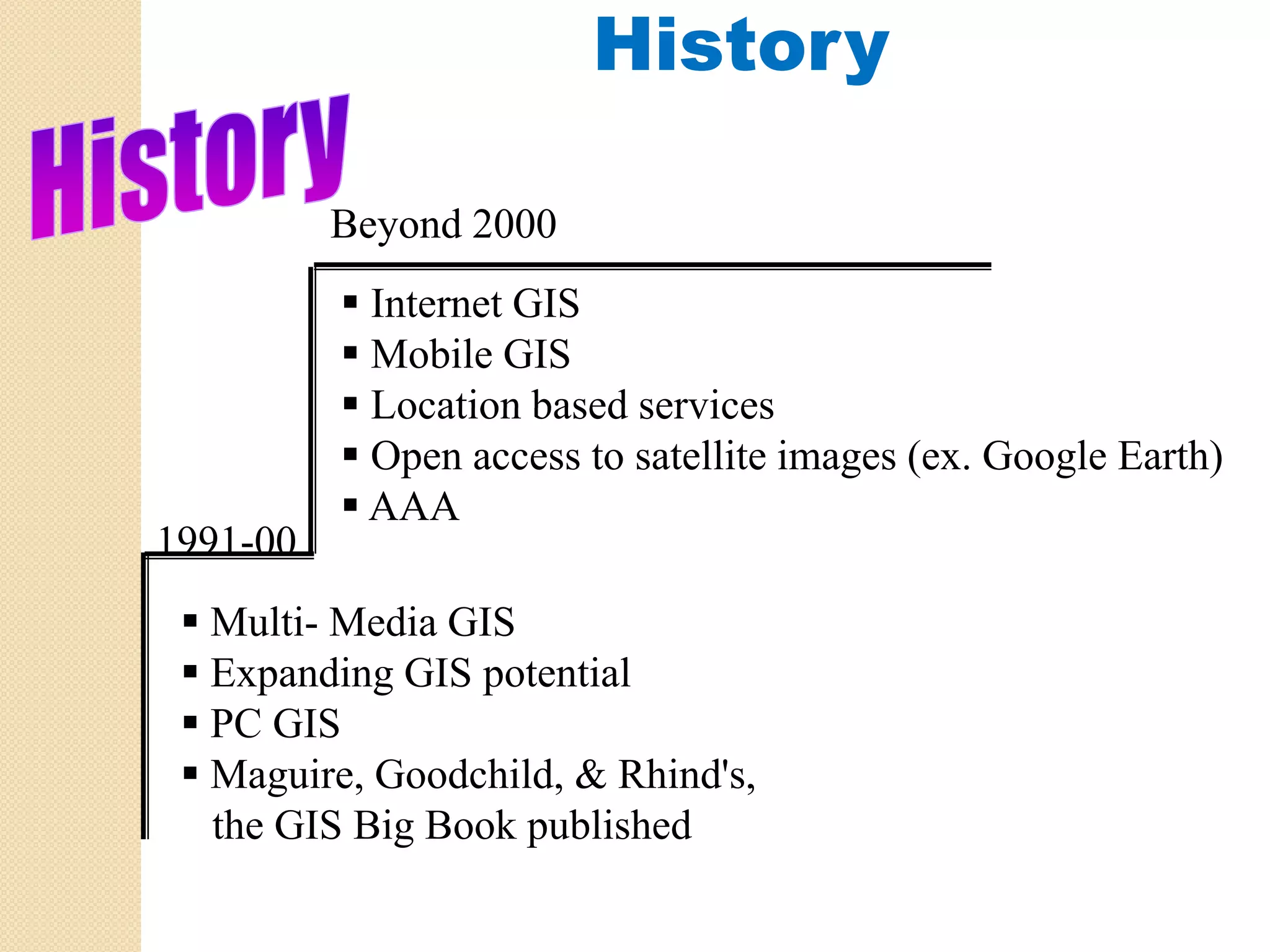
History

          Beyond 2000
           Internet GIS
           Mobile GIS
           Location based services
           Open access to satellite images (ex. Google Earth)
           AAA
1991-00
1991 00
  Multi- Media GIS
  Expanding GIS potential
  PC GIS
  Maguire, Goodchild, & Rhind's,
  the
  th GIS Bi B k published
          Big Book bli h d
Technological
Techn l ical trends
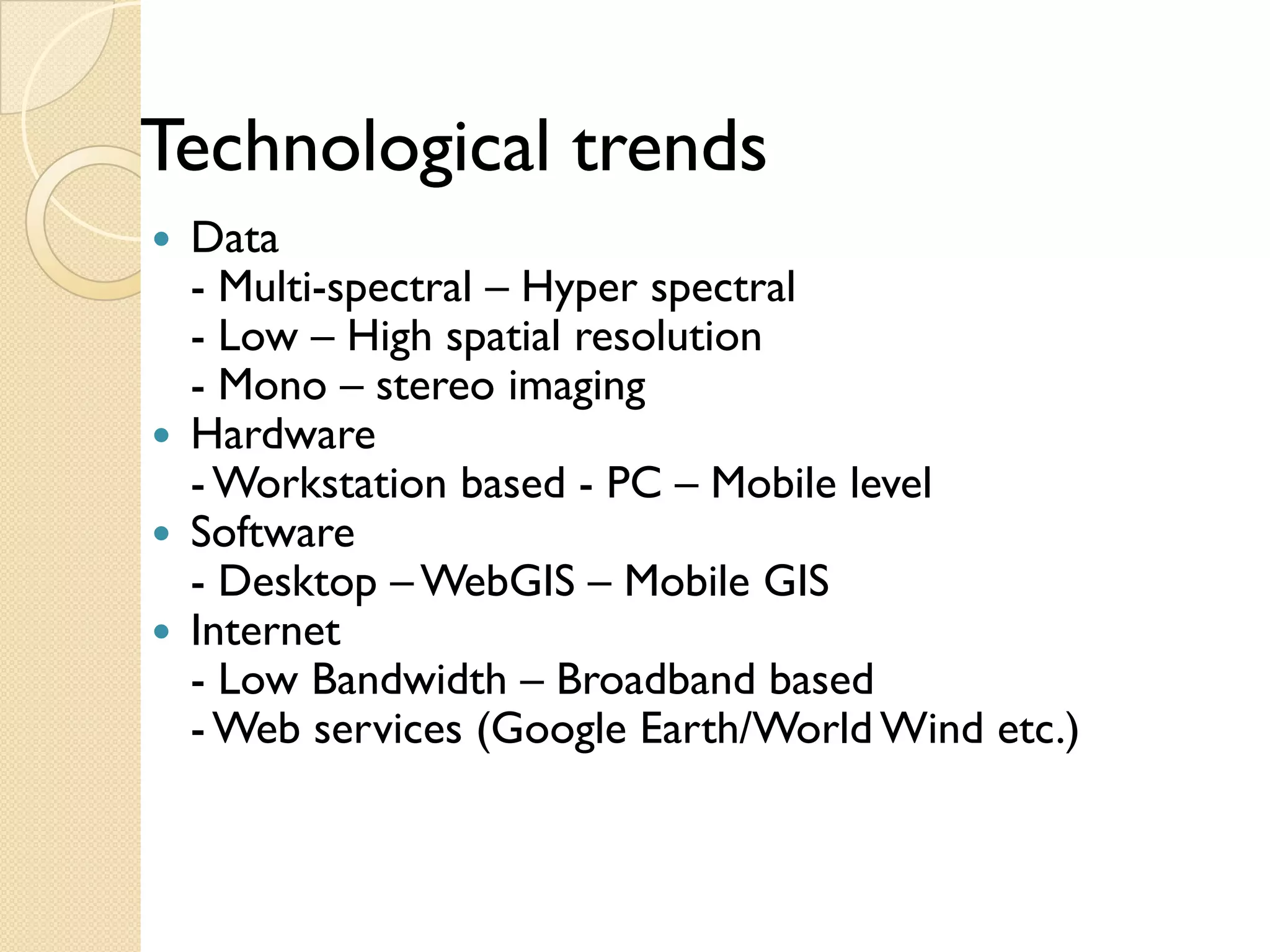
 Data
 -M l
   Multi-spectral – H
                l Hyper spectral l
 - Low – High spatial resolution
 - Mono – stereo imaging
                      g g
 Hardware
 - Workstation based - PC – Mobile level
 Software
 - Desktop – WebGIS – Mobile GIS
 Internet
 - Low Bandwidth – Broadband based
 - Web services (Google Earth/World Wind etc.)
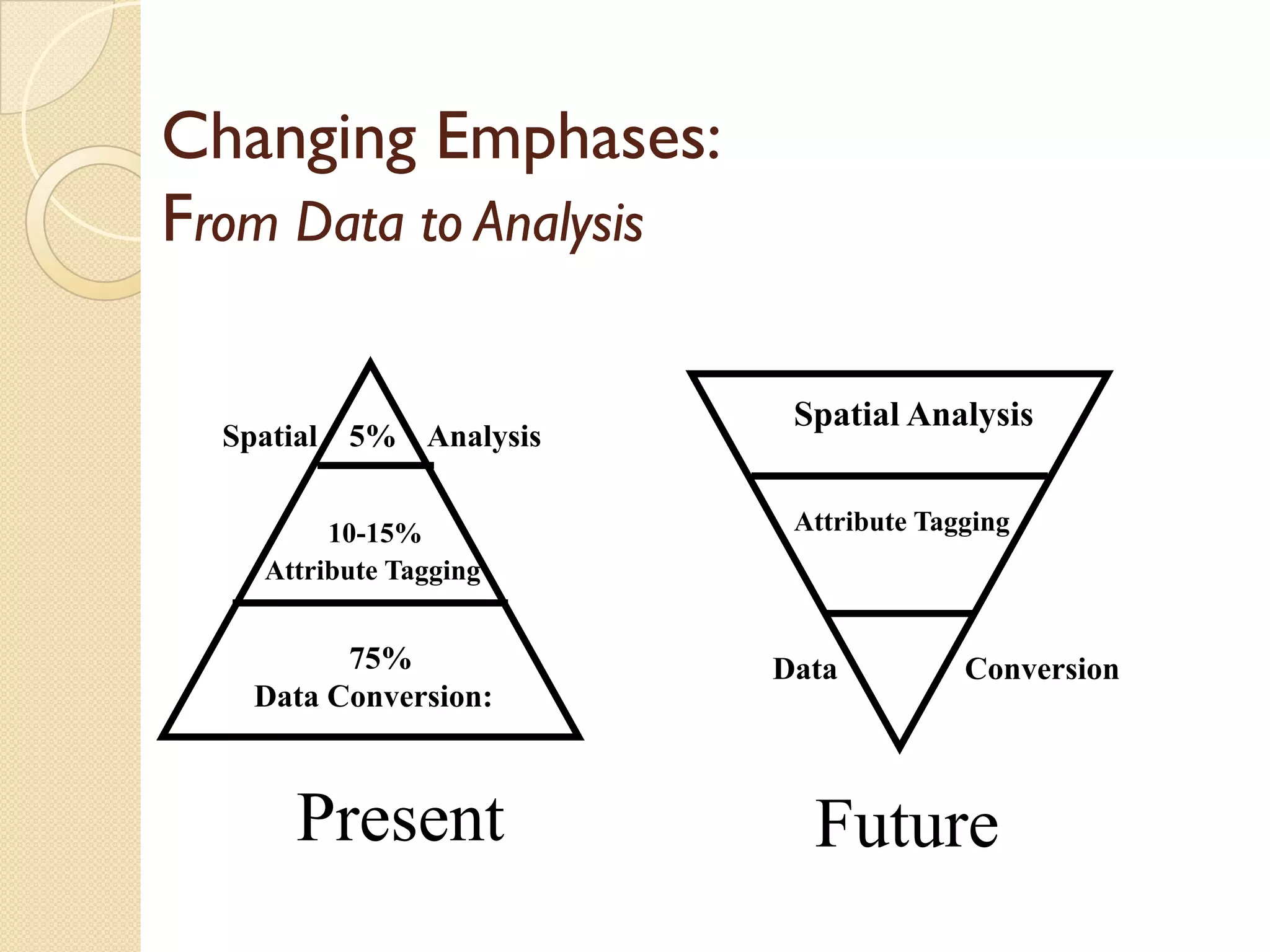
Changing Emphases:
From Data to Analysis

                         Spatial Analysis
                         S ti l A l i
  Spatial 5% Analysis


         10-15%          Attribute Tagging
    Attribute Tagging


         75%            Data          Conversion
   Data Conversion:


      Present             Future
The
Th application of GIS i li i d only b the
       li i      f    is limited l by h
 imagination of those who use it
                           ~ Jack Dangermond
Iirs - Overview of GIS

  • 1.
    OVERVIEW OFGIS P.L.N. P L N Raju Geoinformatics Division Indian Institute of Remote Sensing Indian S I di Space R Research O h Organisation i ti raju@iirs.gov.in
  • 2.
    iirs Further analysis What is the difference with an average December month? Which procedure was used? What can we learn?
  • 3.
    General Understanding ofGIS Understanding GIS (1) U d t di Map reading and information – how it is related to GIS? ◦ What you get from the map? ◦ Can we measure and quantify? ◦ Is it possible to find the changes? ◦ How is it related to GIS?
  • 4.
    General Understanding ofGIS Understanding GIS (2) U d t di Remote Sensing data and relation to GIS What we get from satellite data? Can we find the changes and how? How time series helps in finding patterns? Can we quantify the information? How RS is related to GIS?
  • 5.
    General Understanding ofGIS Understanding GIS (3) GPS and it’s relation to GIS Provides positional information Data generated in the form of point / line / area theme can be directly brought into GIS Updating of GIS information will be easy and fast using GPS
  • 6.
    General Understanding ofGIS Understanding GIS (4) U d t di Models and GIS ◦ We ask children to make models about our earth, Why? ◦ Global warming and climatic change – how it is done? ◦ Models and it’s role in GIS
  • 7.
    General Understanding ofGIS In S I Summary GIS is i Integrating technology g g gy consisting of: ◦ Remote Sensing g ◦ Cartography and Mapping ◦ GPS ◦ Computers ◦ RDMS ◦ Information Technology ◦ Communication technology ◦ Survey and field data collection
  • 8.
    Potential of GIS WhatGIS can do? What GIS can Real world problems do? d ? Identification Where ? Locate What is there? Optimum path O ti th What i th b t Wh t is the best route? t ? Patterns What relations exists between? Trend What has changed ? Models What if ?
  • 9.
    Concepts of GIS Typesof GIS Desktop GIS Professional GIS Enterprise GIS Mobile GIS Internet GIS Embedded GIS 4 D GIS Multimedia GIS
  • 10.
    Concepts of GIS GISterminology Geographical Information System Geographical Information Science Geoinformatics Geomatics Spatial information system Geospatial systems Geospat a Geospatial information e g ee g o at o engineering Land information system …….
  • 11.
    Concepts of GIS Whati the Wh t is th specialty of GIS? i lt f Facilitates faster process of operations Provides solution for many real world problems with options of many scenarios Decision making tool with the support of organized data Integrating technology Dynamic map display and interactive query
  • 12.
    Concepts of GIS ExplainingMeaning of GIS (1) GEOGRAPHICAL INFORMATION SYSTEM
  • 13.
    Concepts of GIS GEOGRAPHY Thescience of Earth’s physical features, resources, climate, f t li t population etc.
  • 14.
    Concepts of GIS GEOGRAPHY = Geo + Graphy SNAKES & LADDER 100 99 98 97 96 95 94 93 92 91 81 82 83 84 85 86 87 88 89 90 80 79 78 77 76 75 74 73 72 71 61 62 63 64 65 66 67 68 69 70 60 59 58 57 56 55 54 53 52 51 41 42 43 44 45 46 47 48 49 50 40 39 38 37 36 35 34 33 32 31 What & Where 21 22 23 24 25 26 27 28 29 30 20 19 18 17 16 15 14 13 12 11 1 2 3 4 5 6 7 8 9 10 Location is important
  • 15.
  • 16.
    Concepts of GIS ExplainingMeaning of GIS (1) P P A E L O G D T C A How we derive information?
  • 17.
    Concepts of GIS ExplainingMeaning of GIS (1) A P P L E D O G C A T
  • 18.
    Concepts of GIS Descriptive Graphical A P P L E D O G C A T Explaining Meaning of GIS (1)
  • 19.
  • 20.
    Concepts of GIS Hardware + Software + Data ware + Human-ware = GIS
  • 21.
    Concepts of GIS Defining GIS for capturing, storing, Toolbox based retrieving, analyzing and - set of tools t ft l displaying which are - a system spatially referenced to earth - an information system Database definitions - a database system in which most of the data are spatia s stem hich indexed, and upon which a set of procedures are operated in order to answer queries about spatial entities in the database. Og Organization b sed de o based definitions o s - a decision support system involving the integration of spatially referenced data in a problem solving environm
  • 22.
    Concepts of GIS HowGIS Works? Describing our World We can describe any element of our world in t i two ways: Attribute Information: What is it? Location Information: i f i Where is it? Species: Oak Height: 15m Age: 75 Yrs 51°N, 112°W
  • 23.
    Concepts of GIS Howit works? A Powerful tool for solving real-world problems A method to visualize, manipulate, analyze, and display spatial data
  • 24.
    Concepts of GIS RASTER- VECTOR Data Models
  • 25.
    iirs Spatial data and geoinformation There is a degree of error in Lineage – describes the all data data. history of a data set, source set In the context of a GIS we of observation or materials. distinguish between: Temporal accuracy, Errors in source data o s sou ce examples changes in p g Processing errors landownership, deforestation In addition the International Completeness, for spatial Cartographic Association features and attributes identified: Logical consistency, Lineage (history) combination of completeness Temporal accuracy and topological consistency Completeness C l t Logical consistency
  • 26.
    iirs Spatial data and geoinformation In a GIS a wider view of Most GIS analysis will quality is important introduce errors. because: Errors are introduced when data is put into the GIS Unlike a conventional map, which is a single end hi h i i gl d product, a GIS contains data from various sources Unlike topographic or p g p cadastral databases, natural resource databases contain “uncertain” data.
  • 27.
    Potential of GIS WhatAnalysis GIS can do? SIMPLE QUERY SPATIAL QUERRYING SINGLE LAYER OPERATION MULTIPLE- LAYER OPERATIONS SPATIAL MODELING SURFACE ANALYSIS NETWORK ANALYSIS POINT PATTERN ANALYSIS GRID ANALYSIS
  • 28.
    GIS Application potential Potential of GIS Where it i used? Wh i is d? Natural resource management Infrastructure development Utility services Business applications Investigation services e-governance
  • 29.
    Potential of GIS Icein Red - is it possible? Any manipulation is possible, in GIS possible
  • 30.
    GIS infrastructure Potential of GIS GIS De el ments in India Developments National level • GIS Entrepreneurs organisations • ESRI India ltd ◦ DOS/ISRO • Leica India ◦ NRDMS/DST Geosystems ltd. ◦ NIC • ERDAS India ltd. ◦ p TCPO/Urban Depts • RMSI State level • TCS departments • Reliance Infocom ◦ S&T Depts.. / SRSCs • Satyam Navigation ◦ Rural Departments • CSDMS/MapIndia ◦ NGOs • Bentley India • Kampsax India ltd.
  • 31.
    H/W and S/W Geoinformaticsfacility at what facility, cost? Computer – PC / Workstation/ Server etc Software’s – Proprietary / Open source / Free S/W F Scanner or Digitizer Plotter / Printer Trained professions Cost – Minimum of 3 Lakh rupees Upto 1 crore and above for full fledged GIS
  • 32.
    H/W and S/W GIS SOFTWARES 1. ARCGIS 2. Leica Geosystems Proprietary S/W s P i 3. ERMAPPER Open source S/W Free Software’s 4. GEOMEDIA 5. GRASS (Open source) Costs C t Free to 6. IGiS (ISRO) ( ) 10/20 lakh 7. Free softwares (ILWIS/GRASS/QGIS/TNTMIPS/GRASS/A RCVIEW3.0/ MAPSERVER
  • 33.
    GIS Potential GIS MARKETIN INDIA Rs. 1780 crores ( INR 17.8 BILLION) ) 85% of industry revenue by 20 companies, 15% by 100 companies GIS – 1250, Photogrammetry – 350, DIP – 180 Major companies: Infotech Geospatial (542 cr.), RMSI (69 cr.), W ) Wapmerr I di (10 ) Pi l G India (10cr.), Pixel Group (10 Cr.). C ) Boon for India with huge human resources Huge outside job work Scope for Entrepreneur, creative and innovative GIS services
  • 34.
  • 35.
    History 1989 TIGER, NCGIA & MGE S/W 1987 IJGIS, SPANS S/W & IDRISI S/W 1986 MAPINFO S/W & First PGIS book 1985 GRASS GIS s/w 1981 ESRI launched ARC/INFO 1971-80 1979 ODYSSEY GIS, the first modern vector GIS GIS 1978 ERDAS was founded, 1978 1977 The USGS developed DLG spatial data format 1976 Minnesota Land Management Information System i d f i 1972 IBM's GFIS (Geographic Information Systems) 1960-70 1969 ESRI, Intergraph and Laserscan, first commercial setups 1967 US Bureau of Census DIME data format &ECU in London 1966 SYMAP (Synagraphic Mapping System) 1964 Harvard Lab for CGSA by Howard Fisher 1963 CGIS (Roger Tomlinson) - analyze Canada's national land inventory, a beginning
  • 36.
    History Beyond 2000 Internet GIS Mobile GIS Location based services Open access to satellite images (ex. Google Earth) AAA 1991-00 1991 00 Multi- Media GIS Expanding GIS potential PC GIS Maguire, Goodchild, & Rhind's, the th GIS Bi B k published Big Book bli h d
  • 37.
    Technological Techn l icaltrends Data -M l Multi-spectral – H l Hyper spectral l - Low – High spatial resolution - Mono – stereo imaging g g Hardware - Workstation based - PC – Mobile level Software - Desktop – WebGIS – Mobile GIS Internet - Low Bandwidth – Broadband based - Web services (Google Earth/World Wind etc.)
  • 38.
    Changing Emphases: From Datato Analysis Spatial Analysis S ti l A l i Spatial 5% Analysis 10-15% Attribute Tagging Attribute Tagging 75% Data Conversion Data Conversion: Present Future
  • 39.
    The Th application ofGIS i li i d only b the li i f is limited l by h imagination of those who use it ~ Jack Dangermond