GIS in Urban Planning
Dilhan
Definition
• Urban Planning
– Urban
• An Area with a relatively high population
density that contains a set of closely related
activities.
– Planning
• A Management Tool in the sense of setting
objectives and targets for production.

– Urban Planning
• Decision Making for the allocation of Land
Uses in a system where the Market is the
primary mode.
Definitions
• Geographic Information System
(GIS)
A GIS is a computer based
information system capable of
assembling, storing, manipulating and
displaying geographically referenced
information.
A computer system
which can hold and use
data describing places
on the earth's surface.
• A GIS is a database
for spatial data
• A GIS stores its
data in layers
• Each layer consists
of a map plus a table
of attribute data
How does GIS looks like?
GIS Capabilities
• Topological map overlay
• Buffer generation
• Proximity analysis
• Spatial data management
• LocationAllocation modeling
• Network analysis
• Sophisticated tabular analysis
• Cartography and mapping
• Report generation
GIS & RS Applications in Urban
Planning
Urban Development Authority
• The Urban Planning is a complex phenomenon which requires
enormous amount of data to support the decision. Our
normal practice is to keep data in file format sometime in
loose papers. After several years, nobody knows where the
data was, how they analyze, and when it was.
• Our urban areas are growing rapidly and therefore need to
be planned and adequately serviced to avoid problems
associated with unplanned and adhoc growth.
• Planning so far has been a time consuming activity and by
the time plan is prepared it would be outdated. A part of
the delay can be attributed to the current status of data
such as outdated maps, lack of information, etc. data
collection procedures, and analysis and techniques used to
prepare plans.
• Another very important aspect with the current methods is
that it is not easy to make rational and informed planning
decisions. Hence there is need for tools and techniques that
enable rapid planning and enable taking rational and
informed planning decisions. This is ultimately, lead to plans
that are better and implementable.
• The innovative technologies make easy to planners to
experiment and select best alternatives for their urban
development proposals.
• Satellite Images and use of Geographic Information
Systems (GIS) are example of such tools that facilitate
preparation of rapid, comprehensive, rational, and
implementable plans.
• The capability of GIS and RS is tremendous. But the
problem is, with those technologies, are we ready to change
the physical formation of the city?,
• Specially, in Sri Lanka Urban development takes place in
adhoc manner. All resources are centered to the wet zone
and we do not consider other zone’s potential.
• Why this has happened?
• We do not have proper guidance on urban development. The
best example we have experienced was Tsunami devastation
and others are flooding and land sliding.
• The GIS Centre of the Urban Development Authority has
identified and recognized this gap.
• Now we focus our attention more usage of RS and GIS
capabilities to the planning processes.
• How do we develop Land Use Database?
• A very detailed and systematic land use survey was carried
out for the built area in the relevant Local authority area.
• There were various layers of information to be represented
such as major land use, land use by floor, intensity of
development for each plot and building types.
• A GIS environment was required to reflect and represent
such a wide range of information, which was not possible
through the Autocad.
• Further, by attaching a database of varied information to
the map, it was possible to carry out several types of spatial
analysis, to support land use planning decisions.
• How do we identify Potential Areas for Future
Development/Urbanizable Zones?
• The most important application of the satellite images was
the mapping of the development sprawl. It gave an indication
of the growth directions.
• We compare two satellite images in two different years and
mapped all changes. It also became evident for the first
time that the town had doubled in size and that most of the
development activities had already occurred outside of the
LA boundary.
• This has tremendous implication on provision of
infrastructure. E.g. Battaramulla Ps area,
• Therefore, it is essential to identify an urbanized zone and
plan for infrastructure in this area in the near future to
avoid problems of adhoc and unplanned growth.
How do we use satellite images for updating the
Road net work?
The satellite images were used for updating the existing road
net work in terms of ,
•correcting the existing road alignment,
•correcting the railway line alignment,
•updating the old map by picking up the new or missing roads,
adding under construction roads,
•new roads and alternative proposals,
•demolishing buildings,
•identifying alternative lands for affected people,
•save as much as natural resources such as paddy lands,
marsh, inland wetlands etc.
•Conservation of Water bodies,
• The Satellite images were used for,
• Inventory of functioning tanks or water
areas and feeder channels,
• Inventory of dried up or encroach water
bodies and nature of encroachment,
• Delineating conservation zones around the
water bodies
• Developing groups of water bodies as open
spaces with recreational activities,
• Up gradation of waste lands and scrubs.
• Demarcation of “No Development Area”,
1. Mapping of Administrative
Boundaries,
2. Delineating of Environmental
Sensitive and Fragile Areas,
3. Conservation of Archaeological and
Historical Monuments,
4. Preparation of Land Use Plans &
Zoning Plans,
5. Water Demand & supply Analysis,
6. Traffic Analysis,
7. Road Network Analysis
GIS & RS application in Urban Planning
Contd.
8. Monitoring Temporal Changes
– Weather changes,
– Urban growth, Land use changes,
9. Prototyping of Routing Work
– Process of Building plan approval
– Process of Change of use of building
– Process of Tax and rental collection
etc.
10. Assessing physical transformation of
cities,
11. Land suitability modeling,
12. Disaster Management, e.g. Fire,
Land slides, Floods, Drought etc.
13. Terrain Modeling, Slope angles,
14. Delineation and incorporation of
socio-infrastructure databases,
15. Urban Information Systems,
Database Management Systems,
Spatial data, Data reference to the earth, e.g. Land
Information System,
Non-Spatial data, e.g.. Socio – economic data, Population,
housing, income, infrastructures etc.
• Tsunami & Hazard Mapping,
• 3D Modeling
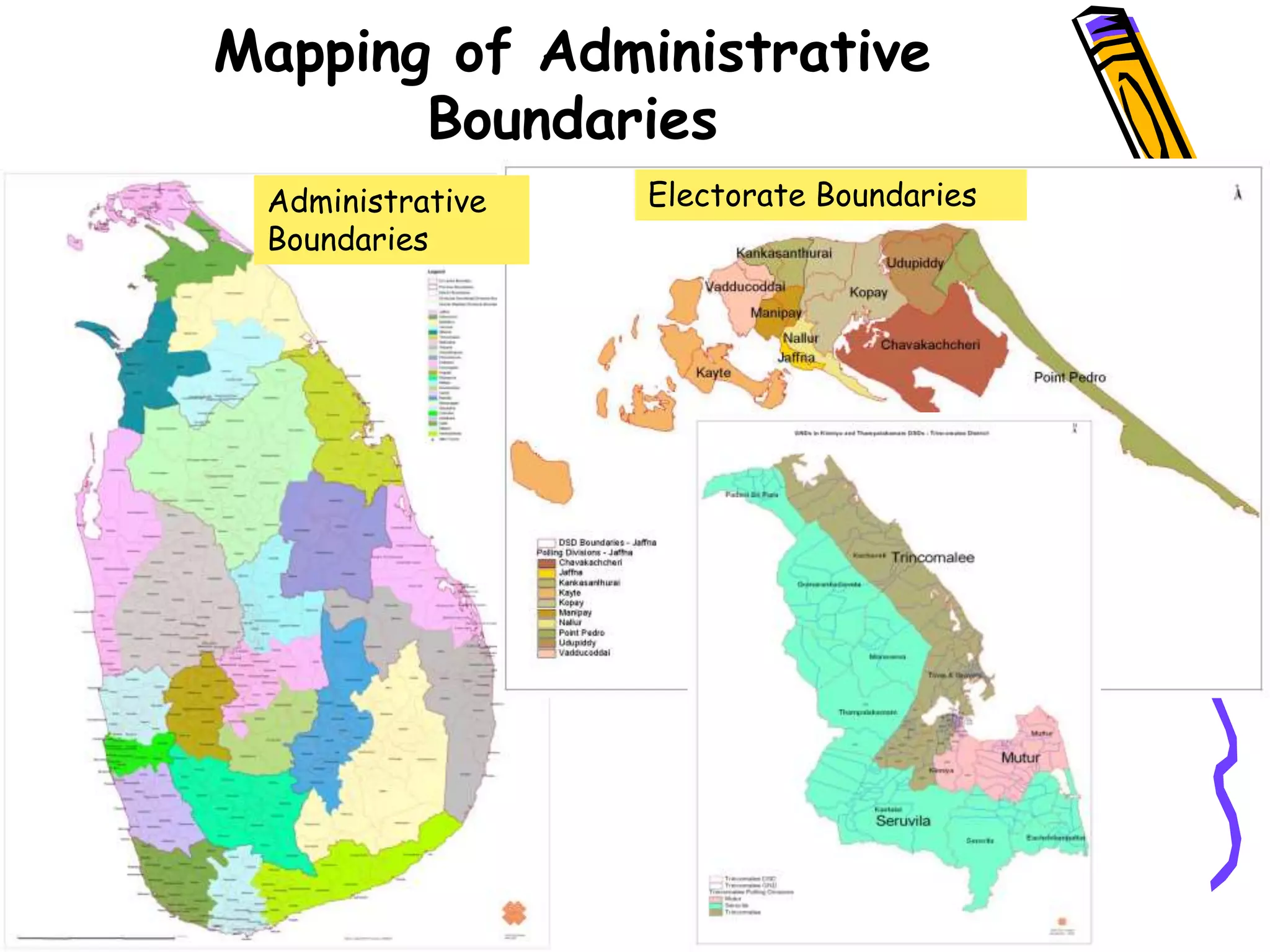
Mapping of Administrative
Boundaries
Electorate BoundariesAdministrative
Boundaries
Delineating of Environmental
Sensitive Areas
Criteria Used
1. All Water Bodies, for Rivers 60 buffer
2. All paddy and inland wetlands
3. All Roads
4. Archaeological Places, 400 metre buffer
5. All forests, Sanctuaries, national Parks
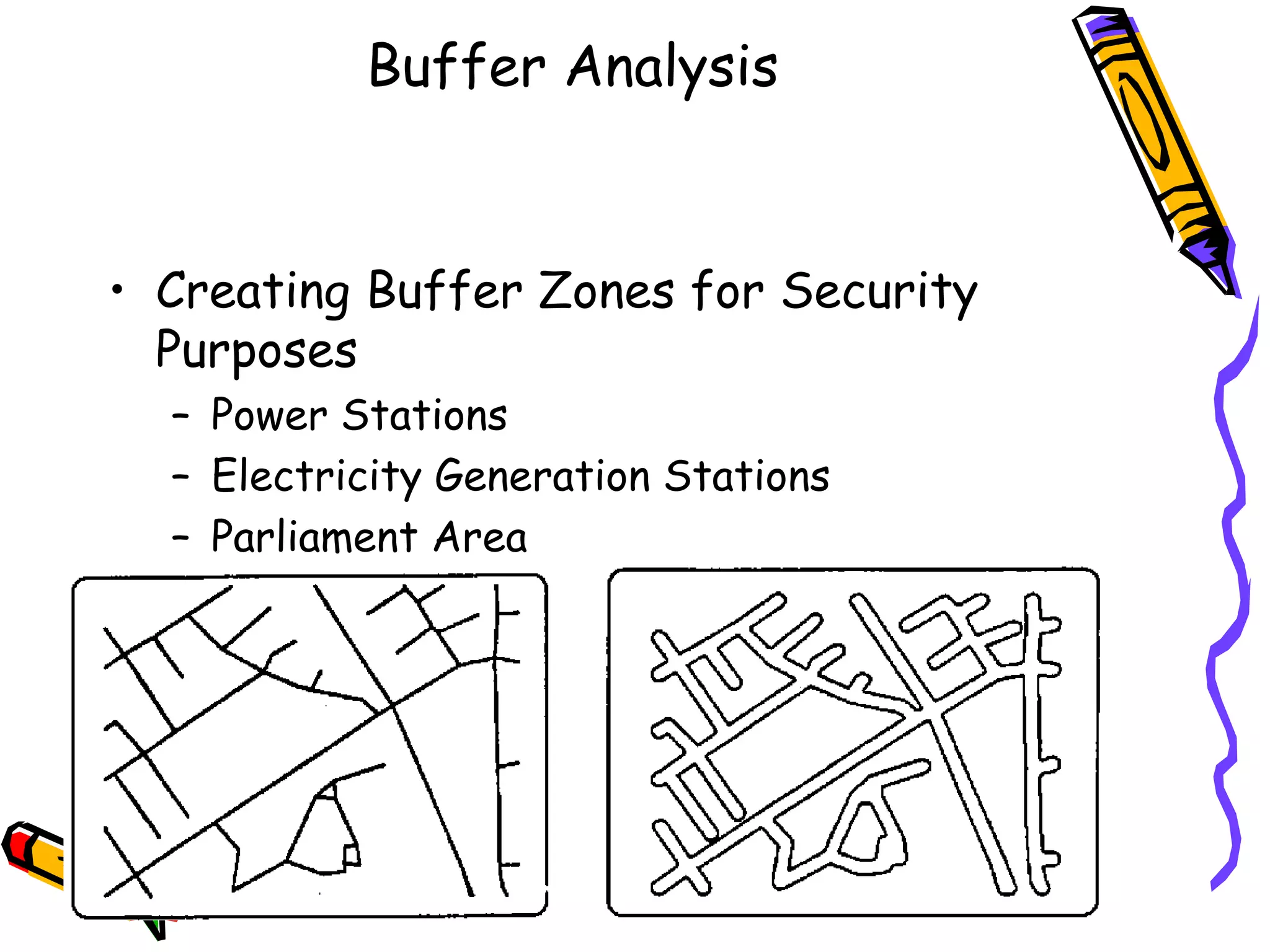
Buffer Analysis
• Creating Buffer Zones for Security
Purposes
– Power Stations
– Electricity Generation Stations
– Parliament Area
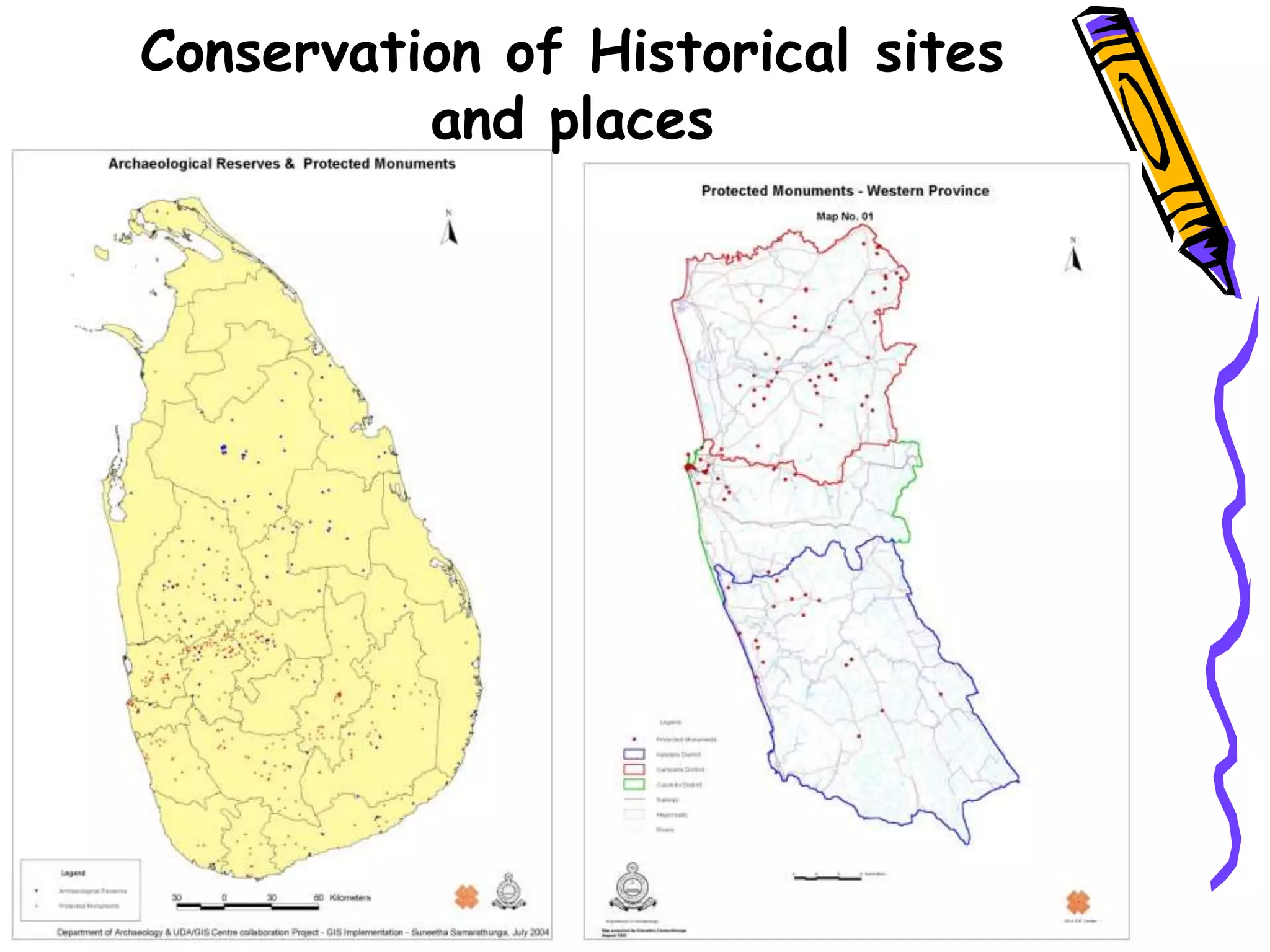
Conservation of Historical sites
and places
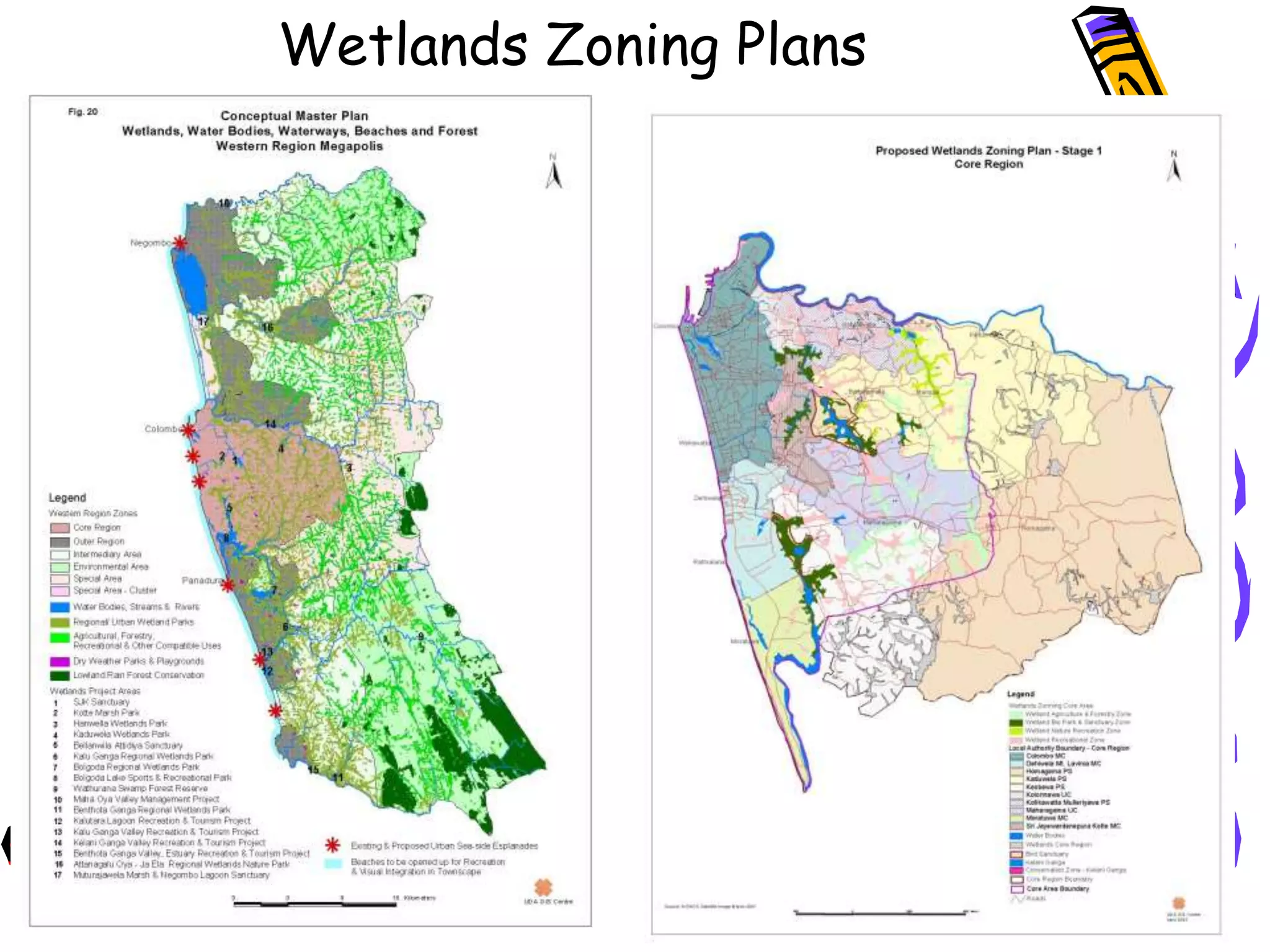
Wetlands Zoning Plans
Water Demand & Supply analysis
Road Network Analysis
Monitoring Land Use changes
Land Information Database
State Lands Mapping
Prototype Applications
• E-plan for DMMC Area
• Land Clearance System for CMC Area
Land Clearance System
City of Colombo
Data Base - Attribute Data
Land Parcels; Assessment Number, Access Road Name &
Width, Extent, Plot Coverage (Residential & Non-
Residential)
Buildings; Building Height, Age, No of Floors, Tenancy
Type, Usage, Ground Floor Area, Other Floor Area,
Total Floor Area, Preserved Buildings
Zone 2010; Zone Name, Maximum Plot Size, Minimum No
of Floors, Maximum no of Floors
Permissible Activities; Activity Name, Maximum Floor
Area, Minimum Site Extent
Spatial Data
Land Parcels Layer
Building Layer
Zone 2010 Layer
• Database Development &
Georeference
GIS Development
The MOSAIC of Scanned Images
• Database 3 Layers with
Attribute Tables
– Land Parcels
– Buildings
– Zone 2010
• Management Information
• Regulation Checks
– Check Location
– Check Zone
– Check Extent
– Check Building Details
Database Check
Land Parcels Layer
King’s
Court
BMICH
Irrigation Dept
Torrington
Flat
Police
Park
Land Parcels Attributes Table
Buildings Layer
Police
Park
BMICH
Church
Sirimavo
Bandaranayake
Vidiyalaya Jawatta
Cemetery
Torrington
Flats
Buildings Attributes Table
Zone-2010
Layer
Tsunami Mapping
In short, a GIS does
not hold maps or
pictures -- it holds a
database from which
the data can be
viewed in a new light.
Thank You

Gis in urban

  • 1.
    GIS in UrbanPlanning Dilhan
  • 2.
    Definition • Urban Planning –Urban • An Area with a relatively high population density that contains a set of closely related activities. – Planning • A Management Tool in the sense of setting objectives and targets for production. – Urban Planning • Decision Making for the allocation of Land Uses in a system where the Market is the primary mode.
  • 3.
    Definitions • Geographic InformationSystem (GIS) A GIS is a computer based information system capable of assembling, storing, manipulating and displaying geographically referenced information.
  • 4.
    A computer system whichcan hold and use data describing places on the earth's surface.
  • 5.
    • A GISis a database for spatial data • A GIS stores its data in layers • Each layer consists of a map plus a table of attribute data How does GIS looks like?
  • 6.
    GIS Capabilities • Topologicalmap overlay • Buffer generation • Proximity analysis • Spatial data management • LocationAllocation modeling • Network analysis • Sophisticated tabular analysis • Cartography and mapping • Report generation
  • 7.
    GIS & RSApplications in Urban Planning Urban Development Authority
  • 8.
    • The UrbanPlanning is a complex phenomenon which requires enormous amount of data to support the decision. Our normal practice is to keep data in file format sometime in loose papers. After several years, nobody knows where the data was, how they analyze, and when it was. • Our urban areas are growing rapidly and therefore need to be planned and adequately serviced to avoid problems associated with unplanned and adhoc growth. • Planning so far has been a time consuming activity and by the time plan is prepared it would be outdated. A part of the delay can be attributed to the current status of data such as outdated maps, lack of information, etc. data collection procedures, and analysis and techniques used to prepare plans. • Another very important aspect with the current methods is that it is not easy to make rational and informed planning decisions. Hence there is need for tools and techniques that enable rapid planning and enable taking rational and informed planning decisions. This is ultimately, lead to plans that are better and implementable.
  • 9.
    • The innovativetechnologies make easy to planners to experiment and select best alternatives for their urban development proposals. • Satellite Images and use of Geographic Information Systems (GIS) are example of such tools that facilitate preparation of rapid, comprehensive, rational, and implementable plans. • The capability of GIS and RS is tremendous. But the problem is, with those technologies, are we ready to change the physical formation of the city?, • Specially, in Sri Lanka Urban development takes place in adhoc manner. All resources are centered to the wet zone and we do not consider other zone’s potential. • Why this has happened? • We do not have proper guidance on urban development. The best example we have experienced was Tsunami devastation and others are flooding and land sliding.
  • 10.
    • The GISCentre of the Urban Development Authority has identified and recognized this gap. • Now we focus our attention more usage of RS and GIS capabilities to the planning processes. • How do we develop Land Use Database? • A very detailed and systematic land use survey was carried out for the built area in the relevant Local authority area. • There were various layers of information to be represented such as major land use, land use by floor, intensity of development for each plot and building types. • A GIS environment was required to reflect and represent such a wide range of information, which was not possible through the Autocad. • Further, by attaching a database of varied information to the map, it was possible to carry out several types of spatial analysis, to support land use planning decisions.
  • 11.
    • How dowe identify Potential Areas for Future Development/Urbanizable Zones? • The most important application of the satellite images was the mapping of the development sprawl. It gave an indication of the growth directions. • We compare two satellite images in two different years and mapped all changes. It also became evident for the first time that the town had doubled in size and that most of the development activities had already occurred outside of the LA boundary. • This has tremendous implication on provision of infrastructure. E.g. Battaramulla Ps area, • Therefore, it is essential to identify an urbanized zone and plan for infrastructure in this area in the near future to avoid problems of adhoc and unplanned growth.
  • 12.
    How do weuse satellite images for updating the Road net work? The satellite images were used for updating the existing road net work in terms of , •correcting the existing road alignment, •correcting the railway line alignment, •updating the old map by picking up the new or missing roads, adding under construction roads, •new roads and alternative proposals, •demolishing buildings, •identifying alternative lands for affected people, •save as much as natural resources such as paddy lands, marsh, inland wetlands etc. •Conservation of Water bodies,
  • 13.
    • The Satelliteimages were used for, • Inventory of functioning tanks or water areas and feeder channels, • Inventory of dried up or encroach water bodies and nature of encroachment, • Delineating conservation zones around the water bodies • Developing groups of water bodies as open spaces with recreational activities, • Up gradation of waste lands and scrubs. • Demarcation of “No Development Area”,
  • 14.
    1. Mapping ofAdministrative Boundaries, 2. Delineating of Environmental Sensitive and Fragile Areas, 3. Conservation of Archaeological and Historical Monuments, 4. Preparation of Land Use Plans & Zoning Plans, 5. Water Demand & supply Analysis, 6. Traffic Analysis, 7. Road Network Analysis GIS & RS application in Urban Planning
  • 15.
    Contd. 8. Monitoring TemporalChanges – Weather changes, – Urban growth, Land use changes, 9. Prototyping of Routing Work – Process of Building plan approval – Process of Change of use of building – Process of Tax and rental collection etc. 10. Assessing physical transformation of cities, 11. Land suitability modeling,
  • 16.
    12. Disaster Management,e.g. Fire, Land slides, Floods, Drought etc. 13. Terrain Modeling, Slope angles, 14. Delineation and incorporation of socio-infrastructure databases, 15. Urban Information Systems, Database Management Systems, Spatial data, Data reference to the earth, e.g. Land Information System, Non-Spatial data, e.g.. Socio – economic data, Population, housing, income, infrastructures etc. • Tsunami & Hazard Mapping, • 3D Modeling
  • 17.
    Mapping of Administrative Boundaries ElectorateBoundariesAdministrative Boundaries
  • 18.
    Delineating of Environmental SensitiveAreas Criteria Used 1. All Water Bodies, for Rivers 60 buffer 2. All paddy and inland wetlands 3. All Roads 4. Archaeological Places, 400 metre buffer 5. All forests, Sanctuaries, national Parks
  • 19.
    Buffer Analysis • CreatingBuffer Zones for Security Purposes – Power Stations – Electricity Generation Stations – Parliament Area
  • 20.
  • 21.
  • 22.
    Water Demand &Supply analysis
  • 23.
  • 25.
  • 26.
  • 27.
    Prototype Applications • E-planfor DMMC Area • Land Clearance System for CMC Area
  • 28.
    Land Clearance System Cityof Colombo Data Base - Attribute Data Land Parcels; Assessment Number, Access Road Name & Width, Extent, Plot Coverage (Residential & Non- Residential) Buildings; Building Height, Age, No of Floors, Tenancy Type, Usage, Ground Floor Area, Other Floor Area, Total Floor Area, Preserved Buildings Zone 2010; Zone Name, Maximum Plot Size, Minimum No of Floors, Maximum no of Floors Permissible Activities; Activity Name, Maximum Floor Area, Minimum Site Extent Spatial Data Land Parcels Layer Building Layer Zone 2010 Layer
  • 29.
    • Database Development& Georeference GIS Development The MOSAIC of Scanned Images
  • 30.
    • Database 3Layers with Attribute Tables – Land Parcels – Buildings – Zone 2010 • Management Information • Regulation Checks – Check Location – Check Zone – Check Extent – Check Building Details Database Check
  • 31.
  • 32.
  • 33.
  • 34.
  • 35.
  • 36.
  • 38.
    In short, aGIS does not hold maps or pictures -- it holds a database from which the data can be viewed in a new light.
  • 39.