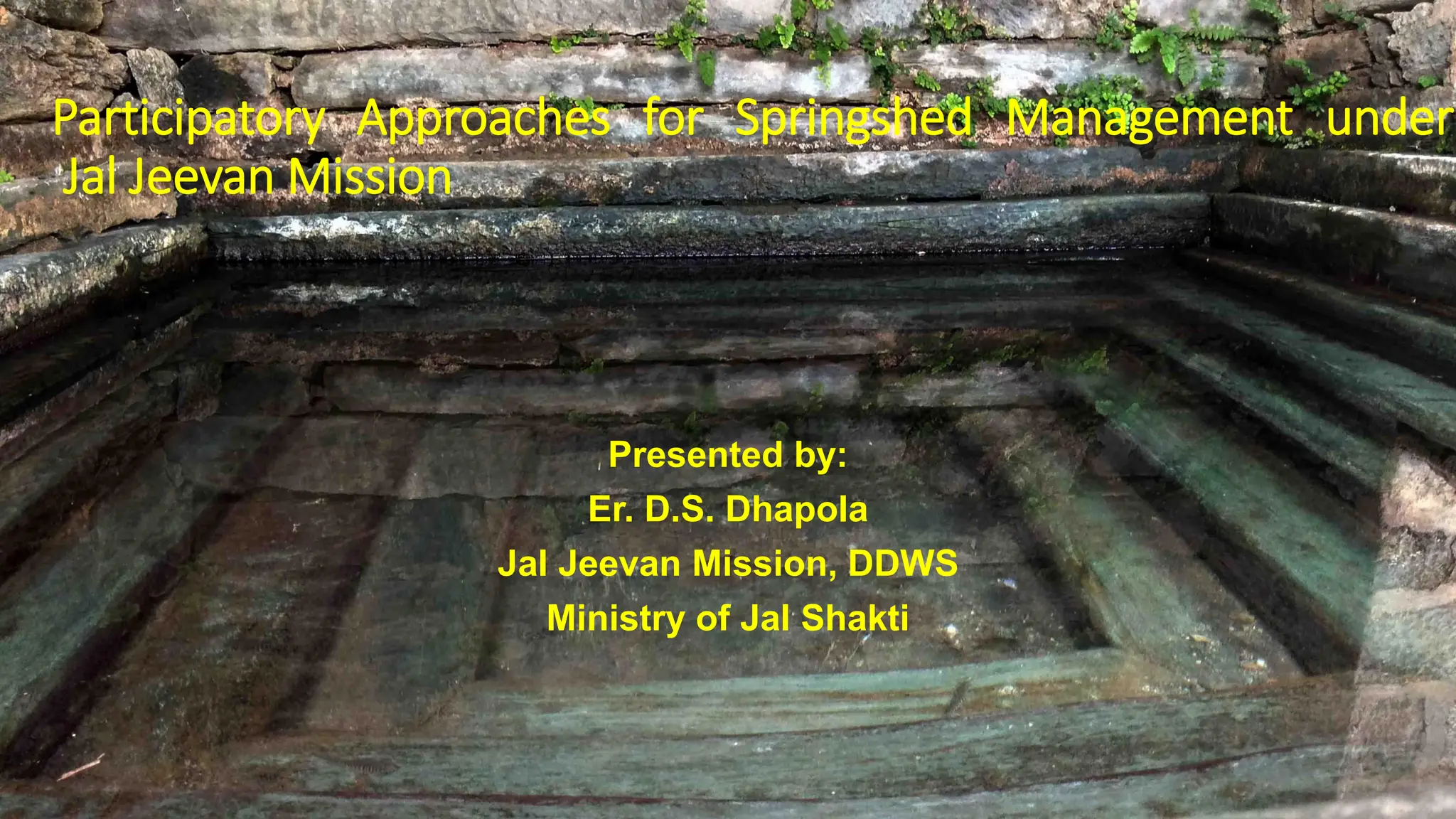
Participatory Approaches for Springshed Management under
Jal Jeevan Mission
Presented by:
Er. D.S. Dhapola
Jal Jeevan Mission, DDWS
Ministry of Jal Shakti
Springs & Springshed
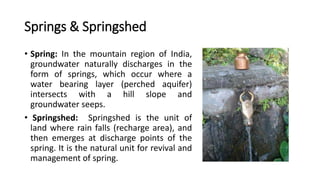
• Spring: In the mountain region of India,
groundwater naturally discharges in the
form of springs, which occur where a
water bearing layer (perched aquifer)
intersects with a hill slope and
groundwater seeps.
• Springshed: Springshed is the unit of
land where rain falls (recharge area), and
then emerges at discharge points of the
spring. It is the natural unit for revival and
management of spring.
Importance of Springs in India
• Springs have provided water to the mountain communities for
centuries and the revival of this traditional source of water is
extremely important for the region's sustainable growth.
• Springs are the main source of water for millions of people in the
mountainous region of India.
• At a larger national scale, a gross estimate of nearly 200 million
Indians depending upon spring water across the Himalayas, Western
Ghats, Eastern Ghats, Aravallis and other such mountain ranges -
implies that more than 15% of India's population depends on spring
water. (Niti Ayog).
Challenges
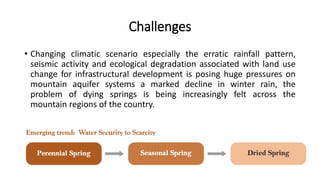
• Changing climatic scenario especially the erratic rainfall pattern,
seismic activity and ecological degradation associated with land use
change for infrastructural development is posing huge pressures on
mountain aquifer systems a marked decline in winter rain, the
problem of dying springs is being increasingly felt across the
mountain regions of the country.
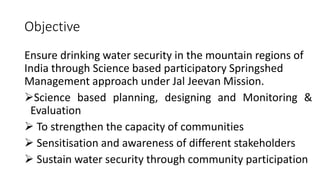
Objective
Ensure drinking water security in the mountain regions of
India through Science based participatory Springshed
Management approach under Jal Jeevan Mission.
Science based planning, designing and Monitoring &
Evaluation
 To strengthen the capacity of communities
 Sensitisation and awareness of different stakeholders
 Sustain water security through community participation
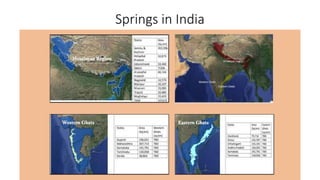
Springs in India
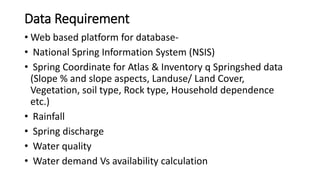
Data Requirement
• Web based platform for database-
• National Spring Information System (NSIS)
• Spring Coordinate for Atlas & Inventory q Springshed data
(Slope % and slope aspects, Landuse/ Land Cover,
Vegetation, soil type, Rock type, Household dependence
etc.)
• Rainfall
• Spring discharge
• Water quality
• Water demand Vs availability calculation
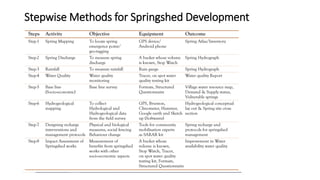
Stepwise Methods for Springshed Development
Traditional water Wisdom
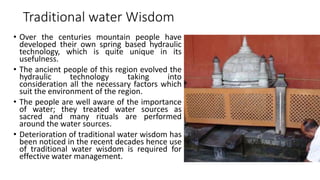
• Over the centuries mountain people have
developed their own spring based hydraulic
technology, which is quite unique in its
usefulness.
• The ancient people of this region evolved the
hydraulic technology taking into
consideration all the necessary factors which
suit the environment of the region.
• The people are well aware of the importance
of water; they treated water sources as
sacred and many rituals are performed
around the water sources.
• Deterioration of traditional water wisdom has
been noticed in the recent decades hence use
of traditional water wisdom is required for
effective water management.
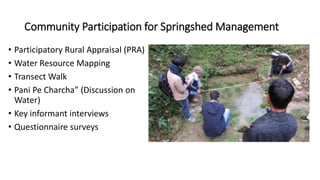
Community Participation for Springshed Management
• Participatory Rural Appraisal (PRA)
• Water Resource Mapping
• Transect Walk
• Pani Pe Charcha” (Discussion on
Water)
• Key informant interviews
• Questionnaire surveys
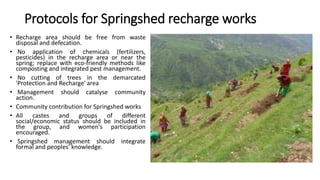
Protocols for Springshed recharge works
• Recharge area should be free from waste
disposal and defecation.
• No application of chemicals (fertilizers,
pesticides) in the recharge area or near the
spring; replace with eco-friendly methods like
composting and integrated pest management.
• No cutting of trees in the demarcated
'Protection and Recharge' area
• Management should catalyse community
action.
• Community contribution for Springshed works
• All castes and groups of different
social/economic status should be included in
the group, and women's participation
encouraged.
• Springshed management should integrate
formal and peoples' knowledge.
Decentralized water governance for sustainable water
management
 Village Water Security Plans (VWSPs) preparation.
 All water management works should be implemented through VWSC which is a sub-committee of Gram
Panchayat.
 Awareness and Behaviour change communications will be done through Implementation Support Agencies
at village level.
 A group of capable people/ para-workers will be developed who will manage their Springsheds on their own
in the long and also ensure social responsibility.
 A community fund should be established with a nominal monetary contribution from each household. This is
important to ensure that the recurrent costs for maintenance and management of springs and recharge
structures can be covered in a sustainable manner.
 District Water and Sanitation Mission (DWSM) will help in formation of sub-committee of Gram Panchayats,
i.e. VWSCs/ Paani Samitis/ User Groups, etc. and handhold to ensure implementation of Springshed
management.
 District Water and Sanitation Mission (DWSM) will identify Implementation Support Agencies (ISA) and
individuals to be trained as master trainers at State level who will in-turn build capacities of Gram Panchayat
and/ or its subcommittee, i.e. VWSC/ Paani Samiti/ User Group, etc.
Thank You

Session_4_Springshed_For_india_Management.pdf

  • 1.
    Participatory Approaches forSpringshed Management under Jal Jeevan Mission Presented by: Er. D.S. Dhapola Jal Jeevan Mission, DDWS Ministry of Jal Shakti
  • 2.
    Springs & Springshed •Spring: In the mountain region of India, groundwater naturally discharges in the form of springs, which occur where a water bearing layer (perched aquifer) intersects with a hill slope and groundwater seeps. • Springshed: Springshed is the unit of land where rain falls (recharge area), and then emerges at discharge points of the spring. It is the natural unit for revival and management of spring.
  • 3.
    Importance of Springsin India • Springs have provided water to the mountain communities for centuries and the revival of this traditional source of water is extremely important for the region's sustainable growth. • Springs are the main source of water for millions of people in the mountainous region of India. • At a larger national scale, a gross estimate of nearly 200 million Indians depending upon spring water across the Himalayas, Western Ghats, Eastern Ghats, Aravallis and other such mountain ranges - implies that more than 15% of India's population depends on spring water. (Niti Ayog).
  • 4.
    Challenges • Changing climaticscenario especially the erratic rainfall pattern, seismic activity and ecological degradation associated with land use change for infrastructural development is posing huge pressures on mountain aquifer systems a marked decline in winter rain, the problem of dying springs is being increasingly felt across the mountain regions of the country.
  • 5.
    Objective Ensure drinking watersecurity in the mountain regions of India through Science based participatory Springshed Management approach under Jal Jeevan Mission. Science based planning, designing and Monitoring & Evaluation  To strengthen the capacity of communities  Sensitisation and awareness of different stakeholders  Sustain water security through community participation
  • 6.
  • 7.
    Data Requirement • Webbased platform for database- • National Spring Information System (NSIS) • Spring Coordinate for Atlas & Inventory q Springshed data (Slope % and slope aspects, Landuse/ Land Cover, Vegetation, soil type, Rock type, Household dependence etc.) • Rainfall • Spring discharge • Water quality • Water demand Vs availability calculation
  • 8.
    Stepwise Methods forSpringshed Development
  • 9.
    Traditional water Wisdom •Over the centuries mountain people have developed their own spring based hydraulic technology, which is quite unique in its usefulness. • The ancient people of this region evolved the hydraulic technology taking into consideration all the necessary factors which suit the environment of the region. • The people are well aware of the importance of water; they treated water sources as sacred and many rituals are performed around the water sources. • Deterioration of traditional water wisdom has been noticed in the recent decades hence use of traditional water wisdom is required for effective water management.
  • 10.
    Community Participation forSpringshed Management • Participatory Rural Appraisal (PRA) • Water Resource Mapping • Transect Walk • Pani Pe Charcha” (Discussion on Water) • Key informant interviews • Questionnaire surveys
  • 11.
    Protocols for Springshedrecharge works • Recharge area should be free from waste disposal and defecation. • No application of chemicals (fertilizers, pesticides) in the recharge area or near the spring; replace with eco-friendly methods like composting and integrated pest management. • No cutting of trees in the demarcated 'Protection and Recharge' area • Management should catalyse community action. • Community contribution for Springshed works • All castes and groups of different social/economic status should be included in the group, and women's participation encouraged. • Springshed management should integrate formal and peoples' knowledge.
  • 12.
    Decentralized water governancefor sustainable water management  Village Water Security Plans (VWSPs) preparation.  All water management works should be implemented through VWSC which is a sub-committee of Gram Panchayat.  Awareness and Behaviour change communications will be done through Implementation Support Agencies at village level.  A group of capable people/ para-workers will be developed who will manage their Springsheds on their own in the long and also ensure social responsibility.  A community fund should be established with a nominal monetary contribution from each household. This is important to ensure that the recurrent costs for maintenance and management of springs and recharge structures can be covered in a sustainable manner.  District Water and Sanitation Mission (DWSM) will help in formation of sub-committee of Gram Panchayats, i.e. VWSCs/ Paani Samitis/ User Groups, etc. and handhold to ensure implementation of Springshed management.  District Water and Sanitation Mission (DWSM) will identify Implementation Support Agencies (ISA) and individuals to be trained as master trainers at State level who will in-turn build capacities of Gram Panchayat and/ or its subcommittee, i.e. VWSC/ Paani Samiti/ User Group, etc.
  • 13.