WATER RESOURCES
DEVELOPMENT IN INDIA
- An Overview
by
R. JEYASEELAN
CHAIRMAN, CENTRAL WATER COMMISSION
 The Resource
 Achievements
 Future Scenario
 Actions Needed
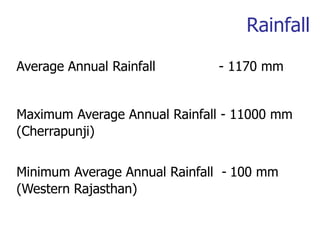
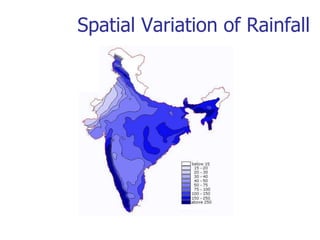
Rainfall
Average Annual Rainfall - 1170 mm
Maximum Average Annual Rainfall - 11000 mm
(Cherrapunji)
Minimum Average Annual Rainfall - 100 mm
(Western Rajasthan)
Spatial Variation of Rainfall
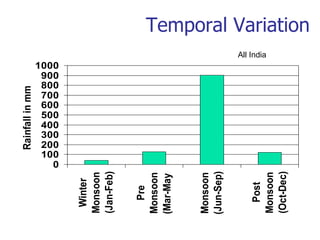
Temporal Variation
0
100
200
300
400
500
600
700
800
900
1000
Winter
Monsoon
(Jan-Feb)
Pre
Monsoon
(Mar-May
Monsoon
(Jun-Sep)
Post
Monsoon
(Oct-Dec)
Rainfallinmm
All India
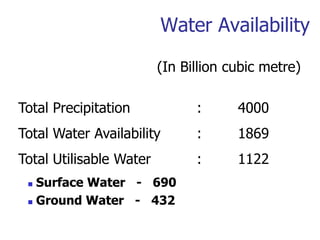
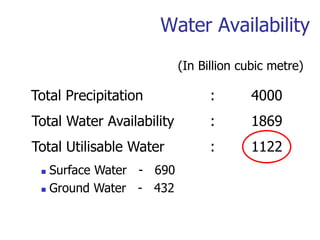
Water Availability
(In Billion cubic metre)
Total Precipitation : 4000
Total Water Availability : 1869
Total Utilisable Water : 1122
 Surface Water - 690
 Ground Water - 432
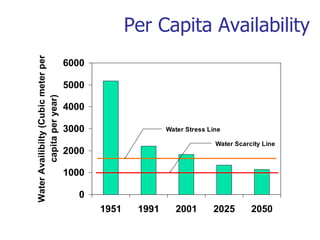
Per Capita Availability
0
1000
2000
3000
4000
5000
6000
1951 1991 2001 2025 2050
WaterAvailibilty(Cubicmeterper
capitaperyear)
Water Stress Line
Water Scarcity Line
Achievements
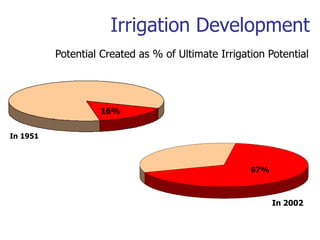
Irrigation Development
In 1951
16%
In 2002
67%
Potential Created as % of Ultimate Irrigation Potential
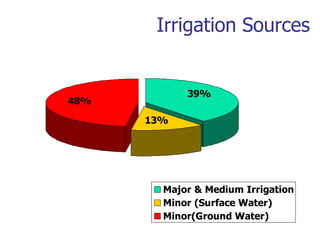
Irrigation Sources
39%
13%
48%
Major & Medium Irrigation
Minor (Surface Water)
Minor(Ground Water)
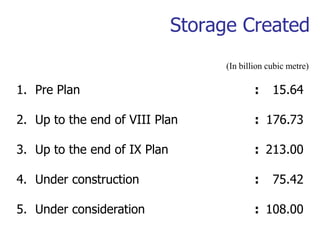
Storage Created
1. Pre Plan : 15.64
2. Up to the end of VIII Plan : 176.73
3. Up to the end of IX Plan : 213.00
4. Under construction : 75.42
5. Under consideration : 108.00
(In billion cubic metre)
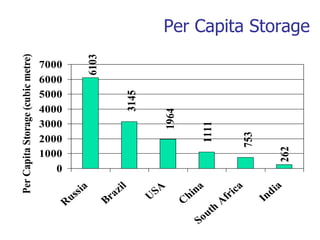
Per Capita Storage
262
753
1111
1964
3145
6103
0
1000
2000
3000
4000
5000
6000
7000
Russia
Brazil
USA
China
South
Africa
India
PerCapitaStorage(cubicmetre)
Future Scenario
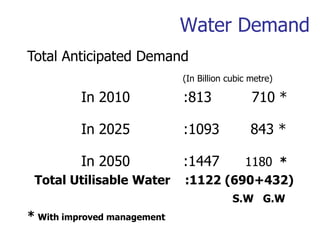
Water Demand
Total Anticipated Demand
(In Billion cubic metre)
In 2010 :813 710 *
In 2025 :1093 843 *
In 2050 :1447 1180 *
Total Utilisable Water :1122 (690+432)
S.W G.W
* With improved management
Water Availability
(In Billion cubic metre)
Total Precipitation : 4000
Total Water Availability : 1869
Total Utilisable Water : 1122
 Surface Water - 690
 Ground Water - 432
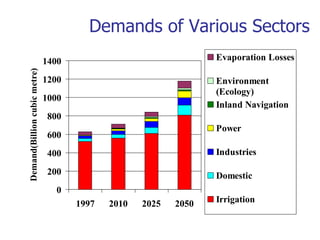
Demands of Various Sectors
0
200
400
600
800
1000
1200
1400
1997 2010 2025 2050
Demand(Billioncubicmetre)
Evaporation Losses
Environment
(Ecology)
Inland Navigation
Power
Industries
Domestic
Irrigation
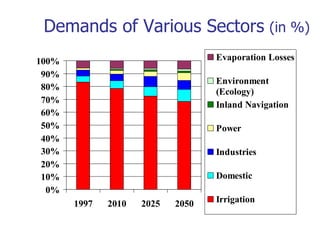
Demands of Various Sectors (in %)
0%
10%
20%
30%
40%
50%
60%
70%
80%
90%
100%
1997 2010 2025 2050
Evaporation Losses
Environment
(Ecology)
Inland Navigation
Power
Industries
Domestic
Irrigation
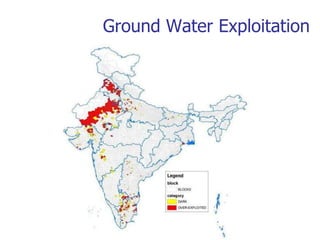
Ground Water Exploitation
Goal
 Pace of development to match with
increasing water demands
 Adoption of better management
practices
Development & Management
Integrated approach with due
consideration to major, medium, minor
(both surface and ground water)
schemes as well as traditional system of
water conservation
Efficient Use of Water
 Optimal water utilization
 Minimization of water losses
People’s Participation
 Awareness of scarcity value of water
 Promotion of water conservation
 Involvement of beneficiaries & other
stakeholders in project planning & at
subsequent stages of development
 Participatory approach in management of water
resources for diverse uses
Objectives
 Better understanding of issues
 Bringing about consensus
 Adopting the best suited approach
The Gap
Availability and Utilization
Potential - Created and Utilized
Demand and Availability
Availability and Utilization
Excessive utilization of surface water
 Water logging problems
 Salinity problems
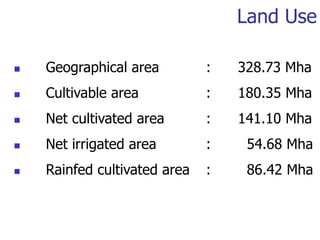
Land Use
 Geographical area : 328.73 Mha
 Cultivable area : 180.35 Mha
 Net cultivated area : 141.10 Mha
 Net irrigated area : 54.68 Mha
 Rainfed cultivated area : 86.42 Mha
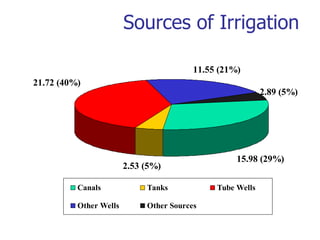
Sources of Irrigation
2.89 (5%)
2.53 (5%)
11.55 (21%)
15.98 (29%)
21.72 (40%)
Canals Tanks Tube Wells
Other Wells Other Sources
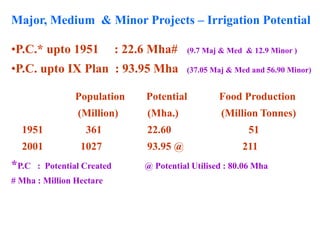
Major, Medium & Minor Projects – Irrigation Potential
•P.C.* upto 1951 : 22.6 Mha# (9.7 Maj & Med & 12.9 Minor )
•P.C. upto IX Plan : 93.95 Mha (37.05 Maj & Med and 56.90 Minor)
Population Potential Food Production
(Million) (Mha.) (Million Tonnes)
1951 361 22.60 51
2001 1027 93.95 @ 211
*P.C : Potential Created @ Potential Utilised : 80.06 Mha
# Mha : Million Hectare
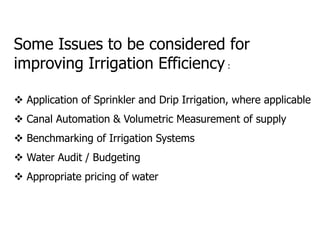
Some Issues to be considered for
improving Irrigation Efficiency :
 Application of Sprinkler and Drip Irrigation, where applicable
 Canal Automation & Volumetric Measurement of supply
 Benchmarking of Irrigation Systems
 Water Audit / Budgeting
 Appropriate pricing of water
Actions Needed
 Pace of water resources
development to match with the
increasing water demands
 Adoption of better management
practices
 Investigation and research for
sustainable utilization of more &
more available water
Efficient Utilization of
Water Resources
in Irrigation
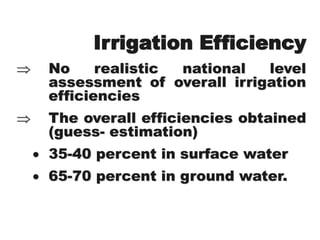
Irrigation Efficiency
 No realistic national level
assessment of overall irrigation
efficiencies
 The overall efficiencies obtained
(guess- estimation)
 35-40 percent in surface water
 65-70 percent in ground water.
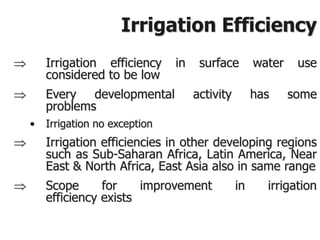
Irrigation Efficiency
 Irrigation efficiency in surface water use
considered to be low
 Every developmental activity has some
problems
• Irrigation no exception
 Irrigation efficiencies in other developing regions
such as Sub-Saharan Africa, Latin America, Near
East & North Africa, East Asia also in same range
 Scope for improvement in irrigation
efficiency exists
Reasons for low irrigation efficiencies
Main reasons for low efficiency:
 Excessive seepage loss
 Inefficient water management
• Lack of maintenance
- Inadequate funds
- Low water charges
• Inequitable and untimely supplies
- Lack of operation plan
- Over use of water by head reach farmers
- Shift towards high water consuming crops
 Lack of involvement of stakeholders
NATIONAL WATER POLICY-2002
WATER ALLOCATION PRIORITIES
 In the planning and operation of systems, water
allocation priorities should be broadly as follows:
 Drinking water
 Irrigation
 Hydro Power
 Ecology
 Agro-Industries and non-agricultural industries
 Navigation and Other Uses
However, the priorities could be modified or added
if warranted by the area/region specific
considerations.
CONSERVATION OF WATER
 Efficiency of utilisation in all the diverse uses of
water should be optimised and an awareness of
water as a scarce resource should be fostered.
 Conservation consciousness should be promoted
through education, regulation, incentives and
disincentives.
 The resources should be conserved and the
availability augmented by maximising retention,
eliminating pollution and minimising losses. For
this, measures like lining in the conveyance
system, modernization and rehabilitation of
existing systems , recycling and re-use of treated
effluents and techniques like drip and sprinkler
may be promoted.
PROJECT PLANNING
 There should be an integrated and multi-
disciplinary approach to the planning,
formulation, clearance and implementation of
projects, including catchment area treatment
and management, environmental and
ecological aspects, the rehabilitation of
affected people and command area
development.
 The drainage system should form an integral
part of any irrigation project right from the
planning stage.
 The involvement and participation of
beneficiaries and other stakeholders should be
encouraged right from the project planning
stage itself.
FINANCIAL AND PHYSICAL SUSTAINABILITY
 Besides creating additional water resources facilities
for various uses, adequate emphasis needs to be
given to the physical and financial sustainability of
existing facilities.
 There is a need to ensure that the water rates for
various uses should be fixed in such a way that they
cover at least the operation and maintenance
charges of providing the service initially and a part
of the capital costs subsequently.
 These rates should be linked directly to the quality
of service provided. The subsidy on water rates to
the disadvantaged and poorer sections of the
society should be well targeted and transparent.

Water resources in india

  • 1.
    WATER RESOURCES DEVELOPMENT ININDIA - An Overview by R. JEYASEELAN CHAIRMAN, CENTRAL WATER COMMISSION
  • 2.
     The Resource Achievements  Future Scenario  Actions Needed
  • 3.
    Rainfall Average Annual Rainfall- 1170 mm Maximum Average Annual Rainfall - 11000 mm (Cherrapunji) Minimum Average Annual Rainfall - 100 mm (Western Rajasthan)
  • 4.
  • 5.
  • 6.
    Water Availability (In Billioncubic metre) Total Precipitation : 4000 Total Water Availability : 1869 Total Utilisable Water : 1122  Surface Water - 690  Ground Water - 432
  • 7.
    Per Capita Availability 0 1000 2000 3000 4000 5000 6000 19511991 2001 2025 2050 WaterAvailibilty(Cubicmeterper capitaperyear) Water Stress Line Water Scarcity Line
  • 8.
  • 9.
    Irrigation Development In 1951 16% In2002 67% Potential Created as % of Ultimate Irrigation Potential
  • 10.
    Irrigation Sources 39% 13% 48% Major &Medium Irrigation Minor (Surface Water) Minor(Ground Water)
  • 11.
    Storage Created 1. PrePlan : 15.64 2. Up to the end of VIII Plan : 176.73 3. Up to the end of IX Plan : 213.00 4. Under construction : 75.42 5. Under consideration : 108.00 (In billion cubic metre)
  • 12.
  • 13.
  • 14.
    Water Demand Total AnticipatedDemand (In Billion cubic metre) In 2010 :813 710 * In 2025 :1093 843 * In 2050 :1447 1180 * Total Utilisable Water :1122 (690+432) S.W G.W * With improved management
  • 15.
    Water Availability (In Billioncubic metre) Total Precipitation : 4000 Total Water Availability : 1869 Total Utilisable Water : 1122  Surface Water - 690  Ground Water - 432
  • 16.
    Demands of VariousSectors 0 200 400 600 800 1000 1200 1400 1997 2010 2025 2050 Demand(Billioncubicmetre) Evaporation Losses Environment (Ecology) Inland Navigation Power Industries Domestic Irrigation
  • 17.
    Demands of VariousSectors (in %) 0% 10% 20% 30% 40% 50% 60% 70% 80% 90% 100% 1997 2010 2025 2050 Evaporation Losses Environment (Ecology) Inland Navigation Power Industries Domestic Irrigation
  • 18.
  • 19.
    Goal  Pace ofdevelopment to match with increasing water demands  Adoption of better management practices
  • 20.
    Development & Management Integratedapproach with due consideration to major, medium, minor (both surface and ground water) schemes as well as traditional system of water conservation
  • 21.
    Efficient Use ofWater  Optimal water utilization  Minimization of water losses
  • 22.
    People’s Participation  Awarenessof scarcity value of water  Promotion of water conservation  Involvement of beneficiaries & other stakeholders in project planning & at subsequent stages of development  Participatory approach in management of water resources for diverse uses
  • 23.
    Objectives  Better understandingof issues  Bringing about consensus  Adopting the best suited approach
  • 24.
    The Gap Availability andUtilization Potential - Created and Utilized Demand and Availability
  • 25.
    Availability and Utilization Excessiveutilization of surface water  Water logging problems  Salinity problems
  • 26.
    Land Use  Geographicalarea : 328.73 Mha  Cultivable area : 180.35 Mha  Net cultivated area : 141.10 Mha  Net irrigated area : 54.68 Mha  Rainfed cultivated area : 86.42 Mha
  • 27.
    Sources of Irrigation 2.89(5%) 2.53 (5%) 11.55 (21%) 15.98 (29%) 21.72 (40%) Canals Tanks Tube Wells Other Wells Other Sources
  • 28.
    Major, Medium &Minor Projects – Irrigation Potential •P.C.* upto 1951 : 22.6 Mha# (9.7 Maj & Med & 12.9 Minor ) •P.C. upto IX Plan : 93.95 Mha (37.05 Maj & Med and 56.90 Minor) Population Potential Food Production (Million) (Mha.) (Million Tonnes) 1951 361 22.60 51 2001 1027 93.95 @ 211 *P.C : Potential Created @ Potential Utilised : 80.06 Mha # Mha : Million Hectare
  • 29.
    Some Issues tobe considered for improving Irrigation Efficiency :  Application of Sprinkler and Drip Irrigation, where applicable  Canal Automation & Volumetric Measurement of supply  Benchmarking of Irrigation Systems  Water Audit / Budgeting  Appropriate pricing of water
  • 30.
    Actions Needed  Paceof water resources development to match with the increasing water demands  Adoption of better management practices  Investigation and research for sustainable utilization of more & more available water
  • 31.
    Efficient Utilization of WaterResources in Irrigation
  • 32.
    Irrigation Efficiency  Norealistic national level assessment of overall irrigation efficiencies  The overall efficiencies obtained (guess- estimation)  35-40 percent in surface water  65-70 percent in ground water.
  • 33.
    Irrigation Efficiency  Irrigationefficiency in surface water use considered to be low  Every developmental activity has some problems • Irrigation no exception  Irrigation efficiencies in other developing regions such as Sub-Saharan Africa, Latin America, Near East & North Africa, East Asia also in same range  Scope for improvement in irrigation efficiency exists
  • 34.
    Reasons for lowirrigation efficiencies Main reasons for low efficiency:  Excessive seepage loss  Inefficient water management • Lack of maintenance - Inadequate funds - Low water charges • Inequitable and untimely supplies - Lack of operation plan - Over use of water by head reach farmers - Shift towards high water consuming crops  Lack of involvement of stakeholders
  • 35.
    NATIONAL WATER POLICY-2002 WATERALLOCATION PRIORITIES  In the planning and operation of systems, water allocation priorities should be broadly as follows:  Drinking water  Irrigation  Hydro Power  Ecology  Agro-Industries and non-agricultural industries  Navigation and Other Uses However, the priorities could be modified or added if warranted by the area/region specific considerations.
  • 36.
    CONSERVATION OF WATER Efficiency of utilisation in all the diverse uses of water should be optimised and an awareness of water as a scarce resource should be fostered.  Conservation consciousness should be promoted through education, regulation, incentives and disincentives.  The resources should be conserved and the availability augmented by maximising retention, eliminating pollution and minimising losses. For this, measures like lining in the conveyance system, modernization and rehabilitation of existing systems , recycling and re-use of treated effluents and techniques like drip and sprinkler may be promoted.
  • 37.
    PROJECT PLANNING  Thereshould be an integrated and multi- disciplinary approach to the planning, formulation, clearance and implementation of projects, including catchment area treatment and management, environmental and ecological aspects, the rehabilitation of affected people and command area development.  The drainage system should form an integral part of any irrigation project right from the planning stage.  The involvement and participation of beneficiaries and other stakeholders should be encouraged right from the project planning stage itself.
  • 38.
    FINANCIAL AND PHYSICALSUSTAINABILITY  Besides creating additional water resources facilities for various uses, adequate emphasis needs to be given to the physical and financial sustainability of existing facilities.  There is a need to ensure that the water rates for various uses should be fixed in such a way that they cover at least the operation and maintenance charges of providing the service initially and a part of the capital costs subsequently.  These rates should be linked directly to the quality of service provided. The subsidy on water rates to the disadvantaged and poorer sections of the society should be well targeted and transparent.