


Computerized system
validation (CSV) as a
Requirement for Good
Manufacturing Practices
B.Sc. of special chemistry- Al-Azhar University.
M.Sc. of Environmental Chemistry – Ain Shams University.
Ph.D. of Inorganic and analytical chemistry. Suez Canal University-
Certified trainer in the Quality Management Systems field.
Member of the Arab Society for experts and Safety Professionals.
More than 16 years of experience in quality field.
QA Manager for MEVAC.
https://eg.linkedin.com/in/ahmed-hasham-mmba-01024b27
Target Audience
• IT Personnel and Managers
• Quality Personnel and Managers
• Auditors and Audit Managers
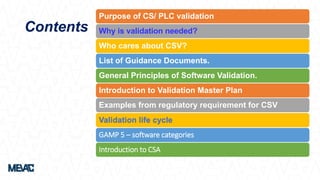
Purpose of CS/ PLC validation
Why is validation needed?
Who cares about CSV?
List of Guidance Documents.
General Principles of Software Validation.
Introduction to Validation Master Plan
Examples from regulatory requirement for CSV
Validation life cycle
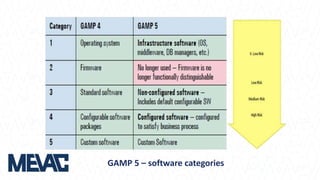
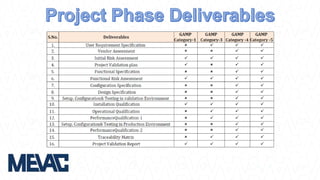
GAMP 5 – software categories
Introduction to CSA
Contents
GMP definition
• WHO defines Good Manufacturing Practices (GMP) as “that
part of quality assurance which ensures that products are
consistently produced and controlled to the quality standards
appropriate to their intended use and as required by the
marketing authorization.”
Validation definition
• Validation (USFDA) is defined as the establishing of
documented evidence which provides a high degree of assurance
that a planned process will consistently perform according to the
intended specified outcomes.
Software Validation definition
• Software Validation is a process of evaluating software product, so
as to ensure that the software meets the pre-defined and specified
business requirements as well as the end users/customers' demands
and expectations.
Purpose of CS/
PLC validation
• The purpose of the validation
process is to provide a high degree of
assurance that a specific process (or
in this case computer system) will
consistently produce a product
(control information's or data which
meets predetermined specifications
and quality attributes.
WHY IS VALIDATION NEEDED?
• To comply with the FDA regulations
• To avoid Failing an FDA audit which can result in FDA
inspectional observations (“483s”) and warning letters.
• Failure to take corrective action in a timely manner can result
in shutting down manufacturing facilities, and this will cause a
financial penalties.
Benefits of CSV conducting
Cost of compliance is low comparing with the cost of non- compliance .
Provides documentation required by FDA,EMEA, other regulatory agencies.
Maximizes the value of the computer system and the employees that use it.
Reduces labor costs by increasing employee's efficiency and effectiveness.
Saves money by discovering defects early
Reduces risk.
Promotes continual process improvement.
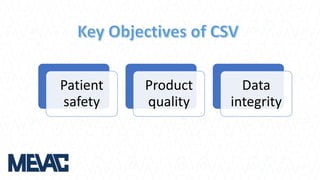
Patient
safety
Product
quality
Data
integrity
Who cares about CSV?
Resources involved in
any way with IT,
computer or automated
systems is affected:
§ Developers
§ Maintainers
§ Users
§ Regulatory Authorities
§ QA
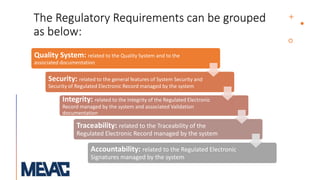
The Regulatory Requirements can be grouped
as below:
Quality System: related to the Quality System and to the
associated documentation
Security: related to the general features of System Security and
Security of Regulated Electronic Record managed by the system
Integrity: related to the Integrity of the Regulated Electronic
Record managed by the system and associated Validation
documentation
Traceability: related to the Traceability of the
Regulated Electronic Record managed by the system
Accountability: related to the Regulated Electronic
Signatures managed by the system
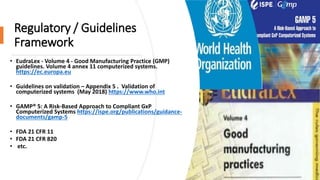
Regulatory / Guidelines
Framework
• EudraLex - Volume 4 - Good Manufacturing Practice (GMP)
guidelines. Volume 4 annex 11 computerized systems.
https://ec.europa.eu
• Guidelines on validation – Appendix 5 . Validation of
computerized systems (May 2018) https://www.who.int
• GAMP® 5: A Risk-Based Approach to Compliant GxP
Computerized Systems https://ispe.org/publications/guidance-
documents/gamp-5
• FDA 21 CFR 11
• FDA 21 CFR 820
• etc.
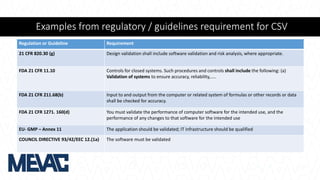
Examples from regulatory / guidelines requirement for CSV
Regulation or Guideline Requirement
21 CFR 820.30 (g) Design validation shall include software validation and risk analysis, where appropriate.
FDA 21 CFR 11.10 Controls for closed systems. Such procedures and controls shall include the following: (a)
Validation of systems to ensure accuracy, reliability,…..
FDA 21 CFR 211.68(b) Input to and output from the computer or related system of formulas or other records or data
shall be checked for accuracy.
FDA 21 CFR 1271. 160(d) You must validate the performance of computer software for the intended use, and the
performance of any changes to that software for the intended use
EU- GMP – Annex 11 The application should be validated; IT infrastructure should be qualified
COUNCIL DIRECTIVE 93/42/EEC 12.(1a) The software must be validated
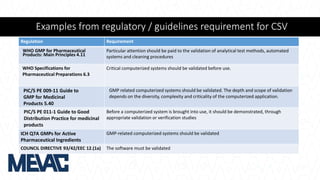
Examples from regulatory / guidelines requirement for CSV
Regulation Requirement
WHO GMP for Pharmaceutical
Products: Main Principles 4.11
Particular attention should be paid to the validation of analytical test methods, automated
systems and cleaning procedures
WHO Specifications for
Pharmaceutical Preparations 6.3
Critical computerized systems should be validated before use.
PIC/S PE 009‐11 Guide to
GMP for Medicinal
Products 5.40
GMP related computerized systems should be validated. The depth and scope of validation
depends on the diversity, complexity and criticality of the computerized application.
PIC/S PE 011‐1 Guide to Good
Distribution Practice for medicinal
products
Before a computerized system is brought into use, it should be demonstrated, through
appropriate validation or verification studies
ICH Q7A GMPs for Active
Pharmaceutical Ingredients
GMP-related computerized systems should be validated
COUNCIL DIRECTIVE 93/42/EEC 12.(1a) The software must be validated
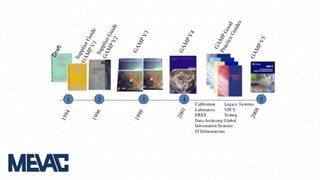
GAMP describes a set of principles and procedures
that help ensure that pharmaceutical Software have
required quality.
Computer system validation (CSV) following GAMP
guidelines require users and suppliers to work
together so that responsibilities regarding the
validation process are understood.
GAMP Aim
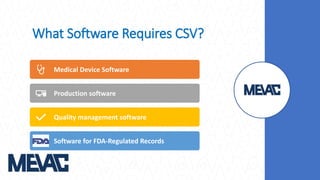
What Software Requires CSV?
Medical Device Software
Production software
Quality management software
Software for FDA-Regulated Records
Examples
for Quality
Management
Software
Change control software
Calibration Software
Document management
software
Deviation tracking software
CAPA tracking software
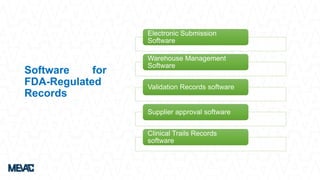
Software for
FDA-Regulated
Records
Electronic Submission
Software
Warehouse Management
Software
Validation Records software
Supplier approval software
Clinical Trails Records
software
It is necessary to
demonstrate that the
system "works well" ...
but how ?
• Software must be designed,
analyzed, built, released and
maintained according to a
predefined and documented
Quality System
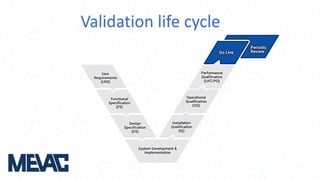
Validation life cycle
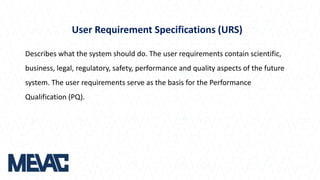
User Requirement Specifications (URS)
Describes what the system should do. The user requirements contain scientific,
business, legal, regulatory, safety, performance and quality aspects of the future
system. The user requirements serve as the basis for the Performance
Qualification (PQ).
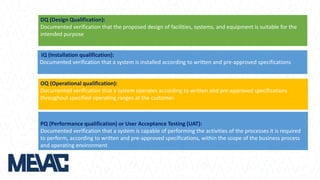
PQ (Performance qualification) or User Acceptance Testing (UAT):
Documented verification that a system is capable of performing the activities of the processes it is required
to perform, according to written and pre-approved specifications, within the scope of the business process
and operating environment
DQ (Design Qualification):
Documented verification that the proposed design of facilities, systems, and equipment is suitable for the
intended purpose
IQ (Installation qualification):
Documented verification that a system is installed according to written and pre-approved specifications
OQ (Operational qualification):
Documented verification that a system operates according to written and pre-approved specifications
throughout specified operating ranges at the customer.
GAMP 5 – software categories
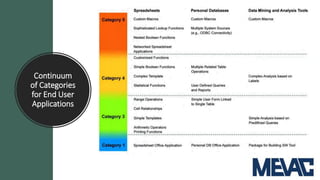
Continuum
of Categories
for End User
Applications
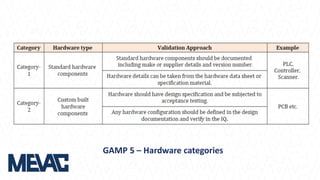
GAMP 5 – Hardware categories
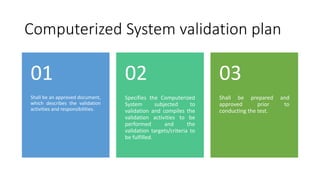
Computerized System validation plan
Shall be an approved document,
which describes the validation
activities and responsibilities.
01
Specifies the Computerized
System subjected to
validation and compiles the
validation activities to be
performed and the
validation targets/criteria to
be fulfilled.
02
Shall be prepared and
approved prior to
conducting the test.
03
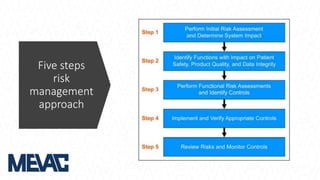
Five steps
risk
management
approach
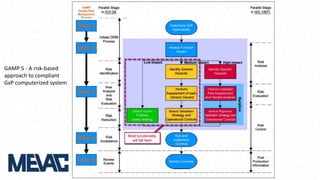
GAMP 5 - A risk-based
approach to compliant
GxP computerized system
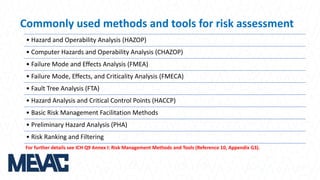
Commonly used methods and tools for risk assessment
• Hazard and Operability Analysis (HAZOP)
• Computer Hazards and Operability Analysis (CHAZOP)
• Failure Mode and Effects Analysis (FMEA)
• Failure Mode, Effects, and Criticality Analysis (FMECA)
• Fault Tree Analysis (FTA)
• Hazard Analysis and Critical Control Points (HACCP)
• Basic Risk Management Facilitation Methods
• Preliminary Hazard Analysis (PHA)
• Risk Ranking and Filtering
For further details see ICH Q9 Annex I: Risk Management Methods and Tools (Reference 10, Appendix G3).
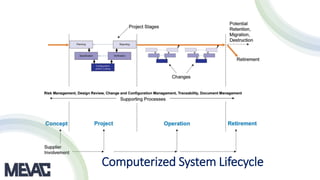
Computerized System Lifecycle
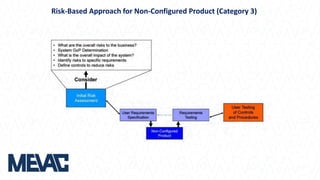
Risk-Based Approach for Non-Configured Product (Category 3)
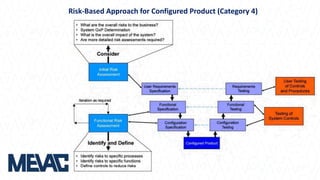
Risk-Based Approach for Configured Product (Category 4)
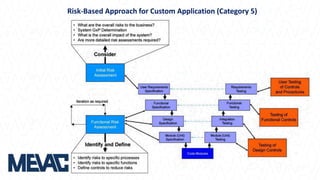
Risk-Based Approach for Custom Application (Category 5)
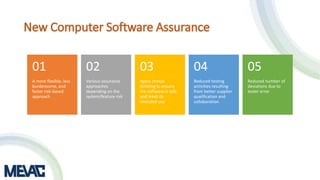
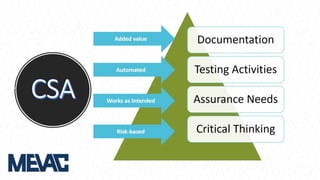
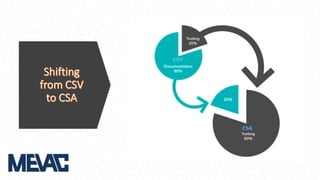
A more flexible, less
burdensome, and
faster risk-based
approach
01
Various assurance
approaches
depending on the
system/feature risk
02
Apply critical
thinking to ensure
the software is safe
and meet its
intended use
03
Reduced testing
activities resulting
from better supplier
qualification and
collaboration
04
Reduced number of
deviations due to
tester error
05
• This presentation provides a review of the CSV as a requirement of GMP and
CSA as a new approach for more practical software acceptance. It highlights the
common elements of CSV and CSA, explains their differences, explains the main
focus of CSA, and highlights how to achieve both, quality and compliance.
• We assume attendees are already aware with concepts like CSV and data
integrity.
1. There are many benefits to implement the CSV.
2. Companies must invest in improve the staff awareness
with the CSV and CSA.
3. CSA will replace CSV approach very soon.
Computerized system validation (CSV) as a requirement for good manufacturing practices (GMP)

Computerized system validation (CSV) as a requirement for good manufacturing practices (GMP)

  • 1.
    Computerized system validation (CSV)as a Requirement for Good Manufacturing Practices
  • 2.
    B.Sc. of specialchemistry- Al-Azhar University. M.Sc. of Environmental Chemistry – Ain Shams University. Ph.D. of Inorganic and analytical chemistry. Suez Canal University- Certified trainer in the Quality Management Systems field. Member of the Arab Society for experts and Safety Professionals. More than 16 years of experience in quality field. QA Manager for MEVAC. https://eg.linkedin.com/in/ahmed-hasham-mmba-01024b27
  • 3.
    Target Audience • ITPersonnel and Managers • Quality Personnel and Managers • Auditors and Audit Managers
  • 4.
    Purpose of CS/PLC validation Why is validation needed? Who cares about CSV? List of Guidance Documents. General Principles of Software Validation. Introduction to Validation Master Plan Examples from regulatory requirement for CSV Validation life cycle GAMP 5 – software categories Introduction to CSA Contents
  • 5.
    GMP definition • WHOdefines Good Manufacturing Practices (GMP) as “that part of quality assurance which ensures that products are consistently produced and controlled to the quality standards appropriate to their intended use and as required by the marketing authorization.”
  • 6.
    Validation definition • Validation(USFDA) is defined as the establishing of documented evidence which provides a high degree of assurance that a planned process will consistently perform according to the intended specified outcomes.
  • 7.
    Software Validation definition •Software Validation is a process of evaluating software product, so as to ensure that the software meets the pre-defined and specified business requirements as well as the end users/customers' demands and expectations.
  • 8.
    Purpose of CS/ PLCvalidation • The purpose of the validation process is to provide a high degree of assurance that a specific process (or in this case computer system) will consistently produce a product (control information's or data which meets predetermined specifications and quality attributes.
  • 9.
    WHY IS VALIDATIONNEEDED? • To comply with the FDA regulations • To avoid Failing an FDA audit which can result in FDA inspectional observations (“483s”) and warning letters. • Failure to take corrective action in a timely manner can result in shutting down manufacturing facilities, and this will cause a financial penalties.
  • 10.
    Benefits of CSVconducting Cost of compliance is low comparing with the cost of non- compliance . Provides documentation required by FDA,EMEA, other regulatory agencies. Maximizes the value of the computer system and the employees that use it. Reduces labor costs by increasing employee's efficiency and effectiveness. Saves money by discovering defects early Reduces risk. Promotes continual process improvement.
  • 11.
  • 12.
    Who cares aboutCSV? Resources involved in any way with IT, computer or automated systems is affected: § Developers § Maintainers § Users § Regulatory Authorities § QA
  • 13.
    The Regulatory Requirementscan be grouped as below: Quality System: related to the Quality System and to the associated documentation Security: related to the general features of System Security and Security of Regulated Electronic Record managed by the system Integrity: related to the Integrity of the Regulated Electronic Record managed by the system and associated Validation documentation Traceability: related to the Traceability of the Regulated Electronic Record managed by the system Accountability: related to the Regulated Electronic Signatures managed by the system
  • 14.
    Regulatory / Guidelines Framework •EudraLex - Volume 4 - Good Manufacturing Practice (GMP) guidelines. Volume 4 annex 11 computerized systems. https://ec.europa.eu • Guidelines on validation – Appendix 5 . Validation of computerized systems (May 2018) https://www.who.int • GAMP® 5: A Risk-Based Approach to Compliant GxP Computerized Systems https://ispe.org/publications/guidance- documents/gamp-5 • FDA 21 CFR 11 • FDA 21 CFR 820 • etc.
  • 15.
    Examples from regulatory/ guidelines requirement for CSV Regulation or Guideline Requirement 21 CFR 820.30 (g) Design validation shall include software validation and risk analysis, where appropriate. FDA 21 CFR 11.10 Controls for closed systems. Such procedures and controls shall include the following: (a) Validation of systems to ensure accuracy, reliability,….. FDA 21 CFR 211.68(b) Input to and output from the computer or related system of formulas or other records or data shall be checked for accuracy. FDA 21 CFR 1271. 160(d) You must validate the performance of computer software for the intended use, and the performance of any changes to that software for the intended use EU- GMP – Annex 11 The application should be validated; IT infrastructure should be qualified COUNCIL DIRECTIVE 93/42/EEC 12.(1a) The software must be validated
  • 16.
    Examples from regulatory/ guidelines requirement for CSV Regulation Requirement WHO GMP for Pharmaceutical Products: Main Principles 4.11 Particular attention should be paid to the validation of analytical test methods, automated systems and cleaning procedures WHO Specifications for Pharmaceutical Preparations 6.3 Critical computerized systems should be validated before use. PIC/S PE 009‐11 Guide to GMP for Medicinal Products 5.40 GMP related computerized systems should be validated. The depth and scope of validation depends on the diversity, complexity and criticality of the computerized application. PIC/S PE 011‐1 Guide to Good Distribution Practice for medicinal products Before a computerized system is brought into use, it should be demonstrated, through appropriate validation or verification studies ICH Q7A GMPs for Active Pharmaceutical Ingredients GMP-related computerized systems should be validated COUNCIL DIRECTIVE 93/42/EEC 12.(1a) The software must be validated
  • 18.
    GAMP describes aset of principles and procedures that help ensure that pharmaceutical Software have required quality. Computer system validation (CSV) following GAMP guidelines require users and suppliers to work together so that responsibilities regarding the validation process are understood. GAMP Aim
  • 19.
    What Software RequiresCSV? Medical Device Software Production software Quality management software Software for FDA-Regulated Records
  • 20.
    Examples for Quality Management Software Change controlsoftware Calibration Software Document management software Deviation tracking software CAPA tracking software
  • 21.
    Software for FDA-Regulated Records Electronic Submission Software WarehouseManagement Software Validation Records software Supplier approval software Clinical Trails Records software
  • 22.
    It is necessaryto demonstrate that the system "works well" ... but how ? • Software must be designed, analyzed, built, released and maintained according to a predefined and documented Quality System
  • 23.
  • 24.
    User Requirement Specifications(URS) Describes what the system should do. The user requirements contain scientific, business, legal, regulatory, safety, performance and quality aspects of the future system. The user requirements serve as the basis for the Performance Qualification (PQ).
  • 25.
    PQ (Performance qualification)or User Acceptance Testing (UAT): Documented verification that a system is capable of performing the activities of the processes it is required to perform, according to written and pre-approved specifications, within the scope of the business process and operating environment DQ (Design Qualification): Documented verification that the proposed design of facilities, systems, and equipment is suitable for the intended purpose IQ (Installation qualification): Documented verification that a system is installed according to written and pre-approved specifications OQ (Operational qualification): Documented verification that a system operates according to written and pre-approved specifications throughout specified operating ranges at the customer.
  • 26.
    GAMP 5 –software categories
  • 27.
  • 28.
    GAMP 5 –Hardware categories
  • 29.
    Computerized System validationplan Shall be an approved document, which describes the validation activities and responsibilities. 01 Specifies the Computerized System subjected to validation and compiles the validation activities to be performed and the validation targets/criteria to be fulfilled. 02 Shall be prepared and approved prior to conducting the test. 03
  • 31.
  • 32.
    GAMP 5 -A risk-based approach to compliant GxP computerized system
  • 34.
    Commonly used methodsand tools for risk assessment • Hazard and Operability Analysis (HAZOP) • Computer Hazards and Operability Analysis (CHAZOP) • Failure Mode and Effects Analysis (FMEA) • Failure Mode, Effects, and Criticality Analysis (FMECA) • Fault Tree Analysis (FTA) • Hazard Analysis and Critical Control Points (HACCP) • Basic Risk Management Facilitation Methods • Preliminary Hazard Analysis (PHA) • Risk Ranking and Filtering For further details see ICH Q9 Annex I: Risk Management Methods and Tools (Reference 10, Appendix G3).
  • 35.
  • 36.
    Risk-Based Approach forNon-Configured Product (Category 3)
  • 37.
    Risk-Based Approach forConfigured Product (Category 4)
  • 38.
    Risk-Based Approach forCustom Application (Category 5)
  • 41.
    A more flexible,less burdensome, and faster risk-based approach 01 Various assurance approaches depending on the system/feature risk 02 Apply critical thinking to ensure the software is safe and meet its intended use 03 Reduced testing activities resulting from better supplier qualification and collaboration 04 Reduced number of deviations due to tester error 05
  • 45.
    • This presentationprovides a review of the CSV as a requirement of GMP and CSA as a new approach for more practical software acceptance. It highlights the common elements of CSV and CSA, explains their differences, explains the main focus of CSA, and highlights how to achieve both, quality and compliance. • We assume attendees are already aware with concepts like CSV and data integrity.
  • 46.
    1. There aremany benefits to implement the CSV. 2. Companies must invest in improve the staff awareness with the CSV and CSA. 3. CSA will replace CSV approach very soon.