An Overview for Software as a Medical Device (SaMD)
The document provides an overview of Software as a Medical Device (SaMD), outlining its definition, development procedures, requirements, maintenance, and classification. It also discusses the FDA's pre-certification program, detailing the process for companies seeking pre-cert status, including the Culture of Quality and Organizational Excellence (CQOE) framework. Additionally, it highlights the importance of real-world performance analytics and resources available from the FDA regarding SaMD.
Introduction to SaMD, key topics covered including definitions, procedures, and classification.
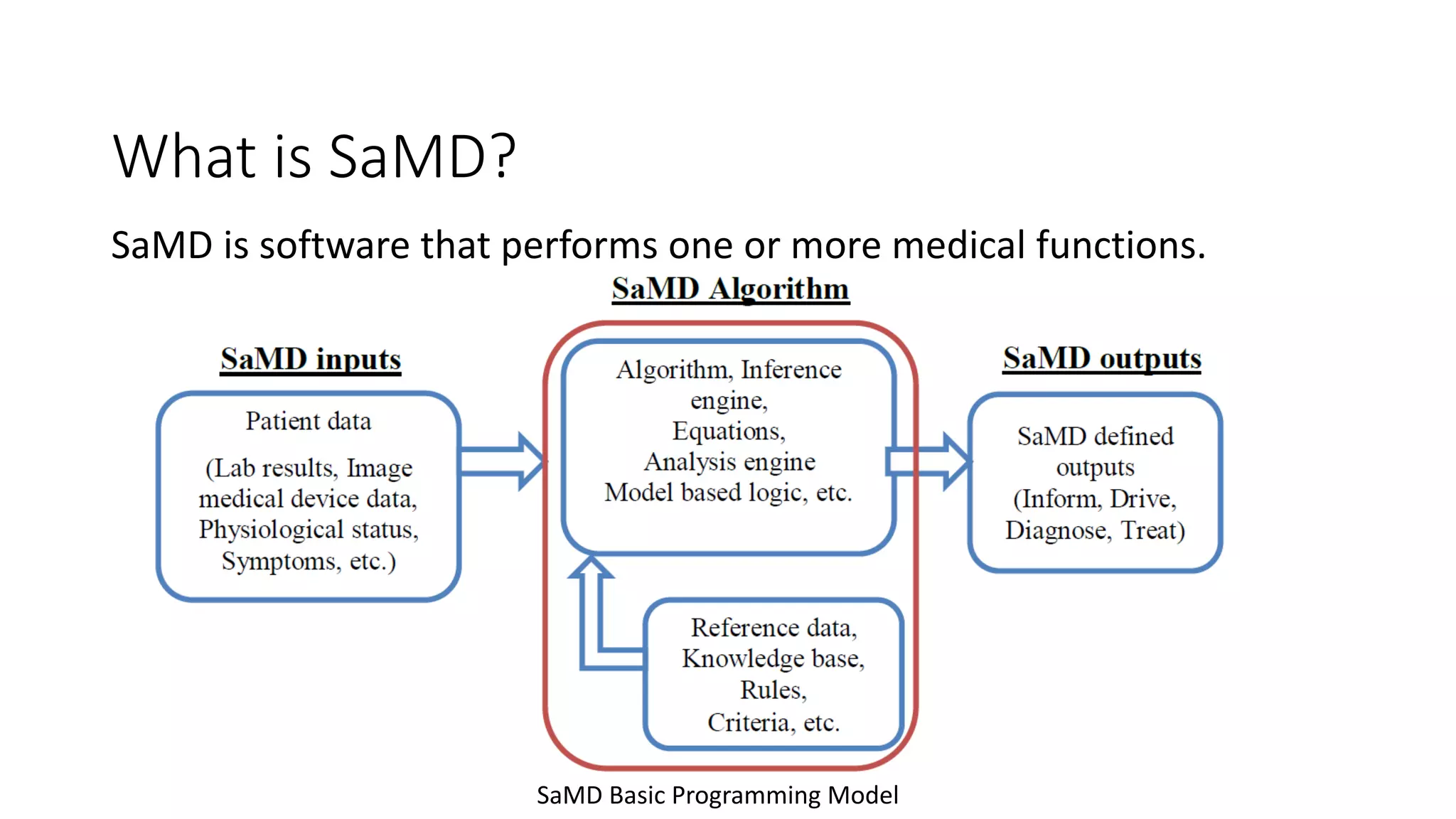
Explains SaMD as software performing medical functions with a basic programming model.
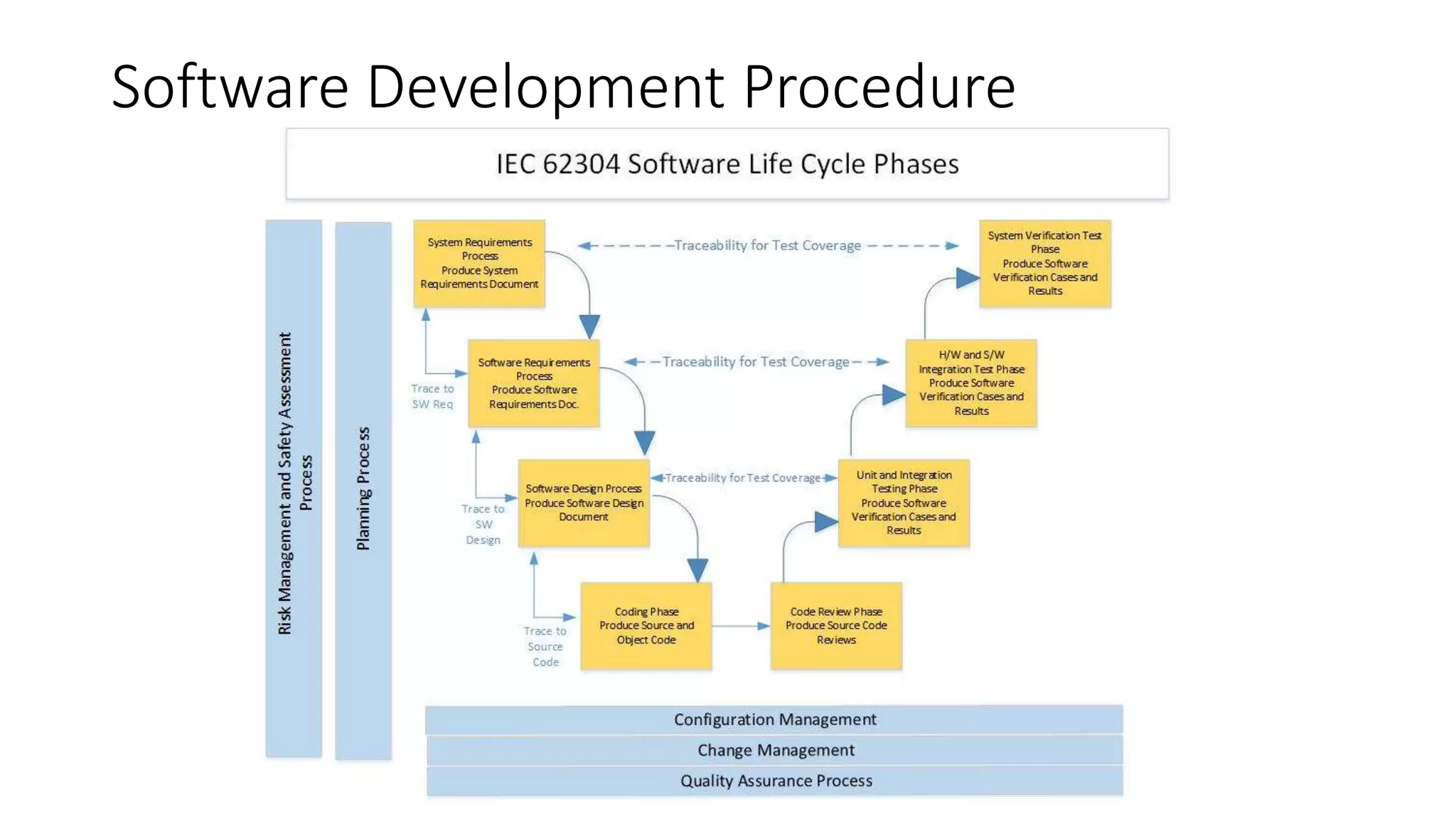
Highlights the software development life cycle phases: requirements, design, implementation, integration, maintenance.
Discusses detailed phases of software development, including requirements, design, implementation, integration, and maintenance.
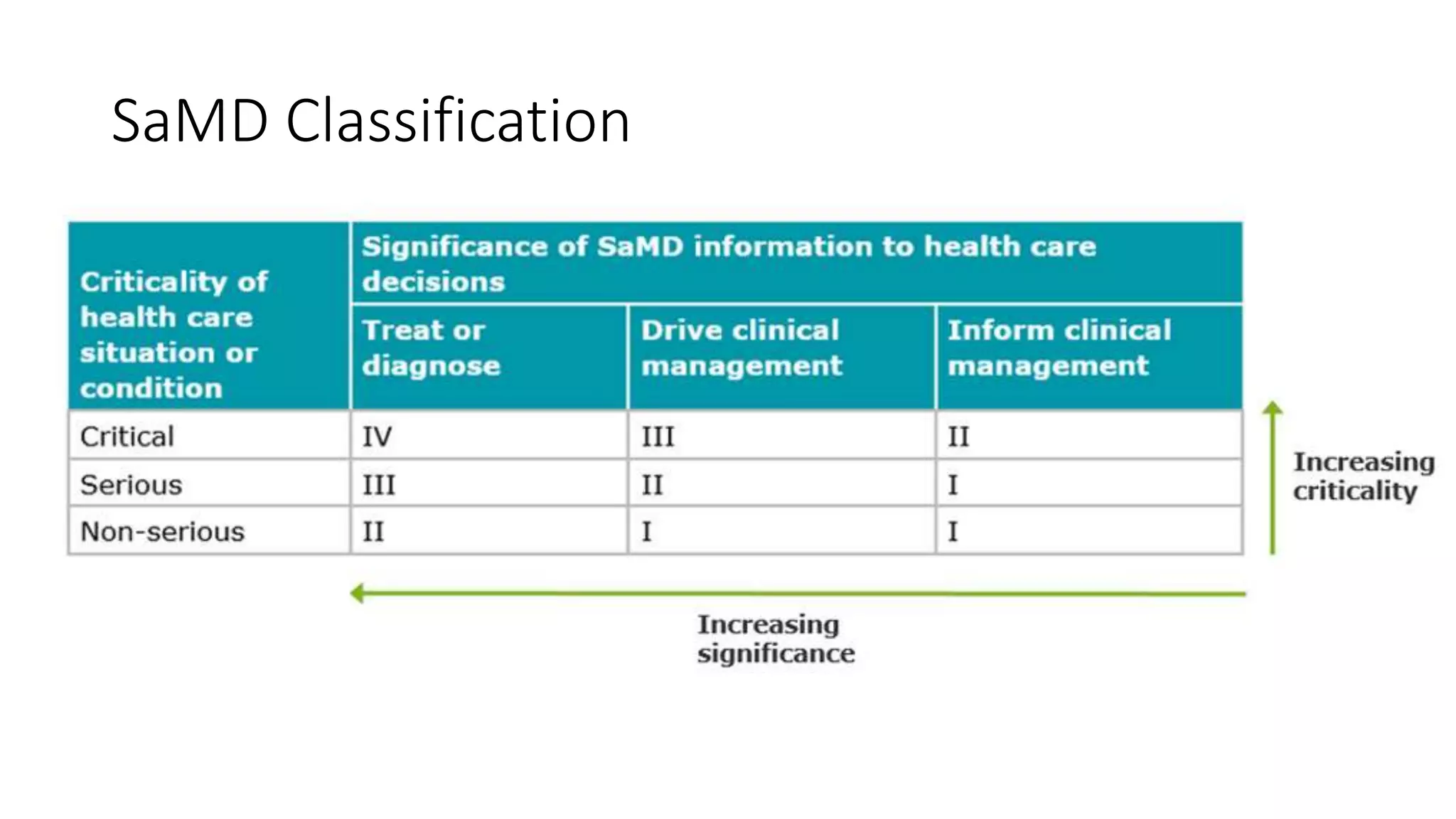
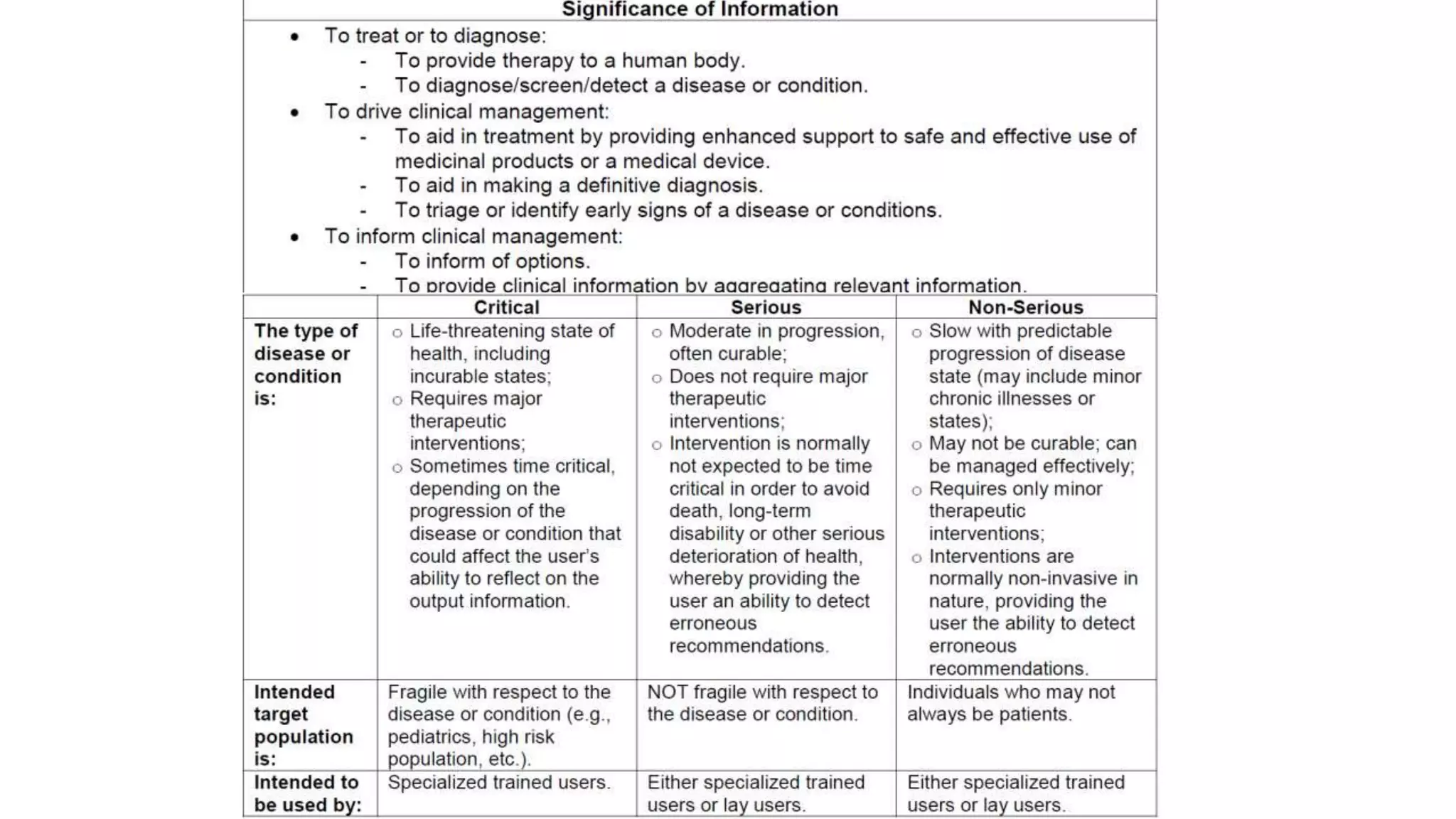
Covers SaMD classification and the FDA Precertification program, its framework, and pilot participants. Explains how FDA evaluates SaMD through the Precert program, emphasizing CQOE scores and market pathways.
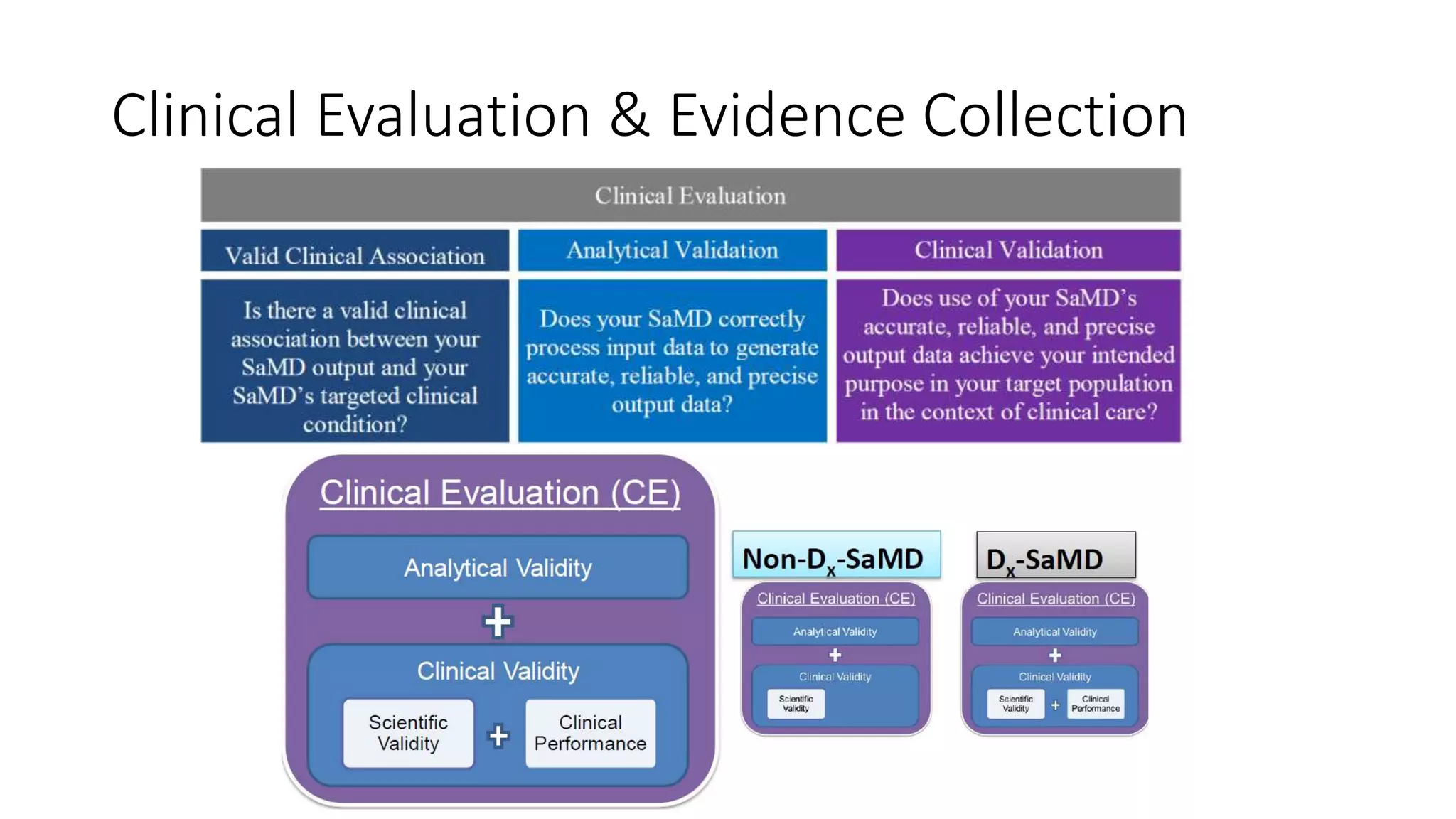
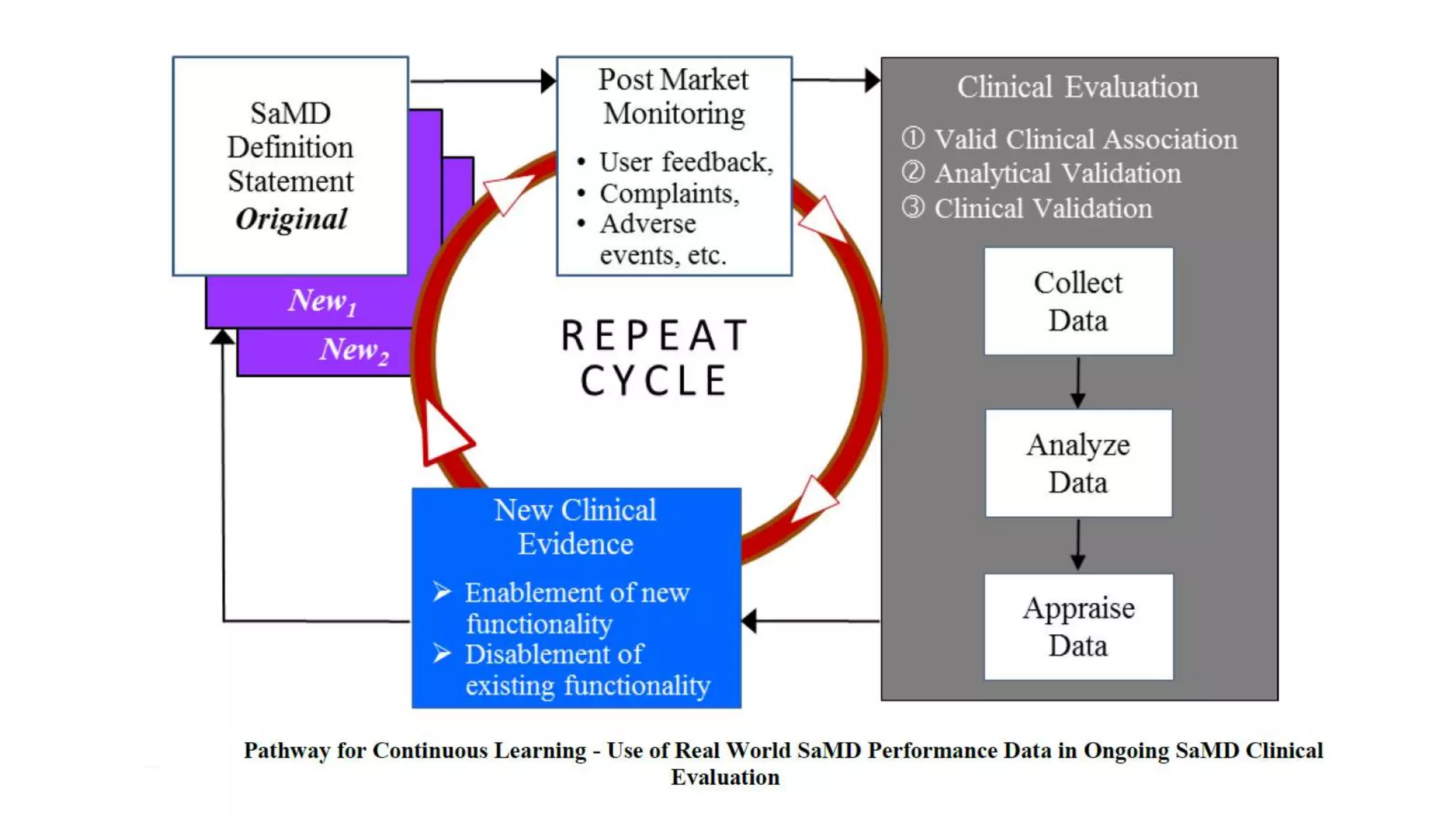
Focuses on post-launch analytics, clinical evaluations, and evidence collection concerning SaMD.
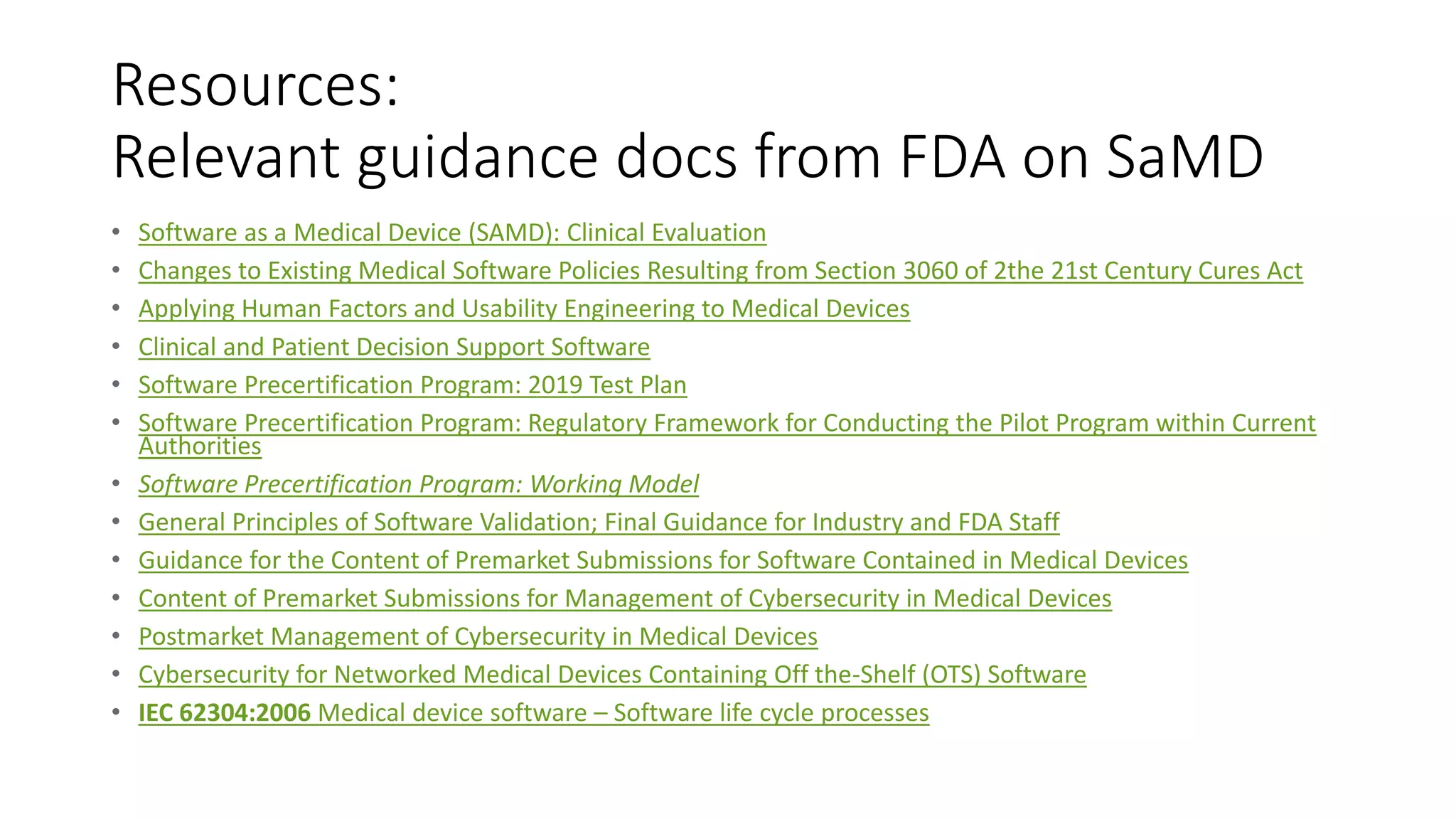
Lists FDA guidance documents and regulations relevant to SaMD, emphasizing regulatory compliance.
Engagement segment for questions regarding the presentation topics on SaMD.
An Overview for Software as a Medical Device (SaMD)
1.
Food for ThoughtSeries Session
An Overview for
Software as a Medical Device
SaMD
Presented by
Harshal Dear
Regulatory Affairs Specialist, West Chester
HDear@its.jnj.com
2.
Content
• What isSaMD
• Software Development Procedure
• Requirements
• Design
• Implementation
• Integration and Test
• Design Transfer (to production)
• Maintenance
• SaMD Classification
• FDA “Precertification” Program
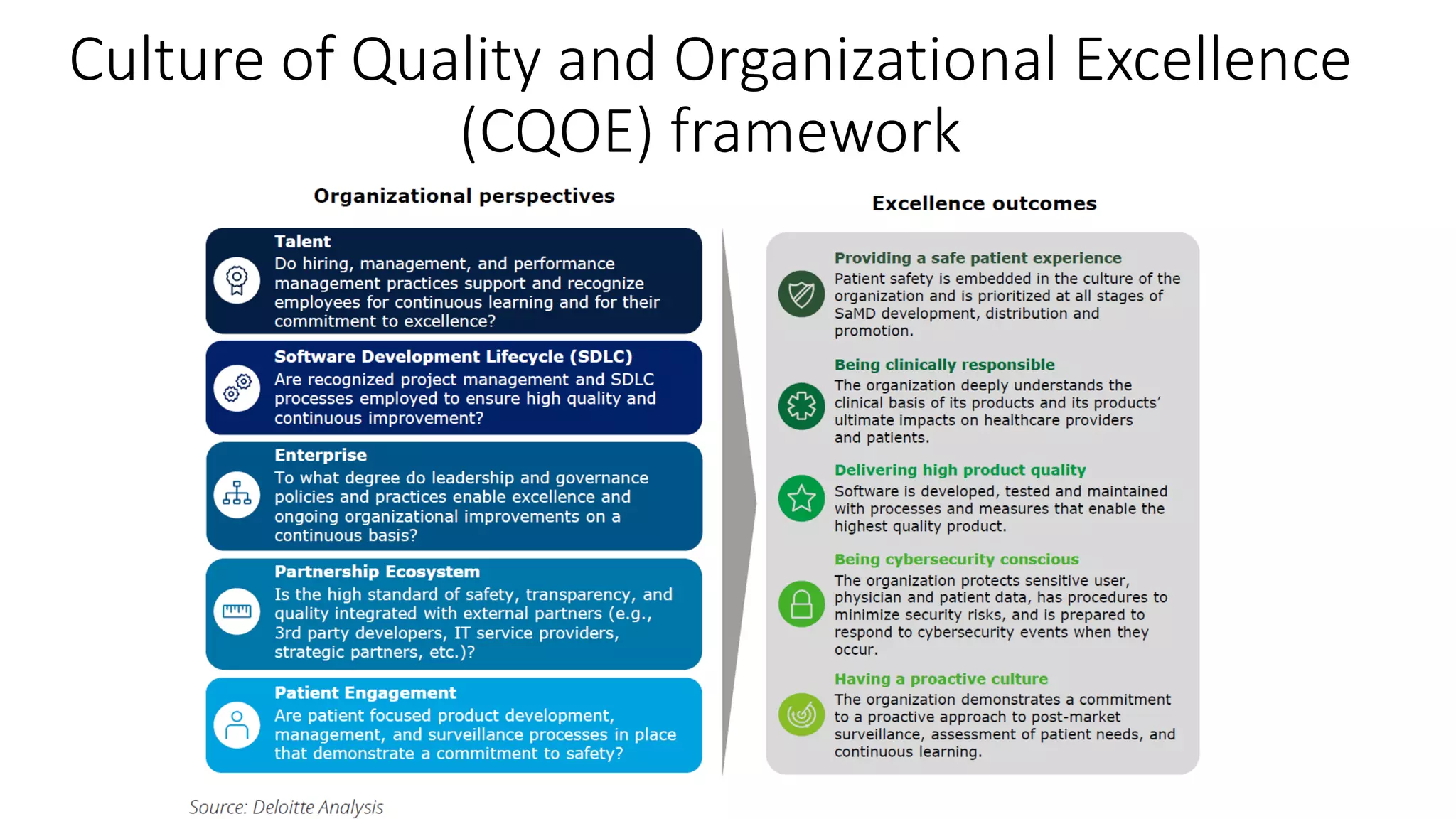
• Culture of Quality and Organizational Excellence (CQOE) framework
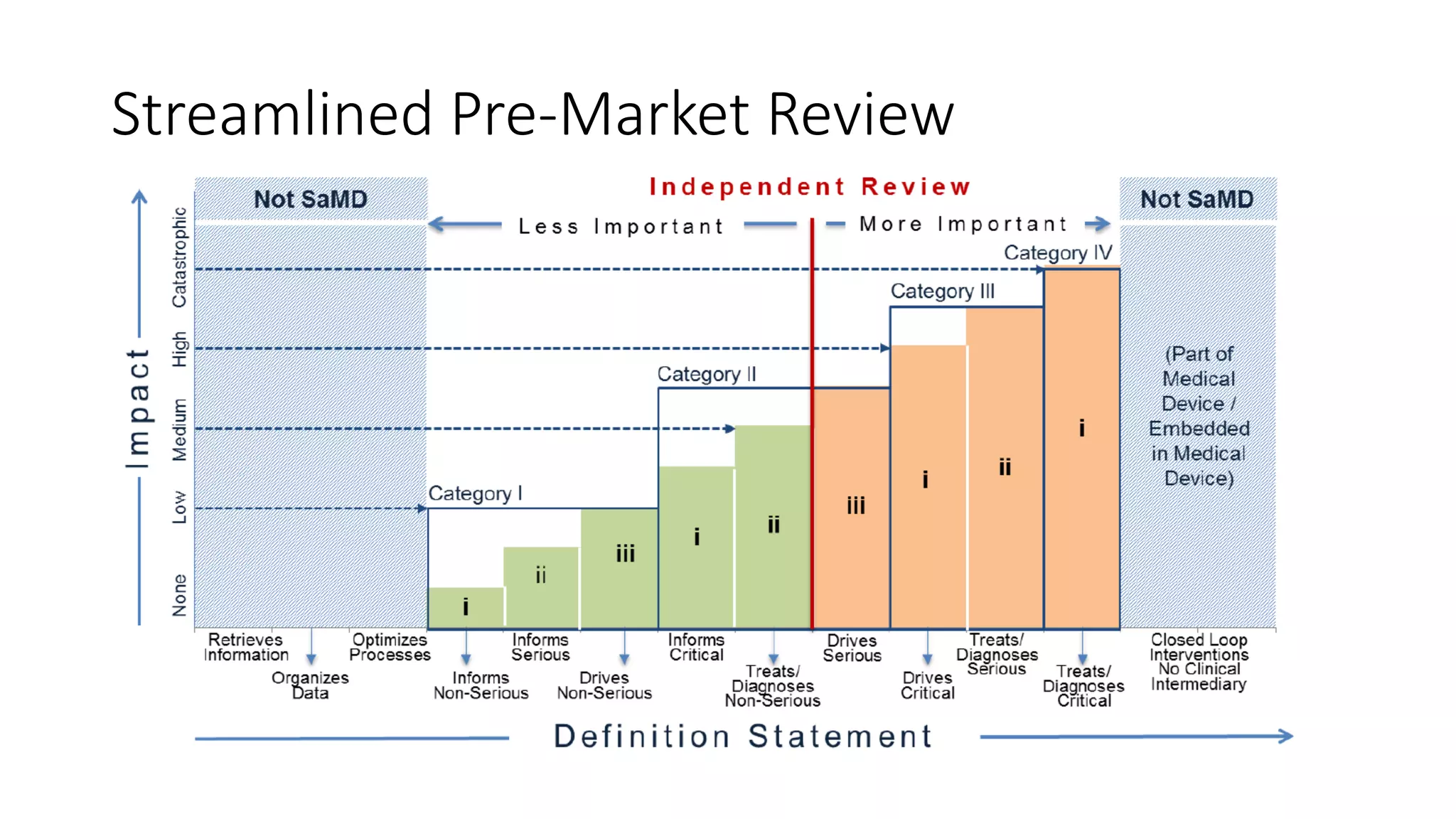
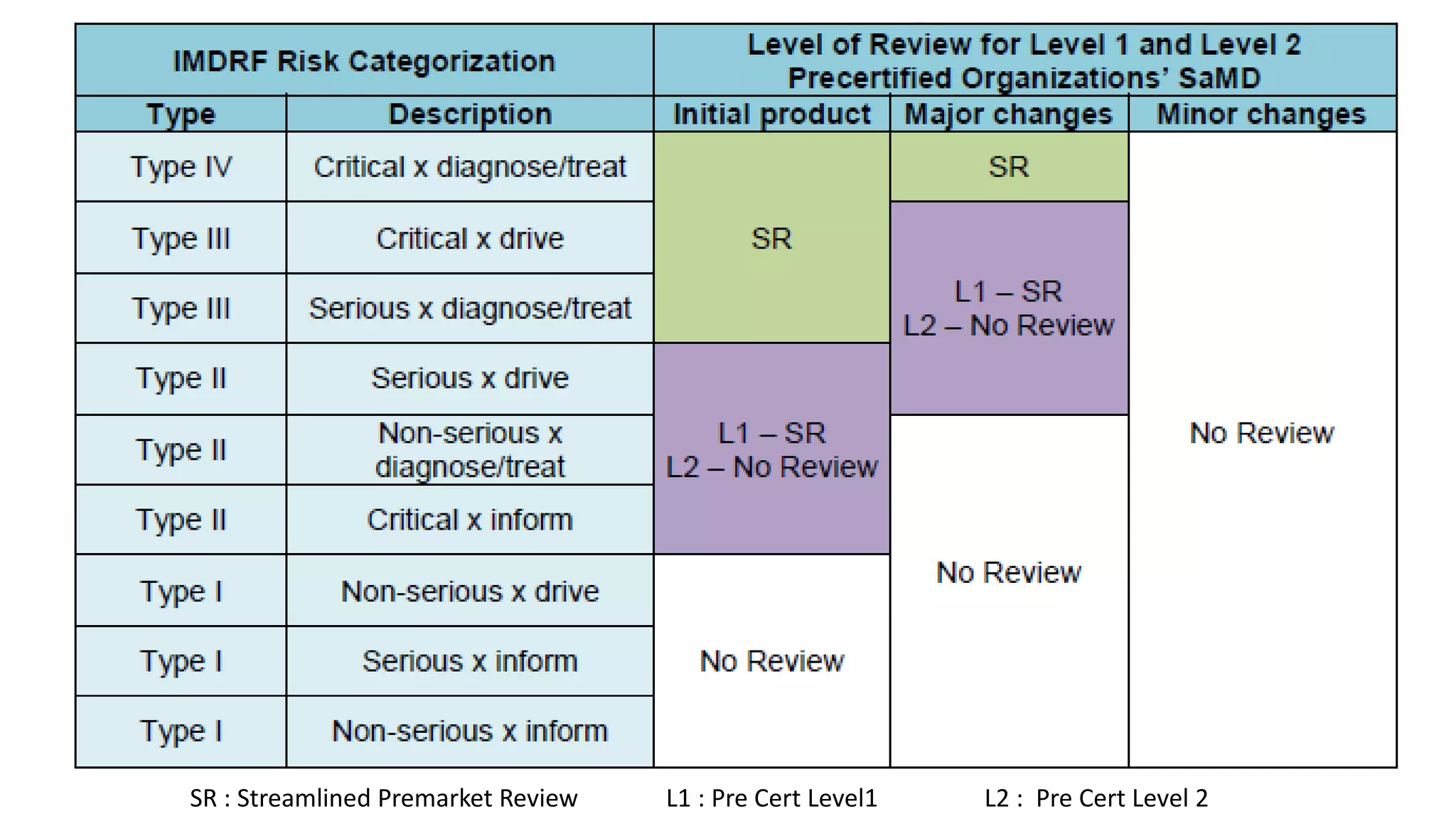
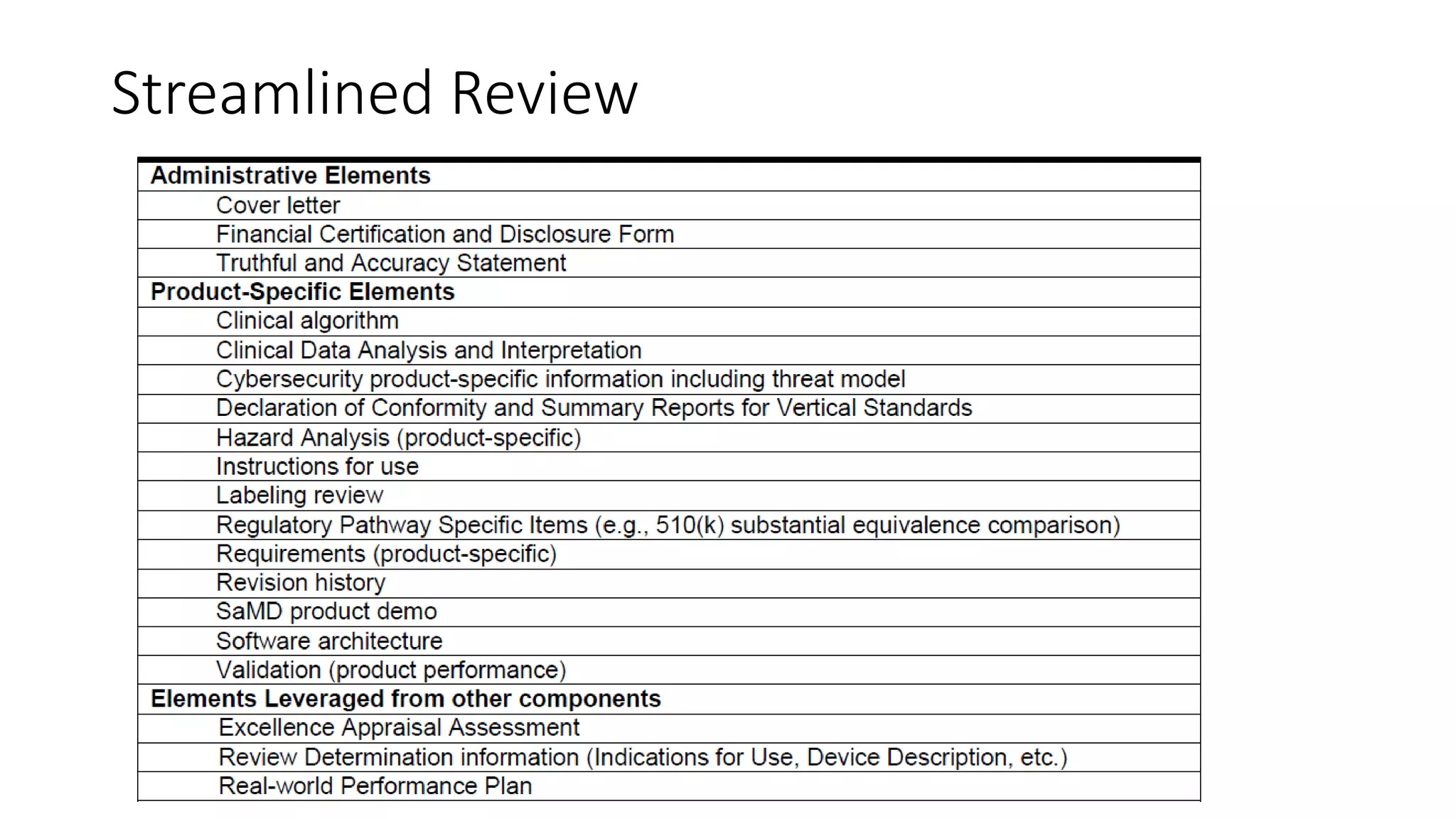
• Streamlined Pre-Market Review
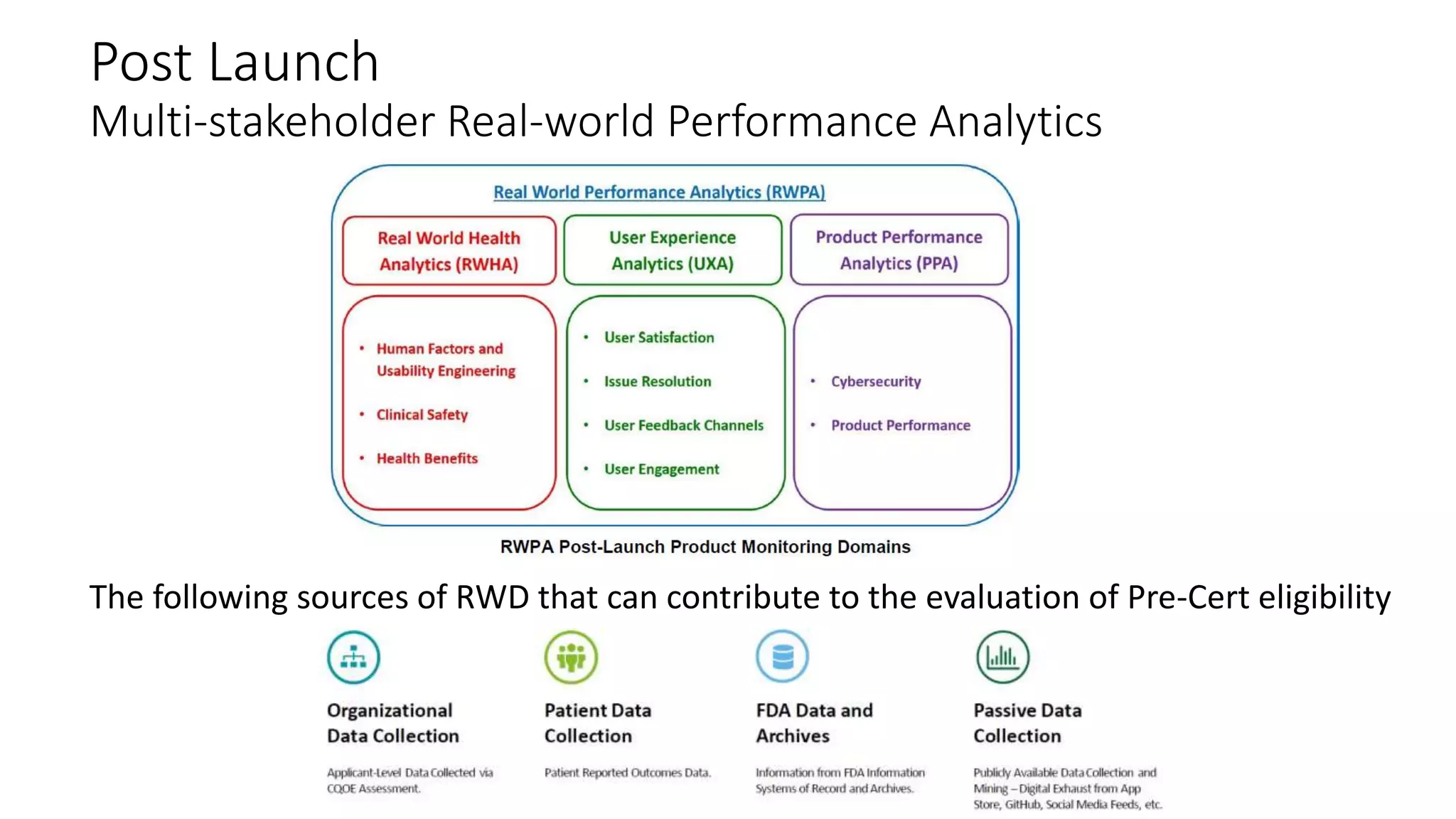
• Post Launch - Multi-stakeholder Real-world Performance Analytics
• Clinical Evaluation & Evidence Collection
• Resources
3.
What is SaMD?
SaMDis software that performs one or more medical functions.
SaMD Basic Programming Model
Software Development LifeCycle
• Typical SDLC phases are:
• Requirements
• Design
• Implementation
• Integration and Test
• Design Transfer (to production)
• Maintenance
7.
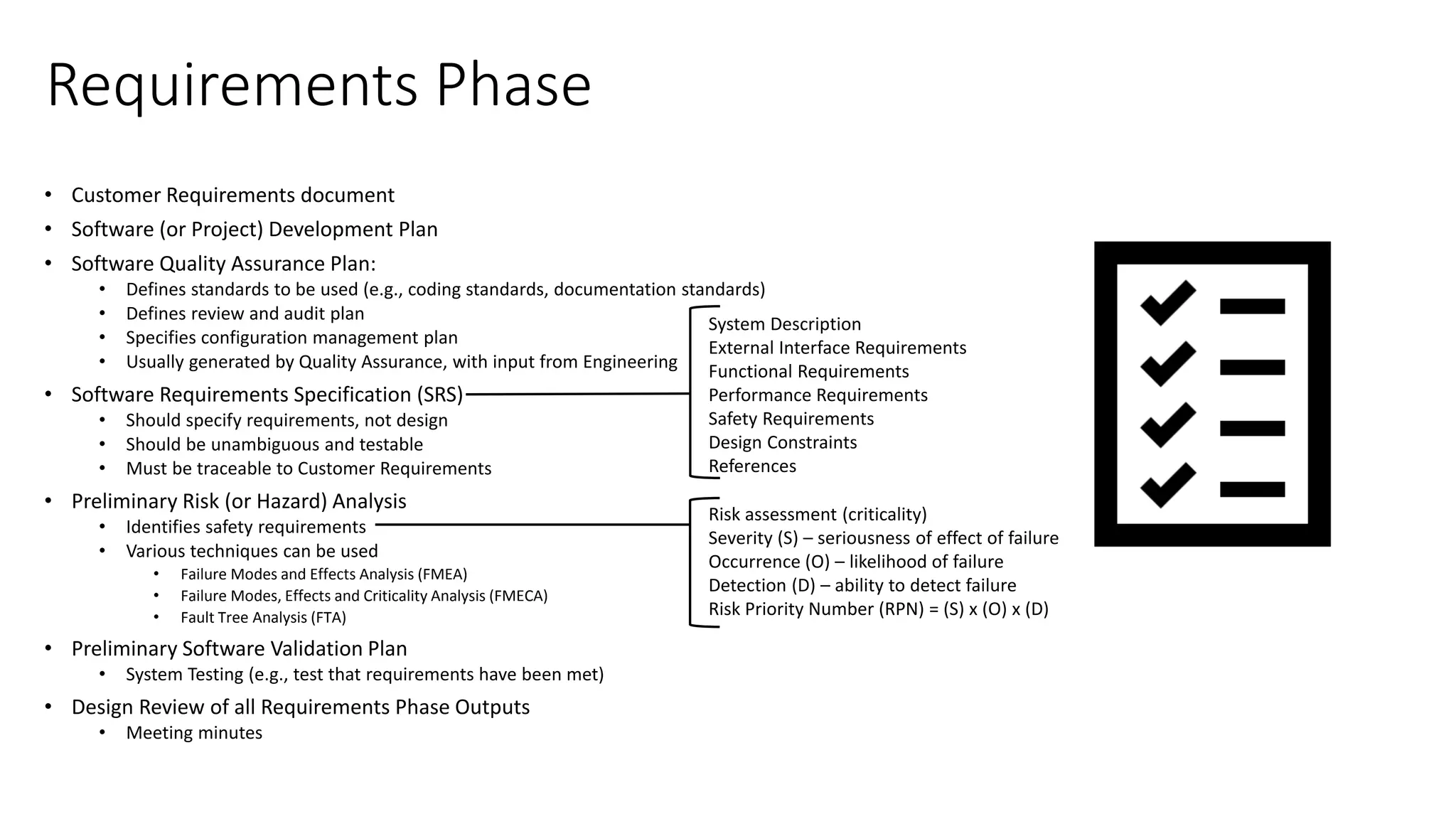
Requirements Phase
• CustomerRequirements document
• Software (or Project) Development Plan
• Software Quality Assurance Plan:
• Defines standards to be used (e.g., coding standards, documentation standards)
• Defines review and audit plan
• Specifies configuration management plan
• Usually generated by Quality Assurance, with input from Engineering
• Software Requirements Specification (SRS)
• Should specify requirements, not design
• Should be unambiguous and testable
• Must be traceable to Customer Requirements
• Preliminary Risk (or Hazard) Analysis
• Identifies safety requirements
• Various techniques can be used
• Failure Modes and Effects Analysis (FMEA)
• Failure Modes, Effects and Criticality Analysis (FMECA)
• Fault Tree Analysis (FTA)
• Preliminary Software Validation Plan
• System Testing (e.g., test that requirements have been met)
• Design Review of all Requirements Phase Outputs
• Meeting minutes
System Description
External Interface Requirements
Functional Requirements
Performance Requirements
Safety Requirements
Design Constraints
References
Risk assessment (criticality)
Severity (S) – seriousness of effect of failure
Occurrence (O) – likelihood of failure
Detection (D) – ability to detect failure
Risk Priority Number (RPN) = (S) x (O) x (D)
8.
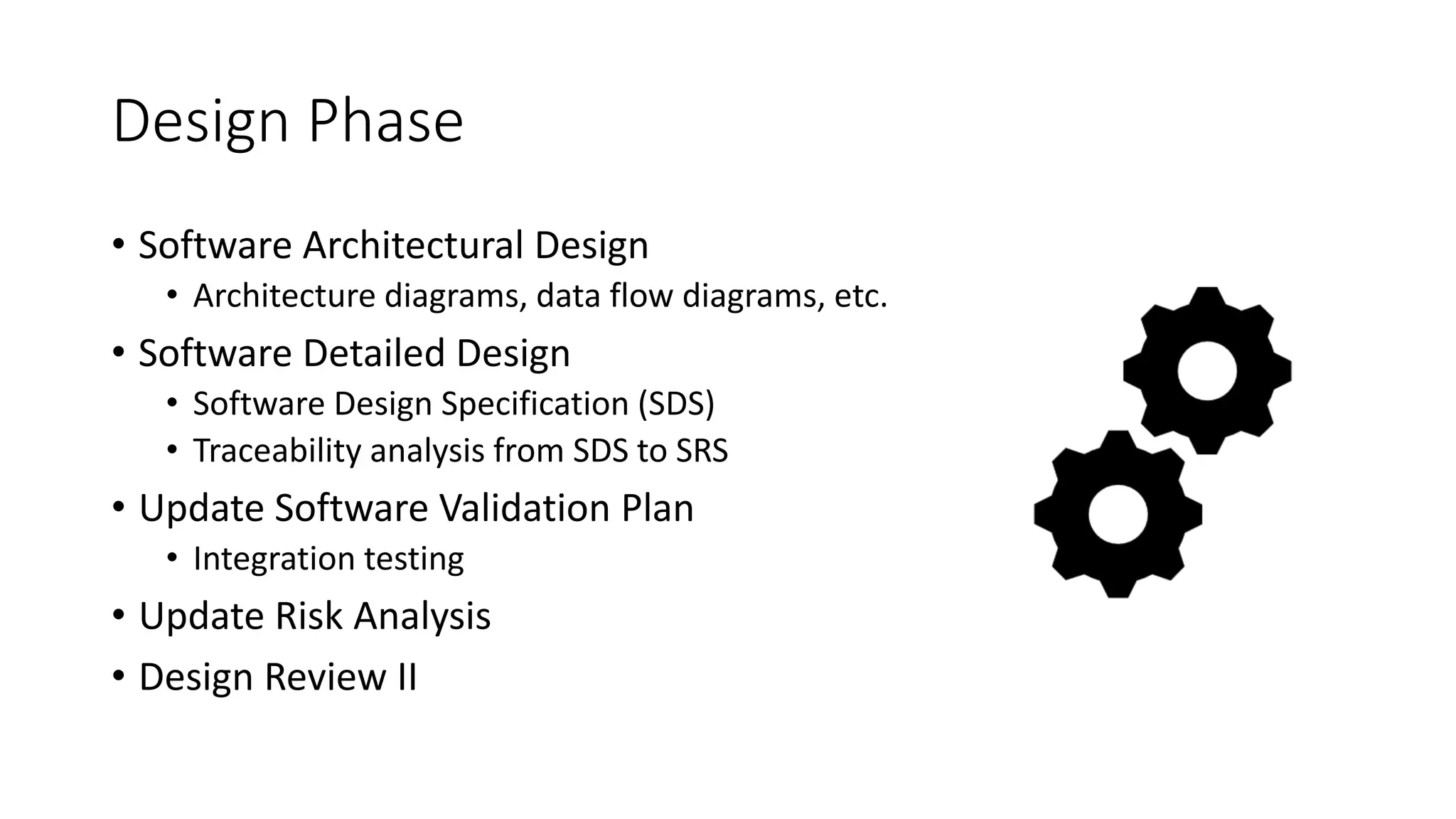
Design Phase
• SoftwareArchitectural Design
• Architecture diagrams, data flow diagrams, etc.
• Software Detailed Design
• Software Design Specification (SDS)
• Traceability analysis from SDS to SRS
• Update Software Validation Plan
• Integration testing
• Update Risk Analysis
• Design Review II
9.
Implementation Phase
• Writesoftware according to Software Quality Assurance Plan (SQAP):
• Programming Guidelines
• Documentation Standards
• Update Software Validation Plan
• Unit or module testing
• Traceability analysis (SVP to SDS/SRS)
• Run module tests and write Test Reports
10.
Integration and TestPhase
• Run Integration Tests and write Test Reports
• Run System Tests and write Test Reports
11.
Design Transfer
• Writerelevant manufacturing procedures
• Software installation procedure
• Software duplication procedure
• Ensure user documentation is complete
• Labeling review
• Release software
• Change control procedure
12.
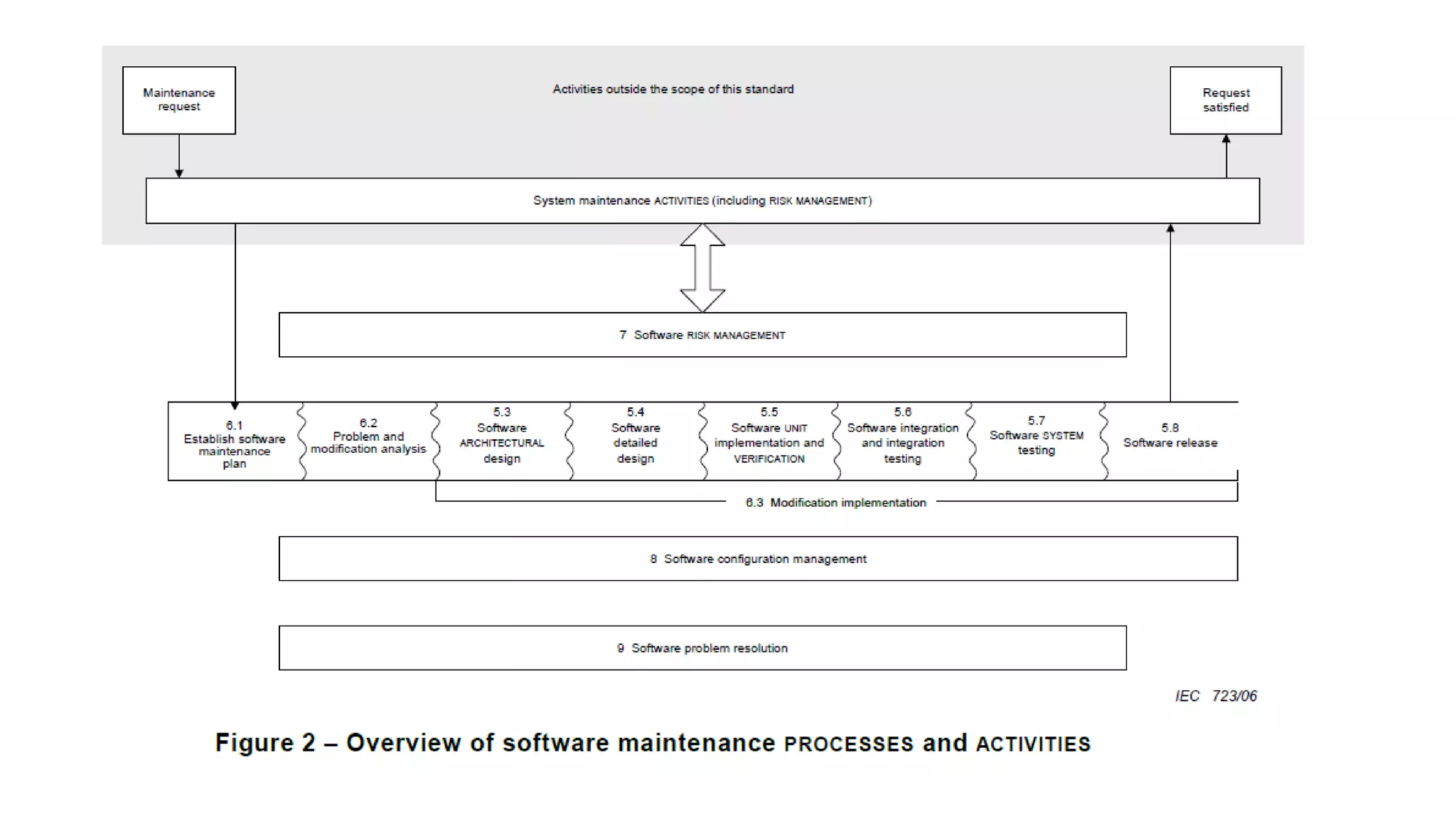
Maintenance Phase
• Reviewand update any necessary documents
(e.g., SRS, Risk Analysis, SDS)
• Implement changes
• Assess testing requirement
• Test changes
• Possible regression testing
• Release via Change Control Procedure
14.
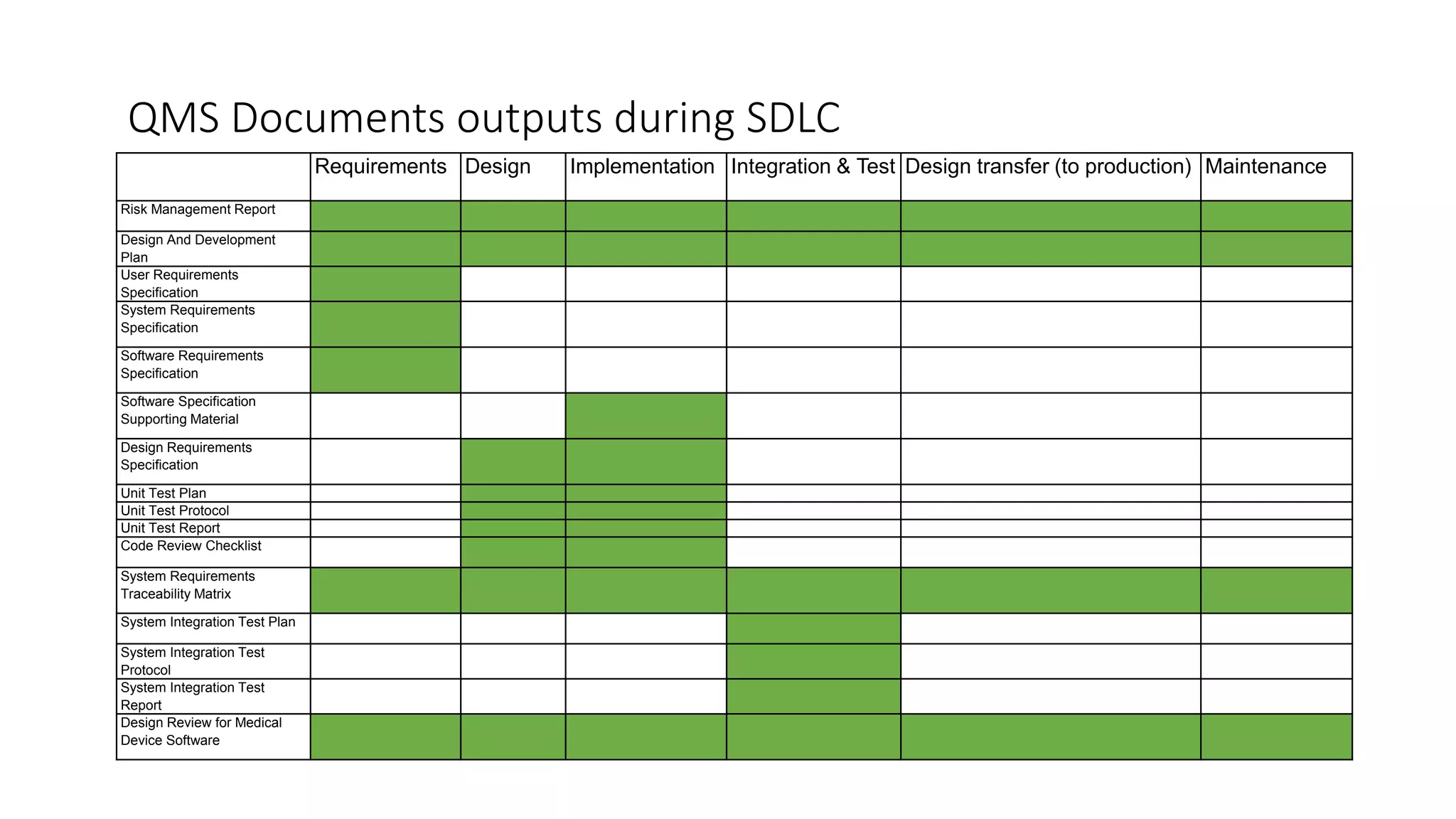
Requirements Design ImplementationIntegration & Test Design transfer (to production) Maintenance
Risk Management Report
Design And Development
Plan
User Requirements
Specification
System Requirements
Specification
Software Requirements
Specification
Software Specification
Supporting Material
Design Requirements
Specification
Unit Test Plan
Unit Test Protocol
Unit Test Report
Code Review Checklist
System Requirements
Traceability Matrix
System Integration Test Plan
System Integration Test
Protocol
System Integration Test
Report
Design Review for Medical
Device Software
QMS Documents outputs during SDLC
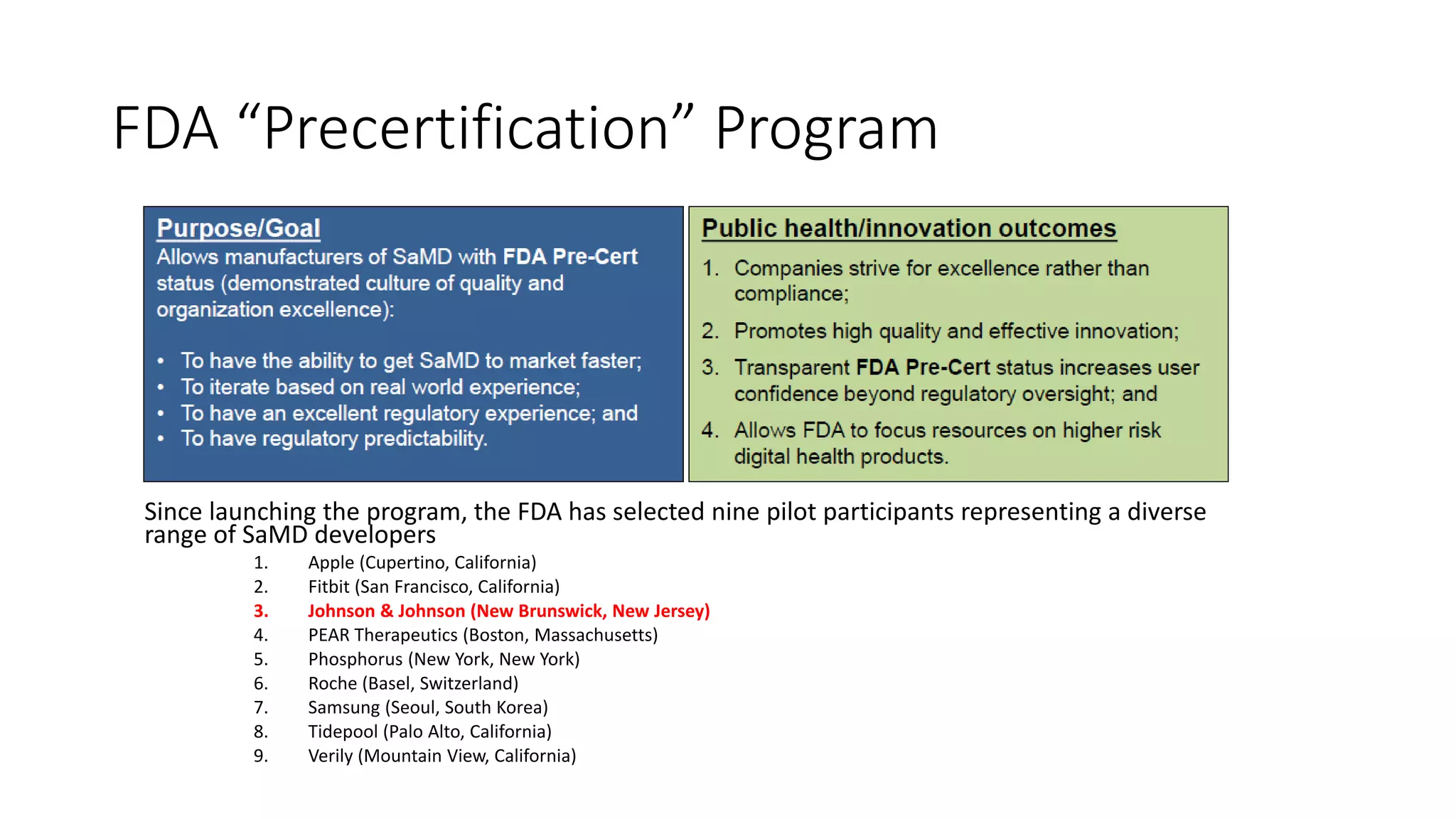
FDA “Precertification” Program
Sincelaunching the program, the FDA has selected nine pilot participants representing a diverse
range of SaMD developers
1. Apple (Cupertino, California)
2. Fitbit (San Francisco, California)
3. Johnson & Johnson (New Brunswick, New Jersey)
4. PEAR Therapeutics (Boston, Massachusetts)
5. Phosphorus (New York, New York)
6. Roche (Basel, Switzerland)
7. Samsung (Seoul, South Korea)
8. Tidepool (Palo Alto, California)
9. Verily (Mountain View, California)
18.
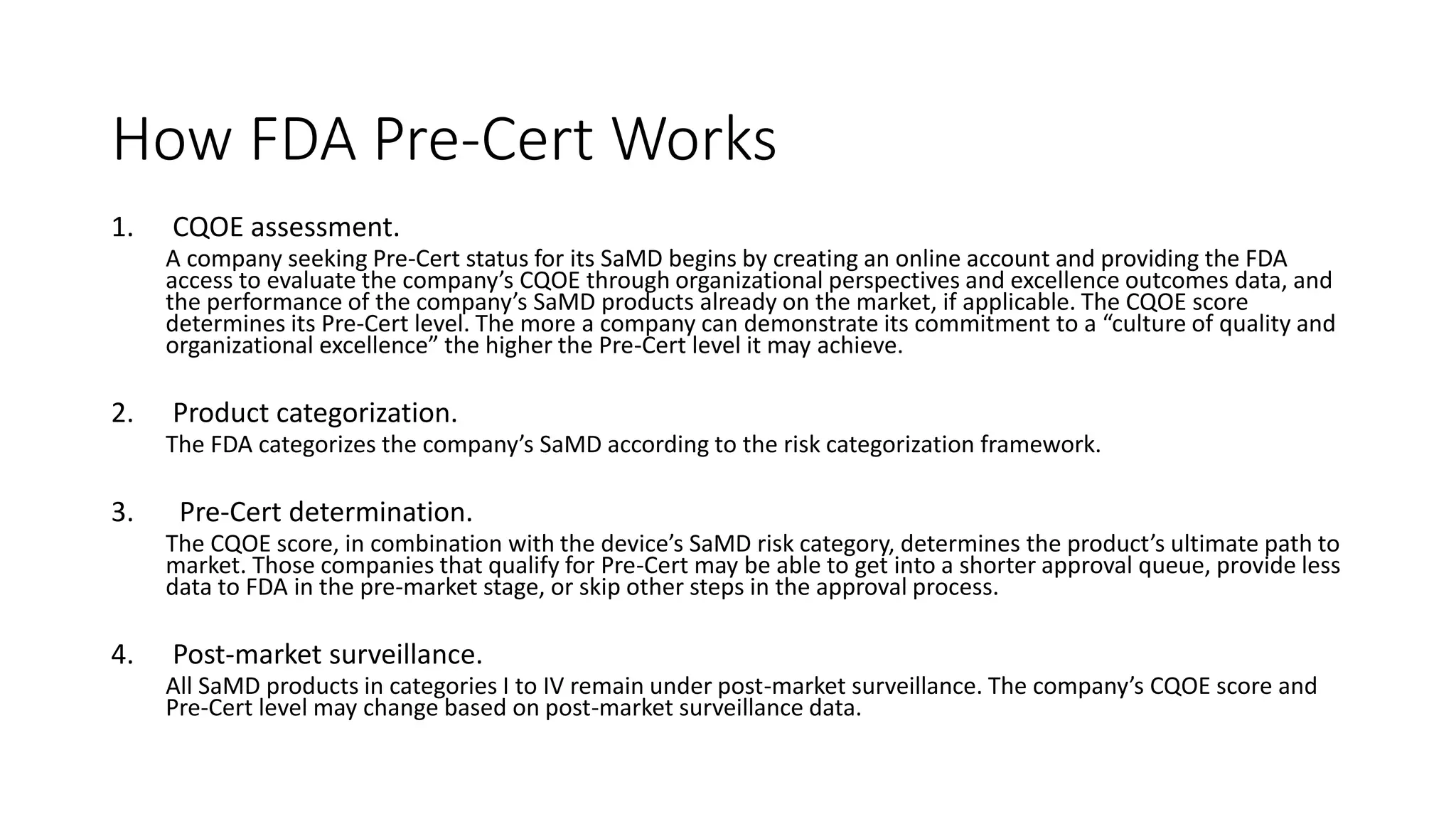
How FDA Pre-CertWorks
1. CQOE assessment.
A company seeking Pre-Cert status for its SaMD begins by creating an online account and providing the FDA
access to evaluate the company’s CQOE through organizational perspectives and excellence outcomes data, and
the performance of the company’s SaMD products already on the market, if applicable. The CQOE score
determines its Pre-Cert level. The more a company can demonstrate its commitment to a “culture of quality and
organizational excellence” the higher the Pre-Cert level it may achieve.
2. Product categorization.
The FDA categorizes the company’s SaMD according to the risk categorization framework.
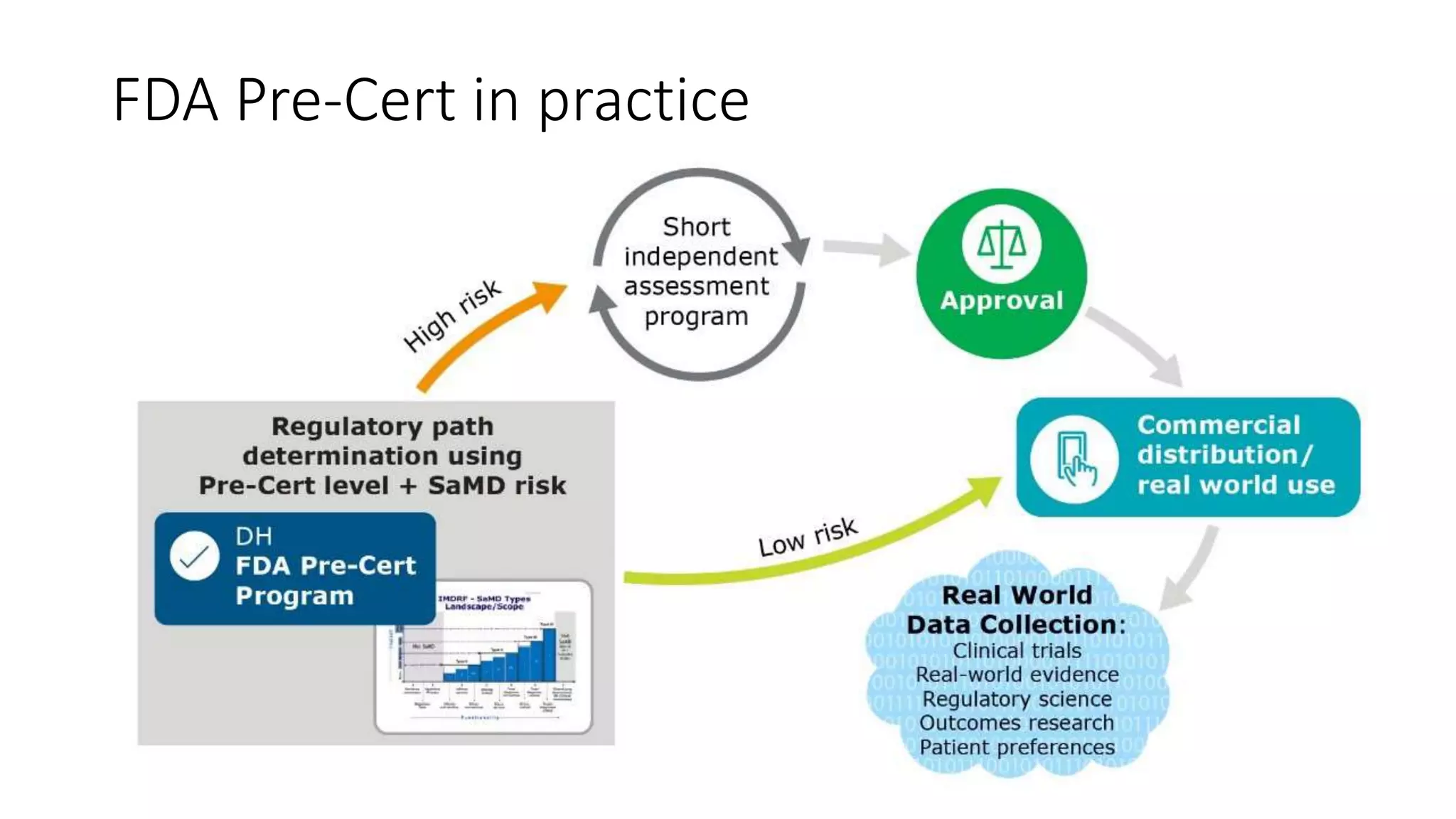
3. Pre-Cert determination.
The CQOE score, in combination with the device’s SaMD risk category, determines the product’s ultimate path to
market. Those companies that qualify for Pre-Cert may be able to get into a shorter approval queue, provide less
data to FDA in the pre-market stage, or skip other steps in the approval process.
4. Post-market surveillance.
All SaMD products in categories I to IV remain under post-market surveillance. The company’s CQOE score and
Pre-Cert level may change based on post-market surveillance data.
Resources:
Relevant guidance docsfrom FDA on SaMD
• Software as a Medical Device (SAMD): Clinical Evaluation
• Changes to Existing Medical Software Policies Resulting from Section 3060 of 2the 21st Century Cures Act
• Applying Human Factors and Usability Engineering to Medical Devices
• Clinical and Patient Decision Support Software
• Software Precertification Program: 2019 Test Plan
• Software Precertification Program: Regulatory Framework for Conducting the Pilot Program within Current
Authorities
• Software Precertification Program: Working Model
• General Principles of Software Validation; Final Guidance for Industry and FDA Staff
• Guidance for the Content of Premarket Submissions for Software Contained in Medical Devices
• Content of Premarket Submissions for Management of Cybersecurity in Medical Devices
• Postmarket Management of Cybersecurity in Medical Devices
• Cybersecurity for Networked Medical Devices Containing Off the-Shelf (OTS) Software
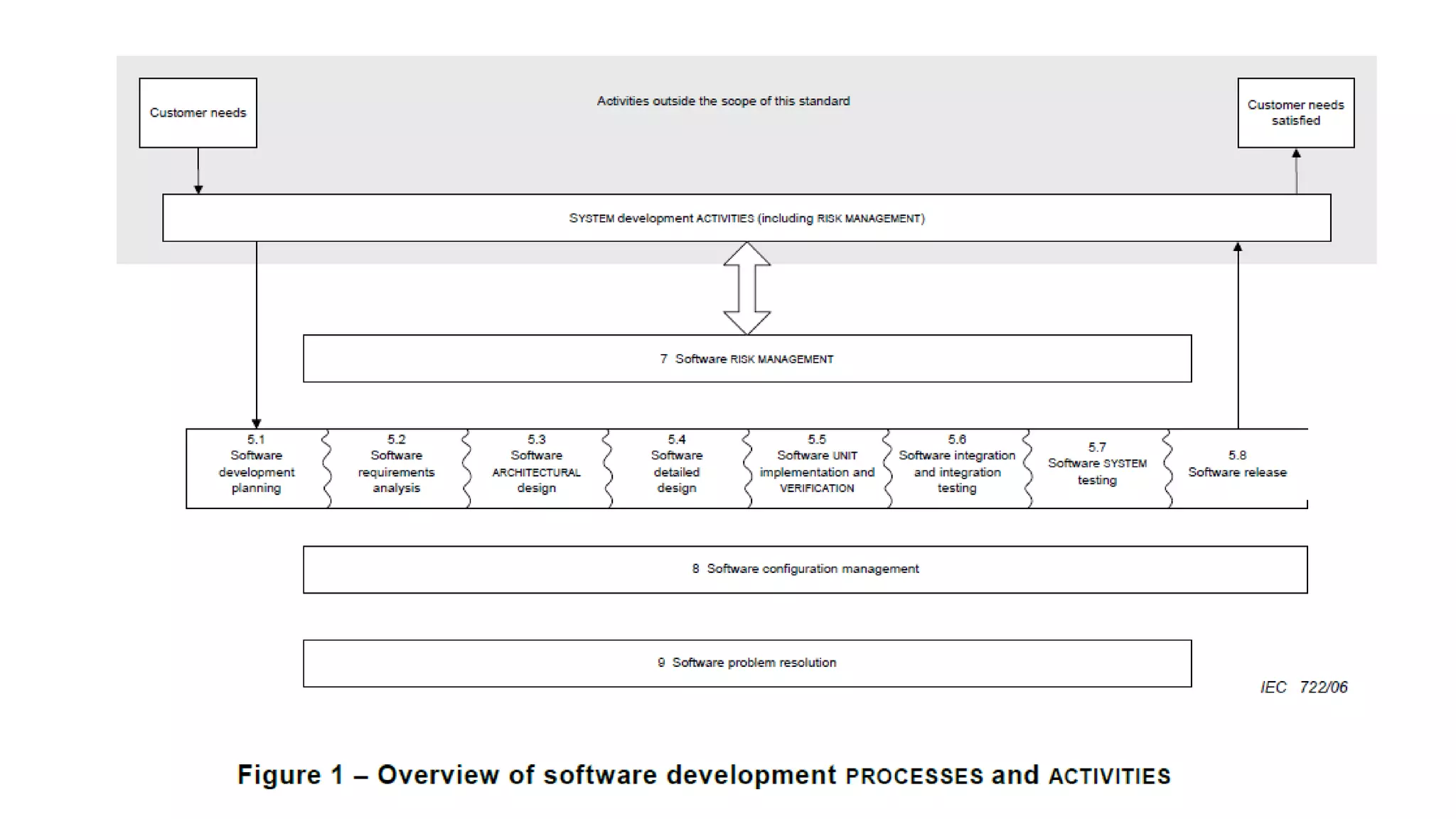
• IEC 62304:2006 Medical device software – Software life cycle processes
#2 Over the last decade, software has begun to permeate and transform virtually every industry—and health care is no exception. One revolutionary development in digital health technology is software that can perform complex medical functions—software as a medical device (SaMD). SaMD can diagnose conditions, suggest treatments, and inform clinical management.