Welcome to this short introduction to the contents of the presentation on Medical Device Compliance and Validation   http://www.PresentationEze.com   This presentation provides information on the contents of the Effective Medical Device Presentation available for PresentationEze. http://www.PresentationEze.com
Section A (i) – Medical Device Compliance and Validation Summary of product contents: Introduction Regulatory Requirements & International Standards Medical Devices Current Good Manufacturing Practice Key components of an effective Quality Management System Documentation Auditing Complaints and Recalls Approach to Process Validations Approach to Software Validation Design Control : Design Input & Design Output Lifecycle Approach to Validation - inc. Qualifications (IQ, OQ, PVS, PQ) Approach to revalidation  The  Validation Master Plan (VMP) Process Validation Gap Analysis Risk Based Approach to Design and Manufacturing Other Validations Protocol Reporting Auditing References http://www.PresentationEze.com
Section A (ii) – Quality Tools and Statistics Quality Improvement Techniques Statistical Techniques http://www.PresentationEze.com
Introduction Why perform Product Validations? Regulatory (FDA, EU. etc.), Customers,  Business expectations, etc. Effort versus Risk. Risk and Process Validation.  Integration of Validation and Risk into the product life cycle, integration into the Quality Management System. Validation versus Verification. Definitions related to Validation. http://www.PresentationEze.com
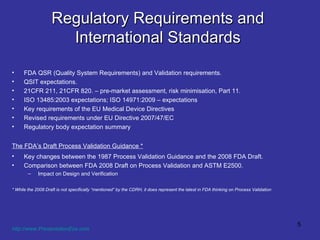
Regulatory Requirements and International Standards FDA QSR (Quality System Requirements) and Validation requirements. QSIT expectations. 21CFR 211, 21CFR 820. – pre-market assessment, risk minimisation, Part 11. ISO 13485:2003 expectations; ISO 14971:2009 – expectations Key requirements of the EU Medical Device Directives Revised requirements under EU Directive 2007/47/EC Regulatory body expectation summary The FDA’s Draft Process Validation Guidance *   Key changes between the 1987 Process Validation Guidance and the 2008 FDA Draft.  Comparison between FDA 2008 Draft on Process Validation and ASTM E2500. Impact on Design and Verification * While the 2008 Draft is not specifically “mentioned” by the CDRH, it does represent the latest in FDA thinking on Process Validation http://www.PresentationEze.com
Medical Devices Definition Types of devices per the Medical Device Directives. Classification Classification rules Risk Assessment http://www.PresentationEze.com
Good Manufacturing Practice. Principles of current Good Manufacturing Practice (cGMP) Intended purpose/Intended Use – Quality Safety and Efficacy Review how GMP is implemented in the workplace. The role of the employee in delivering quality products. http://www.PresentationEze.com
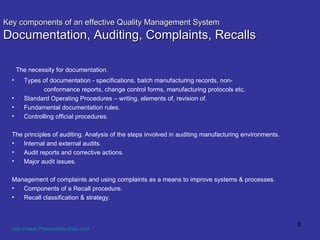
Key components of an effective Quality Management System Documentation, Auditing, Complaints, Recalls The necessity for documentation.  Types of documentation - specifications, batch manufacturing records, non-   conformance reports, change control forms, manufacturing protocols etc.  Standard Operating Procedures – writing, elements of, revision of. Fundamental documentation rules. Controlling official procedures. The principles of auditing. Analysis of the steps involved in auditing manufacturing environments.  Internal and external audits.  Audit reports and corrective actions.  Major audit issues.  Management of complaints and using complaints as a means to improve systems & processes. Components of a Recall procedure. Recall classification & strategy. http://www.PresentationEze.com
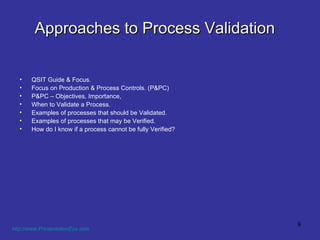
Approaches to Process Validation QSIT Guide & Focus.  Focus on Production & Process Controls. (P&PC) P&PC – Objectives, Importance,  When to Validate a Process. Examples of processes that should be Validated. Examples of processes that may be Verified. How do I know if a process cannot be fully Verified? http://www.PresentationEze.com
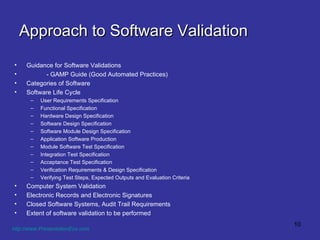
Approach to Software Validation Guidance for Software Validations  - GAMP Guide (Good Automated Practices) Categories of Software Software Life Cycle User Requirements Specification Functional Specification Hardware Design Specification Software Design Specification Software Module Design Specification Application Software Production Module Software Test Specification Integration Test Specification Acceptance Test Specification Verification Requirements & Design Specification Verifying Test Steps, Expected Outputs and Evaluation Criteria Computer System Validation Electronic Records and Electronic Signatures Closed Software Systems, Audit Trail Requirements Extent of software validation to be performed http://www.PresentationEze.com
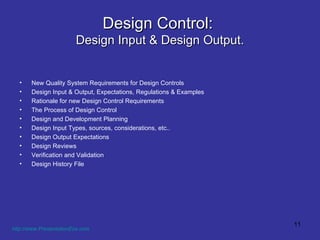
Design Control:  Design Input & Design Output. New Quality System Requirements for Design Controls Design Input & Output, Expectations, Regulations & Examples Rationale for new Design Control Requirements The Process of Design Control Design and Development Planning Design Input Types, sources, considerations, etc.. Design Output Expectations Design Reviews Verification and Validation Design History File http://www.PresentationEze.com
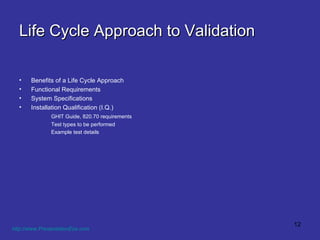
Life Cycle Approach to Validation Benefits of a Life Cycle Approach Functional Requirements System Specifications Installation Qualification (I.Q.) GHIT Guide, 820.70 requirements Test types to be performed Example test details http://www.PresentationEze.com
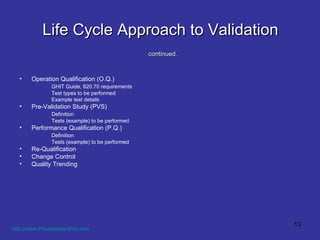
Life Cycle Approach to Validation   continued. Operation Qualification (O.Q.) GHIT Guide, 820.70 requirements Test types to be performed Example test details Pre-Validation Study (PVS) Definition Tests (example) to be performed Performance Qualification (P.Q.) Definition Tests (example) to be performed Re-Qualification Change Control Quality Trending http://www.PresentationEze.com
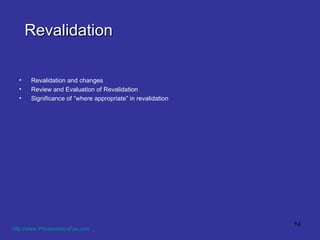
Revalidation Revalidation and changes Review and Evaluation of Revalidation Significance of “where appropriate” in revalidation http://www.PresentationEze.com
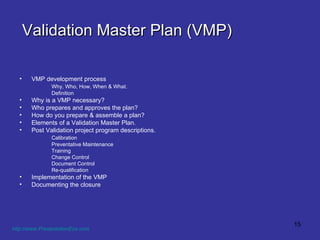
Validation Master Plan (VMP) VMP development process Why, Who, How, When & What. Definition Why is a VMP necessary? Who prepares and approves the plan? How do you prepare & assemble a plan? Elements of a Validation Master Plan. Post Validation project program descriptions. Calibration Preventative Maintenance Training Change Control Document Control Re-qualification Implementation of the VMP Documenting the closure http://www.PresentationEze.com
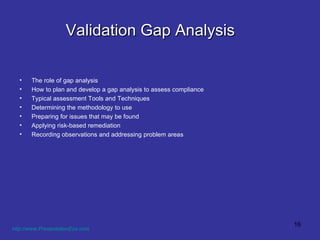
Validation Gap Analysis The role of gap analysis How to plan and develop a gap analysis to assess compliance  Typical assessment Tools and Techniques  Determining the methodology to use  Preparing for issues that may be found  Applying risk-based remediation  Recording observations and addressing problem areas http://www.PresentationEze.com
Risk Based Approach to Design & Manufacturing Why use a risk based approach? What are the various risk assessment models, e.g. EN ISO 14971 What are the various Risk Assessment Tools and Techniques  Scope and Problem determination. Severity, Probability and Detect-ability Advantages / disadvantages, examples, where to apply.  http://www.PresentationEze.com
Other Validations Fixture Qualification Definition Tests to be performed Component/material qualification Definition Content of procedure section http://www.PresentationEze.com
Protocol Reporting Definition Qualification Report Content Protocol Report summary Data Analysis Summary Exception statement http://www.PresentationEze.com
Auditing Approaches to Auditing a Validation Program  Developing the audit terms of reference  Scope and approach to the audit  Auditing techniques  Conducting a risk assessment of audit observations   http://www.PresentationEze.com
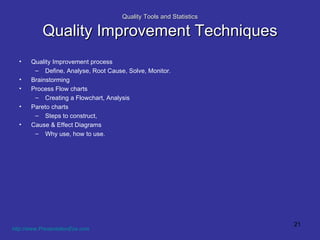
Quality Tools and Statistics Quality Improvement Techniques Quality Improvement process Define, Analyse, Root Cause, Solve, Monitor.  Brainstorming Process Flow charts Creating a Flowchart, Analysis Pareto charts Steps to construct,  Cause & Effect Diagrams Why use, how to use. http://www.PresentationEze.com
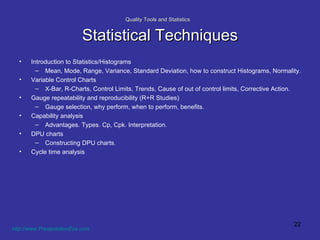
Quality Tools and Statistics   Statistical Techniques Introduction to Statistics/Histograms Mean, Mode, Range, Variance, Standard Deviation, how to construct Histograms, Normality.  Variable Control Charts X-Bar, R-Charts, Control Limits, Trends, Cause of out of control limits, Corrective Action. Gauge repeatability and reproducibility (R+R Studies) Gauge selection, why perform, when to perform, benefits. Capability analysis Advantages. Types. Cp, Cpk. Interpretation. DPU charts Constructing DPU charts. Cycle time analysis http://www.PresentationEze.com
Thank you. PresentationEze.com http://www.PresentationEze.com

Effective Medical Device Validation Introduction Web 2

  • 1.
    Welcome to thisshort introduction to the contents of the presentation on Medical Device Compliance and Validation http://www.PresentationEze.com This presentation provides information on the contents of the Effective Medical Device Presentation available for PresentationEze. http://www.PresentationEze.com
  • 2.
    Section A (i)– Medical Device Compliance and Validation Summary of product contents: Introduction Regulatory Requirements & International Standards Medical Devices Current Good Manufacturing Practice Key components of an effective Quality Management System Documentation Auditing Complaints and Recalls Approach to Process Validations Approach to Software Validation Design Control : Design Input & Design Output Lifecycle Approach to Validation - inc. Qualifications (IQ, OQ, PVS, PQ) Approach to revalidation The Validation Master Plan (VMP) Process Validation Gap Analysis Risk Based Approach to Design and Manufacturing Other Validations Protocol Reporting Auditing References http://www.PresentationEze.com
  • 3.
    Section A (ii)– Quality Tools and Statistics Quality Improvement Techniques Statistical Techniques http://www.PresentationEze.com
  • 4.
    Introduction Why performProduct Validations? Regulatory (FDA, EU. etc.), Customers, Business expectations, etc. Effort versus Risk. Risk and Process Validation. Integration of Validation and Risk into the product life cycle, integration into the Quality Management System. Validation versus Verification. Definitions related to Validation. http://www.PresentationEze.com
  • 5.
    Regulatory Requirements andInternational Standards FDA QSR (Quality System Requirements) and Validation requirements. QSIT expectations. 21CFR 211, 21CFR 820. – pre-market assessment, risk minimisation, Part 11. ISO 13485:2003 expectations; ISO 14971:2009 – expectations Key requirements of the EU Medical Device Directives Revised requirements under EU Directive 2007/47/EC Regulatory body expectation summary The FDA’s Draft Process Validation Guidance * Key changes between the 1987 Process Validation Guidance and the 2008 FDA Draft. Comparison between FDA 2008 Draft on Process Validation and ASTM E2500. Impact on Design and Verification * While the 2008 Draft is not specifically “mentioned” by the CDRH, it does represent the latest in FDA thinking on Process Validation http://www.PresentationEze.com
  • 6.
    Medical Devices DefinitionTypes of devices per the Medical Device Directives. Classification Classification rules Risk Assessment http://www.PresentationEze.com
  • 7.
    Good Manufacturing Practice.Principles of current Good Manufacturing Practice (cGMP) Intended purpose/Intended Use – Quality Safety and Efficacy Review how GMP is implemented in the workplace. The role of the employee in delivering quality products. http://www.PresentationEze.com
  • 8.
    Key components ofan effective Quality Management System Documentation, Auditing, Complaints, Recalls The necessity for documentation. Types of documentation - specifications, batch manufacturing records, non- conformance reports, change control forms, manufacturing protocols etc. Standard Operating Procedures – writing, elements of, revision of. Fundamental documentation rules. Controlling official procedures. The principles of auditing. Analysis of the steps involved in auditing manufacturing environments. Internal and external audits. Audit reports and corrective actions. Major audit issues. Management of complaints and using complaints as a means to improve systems & processes. Components of a Recall procedure. Recall classification & strategy. http://www.PresentationEze.com
  • 9.
    Approaches to ProcessValidation QSIT Guide & Focus. Focus on Production & Process Controls. (P&PC) P&PC – Objectives, Importance, When to Validate a Process. Examples of processes that should be Validated. Examples of processes that may be Verified. How do I know if a process cannot be fully Verified? http://www.PresentationEze.com
  • 10.
    Approach to SoftwareValidation Guidance for Software Validations - GAMP Guide (Good Automated Practices) Categories of Software Software Life Cycle User Requirements Specification Functional Specification Hardware Design Specification Software Design Specification Software Module Design Specification Application Software Production Module Software Test Specification Integration Test Specification Acceptance Test Specification Verification Requirements & Design Specification Verifying Test Steps, Expected Outputs and Evaluation Criteria Computer System Validation Electronic Records and Electronic Signatures Closed Software Systems, Audit Trail Requirements Extent of software validation to be performed http://www.PresentationEze.com
  • 11.
    Design Control: Design Input & Design Output. New Quality System Requirements for Design Controls Design Input & Output, Expectations, Regulations & Examples Rationale for new Design Control Requirements The Process of Design Control Design and Development Planning Design Input Types, sources, considerations, etc.. Design Output Expectations Design Reviews Verification and Validation Design History File http://www.PresentationEze.com
  • 12.
    Life Cycle Approachto Validation Benefits of a Life Cycle Approach Functional Requirements System Specifications Installation Qualification (I.Q.) GHIT Guide, 820.70 requirements Test types to be performed Example test details http://www.PresentationEze.com
  • 13.
    Life Cycle Approachto Validation continued. Operation Qualification (O.Q.) GHIT Guide, 820.70 requirements Test types to be performed Example test details Pre-Validation Study (PVS) Definition Tests (example) to be performed Performance Qualification (P.Q.) Definition Tests (example) to be performed Re-Qualification Change Control Quality Trending http://www.PresentationEze.com
  • 14.
    Revalidation Revalidation andchanges Review and Evaluation of Revalidation Significance of “where appropriate” in revalidation http://www.PresentationEze.com
  • 15.
    Validation Master Plan(VMP) VMP development process Why, Who, How, When & What. Definition Why is a VMP necessary? Who prepares and approves the plan? How do you prepare & assemble a plan? Elements of a Validation Master Plan. Post Validation project program descriptions. Calibration Preventative Maintenance Training Change Control Document Control Re-qualification Implementation of the VMP Documenting the closure http://www.PresentationEze.com
  • 16.
    Validation Gap AnalysisThe role of gap analysis How to plan and develop a gap analysis to assess compliance Typical assessment Tools and Techniques Determining the methodology to use Preparing for issues that may be found Applying risk-based remediation Recording observations and addressing problem areas http://www.PresentationEze.com
  • 17.
    Risk Based Approachto Design & Manufacturing Why use a risk based approach? What are the various risk assessment models, e.g. EN ISO 14971 What are the various Risk Assessment Tools and Techniques Scope and Problem determination. Severity, Probability and Detect-ability Advantages / disadvantages, examples, where to apply. http://www.PresentationEze.com
  • 18.
    Other Validations FixtureQualification Definition Tests to be performed Component/material qualification Definition Content of procedure section http://www.PresentationEze.com
  • 19.
    Protocol Reporting DefinitionQualification Report Content Protocol Report summary Data Analysis Summary Exception statement http://www.PresentationEze.com
  • 20.
    Auditing Approaches toAuditing a Validation Program Developing the audit terms of reference Scope and approach to the audit Auditing techniques Conducting a risk assessment of audit observations http://www.PresentationEze.com
  • 21.
    Quality Tools andStatistics Quality Improvement Techniques Quality Improvement process Define, Analyse, Root Cause, Solve, Monitor. Brainstorming Process Flow charts Creating a Flowchart, Analysis Pareto charts Steps to construct, Cause & Effect Diagrams Why use, how to use. http://www.PresentationEze.com
  • 22.
    Quality Tools andStatistics Statistical Techniques Introduction to Statistics/Histograms Mean, Mode, Range, Variance, Standard Deviation, how to construct Histograms, Normality. Variable Control Charts X-Bar, R-Charts, Control Limits, Trends, Cause of out of control limits, Corrective Action. Gauge repeatability and reproducibility (R+R Studies) Gauge selection, why perform, when to perform, benefits. Capability analysis Advantages. Types. Cp, Cpk. Interpretation. DPU charts Constructing DPU charts. Cycle time analysis http://www.PresentationEze.com
  • 23.
    Thank you. PresentationEze.comhttp://www.PresentationEze.com