Page 1
COMPUTER SYSTEM
VALIDATION
Prepared By- Miss Chitralekha Sonawane
Guided By- Dr. Mrs. S. P. Mahaparale
Page 2
Contents
• Validation
• Computer System
• Principle of CSV
• Steps of Validation
• CSV Models
• Vendor Assessment
• Example- HPLC Software
Page 3
Validation
Establishing documented evidence that
provides a high degree of assurance that a
specific process will consistently produce a
product meeting its pre-determined
specifications and quality attributes.
Page 4
COMPUTER SYSTEM
Page 5
Background
 In 1987 the FDA published a document entitled
‘FDA Guidelines on General Principles of
Process Validation’.
 Definition of validation indicates that validation
can apply to any process including process
managed / controlled by computer systems.
Page 6
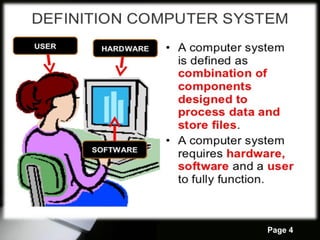
Computer System
Validation
Establishing documented evidence which
provides a high degree of assurance that
a computer system will consistently
produce results that meet its
predetermined specification and quality
attributes.
Page 7
Principle of CSV
 Validation of computer systems is not a one time
event.
 All publications refer to some kind of life cycle
model with a formal change control procedure
being an important part of the whole process.
 There are no detailed instructions on what
should be tested. All guidelines refer to risk
assessment for the extent of validation
Page 8
Steps of Validation
 Validation planning
 Defining user requirements
 Functional specifications
 Design specifications
 Validation during development
 Vendor assessment for purchased systems,
installation
 Initial and ongoing testing and change control
Page 9
CSV Model
• V-Lifecycle model
• 4Q Lifecycle model
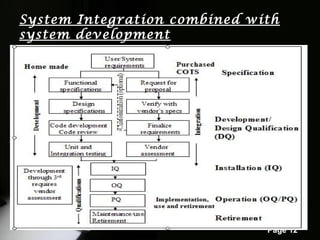
• System Integration combined with system
development
Page 10
V-Lifecycle model
Page 11
4Q Lifecycle model
Page 12
System Integration combined with
system development
Page 13
Vendor Assessment
Objective- To get assurance that the vendor’s
products development and manufacturing
practices meet the requirements of the user’s
firm for quality.
• Documentation of experience with the vendor.
• External references
• Assessment checklists (mail audits)
• 3rd party audits
• Direct vendor audits
Page 14
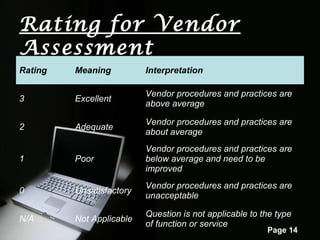
Rating for Vendor
Assessment
Rating Meaning Interpretation
3 Excellent
Vendor procedures and practices are
above average
2 Adequate
Vendor procedures and practices are
about average
1 Poor
Vendor procedures and practices are
below average and need to be
improved
0 Unsatisfactory
Vendor procedures and practices are
unacceptable
N/A Not Applicable
Question is not applicable to the type
of function or service
Page 15
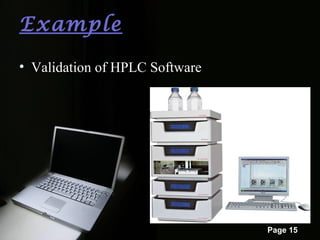
Example
• Validation of HPLC Software
Page 16
User Requirement
Specification Requirement of injection volume, Flow rate, run
time, column temperature, wavelength etc.
 Requirement related to the injection, selection of
vials, sequence copy and paste etc.
 Printing facility.
 System should be capable to run single injection
or sequence of injection.
 System should be capable to control user access
right.
Page 17
Design Qualification
 URS
 Inspection of computer hardware- CPU, on/off
switches.
 Operating system configuration- Processor,
hard disc memory.
 Workstation configuration- Instrument name,
model, software version.
Page 18
Installation
Qualification Compare system with purchase order.
 Check all documents.
 Check the system for any damage.
 Install by connecting all components.
 Switch on the system.
 Install software.
 Configure printer and other equipments.
 List all manuals and SOPs related to equipment.
 Prepare report.
Page 19
Operation
Qualification
 Computer System Qualification
 Software Qualification
Page 20
Computer system
Qualification
• Computer boot up check.
• Date and time check
• Hard disc check
• Print drive check
• Net work connection check
• Software version check
Page 21
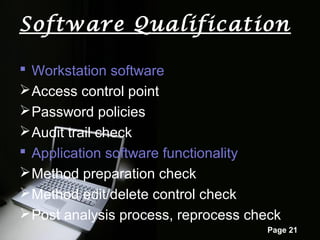
Software Qualification
 Workstation software
Access control point
Password policies
Audit trail check
 Application software functionality
Method preparation check
Method edit/delete control check
Post analysis process, reprocess check
Page 22
Reference
 Dr. Sohan Chitlange, Dr. P. D. Choudhary, Mr. A. E. Shirsat,
Dr. J. N. Snghshetti. “Pharmaceutical Validation” 2014. Suyog
Publication, pp- 8.1-8.11.
 General Principles of Software Validation, U.S. Food and
Drug Administration, January 11, 2002.
 Atul Bendale, Nirav Patel, D. P. Damahe, Sachin B.
Narkhede, Anil G. Jadhav, G. Vidyasagar. Computer Software
Validation In Pharmaceuticals. Asian Journal of
Pharmaceutical Sciences and Clinical Research (AJPSCR)
Vol. 1, Issue 2 (2011), 27-39.
 Ankur Choudhari. Computer Software Validation In
Pharmaceuticals. Pharmaceutical Guidelines.
Page 23

Computer System Validation

  • 1.
    Page 1 COMPUTER SYSTEM VALIDATION PreparedBy- Miss Chitralekha Sonawane Guided By- Dr. Mrs. S. P. Mahaparale
  • 2.
    Page 2 Contents • Validation •Computer System • Principle of CSV • Steps of Validation • CSV Models • Vendor Assessment • Example- HPLC Software
  • 3.
    Page 3 Validation Establishing documentedevidence that provides a high degree of assurance that a specific process will consistently produce a product meeting its pre-determined specifications and quality attributes.
  • 4.
  • 5.
    Page 5 Background  In1987 the FDA published a document entitled ‘FDA Guidelines on General Principles of Process Validation’.  Definition of validation indicates that validation can apply to any process including process managed / controlled by computer systems.
  • 6.
    Page 6 Computer System Validation Establishingdocumented evidence which provides a high degree of assurance that a computer system will consistently produce results that meet its predetermined specification and quality attributes.
  • 7.
    Page 7 Principle ofCSV  Validation of computer systems is not a one time event.  All publications refer to some kind of life cycle model with a formal change control procedure being an important part of the whole process.  There are no detailed instructions on what should be tested. All guidelines refer to risk assessment for the extent of validation
  • 8.
    Page 8 Steps ofValidation  Validation planning  Defining user requirements  Functional specifications  Design specifications  Validation during development  Vendor assessment for purchased systems, installation  Initial and ongoing testing and change control
  • 9.
    Page 9 CSV Model •V-Lifecycle model • 4Q Lifecycle model • System Integration combined with system development
  • 10.
  • 11.
  • 12.
    Page 12 System Integrationcombined with system development
  • 13.
    Page 13 Vendor Assessment Objective-To get assurance that the vendor’s products development and manufacturing practices meet the requirements of the user’s firm for quality. • Documentation of experience with the vendor. • External references • Assessment checklists (mail audits) • 3rd party audits • Direct vendor audits
  • 14.
    Page 14 Rating forVendor Assessment Rating Meaning Interpretation 3 Excellent Vendor procedures and practices are above average 2 Adequate Vendor procedures and practices are about average 1 Poor Vendor procedures and practices are below average and need to be improved 0 Unsatisfactory Vendor procedures and practices are unacceptable N/A Not Applicable Question is not applicable to the type of function or service
  • 15.
  • 16.
    Page 16 User Requirement SpecificationRequirement of injection volume, Flow rate, run time, column temperature, wavelength etc.  Requirement related to the injection, selection of vials, sequence copy and paste etc.  Printing facility.  System should be capable to run single injection or sequence of injection.  System should be capable to control user access right.
  • 17.
    Page 17 Design Qualification URS  Inspection of computer hardware- CPU, on/off switches.  Operating system configuration- Processor, hard disc memory.  Workstation configuration- Instrument name, model, software version.
  • 18.
    Page 18 Installation Qualification Comparesystem with purchase order.  Check all documents.  Check the system for any damage.  Install by connecting all components.  Switch on the system.  Install software.  Configure printer and other equipments.  List all manuals and SOPs related to equipment.  Prepare report.
  • 19.
    Page 19 Operation Qualification  ComputerSystem Qualification  Software Qualification
  • 20.
    Page 20 Computer system Qualification •Computer boot up check. • Date and time check • Hard disc check • Print drive check • Net work connection check • Software version check
  • 21.
    Page 21 Software Qualification Workstation software Access control point Password policies Audit trail check  Application software functionality Method preparation check Method edit/delete control check Post analysis process, reprocess check
  • 22.
    Page 22 Reference  Dr.Sohan Chitlange, Dr. P. D. Choudhary, Mr. A. E. Shirsat, Dr. J. N. Snghshetti. “Pharmaceutical Validation” 2014. Suyog Publication, pp- 8.1-8.11.  General Principles of Software Validation, U.S. Food and Drug Administration, January 11, 2002.  Atul Bendale, Nirav Patel, D. P. Damahe, Sachin B. Narkhede, Anil G. Jadhav, G. Vidyasagar. Computer Software Validation In Pharmaceuticals. Asian Journal of Pharmaceutical Sciences and Clinical Research (AJPSCR) Vol. 1, Issue 2 (2011), 27-39.  Ankur Choudhari. Computer Software Validation In Pharmaceuticals. Pharmaceutical Guidelines.
  • 23.