PhD research Nico Rutten Simulations in school practice professors: Prof. dr. Wouter van Joolingen Prof. dr. Jules Pieters supervisor: Dr. Jan van der Veen
Introduction Theory Literature review Computer Simulations in Science Education Teaching
COMPUTER SIMULATIONS IN SCIENCE EDUCATION INTRODUCTION
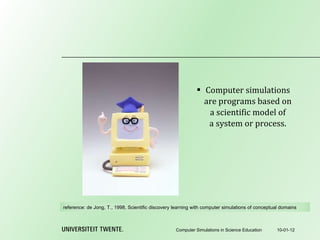
Computer simulations are programs based on a scientific model of a system or process. 10-01-12 Computer Simulations in Science Education reference:  de Jong, T., 1998, Scientific discovery learning with computer simulations of conceptual domains
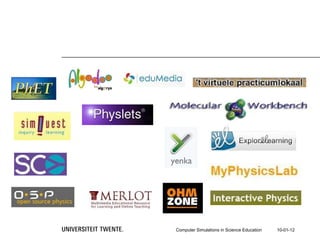
10-01-12 Computer Simulations in Science Education
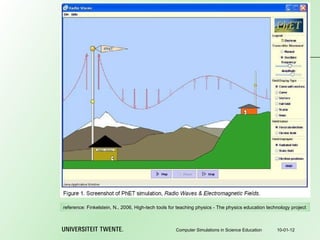
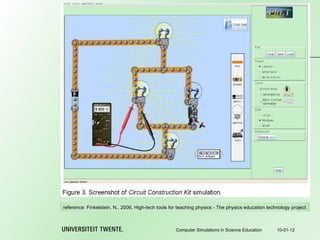
Good  sims  can actually be pedagogically more effective than apparently similar classroom demonstrations and laboratory exercises with real equipment.   PhET sims have two main goals: increased student interest and improved learning . 10-01-12 Computer Simulations in Science Education reference:  Wieman, C.E., 2006, A powerful tool for teaching science
10-01-12 Computer Simulations in Science Education reference:  Finkelstein, N., 2006, High-tech tools for teaching physics - The physics education technology project
Why use them? COMPUTER SIMULATIONS IN SCIENCE EDUCATION INTRODUCTION 10-01-12 Computer Simulations in Science Education
Because simulations are simplified versions of the natural world, they have the potential to facilitate learning by focusing students’ attention more directly on the targeted phenomena. 10-01-12 Computer Simulations in Science Education reference:  de Jong, T., 1998, Scientific discovery learning with computer simulations of conceptual domains
In comparison with alternatives such as textbooks, lectures, and tutorial courseware, a simulation-based approach offers the opportunity… to learn in a relatively realistic problem-solving context to practise task performance without stress to systematically explore both realistic and hypothetical situations to change the time-scale of events to interact with simplified versions of the process or system being simulated. 10-01-12 Computer Simulations in Science Education reference:  van Berkum, J.A., 1991, Instructional environments for simulations
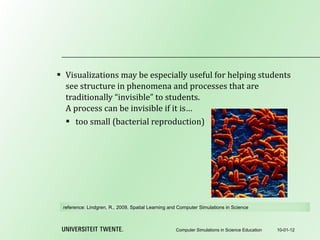
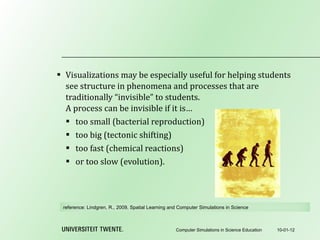
Visualizations may be especially useful for helping students see structure in phenomena and processes that are traditionally “invisible” to students. A process can be invisible if it is… too small (bacterial reproduction) 10-01-12 Computer Simulations in Science Education reference:  Lindgren, R., 2009, Spatial Learning and Computer Simulations in Science
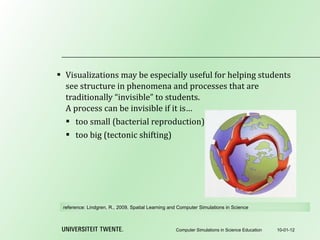
Visualizations may be especially useful for helping students see structure in phenomena and processes that are traditionally “invisible” to students. A process can be invisible if it is… too small (bacterial reproduction) too big (tectonic shifting) 10-01-12 Computer Simulations in Science Education reference:  Lindgren, R., 2009, Spatial Learning and Computer Simulations in Science
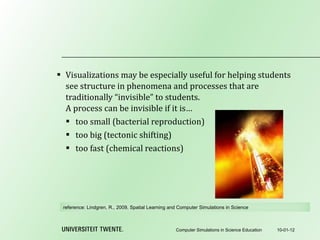
Visualizations may be especially useful for helping students see structure in phenomena and processes that are traditionally “invisible” to students. A process can be invisible if it is… too small (bacterial reproduction) too big (tectonic shifting) too fast (chemical reactions) 10-01-12 Computer Simulations in Science Education reference:  Lindgren, R., 2009, Spatial Learning and Computer Simulations in Science
Visualizations may be especially useful for helping students see structure in phenomena and processes that are traditionally “invisible” to students. A process can be invisible if it is… too small (bacterial reproduction) too big (tectonic shifting) too fast (chemical reactions) or too slow (evolution). 10-01-12 Computer Simulations in Science Education reference:  Lindgren, R., 2009, Spatial Learning and Computer Simulations in Science
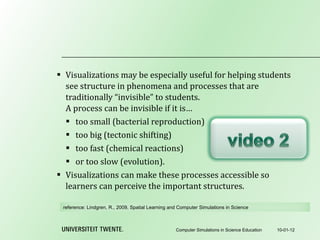
Visualizations may be especially useful for helping students see structure in phenomena and processes that are traditionally “invisible” to students. A process can be invisible if it is… too small (bacterial reproduction) too big (tectonic shifting) too fast (chemical reactions) or too slow (evolution). Visualizations can make these processes accessible so learners can perceive the important structures. 10-01-12 Computer Simulations in Science Education reference:  Lindgren, R., 2009, Spatial Learning and Computer Simulations in Science
Features that are of particular help in the teaching of science: They free up teacher time so that they can interact with students instead of dealing with the management of the experimental setup/apparatus and supervision. Simulations offer an easy way of controlling experimental variables, opening up the possibility of exploration and hypothesizing. Presenting a variety of representational formats including diagrams, graphics, animations, sound and video that can facilitate understanding. 10-01-12 Computer Simulations in Science Education reference:  Blake, C., 2007, Reconsidering simulations in science education at a distance - Features of effective use
COMPUTER SIMULATIONS IN SCIENCE EDUCATION THEORY
Three trends nowadays dominate the field of learning and instruction. Learners are encouraged to:   construct their own knowledge (instead of copying it from an authority be it a book or a teacher):  constructivism   in realistic situations (instead of merely decontextualised, formal situations such as the classroom):  situationism   together with others (instead of on their own):  collaborative learning . 10-01-12 Computer Simulations in Science Education reference:  de Jong, T., 2003, Learning complex domains and complex tasks, the promise of simulation based training
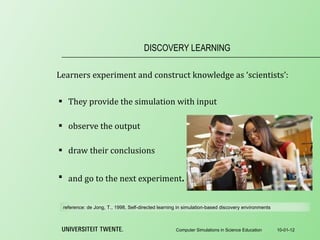
Learners experiment and construct knowledge as ‘scientists’: They provide the simulation with input   observe the output   draw their conclusions   and go to the next experiment . DISCOVERY LEARNING 10-01-12 Computer Simulations in Science Education reference:  de Jong, T., 1998, Self-directed learning in simulation-based discovery environments
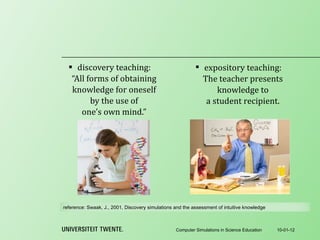
discovery teaching: “All forms of obtaining knowledge for oneself by the use of one’s own mind.” 10-01-12 Computer Simulations in Science Education expository teaching: The teacher presents knowledge to a student recipient. reference:  Swaak, J., 2001, Discovery simulations and the assessment of intuitive knowledge
Scientific discovery is usually interpreted as the processes of mindful coordination between hypothesized theories and evidence collected by experiments. 10-01-12 Computer Simulations in Science Education reference:  Reid, D.J., 2003, Supporting scientific discovery learning in a simulation environment
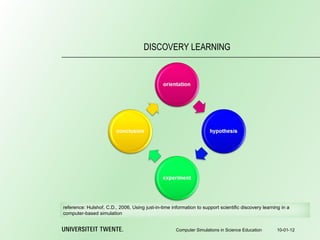
10-01-12 Computer Simulations in Science Education DISCOVERY LEARNING reference:  Hulshof, C.D., 2006, Using just-in-time information to support scientific discovery learning in a computer-based simulation
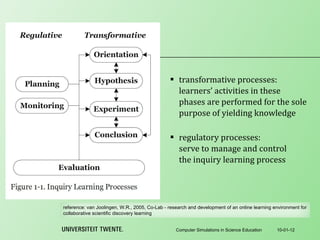
transformative processes: learners’ activities in these phases are performed for the sole purpose of yielding knowledge   regulatory processes: serve to manage and control the inquiry learning process 10-01-12 Computer Simulations in Science Education reference:  van Joolingen, W.R., 2005, Co-Lab - research and development of an online learning environment for collaborative scientific discovery learning
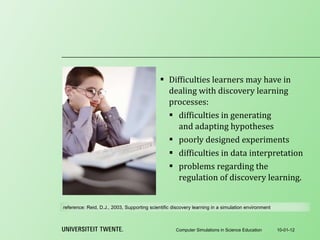
Difficulties learners may have in dealing with discovery learning processes: difficulties in generating and adapting hypotheses poorly designed experiments difficulties in data interpretation problems regarding the regulation of discovery learning . 10-01-12 Computer Simulations in Science Education reference:  Reid, D.J., 2003, Supporting scientific discovery learning in a simulation environment
The goal of scientific discovery learning is not only to help subjects acquire domain knowledge… 10-01-12 Computer Simulations in Science Education … but also to enable them to apply their knowledge in new situations. reference:  van der Meij, J., 2006, Supporting students' learning with multiple representations in a dynamic simulation-based learning environment
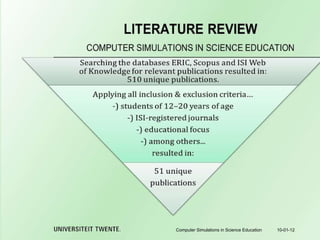
COMPUTER SIMULATIONS IN SCIENCE EDUCATION LITERATURE REVIEW
10-01-12 Computer Simulations in Science Education
 
10-01-12 Computer Simulations in Science Education
Literature review kinds of visualization peer collaboration kinds of support gaming level of engagement
COMPUTER SIMULATIONS IN SCIENCE EDUCATION LITERATURE REVIEW 10-01-12 Computer Simulations in Science Education kinds of visualization
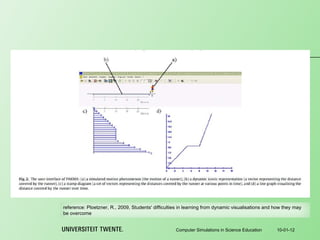
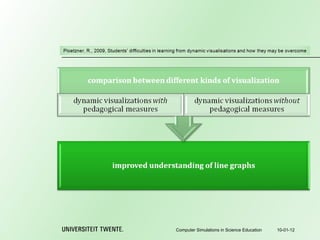
10-01-12 Computer Simulations in Science Education reference:  Ploetzner, R., 2009, Students' difficulties in learning from dynamic visualisations and how they may be overcome
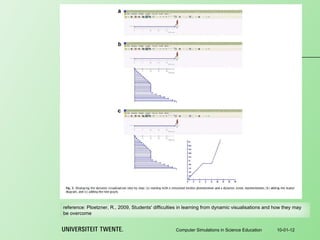
Computer Simulations in Science Education 10-01-12 Ploetzner, R., 2009, Students' difficulties in learning from dynamic visualisations and how they may be overcome
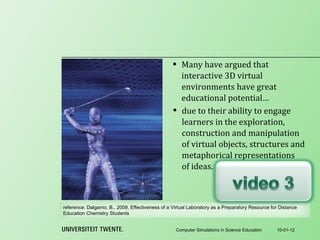
Many have argued that interactive 3D virtual environments have great educational potential… 10-01-12 Computer Simulations in Science Education due to their ability to engage learners in the exploration, construction and manipulation of virtual objects, structures and metaphorical representations of ideas. reference:  Dalgarno, B., 2009, Effectiveness of a Virtual Laboratory as a Preparatory Resource for Distance Education Chemistry Students
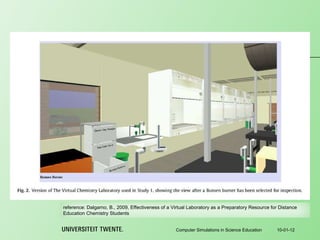
10-01-12 Computer Simulations in Science Education reference:  Dalgarno, B., 2009, Effectiveness of a Virtual Laboratory as a Preparatory Resource for Distance Education Chemistry Students
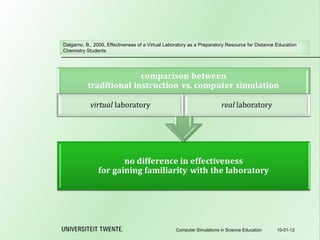
10-01-12 Computer Simulations in Science Education Dalgarno, B., 2009, Effectiveness of a Virtual Laboratory as a Preparatory Resource for Distance Education Chemistry Students
10-01-12 Computer Simulations in Science Education
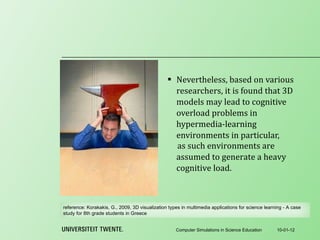
Nevertheless, based on various researchers, it is found that 3D models may lead to cognitive overload problems in hypermedia-learning environments in particular, 10-01-12 Computer Simulations in Science Education as such environments are assumed to generate a heavy cognitive load. reference:  Korakakis, G., 2009, 3D visualization types in multimedia applications for science learning - A case study for 8th grade students in Greece
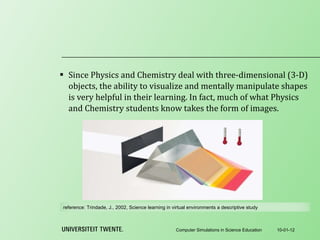
Since Physics and Chemistry deal with three-dimensional (3-D) objects, the ability to visualize and mentally manipulate shapes is very helpful in their learning. In fact, much of what Physics and Chemistry students know takes the form of images. 10-01-12 Computer Simulations in Science Education reference:  Trindade, J., 2002, Science learning in virtual environments a descriptive study
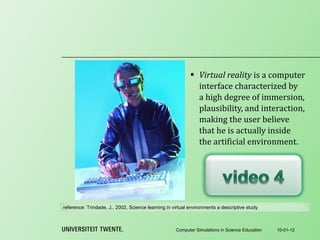
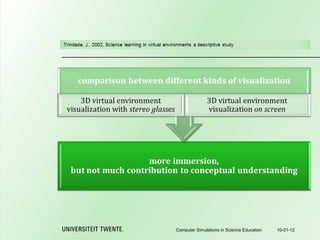
Virtual reality  is a computer interface characterized by a high degree of immersion, plausibility, and interaction, making the user believe that he is actually inside the artificial environment. 10-01-12 Computer Simulations in Science Education reference:  Trindade, J., 2002, Science learning in virtual environments a descriptive study
Computer Simulations in Science Education 10-01-12 Trindade, J., 2002, Science learning in virtual environments a descriptive study
10-01-12 Computer Simulations in Science Education
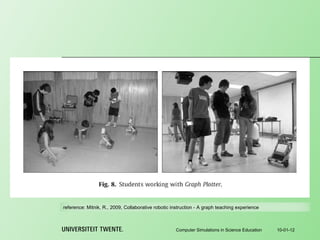
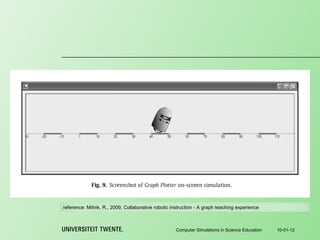
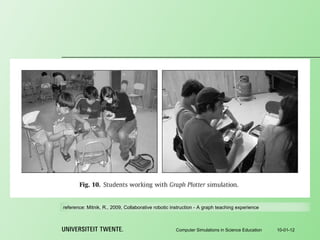
10-01-12 Computer Simulations in Science Education reference:  Mitnik, R., 2009, Collaborative robotic instruction - A graph teaching experience
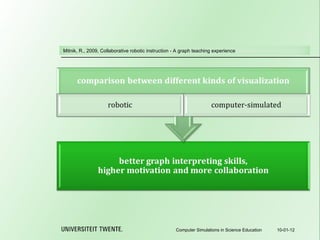
10-01-12 Computer Simulations in Science Education Mitnik, R., 2009, Collaborative robotic instruction - A graph teaching experience
COMPUTER SIMULATIONS IN SCIENCE EDUCATION LITERATURE REVIEW 10-01-12 Computer Simulations in Science Education peer collaboration
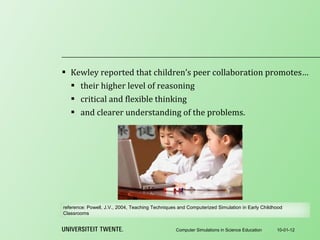
Kewley reported that children’s peer collaboration promotes… their higher level of reasoning critical and flexible thinking and clearer understanding of the problems. 10-01-12 Computer Simulations in Science Education reference:  Powell, J.V., 2004, Teaching Techniques and Computerized Simulation in Early Childhood Classrooms
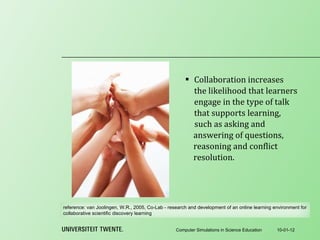
Collaboration increases the likelihood that learners engage in the type of talk that supports learning,  10-01-12 Computer Simulations in Science Education such as asking and answering of questions, reasoning and conflict resolution. reference:  van Joolingen, W.R., 2005, Co-Lab - research and development of an online learning environment for collaborative scientific discovery learning
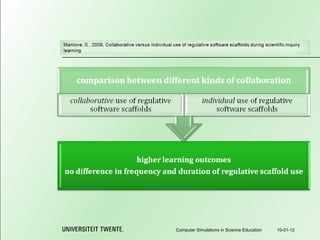
Computer Simulations in Science Education 10-01-12 Manlove, S., 2009, Collaborative versus individual use of regulative software scaffolds during scientific inquiry learning
COMPUTER SIMULATIONS IN SCIENCE EDUCATION LITERATURE REVIEW 10-01-12 Computer Simulations in Science Education kinds of support
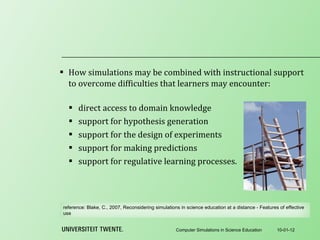
How simulations may be combined with instructional support to overcome difficulties that learners may encounter:   direct access to domain knowledge support for hypothesis generation support for the design of experiments support for making predictions support for regulative learning processes. 10-01-12 Computer Simulations in Science Education reference:  Blake, C., 2007, Reconsidering simulations in science education at a distance - Features of effective use
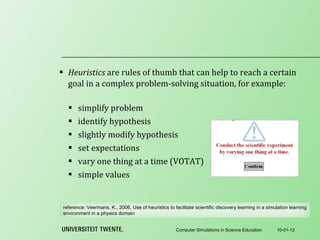
Heuristics  are rules of thumb that can help to reach a certain goal in a complex problem-solving situation, for example:   simplify problem identify hypothesis slightly modify hypothesis set expectations vary one thing at a time (VOTAT) simple values 10-01-12 Computer Simulations in Science Education reference:  Veermans, K., 2006, Use of heuristics to facilitate scientific discovery learning in a simulation learning environment in a physics domain
Heuristics  are rules of thumb that can help to reach a certain goal in a complex problem-solving situation, for example:   equal increments confirm hypothesis extreme values make a graph present evidence keep track. 10-01-12 Computer Simulations in Science Education reference:  Veermans, K., 2006, Use of heuristics to facilitate scientific discovery learning in a simulation learning environment in a physics domain
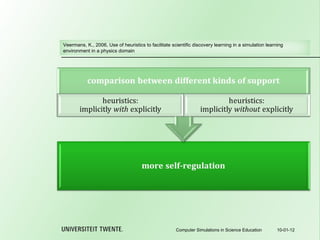
10-01-12 Computer Simulations in Science Education Veermans, K., 2006, Use of heuristics to facilitate scientific discovery learning in a simulation learning environment in a physics domain
COMPUTER SIMULATIONS IN SCIENCE EDUCATION LITERATURE REVIEW 10-01-12 Computer Simulations in Science Education gaming
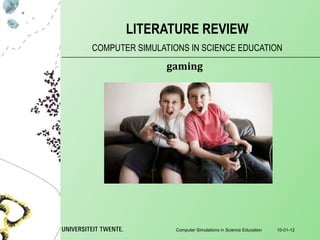
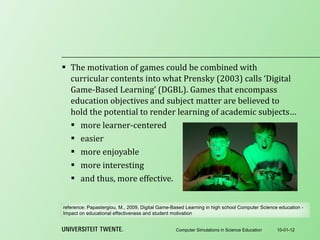
The motivation of games could be combined with curricular contents into what Prensky (2003) calls ‘Digital Game-Based Learning’ (DGBL). Games that encompass education objectives and subject matter are believed to hold the potential to render learning of academic subjects… more learner-centered easier more enjoyable more interesting and thus, more effective. 10-01-12 Computer Simulations in Science Education reference:  Papastergiou, M., 2009, Digital Game-Based Learning in high school Computer Science education - Impact on educational effectiveness and student motivation
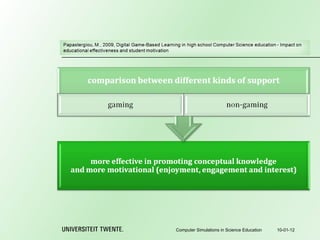
Computer Simulations in Science Education 10-01-12 Papastergiou, M., 2009, Digital Game-Based Learning in high school Computer Science education - Impact on educational effectiveness and student motivation
COMPUTER SIMULATIONS IN SCIENCE EDUCATION LITERATURE REVIEW 10-01-12 Computer Simulations in Science Education level of engagement
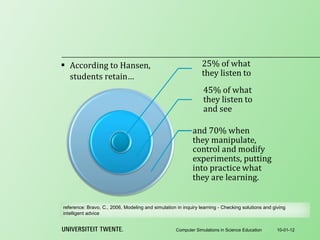
According to Hansen, students retain… 10-01-12 Computer Simulations in Science Education reference:  Bravo, C., 2006, Modeling and simulation in inquiry learning - Checking solutions and giving intelligent advice
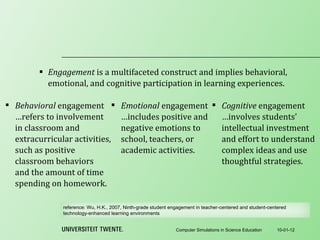
Engagement  is a multifaceted construct and implies behavioral, emotional, and cognitive participation in learning experiences. 10-01-12 Computer Simulations in Science Education Behavioral  engagement …refers to involvement in classroom and extracurricular activities, such as positive classroom behaviors and the amount of time spending on homework. Emotional  engagement …includes positive and negative emotions to school, teachers, or academic activities. Cognitive  engagement …involves students’ intellectual investment and effort to understand complex ideas and use thoughtful strategies. reference:  Wu, H.K., 2007, Ninth-grade student engagement in teacher-centered and student-centered technology-enhanced learning environments
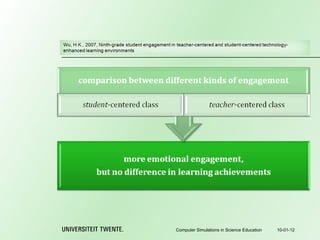
Computer Simulations in Science Education 10-01-12 Wu, H.K., 2007, Ninth-grade student engagement in teacher-centered and student-centered technology-enhanced learning environments
COMPUTER SIMULATIONS IN SCIENCE EDUCATION TEACHING
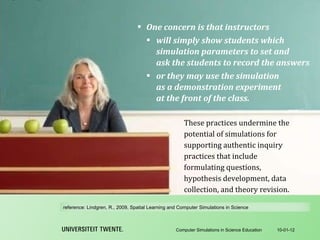
One concern is that instructors will simply show students which simulation parameters to set and ask the students to record the answers or they may use the simulation as a demonstration experiment at the front of the class. 10-01-12 Computer Simulations in Science Education These practices undermine the potential of simulations for supporting authentic inquiry practices that include formulating questions, hypothesis development, data collection, and theory revision. reference:  Lindgren, R., 2009, Spatial Learning and Computer Simulations in Science
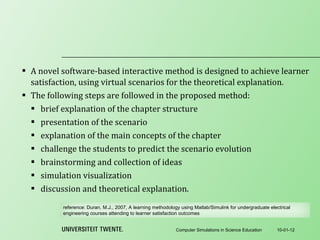
A novel software-based interactive method is designed to achieve learner satisfaction, using virtual scenarios for the theoretical explanation. The following steps are followed in the proposed method : brief explanation of the chapter structure presentation of the scenario explanation of the main concepts of the chapter challenge the students to predict the scenario evolution brainstorming and collection of ideas simulation visualization discussion and theoretical explanation. 10-01-12 Computer Simulations in Science Education reference:  Duran, M.J., 2007, A learning methodology using Matlab/Simulink for undergraduate electrical engineering courses attending to learner satisfaction outcomes
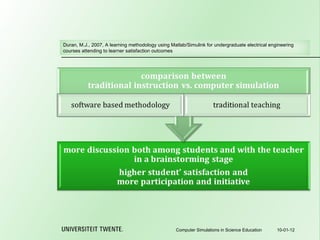
10-01-12 Computer Simulations in Science Education Duran, M.J., 2007, A learning methodology using Matlab/Simulink for undergraduate electrical engineering courses attending to learner satisfaction outcomes
10-01-12 Computer Simulations in Science Education
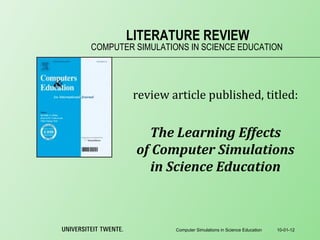
COMPUTER SIMULATIONS IN SCIENCE EDUCATION LITERATURE REVIEW review article published, titled: The Learning Effects of Computer Simulations in Science Education 10-01-12 Computer Simulations in Science Education
10-01-12 Computer Simulations in Science Education http://slidesha.re/simrevEN (case sensitive)

Computer simulations in science education

  • 1.
  • 2.
    PhD research NicoRutten Simulations in school practice professors: Prof. dr. Wouter van Joolingen Prof. dr. Jules Pieters supervisor: Dr. Jan van der Veen
  • 3.
    Introduction Theory Literaturereview Computer Simulations in Science Education Teaching
  • 4.
    COMPUTER SIMULATIONS INSCIENCE EDUCATION INTRODUCTION
  • 5.
    Computer simulations areprograms based on a scientific model of a system or process. 10-01-12 Computer Simulations in Science Education reference: de Jong, T., 1998, Scientific discovery learning with computer simulations of conceptual domains
  • 6.
    10-01-12 Computer Simulationsin Science Education
  • 7.
    Good sims can actually be pedagogically more effective than apparently similar classroom demonstrations and laboratory exercises with real equipment. PhET sims have two main goals: increased student interest and improved learning . 10-01-12 Computer Simulations in Science Education reference: Wieman, C.E., 2006, A powerful tool for teaching science
  • 8.
    10-01-12 Computer Simulationsin Science Education reference: Finkelstein, N., 2006, High-tech tools for teaching physics - The physics education technology project
  • 9.
    10-01-12 Computer Simulationsin Science Education reference: Finkelstein, N., 2006, High-tech tools for teaching physics - The physics education technology project
  • 10.
    Why use them?COMPUTER SIMULATIONS IN SCIENCE EDUCATION INTRODUCTION 10-01-12 Computer Simulations in Science Education
  • 11.
    Because simulations aresimplified versions of the natural world, they have the potential to facilitate learning by focusing students’ attention more directly on the targeted phenomena. 10-01-12 Computer Simulations in Science Education reference: de Jong, T., 1998, Scientific discovery learning with computer simulations of conceptual domains
  • 12.
    In comparison withalternatives such as textbooks, lectures, and tutorial courseware, a simulation-based approach offers the opportunity… to learn in a relatively realistic problem-solving context to practise task performance without stress to systematically explore both realistic and hypothetical situations to change the time-scale of events to interact with simplified versions of the process or system being simulated. 10-01-12 Computer Simulations in Science Education reference: van Berkum, J.A., 1991, Instructional environments for simulations
  • 13.
    Visualizations may beespecially useful for helping students see structure in phenomena and processes that are traditionally “invisible” to students. A process can be invisible if it is… too small (bacterial reproduction) 10-01-12 Computer Simulations in Science Education reference: Lindgren, R., 2009, Spatial Learning and Computer Simulations in Science
  • 14.
    Visualizations may beespecially useful for helping students see structure in phenomena and processes that are traditionally “invisible” to students. A process can be invisible if it is… too small (bacterial reproduction) too big (tectonic shifting) 10-01-12 Computer Simulations in Science Education reference: Lindgren, R., 2009, Spatial Learning and Computer Simulations in Science
  • 15.
    Visualizations may beespecially useful for helping students see structure in phenomena and processes that are traditionally “invisible” to students. A process can be invisible if it is… too small (bacterial reproduction) too big (tectonic shifting) too fast (chemical reactions) 10-01-12 Computer Simulations in Science Education reference: Lindgren, R., 2009, Spatial Learning and Computer Simulations in Science
  • 16.
    Visualizations may beespecially useful for helping students see structure in phenomena and processes that are traditionally “invisible” to students. A process can be invisible if it is… too small (bacterial reproduction) too big (tectonic shifting) too fast (chemical reactions) or too slow (evolution). 10-01-12 Computer Simulations in Science Education reference: Lindgren, R., 2009, Spatial Learning and Computer Simulations in Science
  • 17.
    Visualizations may beespecially useful for helping students see structure in phenomena and processes that are traditionally “invisible” to students. A process can be invisible if it is… too small (bacterial reproduction) too big (tectonic shifting) too fast (chemical reactions) or too slow (evolution). Visualizations can make these processes accessible so learners can perceive the important structures. 10-01-12 Computer Simulations in Science Education reference: Lindgren, R., 2009, Spatial Learning and Computer Simulations in Science
  • 18.
    Features that areof particular help in the teaching of science: They free up teacher time so that they can interact with students instead of dealing with the management of the experimental setup/apparatus and supervision. Simulations offer an easy way of controlling experimental variables, opening up the possibility of exploration and hypothesizing. Presenting a variety of representational formats including diagrams, graphics, animations, sound and video that can facilitate understanding. 10-01-12 Computer Simulations in Science Education reference: Blake, C., 2007, Reconsidering simulations in science education at a distance - Features of effective use
  • 19.
    COMPUTER SIMULATIONS INSCIENCE EDUCATION THEORY
  • 20.
    Three trends nowadaysdominate the field of learning and instruction. Learners are encouraged to: construct their own knowledge (instead of copying it from an authority be it a book or a teacher): constructivism in realistic situations (instead of merely decontextualised, formal situations such as the classroom): situationism together with others (instead of on their own): collaborative learning . 10-01-12 Computer Simulations in Science Education reference: de Jong, T., 2003, Learning complex domains and complex tasks, the promise of simulation based training
  • 21.
    Learners experiment andconstruct knowledge as ‘scientists’: They provide the simulation with input observe the output draw their conclusions and go to the next experiment . DISCOVERY LEARNING 10-01-12 Computer Simulations in Science Education reference: de Jong, T., 1998, Self-directed learning in simulation-based discovery environments
  • 22.
    discovery teaching: “Allforms of obtaining knowledge for oneself by the use of one’s own mind.” 10-01-12 Computer Simulations in Science Education expository teaching: The teacher presents knowledge to a student recipient. reference: Swaak, J., 2001, Discovery simulations and the assessment of intuitive knowledge
  • 23.
    Scientific discovery isusually interpreted as the processes of mindful coordination between hypothesized theories and evidence collected by experiments. 10-01-12 Computer Simulations in Science Education reference: Reid, D.J., 2003, Supporting scientific discovery learning in a simulation environment
  • 24.
    10-01-12 Computer Simulationsin Science Education DISCOVERY LEARNING reference: Hulshof, C.D., 2006, Using just-in-time information to support scientific discovery learning in a computer-based simulation
  • 25.
    transformative processes: learners’activities in these phases are performed for the sole purpose of yielding knowledge regulatory processes: serve to manage and control the inquiry learning process 10-01-12 Computer Simulations in Science Education reference: van Joolingen, W.R., 2005, Co-Lab - research and development of an online learning environment for collaborative scientific discovery learning
  • 26.
    Difficulties learners mayhave in dealing with discovery learning processes: difficulties in generating and adapting hypotheses poorly designed experiments difficulties in data interpretation problems regarding the regulation of discovery learning . 10-01-12 Computer Simulations in Science Education reference: Reid, D.J., 2003, Supporting scientific discovery learning in a simulation environment
  • 27.
    The goal ofscientific discovery learning is not only to help subjects acquire domain knowledge… 10-01-12 Computer Simulations in Science Education … but also to enable them to apply their knowledge in new situations. reference: van der Meij, J., 2006, Supporting students' learning with multiple representations in a dynamic simulation-based learning environment
  • 28.
    COMPUTER SIMULATIONS INSCIENCE EDUCATION LITERATURE REVIEW
  • 29.
    10-01-12 Computer Simulationsin Science Education
  • 30.
  • 31.
    10-01-12 Computer Simulationsin Science Education
  • 32.
    Literature review kindsof visualization peer collaboration kinds of support gaming level of engagement
  • 33.
    COMPUTER SIMULATIONS INSCIENCE EDUCATION LITERATURE REVIEW 10-01-12 Computer Simulations in Science Education kinds of visualization
  • 34.
    10-01-12 Computer Simulationsin Science Education reference: Ploetzner, R., 2009, Students' difficulties in learning from dynamic visualisations and how they may be overcome
  • 35.
    10-01-12 Computer Simulationsin Science Education reference: Ploetzner, R., 2009, Students' difficulties in learning from dynamic visualisations and how they may be overcome
  • 36.
    Computer Simulations inScience Education 10-01-12 Ploetzner, R., 2009, Students' difficulties in learning from dynamic visualisations and how they may be overcome
  • 37.
    Many have arguedthat interactive 3D virtual environments have great educational potential… 10-01-12 Computer Simulations in Science Education due to their ability to engage learners in the exploration, construction and manipulation of virtual objects, structures and metaphorical representations of ideas. reference: Dalgarno, B., 2009, Effectiveness of a Virtual Laboratory as a Preparatory Resource for Distance Education Chemistry Students
  • 38.
    10-01-12 Computer Simulationsin Science Education reference: Dalgarno, B., 2009, Effectiveness of a Virtual Laboratory as a Preparatory Resource for Distance Education Chemistry Students
  • 39.
    10-01-12 Computer Simulationsin Science Education Dalgarno, B., 2009, Effectiveness of a Virtual Laboratory as a Preparatory Resource for Distance Education Chemistry Students
  • 40.
    10-01-12 Computer Simulationsin Science Education
  • 41.
    Nevertheless, based onvarious researchers, it is found that 3D models may lead to cognitive overload problems in hypermedia-learning environments in particular, 10-01-12 Computer Simulations in Science Education as such environments are assumed to generate a heavy cognitive load. reference: Korakakis, G., 2009, 3D visualization types in multimedia applications for science learning - A case study for 8th grade students in Greece
  • 42.
    Since Physics andChemistry deal with three-dimensional (3-D) objects, the ability to visualize and mentally manipulate shapes is very helpful in their learning. In fact, much of what Physics and Chemistry students know takes the form of images. 10-01-12 Computer Simulations in Science Education reference: Trindade, J., 2002, Science learning in virtual environments a descriptive study
  • 43.
    Virtual reality is a computer interface characterized by a high degree of immersion, plausibility, and interaction, making the user believe that he is actually inside the artificial environment. 10-01-12 Computer Simulations in Science Education reference: Trindade, J., 2002, Science learning in virtual environments a descriptive study
  • 44.
    Computer Simulations inScience Education 10-01-12 Trindade, J., 2002, Science learning in virtual environments a descriptive study
  • 45.
    10-01-12 Computer Simulationsin Science Education
  • 46.
    10-01-12 Computer Simulationsin Science Education reference: Mitnik, R., 2009, Collaborative robotic instruction - A graph teaching experience
  • 47.
    10-01-12 Computer Simulationsin Science Education reference: Mitnik, R., 2009, Collaborative robotic instruction - A graph teaching experience
  • 48.
    10-01-12 Computer Simulationsin Science Education reference: Mitnik, R., 2009, Collaborative robotic instruction - A graph teaching experience
  • 49.
    10-01-12 Computer Simulationsin Science Education Mitnik, R., 2009, Collaborative robotic instruction - A graph teaching experience
  • 50.
    COMPUTER SIMULATIONS INSCIENCE EDUCATION LITERATURE REVIEW 10-01-12 Computer Simulations in Science Education peer collaboration
  • 51.
    Kewley reported thatchildren’s peer collaboration promotes… their higher level of reasoning critical and flexible thinking and clearer understanding of the problems. 10-01-12 Computer Simulations in Science Education reference: Powell, J.V., 2004, Teaching Techniques and Computerized Simulation in Early Childhood Classrooms
  • 52.
    Collaboration increases thelikelihood that learners engage in the type of talk that supports learning, 10-01-12 Computer Simulations in Science Education such as asking and answering of questions, reasoning and conflict resolution. reference: van Joolingen, W.R., 2005, Co-Lab - research and development of an online learning environment for collaborative scientific discovery learning
  • 53.
    Computer Simulations inScience Education 10-01-12 Manlove, S., 2009, Collaborative versus individual use of regulative software scaffolds during scientific inquiry learning
  • 54.
    COMPUTER SIMULATIONS INSCIENCE EDUCATION LITERATURE REVIEW 10-01-12 Computer Simulations in Science Education kinds of support
  • 55.
    How simulations maybe combined with instructional support to overcome difficulties that learners may encounter: direct access to domain knowledge support for hypothesis generation support for the design of experiments support for making predictions support for regulative learning processes. 10-01-12 Computer Simulations in Science Education reference: Blake, C., 2007, Reconsidering simulations in science education at a distance - Features of effective use
  • 56.
    Heuristics arerules of thumb that can help to reach a certain goal in a complex problem-solving situation, for example: simplify problem identify hypothesis slightly modify hypothesis set expectations vary one thing at a time (VOTAT) simple values 10-01-12 Computer Simulations in Science Education reference: Veermans, K., 2006, Use of heuristics to facilitate scientific discovery learning in a simulation learning environment in a physics domain
  • 57.
    Heuristics arerules of thumb that can help to reach a certain goal in a complex problem-solving situation, for example: equal increments confirm hypothesis extreme values make a graph present evidence keep track. 10-01-12 Computer Simulations in Science Education reference: Veermans, K., 2006, Use of heuristics to facilitate scientific discovery learning in a simulation learning environment in a physics domain
  • 58.
    10-01-12 Computer Simulationsin Science Education Veermans, K., 2006, Use of heuristics to facilitate scientific discovery learning in a simulation learning environment in a physics domain
  • 59.
    COMPUTER SIMULATIONS INSCIENCE EDUCATION LITERATURE REVIEW 10-01-12 Computer Simulations in Science Education gaming
  • 60.
    The motivation ofgames could be combined with curricular contents into what Prensky (2003) calls ‘Digital Game-Based Learning’ (DGBL). Games that encompass education objectives and subject matter are believed to hold the potential to render learning of academic subjects… more learner-centered easier more enjoyable more interesting and thus, more effective. 10-01-12 Computer Simulations in Science Education reference: Papastergiou, M., 2009, Digital Game-Based Learning in high school Computer Science education - Impact on educational effectiveness and student motivation
  • 61.
    Computer Simulations inScience Education 10-01-12 Papastergiou, M., 2009, Digital Game-Based Learning in high school Computer Science education - Impact on educational effectiveness and student motivation
  • 62.
    COMPUTER SIMULATIONS INSCIENCE EDUCATION LITERATURE REVIEW 10-01-12 Computer Simulations in Science Education level of engagement
  • 63.
    According to Hansen,students retain… 10-01-12 Computer Simulations in Science Education reference: Bravo, C., 2006, Modeling and simulation in inquiry learning - Checking solutions and giving intelligent advice
  • 64.
    Engagement isa multifaceted construct and implies behavioral, emotional, and cognitive participation in learning experiences. 10-01-12 Computer Simulations in Science Education Behavioral engagement …refers to involvement in classroom and extracurricular activities, such as positive classroom behaviors and the amount of time spending on homework. Emotional engagement …includes positive and negative emotions to school, teachers, or academic activities. Cognitive engagement …involves students’ intellectual investment and effort to understand complex ideas and use thoughtful strategies. reference: Wu, H.K., 2007, Ninth-grade student engagement in teacher-centered and student-centered technology-enhanced learning environments
  • 65.
    Computer Simulations inScience Education 10-01-12 Wu, H.K., 2007, Ninth-grade student engagement in teacher-centered and student-centered technology-enhanced learning environments
  • 66.
    COMPUTER SIMULATIONS INSCIENCE EDUCATION TEACHING
  • 67.
    One concern isthat instructors will simply show students which simulation parameters to set and ask the students to record the answers or they may use the simulation as a demonstration experiment at the front of the class. 10-01-12 Computer Simulations in Science Education These practices undermine the potential of simulations for supporting authentic inquiry practices that include formulating questions, hypothesis development, data collection, and theory revision. reference: Lindgren, R., 2009, Spatial Learning and Computer Simulations in Science
  • 68.
    A novel software-basedinteractive method is designed to achieve learner satisfaction, using virtual scenarios for the theoretical explanation. The following steps are followed in the proposed method : brief explanation of the chapter structure presentation of the scenario explanation of the main concepts of the chapter challenge the students to predict the scenario evolution brainstorming and collection of ideas simulation visualization discussion and theoretical explanation. 10-01-12 Computer Simulations in Science Education reference: Duran, M.J., 2007, A learning methodology using Matlab/Simulink for undergraduate electrical engineering courses attending to learner satisfaction outcomes
  • 69.
    10-01-12 Computer Simulationsin Science Education Duran, M.J., 2007, A learning methodology using Matlab/Simulink for undergraduate electrical engineering courses attending to learner satisfaction outcomes
  • 70.
    10-01-12 Computer Simulationsin Science Education
  • 71.
    COMPUTER SIMULATIONS INSCIENCE EDUCATION LITERATURE REVIEW review article published, titled: The Learning Effects of Computer Simulations in Science Education 10-01-12 Computer Simulations in Science Education
  • 72.
    10-01-12 Computer Simulationsin Science Education http://slidesha.re/simrevEN (case sensitive)