Promoting Student Engagement
and Imagination through
Project-Based Learning
Joe Krajcik
CREATE for STEM
Michigan State University
Our challenge
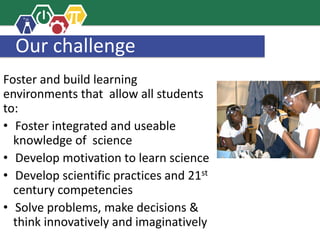
Foster and build learning
environments that allow all students
to:
• Foster integrated and useable
knowledge of science
• Develop motivation to learn science
• Develop scientific practices and 21st
century competencies
• Solve problems, make decisions &
think innovatively and imaginatively
or
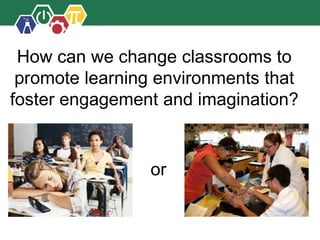
How can we change classrooms to
promote learning environments that
foster engagement and imagination?
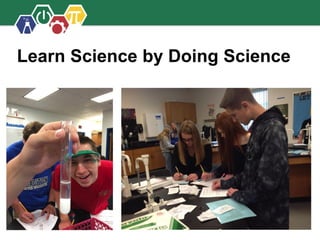
Learn Science by Doing Science
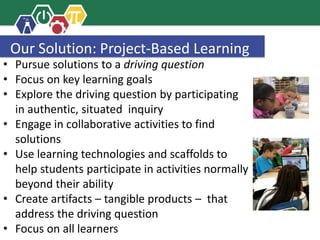
Our Solution: Project-Based Learning
• Pursue solutions to a driving question
• Focus on key learning goals
• Explore the driving question by participating
in authentic, situated inquiry
• Engage in collaborative activities to find
solutions
• Use learning technologies and scaffolds to
help students participate in activities normally
beyond their ability
• Create artifacts – tangible products – that
address the driving question
• Focus on all learners
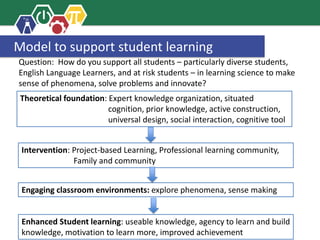
Model to support student learning
Theoretical foundation: Expert knowledge organization, situated
cognition, prior knowledge, active construction,
universal design, social interaction, cognitive tool
Intervention: Project-based Learning, Professional learning community,
Family and community
Enhanced Student learning: useable knowledge, agency to learn and build
knowledge, motivation to learn more, improved achievement
Question: How do you support all students – particularly diverse students,
English Language Learners, and at risk students – in learning science to make
sense of phenomena, solve problems and innovate?
Engaging classroom environments: explore phenomena, sense making
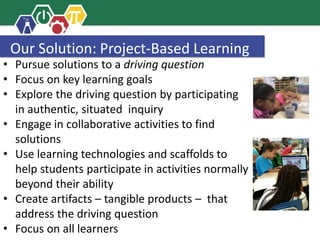
Our Solution: Project-Based Learning
• Pursue solutions to a driving question
• Focus on key learning goals
• Explore the driving question by participating
in authentic, situated inquiry
• Engage in collaborative activities to find
solutions
• Use learning technologies and scaffolds to
help students participate in activities normally
beyond their ability
• Create artifacts – tangible products – that
address the driving question
• Focus on all learners
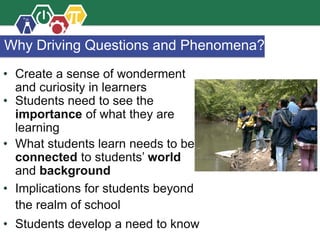
Why Driving Questions and Phenomena?
• Create a sense of wonderment
and curiosity in learners
• Students need to see the
importance of what they are
learning
• What students learn needs to be
connected to students’ world
and background
• Implications for students beyond
the realm of school
• Students develop a need to know
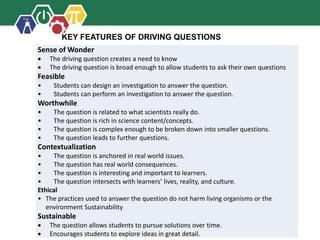
Sense of Wonder
 The driving question creates a need to know
 The driving question is broad enough to allow students to ask their own questions
Feasible
• Students can design an investigation to answer the question.
• Students can perform an investigation to answer the question.
Worthwhile
• The question is related to what scientists really do.
• The question is rich in science content/concepts.
• The question is complex enough to be broken down into smaller questions.
• The question leads to further questions.
Contextualization
• The question is anchored in real world issues.
• The question has real world consequences.
• The question is interesting and important to learners.
• The question intersects with learners’ lives, reality, and culture.
Ethical
• The practices used to answer the question do not harm living organisms or the
environment Sustainability
Sustainable
 The question allows students to pursue solutions over time.
 Encourages students to explore ideas in great detail.
KEY FEATURES OF DRIVING QUESTIONS
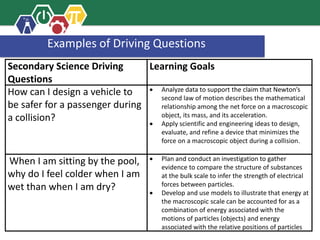
Examples of Driving Questions
Secondary Science Driving
Questions
Learning Goals
How can I design a vehicle to
be safer for a passenger during
a collision?
 Analyze data to support the claim that Newton’s
second law of motion describes the mathematical
relationship among the net force on a macroscopic
object, its mass, and its acceleration.
 Apply scientific and engineering ideas to design,
evaluate, and refine a device that minimizes the
force on a macroscopic object during a collision.
When I am sitting by the pool,
why do I feel colder when I am
wet than when I am dry?
 Plan and conduct an investigation to gather
evidence to compare the structure of substances
at the bulk scale to infer the strength of electrical
forces between particles.
 Develop and use models to illustrate that energy at
the macroscopic scale can be accounted for as a
combination of energy associated with the
motions of particles (objects) and energy
associated with the relative positions of particles
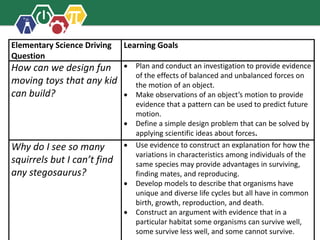
Elementary Science Driving
Question
Learning Goals
How can we design fun
moving toys that any kid
can build?
 Plan and conduct an investigation to provide evidence
of the effects of balanced and unbalanced forces on
the motion of an object.
 Make observations of an object’s motion to provide
evidence that a pattern can be used to predict future
motion.
 Define a simple design problem that can be solved by
applying scientific ideas about forces.
Why do I see so many
squirrels but I can’t find
any stegosaurus?
 Use evidence to construct an explanation for how the
variations in characteristics among individuals of the
same species may provide advantages in surviving,
finding mates, and reproducing.
 Develop models to describe that organisms have
unique and diverse life cycles but all have in common
birth, growth, reproduction, and death.
 Construct an argument with evidence that in a
particular habitat some organisms can survive well,
some survive less well, and some cannot survive.
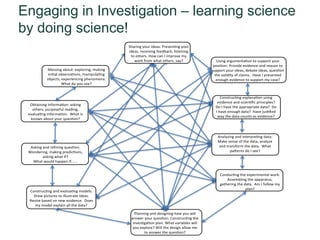
Messing about: exploring, making
ini al observa ons, manipula ng
objects, experiencing phenomena.
What do you see?
Obtaining Informa on: asking
others, purposeful reading,
evalua ng informa on. What is
known about your ques on?
Asking and refining ques on:
Wondering, making predic ons,
asking what if?
What would happen if......
Construc ng and evalua ng models:
Draw pictures to illustrate ideas.
Revise based on new evidence. Does
my model explain all the data?
Planning and designing how you will
answer your ques on: Construc ng the
inves ga on plan. What variables will
you explore? Will the design allow me
to answer the ques on?
Conduc ng the experimental work:
Assembling the apparatus,
gathering the data. Am I follow my
plan?
Analyzing and interpre ng data:
Make sense of the data, analyze
and transform the data. What
pa erns do I see?
Construc ng explana on using
evidence and scien fic principles?
Do I have the appropriate data? Do
I have enough data? Have jus fied
way the data counts as evidence?
Sharing your ideas: Presen ng your
ideas, receiving feedback, listening
to others. How can I improve my
work from what others. say? Using argumenta on to support your
posi on: Provide evidence and reason to
support your ideas, debate ideas, ques on
the validity of claims. Have I presented
enough evidence to support my case?
Engaging in Investigation – learning science
by doing science!
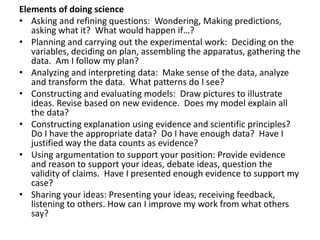
Elements of doing science
• Asking and refining questions: Wondering, Making predictions,
asking what it? What would happen if…?
• Planning and carrying out the experimental work: Deciding on the
variables, deciding on plan, assembling the apparatus, gathering the
data. Am I follow my plan?
• Analyzing and interpreting data: Make sense of the data, analyze
and transform the data. What patterns do I see?
• Constructing and evaluating models: Draw pictures to illustrate
ideas. Revise based on new evidence. Does my model explain all
the data?
• Constructing explanation using evidence and scientific principles?
Do I have the appropriate data? Do I have enough data? Have I
justified way the data counts as evidence?
• Using argumentation to support your position: Provide evidence
and reason to support your ideas, debate ideas, question the
validity of claims. Have I presented enough evidence to support my
case?
• Sharing your ideas: Presenting your ideas, receiving feedback,
listening to others. How can I improve my work from what others
say?
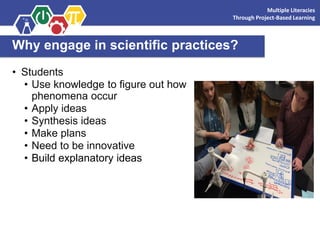
Why engage in scientific practices?
• Students
• Use knowledge to figure out how
phenomena occur
• Apply ideas
• Synthesis ideas
• Make plans
• Need to be innovative
• Build explanatory ideas
Multiple Literacies
Through Project-Based Learning
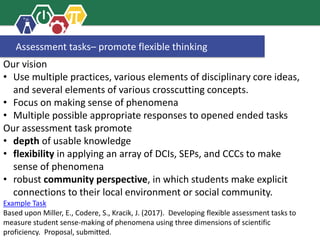
Assessment tasks– promote flexible thinking
Our vision
• Use multiple practices, various elements of disciplinary core ideas,
and several elements of various crosscutting concepts.
• Focus on making sense of phenomena
• Multiple possible appropriate responses to opened ended tasks
Our assessment task promote
• depth of usable knowledge
• flexibility in applying an array of DCIs, SEPs, and CCCs to make
sense of phenomena
• robust community perspective, in which students make explicit
connections to their local environment or social community.
Example Task
Based upon Miller, E., Codere, S., Kracik, J. (2017). Developing flexible assessment tasks to
measure student sense-making of phenomena using three dimensions of scientific
proficiency. Proposal, submitted.
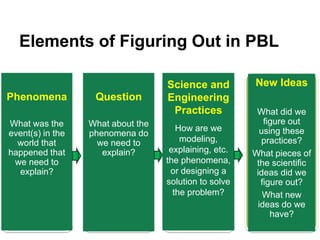
Elements of Figuring Out in PBL
Phenomena
What was the
event(s) in the
world that
happened that
we need to
explain?
Question
What about the
phenomena do
we need to
explain?
Science and
Engineering
Practices
How are we
modeling,
explaining, etc.
the phenomena,
or designing a
solution to solve
the problem?
New Ideas
What did we
figure out
using these
practices?
What pieces of
the scientific
ideas did we
figure out?
What new
ideas do we
have?
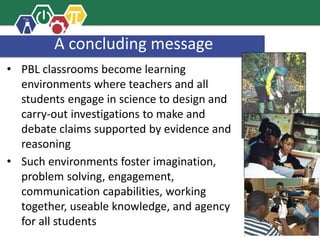
A concluding message
• PBL classrooms become learning
environments where teachers and all
students engage in science to design and
carry-out investigations to make and
debate claims supported by evidence and
reasoning
• Such environments foster imagination,
problem solving, engagement,
communication capabilities, working
together, useable knowledge, and agency
for all students
Thank You!
Joe Krajcik, krajcik@msu.edu @krajcikjoe
Thanks to all my collaborators: Barbara
Schneider, Emily Miller, Deborah Peek-Brown,
Susan Codere, Tom Bielik ,

Promoting Student Engagement and Imagination Through Project-Based Learning

  • 1.
    Promoting Student Engagement andImagination through Project-Based Learning Joe Krajcik CREATE for STEM Michigan State University
  • 2.
    Our challenge Foster andbuild learning environments that allow all students to: • Foster integrated and useable knowledge of science • Develop motivation to learn science • Develop scientific practices and 21st century competencies • Solve problems, make decisions & think innovatively and imaginatively
  • 3.
    or How can wechange classrooms to promote learning environments that foster engagement and imagination?
  • 4.
    Learn Science byDoing Science
  • 5.
    Our Solution: Project-BasedLearning • Pursue solutions to a driving question • Focus on key learning goals • Explore the driving question by participating in authentic, situated inquiry • Engage in collaborative activities to find solutions • Use learning technologies and scaffolds to help students participate in activities normally beyond their ability • Create artifacts – tangible products – that address the driving question • Focus on all learners
  • 6.
    Model to supportstudent learning Theoretical foundation: Expert knowledge organization, situated cognition, prior knowledge, active construction, universal design, social interaction, cognitive tool Intervention: Project-based Learning, Professional learning community, Family and community Enhanced Student learning: useable knowledge, agency to learn and build knowledge, motivation to learn more, improved achievement Question: How do you support all students – particularly diverse students, English Language Learners, and at risk students – in learning science to make sense of phenomena, solve problems and innovate? Engaging classroom environments: explore phenomena, sense making
  • 7.
    Our Solution: Project-BasedLearning • Pursue solutions to a driving question • Focus on key learning goals • Explore the driving question by participating in authentic, situated inquiry • Engage in collaborative activities to find solutions • Use learning technologies and scaffolds to help students participate in activities normally beyond their ability • Create artifacts – tangible products – that address the driving question • Focus on all learners
  • 8.
    Why Driving Questionsand Phenomena? • Create a sense of wonderment and curiosity in learners • Students need to see the importance of what they are learning • What students learn needs to be connected to students’ world and background • Implications for students beyond the realm of school • Students develop a need to know
  • 9.
    Sense of Wonder The driving question creates a need to know  The driving question is broad enough to allow students to ask their own questions Feasible • Students can design an investigation to answer the question. • Students can perform an investigation to answer the question. Worthwhile • The question is related to what scientists really do. • The question is rich in science content/concepts. • The question is complex enough to be broken down into smaller questions. • The question leads to further questions. Contextualization • The question is anchored in real world issues. • The question has real world consequences. • The question is interesting and important to learners. • The question intersects with learners’ lives, reality, and culture. Ethical • The practices used to answer the question do not harm living organisms or the environment Sustainability Sustainable  The question allows students to pursue solutions over time.  Encourages students to explore ideas in great detail. KEY FEATURES OF DRIVING QUESTIONS
  • 10.
    Examples of DrivingQuestions Secondary Science Driving Questions Learning Goals How can I design a vehicle to be safer for a passenger during a collision?  Analyze data to support the claim that Newton’s second law of motion describes the mathematical relationship among the net force on a macroscopic object, its mass, and its acceleration.  Apply scientific and engineering ideas to design, evaluate, and refine a device that minimizes the force on a macroscopic object during a collision. When I am sitting by the pool, why do I feel colder when I am wet than when I am dry?  Plan and conduct an investigation to gather evidence to compare the structure of substances at the bulk scale to infer the strength of electrical forces between particles.  Develop and use models to illustrate that energy at the macroscopic scale can be accounted for as a combination of energy associated with the motions of particles (objects) and energy associated with the relative positions of particles
  • 11.
    Elementary Science Driving Question LearningGoals How can we design fun moving toys that any kid can build?  Plan and conduct an investigation to provide evidence of the effects of balanced and unbalanced forces on the motion of an object.  Make observations of an object’s motion to provide evidence that a pattern can be used to predict future motion.  Define a simple design problem that can be solved by applying scientific ideas about forces. Why do I see so many squirrels but I can’t find any stegosaurus?  Use evidence to construct an explanation for how the variations in characteristics among individuals of the same species may provide advantages in surviving, finding mates, and reproducing.  Develop models to describe that organisms have unique and diverse life cycles but all have in common birth, growth, reproduction, and death.  Construct an argument with evidence that in a particular habitat some organisms can survive well, some survive less well, and some cannot survive.
  • 12.
    Messing about: exploring,making ini al observa ons, manipula ng objects, experiencing phenomena. What do you see? Obtaining Informa on: asking others, purposeful reading, evalua ng informa on. What is known about your ques on? Asking and refining ques on: Wondering, making predic ons, asking what if? What would happen if...... Construc ng and evalua ng models: Draw pictures to illustrate ideas. Revise based on new evidence. Does my model explain all the data? Planning and designing how you will answer your ques on: Construc ng the inves ga on plan. What variables will you explore? Will the design allow me to answer the ques on? Conduc ng the experimental work: Assembling the apparatus, gathering the data. Am I follow my plan? Analyzing and interpre ng data: Make sense of the data, analyze and transform the data. What pa erns do I see? Construc ng explana on using evidence and scien fic principles? Do I have the appropriate data? Do I have enough data? Have jus fied way the data counts as evidence? Sharing your ideas: Presen ng your ideas, receiving feedback, listening to others. How can I improve my work from what others. say? Using argumenta on to support your posi on: Provide evidence and reason to support your ideas, debate ideas, ques on the validity of claims. Have I presented enough evidence to support my case? Engaging in Investigation – learning science by doing science!
  • 13.
    Elements of doingscience • Asking and refining questions: Wondering, Making predictions, asking what it? What would happen if…? • Planning and carrying out the experimental work: Deciding on the variables, deciding on plan, assembling the apparatus, gathering the data. Am I follow my plan? • Analyzing and interpreting data: Make sense of the data, analyze and transform the data. What patterns do I see? • Constructing and evaluating models: Draw pictures to illustrate ideas. Revise based on new evidence. Does my model explain all the data? • Constructing explanation using evidence and scientific principles? Do I have the appropriate data? Do I have enough data? Have I justified way the data counts as evidence? • Using argumentation to support your position: Provide evidence and reason to support your ideas, debate ideas, question the validity of claims. Have I presented enough evidence to support my case? • Sharing your ideas: Presenting your ideas, receiving feedback, listening to others. How can I improve my work from what others say?
  • 14.
    Why engage inscientific practices? • Students • Use knowledge to figure out how phenomena occur • Apply ideas • Synthesis ideas • Make plans • Need to be innovative • Build explanatory ideas Multiple Literacies Through Project-Based Learning
  • 15.
    Assessment tasks– promoteflexible thinking Our vision • Use multiple practices, various elements of disciplinary core ideas, and several elements of various crosscutting concepts. • Focus on making sense of phenomena • Multiple possible appropriate responses to opened ended tasks Our assessment task promote • depth of usable knowledge • flexibility in applying an array of DCIs, SEPs, and CCCs to make sense of phenomena • robust community perspective, in which students make explicit connections to their local environment or social community. Example Task Based upon Miller, E., Codere, S., Kracik, J. (2017). Developing flexible assessment tasks to measure student sense-making of phenomena using three dimensions of scientific proficiency. Proposal, submitted.
  • 16.
    Elements of FiguringOut in PBL Phenomena What was the event(s) in the world that happened that we need to explain? Question What about the phenomena do we need to explain? Science and Engineering Practices How are we modeling, explaining, etc. the phenomena, or designing a solution to solve the problem? New Ideas What did we figure out using these practices? What pieces of the scientific ideas did we figure out? What new ideas do we have?
  • 17.
    A concluding message •PBL classrooms become learning environments where teachers and all students engage in science to design and carry-out investigations to make and debate claims supported by evidence and reasoning • Such environments foster imagination, problem solving, engagement, communication capabilities, working together, useable knowledge, and agency for all students
  • 18.
    Thank You! Joe Krajcik,krajcik@msu.edu @krajcikjoe Thanks to all my collaborators: Barbara Schneider, Emily Miller, Deborah Peek-Brown, Susan Codere, Tom Bielik ,