CURRICULUM
DEVELOPMENT
PROCESSES AND MODELS
CURRICULUM DEVELOPMENT
- Is defined as planned,
purposeful, progressive, and
systematic process to create
positive improvements in the
educational system.
Curriculum Development
Process
-it is dynamic process involving many
different people and procedures.
-development connotes changes
which is systematic.
-it will systematically organizes
through what will be taught, who
will be taught, and how it will be
taught the lesson.
Four (4) Phases of Curriculum
Development Process
1. Curriculum Planning
- Considers the school vision, mission and
goals
2. Curriculum Designing
-Is the way curriculum is conceptualized to
include the selection and organization of
the content, the selection and organization
of learning experiences or activities and the
selection of the assessment procedures and
tools to measure achieved learning
outcomes.
3.Curriculum Implementing
-is putting into action the
plan which is based on the
curriculum design in the
classroom setting or the
learning environment.
4. Curriculum Evaluating
-determines the extent to
which the desired
outcomes have been
achieved.
What is curriculum model?
A model is format for curriculum
design developed to meet unique
needs, contexts and/or purposes. In
order to address these goals,
curriculum developers design,
reconfigure, or rearrange, one or
more key curriculum components.
Models From Well-known
Curricuralist
Tyler’s Model
HildaTaba’s Model
Galen Saylor and William
Alexander Curriculum
Model
The Tyler’s Model
- Also known asTyler’s
Rationale
- Book Basic Principles of
Curriculum and Instruction
- Deductive
4 Fundamental Principles
and Questions
1. What educational purposes
should the school to attain?
-Determine the school’s
purposes.
2. What educational
experiences can be
provided that are likely to
attain these purposes?
- Identify educational
experiences related to
purpose.
3. How can these
educational experiences be
effectively organized ?
- Organizes the experience
4. How can we determine
whether these purposes
are being attained?
- Evaluate the purpose
The Hilda Taba’s Model
 Grassroots Approach
 HildaTaba is the developer of of the
Taba Model of Learning
 The main concepts of this approach
to curriculum development is that
teachers must be involved in the
development curriculum.
7 STEPS IN TABA MODEL
1.Diagnosis of the learners
need and expectations of
the larger society
2.Formulation of objectives
3.Selection of the content
4. Organization of the content
5. Selection of the leaning
experiences
6. Organization of the learning
activities
7. Determines of what to
evaluate and the means of
doing it
Galen Saylor and William
Alexander Model
-Curriculum is plan for providing
sets of learning opportunities to
achieve broad educational goals
and related specific objectives
for identifiable population
served by a single school center.
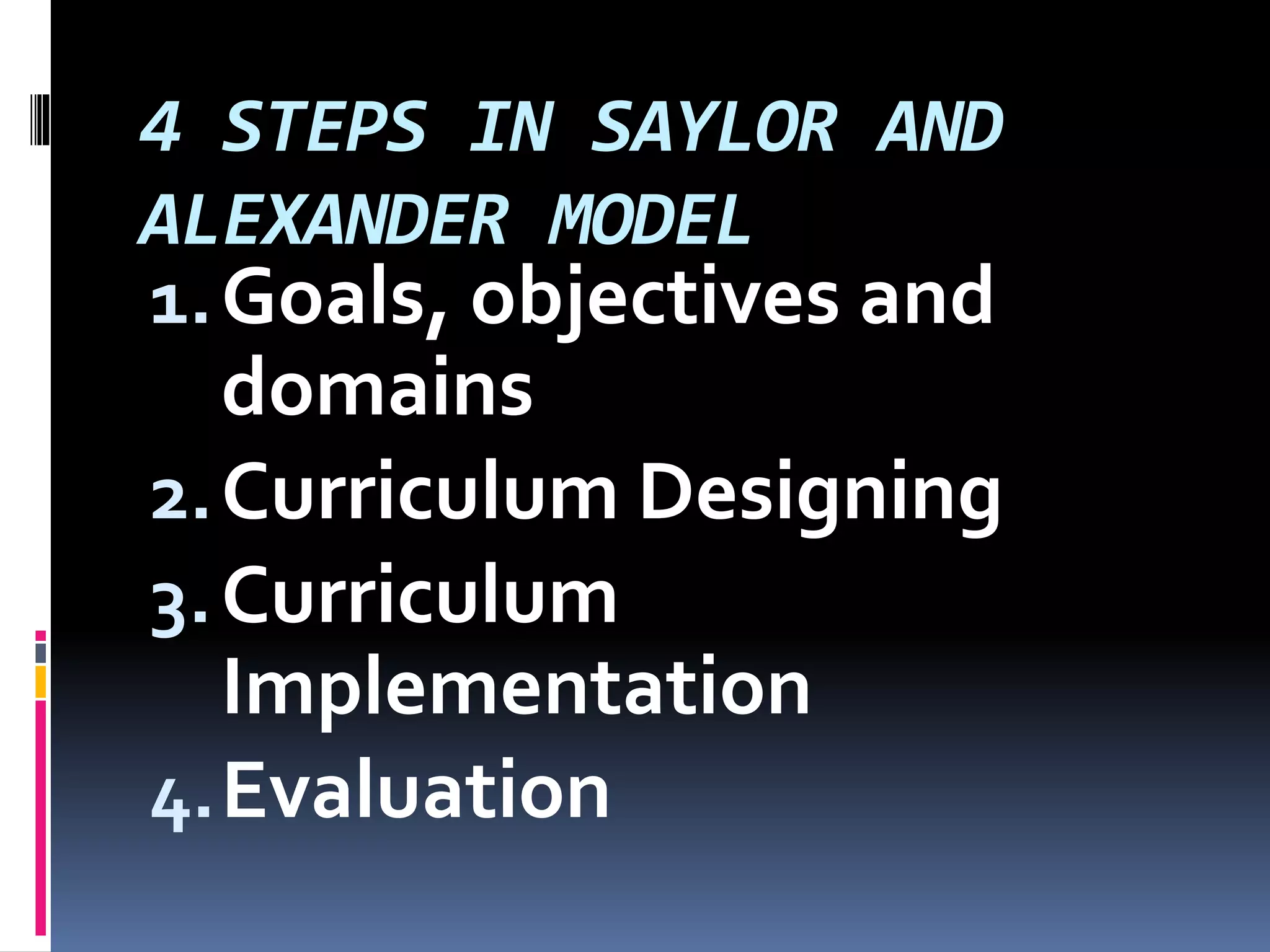
4 STEPS IN SAYLOR AND
ALEXANDER MODEL
1.Goals, objectives and
domains
2.Curriculum Designing
3.Curriculum
Implementation
4.Evaluation
CURRICULUM DEVELOPMENT PROCESSES AND MODELS.pptx

CURRICULUM DEVELOPMENT PROCESSES AND MODELS.pptx

  • 1.
  • 2.
    CURRICULUM DEVELOPMENT - Isdefined as planned, purposeful, progressive, and systematic process to create positive improvements in the educational system.
  • 3.
    Curriculum Development Process -it isdynamic process involving many different people and procedures. -development connotes changes which is systematic. -it will systematically organizes through what will be taught, who will be taught, and how it will be taught the lesson.
  • 4.
    Four (4) Phasesof Curriculum Development Process 1. Curriculum Planning - Considers the school vision, mission and goals 2. Curriculum Designing -Is the way curriculum is conceptualized to include the selection and organization of the content, the selection and organization of learning experiences or activities and the selection of the assessment procedures and tools to measure achieved learning outcomes.
  • 5.
    3.Curriculum Implementing -is puttinginto action the plan which is based on the curriculum design in the classroom setting or the learning environment.
  • 6.
    4. Curriculum Evaluating -determinesthe extent to which the desired outcomes have been achieved.
  • 7.
    What is curriculummodel? A model is format for curriculum design developed to meet unique needs, contexts and/or purposes. In order to address these goals, curriculum developers design, reconfigure, or rearrange, one or more key curriculum components.
  • 8.
    Models From Well-known Curricuralist Tyler’sModel HildaTaba’s Model Galen Saylor and William Alexander Curriculum Model
  • 9.
    The Tyler’s Model -Also known asTyler’s Rationale - Book Basic Principles of Curriculum and Instruction - Deductive
  • 10.
    4 Fundamental Principles andQuestions 1. What educational purposes should the school to attain? -Determine the school’s purposes.
  • 11.
    2. What educational experiencescan be provided that are likely to attain these purposes? - Identify educational experiences related to purpose.
  • 12.
    3. How canthese educational experiences be effectively organized ? - Organizes the experience
  • 13.
    4. How canwe determine whether these purposes are being attained? - Evaluate the purpose
  • 14.
    The Hilda Taba’sModel  Grassroots Approach  HildaTaba is the developer of of the Taba Model of Learning  The main concepts of this approach to curriculum development is that teachers must be involved in the development curriculum.
  • 15.
    7 STEPS INTABA MODEL 1.Diagnosis of the learners need and expectations of the larger society 2.Formulation of objectives 3.Selection of the content
  • 16.
    4. Organization ofthe content 5. Selection of the leaning experiences 6. Organization of the learning activities 7. Determines of what to evaluate and the means of doing it
  • 17.
    Galen Saylor andWilliam Alexander Model -Curriculum is plan for providing sets of learning opportunities to achieve broad educational goals and related specific objectives for identifiable population served by a single school center.
  • 18.
    4 STEPS INSAYLOR AND ALEXANDER MODEL 1.Goals, objectives and domains 2.Curriculum Designing 3.Curriculum Implementation 4.Evaluation