CURRICULUM
Meaning- From it’s early latin
origins it means “to run a
course.”

Multiple definition of curriculum , from olivia ( 1977 ).
Curriculum is:










That which is taught in schools.
A set of subjects.
Content
A program of studies.
A set of materials.
A sequence of courses,
A set of performance objectives.
A course of study.
Is everything that goes on within the school,
including extra-class activities, guidance, and
interpersonal relationships.
 Everything that is planned by school personnel.
 A series of experiences undergone by learners
in a school.
 That which an individual learner experiences as
a result of schooling.
( from Leslie Owen Wilson,s curriculum index,
http://www4.uwsp.edu/education/lwilson/curric/curtyp.htm )

Personal Definition ( wikepedia ) of curriculum
is the planned interaction of pupils with
instructional content, materials, resources, and
processes for evaluating the attainment of
educational objectives. This process includes the
use of literacies and datagogies that are
interwoven through the use of digital media
and/or texts that address the complexities of
learning.
TYPES OF CURRICULUM

1. Overt, explicit, or written
curriculum.
Is simply that which is written as part of
formal instruction of schooling
experiences. It may refer to a
curriculum document, texts, films, and
supportive teaching materials that are
overtly chosen to support the
international agenda of a school. Thus,
the overt curriculum is usually confined
to those written understandings and
directions formally designated and
reviewed by administrators, curriculum
directors and teachers, often
collectively.
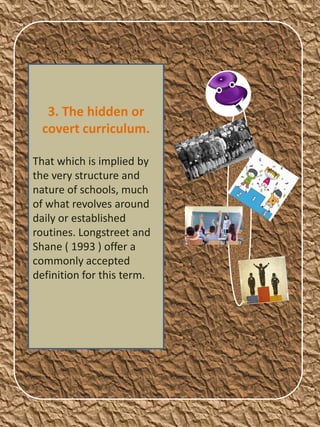
3. The hidden or
covert curriculum.
That which is implied by
the very structure and
nature of schools, much
of what revolves around
daily or established
routines. Longstreet and
Shane ( 1993 ) offer a
commonly accepted
definition for this term.
…the “hidden curriculum, “ which
refers to the kind of learnings children
derive from the very nature and
organizational design of the public
school, as well as from the behaviors
and attitudes of teachers and
administrators. Ex. Messages and
lessons derived from the mere
organization of schools—the emphasis
on: sequencial room arrangements; the
cellular, timed segments of formal
instruction; an annual schedule that is
still arranged to accommodate an
agrarian age; disciplines messages
where concentration equates to
student behaviors were they are sitting
up straight and are continually quiet;
students getting in and standing in line
silently; student quietly raising their
hands to be called on; the endless
competition for grades, and so on. The
hidden curriculum may include both
positive or negative messages,
depending on the models provided and
the perspectives of the learner or the
observer,
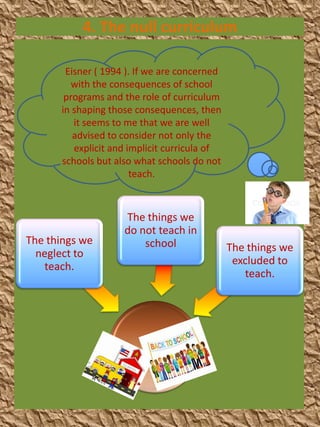
4. The null curriculum
Eisner ( 1994 ). If we are concerned
with the consequences of school
programs and the role of curriculum
in shaping those consequences, then
it seems to me that we are well
advised to consider not only the
explicit and implicit curricula of
schools but also what schools do not
teach.

The things we
neglect to
teach.

The things we
do not teach in
school

The things we
excluded to
teach.
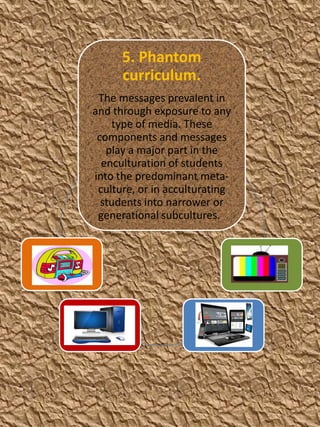
5. Phantom
curriculum.
The messages prevalent in
and through exposure to any
type of media. These
components and messages
play a major part in the
enculturation of students
into the predominant metaculture, or in acculturating
students into narrower or
generational subcultures.
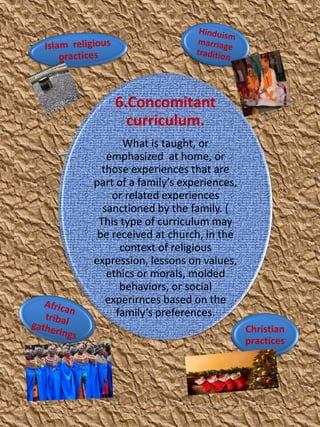
6.Concomitant
curriculum.
What is taught, or
emphasized at home, or
those experiences that are
part of a family’s experiences,
or related experiences
sanctioned by the family. (
This type of curriculum may
be received at church, in the
context of religious
expression, lessons on values,
ethics or morals, molded
behaviors, or social
experirnces based on the
family’s preferences.
Christian
practices
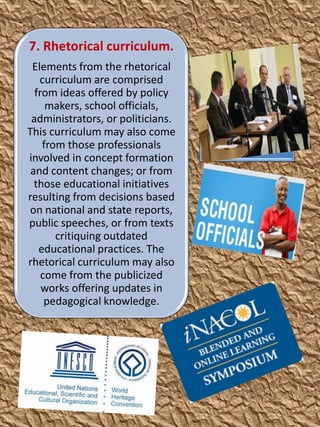
7. Rhetorical curriculum.
Elements from the rhetorical
curriculum are comprised
from ideas offered by policy
makers, school officials,
administrators, or politicians.
This curriculum may also come
from those professionals
involved in concept formation
and content changes; or from
those educational initiatives
resulting from decisions based
on national and state reports,
public speeches, or from texts
critiquing outdated
educational practices. The
rhetorical curriculum may also
come from the publicized
works offering updates in
pedagogical knowledge.
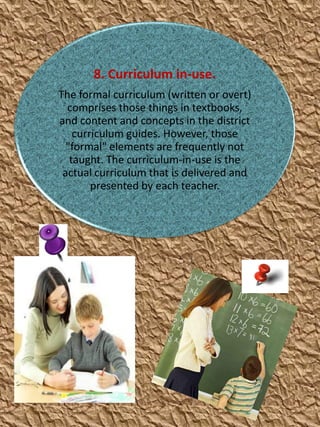
8. Curriculum in-use.
The formal curriculum (written or overt)
comprises those things in textbooks,
and content and concepts in the district
curriculum guides. However, those
"formal" elements are frequently not
taught. The curriculum-in-use is the
actual curriculum that is delivered and
presented by each teacher.
9. Received curriculum.
Those things that students
actually take out of classroom;
those concepts and content that
are truly learned and
remembered.
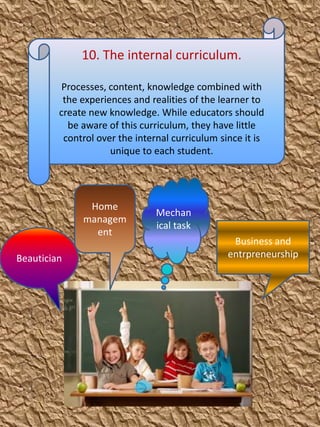
10. The internal curriculum.
Processes, content, knowledge combined with
the experiences and realities of the learner to
create new knowledge. While educators should
be aware of this curriculum, they have little
control over the internal curriculum since it is
unique to each student.

Home
managem
ent
Beautician

Mechan
ical task
Business and
entrpreneurship
11. The electronic curriculum
Those lessons learned through
searching the Internet for
information, or through using
e-forms of communication.
References:
Leslie Owen Wilson's
Curriculum Index ,
http://www4.uwsp.edu/education/l
wilson/curric/curtyp.htm
Cortes, C.E. (1981) The societal curriculum: Implications for
multiethnic educations. In Banks, J.A (ed.) Educations in the
80's: Multiethnic education. National Education Association.
Eisner, E.W. (1994) The educational imagination: On design
and evaluation of school programs. (3rd. ed) New York:
Macmillan.
Longstreet, W.S. and Shane, H.G. (1993) Curriculum for a
new millennium. Boston: Allyn and Bacon.
Oliva, P. (1997) The curriculum: Theoretical dimensions. New
York: Longman.
Wilson, L. O. (1990, 2004, 2006) Curriculum course packets
ED 721 & 726, unpublished.

Wikipedia, the free encyclopedia

google clip art and images
Prepared by: Jasmin Rael Sibayan

Presentation3 pdf

  • 1.
    CURRICULUM Meaning- From it’searly latin origins it means “to run a course.” Multiple definition of curriculum , from olivia ( 1977 ). Curriculum is:          That which is taught in schools. A set of subjects. Content A program of studies. A set of materials. A sequence of courses, A set of performance objectives. A course of study. Is everything that goes on within the school, including extra-class activities, guidance, and interpersonal relationships.
  • 2.
     Everything thatis planned by school personnel.  A series of experiences undergone by learners in a school.  That which an individual learner experiences as a result of schooling. ( from Leslie Owen Wilson,s curriculum index, http://www4.uwsp.edu/education/lwilson/curric/curtyp.htm ) Personal Definition ( wikepedia ) of curriculum is the planned interaction of pupils with instructional content, materials, resources, and processes for evaluating the attainment of educational objectives. This process includes the use of literacies and datagogies that are interwoven through the use of digital media and/or texts that address the complexities of learning.
  • 3.
    TYPES OF CURRICULUM 1.Overt, explicit, or written curriculum. Is simply that which is written as part of formal instruction of schooling experiences. It may refer to a curriculum document, texts, films, and supportive teaching materials that are overtly chosen to support the international agenda of a school. Thus, the overt curriculum is usually confined to those written understandings and directions formally designated and reviewed by administrators, curriculum directors and teachers, often collectively.
  • 5.
    3. The hiddenor covert curriculum. That which is implied by the very structure and nature of schools, much of what revolves around daily or established routines. Longstreet and Shane ( 1993 ) offer a commonly accepted definition for this term.
  • 6.
    …the “hidden curriculum,“ which refers to the kind of learnings children derive from the very nature and organizational design of the public school, as well as from the behaviors and attitudes of teachers and administrators. Ex. Messages and lessons derived from the mere organization of schools—the emphasis on: sequencial room arrangements; the cellular, timed segments of formal instruction; an annual schedule that is still arranged to accommodate an agrarian age; disciplines messages where concentration equates to student behaviors were they are sitting up straight and are continually quiet; students getting in and standing in line silently; student quietly raising their hands to be called on; the endless competition for grades, and so on. The hidden curriculum may include both positive or negative messages, depending on the models provided and the perspectives of the learner or the observer,
  • 7.
    4. The nullcurriculum Eisner ( 1994 ). If we are concerned with the consequences of school programs and the role of curriculum in shaping those consequences, then it seems to me that we are well advised to consider not only the explicit and implicit curricula of schools but also what schools do not teach. The things we neglect to teach. The things we do not teach in school The things we excluded to teach.
  • 8.
    5. Phantom curriculum. The messagesprevalent in and through exposure to any type of media. These components and messages play a major part in the enculturation of students into the predominant metaculture, or in acculturating students into narrower or generational subcultures.
  • 9.
    6.Concomitant curriculum. What is taught,or emphasized at home, or those experiences that are part of a family’s experiences, or related experiences sanctioned by the family. ( This type of curriculum may be received at church, in the context of religious expression, lessons on values, ethics or morals, molded behaviors, or social experirnces based on the family’s preferences. Christian practices
  • 10.
    7. Rhetorical curriculum. Elementsfrom the rhetorical curriculum are comprised from ideas offered by policy makers, school officials, administrators, or politicians. This curriculum may also come from those professionals involved in concept formation and content changes; or from those educational initiatives resulting from decisions based on national and state reports, public speeches, or from texts critiquing outdated educational practices. The rhetorical curriculum may also come from the publicized works offering updates in pedagogical knowledge.
  • 11.
    8. Curriculum in-use. Theformal curriculum (written or overt) comprises those things in textbooks, and content and concepts in the district curriculum guides. However, those "formal" elements are frequently not taught. The curriculum-in-use is the actual curriculum that is delivered and presented by each teacher.
  • 12.
    9. Received curriculum. Thosethings that students actually take out of classroom; those concepts and content that are truly learned and remembered.
  • 13.
    10. The internalcurriculum. Processes, content, knowledge combined with the experiences and realities of the learner to create new knowledge. While educators should be aware of this curriculum, they have little control over the internal curriculum since it is unique to each student. Home managem ent Beautician Mechan ical task Business and entrpreneurship
  • 14.
    11. The electroniccurriculum Those lessons learned through searching the Internet for information, or through using e-forms of communication.
  • 15.
    References: Leslie Owen Wilson's CurriculumIndex , http://www4.uwsp.edu/education/l wilson/curric/curtyp.htm Cortes, C.E. (1981) The societal curriculum: Implications for multiethnic educations. In Banks, J.A (ed.) Educations in the 80's: Multiethnic education. National Education Association. Eisner, E.W. (1994) The educational imagination: On design and evaluation of school programs. (3rd. ed) New York: Macmillan. Longstreet, W.S. and Shane, H.G. (1993) Curriculum for a new millennium. Boston: Allyn and Bacon. Oliva, P. (1997) The curriculum: Theoretical dimensions. New York: Longman. Wilson, L. O. (1990, 2004, 2006) Curriculum course packets ED 721 & 726, unpublished. Wikipedia, the free encyclopedia google clip art and images Prepared by: Jasmin Rael Sibayan