Julie Evans
CEO, Project Tomorrow
Speak Up 2015 National Results
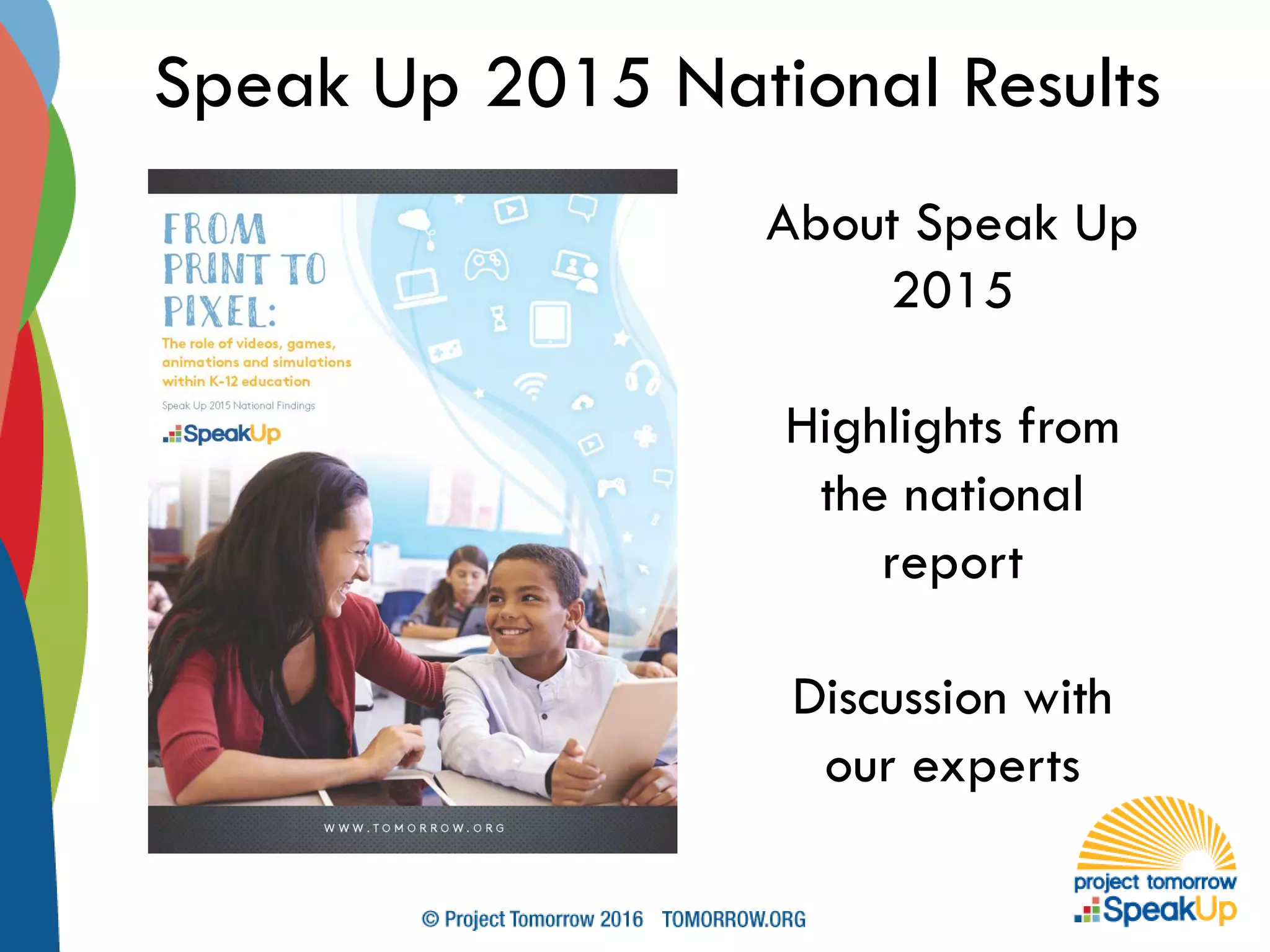
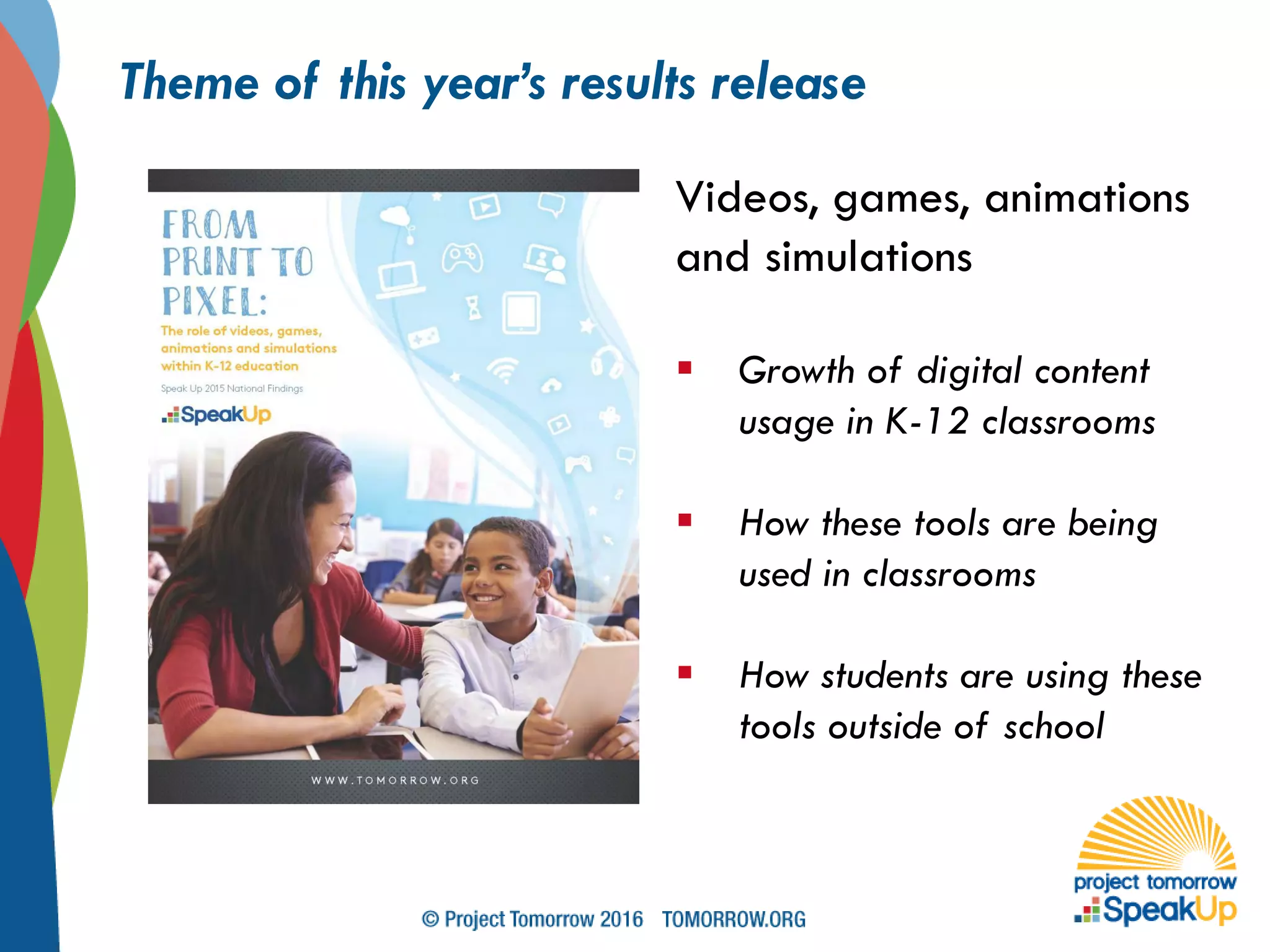
From Print to Pixel: the role of videos, games,
animations and simulations within K-12 education
May 5, 2016
Today’s agenda
Welcome and Remarks
 Julie Evans, Project Tomorrow
 Lee Blakemore and Stephanie Weeks,
Blackboard
Release of National Findings
 Role of videos, games, animations and
simulations with learning
Discussion with our Panel of Experts – meet
our students and teachers
Your Questions,Thoughts and Comments
Students and teachers from these school districts:
Baltimore City Public Schools, Maryland
Calvert County Public Schools, Maryland
Fairfax County Public Schools, Virginia
Frederick County Public Schools, Virginia
Prince William County Public Schools, Virginia
Meet our panel of experts
Thank you!
Representative Dan Lipinski
Ilinois, 3rd District
@JulieEvans_PT
@SpeakUpEd
#SpeakUpBriefing
Project Tomorrow, a global education
nonprofit organization
Programs:
• Research & evaluation studies
• STEM education programs
• Advocacy for digital learning
Mission: To ensure that today’s
students are prepared to become
tomorrow’s leaders, innovators and
engaged citizens of the world.
Speak Up Research Project about Digital Learning Trends
 Annual research since 2003
 Uses online surveys + focus groups
 Schools/districts register to participate
 Surveys for: K-12 Students, Teachers, Parents, Administrators,
Community Members
 Special: Pre-Service Teachers in Schools of Education
 Open for all K-12 schools and schools of education
 Schools, districts & colleges receive free report with their own
data
4.5 million
surveys since
2003
Data informs: policies,
programs, funding at
local, state and
federal levels
Thanks to our K-12 National Champion Outreach Partners:
Saluting our Speak Up 2015 Sponsors:
Welcoming remarks
Lee Blakemore
Senior Vice President, K-12
Stephanie Weeks
Vice President, K-12 Strategy
Speak Up 2015 National Results
About Speak Up
2015
Highlights from
the national
report
Discussion with
our experts
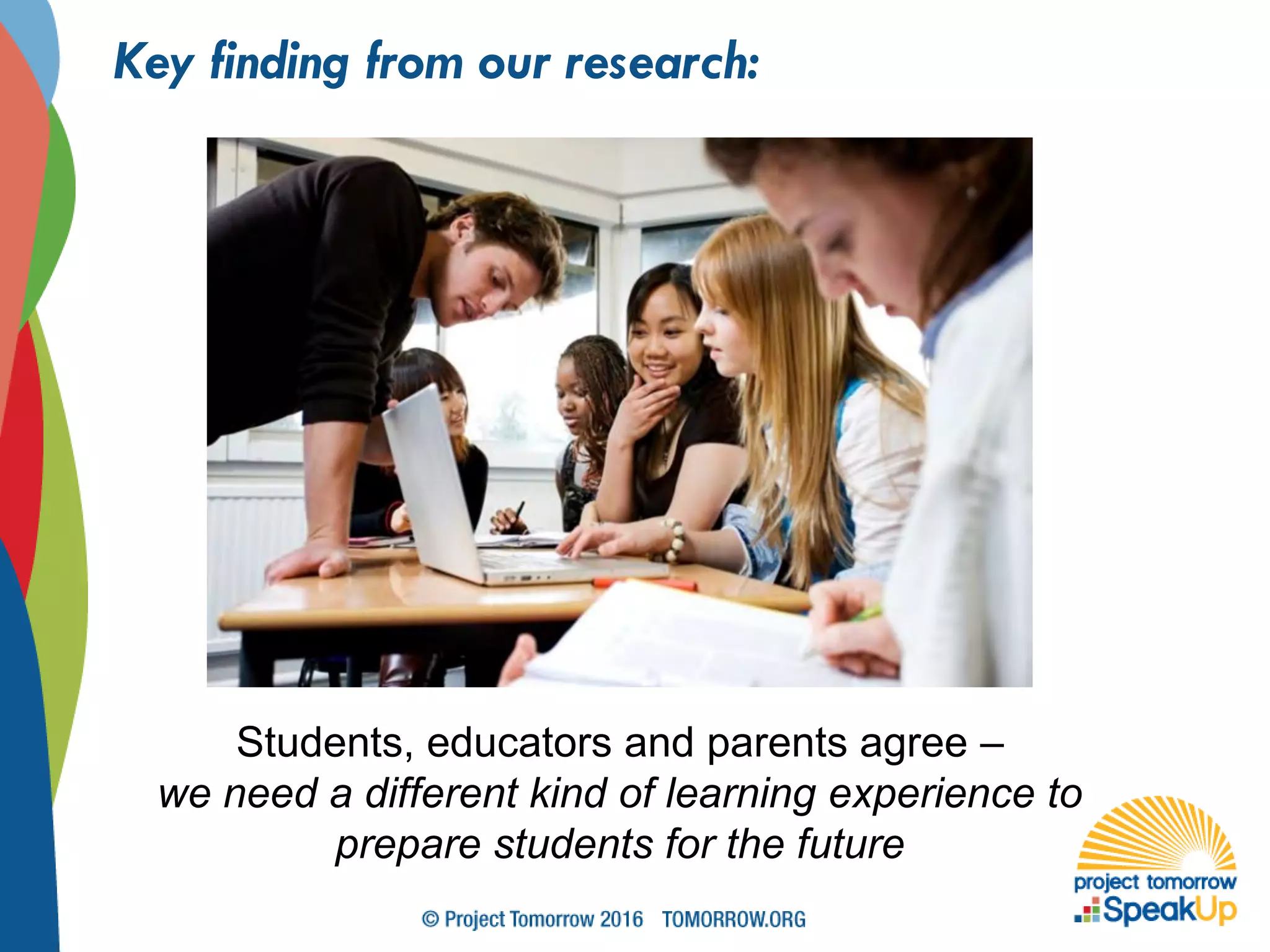
Key finding from our research:
Students, educators and parents agree –
we need a different kind of learning experience to
prepare students for the future
Theme of this year’s results release
Videos, games, animations
and simulations
 Growth of digital content
usage in K-12 classrooms
 How these tools are being
used in classrooms
 How students are using these
tools outside of school
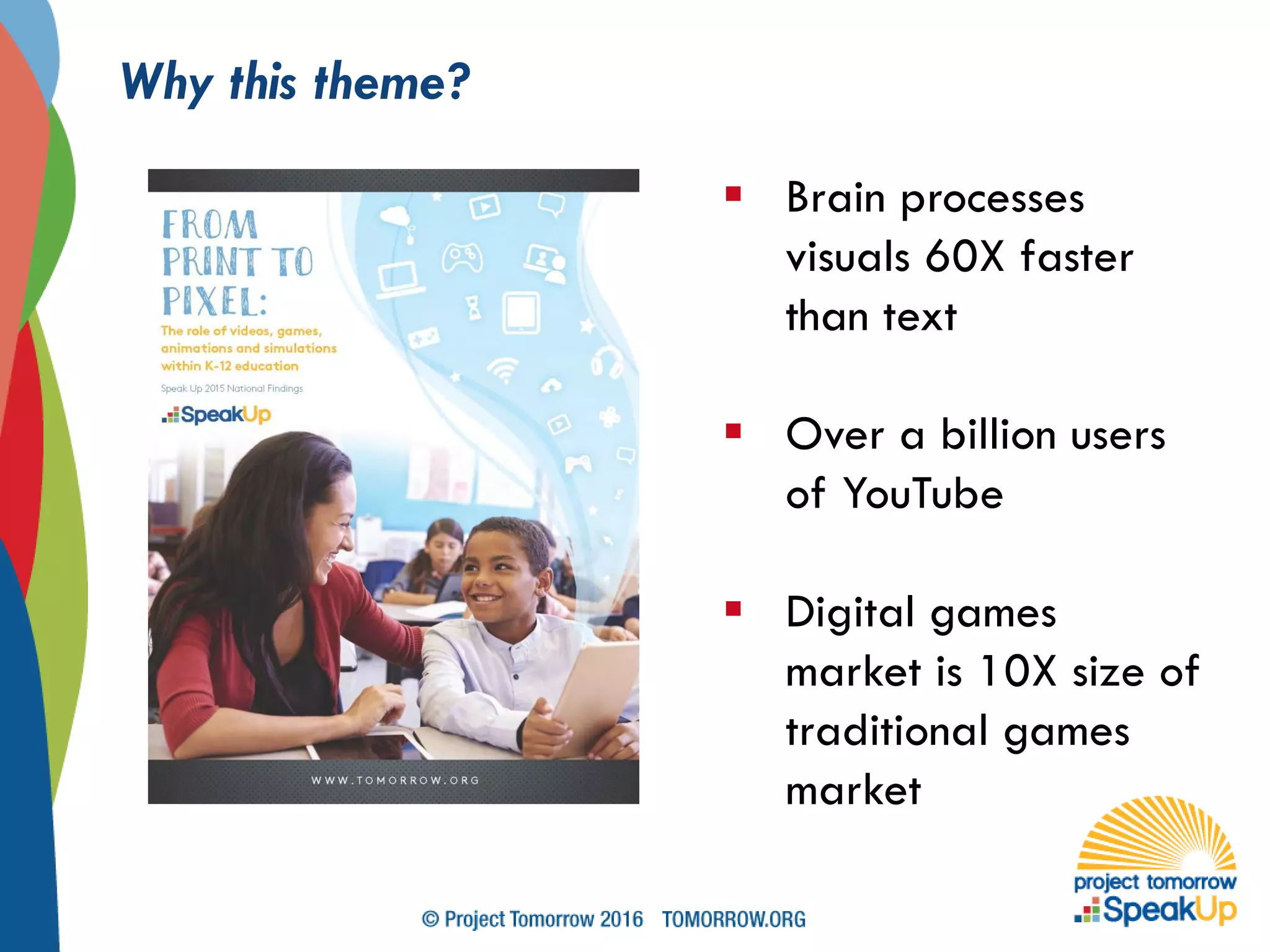
Why this theme?
 Brain processes
visuals 60X faster
than text
 Over a billion users
of YouTube
 Digital games
market is 10X size of
traditional games
market
10%
8%
14%
20%
21%
21%
30%
47%
10%
12%
17%
27%
30%
36%
48%
68%
Simulations
Videos - self created
Virtual field trips
Animations
Online textbooks
Online curriculum
Games
Videos - found online
2015
2012
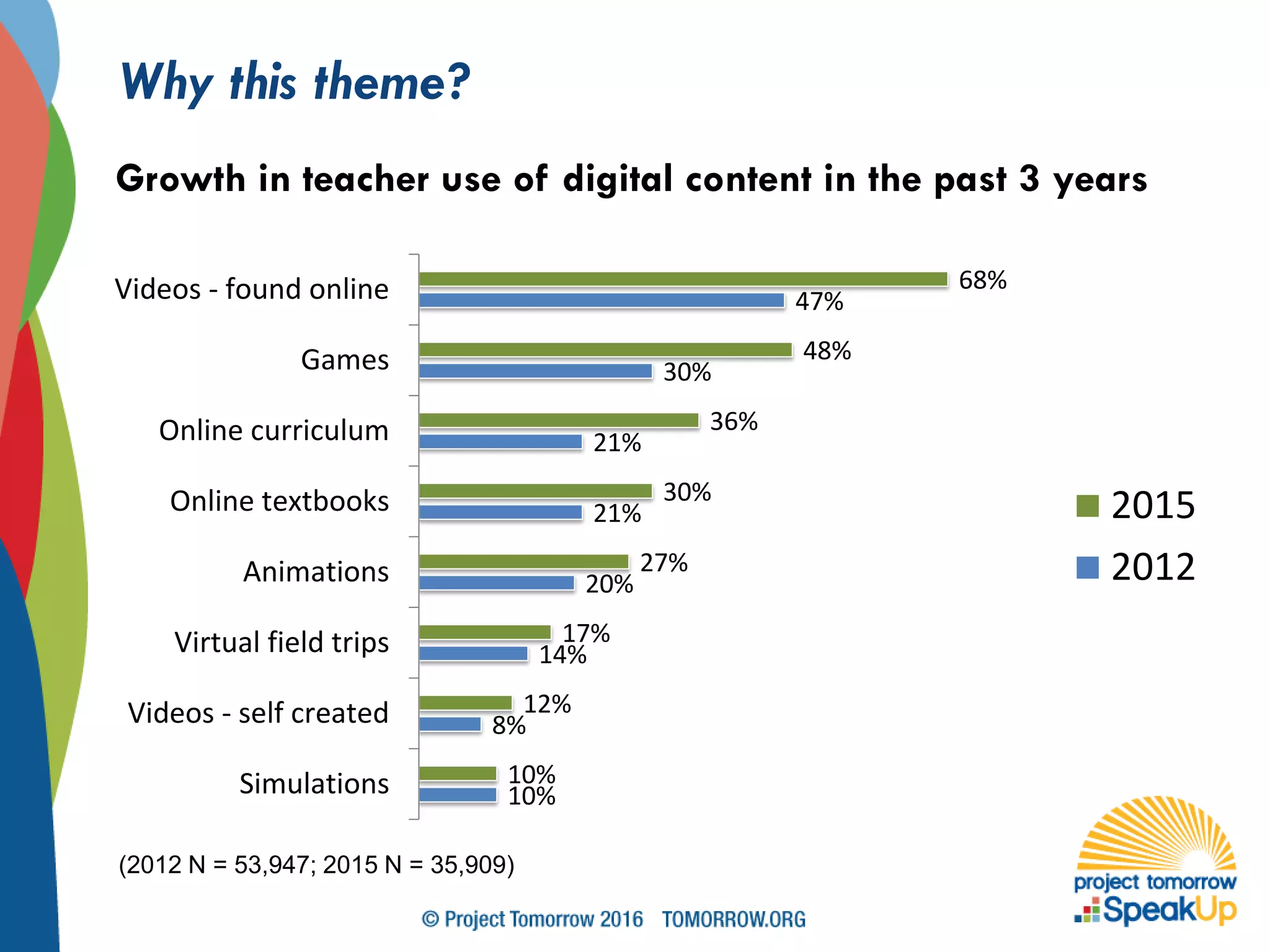
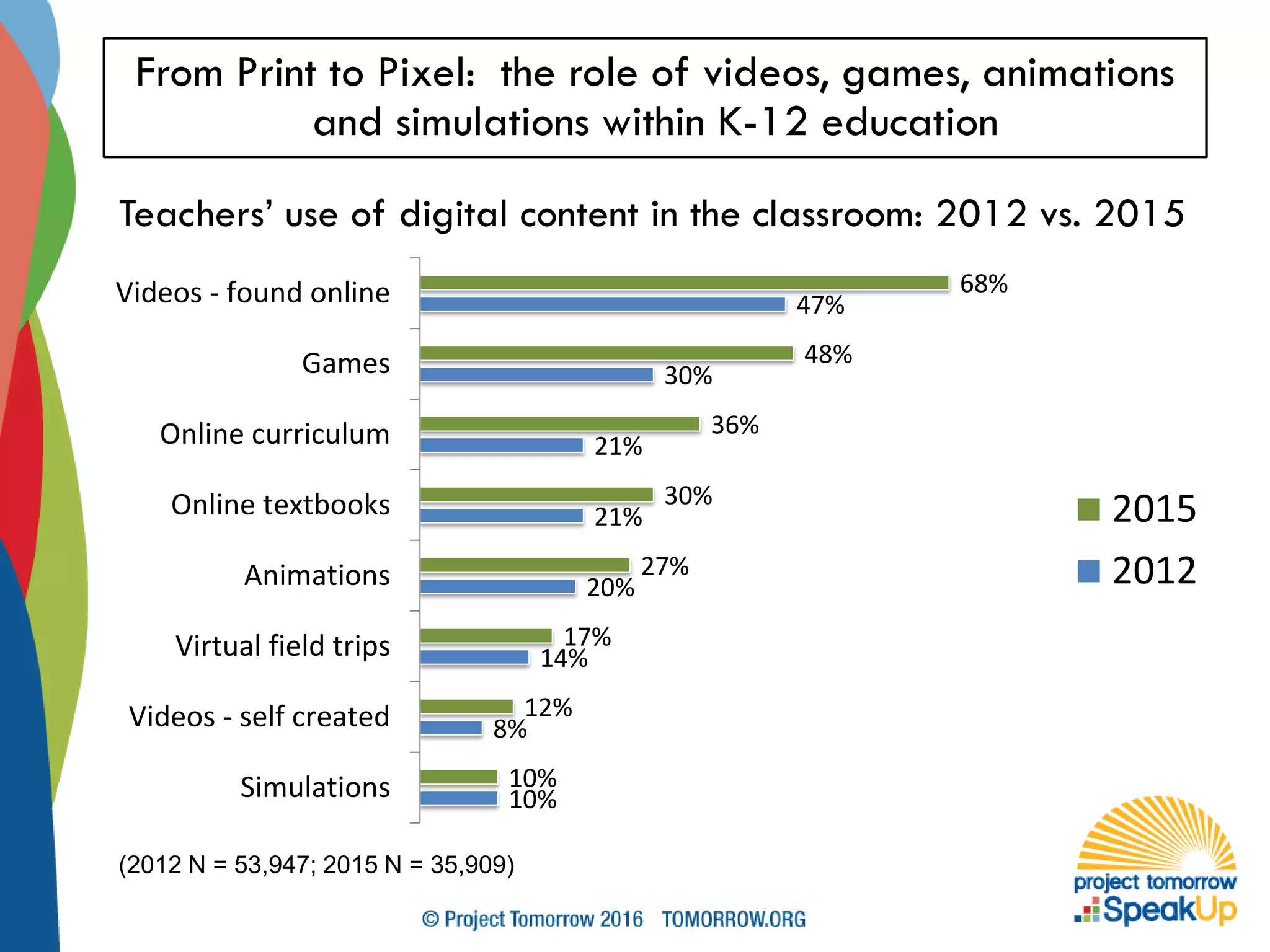
Growth in teacher use of digital content in the past 3 years
(2012 N = 53,947; 2015 N = 35,909)
Why this theme?
Why this theme?
“Students would learn faster and more efficiently
through technology use consisting of social media
messengers, online videos and step-by-step formats
given on google. I believe those learning methods
can show a path that's much easier for visual
learners, including those with creative minds too.”
10th grade girl, Guam
Let’s think back to high school for a few moments
What was your hardest subject when you were in high
school?
1. Algebra
2. Chemistry
3. Economics
4. World Language
@SpeakUpEd
#SpeakUpBriefing
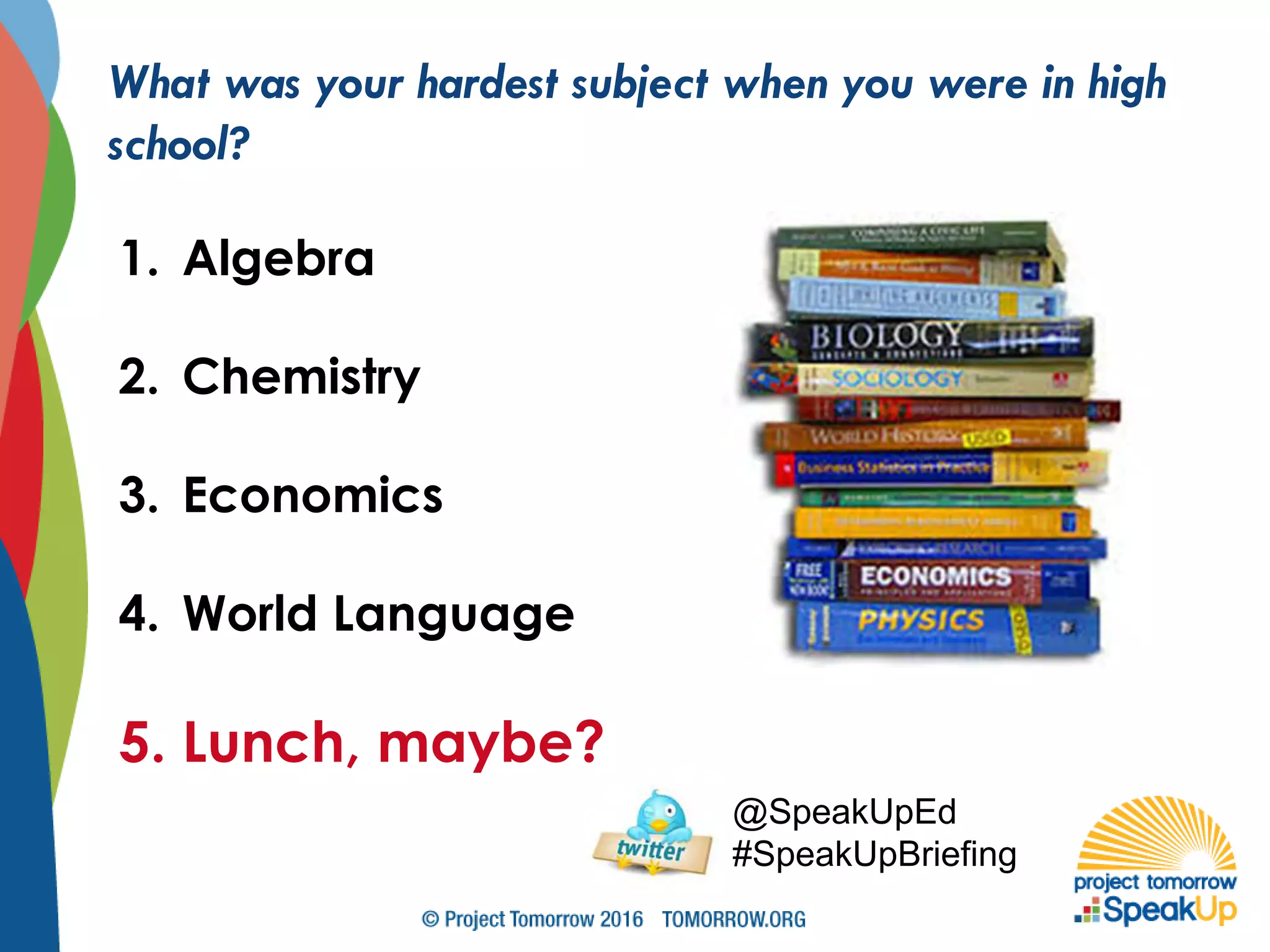
What was your hardest subject when you were in high
school?
1. Algebra
2. Chemistry
3. Economics
4. World Language
5. Lunch, maybe?
@SpeakUpEd
#SpeakUpBriefing
Let’s pretend we are students in Chemistry class again!
Ms. Megonigal’s Chemistry website
Unit 5: Chemical Reactions
Key questions to think about:
 How would a teacher use a video like this in class?
 What would be the benefits of using a video?
 Would students be more engaged in learning?
 Would they learn more?
 Would this experience nurture greater interest in
the subject?
From Print to Pixel: the role of videos, games,
animations and simulations within K-12
education
Digital content in schools
Use in classrooms
Enabling self-directed learning
K-12 Students 415,686
Teachers & Librarians 38,613
Parents (in English & Spanish) 40,218
School/District Administrators/Tech Leaders 4,536
Community Members 6,623
About the participating schools & districts
o 7,825 schools and 2,676 districts
o 25% urban / 35% rural / 40% suburban
o All 50 states + DC + Guam + DODEA schools
Speak Up 2015 national participation: 505,676
o K-12 Students
o Teachers
o Parents
o Administrators
Activities
Attitudes
Aspirations
From Print to Pixel: the role of
videos, games, animations and
simulations within K-12 education
Digital content use in school
From Print to Pixel: the role of videos, games, animations
and simulations within K-12 education
 82% of districts are using digital
content and online resources regularly
within classroom instruction
 40% say the same about digital games
specifically
From Print to Pixel: the role of videos, games, animations
and simulations within K-12 education
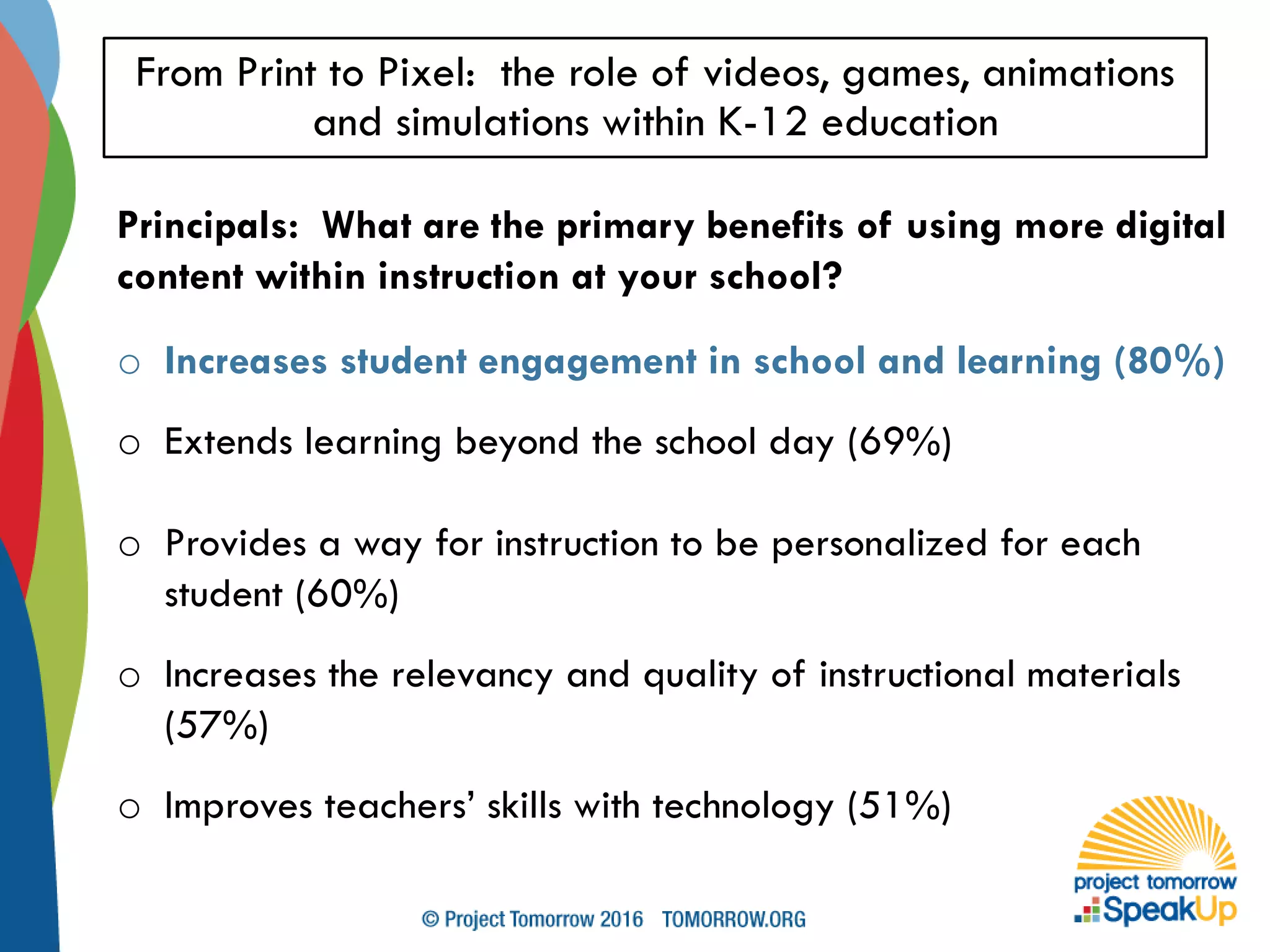
Principals: What are the primary benefits of using more digital
content within instruction at your school?
o Increases student engagement in school and learning (80%)
o Extends learning beyond the school day (69%)
o Provides a way for instruction to be personalized for each
student (60%)
o Increases the relevancy and quality of instructional materials
(57%)
o Improves teachers’ skills with technology (51%)
From Print to Pixel: the role of videos, games, animations
and simulations within K-12 education
Greatest challenge?
54% of principals say it is motivating teachers to
change the way they are teaching to leverage these
multi-media, multi-sensory digital tools
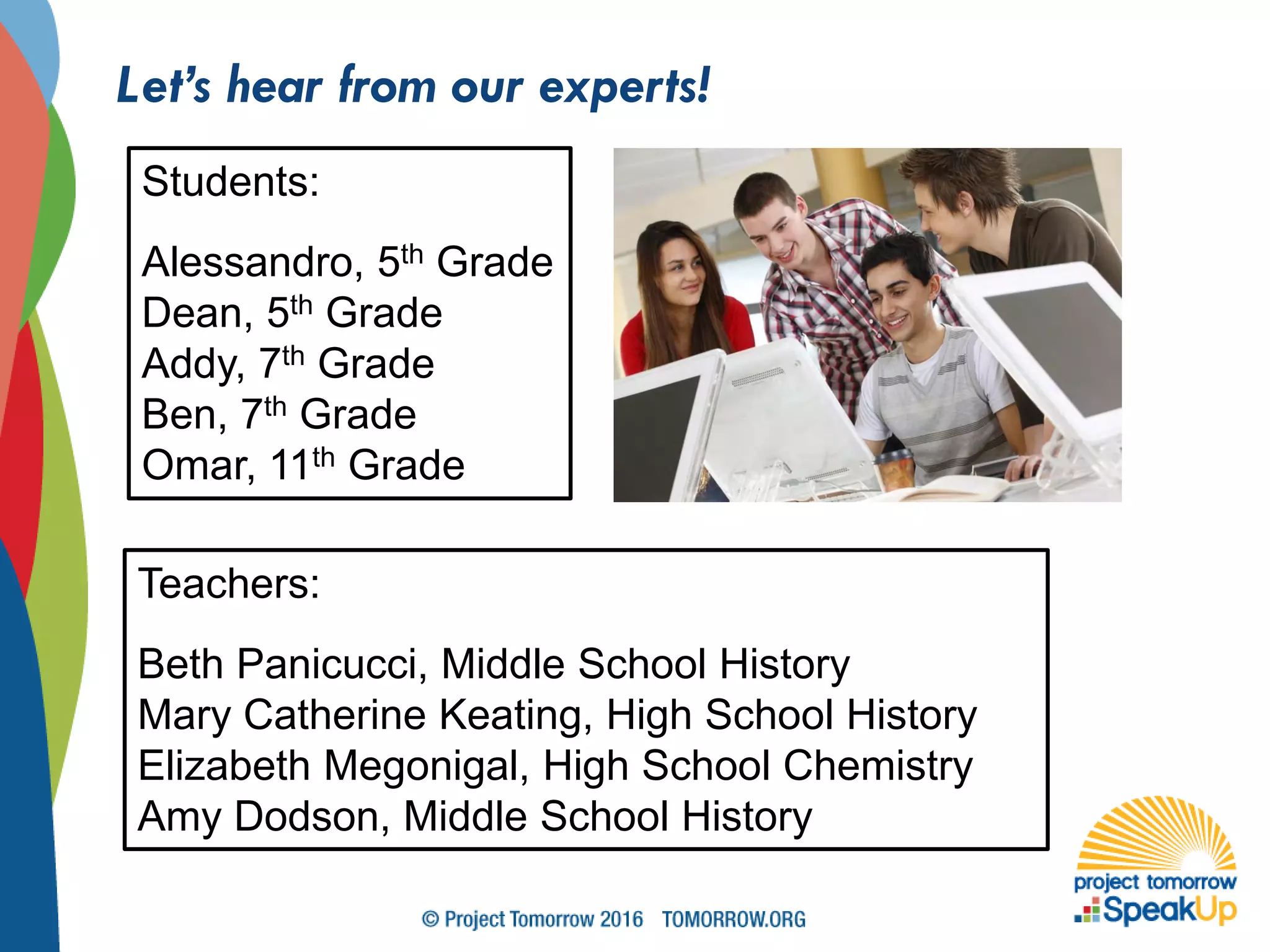
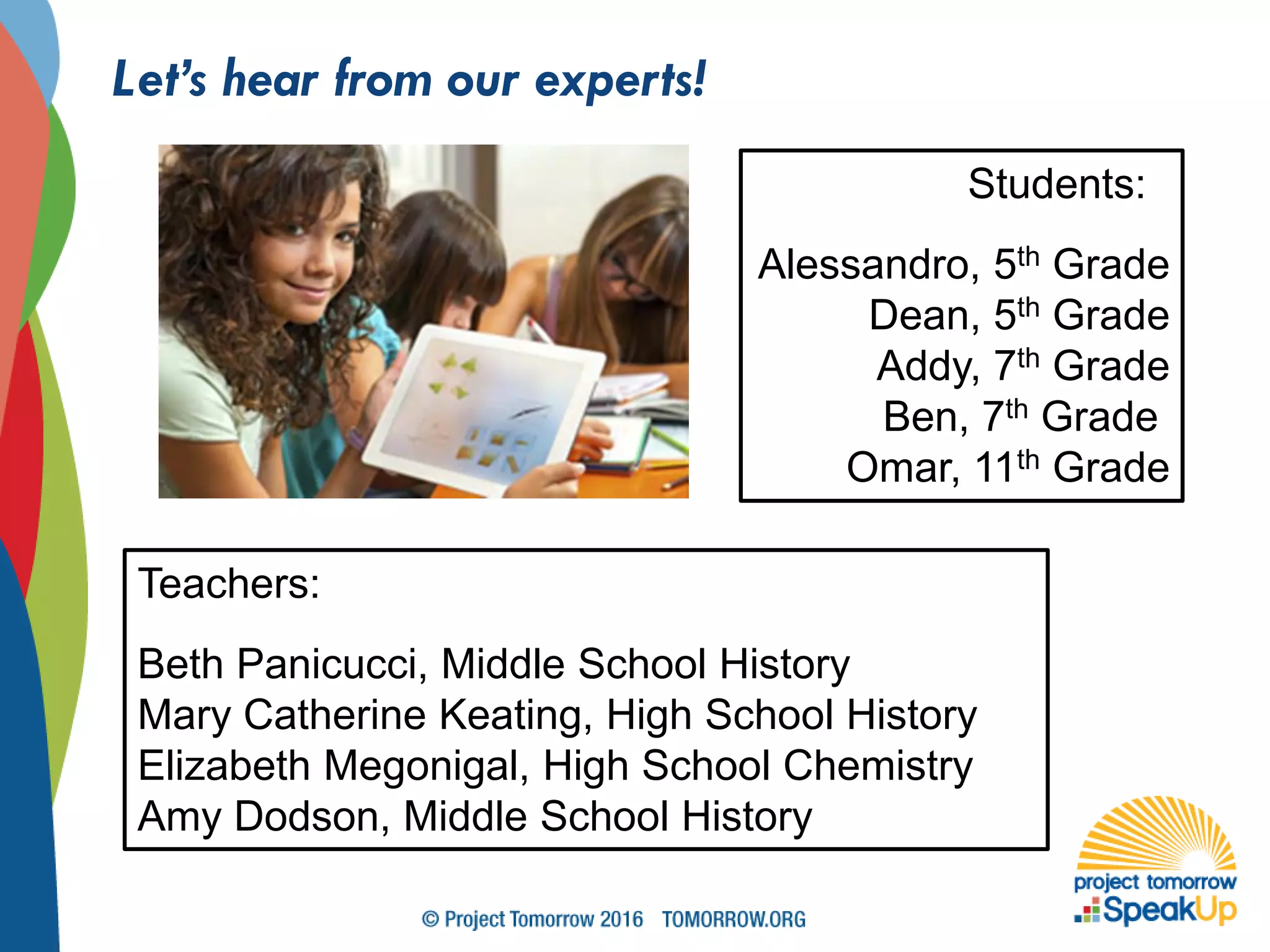
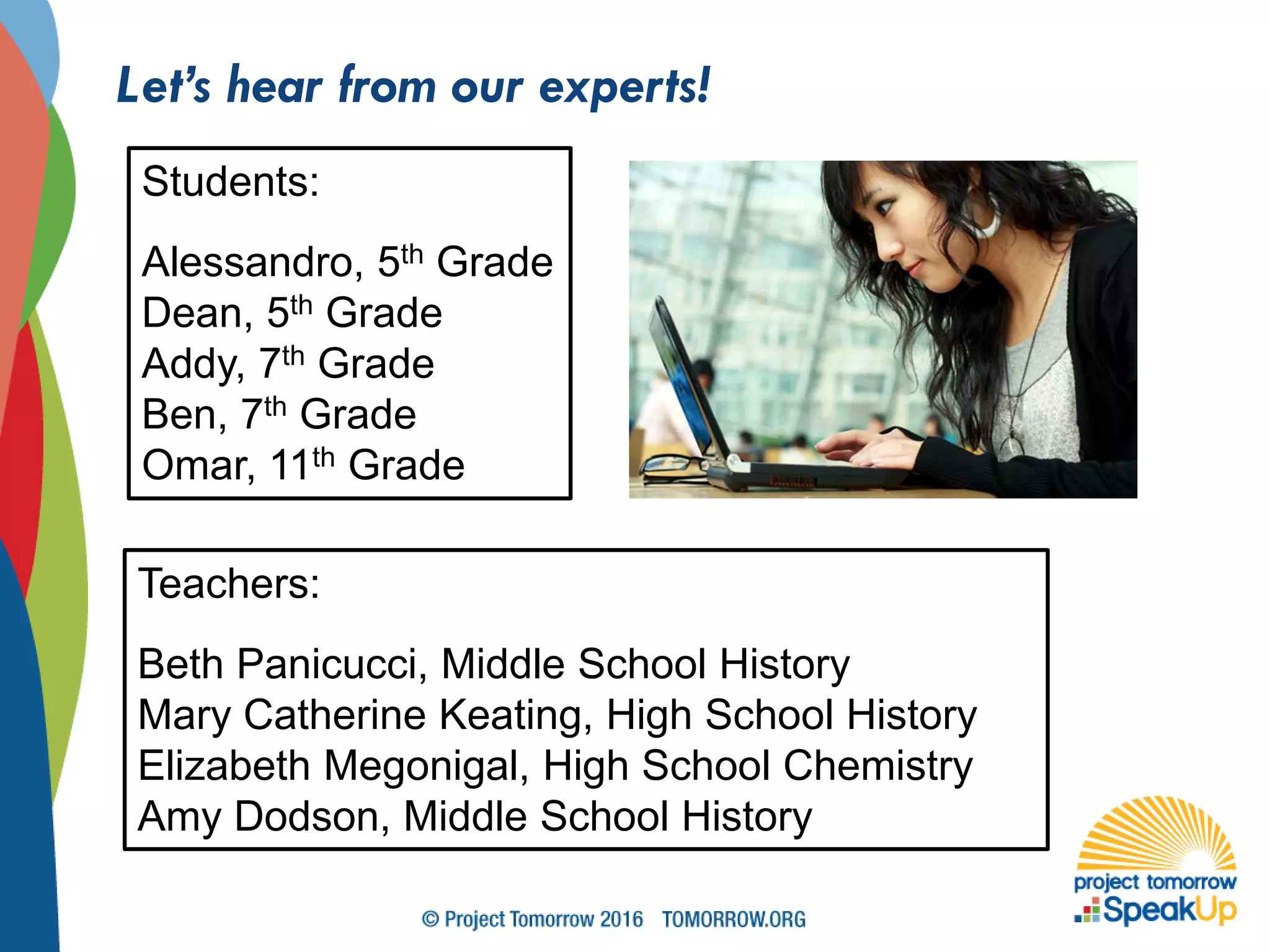
Let’s hear from our experts!
Students:
Alessandro, 5th Grade
Dean, 5th Grade
Addy, 7th Grade
Ben, 7th Grade
Omar, 11th Grade
Teachers:
Beth Panicucci, Middle School History
Mary Catherine Keating, High School History
Elizabeth Megonigal, High School Chemistry
Amy Dodson, Middle School History
Use of videos, games, animations and
simulations in the classroom
10%
8%
14%
20%
21%
21%
30%
47%
10%
12%
17%
27%
30%
36%
48%
68%
Simulations
Videos - self created
Virtual field trips
Animations
Online textbooks
Online curriculum
Games
Videos - found online
2015
2012
Teachers’ use of digital content in the classroom: 2012 vs. 2015
(2012 N = 53,947; 2015 N = 35,909)
From Print to Pixel: the role of videos, games, animations
and simulations within K-12 education
From Print to Pixel: the role of videos, games, animations
and simulations within K-12 education
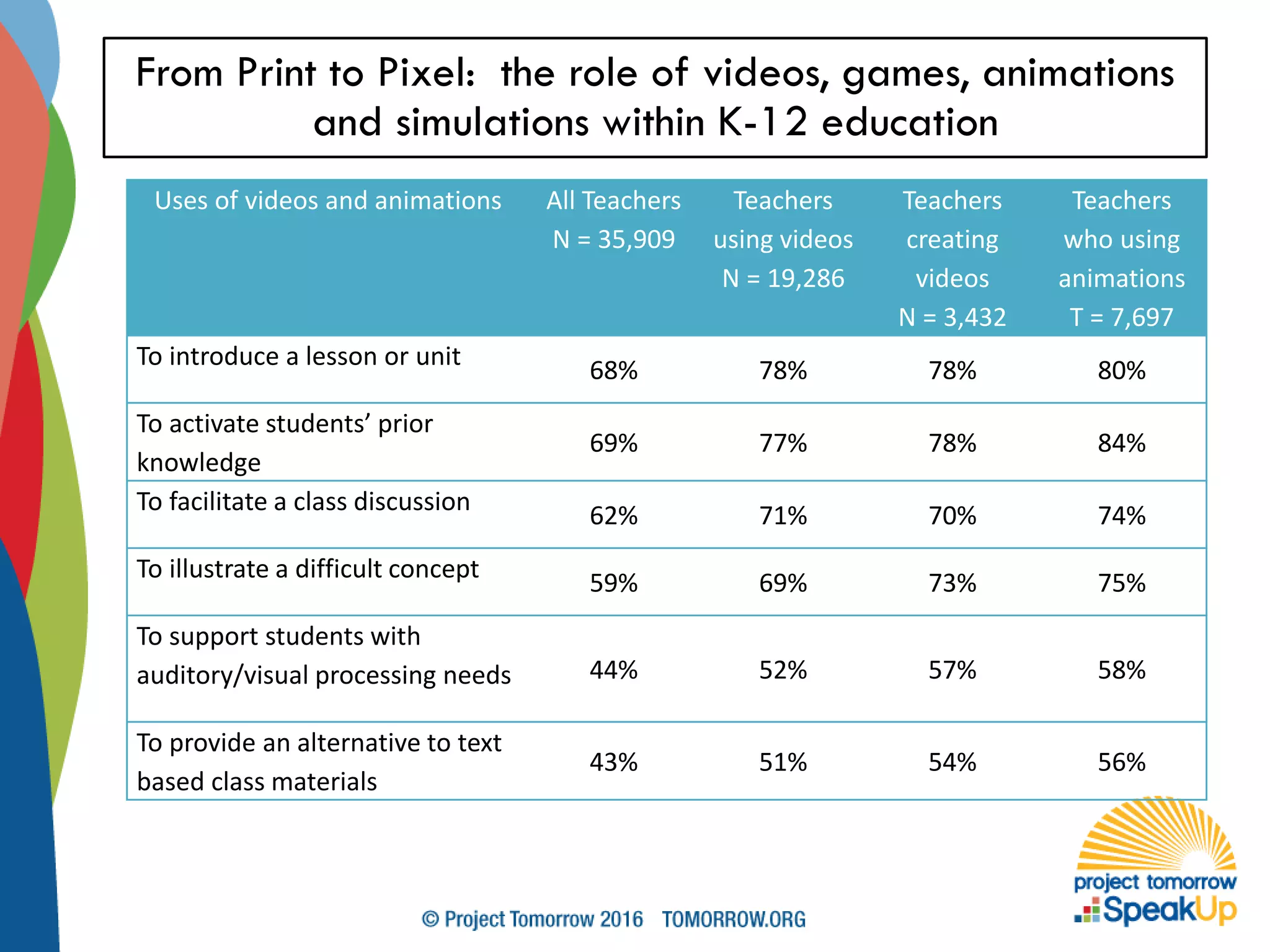
Uses of videos and animations All Teachers
N = 35,909
Teachers
using videos
N = 19,286
Teachers
creating
videos
N = 3,432
Teachers
who using
animations
T = 7,697
To introduce a lesson or unit
68% 78% 78% 80%
To activate students’ prior
knowledge
69% 77% 78% 84%
To facilitate a class discussion
62% 71% 70% 74%
To illustrate a difficult concept
59% 69% 73% 75%
To support students with
auditory/visual processing needs 44% 52% 57% 58%
To provide an alternative to text
based class materials
43% 51% 54% 56%
From Print to Pixel: the role of videos, games, animations
and simulations within K-12 education
Benefits of videos and
animations
All Teachers
N = 35,909
Teachers using
videos
N = 19,286
Teachers
creating
videos
N = 3,432
Teachers
using
animations
T = 7,697
Increased student engagement in
the material
65% 75% 75% 78%
Addressed different learning
styles
58% 66% 69% 74%
Provided a different teaching
approach than my own
46% 55% 56% 59%
More relevant lesson 59% 68% 70% 72%
Enhanced student vocabulary 48% 55% 56% 65%
More efficient learning process
by shrinking time students need
to digest information
23% 28% 35% 39%
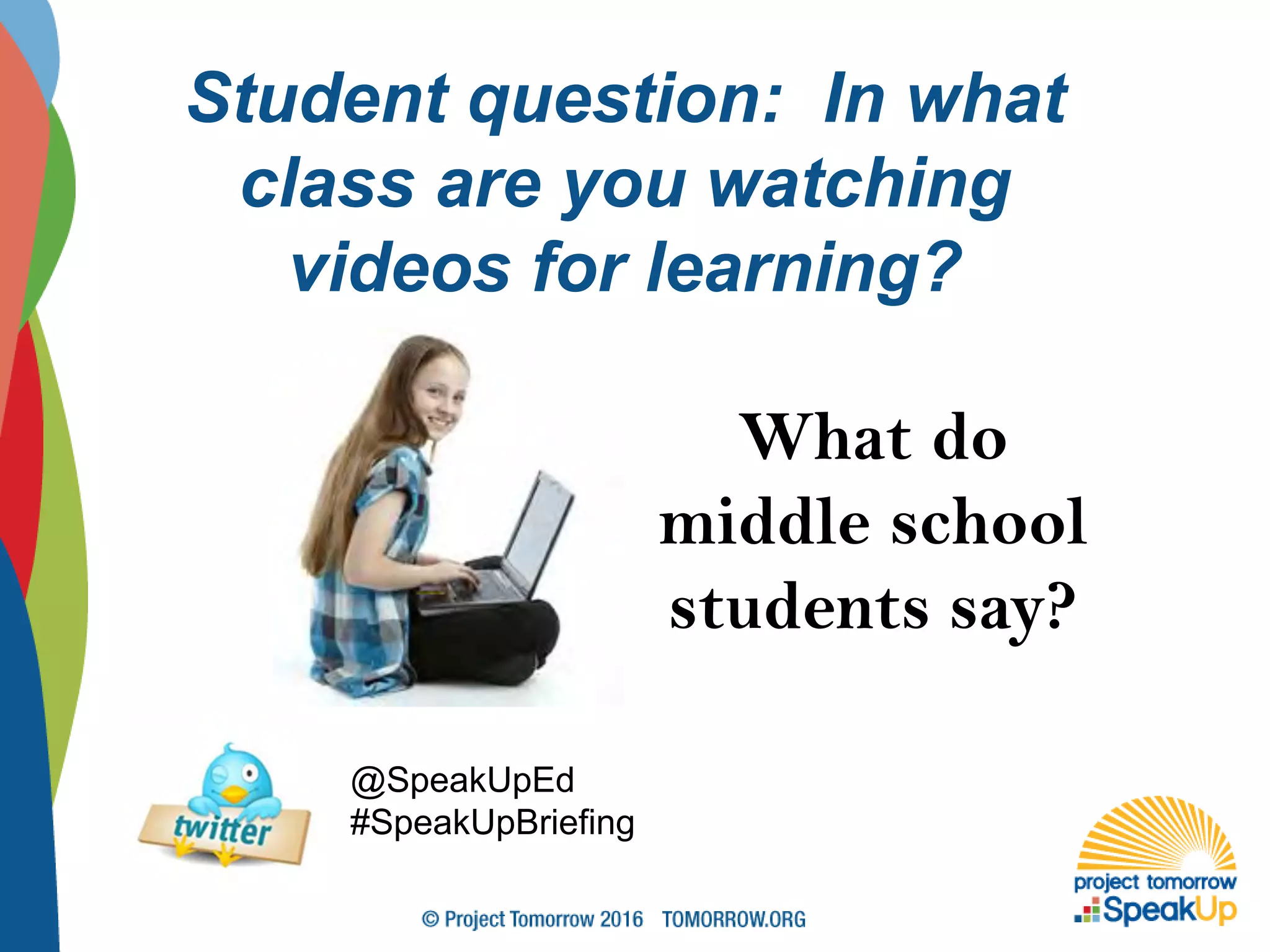
Student question: In what
class are you watching
videos for learning?
What do
middle school
students say?
@SpeakUpEd
#SpeakUpBriefing
Middle school students say they are
watching videos in:
1.Science (69%)
2.Math (63%)
3.Social Studies/History (57%)
4.English/Language Arts (48%)
From Print to Pixel: the role of videos, games, animations
and simulations within K-12 education
From Print to Pixel: the role of videos, games, animations
and simulations within K-12 education
 I can watch it as many times as I need to (61%)
 Makes it easier to understand difficult concepts (55%)
 Connects what I am learning to the real world (54%)
 Fits my learning style (53%)
 Easy to find videos to help with schoolwork and easy to access
on mobile devices (53%)
 More engaging and keeps my attention (48%)
Students: why is watching videos a good way for
you to learn?
Let’s hear from our experts!
Students:
Alessandro, 5th Grade
Dean, 5th Grade
Addy, 7th Grade
Ben, 7th Grade
Omar, 11th Grade
Teachers:
Beth Panicucci, Middle School History
Mary Catherine Keating, High School History
Elizabeth Megonigal, High School Chemistry
Amy Dodson, Middle School History
Use of videos, games, animations and
simulations outside of the classroom
From Print to Pixel: the role of videos, games, animations
and simulations within K-12 education
“I am learning important things for my
future on my own outside of school”
Agreed:
54% of students in grades 6-8
50% of students in grades 9-12
From Print to Pixel: the role of videos, games, animations
and simulations within K-12 education
17%
9%
22%
13%
32%
29%
19%
27%
10%
22%
Play an online game
Watch a video
Never Rarely Sometimes Often All of the time
Students’ self-directed learning with visual tools
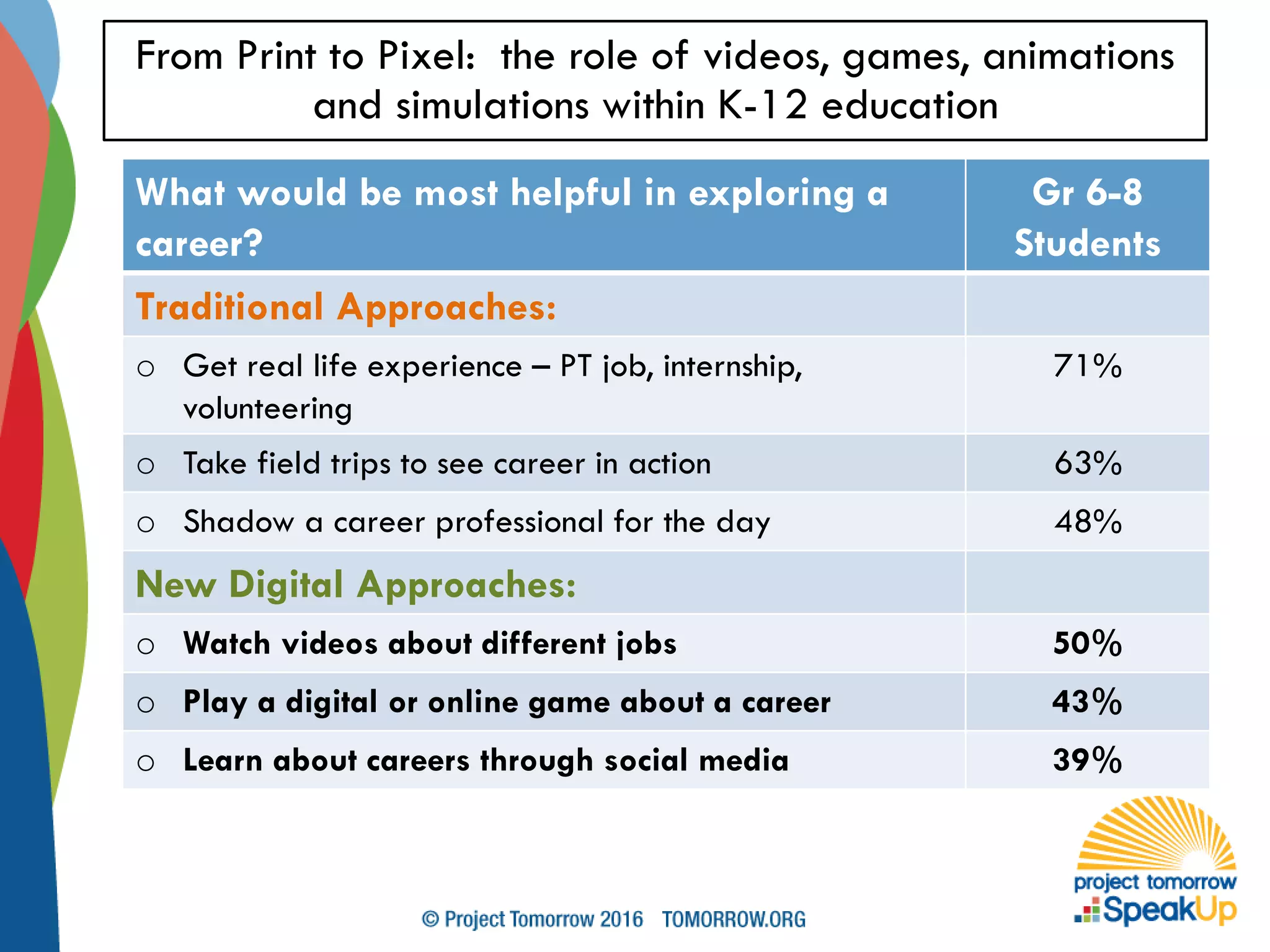
What would be most helpful in exploring a
career?
Gr 6-8
Students
Traditional Approaches:
o Get real life experience – PT job, internship,
volunteering
71%
o Take field trips to see career in action 63%
o Shadow a career professional for the day 48%
New Digital Approaches:
o Watch videos about different jobs 50%
o Play a digital or online game about a career 43%
o Learn about careers through social media 39%
From Print to Pixel: the role of videos, games, animations
and simulations within K-12 education
From Print to Pixel: the role of videos, games, animations
and simulations within K-12 education
Visually based social media use
Social Media Tool Never/Rarely All of the time/Often
Boys Girls Boys Girls
Facebook 51% 46% 31% 38%
Instagram 36% 21% 49% 68%
Pinterest 85% 51% 7% 31%
Twitter 57% 50% 29% 39%
YouTube 8% 9% 78% 71%
Online games/apps 33% 45% 45% 32%
Massively multiplayer
online games (MMOG,
MMORPG)
39% 80% 28% 7%
From Print to Pixel: the role of videos, games, animations
and simulations within K-12 education
Visually based social media use
Social Media Tool Never/Rarely All of the time/Often
Boys Girls Boys Girls
Facebook 51% 46% 31% 38%
Instagram 36% 21% 49% 68%
Pinterest 85% 51% 7% 31%
Twitter 57% 50% 29% 39%
YouTube 8% 9% 78% 71%
Online games/apps 33% 45% 45% 32%
Massively multiplayer
online games (MMOG,
MMORPG)
39% 80% 28% 7%
Girls
Boys
Let’s hear from our experts!
Students:
Alessandro, 5th Grade
Dean, 5th Grade
Addy, 7th Grade
Ben, 7th Grade
Omar, 11th Grade
Teachers:
Beth Panicucci, Middle School History
Mary Catherine Keating, High School History
Elizabeth Megonigal, High School Chemistry
Amy Dodson, Middle School History
Your
thoughts,
ideas,
questions
@SpeakUpEd
#SpeakUpBriefing
Key finding from our research:
Students, educators and parents agree –
we need a different kind of learning experience to
prepare students for the future
Speak Up 2015 National Results
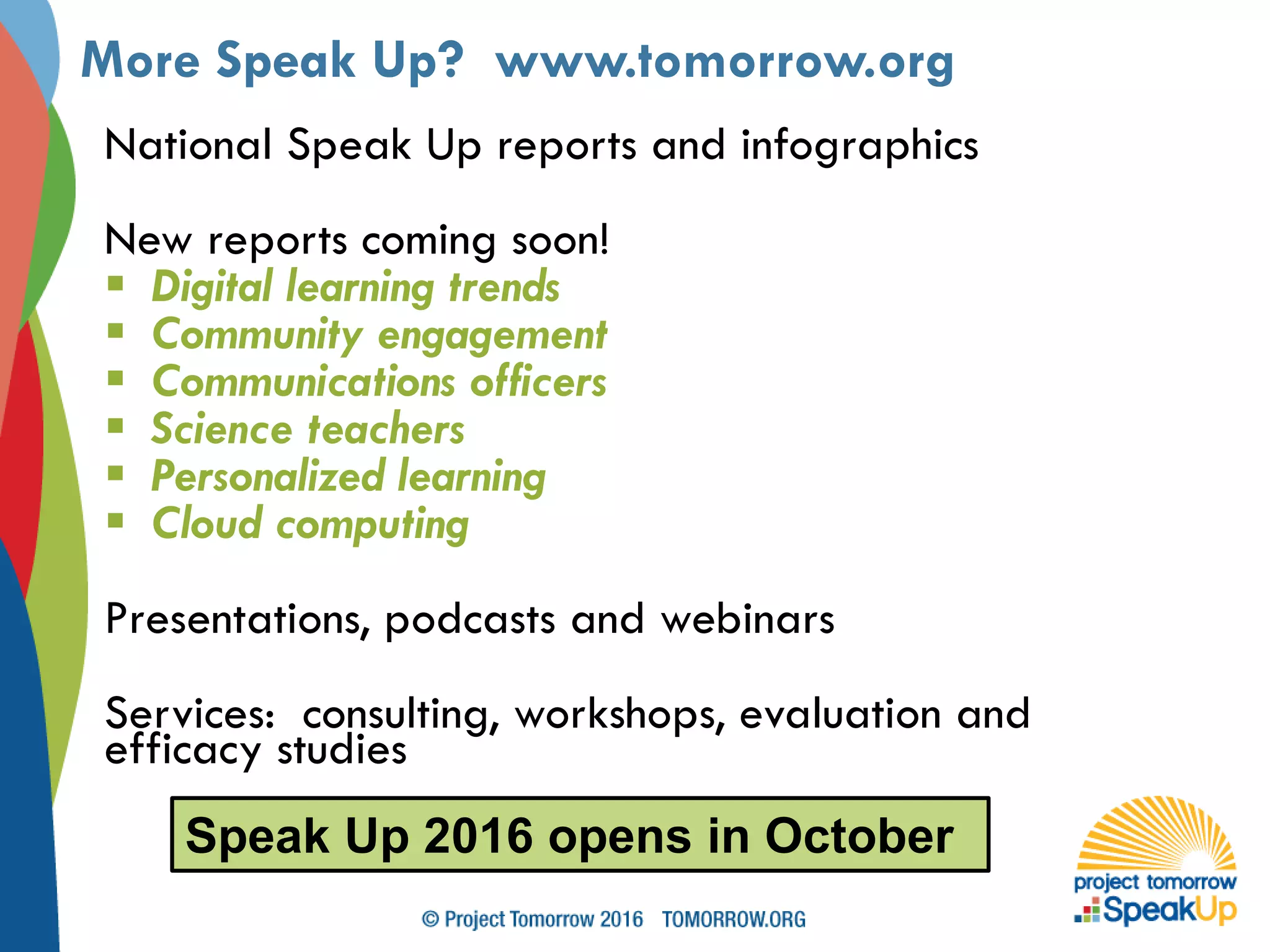
National Speak Up reports and infographics
New reports coming soon!
 Digital learning trends
 Community engagement
 Communications officers
 Science teachers
 Personalized learning
 Cloud computing
Presentations, podcasts and webinars
Services: consulting, workshops, evaluation and
efficacy studies
More Speak Up? www.tomorrow.org
Speak Up 2016 opens in October
Thanks to our K-12 National Champion Outreach Partners:
Saluting our Speak Up 2015 Sponsors:
Thank you for being part of this year’s
Speak Up national results release!
Julie Evans
jevans@tomorrow.org
949-609-4660 x15
Twitter: JulieEvans_PT and SpeakUpEd
Copyright Project Tomorrow 2016
This work is the intellectual property of the author. Permission is granted
for this material to be shared for non-commercial, educational purposes,
provided that this copyright statement appears on the reproduced
materials and notice is given that the copying is by permission of the
author. To disseminate otherwise or to republish requires written
permission from the author.

Speak Up 2015 National Results - From Print to Pixel

  • 1.
    Julie Evans CEO, ProjectTomorrow Speak Up 2015 National Results From Print to Pixel: the role of videos, games, animations and simulations within K-12 education May 5, 2016
  • 2.
    Today’s agenda Welcome andRemarks  Julie Evans, Project Tomorrow  Lee Blakemore and Stephanie Weeks, Blackboard Release of National Findings  Role of videos, games, animations and simulations with learning Discussion with our Panel of Experts – meet our students and teachers Your Questions,Thoughts and Comments
  • 3.
    Students and teachersfrom these school districts: Baltimore City Public Schools, Maryland Calvert County Public Schools, Maryland Fairfax County Public Schools, Virginia Frederick County Public Schools, Virginia Prince William County Public Schools, Virginia Meet our panel of experts
  • 4.
    Thank you! Representative DanLipinski Ilinois, 3rd District
  • 5.
  • 6.
    Project Tomorrow, aglobal education nonprofit organization Programs: • Research & evaluation studies • STEM education programs • Advocacy for digital learning Mission: To ensure that today’s students are prepared to become tomorrow’s leaders, innovators and engaged citizens of the world.
  • 7.
    Speak Up ResearchProject about Digital Learning Trends  Annual research since 2003  Uses online surveys + focus groups  Schools/districts register to participate  Surveys for: K-12 Students, Teachers, Parents, Administrators, Community Members  Special: Pre-Service Teachers in Schools of Education  Open for all K-12 schools and schools of education  Schools, districts & colleges receive free report with their own data 4.5 million surveys since 2003 Data informs: policies, programs, funding at local, state and federal levels
  • 8.
    Thanks to ourK-12 National Champion Outreach Partners:
  • 9.
    Saluting our SpeakUp 2015 Sponsors:
  • 10.
    Welcoming remarks Lee Blakemore SeniorVice President, K-12 Stephanie Weeks Vice President, K-12 Strategy
  • 11.
    Speak Up 2015National Results About Speak Up 2015 Highlights from the national report Discussion with our experts
  • 12.
    Key finding fromour research: Students, educators and parents agree – we need a different kind of learning experience to prepare students for the future
  • 13.
    Theme of thisyear’s results release Videos, games, animations and simulations  Growth of digital content usage in K-12 classrooms  How these tools are being used in classrooms  How students are using these tools outside of school
  • 14.
    Why this theme? Brain processes visuals 60X faster than text  Over a billion users of YouTube  Digital games market is 10X size of traditional games market
  • 15.
    10% 8% 14% 20% 21% 21% 30% 47% 10% 12% 17% 27% 30% 36% 48% 68% Simulations Videos - selfcreated Virtual field trips Animations Online textbooks Online curriculum Games Videos - found online 2015 2012 Growth in teacher use of digital content in the past 3 years (2012 N = 53,947; 2015 N = 35,909) Why this theme?
  • 16.
    Why this theme? “Studentswould learn faster and more efficiently through technology use consisting of social media messengers, online videos and step-by-step formats given on google. I believe those learning methods can show a path that's much easier for visual learners, including those with creative minds too.” 10th grade girl, Guam
  • 17.
    Let’s think backto high school for a few moments
  • 18.
    What was yourhardest subject when you were in high school? 1. Algebra 2. Chemistry 3. Economics 4. World Language @SpeakUpEd #SpeakUpBriefing
  • 19.
    What was yourhardest subject when you were in high school? 1. Algebra 2. Chemistry 3. Economics 4. World Language 5. Lunch, maybe? @SpeakUpEd #SpeakUpBriefing
  • 20.
    Let’s pretend weare students in Chemistry class again! Ms. Megonigal’s Chemistry website Unit 5: Chemical Reactions
  • 21.
    Key questions tothink about:  How would a teacher use a video like this in class?  What would be the benefits of using a video?  Would students be more engaged in learning?  Would they learn more?  Would this experience nurture greater interest in the subject?
  • 22.
    From Print toPixel: the role of videos, games, animations and simulations within K-12 education Digital content in schools Use in classrooms Enabling self-directed learning
  • 23.
    K-12 Students 415,686 Teachers& Librarians 38,613 Parents (in English & Spanish) 40,218 School/District Administrators/Tech Leaders 4,536 Community Members 6,623 About the participating schools & districts o 7,825 schools and 2,676 districts o 25% urban / 35% rural / 40% suburban o All 50 states + DC + Guam + DODEA schools Speak Up 2015 national participation: 505,676
  • 24.
    o K-12 Students oTeachers o Parents o Administrators Activities Attitudes Aspirations From Print to Pixel: the role of videos, games, animations and simulations within K-12 education
  • 25.
  • 26.
    From Print toPixel: the role of videos, games, animations and simulations within K-12 education  82% of districts are using digital content and online resources regularly within classroom instruction  40% say the same about digital games specifically
  • 27.
    From Print toPixel: the role of videos, games, animations and simulations within K-12 education Principals: What are the primary benefits of using more digital content within instruction at your school? o Increases student engagement in school and learning (80%) o Extends learning beyond the school day (69%) o Provides a way for instruction to be personalized for each student (60%) o Increases the relevancy and quality of instructional materials (57%) o Improves teachers’ skills with technology (51%)
  • 28.
    From Print toPixel: the role of videos, games, animations and simulations within K-12 education Greatest challenge? 54% of principals say it is motivating teachers to change the way they are teaching to leverage these multi-media, multi-sensory digital tools
  • 29.
    Let’s hear fromour experts! Students: Alessandro, 5th Grade Dean, 5th Grade Addy, 7th Grade Ben, 7th Grade Omar, 11th Grade Teachers: Beth Panicucci, Middle School History Mary Catherine Keating, High School History Elizabeth Megonigal, High School Chemistry Amy Dodson, Middle School History
  • 30.
    Use of videos,games, animations and simulations in the classroom
  • 31.
    10% 8% 14% 20% 21% 21% 30% 47% 10% 12% 17% 27% 30% 36% 48% 68% Simulations Videos - selfcreated Virtual field trips Animations Online textbooks Online curriculum Games Videos - found online 2015 2012 Teachers’ use of digital content in the classroom: 2012 vs. 2015 (2012 N = 53,947; 2015 N = 35,909) From Print to Pixel: the role of videos, games, animations and simulations within K-12 education
  • 32.
    From Print toPixel: the role of videos, games, animations and simulations within K-12 education Uses of videos and animations All Teachers N = 35,909 Teachers using videos N = 19,286 Teachers creating videos N = 3,432 Teachers who using animations T = 7,697 To introduce a lesson or unit 68% 78% 78% 80% To activate students’ prior knowledge 69% 77% 78% 84% To facilitate a class discussion 62% 71% 70% 74% To illustrate a difficult concept 59% 69% 73% 75% To support students with auditory/visual processing needs 44% 52% 57% 58% To provide an alternative to text based class materials 43% 51% 54% 56%
  • 33.
    From Print toPixel: the role of videos, games, animations and simulations within K-12 education Benefits of videos and animations All Teachers N = 35,909 Teachers using videos N = 19,286 Teachers creating videos N = 3,432 Teachers using animations T = 7,697 Increased student engagement in the material 65% 75% 75% 78% Addressed different learning styles 58% 66% 69% 74% Provided a different teaching approach than my own 46% 55% 56% 59% More relevant lesson 59% 68% 70% 72% Enhanced student vocabulary 48% 55% 56% 65% More efficient learning process by shrinking time students need to digest information 23% 28% 35% 39%
  • 34.
    Student question: Inwhat class are you watching videos for learning? What do middle school students say? @SpeakUpEd #SpeakUpBriefing
  • 35.
    Middle school studentssay they are watching videos in: 1.Science (69%) 2.Math (63%) 3.Social Studies/History (57%) 4.English/Language Arts (48%) From Print to Pixel: the role of videos, games, animations and simulations within K-12 education
  • 36.
    From Print toPixel: the role of videos, games, animations and simulations within K-12 education  I can watch it as many times as I need to (61%)  Makes it easier to understand difficult concepts (55%)  Connects what I am learning to the real world (54%)  Fits my learning style (53%)  Easy to find videos to help with schoolwork and easy to access on mobile devices (53%)  More engaging and keeps my attention (48%) Students: why is watching videos a good way for you to learn?
  • 37.
    Let’s hear fromour experts! Students: Alessandro, 5th Grade Dean, 5th Grade Addy, 7th Grade Ben, 7th Grade Omar, 11th Grade Teachers: Beth Panicucci, Middle School History Mary Catherine Keating, High School History Elizabeth Megonigal, High School Chemistry Amy Dodson, Middle School History
  • 38.
    Use of videos,games, animations and simulations outside of the classroom
  • 39.
    From Print toPixel: the role of videos, games, animations and simulations within K-12 education “I am learning important things for my future on my own outside of school” Agreed: 54% of students in grades 6-8 50% of students in grades 9-12
  • 40.
    From Print toPixel: the role of videos, games, animations and simulations within K-12 education 17% 9% 22% 13% 32% 29% 19% 27% 10% 22% Play an online game Watch a video Never Rarely Sometimes Often All of the time Students’ self-directed learning with visual tools
  • 41.
    What would bemost helpful in exploring a career? Gr 6-8 Students Traditional Approaches: o Get real life experience – PT job, internship, volunteering 71% o Take field trips to see career in action 63% o Shadow a career professional for the day 48% New Digital Approaches: o Watch videos about different jobs 50% o Play a digital or online game about a career 43% o Learn about careers through social media 39% From Print to Pixel: the role of videos, games, animations and simulations within K-12 education
  • 42.
    From Print toPixel: the role of videos, games, animations and simulations within K-12 education Visually based social media use Social Media Tool Never/Rarely All of the time/Often Boys Girls Boys Girls Facebook 51% 46% 31% 38% Instagram 36% 21% 49% 68% Pinterest 85% 51% 7% 31% Twitter 57% 50% 29% 39% YouTube 8% 9% 78% 71% Online games/apps 33% 45% 45% 32% Massively multiplayer online games (MMOG, MMORPG) 39% 80% 28% 7%
  • 43.
    From Print toPixel: the role of videos, games, animations and simulations within K-12 education Visually based social media use Social Media Tool Never/Rarely All of the time/Often Boys Girls Boys Girls Facebook 51% 46% 31% 38% Instagram 36% 21% 49% 68% Pinterest 85% 51% 7% 31% Twitter 57% 50% 29% 39% YouTube 8% 9% 78% 71% Online games/apps 33% 45% 45% 32% Massively multiplayer online games (MMOG, MMORPG) 39% 80% 28% 7% Girls Boys
  • 44.
    Let’s hear fromour experts! Students: Alessandro, 5th Grade Dean, 5th Grade Addy, 7th Grade Ben, 7th Grade Omar, 11th Grade Teachers: Beth Panicucci, Middle School History Mary Catherine Keating, High School History Elizabeth Megonigal, High School Chemistry Amy Dodson, Middle School History
  • 45.
  • 46.
    Key finding fromour research: Students, educators and parents agree – we need a different kind of learning experience to prepare students for the future
  • 47.
    Speak Up 2015National Results
  • 48.
    National Speak Upreports and infographics New reports coming soon!  Digital learning trends  Community engagement  Communications officers  Science teachers  Personalized learning  Cloud computing Presentations, podcasts and webinars Services: consulting, workshops, evaluation and efficacy studies More Speak Up? www.tomorrow.org Speak Up 2016 opens in October
  • 49.
    Thanks to ourK-12 National Champion Outreach Partners:
  • 50.
    Saluting our SpeakUp 2015 Sponsors:
  • 51.
    Thank you forbeing part of this year’s Speak Up national results release! Julie Evans jevans@tomorrow.org 949-609-4660 x15 Twitter: JulieEvans_PT and SpeakUpEd Copyright Project Tomorrow 2016 This work is the intellectual property of the author. Permission is granted for this material to be shared for non-commercial, educational purposes, provided that this copyright statement appears on the reproduced materials and notice is given that the copying is by permission of the author. To disseminate otherwise or to republish requires written permission from the author.