CURRICULUM
Curriculum
-From the Latin term “currere” which
means race course (Bandi & Wales, 2005)
Bandi & Wales (2005) also stated that “ for
many students, the SCHOOL CURRICULUM
is a race to be run, a series of obstacles or
hurdles (subjects) to be passed.”
The word curriculum
has been used
historically to describe
the subjects that were
being taught during
the classical period of
Greek Civilization.
Curriculum from
Different Points ofView
1. Traditional Points ofView
2. Progressive Points ofView
Traditional Points of View
in the Curriculum
Curriculum is defined
as a body of subjects or
subject matter
prepared by the teachers
for the students to learn.
Synonymous to “course
of study” or “syllabus”
• Perennialist
• Views curriculum as “permanent studies”
Robert
Hutchins
• Essentialist
• Curriculum should focus on the fundamental
intellectual disciplines of grammar, literature,
writing, math, science, history, & foreign
language
Arthur
Bestor
• Discipline is the sole source of curriculum
• Hence, curriculum is divided into chunks of
knowledge called subject areas (in basic
education); in college, it includes humanities,
languages, sciences, etc.
Joseph
Schwab
Phenix
Curriculum should consist entirely
of knowledge which comes from
various disciplines.
Most traditionalists
view curriculum as
written documents or a
plan of action in
accomplishing goals
Progressivists’
View of
Curriculum
Total
learning
experiences
of the
learner
Anchored on
John
Dewey’s
definition of
experience
and
education.
Reflective
thinking is
what unifies
curricular
elements
• All experiences children have under the
guidance of teachers.
Caswell and
Campbell
• It is a sequence of potential experiences
set up in schools for the purpose of
disciplining children and youth in group
ways of thinking and acting.
Smith,
Stanley and
Shores
• it refers to all experiences in the
classroom which are planned and enacted
by the teacher, and learned by the
students.
Marsh and
Willis
Points ofView on
Curriculum Development
RalphTyler’s
Model: Four
Basic Principles
HildaTaba’s
Model
Two Models of Curriculum
Development and Concepts
Fundamental Principles of Ralph Tyler
Purposes of
the School
What
educational
purposes
should the
school seek
to attain?
Educational
Experiences
related to
the Purpose
What
educational
experiences
can be
provided
that are
likely to
attain these
purposes?
Organization
of
Experiences
How can
these
educational
experiences
be
effectively
organized?
Evaluation
of
Experiences
How can
we
determine
whether
these
purposes
are being
attained
or not?
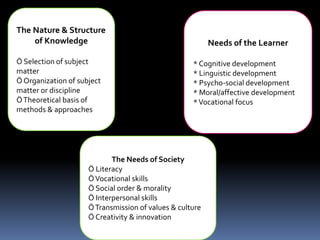
•The nature & structure
of knowledge
•The needs of the society
•The needs of the learner
The Nature & Structure
of Knowledge
Ö Selection of subject
matter
Ö Organization of subject
matter or discipline
ÖTheoretical basis of
methods & approaches
Needs of the Learner
* Cognitive development
* Linguistic development
* Psycho-social development
* Moral/affective development
*Vocational focus
The Needs of Society
Ö Literacy
ÖVocational skills
Ö Social order & morality
Ö Interpersonal skills
ÖTransmission of values & culture
Ö Creativity & innovation
Hilda Taba’s Improved Tyler’s Rationale
Diagnosis of learners needs and expectations
of the larger society
Formulation of learning Objectives
Selection of Learning Content
Organization of Learning Content
Selection of learning experiences
Organization of learning activities
Determination of what to evaluate and the
means of doing it
Advocates
grassroots
approach
Three
Interacting
Processes in
Curriculum
Developme
nt
Planning
Implemen
-ting
Evaluating
Recommended
Curriculum
-Proposed by
scholars and
professional
organizations
Written
Curriculum
-Appears in
school, district,
division or country
documents
Taught
Curriculum
-What Teachers
implement or
deliver in the
classrooms and
schools
Supported
Curriculum
-Resources-
textbooks,
computers, audio-
visual materials
which support the
implementation of
the curriculum.
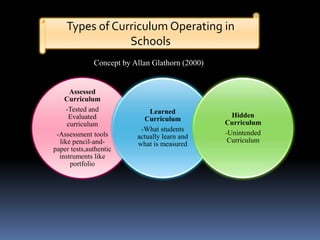
Types of Curriculum Operating in
Schools
Concept by Allan Glathorn (2000)
Assessed
Curriculum
-Tested and
Evaluated
curriculum
-Assessment tools
like pencil-and-
paper tests,authentic
instruments like
portfolio
Learned
Curriculum
-What students
actually learn and
what is measured
Hidden
Curriculum
-Unintended
Curriculum
Types of Curriculum Operating in
Schools
Concept by Allan Glathorn (2000)
Major Foundations of Curriculum
HISTORI-
CAL
SOCIAL
PSYCHO-
LOGICAL
PHILOSO-
PHICAL
I PHILOSOPHICAL
Four Educational Philosophies (Ornstein and Hunkins,
2004)
1. -Perenialism
2. -Progressivism
3. -Essentialism
4. -Reconstructionism
Educational philosophy lays the strong
foundation of any curriculum.
PERENNIALISM PROGRESSIVISM ESSENTIALISM RECONSTRUCTIO
NISM
Aim of
Educa-
tion
To educate the
rational person; to
cultivate the intellect
To promote democratic
and social living
To promote the
intellectual growth of
the individual and
educate a competent
person
To improve and
reconstruct
society; education
for change
Role of
Educa-
tion
Teachers help
students think
with reason
Knowledge leads to
growth and
development of
lifelong learners
who actively learn
by doing.
The teacher is the
sole authority in
his/her subject
area/field of
specialization
Teachers act as
agents of
change and
reform in
various
educational
projects
including
research
PERENNIALISM PROGRESSIVISM ESSENTIALISM RECONSTRUCTI
ONISM
Focus in
the
Curricu-
lum
Classical subjects,
Literary analysis
and curriculum is
constant
Subjects are
interdisciplinary,
integrative and
interactive
3Rs and essential
subjects of
English, science,
History, Math and
foreign languages.
Focus on
present and
future trends
and issues of
national
international
interests
Curricu-
lum
Trends
Use of great
books and return
to liberal arts
School reforms,
relevant and
contextualized
curriculum,
humanistic
education
Excellence in
education, back to
basics and cultural
literacy
Equality of
educational
opportunities in
education,
access to global
education
Period Goal Focus Method Course
of
Study
General
Characteristics
Pre-
Hispanic
Era
Integration
of
individuals
into the
tribe
Customs
and
traditions
Oral
immersio
n
None Not formal;
community-based;
no educational
system
Period Goal Focus Method Course of
Study
General
Characteristics
Spanish
Eral
Spread of
Christianity
Religion Catechetical
instruction;
use of corporal
punishment;
rote
memorization
Not
prescribe
d;
flexible;
not
centralize
d
Not formal;
community-based;
no educational
system
Period Goal Focus Method Course
of
Study
General
Characteristics
American
Era
Spread of
Democracy
Academic
English
Language
and
Literature
Democra
tic
English
as
medium
of
instructio
n
prescri
bed
Unifor
m
centrali
zed
Formal;
structured;
existence of an
educational
system
Period Goal Focus Method Course
of
Study
General
Characteristics
Japanese
Era
Spread of
the New
Asian Order
Principles
of the New
Order
Rote
Memoriz
ation;
Use of
threat
and
punishm
ent
prescri
bed
Unifor
m
centrali
zed
Propaganda tool
Repressively anti-
American and
anti-British
Military-backed
existence of an
educational
system
II. Historical Foundations of Curriculum
• Franklin Bobbit (1876-1956)- presented curriculum as a science that
emphasizes on student’s need.
•Werret Charters (1875-1952) -Curriculum is a science. Subject matter is
related to objectives.
•William Kilpatrick 1871-1965) Curricula are purposeful activities which are
child centered.
•Harold Rugg (1886-1960)- Emphasizes social studies and teacher plans
curriculum in advance.
•Hollis Caswell (1902-1989)- Curriculum as organized around social functions
of themes, organized knowledge and learner’s interest.
•Ralph Tyler (1902-1994) – Curriculum is a science and an extension of
school’s philosophy.
The historical development
shows the different
CHANGES in the
PURPOSES, PRINCIPLES
and CONTENT of the
curriculum.
The different changes are
influenced by
EDUCATIONAL
PHILOSOPHY,
PSYCHOLOGY , and
PEDAGOGICALTHEORIES.
III PSYCHOLOGICAL FOUNDATIONS OF
CURRICULUM
Psychology provides a
basis for the teaching and
learning process.
It unifies the elements of
the learning process.
III PSYCHOLOGICAL FOUNDATIONS OF
CURRICULUM
Behavioral Psychology
-Learning should be organized in order that
students can experience success in the process of
mastering the subject matter.
III PSYCHOLOGICAL FOUNDATIONS OF
EDUCATION
Cognitive Psychology
-Focused on how individual process information
and how they monitor and manage thinking. Some
cognitive psychologists are Vygotsky (Social
Constructivism), Piaget (Cognitive Development), Gardner
(Multiple Intelligences), Felder and Silverman (Learning
Styles).
Humanistic Psychology
-Concerned with how learners can develop their human
potential. This is built on Gestalt Psychology.
-Humanistic psychology in curriculum is more
concerned with PROCESS, not the PRODUCTS; personal
needs subject matter.
III PSYCHOLOGICAL FOUNDATIONS OF
EDUCATION
Psychological foundations will help curriculum
makers in nurturing more ADVANCED, more
COMPREHENSIVE, and COMPLETE HUMAN
LEARNING.
IV SOCIAL FOUNDATIONS OF
CURRICULUM
School exists within the social context.
Societal culture affects and shapes schools
and curricula.
Schools are only one of the many
institutions that educate the society.
Curriculum and society are interdependent.
Schools should reflect and preserve the
culture of society; society should also
imbibe the changes brought about by the
schools.
Major Components of the curriculum are the following:
1. Aims, goals and Objectives
2. Subject Matter/Content
3. Learning Experiences
4. Evaluation approaches
IV SOCIAL
COMPONENT 1: Aims, Goals and Objectives
General Goals of Schools (Phil Consti 1987)
-Inculcate patriotism and nationalism
- Foster love of Humanity
-Promote Respect for Human Rights
-Teach the rights and duties of citizenship.
IV SOCIAL
Aims of Elementary Education (Education Act of 1982)
-Provide knowledge and develop skills, attitudes, values essential
to personal development
-Provide learning experiences which increase the child’s awareness
and responsiveness to the changes in society;
-Promote and intensify knowledge, identification with and love for
the nation .
IV SOCIAL
Aims of Secondary Education
-Continue to promote the objectives of elementary education;
-Discover and enhance the different aptitudes and interests of
students in order to equip them with skills for productive endeavor
and or to prepare them for tertiary level.
IV SOCIAL
New Elementary School Curriculum (NESC) 1984-2002
-NESC – first research based curriculum in the Philippines.
It had fewer learning areas in the first three grades: Filipino,
English, Mathematics and Civics and Culture.
Science and Health was added starting Grade III.
MAPE were integrated in Grades I and II and became a separate
subject starting from Grade III.
IV SOCIAL
New Secondary Education Curriculum (NESC) 1984-2002
-Learning areas were taught for 400 minutes daily from 1st year to
4th year.
IV SOCIAL
Basic Education Curriculum (BEC) pilot tested nationwide in
year 2002. DepEd Order No. 43 s. 2002
--Emphasis on learning-to-learn skills has long been a feature of the
curriculum. BEC’s emphasis was along the development of functional
literacy.
--Four (4) core subjects Filipino, English, Mathematics and Science.
--The 5th subject is MAKABAYAN which is envisioned to be a
“laboratory life”
IV SOCIAL
-Revitalized Basic Education Curriculum (RBEC) after one
year of Basic Education Curriculum.
-Secondary Education Curriculum (SEC) DepEd Order No. 43 s.
2002
-The Enhanced K+12 Basic Curriculum Education Program
IV SOCIAL
K+12 Basic Education Program: Rationale:
-Enhancing the quality of basic Education in the Philippines is
urgent and critical
-The poor quality of basic reflected in the low achievement scores
of Filipino students.
-The congested curriculum partly explains the present state of
education.
-The Quality of education is reflected in the inadequate preparation
of high school graduates for the world of work or entrepreneurship
or higher education.
-Most graduates are too young to enter labor force.
-Filipino graduates are not automatically recognized as
professionals abroad.
IV SOCIAL
COMPONENT 2: Curriculum Content or
Subject Matter
Content is more than simply information to be learned in school
SUBJECT CENTERED- repository of accumulated discoveries and
inventions of man down centuries, due to man’s exploration of his
world.
STUDENT CENTERED- relates knowledge to the individual’s
personal and social world and how he defines reality.
IV SOCIAL
COMPONENT 3: Curriculum Experiences
This Links to instructional strategies/methodologies/pedagogies
that are utilized to facilitate learning.
IV SOCIAL
COMPONENT 4: Curriculum Evaluation
This may refer to effectiveness of the program, process, product of
the curriculum. (Worthen, 1987)
IV SOCIAL
Curriculum Design Models
Subject- Centered design model
- Focuses on the content of the curriculum
Learner- Centered Design
- Very Strong in the elementary level. Learner is the
center of the Educative process.
IV SOCIAL
Curriculum Design Models
Example of Learner-centered Design
Child-Centered- anchored on the needs and interest of the
child. One learns by doing.
Experience-centered- Experiences of the learners become
the starting point of the curriculum, thus, the school
environment is left-open and free.
Humanistic-centered- development of self is the ultimate
objective of learning.
IV SOCIAL
Problem-centered Design- this design draws on
social problems, needs, interest and abilities of the
learners
Life-Situation design – contents are organized in ways that allow
students to clearly view problem areas clearly.
Core Design- it Centers on general education and the problems
are based on common human activities.
1. Goal-Oriented Instructional Model
Pre-assessment
of learner’s need
Statement
of
Objectives
Instruction Evaluation
Reteach?
Remediator or
Reinforce?
Move to next
Lesson
Models of Instruction that Show the Relatedness Between
Curriculum and Instruction
2. Wiles and Bondi’s
1. Review of
Curriculum
Guide
2. Assess
student
Ability
3. Consider
Mthodology
4. Implement
Instructional
Strategies
5. Select
Assessment
Devices
6. Judge
Success of
Strategies
3. Phases/Process in curriculum Development
Curriculum
Planning
Curriculum
Organizatio
n and design
Curriculum
Implementation
Evaluation
Improvement
and change
The Six (6) Features of a Curriculum
•Who Teaches? – The Teacher
•Who do the teachers teach? – The Learners
•What do the teachers teach? – Knowledge, Skills, Values
•How do the teachers teach? – Strategies and Methods
•How mush of the teaching was learned ? – Performance
•Whom do we teach? – Community Partners
Assessing the Curriculum
• Purpose of the Curriculum Assessment
• Intended curriculum – refers to a set of objectives at the
beginning of any curricular plan.
• Implemented curriculum – refers to the various learning
activities or experiences of the students in order to achieve the
intended curricular outcomes
•Achieve curriculum- refers to the curriculum outcomes based
on the types of curriculum
Curriculum Evaluation
•Refers to the formal determination of the quality, effectiveness, or
value of a curriculum (Stufflebeam,1991)
• Process Evaluation- provide information about the extent to
which plans for curriculum implementation are executed
•Product Evaluation- gathering, interpreting and appraising

Introduction-to-Curriculum-Development.ppt

  • 1.
  • 2.
    Curriculum -From the Latinterm “currere” which means race course (Bandi & Wales, 2005) Bandi & Wales (2005) also stated that “ for many students, the SCHOOL CURRICULUM is a race to be run, a series of obstacles or hurdles (subjects) to be passed.”
  • 3.
    The word curriculum hasbeen used historically to describe the subjects that were being taught during the classical period of Greek Civilization.
  • 4.
    Curriculum from Different PointsofView 1. Traditional Points ofView 2. Progressive Points ofView
  • 5.
    Traditional Points ofView in the Curriculum Curriculum is defined as a body of subjects or subject matter prepared by the teachers for the students to learn. Synonymous to “course of study” or “syllabus”
  • 6.
    • Perennialist • Viewscurriculum as “permanent studies” Robert Hutchins • Essentialist • Curriculum should focus on the fundamental intellectual disciplines of grammar, literature, writing, math, science, history, & foreign language Arthur Bestor • Discipline is the sole source of curriculum • Hence, curriculum is divided into chunks of knowledge called subject areas (in basic education); in college, it includes humanities, languages, sciences, etc. Joseph Schwab
  • 7.
    Phenix Curriculum should consistentirely of knowledge which comes from various disciplines. Most traditionalists view curriculum as written documents or a plan of action in accomplishing goals
  • 8.
    Progressivists’ View of Curriculum Total learning experiences of the learner Anchoredon John Dewey’s definition of experience and education. Reflective thinking is what unifies curricular elements
  • 9.
    • All experienceschildren have under the guidance of teachers. Caswell and Campbell • It is a sequence of potential experiences set up in schools for the purpose of disciplining children and youth in group ways of thinking and acting. Smith, Stanley and Shores • it refers to all experiences in the classroom which are planned and enacted by the teacher, and learned by the students. Marsh and Willis
  • 10.
  • 11.
    RalphTyler’s Model: Four Basic Principles HildaTaba’s Model TwoModels of Curriculum Development and Concepts
  • 12.
    Fundamental Principles ofRalph Tyler Purposes of the School What educational purposes should the school seek to attain? Educational Experiences related to the Purpose What educational experiences can be provided that are likely to attain these purposes? Organization of Experiences How can these educational experiences be effectively organized? Evaluation of Experiences How can we determine whether these purposes are being attained or not?
  • 13.
    •The nature &structure of knowledge •The needs of the society •The needs of the learner
  • 14.
    The Nature &Structure of Knowledge Ö Selection of subject matter Ö Organization of subject matter or discipline ÖTheoretical basis of methods & approaches Needs of the Learner * Cognitive development * Linguistic development * Psycho-social development * Moral/affective development *Vocational focus The Needs of Society Ö Literacy ÖVocational skills Ö Social order & morality Ö Interpersonal skills ÖTransmission of values & culture Ö Creativity & innovation
  • 15.
    Hilda Taba’s ImprovedTyler’s Rationale Diagnosis of learners needs and expectations of the larger society Formulation of learning Objectives Selection of Learning Content Organization of Learning Content Selection of learning experiences Organization of learning activities Determination of what to evaluate and the means of doing it Advocates grassroots approach
  • 16.
  • 17.
    Recommended Curriculum -Proposed by scholars and professional organizations Written Curriculum -Appearsin school, district, division or country documents Taught Curriculum -What Teachers implement or deliver in the classrooms and schools Supported Curriculum -Resources- textbooks, computers, audio- visual materials which support the implementation of the curriculum. Types of Curriculum Operating in Schools Concept by Allan Glathorn (2000)
  • 18.
    Assessed Curriculum -Tested and Evaluated curriculum -Assessment tools likepencil-and- paper tests,authentic instruments like portfolio Learned Curriculum -What students actually learn and what is measured Hidden Curriculum -Unintended Curriculum Types of Curriculum Operating in Schools Concept by Allan Glathorn (2000)
  • 19.
    Major Foundations ofCurriculum HISTORI- CAL SOCIAL PSYCHO- LOGICAL PHILOSO- PHICAL
  • 20.
    I PHILOSOPHICAL Four EducationalPhilosophies (Ornstein and Hunkins, 2004) 1. -Perenialism 2. -Progressivism 3. -Essentialism 4. -Reconstructionism Educational philosophy lays the strong foundation of any curriculum.
  • 21.
    PERENNIALISM PROGRESSIVISM ESSENTIALISMRECONSTRUCTIO NISM Aim of Educa- tion To educate the rational person; to cultivate the intellect To promote democratic and social living To promote the intellectual growth of the individual and educate a competent person To improve and reconstruct society; education for change Role of Educa- tion Teachers help students think with reason Knowledge leads to growth and development of lifelong learners who actively learn by doing. The teacher is the sole authority in his/her subject area/field of specialization Teachers act as agents of change and reform in various educational projects including research
  • 22.
    PERENNIALISM PROGRESSIVISM ESSENTIALISMRECONSTRUCTI ONISM Focus in the Curricu- lum Classical subjects, Literary analysis and curriculum is constant Subjects are interdisciplinary, integrative and interactive 3Rs and essential subjects of English, science, History, Math and foreign languages. Focus on present and future trends and issues of national international interests Curricu- lum Trends Use of great books and return to liberal arts School reforms, relevant and contextualized curriculum, humanistic education Excellence in education, back to basics and cultural literacy Equality of educational opportunities in education, access to global education
  • 23.
    Period Goal FocusMethod Course of Study General Characteristics Pre- Hispanic Era Integration of individuals into the tribe Customs and traditions Oral immersio n None Not formal; community-based; no educational system
  • 24.
    Period Goal FocusMethod Course of Study General Characteristics Spanish Eral Spread of Christianity Religion Catechetical instruction; use of corporal punishment; rote memorization Not prescribe d; flexible; not centralize d Not formal; community-based; no educational system
  • 25.
    Period Goal FocusMethod Course of Study General Characteristics American Era Spread of Democracy Academic English Language and Literature Democra tic English as medium of instructio n prescri bed Unifor m centrali zed Formal; structured; existence of an educational system
  • 26.
    Period Goal FocusMethod Course of Study General Characteristics Japanese Era Spread of the New Asian Order Principles of the New Order Rote Memoriz ation; Use of threat and punishm ent prescri bed Unifor m centrali zed Propaganda tool Repressively anti- American and anti-British Military-backed existence of an educational system
  • 27.
    II. Historical Foundationsof Curriculum • Franklin Bobbit (1876-1956)- presented curriculum as a science that emphasizes on student’s need. •Werret Charters (1875-1952) -Curriculum is a science. Subject matter is related to objectives. •William Kilpatrick 1871-1965) Curricula are purposeful activities which are child centered. •Harold Rugg (1886-1960)- Emphasizes social studies and teacher plans curriculum in advance. •Hollis Caswell (1902-1989)- Curriculum as organized around social functions of themes, organized knowledge and learner’s interest. •Ralph Tyler (1902-1994) – Curriculum is a science and an extension of school’s philosophy.
  • 28.
    The historical development showsthe different CHANGES in the PURPOSES, PRINCIPLES and CONTENT of the curriculum. The different changes are influenced by EDUCATIONAL PHILOSOPHY, PSYCHOLOGY , and PEDAGOGICALTHEORIES.
  • 29.
    III PSYCHOLOGICAL FOUNDATIONSOF CURRICULUM Psychology provides a basis for the teaching and learning process. It unifies the elements of the learning process.
  • 30.
    III PSYCHOLOGICAL FOUNDATIONSOF CURRICULUM Behavioral Psychology -Learning should be organized in order that students can experience success in the process of mastering the subject matter.
  • 31.
    III PSYCHOLOGICAL FOUNDATIONSOF EDUCATION Cognitive Psychology -Focused on how individual process information and how they monitor and manage thinking. Some cognitive psychologists are Vygotsky (Social Constructivism), Piaget (Cognitive Development), Gardner (Multiple Intelligences), Felder and Silverman (Learning Styles).
  • 32.
    Humanistic Psychology -Concerned withhow learners can develop their human potential. This is built on Gestalt Psychology. -Humanistic psychology in curriculum is more concerned with PROCESS, not the PRODUCTS; personal needs subject matter. III PSYCHOLOGICAL FOUNDATIONS OF EDUCATION
  • 33.
    Psychological foundations willhelp curriculum makers in nurturing more ADVANCED, more COMPREHENSIVE, and COMPLETE HUMAN LEARNING.
  • 34.
    IV SOCIAL FOUNDATIONSOF CURRICULUM School exists within the social context. Societal culture affects and shapes schools and curricula. Schools are only one of the many institutions that educate the society. Curriculum and society are interdependent. Schools should reflect and preserve the culture of society; society should also imbibe the changes brought about by the schools.
  • 35.
    Major Components ofthe curriculum are the following: 1. Aims, goals and Objectives 2. Subject Matter/Content 3. Learning Experiences 4. Evaluation approaches
  • 36.
    IV SOCIAL COMPONENT 1:Aims, Goals and Objectives General Goals of Schools (Phil Consti 1987) -Inculcate patriotism and nationalism - Foster love of Humanity -Promote Respect for Human Rights -Teach the rights and duties of citizenship.
  • 37.
    IV SOCIAL Aims ofElementary Education (Education Act of 1982) -Provide knowledge and develop skills, attitudes, values essential to personal development -Provide learning experiences which increase the child’s awareness and responsiveness to the changes in society; -Promote and intensify knowledge, identification with and love for the nation .
  • 38.
    IV SOCIAL Aims ofSecondary Education -Continue to promote the objectives of elementary education; -Discover and enhance the different aptitudes and interests of students in order to equip them with skills for productive endeavor and or to prepare them for tertiary level.
  • 39.
    IV SOCIAL New ElementarySchool Curriculum (NESC) 1984-2002 -NESC – first research based curriculum in the Philippines. It had fewer learning areas in the first three grades: Filipino, English, Mathematics and Civics and Culture. Science and Health was added starting Grade III. MAPE were integrated in Grades I and II and became a separate subject starting from Grade III.
  • 40.
    IV SOCIAL New SecondaryEducation Curriculum (NESC) 1984-2002 -Learning areas were taught for 400 minutes daily from 1st year to 4th year.
  • 41.
    IV SOCIAL Basic EducationCurriculum (BEC) pilot tested nationwide in year 2002. DepEd Order No. 43 s. 2002 --Emphasis on learning-to-learn skills has long been a feature of the curriculum. BEC’s emphasis was along the development of functional literacy. --Four (4) core subjects Filipino, English, Mathematics and Science. --The 5th subject is MAKABAYAN which is envisioned to be a “laboratory life”
  • 42.
    IV SOCIAL -Revitalized BasicEducation Curriculum (RBEC) after one year of Basic Education Curriculum. -Secondary Education Curriculum (SEC) DepEd Order No. 43 s. 2002 -The Enhanced K+12 Basic Curriculum Education Program
  • 43.
    IV SOCIAL K+12 BasicEducation Program: Rationale: -Enhancing the quality of basic Education in the Philippines is urgent and critical -The poor quality of basic reflected in the low achievement scores of Filipino students. -The congested curriculum partly explains the present state of education. -The Quality of education is reflected in the inadequate preparation of high school graduates for the world of work or entrepreneurship or higher education. -Most graduates are too young to enter labor force. -Filipino graduates are not automatically recognized as professionals abroad.
  • 44.
    IV SOCIAL COMPONENT 2:Curriculum Content or Subject Matter Content is more than simply information to be learned in school SUBJECT CENTERED- repository of accumulated discoveries and inventions of man down centuries, due to man’s exploration of his world. STUDENT CENTERED- relates knowledge to the individual’s personal and social world and how he defines reality.
  • 45.
    IV SOCIAL COMPONENT 3:Curriculum Experiences This Links to instructional strategies/methodologies/pedagogies that are utilized to facilitate learning.
  • 46.
    IV SOCIAL COMPONENT 4:Curriculum Evaluation This may refer to effectiveness of the program, process, product of the curriculum. (Worthen, 1987)
  • 47.
    IV SOCIAL Curriculum DesignModels Subject- Centered design model - Focuses on the content of the curriculum Learner- Centered Design - Very Strong in the elementary level. Learner is the center of the Educative process.
  • 48.
    IV SOCIAL Curriculum DesignModels Example of Learner-centered Design Child-Centered- anchored on the needs and interest of the child. One learns by doing. Experience-centered- Experiences of the learners become the starting point of the curriculum, thus, the school environment is left-open and free. Humanistic-centered- development of self is the ultimate objective of learning.
  • 49.
    IV SOCIAL Problem-centered Design-this design draws on social problems, needs, interest and abilities of the learners Life-Situation design – contents are organized in ways that allow students to clearly view problem areas clearly. Core Design- it Centers on general education and the problems are based on common human activities.
  • 50.
    1. Goal-Oriented InstructionalModel Pre-assessment of learner’s need Statement of Objectives Instruction Evaluation Reteach? Remediator or Reinforce? Move to next Lesson Models of Instruction that Show the Relatedness Between Curriculum and Instruction
  • 51.
    2. Wiles andBondi’s 1. Review of Curriculum Guide 2. Assess student Ability 3. Consider Mthodology 4. Implement Instructional Strategies 5. Select Assessment Devices 6. Judge Success of Strategies
  • 52.
    3. Phases/Process incurriculum Development Curriculum Planning Curriculum Organizatio n and design Curriculum Implementation Evaluation Improvement and change
  • 53.
    The Six (6)Features of a Curriculum •Who Teaches? – The Teacher •Who do the teachers teach? – The Learners •What do the teachers teach? – Knowledge, Skills, Values •How do the teachers teach? – Strategies and Methods •How mush of the teaching was learned ? – Performance •Whom do we teach? – Community Partners
  • 54.
    Assessing the Curriculum •Purpose of the Curriculum Assessment • Intended curriculum – refers to a set of objectives at the beginning of any curricular plan. • Implemented curriculum – refers to the various learning activities or experiences of the students in order to achieve the intended curricular outcomes •Achieve curriculum- refers to the curriculum outcomes based on the types of curriculum
  • 55.
    Curriculum Evaluation •Refers tothe formal determination of the quality, effectiveness, or value of a curriculum (Stufflebeam,1991) • Process Evaluation- provide information about the extent to which plans for curriculum implementation are executed •Product Evaluation- gathering, interpreting and appraising

Editor's Notes

  • #21 We anchor our decision making process on a sound philosophy