
Prepared by:
Pooja Mehta
Zalak Patel
Bhargav Rathod
Naimish Thaker
Niharika Dhandhukiya
COMPUTER ARCHITECTURE
GTU PG School, Gandhinagar
Topics
2
Introduction to Computer Architecture
Instruction Set and Micro Architecture
System Design
Abstraction Layers
Applications and Conclusion
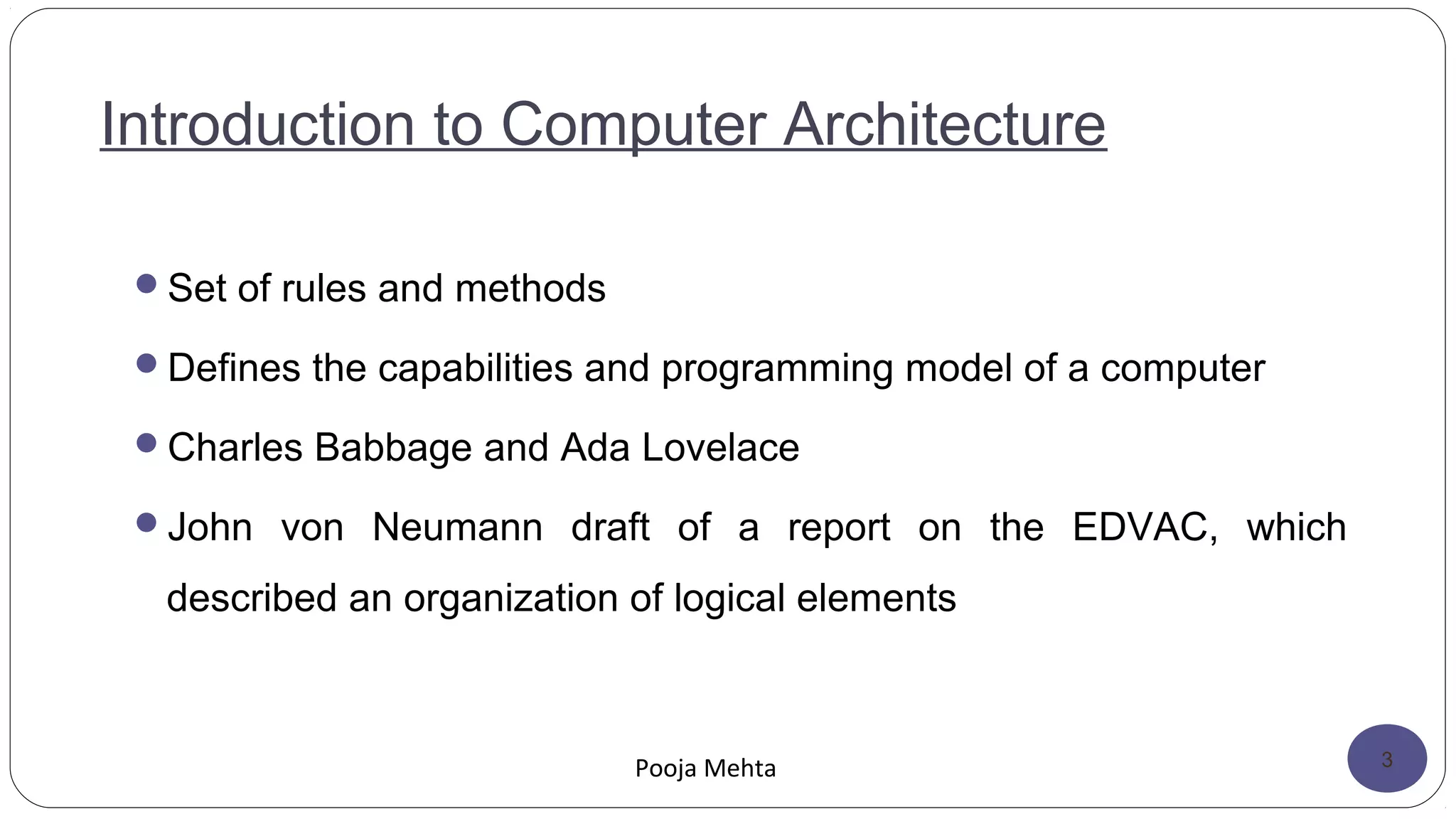
Introduction to Computer Architecture
Set of rules and methods
Defines the capabilities and programming model of a computer
Charles Babbage and Ada Lovelace
John von Neumann draft of a report on the EDVAC, which
described an organization of logical elements
Pooja Mehta 3
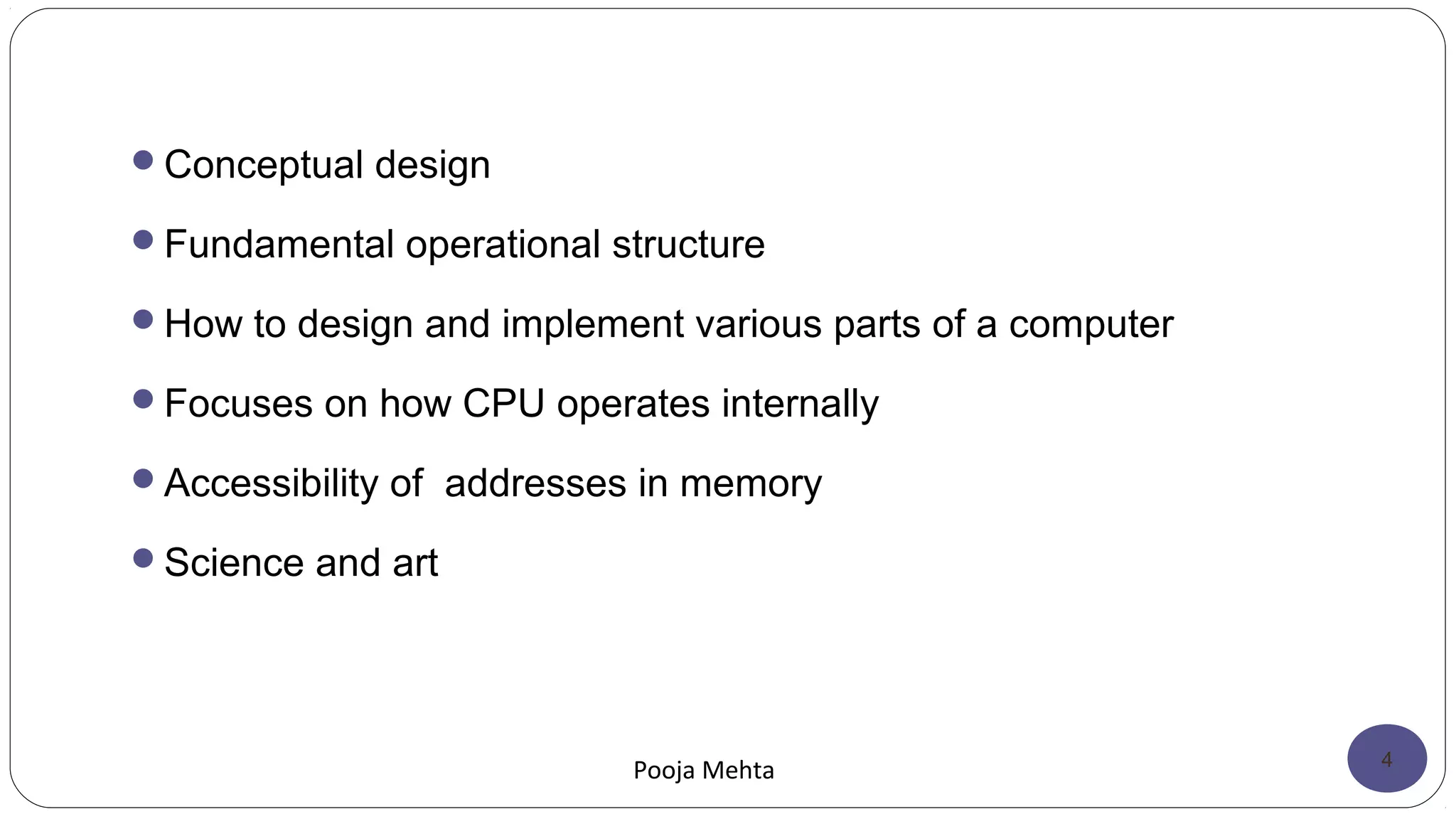
Conceptual design
Fundamental operational structure
How to design and implement various parts of a computer
Focuses on how CPU operates internally
Accessibility of addresses in memory
Science and art
Pooja Mehta 4
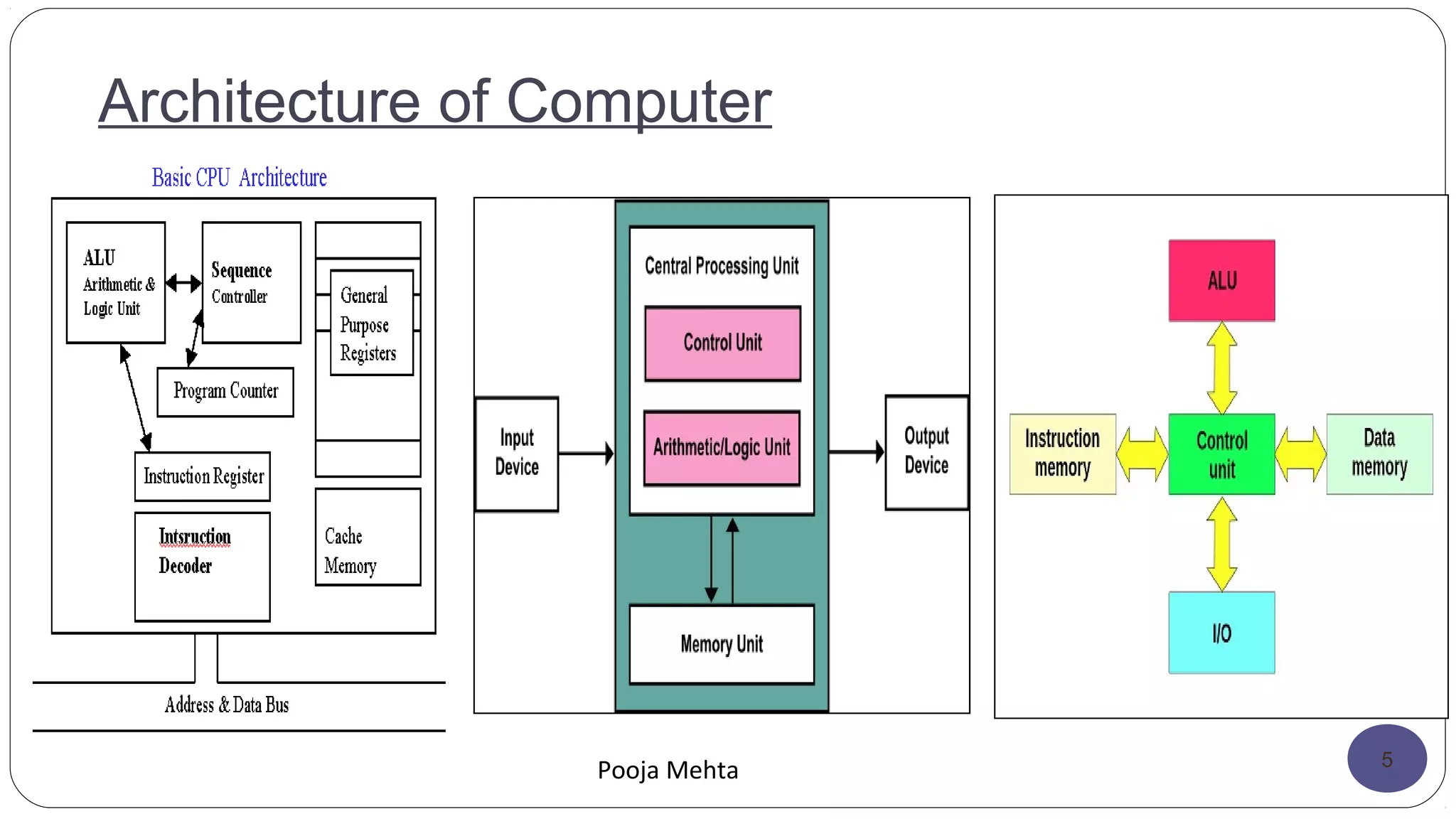
Architecture of Computer
5
Pooja Mehta
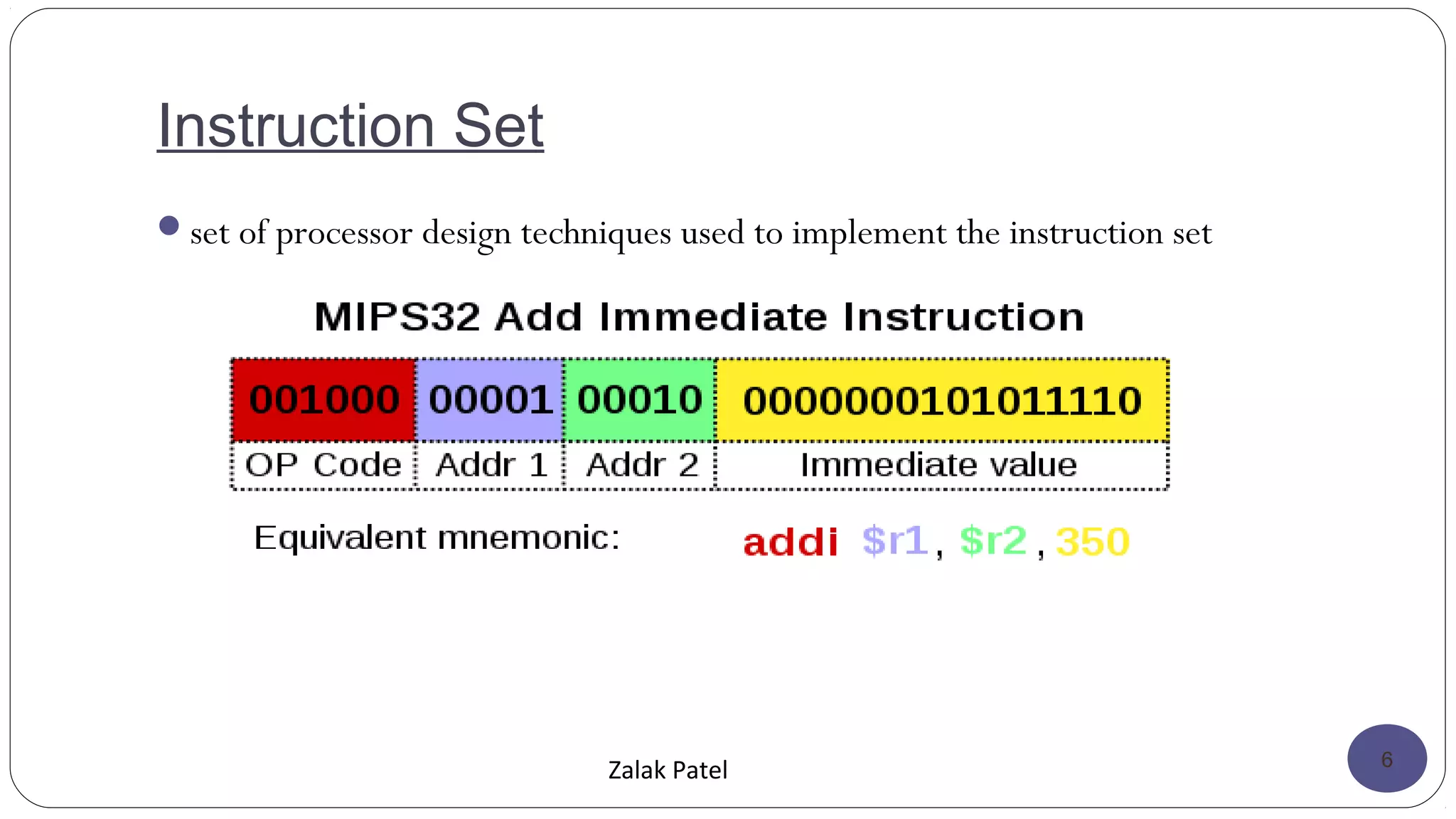
Instruction Set
set of processor design techniques used to implement the instruction set
6
Zalak Patel
Micro Architecture
Computer organization is a lower level, a detailed description of the
system that is sufficient for completely describing the operation of
all parts of the computing system, and how they are inter-
connected and inter-operate in order to implement the instruction
set.
The size of a computer's cache for instance, is an organizational
issue that generally has nothing to do with the instruction set.
7
Zalak Patel
Zalak Patel 8
System Design
9
Bhargav Rathod
RISC : Reduced Instruction Set computing
CISC : Complex Instruction Set Computing
Bhargav Rathod 10
Bhargav Rathod 11
Abstraction Layers
12
Naimish Thaker
Naimish Thaker 13
Naimish Thaker 14
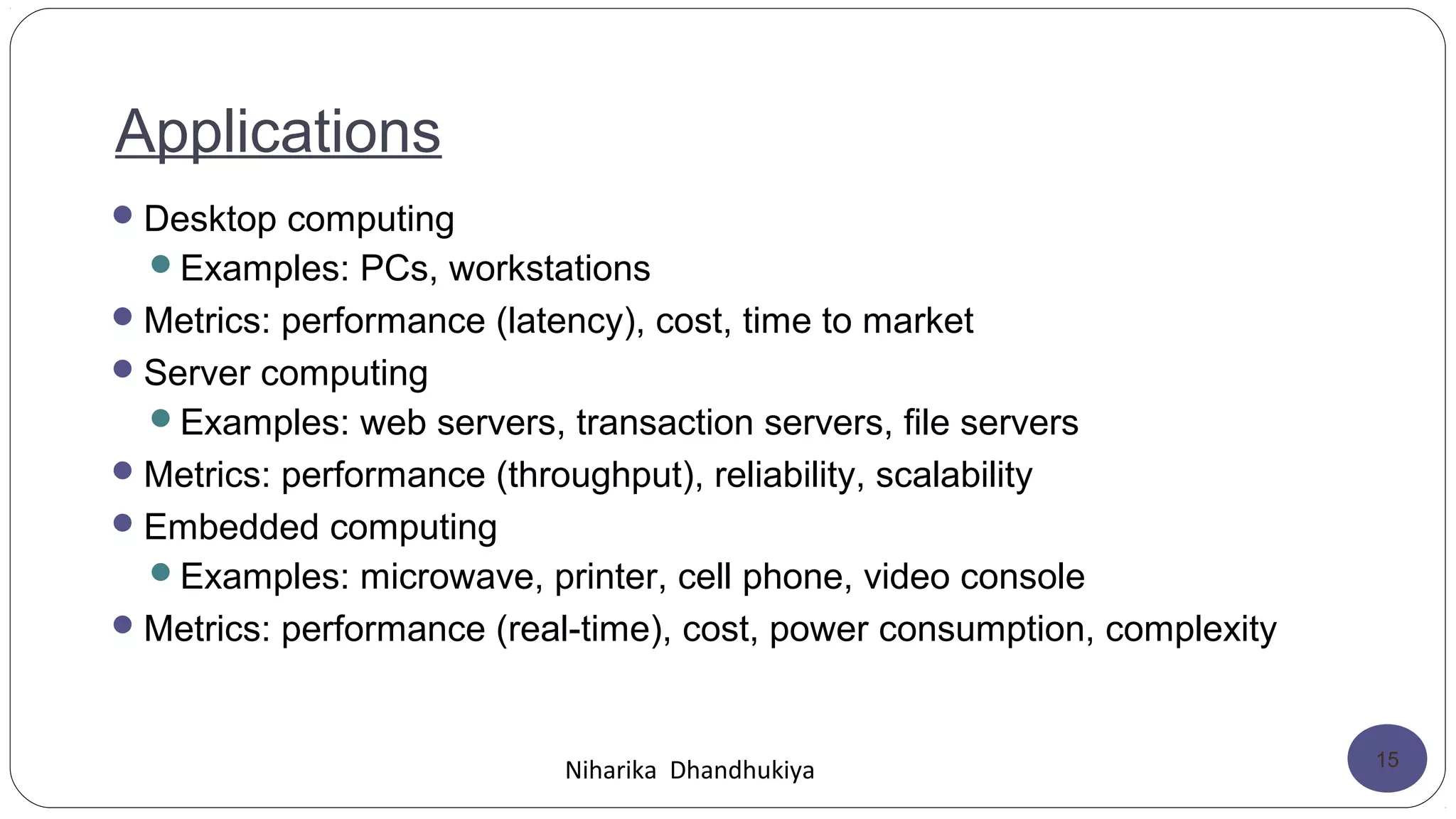
Applications
Desktop computing
Examples: PCs, workstations
Metrics: performance (latency), cost, time to market
Server computing
Examples: web servers, transaction servers, file servers
Metrics: performance (throughput), reliability, scalability
Embedded computing
Examples: microwave, printer, cell phone, video console
Metrics: performance (real-time), cost, power consumption, complexity
Niharika Dhandhukiya 15
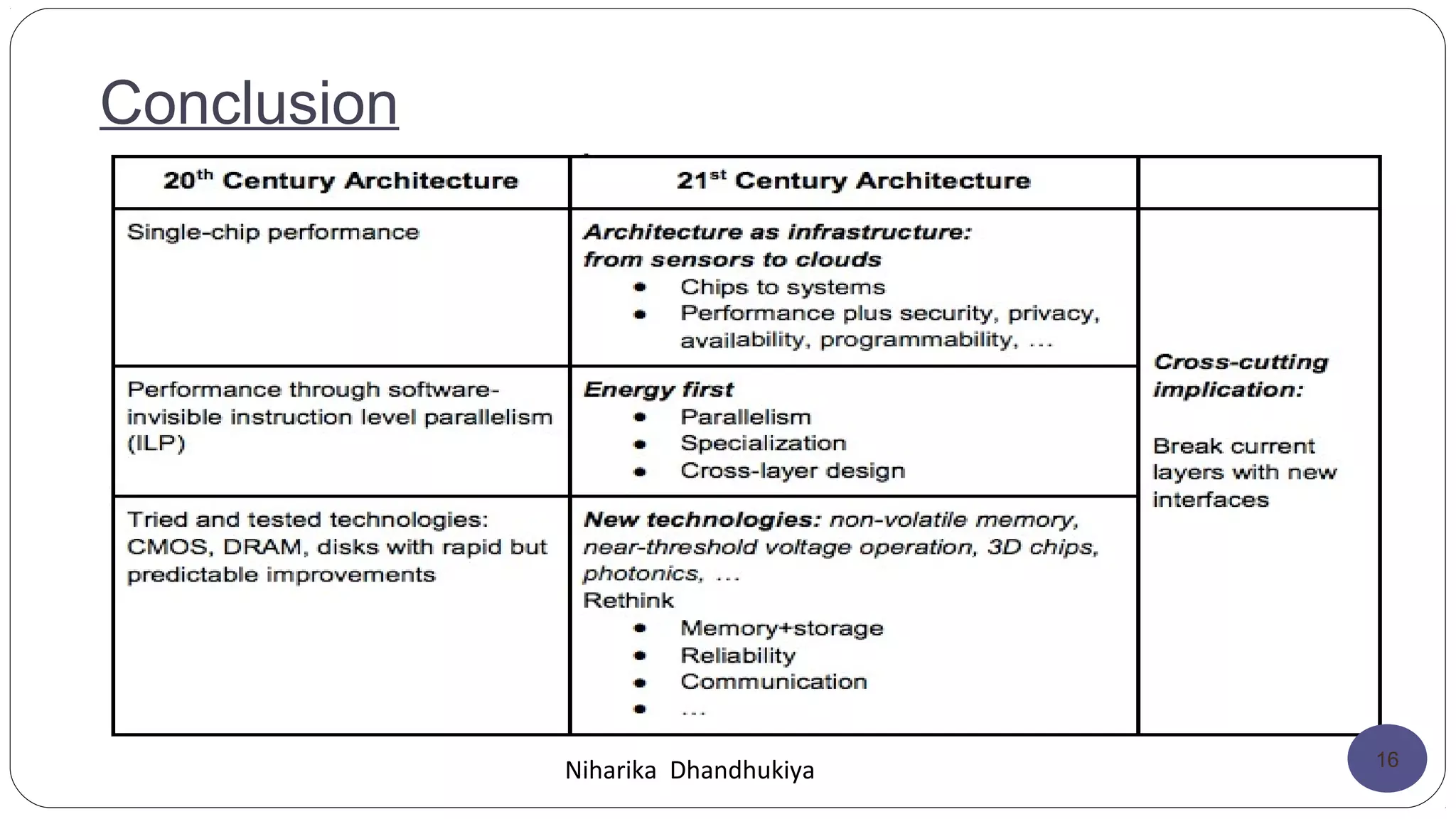
Conclusion
Niharika Dhandhukiya 16
References
https://en.wikipedia.org/wiki/Computer_architecture
http://superuser.com/questions/179919/x86-vs-x64-why-is-32-bit-
called-x86
http://csl.stanford.edu/~christos/publications/2012.21stcenturyarchit
ecture.whitepaper.pdf
17
Computer organization and architecture

Computer organization and architecture

Editor's Notes

  • #4 Set of rules and methods that describe the functionality, organization and implementation of computer systems Computer architecture is a specification detailing how a set of software and hardware technology standards interact to form a computer system or platform. In short, computer architecture refers to how a computer system is designed and what technologies it is compatible with The first computer architecture was in the correspondence between Charles Babbage and Ada Lovelace, describing the analytical engine John von Neumann's 1945 paper, First Draft of a Report on the EDVAC, which described an organization of logical elements Alan Turing's more detailed Proposed Electronic Calculator for the Automatic Computing Engine, also 1945 and which cited von Neumann's paper
  • #5 It can be defined as the science and art of selecting and interconnecting hardware components to create computers that meet functional, performance and cost goals.
  • #7 Instruction set architecture is distinguished from the micro architecture, which is the set of processor design techniques used to implement the instruction set. Computers with different micro architectures can share a common instruction set. For example, the Intel Pentium and the AMD Athlon implement nearly identical versions of the x86 instruction set, but have radically different internal designs. On traditional architectures, an instruction includes an opcode that specifies the operation to perform, such as add contents of memory to register—and zero or more operand specifiers, which may specify registers, memory locations, or literal data. The operand specifiers may have addressing modes determining their meaning or may be in fixed fields. In very long instruction word (VLIW) architectures, which include many microcode architectures, multiple simultaneous opcodes and operands are specified in a single instruction. Some exotic instruction sets do not have an opcode field (such as Transport Triggered Architectures (TTA) or the Forth virtual machine), only operand(s). Other unusual "0-operand" instruction sets lack any operand specifier fields, such as some stack machines including NOSC
  • #16 The term x86 refers to a family of instruction set architectures based on the Intel 8086. The 8086 was launched in 1978 as a fully 16-bit extension of Intel's early 8-bit based microprocessors and also introduced segmentation to overcome the 16-bit addressing barrier of earlier chips. The term x86 derived from the fact that early successors to the 8086 also had names ending in "86".