Data Validation
for
Business Continuity Planning
Prepared by:
Ms. Pooja Mehta
ITSNS Branch,
GTU-CDAC-BISAG ME Program,
Gandhinagar
1
3 March 2016By: Pooja Mehta
2
Content
2
 Introduction
 Conceptual Architecture
 Rules
 Experiments
 Conclusion
 References
Introduction
3 March 2016By: Pooja Mehta
3
 Important activity for any services delivery
organization
 Important activities in BCP are:
 Impact statement &
 Develop resumption plan
 Data validation is an important step for any
organization to verify and validate the sanctity of the
data.
4
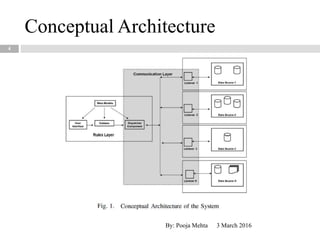
Conceptual Architecture
3 March 2016By: Pooja Mehta
Cont..
3 March 2016By: Pooja Mehta
5
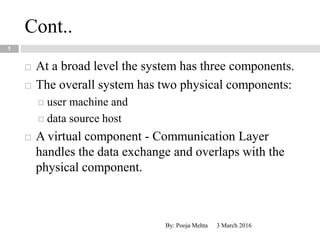
 At a broad level the system has three components.
 The overall system has two physical components:
 user machine and
 data source host
 A virtual component - Communication Layer
handles the data exchange and overlaps with the
physical component.
Cont..
3 March 2016By: Pooja Mehta
6
Cont..
3 March 2016By: Pooja Mehta
7
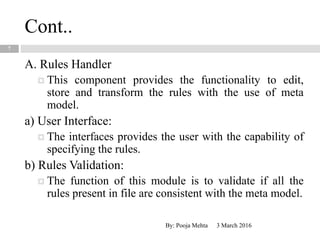
A. Rules Handler
 This component provides the functionality to edit,
store and transform the rules with the use of meta
model.
a) User Interface:
 The interfaces provides the user with the capability of
specifying the rules.
b) Rules Validation:
 The function of this module is to validate if all the
rules present in file are consistent with the meta model.
Cont..
3 March 2016By: Pooja Mehta
8
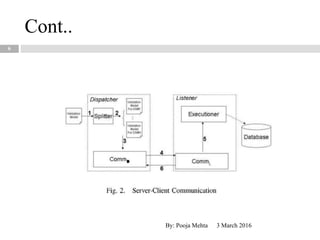
B. Communication Handler
c) Dispatcher:
 Dispatcher takes the validated rules object and
generate separate object for each data source such that
each object will have rules only for a corresponding
data source.
d) Listener:
 Listener runs on each data source machine as a daemon
process in the background. It takes the validation
object send by dispatcher and execute the rules and
revert back the response to the dispatcher.
Cont..
3 March 2016By: Pooja Mehta
9
C. Data Sources Handler
 These are all the different data sources hosts in the
organization.
 Each host may contain single or multiple databases.
10
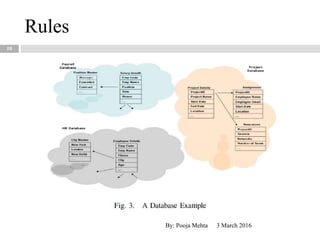
Rules
3 March 2016By: Pooja Mehta
Cont..
3 March 2016By: Pooja Mehta
11
Cont..
3 March 2016By: Pooja Mehta
12
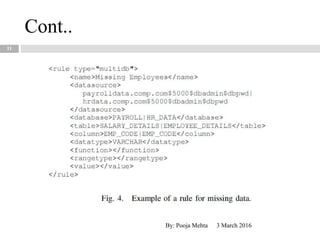
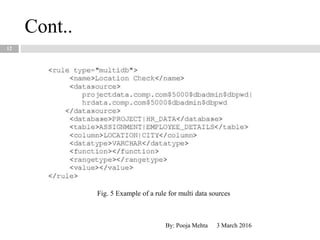
Fig. 5 Example of a rule for multi data sources
Experiments
3 March 2016By: Pooja Mehta
13
14
Cont..
3 March 2016By: Pooja Mehta
Conclusion
15
 In this paper, they have proposed a Metadata driven
rule-based data validation system, which is domain
independent, distributed and can easily accommodate
changes in business requirements.
 As proof-of-concept, they have applied their system on
real data sets.
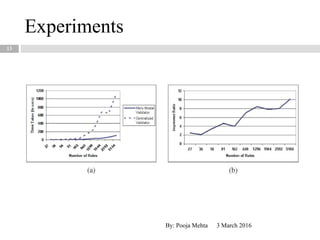
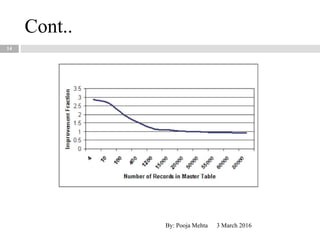
 Experimental results illustrated that their system is easy
to use, very adaptable for changes in business
requirements, faster then traditional Centralized
validation systems, scalable and does not expose the
sensitive data.
3 March 2016By: Pooja Mehta
Reference
16
 http://ieeexplore.ieee.org/stamp/stamp.jsp?tp=&arnum
ber=6273507
3 March 2016By: Pooja Mehta
17
Thank
you...!

Data Validation for Business Continuity Planning

  • 1.
    Data Validation for Business ContinuityPlanning Prepared by: Ms. Pooja Mehta ITSNS Branch, GTU-CDAC-BISAG ME Program, Gandhinagar 1
  • 2.
    3 March 2016By:Pooja Mehta 2 Content 2  Introduction  Conceptual Architecture  Rules  Experiments  Conclusion  References
  • 3.
    Introduction 3 March 2016By:Pooja Mehta 3  Important activity for any services delivery organization  Important activities in BCP are:  Impact statement &  Develop resumption plan  Data validation is an important step for any organization to verify and validate the sanctity of the data.
  • 4.
  • 5.
    Cont.. 3 March 2016By:Pooja Mehta 5  At a broad level the system has three components.  The overall system has two physical components:  user machine and  data source host  A virtual component - Communication Layer handles the data exchange and overlaps with the physical component.
  • 6.
  • 7.
    Cont.. 3 March 2016By:Pooja Mehta 7 A. Rules Handler  This component provides the functionality to edit, store and transform the rules with the use of meta model. a) User Interface:  The interfaces provides the user with the capability of specifying the rules. b) Rules Validation:  The function of this module is to validate if all the rules present in file are consistent with the meta model.
  • 8.
    Cont.. 3 March 2016By:Pooja Mehta 8 B. Communication Handler c) Dispatcher:  Dispatcher takes the validated rules object and generate separate object for each data source such that each object will have rules only for a corresponding data source. d) Listener:  Listener runs on each data source machine as a daemon process in the background. It takes the validation object send by dispatcher and execute the rules and revert back the response to the dispatcher.
  • 9.
    Cont.. 3 March 2016By:Pooja Mehta 9 C. Data Sources Handler  These are all the different data sources hosts in the organization.  Each host may contain single or multiple databases.
  • 10.
  • 11.
    Cont.. 3 March 2016By:Pooja Mehta 11
  • 12.
    Cont.. 3 March 2016By:Pooja Mehta 12 Fig. 5 Example of a rule for multi data sources
  • 13.
  • 14.
  • 15.
    Conclusion 15  In thispaper, they have proposed a Metadata driven rule-based data validation system, which is domain independent, distributed and can easily accommodate changes in business requirements.  As proof-of-concept, they have applied their system on real data sets.  Experimental results illustrated that their system is easy to use, very adaptable for changes in business requirements, faster then traditional Centralized validation systems, scalable and does not expose the sensitive data. 3 March 2016By: Pooja Mehta
  • 16.
  • 17.