JMHM Jayamaha
SEU/IS/10/PS/104
PS0372
 Definition
 Example of Critical section problem
 Solution to critical section problem
Software solution
 Algorithm 1
 Algorithm 2
 Algorithm 3
 Critical Region
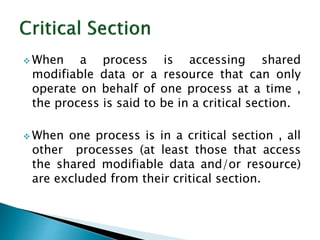
 When a process is accessing shared
modifiable data or a resource that can only
operate on behalf of one process at a time ,
the process is said to be in a critical section.
 When one process is in a critical section , all
other processes (at least those that access
the shared modifiable data and/or resource)
are excluded from their critical section.
 n processes all competing to use some shared data
 Each process has a code segment, called critical section, in which
the shared data is accessed.
 Problem – ensure that when one process is executing in its critical
section, no other process is allowed to execute in its critical section.
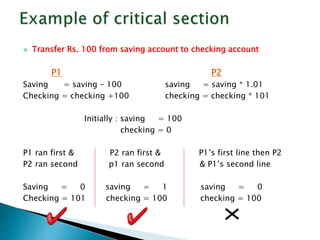
 Transfer Rs. 100 from saving account to checking account
P1 P2
Saving = saving – 100 saving = saving * 1.01
Checking = checking +100 checking = checking * 101
Initially : saving = 100
checking = 0
P1 ran first & P2 ran first & P1’s first line then P2
P2 ran second p1 ran second & P1’s second line
Saving = 0 saving = 1 saving = 0
Checking = 101 checking = 100 checking = 100
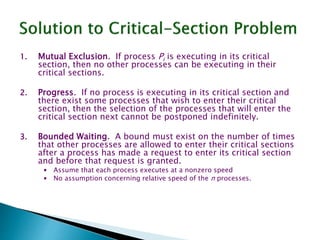
1. Mutual Exclusion. If process Pi is executing in its critical
section, then no other processes can be executing in their
critical sections.
2. Progress. If no process is executing in its critical section and
there exist some processes that wish to enter their critical
section, then the selection of the processes that will enter the
critical section next cannot be postponed indefinitely.
3. Bounded Waiting. A bound must exist on the number of times
that other processes are allowed to enter their critical sections
after a process has made a request to enter its critical section
and before that request is granted.
 Assume that each process executes at a nonzero speed
 No assumption concerning relative speed of the n processes.
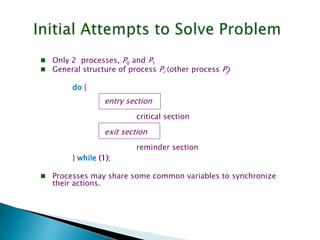
 Only 2 processes, P0 and P1
 General structure of process Pi (other process Pj)
do {
entry section
critical section
exit section
reminder section
} while (1);
 Processes may share some common variables to synchronize
their actions.
 Shared variables:
 int turn;
initially turn = 0
 turn = i Pi can enter its critical section
 Process Pi
do {
while (turn != i) ;
critical section
turn = j;
reminder section
} while (1);
 Satisfies mutual exclusion, but not progress
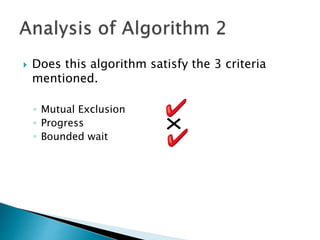
 Does this algorithm satisfy the 3 criteria
mentioned.
◦ Mutual Exclusion
◦ Progress
◦ Bounded wait
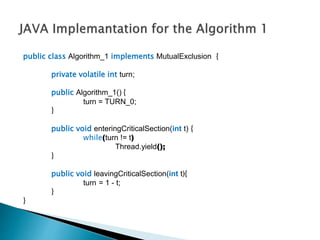
public class Algorithm_1 implements MutualExclusion {
private volatile int turn;
public Algorithm_1() {
turn = TURN_0;
}
public void enteringCriticalSection(int t) {
while(turn != t)
Thread.yield();
}
public void leavingCriticalSection(int t){
turn = 1 - t;
}
}
 Shared variables
 boolean flag[2];
initially flag [0] = flag [1] = false.
 flag [i] = true  Pi ready to enter its critical section
 Process Pi
do {
flag[i] := true;
while (flag[j]) ;
critical section
flag [i] = false;
remainder section
} while (1);
 Satisfies mutual exclusion, but not progress
requirement.
 Does this algorithm satisfy the 3 criteria
mentioned.
◦ Mutual Exclusion
◦ Progress
◦ Bounded wait
public class Algorithm_2 implements MutualExclusion {
private volatile boolean flag0;
private volatile boolean flag1;
public Algorithm_2() {
flag0 = false;
flag1 = false;
}
public void enteringCriticalSection(int t) {
if(t == 0){
flag0 = true;
while(flag1 == true)
Thread.yield();
} else {
flag1 = false;
while(flag0 == true)
Thread.yield();
}
}
public void leavingCriticalSection(int t) {
if(t == 0)
flag0 = false;
else
flag1 = false;
}
}
 Combined shared variables of algorithms 1
and 2.
 Process Pi
do {
flag [i]:= true;
turn = j;
while (flag [j] and turn = j) ;
critical section
flag [i] = false;
remainder section
} while (1);
 Meets all three requirements; solves the
critical-section problem for two processes.
 Does this algorithm satisfy the 3 criteria
mentioned.
◦ Mutual Exclusion
◦ Progress
◦ Bounded wait
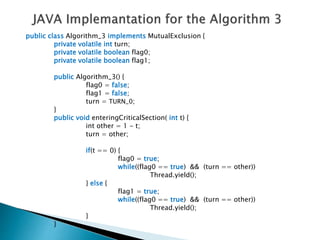
public class Algorithm_3 implements MutualExclusion {
private volatile int turn;
private volatile boolean flag0;
private volatile boolean flag1;
public Algorithm_3() {
flag0 = false;
flag1 = false;
turn = TURN_0;
}
public void enteringCriticalSection( int t) {
int other = 1 - t;
turn = other;
if(t == 0) {
flag0 = true;
while((flag0 == true) && (turn == other))
Thread.yield();
} else {
flag1 = true;
while((flag0 == true) && (turn == other))
Thread.yield();
}
}
public void leavingCriticalSection( int t) {
if(t == 0)
flag0 = false;
else
flag1 = false;
}
}
 High-level synchronization construct
 A shared variable v of type T, is declared
as:
v: shared T
 Variable v accessed only inside statement
region v when B do S
where B is a boolean expression.
 While statement S is being executed, no
other process can access variable v.
 Regions referring to the same shared
variable exclude each other in time.
 When a process tries to execute the
region statement, the Boolean
expression B is evaluated. If B is true,
statement S is executed. If it is false,
the process is delayed until B becomes
true and no other process is in the
region associated with v.
Operating system   critical section

Operating system critical section

  • 1.
  • 2.
     Definition  Exampleof Critical section problem  Solution to critical section problem Software solution  Algorithm 1  Algorithm 2  Algorithm 3  Critical Region
  • 3.
     When aprocess is accessing shared modifiable data or a resource that can only operate on behalf of one process at a time , the process is said to be in a critical section.  When one process is in a critical section , all other processes (at least those that access the shared modifiable data and/or resource) are excluded from their critical section.
  • 4.
     n processesall competing to use some shared data  Each process has a code segment, called critical section, in which the shared data is accessed.  Problem – ensure that when one process is executing in its critical section, no other process is allowed to execute in its critical section.
  • 5.
     Transfer Rs.100 from saving account to checking account P1 P2 Saving = saving – 100 saving = saving * 1.01 Checking = checking +100 checking = checking * 101 Initially : saving = 100 checking = 0 P1 ran first & P2 ran first & P1’s first line then P2 P2 ran second p1 ran second & P1’s second line Saving = 0 saving = 1 saving = 0 Checking = 101 checking = 100 checking = 100
  • 6.
    1. Mutual Exclusion.If process Pi is executing in its critical section, then no other processes can be executing in their critical sections. 2. Progress. If no process is executing in its critical section and there exist some processes that wish to enter their critical section, then the selection of the processes that will enter the critical section next cannot be postponed indefinitely. 3. Bounded Waiting. A bound must exist on the number of times that other processes are allowed to enter their critical sections after a process has made a request to enter its critical section and before that request is granted.  Assume that each process executes at a nonzero speed  No assumption concerning relative speed of the n processes.
  • 7.
     Only 2processes, P0 and P1  General structure of process Pi (other process Pj) do { entry section critical section exit section reminder section } while (1);  Processes may share some common variables to synchronize their actions.
  • 8.
     Shared variables: int turn; initially turn = 0  turn = i Pi can enter its critical section  Process Pi do { while (turn != i) ; critical section turn = j; reminder section } while (1);  Satisfies mutual exclusion, but not progress
  • 9.
     Does thisalgorithm satisfy the 3 criteria mentioned. ◦ Mutual Exclusion ◦ Progress ◦ Bounded wait
  • 10.
    public class Algorithm_1implements MutualExclusion { private volatile int turn; public Algorithm_1() { turn = TURN_0; } public void enteringCriticalSection(int t) { while(turn != t) Thread.yield(); } public void leavingCriticalSection(int t){ turn = 1 - t; } }
  • 11.
     Shared variables boolean flag[2]; initially flag [0] = flag [1] = false.  flag [i] = true  Pi ready to enter its critical section  Process Pi do { flag[i] := true; while (flag[j]) ; critical section flag [i] = false; remainder section } while (1);  Satisfies mutual exclusion, but not progress requirement.
  • 12.
     Does thisalgorithm satisfy the 3 criteria mentioned. ◦ Mutual Exclusion ◦ Progress ◦ Bounded wait
  • 13.
    public class Algorithm_2implements MutualExclusion { private volatile boolean flag0; private volatile boolean flag1; public Algorithm_2() { flag0 = false; flag1 = false; } public void enteringCriticalSection(int t) { if(t == 0){ flag0 = true; while(flag1 == true) Thread.yield(); } else { flag1 = false; while(flag0 == true) Thread.yield(); } }
  • 14.
    public void leavingCriticalSection(intt) { if(t == 0) flag0 = false; else flag1 = false; } }
  • 15.
     Combined sharedvariables of algorithms 1 and 2.  Process Pi do { flag [i]:= true; turn = j; while (flag [j] and turn = j) ; critical section flag [i] = false; remainder section } while (1);  Meets all three requirements; solves the critical-section problem for two processes.
  • 16.
     Does thisalgorithm satisfy the 3 criteria mentioned. ◦ Mutual Exclusion ◦ Progress ◦ Bounded wait
  • 17.
    public class Algorithm_3implements MutualExclusion { private volatile int turn; private volatile boolean flag0; private volatile boolean flag1; public Algorithm_3() { flag0 = false; flag1 = false; turn = TURN_0; } public void enteringCriticalSection( int t) { int other = 1 - t; turn = other; if(t == 0) { flag0 = true; while((flag0 == true) && (turn == other)) Thread.yield(); } else { flag1 = true; while((flag0 == true) && (turn == other)) Thread.yield(); } }
  • 18.
    public void leavingCriticalSection(int t) { if(t == 0) flag0 = false; else flag1 = false; } }
  • 19.
     High-level synchronizationconstruct  A shared variable v of type T, is declared as: v: shared T  Variable v accessed only inside statement region v when B do S where B is a boolean expression.  While statement S is being executed, no other process can access variable v.
  • 20.
     Regions referringto the same shared variable exclude each other in time.  When a process tries to execute the region statement, the Boolean expression B is evaluated. If B is true, statement S is executed. If it is false, the process is delayed until B becomes true and no other process is in the region associated with v.