NETWORK
TOPOLOGY
PRESENTED BY:-
KARAN SINGH
REE032A05
11503083
 Introduction to computer network
 Types of network
 Introduction to network topology
 Physical and Logical Topology
 Types of Topology
 Advantages and Disadvantages
 Applications
 Communication Schemes
Outline:-
Computer Network:-
A computer network is a group of computer systems and other computing
hardware devices that are linked together through communication
channels to facilitate communication and resource-sharing among a wide
range of users. Networks are commonly categorized based on their
characteristics.
The first computer network designed was the ‘Advanced Research Projects
Agency Network (ARPANET)’ by the United States Department of Defense.
ARPANET took advantage of the new idea of sending information in small
units called packets that could be routed on different paths and
reconstructed at their destination.
 Local Area Networks (LAN)
 Personal Area Networks (PAN)
 Home Area Networks (HAN)
 Wide Area Networks (WAN)
 Campus Networks
 Metropolitan Area Networks
(MAN)
 Enterprise Private Networks
 Internetworks
 Backbone Networks (BBN)
 Global Area Networks (GAN)
 The Internet
Types of network:-
 Local Area Network (LAN)
A Local Area Network (LAN) is a network that is restricted to smaller
physical areas e.g. a local office, school, or house. Approximately all
current LANs whether wired or wireless are based on Ethernet.
 Metropolitan Area Network (MAN)
A Metropolitan Area Network (MAN) is a network that connects two or
more computers, communicating devices or networks in a single network
that has geographic area larger than that covered by even a large ‘Local
Area Network’ but smaller than the region covered by a ‘Wide Area
Network’. MANs are mostly built for cities or towns to provide a high data
connection and usually owned by a single large organization.
 Wide Area Network (WAN)
Wide Area Network is a computer network that covers relatively larger
geographical area such as a state, province or country.
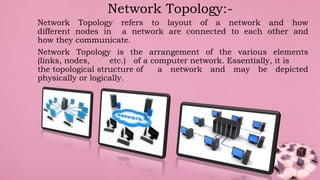
Network Topology refers to layout of a network and how
different nodes in a network are connected to each other and
how they communicate.
Network Topology is the arrangement of the various elements
(links, nodes, etc.) of a computer network. Essentially, it is
the topological structure of a network and may be depicted
physically or logically.
Network Topology:-
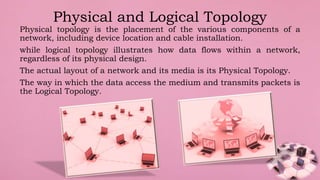
Physical topology is the placement of the various components of a
network, including device location and cable installation.
while logical topology illustrates how data flows within a network,
regardless of its physical design.
The actual layout of a network and its media is its Physical Topology.
The way in which the data access the medium and transmits packets is
the Logical Topology.
Physical and Logical Topology
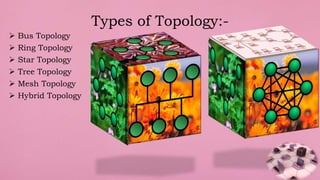
 Bus Topology
 Ring Topology
 Star Topology
 Tree Topology
 Mesh Topology
 Hybrid Topology
Types of Topology:-
We will discuss only…
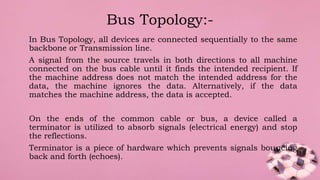
In Bus Topology, all devices are connected sequentially to the same
backbone or Transmission line.
A signal from the source travels in both directions to all machine
connected on the bus cable until it finds the intended recipient. If
the machine address does not match the intended address for the
data, the machine ignores the data. Alternatively, if the data
matches the machine address, the data is accepted.
On the ends of the common cable or bus, a device called a
terminator is utilized to absorb signals (electrical energy) and stop
the reflections.
Terminator is a piece of hardware which prevents signals bouncing
back and forth (echoes).
Bus Topology:-
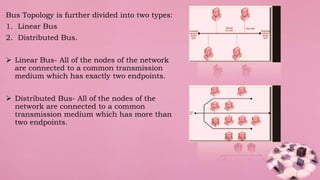
Bus Topology is further divided into two types:
1. Linear Bus
2. Distributed Bus.
 Linear Bus- All of the nodes of the network
are connected to a common transmission
medium which has exactly two endpoints.
 Distributed Bus- All of the nodes of the
network are connected to a common
transmission medium which has more than
two endpoints.
 Most computer motherboard.
 Ethernet and Local Talk
networks use a linear bus
topology
Applications:-
Advantages
 Inexpensive to install
 Easy to add stations
 Use less cable than other
topologies
 Works well for small networks
Bus Topology
Disadvantages
 No longer recommended
 Backbone breaks, whole
network down
 Limited no of devices can be
attached
 Difficult to isolate problems
 Sharing same cable slows
response rates
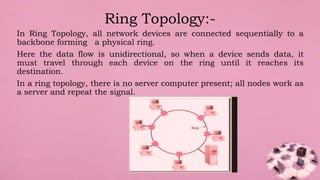
In Ring Topology, all network devices are connected sequentially to a
backbone forming a physical ring.
Here the data flow is unidirectional, so when a device sends data, it
must travel through each device on the ring until it reaches its
destination.
In a ring topology, there is no server computer present; all nodes work as
a server and repeat the signal.
Ring Topology:-
 Ring topologies are found in some office buildings or school
campuses.
 Token Ring LAN. Token ring local area network (LAN)
technology is a communications protocol for local area
networks.
Applications:-
Advantages
 Data packets travel at great
speed
 No collisions
 Easier to fault find
 No terminators required
Ring Topology:-
Disadvantages
 Requires more cable than a
bus
 Failure of one computer can
impact the rest of the
network.
 Not as common as the bus –
less devices available
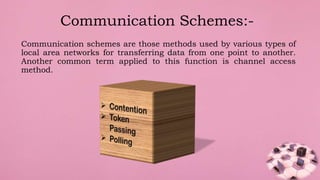
Communication schemes are those methods used by various types of
local area networks for transferring data from one point to another.
Another common term applied to this function is channel access
method.
Communication Schemes:-
The term is used especially in networks to describe the situation
where two or more nodes attempt to transmit a message across
the same wire at the same time.
The contention channel access method involves multiple devices
sharing a common transmission media.
This system breaks down when two computers attempt to
transmit at the same time. This is a case of collision. To avoid
collision, carrier sensing mechanism is used.
Contention:-
Token passing is a channel access method where a signal called a
token is passed between nodes that authorizes the node to
communicate.
Token passing uses a token, or series of bits, to grant a device
permission to transmit over the network. Whichever device has the
token can put data into the network. When its transmission is
complete, the device passes the token along to the next device in the
topology.
Token Passing:-
In a master/slave scenario, the master queries each slave device in
turn as to whether it has any data to transmit. If the slave answers
yes then the device is permitted to transmit its data. If the slave
answers no then the master moves on and polls the next slave
device. The process is repeated continuously.
Polling:-
Network topology  3D  Animation

Network topology 3D Animation

  • 1.
  • 2.
     Introduction tocomputer network  Types of network  Introduction to network topology  Physical and Logical Topology  Types of Topology  Advantages and Disadvantages  Applications  Communication Schemes Outline:-
  • 3.
    Computer Network:- A computernetwork is a group of computer systems and other computing hardware devices that are linked together through communication channels to facilitate communication and resource-sharing among a wide range of users. Networks are commonly categorized based on their characteristics. The first computer network designed was the ‘Advanced Research Projects Agency Network (ARPANET)’ by the United States Department of Defense. ARPANET took advantage of the new idea of sending information in small units called packets that could be routed on different paths and reconstructed at their destination.
  • 4.
     Local AreaNetworks (LAN)  Personal Area Networks (PAN)  Home Area Networks (HAN)  Wide Area Networks (WAN)  Campus Networks  Metropolitan Area Networks (MAN)  Enterprise Private Networks  Internetworks  Backbone Networks (BBN)  Global Area Networks (GAN)  The Internet Types of network:-
  • 5.
     Local AreaNetwork (LAN) A Local Area Network (LAN) is a network that is restricted to smaller physical areas e.g. a local office, school, or house. Approximately all current LANs whether wired or wireless are based on Ethernet.  Metropolitan Area Network (MAN) A Metropolitan Area Network (MAN) is a network that connects two or more computers, communicating devices or networks in a single network that has geographic area larger than that covered by even a large ‘Local Area Network’ but smaller than the region covered by a ‘Wide Area Network’. MANs are mostly built for cities or towns to provide a high data connection and usually owned by a single large organization.  Wide Area Network (WAN) Wide Area Network is a computer network that covers relatively larger geographical area such as a state, province or country.
  • 7.
    Network Topology refersto layout of a network and how different nodes in a network are connected to each other and how they communicate. Network Topology is the arrangement of the various elements (links, nodes, etc.) of a computer network. Essentially, it is the topological structure of a network and may be depicted physically or logically. Network Topology:-
  • 8.
    Physical topology isthe placement of the various components of a network, including device location and cable installation. while logical topology illustrates how data flows within a network, regardless of its physical design. The actual layout of a network and its media is its Physical Topology. The way in which the data access the medium and transmits packets is the Logical Topology. Physical and Logical Topology
  • 9.
     Bus Topology Ring Topology  Star Topology  Tree Topology  Mesh Topology  Hybrid Topology Types of Topology:-
  • 10.
  • 11.
    In Bus Topology,all devices are connected sequentially to the same backbone or Transmission line. A signal from the source travels in both directions to all machine connected on the bus cable until it finds the intended recipient. If the machine address does not match the intended address for the data, the machine ignores the data. Alternatively, if the data matches the machine address, the data is accepted. On the ends of the common cable or bus, a device called a terminator is utilized to absorb signals (electrical energy) and stop the reflections. Terminator is a piece of hardware which prevents signals bouncing back and forth (echoes). Bus Topology:-
  • 12.
    Bus Topology isfurther divided into two types: 1. Linear Bus 2. Distributed Bus.  Linear Bus- All of the nodes of the network are connected to a common transmission medium which has exactly two endpoints.  Distributed Bus- All of the nodes of the network are connected to a common transmission medium which has more than two endpoints.
  • 13.
     Most computermotherboard.  Ethernet and Local Talk networks use a linear bus topology Applications:-
  • 14.
    Advantages  Inexpensive toinstall  Easy to add stations  Use less cable than other topologies  Works well for small networks Bus Topology Disadvantages  No longer recommended  Backbone breaks, whole network down  Limited no of devices can be attached  Difficult to isolate problems  Sharing same cable slows response rates
  • 15.
    In Ring Topology,all network devices are connected sequentially to a backbone forming a physical ring. Here the data flow is unidirectional, so when a device sends data, it must travel through each device on the ring until it reaches its destination. In a ring topology, there is no server computer present; all nodes work as a server and repeat the signal. Ring Topology:-
  • 16.
     Ring topologiesare found in some office buildings or school campuses.  Token Ring LAN. Token ring local area network (LAN) technology is a communications protocol for local area networks. Applications:-
  • 17.
    Advantages  Data packetstravel at great speed  No collisions  Easier to fault find  No terminators required Ring Topology:- Disadvantages  Requires more cable than a bus  Failure of one computer can impact the rest of the network.  Not as common as the bus – less devices available
  • 18.
    Communication schemes arethose methods used by various types of local area networks for transferring data from one point to another. Another common term applied to this function is channel access method. Communication Schemes:-
  • 19.
    The term isused especially in networks to describe the situation where two or more nodes attempt to transmit a message across the same wire at the same time. The contention channel access method involves multiple devices sharing a common transmission media. This system breaks down when two computers attempt to transmit at the same time. This is a case of collision. To avoid collision, carrier sensing mechanism is used. Contention:-
  • 20.
    Token passing isa channel access method where a signal called a token is passed between nodes that authorizes the node to communicate. Token passing uses a token, or series of bits, to grant a device permission to transmit over the network. Whichever device has the token can put data into the network. When its transmission is complete, the device passes the token along to the next device in the topology. Token Passing:-
  • 21.
    In a master/slavescenario, the master queries each slave device in turn as to whether it has any data to transmit. If the slave answers yes then the device is permitted to transmit its data. If the slave answers no then the master moves on and polls the next slave device. The process is repeated continuously. Polling:-