Friday, January 23, 2015 1
Presented By
Manoj Kumar
Object Oriented Methodology
 It is a new way of thinking about problems using models based
on real world concepts.
 The basic construct is object which combines both data
structure and behavior in a single entity.
 Rambaugh presents an object oriented software development
methodology, the Object Modeling Technique (OMT) which
extends from analysis through design to implementation.
Friday, January 23, 2015 2
 Analysis model is built to abstract essential aspects of application
domain which contains objects found in application, their properties
and behavior.
Then design model is made to describe and optimize the
implementation.
Finally, the design model is implemented in a programming
language, database or hardware.
 Graphical notation is used for expressing object-oriented models.
Friday, January 23, 2015 3
Continue…
Friday, January 23, 2015 4
What is Object-Oriented?
 Software is organized as a collection of discrete objects that incorporate
both data structure and behavior.
In general, it includes - identity, classification, polymorphism and
inheritance.
Object Oriented Programming Language =
Object Based Programming Language + Inheritance + Dynamic Binding
Friday, January 23, 2015 5Friday, January 23, 2015 5
Object-Oriented Development?
 The theme is the identification and organization of application
concepts rather than final representation in a prog. Language.
 OOD approach encourages software developers to work and
think in terms of the application domain through most of the
software engineering life cycle.
 It is a conceptual process independent of a programming
language until the final stage
Friday, January 23, 2015 6
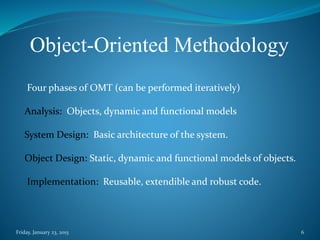
Object-Oriented Methodology
Four phases of OMT (can be performed iteratively)
Analysis: Objects, dynamic and functional models
System Design: Basic architecture of the system.
Object Design: Static, dynamic and functional models of objects.
Implementation: Reusable, extendible and robust code.
Friday, January 23, 2015 7
Object-Oriented Models
A model is an abstraction of something for the purpose of
understanding it before building it.
There are three models,
 Object model
 Dynamic model
Functional model
Friday, January 23, 2015 8
Object Model
 Describes basic structure of objects and their relationship.
 Contains object diagram.
 Object diagram is a graph whose nodes are object classes
(Classes) and whose arcs are relationships among classes.
Friday, January 23, 2015 9Friday, January 23, 2015 9
Dynamic Model
 Describes the aspects of a system that change over time.
 It specifies and implement control aspects of a system.
 Contains state diagram.
 State diagram is a graph whose nodes are states and
whose arcs are data-flows.
Friday, January 23, 2015 10Friday, January 23, 2015 10Friday, January 23, 2015 10
Functional Model
 Describes data value transformation within a system.
 Contains data flow diagram.
 Data Flow Diagram is a graph whose nodes are
processes and whose arcs are data flows.
Friday, January 23, 2015 11Friday, January 23, 2015 11Friday, January 23, 2015 11
Dynamic Modeling
 First examine the system at a single moment of time.
 Then examine changes to objects and their relationships over time.
 Those aspects of a system that are concerned with time and changes
are dynamic model, in contrast with static or object model.
 Control is the aspect of a system that describes the sequences of
operations that occur in response to external stimuli without
considering what the operation do, what they operate on, and how
they are implemented.
Friday, January 23, 2015 12Friday, January 23, 2015 12Friday, January 23, 2015 12Friday, January 23, 2015 12
Events
 It is something that happens at a point in time
One event may logically precede or follow another or the two events
may be unrelated.
The two events are causally related.
The two events are causally unrelated are said to be concurrent i.e.
they have no effect on each other.
In modeling a system we do not establish an ordering between
concurrent events because they can occur at any order
Friday, January 23, 2015 13Friday, January 23, 2015 13Friday, January 23, 2015 13Friday, January 23, 2015 13Friday, January 23, 2015 13
Continue…
An event is a one-way transmission of information from one
object to another.
In real world, all objects exist concurrently.
An object sending an event to another object may expect a
reply but the reply is a separate event under the control of
the second object which may or may not choose to send it.
Every event is a unique occurrence, but we group them into
event classes and give each event class a name to indicate
common structure and behavior.
Friday, January 23, 2015 14
A scenario is a sequence of events that occurs during one particular
execution of a system.
The scope of a scenario can vary; it may include all events in the
system or it may include only those events generated by certain
objects in the system.
It can be the historical record of executing a system or a thought
experiment of executing a proposed system.
An event trace extends the scenario to clarify events between objects
Scenario & Event-Trace
It is an abstraction of the attribute values and links of an object.
Set of values are grouped together into a state according to
properties that affect the gross behavior of the object e.g. the state
of bank is either solvent or insolvent whether its assets are greater
than liabilities.
 A state specifies the response of the object to input events.
Response is same for all values within the same state and may
be different for values in different states
Response of an object to an event may include an action or
change of states by the object.
Friday, January 23, 2015 15
States
Friday, January 23, 2015 16
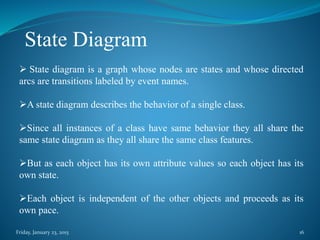
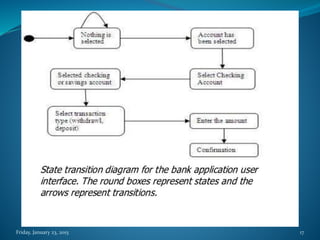
 State diagram is a graph whose nodes are states and whose directed
arcs are transitions labeled by event names.
A state diagram describes the behavior of a single class.
Since all instances of a class have same behavior they all share the
same state diagram as they all share the same class features.
But as each object has its own attribute values so each object has its
own state.
Each object is independent of the other objects and proceeds as its
own pace.
State Diagram
Friday, January 23, 2015 17
Friday, January 23, 2015 18
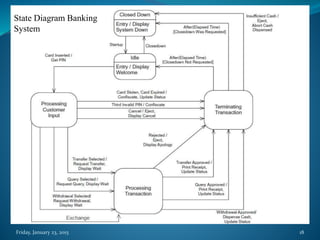
State Diagram Banking
System
ANY
QUESTION?
Friday, January 23, 2015 19
THANK
YOU!
Friday, January 23, 2015 20

Some Basic Concepts of Object Oriented Methodology

  • 1.
    Friday, January 23,2015 1 Presented By Manoj Kumar Object Oriented Methodology
  • 2.
     It isa new way of thinking about problems using models based on real world concepts.  The basic construct is object which combines both data structure and behavior in a single entity.  Rambaugh presents an object oriented software development methodology, the Object Modeling Technique (OMT) which extends from analysis through design to implementation. Friday, January 23, 2015 2
  • 3.
     Analysis modelis built to abstract essential aspects of application domain which contains objects found in application, their properties and behavior. Then design model is made to describe and optimize the implementation. Finally, the design model is implemented in a programming language, database or hardware.  Graphical notation is used for expressing object-oriented models. Friday, January 23, 2015 3 Continue…
  • 4.
    Friday, January 23,2015 4 What is Object-Oriented?  Software is organized as a collection of discrete objects that incorporate both data structure and behavior. In general, it includes - identity, classification, polymorphism and inheritance. Object Oriented Programming Language = Object Based Programming Language + Inheritance + Dynamic Binding
  • 5.
    Friday, January 23,2015 5Friday, January 23, 2015 5 Object-Oriented Development?  The theme is the identification and organization of application concepts rather than final representation in a prog. Language.  OOD approach encourages software developers to work and think in terms of the application domain through most of the software engineering life cycle.  It is a conceptual process independent of a programming language until the final stage
  • 6.
    Friday, January 23,2015 6 Object-Oriented Methodology Four phases of OMT (can be performed iteratively) Analysis: Objects, dynamic and functional models System Design: Basic architecture of the system. Object Design: Static, dynamic and functional models of objects. Implementation: Reusable, extendible and robust code.
  • 7.
    Friday, January 23,2015 7 Object-Oriented Models A model is an abstraction of something for the purpose of understanding it before building it. There are three models,  Object model  Dynamic model Functional model
  • 8.
    Friday, January 23,2015 8 Object Model  Describes basic structure of objects and their relationship.  Contains object diagram.  Object diagram is a graph whose nodes are object classes (Classes) and whose arcs are relationships among classes.
  • 9.
    Friday, January 23,2015 9Friday, January 23, 2015 9 Dynamic Model  Describes the aspects of a system that change over time.  It specifies and implement control aspects of a system.  Contains state diagram.  State diagram is a graph whose nodes are states and whose arcs are data-flows.
  • 10.
    Friday, January 23,2015 10Friday, January 23, 2015 10Friday, January 23, 2015 10 Functional Model  Describes data value transformation within a system.  Contains data flow diagram.  Data Flow Diagram is a graph whose nodes are processes and whose arcs are data flows.
  • 11.
    Friday, January 23,2015 11Friday, January 23, 2015 11Friday, January 23, 2015 11 Dynamic Modeling  First examine the system at a single moment of time.  Then examine changes to objects and their relationships over time.  Those aspects of a system that are concerned with time and changes are dynamic model, in contrast with static or object model.  Control is the aspect of a system that describes the sequences of operations that occur in response to external stimuli without considering what the operation do, what they operate on, and how they are implemented.
  • 12.
    Friday, January 23,2015 12Friday, January 23, 2015 12Friday, January 23, 2015 12Friday, January 23, 2015 12 Events  It is something that happens at a point in time One event may logically precede or follow another or the two events may be unrelated. The two events are causally related. The two events are causally unrelated are said to be concurrent i.e. they have no effect on each other. In modeling a system we do not establish an ordering between concurrent events because they can occur at any order
  • 13.
    Friday, January 23,2015 13Friday, January 23, 2015 13Friday, January 23, 2015 13Friday, January 23, 2015 13Friday, January 23, 2015 13 Continue… An event is a one-way transmission of information from one object to another. In real world, all objects exist concurrently. An object sending an event to another object may expect a reply but the reply is a separate event under the control of the second object which may or may not choose to send it. Every event is a unique occurrence, but we group them into event classes and give each event class a name to indicate common structure and behavior.
  • 14.
    Friday, January 23,2015 14 A scenario is a sequence of events that occurs during one particular execution of a system. The scope of a scenario can vary; it may include all events in the system or it may include only those events generated by certain objects in the system. It can be the historical record of executing a system or a thought experiment of executing a proposed system. An event trace extends the scenario to clarify events between objects Scenario & Event-Trace
  • 15.
    It is anabstraction of the attribute values and links of an object. Set of values are grouped together into a state according to properties that affect the gross behavior of the object e.g. the state of bank is either solvent or insolvent whether its assets are greater than liabilities.  A state specifies the response of the object to input events. Response is same for all values within the same state and may be different for values in different states Response of an object to an event may include an action or change of states by the object. Friday, January 23, 2015 15 States
  • 16.
    Friday, January 23,2015 16  State diagram is a graph whose nodes are states and whose directed arcs are transitions labeled by event names. A state diagram describes the behavior of a single class. Since all instances of a class have same behavior they all share the same state diagram as they all share the same class features. But as each object has its own attribute values so each object has its own state. Each object is independent of the other objects and proceeds as its own pace. State Diagram
  • 17.
  • 18.
    Friday, January 23,2015 18 State Diagram Banking System
  • 19.
  • 20.

Editor's Notes

  • #7 OOA: Analysis (What) — understanding, finding and describing concepts in the problem domain. Model the real world showing its important properties. It is used to provide a detailed description of a system using object-oriented notation, concepts, and methodology OOD: Design (How) — understanding and defining software solution/objects that represent the analysis concepts and will eventually be implemented in code. concentrates on providing the blueprint for implementation OOP: Implementation: Translate the object classes and relationships into a programming language