Multimedia:
Text and Graphics


       Dr. Tan CK   1
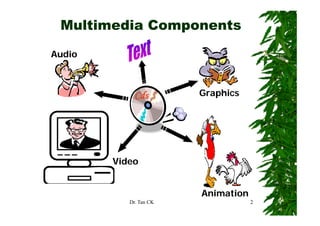
Multimedia Components

Audio


            Cds         Graphics


        Video


                        Animation
                        A i   i
           Dr. Tan CK               2
What is typography ?


It is the art of
choosing and
  h     i      d
arranging font


              Dr. Tan CK   3
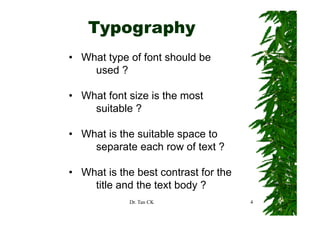
Typography
     yp g p y
• What type of font should be
        yp
    used ?

• What font size is the most
    suitable ?

• What is the suitable space to
                        p
    separate each row of text ?

• What is the best contrast for the
    title and the text body ?
                          y
             Dr. Tan CK               4
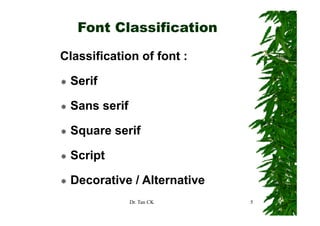
Font Classification

Classification of font :

 Serif

 Sans serif

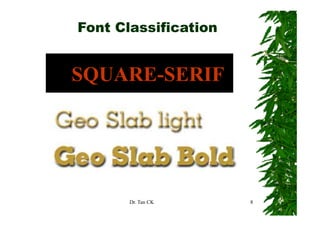
 Square serif

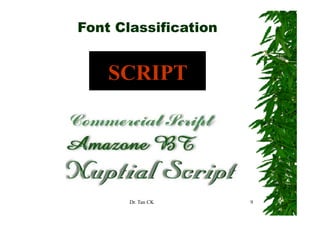
 Script

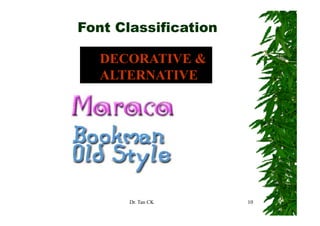
 Decorative / Alternative
              Dr. Tan CK    5
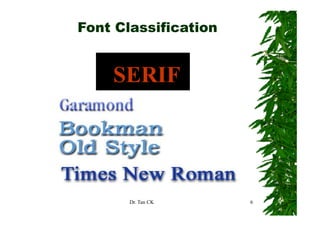
Font Classification


    SERIF


       Dr. Tan CK     6
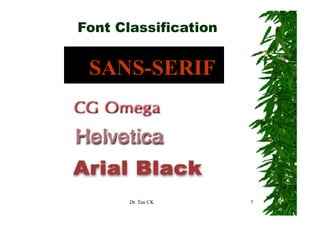
Font Classification


 SANS-SERIF
 SANS SERIF


       Dr. Tan CK     7
Font Classification


SQUARE-SERIF


       Dr. Tan CK     8
Font Classification


    SCRIPT


       Dr. Tan CK     9
Font Classification

   DECORATIVE &
   ALTERNATIVE


       Dr. Tan CK     10
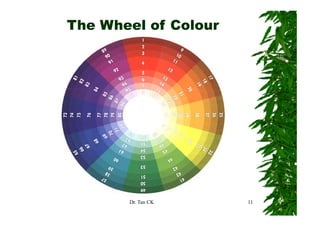
The Wheel of Colour


       Dr. Tan CK     11
The Saying goes …
Color affects our life.
Color is physical ……we see it.
Color
C l communicates ……we receive it
              i t               i
      information from the language of
  color.
  color
Color is emotional ……it evokes our
  feelings.
                               Bride M. Whelan
                                     M            .
                               (
                               (Color Harmony 2)...
                                            y )
                  Dr. Tan CK                     12
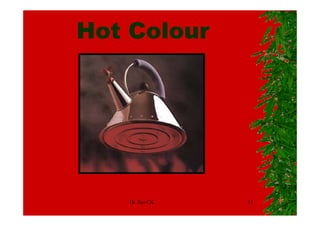
Hot Colour


   Dr. Tan CK   13
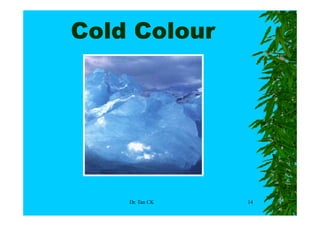
Cold Colour


    Dr. Tan CK   14
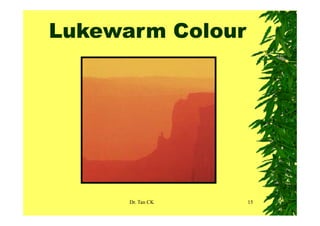
Lukewarm Colour


      Dr. Tan CK   15
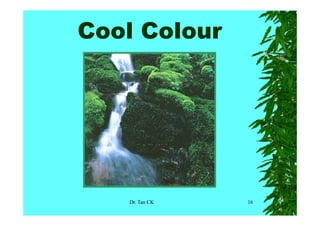
Cool Colour


   Dr. Tan CK   16
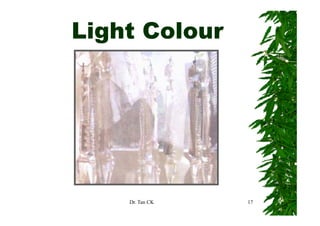
Light Colour


    Dr. Tan CK   17
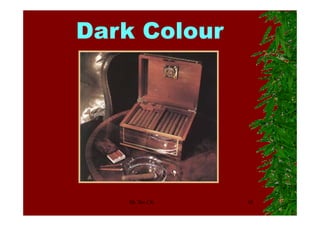
Dark Colour


   Dr. Tan CK   18
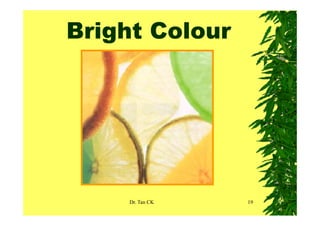
Bright Colour


    Dr. Tan CK   19
Terms Related to Colour

 Hue refers to colo r ( green yellow, red
 H             colour green, ello
     and others)
 Value refers to value of the brightness /
       darkness
       when we add more white colour, the
       value is higher
       when we add more black colour, the
       value is lower

                   Dr. Tan CK                20
Terms Related to Colour
Saturation the intensity, natural and richness
                       y,
           of the colour
            usually represents the middle
                ll          t th iddl
            segment of the wheel of colour
            pure colour (without white,
            black and grey)
                      g y)
Tint        colour which is added with white
            little by little to become lighter
                   b
            colour

                   Dr. Tan CK                    21
Terms Related to Colour

 Shades   colour which is added with
          black little by little until it
          becomes darker colour


              Dr. Tan CK                    22
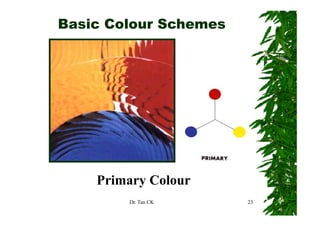
Basic Colour Schemes


    Primary Colour
        Dr. Tan CK     23
Basic Colour Schemes


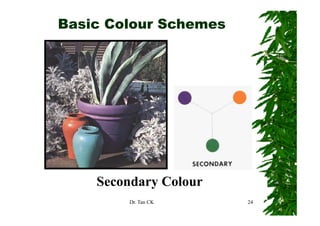
    Secondary Colour
        Dr. Tan CK     24
Basic Colour Schemes


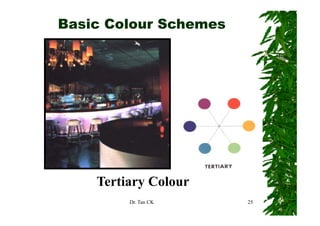
    Tertiary Colour
         Dr. Tan CK    25
Basic Colour Schemes


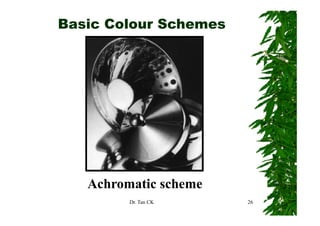
   Achromatic scheme
         Dr. Tan CK    26
Basic Colour Schemes


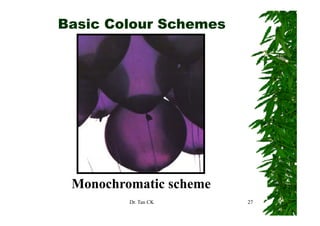
 Monochromatic scheme
         Dr. Tan CK     27
Basic Colour Schemes


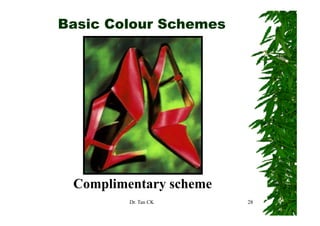
 Complimentary scheme
    p        y
         Dr. Tan CK     28
Basic Colour Schemes


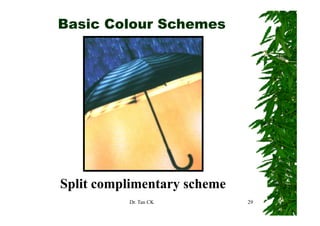
Split complimentary scheme
 p       p        y
          Dr. Tan CK         29
Basic Colour Schemes


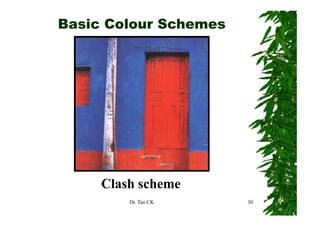
     Clash scheme
         Dr. Tan CK    30
Basic Colour Schemes


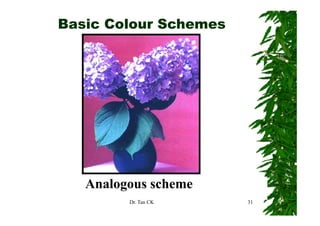
   Analogous scheme
        g
         Dr. Tan CK    31
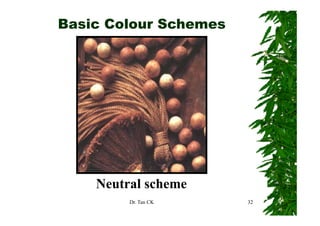
Basic Colour Schemes


    Neutral scheme
         Dr. Tan CK    32
Text Layout
Elements of effective text
 layout :

 C – Contrast
 R - Repetition
 A - Alignment
 P – P i it
     Proximity

           Dr. Tan CK        33
Text Layout
              Font Contrast
Contrast
C t    t      Colour C
              C      Contrast
              Graphics Contrast


       Repetition
 Repetition of characters
 R    titi   f h     t
 Repetition of g ap cs
   epet t o o graphics
 Combined Repetition of graphics and
 text
 te t
             Dr. Tan CK           34
Text Layout
Alignment
 Alignment of characters
 Graphics Alignment
 Text and graphics Alignment

        Proximity
 Distance between characters
 Distance between the graphics
                      g p
 Distance between characters and
 graphics
             Dr. Tan CK            35
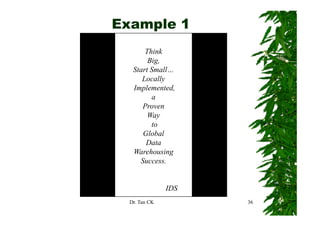
Example 1
       Think
        Big,
        Big
   Start Small…
      Locally
   Implemented,
   Implemented
         a
      Proven
        Way
         to
      Global
       Data
   Warehousing
     Success.


               IDS
  Dr. Tan CK         36
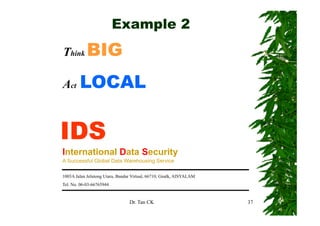
Example 2
Think BIG

Act LOCAL


IDS
International Data Security
A Successful Global Data Warehousing Service

1003A Jalan Jelutong Utara, Bandar Virtual, 66710, Gnalk, AISYALAM
Tel. No. 06-03-66765944


                                 Dr. Tan CK                          37
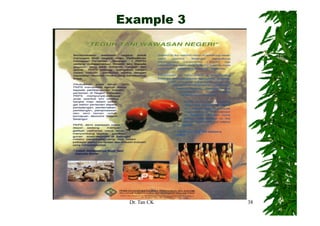
Example 3


 Dr. Tan CK   38
Graphic images
         p       g
• A digital display is divided into
  discrete, individually addressable
  points called pixels

• Images are produced by
  assigning a color and intensity to
  each pixel


              Dr. Tan CK               39
Screen Resolution (SR)
• The maximal image area of the
  computer screen expressed in
            screen,
  horizontal and vertical pixels

• Standard screen resolutions:
  • 640 x 480
  • 800 x 600
  • 1024 x 768
  • 1280 x 1024
              Dr. Tan CK           40
Screen Resolution
• When screen resolution
  increases, images become
  i          i      b
  smaller

• M t h screen resolutions with
  Match              l ti      ith
  actual screen size:
   • 640 x 480 (ss: 14”, 15”)
   • 800 x 600 ( 15” 17”, 21”)
               (ss: 15”, 17”
   • 1024 x 768 (ss: 17”, 21”)
      0               7 ,     )
              Dr. Tan CK             41
Vector Graphics
• It is stored as a set of instruction
  which describe the dimension
  and shape of every component of
  the drawing
• To display a vector graphic, each
                         graphic
  instruction is read and converted
  to the shapes and colors that
  comprise the image
• Created by DRAW programs
  (CorelDraw, MacDraw, etc )
  (CorelDraw MacDraw etc.)
               Dr. Tan CK                42
Vector Graphics
• Advantageous:
  • Object orientation: objects in a
    g p
    graphic can be manipulated
                         p
    separately
  • Good for line art and charts

• Disadvantageous:
   i d
  • The larger the graphic, the longer it
            g      g p ,           g
    takes to render the image

                 Dr. Tan CK                 43
Bit Maps
• It is stored as a set of bits in
  computer memory that define the
                         h d fi h
  color and intensity of each pixel
                      y          p
  in an image
• Created by digitizing images
  (photo, art work) or using PAINT
  programs (PC P i b h
                   Paintbrush,
  PaintShop Pro, etc.)
             p          )
• Also called raster or pixel maps
              Dr. Tan CK              44
Bit Maps
• Advantageous:
  • C di l faster than vector
    Can display f t th         t
    graphics
  • Good for reproducing images with
    complex variations in color,
    shading and detail
• Disadvantageous:
  • Require more disk space
  • Fi d resolution can lead to
    Fixed      l ti      l dt
    scalability problems
               Dr. Tan CK              45
Image Resolution (IR)
• Size of the digitized image expressed
  in horizontal and vertical pixels
• When IR and SR are identical, the
  image fills the screen
  i       fill th
• A 320 x 240 pixel image on a 640 x
  480 pixel display will be one half the
  length and height of the screen and
      g           g
  fill one quarter of the screen area
• When IR > SR, only a portion of the
                SR
  image can be displayed (required
  scroll bars)
                Dr. Tan CK                 46
Image Depth
• Image depth refers to the maximal
  number of colors used in bitmap  p
• Each pixel can have 1 or more bits of
  color information attached to it
Bits Colors                  Uses
 1      2           Text, line drawing
 4     16     Simple drawings, graphics
 8     256            Natural images
 24   16.7M     Photographic realism
                     g p
                Dr. Tan CK                47
Color Models
• RGB        each component of colors;
  red,
  red green and blue is stored. For
                          stored
  example: in 24 bit color, there will be
  8 bits of info for each of the 3 colors
     bit f i f f        h f th       l
• HSL       color info is divided into
  components of hue, saturation and
  luminosity (intensity)
• CMYK         components of cyan,
  magenta, yellow and black are stored.
  It is usually used for publishing

                 Dr. Tan CK                 48
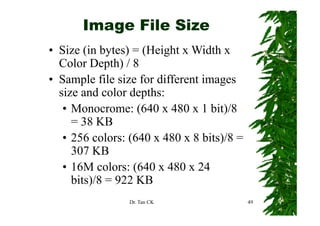
Image File Size
• Size (in bytes) = (Height x Width x
  Color Depth) / 8
• Sample file size for different images
  size and color depths:
   • Monocrome: (640 x 480 x 1 bit)/8
                   (                 )
     = 38 KB
   • 256 colors: (640 x 480 x 8 bits)/8 =
     307 KB
   • 16M colors: (640 x 480 x 24
             l
     bits)/8 = 922 KB
                 Dr. Tan CK                 49
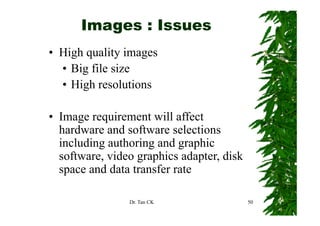
Images : Issues
• High quality images
  • Big file size
  • High resolutions

• I
  Image requirement will affect
             i         ill ff
  hardware and software selections
  including h i
  i l di authoring and graphic
                         d     hi
  software, video graphics adapter, disk
  space and data transfer rate

                Dr. Tan CK                 50
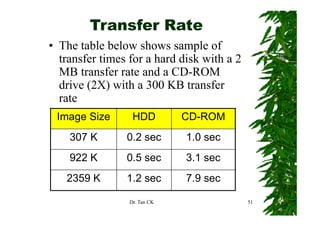
Transfer Rate
• The table below shows sample of
  transfer times for a hard disk with a 2
  MB transfer rate and a CD-ROM
  drive (2X) with a 300 KB transfer
  rate
 Image Size
 I     Si         HDD         CD-ROM
                              CD ROM
    307 K       0.2
                0 2 sec       1.0
                              1 0 sec
    922 K       0.5 sec       3.1 sec
   2359 K       1.2 sec       7.9 sec

                 Dr. Tan CK                 51
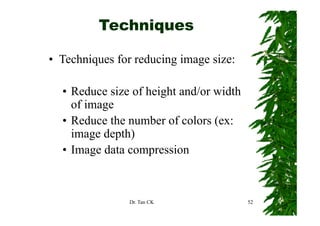
Techniques

• Techniques for reducing image size:

  •R d
    Reduce size of height and/or width
             i   f h i h d/       id h
    of image
  • Reduce the number of colors (ex:
    image depth)
        g    p )
  • Image data compression


                Dr. Tan CK               52
Image Compression
• Data compression reduces file size by
  eliminating redundancy
• Compression involves two parts :
  compression and decompression
  called codecs
• Two types of data compression:
   • Lossless output is exactly the
     same compression (used for
     programs and data) (done by
     PKZIP, stacker)
                Dr. Tan CK                53
Image Compression
• Second type of data compression:
   • Lossy a set of data will undergo
     a loss of accuracy after
                       y
     compression. Typically used on
     image or graphics, animation,
          g    g p       ,          ,
     audio and video
   • Eliminates info that is difficult for
     our eyes to detect (Ex: eye is less
     sensitive to change in color than it
     is to change in intensity
                  Dr. Tan CK                 54
Image Formats
• Bitmap (.bmp)
   • Internal format used by Windows
• Device Independent Bitmap (.dib)
   • S d d windows bitmap
     Standard i d        bi
• Encapsulated PostScript Format
        p                 p
  (.eps)
   • Used to exchange images between
     programs and platform
• Graphics Interchange Format (.gif)
                               ( gif)
   • Used to transmit and exchange
     images betweenCKplatforms
                 Dr. Tan                55
Image Formats
• Joint Photographic Expert Group
  ( jpg jp g)
  (.jpg/.jpeg)
   • Offers the greatest compression
     (10:1 without visible loss)
• Targa (.tga)
   • Used in high end image capture
     (35% compression)
• Tagged Image File Format (.tif)
• Zsoft PCX (.pcx)
               ( pcx)
   • Used to exchange images bewteen
     programs
               Dr. Tan CK              56

Textgraphics1

  • 1.
  • 2.
    Multimedia Components Audio Cds Graphics Video Animation A i i Dr. Tan CK 2
  • 3.
    What is typography? It is the art of choosing and h i d arranging font Dr. Tan CK 3
  • 4.
    Typography yp g p y • What type of font should be yp used ? • What font size is the most suitable ? • What is the suitable space to p separate each row of text ? • What is the best contrast for the title and the text body ? y Dr. Tan CK 4
  • 5.
    Font Classification Classification offont : Serif Sans serif Square serif Script Decorative / Alternative Dr. Tan CK 5
  • 6.
    Font Classification SERIF Dr. Tan CK 6
  • 7.
    Font Classification SANS-SERIF SANS SERIF Dr. Tan CK 7
  • 8.
  • 9.
    Font Classification SCRIPT Dr. Tan CK 9
  • 10.
    Font Classification DECORATIVE & ALTERNATIVE Dr. Tan CK 10
  • 11.
    The Wheel ofColour Dr. Tan CK 11
  • 12.
    The Saying goes… Color affects our life. Color is physical ……we see it. Color C l communicates ……we receive it i t i information from the language of color. color Color is emotional ……it evokes our feelings. Bride M. Whelan M . ( (Color Harmony 2)... y ) Dr. Tan CK 12
  • 13.
    Hot Colour Dr. Tan CK 13
  • 14.
    Cold Colour Dr. Tan CK 14
  • 15.
    Lukewarm Colour Dr. Tan CK 15
  • 16.
    Cool Colour Dr. Tan CK 16
  • 17.
    Light Colour Dr. Tan CK 17
  • 18.
    Dark Colour Dr. Tan CK 18
  • 19.
    Bright Colour Dr. Tan CK 19
  • 20.
    Terms Related toColour Hue refers to colo r ( green yellow, red H colour green, ello and others) Value refers to value of the brightness / darkness when we add more white colour, the value is higher when we add more black colour, the value is lower Dr. Tan CK 20
  • 21.
    Terms Related toColour Saturation the intensity, natural and richness y, of the colour usually represents the middle ll t th iddl segment of the wheel of colour pure colour (without white, black and grey) g y) Tint colour which is added with white little by little to become lighter b colour Dr. Tan CK 21
  • 22.
    Terms Related toColour Shades colour which is added with black little by little until it becomes darker colour Dr. Tan CK 22
  • 23.
    Basic Colour Schemes Primary Colour Dr. Tan CK 23
  • 24.
    Basic Colour Schemes Secondary Colour Dr. Tan CK 24
  • 25.
    Basic Colour Schemes Tertiary Colour Dr. Tan CK 25
  • 26.
    Basic Colour Schemes Achromatic scheme Dr. Tan CK 26
  • 27.
    Basic Colour Schemes Monochromatic scheme Dr. Tan CK 27
  • 28.
    Basic Colour Schemes Complimentary scheme p y Dr. Tan CK 28
  • 29.
    Basic Colour Schemes Splitcomplimentary scheme p p y Dr. Tan CK 29
  • 30.
    Basic Colour Schemes Clash scheme Dr. Tan CK 30
  • 31.
    Basic Colour Schemes Analogous scheme g Dr. Tan CK 31
  • 32.
    Basic Colour Schemes Neutral scheme Dr. Tan CK 32
  • 33.
    Text Layout Elements ofeffective text layout : C – Contrast R - Repetition A - Alignment P – P i it Proximity Dr. Tan CK 33
  • 34.
    Text Layout Font Contrast Contrast C t t Colour C C Contrast Graphics Contrast Repetition Repetition of characters R titi f h t Repetition of g ap cs epet t o o graphics Combined Repetition of graphics and text te t Dr. Tan CK 34
  • 35.
    Text Layout Alignment Alignmentof characters Graphics Alignment Text and graphics Alignment Proximity Distance between characters Distance between the graphics g p Distance between characters and graphics Dr. Tan CK 35
  • 36.
    Example 1 Think Big, Big Start Small… Locally Implemented, Implemented a Proven Way to Global Data Warehousing Success. IDS Dr. Tan CK 36
  • 37.
    Example 2 Think BIG ActLOCAL IDS International Data Security A Successful Global Data Warehousing Service 1003A Jalan Jelutong Utara, Bandar Virtual, 66710, Gnalk, AISYALAM Tel. No. 06-03-66765944 Dr. Tan CK 37
  • 38.
    Example 3 Dr.Tan CK 38
  • 39.
    Graphic images p g • A digital display is divided into discrete, individually addressable points called pixels • Images are produced by assigning a color and intensity to each pixel Dr. Tan CK 39
  • 40.
    Screen Resolution (SR) •The maximal image area of the computer screen expressed in screen, horizontal and vertical pixels • Standard screen resolutions: • 640 x 480 • 800 x 600 • 1024 x 768 • 1280 x 1024 Dr. Tan CK 40
  • 41.
    Screen Resolution • Whenscreen resolution increases, images become i i b smaller • M t h screen resolutions with Match l ti ith actual screen size: • 640 x 480 (ss: 14”, 15”) • 800 x 600 ( 15” 17”, 21”) (ss: 15”, 17” • 1024 x 768 (ss: 17”, 21”) 0 7 , ) Dr. Tan CK 41
  • 42.
    Vector Graphics • Itis stored as a set of instruction which describe the dimension and shape of every component of the drawing • To display a vector graphic, each graphic instruction is read and converted to the shapes and colors that comprise the image • Created by DRAW programs (CorelDraw, MacDraw, etc ) (CorelDraw MacDraw etc.) Dr. Tan CK 42
  • 43.
    Vector Graphics • Advantageous: • Object orientation: objects in a g p graphic can be manipulated p separately • Good for line art and charts • Disadvantageous: i d • The larger the graphic, the longer it g g p , g takes to render the image Dr. Tan CK 43
  • 44.
    Bit Maps • Itis stored as a set of bits in computer memory that define the h d fi h color and intensity of each pixel y p in an image • Created by digitizing images (photo, art work) or using PAINT programs (PC P i b h Paintbrush, PaintShop Pro, etc.) p ) • Also called raster or pixel maps Dr. Tan CK 44
  • 45.
    Bit Maps • Advantageous: • C di l faster than vector Can display f t th t graphics • Good for reproducing images with complex variations in color, shading and detail • Disadvantageous: • Require more disk space • Fi d resolution can lead to Fixed l ti l dt scalability problems Dr. Tan CK 45
  • 46.
    Image Resolution (IR) •Size of the digitized image expressed in horizontal and vertical pixels • When IR and SR are identical, the image fills the screen i fill th • A 320 x 240 pixel image on a 640 x 480 pixel display will be one half the length and height of the screen and g g fill one quarter of the screen area • When IR > SR, only a portion of the SR image can be displayed (required scroll bars) Dr. Tan CK 46
  • 47.
    Image Depth • Imagedepth refers to the maximal number of colors used in bitmap p • Each pixel can have 1 or more bits of color information attached to it Bits Colors Uses 1 2 Text, line drawing 4 16 Simple drawings, graphics 8 256 Natural images 24 16.7M Photographic realism g p Dr. Tan CK 47
  • 48.
    Color Models • RGB each component of colors; red, red green and blue is stored. For stored example: in 24 bit color, there will be 8 bits of info for each of the 3 colors bit f i f f h f th l • HSL color info is divided into components of hue, saturation and luminosity (intensity) • CMYK components of cyan, magenta, yellow and black are stored. It is usually used for publishing Dr. Tan CK 48
  • 49.
    Image File Size •Size (in bytes) = (Height x Width x Color Depth) / 8 • Sample file size for different images size and color depths: • Monocrome: (640 x 480 x 1 bit)/8 ( ) = 38 KB • 256 colors: (640 x 480 x 8 bits)/8 = 307 KB • 16M colors: (640 x 480 x 24 l bits)/8 = 922 KB Dr. Tan CK 49
  • 50.
    Images : Issues •High quality images • Big file size • High resolutions • I Image requirement will affect i ill ff hardware and software selections including h i i l di authoring and graphic d hi software, video graphics adapter, disk space and data transfer rate Dr. Tan CK 50
  • 51.
    Transfer Rate • Thetable below shows sample of transfer times for a hard disk with a 2 MB transfer rate and a CD-ROM drive (2X) with a 300 KB transfer rate Image Size I Si HDD CD-ROM CD ROM 307 K 0.2 0 2 sec 1.0 1 0 sec 922 K 0.5 sec 3.1 sec 2359 K 1.2 sec 7.9 sec Dr. Tan CK 51
  • 52.
    Techniques • Techniques forreducing image size: •R d Reduce size of height and/or width i f h i h d/ id h of image • Reduce the number of colors (ex: image depth) g p ) • Image data compression Dr. Tan CK 52
  • 53.
    Image Compression • Datacompression reduces file size by eliminating redundancy • Compression involves two parts : compression and decompression called codecs • Two types of data compression: • Lossless output is exactly the same compression (used for programs and data) (done by PKZIP, stacker) Dr. Tan CK 53
  • 54.
    Image Compression • Secondtype of data compression: • Lossy a set of data will undergo a loss of accuracy after y compression. Typically used on image or graphics, animation, g g p , , audio and video • Eliminates info that is difficult for our eyes to detect (Ex: eye is less sensitive to change in color than it is to change in intensity Dr. Tan CK 54
  • 55.
    Image Formats • Bitmap(.bmp) • Internal format used by Windows • Device Independent Bitmap (.dib) • S d d windows bitmap Standard i d bi • Encapsulated PostScript Format p p (.eps) • Used to exchange images between programs and platform • Graphics Interchange Format (.gif) ( gif) • Used to transmit and exchange images betweenCKplatforms Dr. Tan 55
  • 56.
    Image Formats • JointPhotographic Expert Group ( jpg jp g) (.jpg/.jpeg) • Offers the greatest compression (10:1 without visible loss) • Targa (.tga) • Used in high end image capture (35% compression) • Tagged Image File Format (.tif) • Zsoft PCX (.pcx) ( pcx) • Used to exchange images bewteen programs Dr. Tan CK 56