Clipping Polygons Clipping polygons is more complex than clipping the individual lines Input: polygon Output: original polygon, new polygon, or nothing The biggest optimizer we had was trivial accept or reject… When can we trivially accept/reject a polygon as opposed to the line segments that make up the polygon?
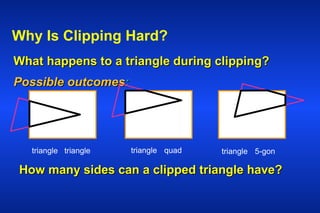
What happens to a triangle during clipping? Possible outcomes : Why Is Clipping Hard? triangle    triangle triangle     quad triangle     5-gon How many sides can a clipped triangle have?
How many sides? Seven…
A really tough case:  Why Is Clipping Hard?
A really tough case:  Why Is Clipping Hard? concave polygon     multiple polygons
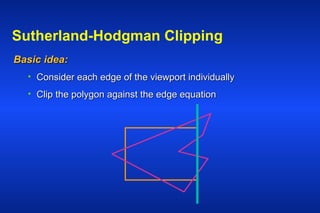
Sutherland-Hodgman Clipping Basic idea: Consider each edge of the view window individually Clip the polygon against the view window edge’s equation
Sutherland-Hodgman Clipping Basic idea: Consider each edge of the viewport individually Clip the polygon against the edge equation
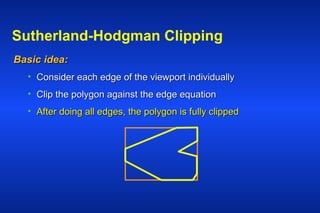
Sutherland-Hodgman Clipping Basic idea: Consider each edge of the viewport individually Clip the polygon against the edge equation After doing all edges, the polygon is fully clipped
Sutherland-Hodgman Clipping Input/output for algorithm: Input: list of polygon vertices in order  Output: list of clipped polygon vertices consisting of old vertices (maybe) and new vertices (maybe) Note: this is exactly what we expect from the clipping operation against each edge
Sutherland-Hodgman Clipping Sutherland-Hodgman basic routine: Go around polygon one vertex at a time Current vertex has position  p   Previous vertex had position  s , and it has been added to the output if appropriate
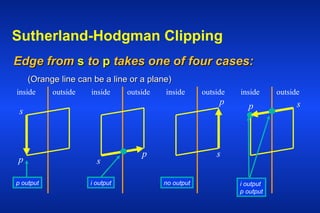
Sutherland-Hodgman Clipping Edge from  s  to  p   takes one of four cases: (Orange line can be a line or a plane) inside outside s p p output inside outside s p no output inside outside s p i output inside outside s p i output p output
Sutherland-Hodgman Clipping Four cases: s  inside plane and  p  inside plane Add  p  to output Note:  s  has already been added s  inside plane and  p  outside plane Find intersection point  i Add  i  to output s  outside plane and  p   outside plane Add nothing s   outside plane and  p  inside plane Find intersection point  i Add  i  to output, followed by  p

Polygon clipping

  • 1.
    Clipping Polygons Clippingpolygons is more complex than clipping the individual lines Input: polygon Output: original polygon, new polygon, or nothing The biggest optimizer we had was trivial accept or reject… When can we trivially accept/reject a polygon as opposed to the line segments that make up the polygon?
  • 2.
    What happens toa triangle during clipping? Possible outcomes : Why Is Clipping Hard? triangle  triangle triangle  quad triangle  5-gon How many sides can a clipped triangle have?
  • 3.
  • 4.
    A really toughcase: Why Is Clipping Hard?
  • 5.
    A really toughcase: Why Is Clipping Hard? concave polygon  multiple polygons
  • 6.
    Sutherland-Hodgman Clipping Basicidea: Consider each edge of the view window individually Clip the polygon against the view window edge’s equation
  • 7.
    Sutherland-Hodgman Clipping Basicidea: Consider each edge of the viewport individually Clip the polygon against the edge equation
  • 8.
    Sutherland-Hodgman Clipping Basicidea: Consider each edge of the viewport individually Clip the polygon against the edge equation
  • 9.
    Sutherland-Hodgman Clipping Basicidea: Consider each edge of the viewport individually Clip the polygon against the edge equation
  • 10.
    Sutherland-Hodgman Clipping Basicidea: Consider each edge of the viewport individually Clip the polygon against the edge equation
  • 11.
    Sutherland-Hodgman Clipping Basicidea: Consider each edge of the viewport individually Clip the polygon against the edge equation
  • 12.
    Sutherland-Hodgman Clipping Basicidea: Consider each edge of the viewport individually Clip the polygon against the edge equation
  • 13.
    Sutherland-Hodgman Clipping Basicidea: Consider each edge of the viewport individually Clip the polygon against the edge equation
  • 14.
    Sutherland-Hodgman Clipping Basicidea: Consider each edge of the viewport individually Clip the polygon against the edge equation
  • 15.
    Sutherland-Hodgman Clipping Basicidea: Consider each edge of the viewport individually Clip the polygon against the edge equation After doing all edges, the polygon is fully clipped
  • 16.
    Sutherland-Hodgman Clipping Input/outputfor algorithm: Input: list of polygon vertices in order Output: list of clipped polygon vertices consisting of old vertices (maybe) and new vertices (maybe) Note: this is exactly what we expect from the clipping operation against each edge
  • 17.
    Sutherland-Hodgman Clipping Sutherland-Hodgmanbasic routine: Go around polygon one vertex at a time Current vertex has position p Previous vertex had position s , and it has been added to the output if appropriate
  • 18.
    Sutherland-Hodgman Clipping Edgefrom s to p takes one of four cases: (Orange line can be a line or a plane) inside outside s p p output inside outside s p no output inside outside s p i output inside outside s p i output p output
  • 19.
    Sutherland-Hodgman Clipping Fourcases: s inside plane and p inside plane Add p to output Note: s has already been added s inside plane and p outside plane Find intersection point i Add i to output s outside plane and p outside plane Add nothing s outside plane and p inside plane Find intersection point i Add i to output, followed by p