COMPUTER ASSISTED INSTRUCTION
CAI refers to the use of the computer as a tool to facilitate and
improve instruction.
Computer-Assisted Instruction (CAI) is an interactive instructional
technique whereby a computer is used to present the instructional
material and monitor the learning that takes place.
ADVANTAGES
• Self-learning technique
• Uses a combination of text, graphics, sound and video
• Provides individualised instruction
• Enhances the level of student performance
• One to one interaction
• Self directed learning
• Learn more and more rapidly
• Can provide instant feedback
• Multi sensory approach
• Provide space for relearning
DISADVANTAGES
•Fails to appreciate emotion of students
•Do not solve psychological or learning problems
•Results in dehumanisation
•Lack of infrastructure
•Learning becomes too mechanical
METHODS OF CAI
•Drill & practice
•Tutorial
•Gaming
•Simulation
•Discovery
•Problem solving
DRILL & PRACTICE
Computer programme provides the learner through a series of repeated
experiences related to the concepts, principles or processes until the mastery
of skill acquired by the learner
Provides variety of questions in various formats
Items of different difficulty level are included in the same programme
Positive & negative feedback, reinforcement are also provided
TUTORIAL
•Computer act as a teacher. all the interactions are made between the
computer & the learner
•Branched programming pattern is followed in tutorial
•Computer suggests the instructional & learning activities, clear the doubts of
learners
•Very effective for giving instruction, practice & feedback based on the
response of the learner to the questions or activities.
GAMING
•Use of computerised educational games for learning purposes as an
instructional strategy
•Playful environment where the learner follows prescribed rules to attain the
goals
•Gaming demands learners have problem solving skills, mastery of content
with high degree of accuracy & efficiency
SIMULATION
•Simulation software is based on the process of modeling a real phenomenon.
•A program that allows the user to observe an operation through simulation
without actually performing that operation
DISCOVERY
•Activities using inductive approach
•Utilizes Information retrieval strategy
•Computer presents problem to the learners
•Learners solves the problems through trial & error learning
PROBLEM SOLVING
•Computer present problem
•Learners examine, define the problem & generate solution
•Can manipulate the data on learners’ command, maintain database &
provide feedback
COMPUTER MANAGED INSTRUCTION
Use of computer system to manage the information about learner
performance & learning resources to direct & control
individualised instructions
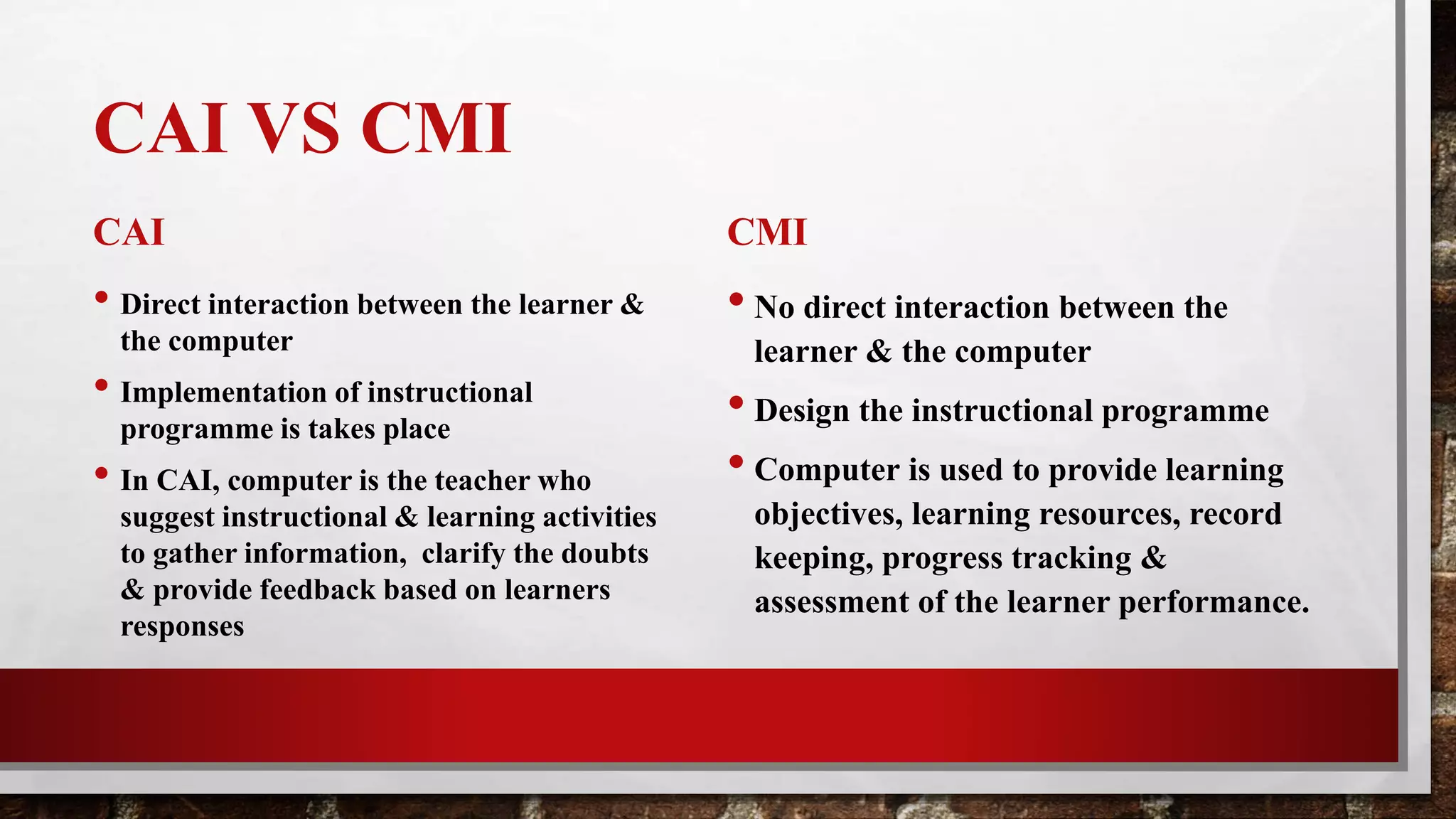
CAI VS CMI
CAI
• Direct interaction between the learner &
the computer
• Implementation of instructional
programme is takes place
• In CAI, computer is the teacher who
suggest instructional & learning activities
to gather information, clarify the doubts
& provide feedback based on learners
responses
CMI
• No direct interaction between the
learner & the computer
• Design the instructional programme
• Computer is used to provide learning
objectives, learning resources, record
keeping, progress tracking &
assessment of the learner performance.
THANK YOU

Computer assisted instruction vs computer managed instruction

  • 2.
    COMPUTER ASSISTED INSTRUCTION CAIrefers to the use of the computer as a tool to facilitate and improve instruction. Computer-Assisted Instruction (CAI) is an interactive instructional technique whereby a computer is used to present the instructional material and monitor the learning that takes place.
  • 3.
    ADVANTAGES • Self-learning technique •Uses a combination of text, graphics, sound and video • Provides individualised instruction • Enhances the level of student performance • One to one interaction • Self directed learning • Learn more and more rapidly • Can provide instant feedback • Multi sensory approach • Provide space for relearning
  • 4.
    DISADVANTAGES •Fails to appreciateemotion of students •Do not solve psychological or learning problems •Results in dehumanisation •Lack of infrastructure •Learning becomes too mechanical
  • 5.
    METHODS OF CAI •Drill& practice •Tutorial •Gaming •Simulation •Discovery •Problem solving
  • 6.
    DRILL & PRACTICE Computerprogramme provides the learner through a series of repeated experiences related to the concepts, principles or processes until the mastery of skill acquired by the learner Provides variety of questions in various formats Items of different difficulty level are included in the same programme Positive & negative feedback, reinforcement are also provided
  • 7.
    TUTORIAL •Computer act asa teacher. all the interactions are made between the computer & the learner •Branched programming pattern is followed in tutorial •Computer suggests the instructional & learning activities, clear the doubts of learners •Very effective for giving instruction, practice & feedback based on the response of the learner to the questions or activities.
  • 8.
    GAMING •Use of computerisededucational games for learning purposes as an instructional strategy •Playful environment where the learner follows prescribed rules to attain the goals •Gaming demands learners have problem solving skills, mastery of content with high degree of accuracy & efficiency
  • 9.
    SIMULATION •Simulation software isbased on the process of modeling a real phenomenon. •A program that allows the user to observe an operation through simulation without actually performing that operation
  • 10.
    DISCOVERY •Activities using inductiveapproach •Utilizes Information retrieval strategy •Computer presents problem to the learners •Learners solves the problems through trial & error learning
  • 11.
    PROBLEM SOLVING •Computer presentproblem •Learners examine, define the problem & generate solution •Can manipulate the data on learners’ command, maintain database & provide feedback
  • 12.
    COMPUTER MANAGED INSTRUCTION Useof computer system to manage the information about learner performance & learning resources to direct & control individualised instructions
  • 13.
    CAI VS CMI CAI •Direct interaction between the learner & the computer • Implementation of instructional programme is takes place • In CAI, computer is the teacher who suggest instructional & learning activities to gather information, clarify the doubts & provide feedback based on learners responses CMI • No direct interaction between the learner & the computer • Design the instructional programme • Computer is used to provide learning objectives, learning resources, record keeping, progress tracking & assessment of the learner performance.
  • 14.