BHAGWANTI EDUCATION CENTRE
SHARDA NAGAR, KANPUR
By:
Rashmi Kumari
2nd
Semester
MEd
 Subject: Psychology
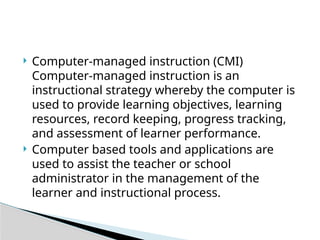
 Topic: Computer Assisted Instruction (CAI)
Submitted to
 Dr Laxmi Singh
 Department of Psychology
 ..
 Computer-based education (CBE) and
computer-based instruction (CBI) are the
broadest terms and can refer to virtually any
kind of computer use in educational settings.
 Computer-assisted instruction (CAI) Computer
Aided Instruction (CAI) is a narrower term and
most often refers to drill-and-practice, tutorial,
or simulation activities.
Computer Assisted Instruction (CAI)
 Computer-managed instruction (CMI)
Computer-managed instruction is an
instructional strategy whereby the computer is
used to provide learning objectives, learning
resources, record keeping, progress tracking,
and assessment of learner performance.
 Computer based tools and applications are
used to assist the teacher or school
administrator in the management of the
learner and instructional process.
 A self-learning technique, usually offline/online,
involving interaction of the student with
programmed instructional materials.
 Computer-assisted instruction (CAI) is an
interactive instructional technique whereby a
computer is used to present the instructional
material and monitor the learning that takes
place.
 CAI uses a combination of text, graphics, sound
and video in enhancing the learning process.
Computer Assisted Instruction (CAI)
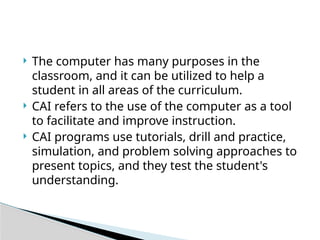
 The computer has many purposes in the
classroom, and it can be utilized to help a
student in all areas of the curriculum.
 CAI refers to the use of the computer as a tool
to facilitate and improve instruction.
 CAI programs use tutorials, drill and practice,
simulation, and problem solving approaches to
present topics, and they test the student's
understanding.
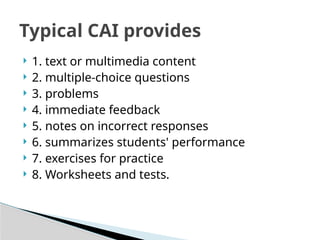
 1. text or multimedia content
 2. multiple-choice questions
 3. problems
 4. immediate feedback
 5. notes on incorrect responses
 6. summarizes students' performance
 7. exercises for practice
 8. Worksheets and tests.
Typical CAI provides
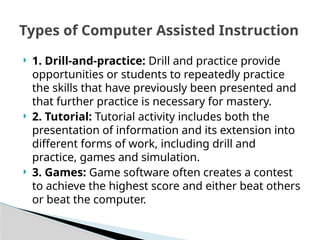
 1. Drill-and-practice: Drill and practice provide
opportunities or students to repeatedly practice
the skills that have previously been presented and
that further practice is necessary for mastery.
 2. Tutorial: Tutorial activity includes both the
presentation of information and its extension into
different forms of work, including drill and
practice, games and simulation.
 3. Games: Game software often creates a contest
to achieve the highest score and either beat others
or beat the computer.
Types of Computer Assisted Instruction
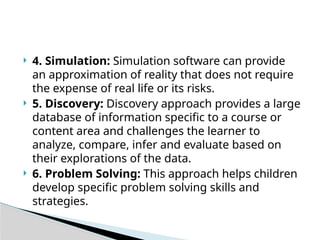
 4. Simulation: Simulation software can provide
an approximation of reality that does not require
the expense of real life or its risks.
 5. Discovery: Discovery approach provides a large
database of information specific to a course or
content area and challenges the learner to
analyze, compare, infer and evaluate based on
their explorations of the data.
 6. Problem Solving: This approach helps children
develop specific problem solving skills and
strategies.
 one-to-one interaction
 great motivator
 freedom to experiment with different options
 instantaneous response/immediate feedback
to the answers elicited
 Self pacing - allow students to proceed at their
own pace
Advantages of CAI
 Helps teacher can devote more time to
individual students
 Privacy helps the shy and slow learner to learns
 Individual attention
 learn more and more rapidly
 multimedia helps to understand difficult
concepts through multi sensory approach
 self directed learning – students can decide
when, where, and what to learn
 may feel overwhelmed by the information and
resources available
 over use of multimedia may divert the
attention from the content
 learning becomes too mechanical
 non availability of good CAI packages
 lack of infrastructure
Limitations of CAI
12
 https://wikieducator.org/Computer_Assisted_In
struction_(CAI
)
 https://
www.britannica.com/topic/computer-assisted-i
nstruction
 https://drarockiasamy.wordpress.com/compute
r-assisted-instructions-cai
/
Bibilography

MED Topics Computer Assisted Instruction.pptx

  • 1.
    BHAGWANTI EDUCATION CENTRE SHARDANAGAR, KANPUR By: Rashmi Kumari 2nd Semester MEd  Subject: Psychology  Topic: Computer Assisted Instruction (CAI) Submitted to  Dr Laxmi Singh  Department of Psychology  ..
  • 2.
     Computer-based education(CBE) and computer-based instruction (CBI) are the broadest terms and can refer to virtually any kind of computer use in educational settings.  Computer-assisted instruction (CAI) Computer Aided Instruction (CAI) is a narrower term and most often refers to drill-and-practice, tutorial, or simulation activities. Computer Assisted Instruction (CAI)
  • 3.
     Computer-managed instruction(CMI) Computer-managed instruction is an instructional strategy whereby the computer is used to provide learning objectives, learning resources, record keeping, progress tracking, and assessment of learner performance.  Computer based tools and applications are used to assist the teacher or school administrator in the management of the learner and instructional process.
  • 4.
     A self-learningtechnique, usually offline/online, involving interaction of the student with programmed instructional materials.  Computer-assisted instruction (CAI) is an interactive instructional technique whereby a computer is used to present the instructional material and monitor the learning that takes place.  CAI uses a combination of text, graphics, sound and video in enhancing the learning process. Computer Assisted Instruction (CAI)
  • 5.
     The computerhas many purposes in the classroom, and it can be utilized to help a student in all areas of the curriculum.  CAI refers to the use of the computer as a tool to facilitate and improve instruction.  CAI programs use tutorials, drill and practice, simulation, and problem solving approaches to present topics, and they test the student's understanding.
  • 6.
     1. textor multimedia content  2. multiple-choice questions  3. problems  4. immediate feedback  5. notes on incorrect responses  6. summarizes students' performance  7. exercises for practice  8. Worksheets and tests. Typical CAI provides
  • 7.
     1. Drill-and-practice:Drill and practice provide opportunities or students to repeatedly practice the skills that have previously been presented and that further practice is necessary for mastery.  2. Tutorial: Tutorial activity includes both the presentation of information and its extension into different forms of work, including drill and practice, games and simulation.  3. Games: Game software often creates a contest to achieve the highest score and either beat others or beat the computer. Types of Computer Assisted Instruction
  • 8.
     4. Simulation:Simulation software can provide an approximation of reality that does not require the expense of real life or its risks.  5. Discovery: Discovery approach provides a large database of information specific to a course or content area and challenges the learner to analyze, compare, infer and evaluate based on their explorations of the data.  6. Problem Solving: This approach helps children develop specific problem solving skills and strategies.
  • 9.
     one-to-one interaction great motivator  freedom to experiment with different options  instantaneous response/immediate feedback to the answers elicited  Self pacing - allow students to proceed at their own pace Advantages of CAI
  • 10.
     Helps teachercan devote more time to individual students  Privacy helps the shy and slow learner to learns  Individual attention  learn more and more rapidly  multimedia helps to understand difficult concepts through multi sensory approach  self directed learning – students can decide when, where, and what to learn
  • 11.
     may feeloverwhelmed by the information and resources available  over use of multimedia may divert the attention from the content  learning becomes too mechanical  non availability of good CAI packages  lack of infrastructure Limitations of CAI
  • 12.