Behaviourism
Presented by: Surekha V S
Asst. Professor in Commerce Education
SVTEC, Akkikkavu
Meaning &
Features
Behaviourism
Meaning: Learning based on
the behaviour modification
of the learners
Features:
❏ Learners are passive
❏ Behaviour is shaped by
reinforcement
❏ Behaviourism is the
precursor to cognitive
learning
❏ Behaviour is the result
of stimulus-response
❏ Drill & practice are
common techniques for
learning
Theories of behaviourism
● Thorndike’s Trial & Error Theory
● Pavlov’s Theory of Classical Conditioning
● Skinner’s Theory of Operant Conditioning
● Hull’s Reinforcement Theory
Thorndike’s Trial & Error Theory
❖ Propounded by E L Thorndike, an American
Psychologist
❖ Various responses are tried until a solution
is attained
❖ Learning is the stamping in of the correct
responses & stamping out of the incorrect
responses through trial & error
❖ Learning is the process of elimination of
erroneous responses for the establishment of
correct responses on each trial
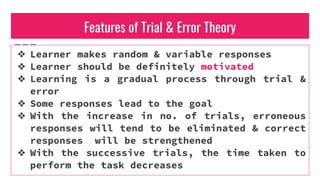
Features of Trial & Error Theory
❖ Learner makes random & variable responses
❖ Learner should be definitely motivated
❖ Learning is a gradual process through trial &
error
❖ Some responses lead to the goal
❖ With the increase in no. of trials, erroneous
responses will tend to be eliminated & correct
responses will be strengthened
❖ With the successive trials, the time taken to
perform the task decreases
Thorndike’s Law of Learning
1.Law of Readiness
When a conduction unit is ready to conduct,
for it to do so is satisfying. When a
conduction unit is not ready to conduct, for
it to conduct is annoying. When a conduction
unit is ready to conduct, not to conduct is
2. Law of Exercise
Strengthening of S-R connection with practice
& their weakening when practice is not continued
a. Law of Use
b. Law of Disuse
3. Law of Effect
When a modifiable connection between
stimulus & response is made & is accompanied by a
satisfying state of affairs, that connection’s
strength is increased. When it is accompanied by
an annoying state of affairs, its strength is
decreased
Educational Implications
➢ Attention to the importance of motivation &
reinforcement
➢ Review of learned material is necessary
➢ Importance given to the mental readiness of
learners
➢ More & more opportunities to apply the
knowledge already gained in the classroom
➢ Stress is given to what is being taught in one
situation should be linked with the past
experience of the learners

Behaviourism & Thorndike's Trial & Error Theory.pptx

  • 1.
    Behaviourism Presented by: SurekhaV S Asst. Professor in Commerce Education SVTEC, Akkikkavu
  • 2.
    Meaning & Features Behaviourism Meaning: Learningbased on the behaviour modification of the learners Features: ❏ Learners are passive ❏ Behaviour is shaped by reinforcement ❏ Behaviourism is the precursor to cognitive learning ❏ Behaviour is the result of stimulus-response ❏ Drill & practice are common techniques for learning
  • 3.
    Theories of behaviourism ●Thorndike’s Trial & Error Theory ● Pavlov’s Theory of Classical Conditioning ● Skinner’s Theory of Operant Conditioning ● Hull’s Reinforcement Theory
  • 4.
    Thorndike’s Trial &Error Theory ❖ Propounded by E L Thorndike, an American Psychologist ❖ Various responses are tried until a solution is attained ❖ Learning is the stamping in of the correct responses & stamping out of the incorrect responses through trial & error ❖ Learning is the process of elimination of erroneous responses for the establishment of correct responses on each trial
  • 5.
    Features of Trial& Error Theory ❖ Learner makes random & variable responses ❖ Learner should be definitely motivated ❖ Learning is a gradual process through trial & error ❖ Some responses lead to the goal ❖ With the increase in no. of trials, erroneous responses will tend to be eliminated & correct responses will be strengthened ❖ With the successive trials, the time taken to perform the task decreases
  • 6.
    Thorndike’s Law ofLearning 1.Law of Readiness When a conduction unit is ready to conduct, for it to do so is satisfying. When a conduction unit is not ready to conduct, for it to conduct is annoying. When a conduction unit is ready to conduct, not to conduct is
  • 7.
    2. Law ofExercise Strengthening of S-R connection with practice & their weakening when practice is not continued a. Law of Use b. Law of Disuse
  • 8.
    3. Law ofEffect When a modifiable connection between stimulus & response is made & is accompanied by a satisfying state of affairs, that connection’s strength is increased. When it is accompanied by an annoying state of affairs, its strength is decreased
  • 9.
    Educational Implications ➢ Attentionto the importance of motivation & reinforcement ➢ Review of learned material is necessary ➢ Importance given to the mental readiness of learners ➢ More & more opportunities to apply the knowledge already gained in the classroom ➢ Stress is given to what is being taught in one situation should be linked with the past experience of the learners