Presentation By :-
Pawan Singh Raikhola
INTRODUCTION
C:-Commonly
O:-Operated
M:-Machine
P:-Personal
U:-Used for
T:-Technical
E:-Educational
R:-Reasearch
Definition:-
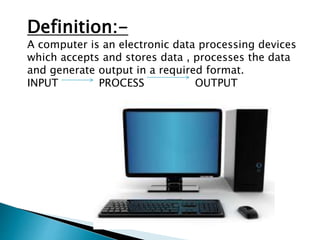
A computer is an electronic data processing devices
which accepts and stores data , processes the data
and generate output in a required format.
INPUT PROCESS OUTPUT
Characteristics of computers:-
•Speed
•Accuracy/precision
•Versatility
•Power of remembering
•Storage capacity
•Diligence
•No feelings
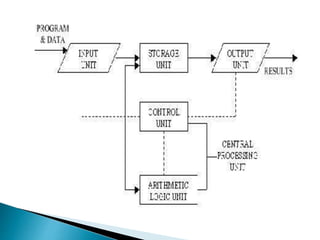
FUNCTIONAL UNITS:-
•Input unit
•Output unit
•Central Processing Unit(CPU)
A. It is considered as the as the brain of the computer
because it help in transfering the data.
B. It examines and fetches data and instruction to the main
memory of computer.
1.Arithmetic logic unit
2.Control unit
MEMORY UNIT:-
1. RAM(Random Acess Memory):-It is the place in
a computer where the operating system ,
application programs and the data is current
use are kept temporarily so that they can be
accessed by the computer’s processor.
There are two types of RAM:-
• Dynamic RAM
• Static RAM
•PRIMARY MEMORY
2. ROM(Read Only Memory):-ROM is a special type
of memory which can only be read.
•Mask ROM
•P-ROM(Programmable Read Only Memory)
•EP-ROM(Erasable Programmable Read Only
Memory)
•EEP-ROM(Electrically Erasable Programmable Read
Only Memory)
•EAP-ROM(Electrically Alterable Programmable Read
Only Memory)
SECONDARY MEMORY
•Hard Disk :-Hard disks are made up of rigid material and
are usually a stack of metal disks sealed in a box. The hard
disk and the hard disk drive exist together as a unit and is
a permanent part of the computer where data and
programs are saved.
•Compact Disk:-Compact Disk (CD) is portable disk having
data storage capacity between 650-700 MB.
•Digital Video Disk:-Digital Video Disk (DVD) is similar to a
CD but has larger storage capacity and enormous clarity.
Computer and its basic concepts

Computer and its basic concepts

  • 1.
  • 2.
  • 3.
    Definition:- A computer isan electronic data processing devices which accepts and stores data , processes the data and generate output in a required format. INPUT PROCESS OUTPUT
  • 5.
    Characteristics of computers:- •Speed •Accuracy/precision •Versatility •Powerof remembering •Storage capacity •Diligence •No feelings
  • 6.
    FUNCTIONAL UNITS:- •Input unit •Outputunit •Central Processing Unit(CPU) A. It is considered as the as the brain of the computer because it help in transfering the data. B. It examines and fetches data and instruction to the main memory of computer. 1.Arithmetic logic unit 2.Control unit
  • 7.
    MEMORY UNIT:- 1. RAM(RandomAcess Memory):-It is the place in a computer where the operating system , application programs and the data is current use are kept temporarily so that they can be accessed by the computer’s processor. There are two types of RAM:- • Dynamic RAM • Static RAM •PRIMARY MEMORY
  • 8.
    2. ROM(Read OnlyMemory):-ROM is a special type of memory which can only be read. •Mask ROM •P-ROM(Programmable Read Only Memory) •EP-ROM(Erasable Programmable Read Only Memory) •EEP-ROM(Electrically Erasable Programmable Read Only Memory) •EAP-ROM(Electrically Alterable Programmable Read Only Memory)
  • 9.
    SECONDARY MEMORY •Hard Disk:-Hard disks are made up of rigid material and are usually a stack of metal disks sealed in a box. The hard disk and the hard disk drive exist together as a unit and is a permanent part of the computer where data and programs are saved. •Compact Disk:-Compact Disk (CD) is portable disk having data storage capacity between 650-700 MB. •Digital Video Disk:-Digital Video Disk (DVD) is similar to a CD but has larger storage capacity and enormous clarity.