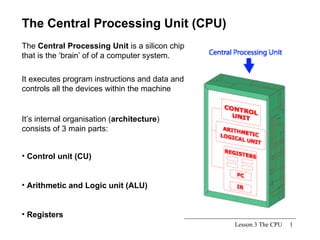
Lesson 3 The CPU The Central Processing Unit (CPU) The  Central Processing Unit  is a silicon chip that is the ‘brain’ of of a computer system.  Control unit (CU) Arithmetic and Logic unit (ALU) Registers It executes program instructions and data and controls all the devices within the machine It’s internal organisation ( architecture ) consists of 3 main parts:
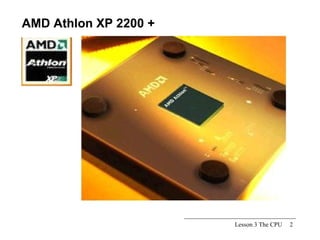
Lesson 3 The CPU AMD Athlon XP 2200 +
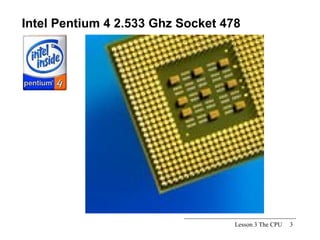
Lesson 3 The CPU Intel Pentium 4 2.533 Ghz Socket 478
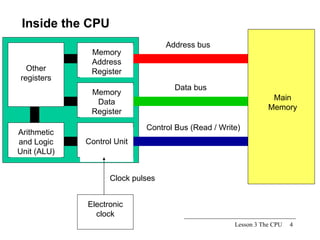
Lesson 3 The CPU Inside the CPU Control Unit Arithmetic and Logic Unit (ALU) Other registers Memory Address Register Memory Data Register Main Memory Address bus Data bus Control Bus (Read / Write) Electronic clock Clock pulses
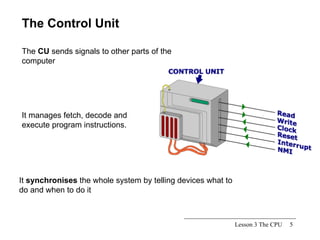
Lesson 3 The CPU The Control Unit It manages fetch, decode and execute program instructions. It  synchronises  the whole system by telling devices what to do and when to do it The  CU  sends signals to other parts of the computer
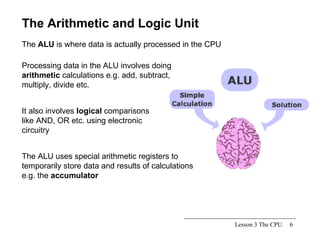
Lesson 3 The CPU The Arithmetic and Logic Unit The  ALU  is where data is actually processed in the CPU Processing data in the ALU involves doing  arithmetic  calculations e.g. add, subtract, multiply, divide etc. It also involves  logical  comparisons like AND, OR etc. using electronic circuitry The ALU uses special arithmetic registers to temporarily store data and results of calculations e.g. the  accumulator
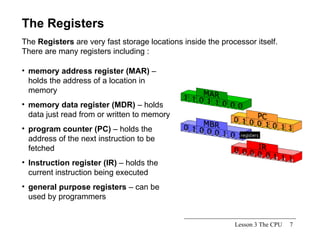
Lesson 3 The CPU The Registers The  Registers  are very fast storage locations inside the processor itself.  There are many registers including : memory address register (MAR)  – holds the address of a location in memory memory data register (MDR)  – holds data just read from or written to memory program counter (PC)  – holds the address of the next instruction to be fetched Instruction register (IR)  – holds the current instruction being executed general purpose registers  – can be used by programmers

CPU

  • 1.
    Lesson 3 TheCPU The Central Processing Unit (CPU) The Central Processing Unit is a silicon chip that is the ‘brain’ of of a computer system. Control unit (CU) Arithmetic and Logic unit (ALU) Registers It executes program instructions and data and controls all the devices within the machine It’s internal organisation ( architecture ) consists of 3 main parts:
  • 2.
    Lesson 3 TheCPU AMD Athlon XP 2200 +
  • 3.
    Lesson 3 TheCPU Intel Pentium 4 2.533 Ghz Socket 478
  • 4.
    Lesson 3 TheCPU Inside the CPU Control Unit Arithmetic and Logic Unit (ALU) Other registers Memory Address Register Memory Data Register Main Memory Address bus Data bus Control Bus (Read / Write) Electronic clock Clock pulses
  • 5.
    Lesson 3 TheCPU The Control Unit It manages fetch, decode and execute program instructions. It synchronises the whole system by telling devices what to do and when to do it The CU sends signals to other parts of the computer
  • 6.
    Lesson 3 TheCPU The Arithmetic and Logic Unit The ALU is where data is actually processed in the CPU Processing data in the ALU involves doing arithmetic calculations e.g. add, subtract, multiply, divide etc. It also involves logical comparisons like AND, OR etc. using electronic circuitry The ALU uses special arithmetic registers to temporarily store data and results of calculations e.g. the accumulator
  • 7.
    Lesson 3 TheCPU The Registers The Registers are very fast storage locations inside the processor itself. There are many registers including : memory address register (MAR) – holds the address of a location in memory memory data register (MDR) – holds data just read from or written to memory program counter (PC) – holds the address of the next instruction to be fetched Instruction register (IR) – holds the current instruction being executed general purpose registers – can be used by programmers