Lesson: Pharmaceutical
marketing channels
By : Mr. Vishal Singh, Assistant professor, KIPS- Kanpur
Unit- IV
Objective
This aims to provide an understanding about:
● Marketing channel - definition
● Channel members, its designing and appropriate channel selection
● Channel conflicts
● Strategic significance of physical distribution management
● Tasks in physical distribution management
Definition
● It can be defined as the distribution networks through which pharmaceutical
products are brought from manufacturers to end-users, such as patients or
healthcare providers.
● These channels typically involve various intermediaries, including wholesalers,
distributors, pharmacies, hospitals, clinics, and sometimes direct sales
representatives.
● Pharmaceutical marketing channels are highly regulated and designed to
ensure the safe and efficient delivery of medications.
Channel members
● Pharmaceutical marketing channel members are the entities involved in the
distribution and sale of pharmaceutical products.
● Each member of the pharmaceutical marketing channel plays a crucial role in
ensuring the safe and timely delivery of medications to patients while
following the regulatory requirements and ethical standards within the
healthcare industry. Examples include:
Manufacturers: Pharmaceutical companies that produce medications, such as
Pfizer, Novartis, or Johnson & Johnson.
Wholesalers: they purchase large quantities of pharmaceuticals from
manufacturers and sell them to pharmacies, hospitals, and other healthcare
facilities. Meher Distribution, Jay Pharma, Ikris Pharma, Biocoral Pharma, etc. are
prominent wholesalers.
Channel members
Distributors: Distributors find wholesalers who will resale their products. They
perform some of the same functions as a wholesaler but generally takes a more
active role.
Pharmacies: also known as Retail outlets or retailers where consumers purchase
prescription and over-the-counter medications. Examples include CVS Health,
Walgreens, and independent pharmacies.
Healthcare Providers: Physicians, nurses, and other healthcare professionals who
prescribe medications to patients. They can purchase the product directly from the
wholesalers.
Patients: Individuals who ultimately consume pharmaceutical products for
therapeutic purposes.
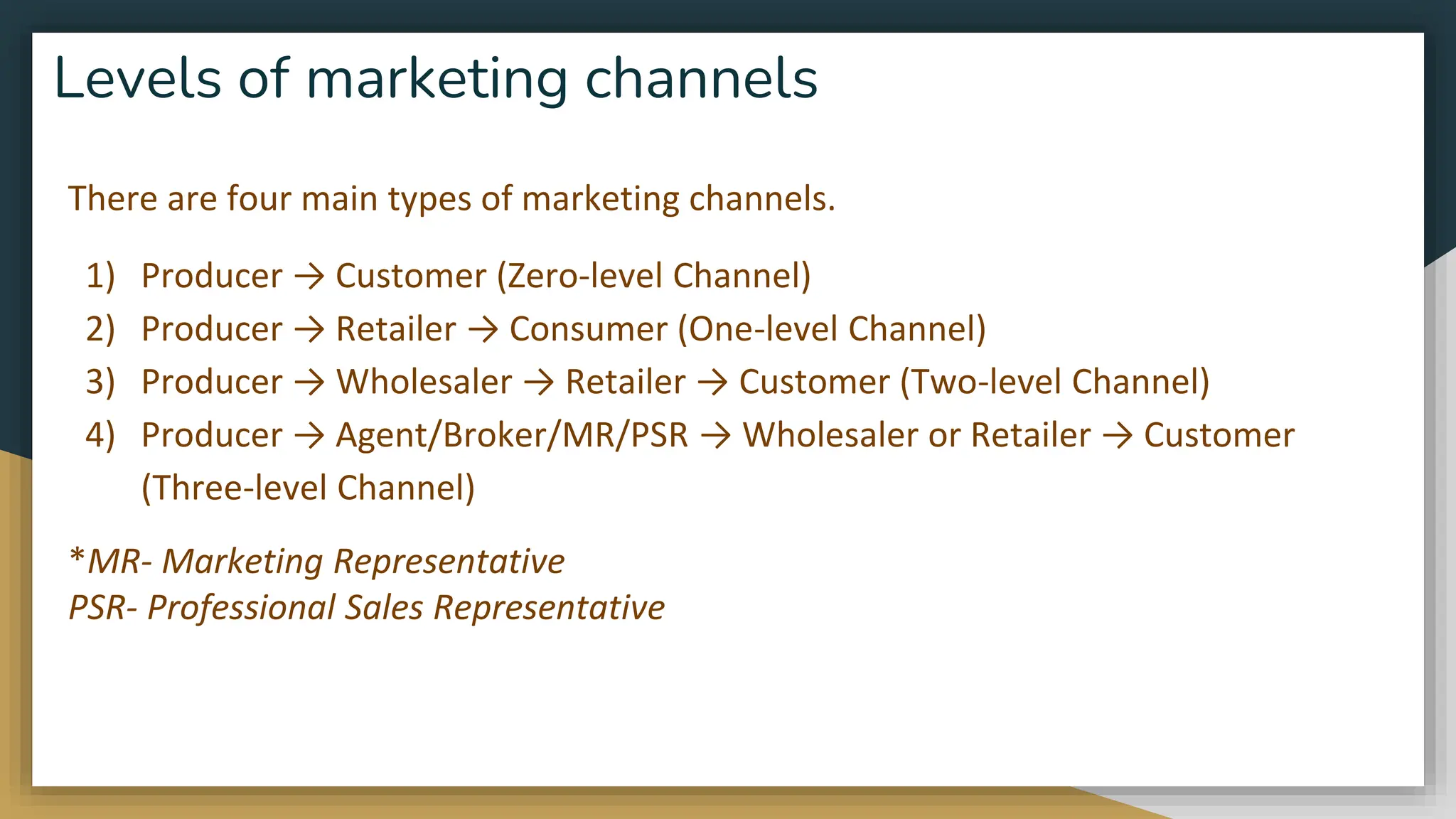
Levels of marketing channels
There are four main types of marketing channels.
1) Producer → Customer (Zero-level Channel)
2) Producer → Retailer → Consumer (One-level Channel)
3) Producer → Wholesaler → Retailer → Customer (Two-level Channel)
4) Producer → Agent/Broker/MR/PSR → Wholesaler or Retailer → Customer
(Three-level Channel)
*MR- Marketing Representative
PSR- Professional Sales Representative
Channel design & appropriate channel selection
Designing a marketing channel involves strategizing the most effective path for
products or services to reach consumers.
● Understanding Target Market: Identify consumer needs, preferences, and
buying behaviors.
● Selecting Channel Options: Evaluate various distribution channels such as
direct sales, retailers, wholesalers, or online platforms.
● Determining Channel Structure: Decide on the structure of the channel,
whether it's direct, indirect, or multi-channel, based on factors like control,
cost, and reach.
Channel design & appropriate channel selection
● Choosing Channel Members: Select partners like wholesalers, retailers, or
distributors based on their capabilities, reach, and alignment with brand
values.
● Managing Channel Relationships: Build strong relationships with channel
partners, provide support, and incentivize performance to ensure mutual
success.
● Optimizing Channel Performance: Continuously monitor and evaluate channel
performance, making adjustments as needed to improve efficiency and
effectiveness.
Channel conflicts
● A disagreement between two channel members occurs when one of them tries
to convince the other to agree with their goals or points of view. This is known
as a channel conflict.
● It may happen when one channel partner obstructs another's efforts to
achieve their own objectives.
Physical distribution management
● Physical distribution management involves efficient management of the
movement of goods from production to consumption.
● An effective physical distribution management enhances customer
satisfaction, reduces operating costs, and improves overall supply chain
performance.
Importance of physical distribution management:
Inventory Management: Ensuring the right amount of inventory is available at the
right locations to meet customer demand while minimizing carrying costs and
stockouts.
Warehousing: Establishing and managing warehouses strategically to store and
handle goods efficiently, optimizing space utilization and order fulfillment
processes.
Importance of Physical distribution management
Transportation: Selecting the most suitable transportation modes and carriers to
transport goods cost-effectively while meeting delivery timelines and service
requirements.
Order Processing: Order processing systems can be optimized, from receiving to
fulfillment, in order to reduce lead times and errors while enhancing customer
satisfaction.
Packaging and Handling: appropriate packaging and handling protects the products
during transit, reduce damage, and facilitate efficient loading and unloading.
Reverse Logistics: Managing product returns and exchanges effectively, including
handling, transportation, and disposition of returned goods, to minimize costs and
maximize value recovery.
Thank You

Unit-IV- Pharma. Marketing Channels.pptx

  • 1.
    Lesson: Pharmaceutical marketing channels By: Mr. Vishal Singh, Assistant professor, KIPS- Kanpur Unit- IV
  • 2.
    Objective This aims toprovide an understanding about: ● Marketing channel - definition ● Channel members, its designing and appropriate channel selection ● Channel conflicts ● Strategic significance of physical distribution management ● Tasks in physical distribution management
  • 3.
    Definition ● It canbe defined as the distribution networks through which pharmaceutical products are brought from manufacturers to end-users, such as patients or healthcare providers. ● These channels typically involve various intermediaries, including wholesalers, distributors, pharmacies, hospitals, clinics, and sometimes direct sales representatives. ● Pharmaceutical marketing channels are highly regulated and designed to ensure the safe and efficient delivery of medications.
  • 4.
    Channel members ● Pharmaceuticalmarketing channel members are the entities involved in the distribution and sale of pharmaceutical products. ● Each member of the pharmaceutical marketing channel plays a crucial role in ensuring the safe and timely delivery of medications to patients while following the regulatory requirements and ethical standards within the healthcare industry. Examples include: Manufacturers: Pharmaceutical companies that produce medications, such as Pfizer, Novartis, or Johnson & Johnson. Wholesalers: they purchase large quantities of pharmaceuticals from manufacturers and sell them to pharmacies, hospitals, and other healthcare facilities. Meher Distribution, Jay Pharma, Ikris Pharma, Biocoral Pharma, etc. are prominent wholesalers.
  • 5.
    Channel members Distributors: Distributorsfind wholesalers who will resale their products. They perform some of the same functions as a wholesaler but generally takes a more active role. Pharmacies: also known as Retail outlets or retailers where consumers purchase prescription and over-the-counter medications. Examples include CVS Health, Walgreens, and independent pharmacies. Healthcare Providers: Physicians, nurses, and other healthcare professionals who prescribe medications to patients. They can purchase the product directly from the wholesalers. Patients: Individuals who ultimately consume pharmaceutical products for therapeutic purposes.
  • 6.
    Levels of marketingchannels There are four main types of marketing channels. 1) Producer → Customer (Zero-level Channel) 2) Producer → Retailer → Consumer (One-level Channel) 3) Producer → Wholesaler → Retailer → Customer (Two-level Channel) 4) Producer → Agent/Broker/MR/PSR → Wholesaler or Retailer → Customer (Three-level Channel) *MR- Marketing Representative PSR- Professional Sales Representative
  • 7.
    Channel design &appropriate channel selection Designing a marketing channel involves strategizing the most effective path for products or services to reach consumers. ● Understanding Target Market: Identify consumer needs, preferences, and buying behaviors. ● Selecting Channel Options: Evaluate various distribution channels such as direct sales, retailers, wholesalers, or online platforms. ● Determining Channel Structure: Decide on the structure of the channel, whether it's direct, indirect, or multi-channel, based on factors like control, cost, and reach.
  • 8.
    Channel design &appropriate channel selection ● Choosing Channel Members: Select partners like wholesalers, retailers, or distributors based on their capabilities, reach, and alignment with brand values. ● Managing Channel Relationships: Build strong relationships with channel partners, provide support, and incentivize performance to ensure mutual success. ● Optimizing Channel Performance: Continuously monitor and evaluate channel performance, making adjustments as needed to improve efficiency and effectiveness.
  • 9.
    Channel conflicts ● Adisagreement between two channel members occurs when one of them tries to convince the other to agree with their goals or points of view. This is known as a channel conflict. ● It may happen when one channel partner obstructs another's efforts to achieve their own objectives.
  • 10.
    Physical distribution management ●Physical distribution management involves efficient management of the movement of goods from production to consumption. ● An effective physical distribution management enhances customer satisfaction, reduces operating costs, and improves overall supply chain performance. Importance of physical distribution management: Inventory Management: Ensuring the right amount of inventory is available at the right locations to meet customer demand while minimizing carrying costs and stockouts. Warehousing: Establishing and managing warehouses strategically to store and handle goods efficiently, optimizing space utilization and order fulfillment processes.
  • 11.
    Importance of Physicaldistribution management Transportation: Selecting the most suitable transportation modes and carriers to transport goods cost-effectively while meeting delivery timelines and service requirements. Order Processing: Order processing systems can be optimized, from receiving to fulfillment, in order to reduce lead times and errors while enhancing customer satisfaction. Packaging and Handling: appropriate packaging and handling protects the products during transit, reduce damage, and facilitate efficient loading and unloading. Reverse Logistics: Managing product returns and exchanges effectively, including handling, transportation, and disposition of returned goods, to minimize costs and maximize value recovery.
  • 12.