Units
and
Measurements
Physical Quantity
- Quantities which can be
measured by an
instrument and used to
describe Laws of physics
are physical quantities
- Physical quantity =
Numerical value (N) × Unit (U)
TYPES
Fundamental quantities do
not depend upon other
quantities:
(1) Length (2) Mass (3) Time
(4) Temperature
(5) Amount of Substance
(6) Electric current
(7) Luminous Intensity
- Derived quantities are
formed by combining more
than one fundamental
physical quantities
- Area, Volume, velocity
and acceleration are
some Derived quantities
Two supplementary S.I units are:-
(1) Radian(plane angle)
, Q= , arc
radius
(2) Steradian (solid angle),
Ω =
2
arc
(radius)
Dimensional Analysis
Dimension formula is the
expression for the unit of a
physical quantity in terms of
the fundamental quantities
Dimensional formula is
expressed in terms of
power of M, L and T.
Primary or fundamental
Dimensional Formula
Secondary or derived
dimensional Formula
(i) Other than Fundame-
ntal formula all other
are derived
dimensional Formula
(ii) example: (1) [speed] =
[MoL1T-1],
(2) [Acceleration]
= [MoL1T2]
There are seven
fundamental
dimensional formulas:
(1) Mass = [M], (2) Length
= [L], (3) Time = [T],
(4) Temperature = [K] or
[Q], (5) Electric Current
= [I], (6) Luminous
intensity = [cd],
(7) amount of matter
= [mol]
PRINCIPLE OF HOMOGENITY
Principle of homogeneity
states that the
dimension of each term
on both sides of
dimensional equation
should be same.
Conversion of Units From
are system to another
N1 = numerical part of
one system
N2 = numerical part of
another system
a b
1 1 1
2 1
2 2 2
M L T
N N
M L T
     
=      
     
UNITS
(1) Unit is defined as the
reference standard used
for measurements.
(2) Measurements consists of
a numerical value along with
a relevant unit.
(3) Example: meter, newton,
joule, seconds etc.
MKS
(m, kg, s)
CGS
(m, gm, s)
FPS (Ft,
pound, s)
- The system of units
accepted internationally
- S.I units of time is ‘sec’
is the example of S.I system
S.I Units
SOME OTHER UNITS
(1) mass:- 1 quintal = 100 kg,
1 ton = 1000 kg
(2) length:- 1 light year =
9.46 × 10¹⁵ m
1 au = 1.496 × 10¹¹ m
(3) Temperature: Oo C =
273 K 1o F = 255.928 K
KNOW YOUR LCROS
(SIGNIFICANT FIGURES)
The number of digits in the
measured values about the
correctness are known as
significant figures.
4.125 - 4 sf;
123 - 3 sf
All non – zero
digits are
significant
Leading zeroes i.e
, are never
significant placed
to the left of the
number
0.0403 - 3 sf;
0.04030 - 4 sf
10.9 - 3 sf;
400.001 - 4 sf
All zero lie in
between the non
– zero digits are
significant
38.3 × 10⁴ - 3 sf;
38.30 × 10⁻⁹ - 4 sf
Order of magnitud
e is not considered
Constants and pure
numbers have infinite
significant figures;
Trailing zero digits
are significant only
when they appear
after decimal 4.00 - 3 sf;
0.043010 - 5 sf
RULE OF ROUNDING OFF
- Rules of Rounding off the
uncertain digits
(up to 3 Significant Figures)
If digit > 5
then, preceding digit +1
If digit <5 then, preceding
digit remain same
If insignificant digit = 5;
(a) Preceding digit
remain same when
rounded off digit is even.;
(b) Preceding digit +1 when
rounded off digit is odd
ORDER OF MAGNITUDE
It is defined as the power
of 10 which is closest to
its magnitude
N = n × 10x; x = order
of magnitude.
ERRORS
The uncertainty in
measurement is called
errors
- Error = true value –
measured Value
TYPES OF ERROR
Absolute Error, =
true value –
measured value
Mean absolute errors
1 2 n
mean
.............
n
∆α + ∆α + + ∆α
∆α =
Relative error
mean
mean
∆α
α
Percentage error,
is difference the
measured value and the
true value as a
percentage of true value
Percentage error
mean
mean
100
∆α
×
α
ACCURACY PRECCISION
Precision is the range
of variation of true
value during several
observation
Accuracy is degree of
closeness of measured
value to the true value;
- shows that how closely
the results with the
standard value.
VERNIER CALLIPERS
Least Count (L.C) =
1 MSD – 1 VSD; MSD =
main scale division;
VSD = Vernier
scale division
Total reading = Main
scale Reading
+(Vernier Coincidence
× least Count)
Zero error = N × L.C;
N = no. of coinciding
division;
L.C = Least count of an
instrunment.
displacement of screw
no. of rotations
Pitch =
L.C. =
Pitch
total no. of divisions
Unit
45
kg
Numerical
Value
coefficient
6.022 x 10²³
exponent
base
Vernier scale
Main scale
Zero error = N × L.C
N = no. of circular
scale division that
coincides with the
reference line
L.C = Least Count
Positive Zero Error
10
0
5
0
Positive Zero Error
Negaitive Zero Error
0
0
95
90
Negative Zero Error
Positive zero error
0 1
0 5 10
Main Scale
Vernier scale
Negative zero error
0 1
0 5 10
Main Scale
Vernier scale
Measurments
Units And
r
r
‘A’ is
Area r2
Equivalent
in area
r
r
1
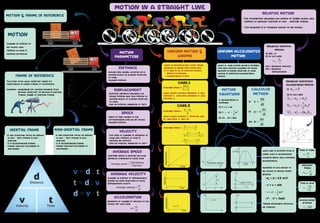
MOTION IN A STRAIGHT LINE
RELATIVE MOTION
• The Comparison between the motion of single object with
respect to another inertial or non – inertial frame.
• This Analysis is of relative motion of an object.
UNIFORM MOTION &
GRAPHS
UNIFORM ACCELERATED
MOTION
• when a moving object cover equal
distance in equal time intervals.
IT is said to be in uniform motion.
• speed is constant.
• Acceleration is zero
Average speed =
Average speed =
Average speed =
CASE.2
CASE.1
1 2
V V
2
+
When object travels distance ‘d’ with
velocity V1
and next distance ‘d’ with
velocity v2
When object travels ‘t’ interval with
V1 and next ‘t’ with v2
1 2
1 2
2V V
V V
+
1 n
1 n
d .......... d
t ........... t
+ +
+ +
1 n
1 1 n n
d .......... d
d V ........... d v
+ +
=
+ +
1 1 n n
1 n
V t .......... V t
t ........... t
+ +
=
+ +
ACCELERATION
AVERAGE VELOCITY
VELOCITY
SPEED
DISPLACEMENT
DISTANCE
MOTION
PARAMETERS
AVERAGE SPEED
Measure of change in velocity of an
object per unit time
x
a =
t
∆
∆
Change in position or displacement
divided by time intervals in which
displacement occurs
x
Average Velocity =
t
∆
∆
Average speed is defined as total
distance travelled in total time
Total distance
Average speed =
Total time
• The rate of change of distance of
body with respect to time is
defined as velocity
• Can be positive, negative or zero
• Ratio of path length to the
corresponding time by an object
• Always positive
• Shortest distance between the
initial position and find position of
moving object in a given interval
of time.
• can be positive, negative or Zero
• Actual path length covered by a
moving object in a given interval
of time.
• Always positive
when a body moves along a straight
line and velocity changes by equal
amount in equal interval of time,
motion is uniformly accelerated
motion
MOTION
EQUATIONS
CALCULUS
METHOD
(1) V = u + at
(2)
(3) v2 – u2 = 2as
If acceleration is
constant
2
1
S ut at
2
= +
dx
v
dt
=
dv
a v
dt
=
dv
a
dt
=
(i)
(ii)
(iii)
When ball is dropped from a
height then it accelerates
towards earth with constant
acceleration.
Analysis of this motion of
an object is motion under
gravity
• ay
= g = 9.8 m/s2
• v = u + ayt
•
• V2
– u2
= 2ays
2
1
s ut ayt
2
= +
Taking downward direction
as ‘positive’
2u
T
g
=
Time of flight
2
max
u
H
2g
=
Maximum
Height
2h
T
g
=
Time to drop
V 2gh
=
Velocity after
dropping
Relative Uniform
Motion
Relative Uniformly
Accelerated Motion
(1) a12 = 0
(2) In this case
12
12
S
V
t
=
V12 = Relative Velocity
S12 = Relative
displacement
(1)
(2) In this case
12
a 0
≠
12 12 12
V u a t
= +
2
12 12 12
1
S u t a t
2
= +
2 2
12 12 12 12
V u 2a S
− =
MOTION & FRAME OF REFERENCE
Change in position of
an object with
respect to time is
defined as Motion
FRAME OF REFERENCE
The point from which observer takes it’s
observation is called frame of reference.
Example:- Analysing lift moving upwards From
ground. Observer on ground is inertial
frame. Image of Inertial frame
Displacement Time
o
Velocity
Time
o
Acceleration
Time
o
a = 0
x
x0
t
Parabolic nature
v
ux
0 T t
axT
a
t
a > 0
x
(u2
/2g)
(u/g) t
O
(u/g) (2u/g)
v
u
O
–u
t
O
a
t
-g
• If net external force on system
is non – zero frame is non –
inertial
• It is Accelerating Frame.
• Frame velocity increases or
decreases
• If net external force on system
is non – zero frame is non –
inertial
• It is Accelerating Frame.
• Frame velocity increases or
decreases
INERTIAL FRAME NON-INERTIAL FRAME
40
30
20
10
0
0 1 2 3 4
TIME
Displacement
MOTION
Vector (magnitude + Direction)
Basic Terminologies
. Null vector:
. Unit vector:
. Equal vector:
. Axial vector: used in rotation
. Orthogonal vector Angle b/w
. Parallel Vector :
. Anti-Parallel Vector :
A

= 0
 A
A
A
= =

 1
}
A
B
A B
→
→
=





 

r W
V
r x
V W
=
A & B ( θ = 900
)
A & B ( θ = 00
)
A & B ( θ = 1800
)
θ = 900
A
A
B
B
B
A
Angel b/w
Angel b/w
I A I = n I B I
I A I = - n I B I
Mathematical operations
A

B

( 9g = (a1
+ b1
+ c1
) = (a1
+ b1
+ c1
)
i
 Lorem ipsum
j
 K
v
i
 Lorem ipsum
j
 K
v
&
Resolution of vector
θ
Px
= PCOSθ
Py
= PSinθ
P
Addition
Subtraction

1 2 1 2 1 2
A B (a a )i (b b )j (c c )k
+ = + + + + +
 

 

1 2 1 2 1 2
A B (a a )i (b b )j (c c )k
+ = − + − + −
 

 
Multiplication
Dot product
(Scalar product)
Cross product
(vector product)
A B A B Cos
+ = θ
 
  

1 2 1 2 1 2
A .B a a b b c c
= + +
 

i. i 1
=
 
i. j 0
=
 

i . k 0etc
=

1) 1)
2)
2)
3)
3)
A B A B sin
+ = θ
 
  


1 1 1
2 2 2
i j k
A B a b c
a b c
× =
 
 

i (b1
c2
- c1
b2
) + j (a1
c2
- c1
a2
)
+ k (a1
b2
- b1
a2
)
v
v
v

i i 0
i j 1
1
i k
× =
× =
= −
×
 
 

Arithmetic operations
Vector law’s
Triangle law:
R
A
B
θ
α
By
= Bsinθ
Bx
= Bcosθ
−
−
−
R


= ( A + Bcos θ ) i + Bsin θ j
2 2
R A B 2 A B Cos
= + + θ

  

tanα
B sin
A B cos
θ
+ θ


 

=
=
A
A
B
B
θ
α
α
α
Parallelogram law:
Lammis Theorem:
3
1 2 F
F F
sin sin sin
= =
∝ β γ β
β
γ
γ
F1
F1
F3
F3
F2
F2
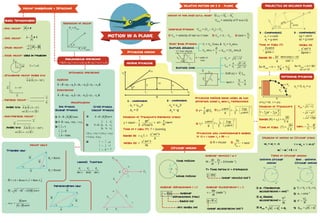
MOTION IN A PLANE
Circular motion
r
r
L
θ
Final position
initial position
Angular displacement ( θ ):
Angular velocity ( w ):
R
= θ
 Angular
displacement (rad.)
Radius (m)
Arc length (m)
1
d 2
W 2 f (rads )
dt T
−
θ π
= = = π
T= Time period if = frequency
V RW
=
linear velocity (ms-1
)
Angular Acceleration ( α ):
2
dw
(rads )
dt
−
∝=
a R
= ∝
linear acceleration (ms-1
)
Equation of motion on Circular track:
wf
= Wi
+ αt θ = Wit
+ ½ nαt2
2 2
f i
W W 2
- = ∝ θ
Types of Circular motion:
Uniform circular
motion
Non – uniform
Circular motion
V V
V
V
r
V3
V2
V4
V1
r
1) aτ (Tangential
acceleration) = oms-2
2) ar
(Radial
acceleration) =
2
V
R
3) anet
= 2 2
T 0
a a
+ = ar
1 2 3 4
V V V V
≠ ≠ ≠
1)
2)
3)
4)
2
T
a oms−
≠
2
r ins
V
a
R
=
2 2
net T r
a a a
= +
Projectile motion
oblique projectile
H
y y
t2
t1
θ
u
ux
uy
R
x – component y – component
y – components
. ux
= uCos
θ
. ax
= 0
. ug
= usin
θ
. ag
= -g
Equation of Trajectory (parabolic track)
y = xtanθ -
1
2
2
2 2
gx
u Cos θ
x
x(1 ) tan
R
− θ
=
Time of f hight (T), T = 2usinθ/g
Range (R) = ux
T, =
2 2
sin
g
µ θ
Height (H)
2 2
sin
2g
µ θ
=
Projectile passing same height at two
different times t1
and t2
respectively
1 2
1
gt t
2
1) y= 2)
2
sin 2 gy
1 1
g sin
 
 
µ θ  
− −  
 
µ θ
 
 
t1
=
3)
2
sin 2 gy
1 1
g sin
 
 
µ θ  
+ −  
 
µ θ
 
 
t2
=
Projective with complimentary angles,
If θ1 = θ then θ2
= 90 - θ
1) R = Hcosθ 2)
90
T
T − θ
θ
= tanθ
Horizontal projectile
ux
= u
uy
= 0,
H
vy
vx
v
x
β
x=ux
t =ut, t = x/u
Equation of Trajectory
2
2
2
X
1 1
Y gt g
2 2
= =
µ
Range (R) = ux
t =
2H
g
u
Time of flight
2H
g
(T) =
2 2 2
v u g t
2 2
x y
vins
v v
= u2 +2gy
tanφ = =
vy
vx
gt
u
PROJECTILE ON INCLINED PLANE
B
O
y
u A
X
g
gsin
gcos
X – Components
ux
= u cosθ
ax
= g sinθ
ug = usinθ
ay = g cosθ
Time of flight (T) Height (H)
Range (R)
2
2
2u sin cos( )
g cos
θ ∝+ θ
∝
=
2usin
gcos
θ
∝
=
2 2
u sin
2gcos
θ
∝
=
for Rmax
= θ =
4 2
π ∝
+ for Hmax
= θ = 90o
or α= 0o
RELATIVE MOTION ON 2 D – PLANE
motion of one body w.r.t. other: P/Q P Q
V V V
= −
  
VP/Q
= velocity of P w.e.t.Q
Umbrella problem: VmG
= (Vm
– VG
) = Vm
1) Vrm
= velocity of rain w.r.t man 2) Vrm
= Vr
– Vm
3) tanθ = m
r
V
V
River Boat Problem
Shortest distance
Vr
= Vbr
Cosα & Vb
= Vbr
sinα
Vbr
sinα = = dmin
= (Vbr
sinα)t
d
t
Shortest time
Vbr
= 2 2
b r
V V
+
tmin
=
2 2
2 2
b b r
X d
d
V V V
+
=
+
Drift (x) = r min
V t


tanθ = r
m
V x
V d
=
θ
Vb
Vbr
Vbr
Vbg
Vbr
Vr
Vr
Vr
= river velocity
x
d
θ
α
d = width of
river
NEWTON’S LAWS OF MOTION
Newton’s 1st law
A body Continues its sate of
rest or motion until unless an
external force is acted on it.
If ext
F o
=

; a o
=

INERTIA OF REST
The property of a
body due to which it
cannot change its
state of rest by it
self.
The property due to
which a body cannot
change its direction of
motion by itself.
The tendency of a
body to remain in
a state of uniform
motion in a
straight Line.
INERTIA OF DIRECTION INERTIA OF MOTION
FORCES
(i) Normal Contact force
(1) always acts along the
common Normal of two surface
in contact.
(2) Always directed towards the
system.
(3) It is an electromagnetic
type of force. Normal force on
block is N. N = mg
(ii) Tension Force
(1) Acts along the string and
away from the system on
which it acts.
(2) Tension in a massless string
remains constant throughout
the string if no tangential
force acts along the string.
(3) This is force applied by a
string on an object or force
applied by one part of string
on the remaining part of
string.
(4) It is an electromagnetic
type of force.
(iii) Friction Force
(1) Rolling friction:- The force of friction which
comes into play when one body Ralls or tends
to roll on the surface of a norther body.
(iV) Sliding friction
Resistance offered to the
relative motion between
the surface of two bodies
in contact.
The frictional force f is
directly proportional to
the Normal force N
exerted by the surface
on the body.
(F ∝ N or f/N = Constant = µ).
The friction force depends
upon the nature of surfaces
in Contact and independent
of the area of Contact.
Types of friction
fs = µsN.
acts when a body is
just at the verge
of movement
acts when a body is
at rest on application
of a force
Fl = µsN.
acts when a body
is actually sliding
fk = µKN
Newton’s 2nd Law
The rate of change of linear momentum of a body
is directly proportional to the external force applied on
the body in the direction of force.
dp
F ma
dt
= =

 
S.I . Unit of force = Newton (W)
dimensional formula = [M1L1T-2]
if m = const
mdv
F ma
dt
= =

 
⇒
if V Cost
=

=
dm
F V
dt
=
 
convey or belt &
rocket propulsion
Conservation of linear momentum:-
if there is no external force
acting on it, total momentum of
an isolated system of interacting
particles is conserved
ext initial final
dp
F o or P P
dt
= = =


Impulse
avg
I F t P
= ∆ = ∆
  

⇒ I = P F.dt
∆ = ∫ = area under f – t curve
Newton’s 3rd law
To every action there is always on
equal and opposite reaction.
AB BA
F F
= −
 
Action & Reaction act on different
bodies and not on the same body. -
action – reaction forces are of
same type.
We cannot produce a single isolated
force in nature force are always
produce in action – reaction pair.
due to no time gap, any one force
can be action, and other reaction.
applicable for all the interactive
forces eg. Gravitational,
electrostatic, electromagnetic,
Tension, friction, viscous forces, etc.
For Non – inertial frame
ext Pseudo
F F ma
+ =
  
pseudo frame
F Ma
= −
 
• Draw FBD of bodies in the system.
• Choose a convenient part of the assembly as one
system.
• Identify the unknown force and accelerations.
• Resolve forces into their Components.
• Apply F ma
=
∑
 
in the direc�on of mo�on.
• Apply F O
=
∑

in the direc�on of equilibrium
• Write constraint rela�on if exists.
• Solve the equa�on F ma & F O
= =
∑ ∑
  
.
Horizontal Circular motion
(Conical Pendulum):-
2
Sin cos
mv
T & T mg
r
θ θ
= =
V rgtan
= θ
Angular Speed, w =
v gtan
W
r r
θ
= =
2
T
w
π
= r Lcos
2 2
gtan g
θ
π = π
θ
Time Period
Vertical Circular motion
Particle ossillates in lower half circle.
Condition of ossillation (O u 2gR)
< ≤
1.
2.
3.
Particles moves to upper half circle but not able to complete the loop.
Condition of leaving the circle: ( )
2gR u 5gR
< <
particle completes loop. Condition of looping the loop ( )
u 5gR
≥
MOTION OF A CAR M LEVEL ROAD
(by friction only):-
Vmax S
Rg
≤ µ
MOTION OF A CAR ON
BANKED ROAD
(i) Optimum speed of a vehicle on a banked road. V rgtan
= θ
maximum safe speed on a banked frictional road. max
rg( tan )
V
1 tan
µ + θ
=
−µ θ
minimum safe speed on a banked frictional road min
Rg(tan )
V
(1 tan )
θ − µ
=
+µ θ
Kinematics of Uniform Circular motion
1.A particle moves in a circle at a constant
speed
2. Angular displacement (θ) SI Unit: rad or
degree.
3. Angular Velocity (W):
avg
W [Unit . rad / sec]
t
∆θ
=
∆
ins
d
W
dt
θ
=
Centripetal Force
Fc = mac =
2
mv
r
= mrw2
S r O
∆ = ∆ v = wr
V w r
= ×
 
 
V

is linear velocity (tangential vector)
w


(axial vector)
r

= radius vector
Speed of the particle in a
horizontal circular motion
changes with respect to time.
f
N
mg
R
Speed = v
a = v² / R
O
Tangential acceleration:
t
a r
= α ×

 
 
Centripetal force
Fc = mac =
2
2
mv
mrw
r
=
Tangential force Ft = mat
Net force Fnet = 2 2
c t
m a a
+
C
a

responsible for change in direc�on of movement of particle
Static friction Limiting friction Kinetic friction
Circular
motion
N
f
mg
Kinematics of non – Uniform
circular motion
SOLVING PROBLEMS IN MECHANICS
T
O




P
L
mg cos
mg sin
mg
F Cosθ
F sinθ
θ
θ
h
r
l
F
mg
WORK,ENERGY AND pOWER
• An instance of one moving body striking
with another
• Collision of car with truck, collision of
balls in snooker are examples.
NATURE OF
COLLISIONS
CONSERVATION OF
MOMENTUM
SPECIAL CASES
2 - D COLLISION
1 - D COLLISION
• Value of coefficient of
restitution defines
nature of collision,
seperation
approach
V
e
V
=
• e = O, e = 1, O < e< 1
Defines nature of
collisions
2n
n
h e ho
=
(1)
e = coefficient of
restitution.
n = nth collision,
ho = initial height,
hn = height after nth
collision
(2) Vn = enVo,
n = nth collision,
Vo = initial velocity,
vn = velocity after nth
collision.
(3) H = ho
2
2
1 e
1 e
 
+
 
−
 
H = total distance
travelled before it stops
(4) T =
2
o
2
2h
1 e
1 e g
 
+
 
−
 
T = time taken by ball
to stope bounding.
(1) Bodies moving in a
plane results in
arbitrary collision in
different directions is
2 – D.
(2) P O
∆ =


x
P O
∆ =
1 1 2 2 1 1 2 2
m x m x m v x m v x
µ + µ = +
y
P O
∆ =
1 1 2 2 1 1 2 2
m y m m v y m v y
µ + µ = +
( )sys
P O
∆ =
(1)
(2) e =
(3) V1
=
(4) V2
=
(5) Change in Kinetic
energy,
2 1
1 2
V V
−
µ − µ
1 2 2
1 2
1 2 1 2
m em (1 e)m
m m m m
 
− +
µ + µ
 
+ +
 
velocity of first particle
after collision.
1 2
1 2
1 2 1 2
m (1 e) m em
m m m m
− + −
µ + µ
+ +
velocity of second particle
after collision
K
∆
2
1 2
1 2
1 2
m m
1
K ( ) (1 e)
2 m m
∆ = µ − µ −
+

 

• In elastic collision,
momentum and K.E of
system are conserved
• e = 1
• Bodies do not stick
together after collision
• In inelastic collision,
momentum is conserved
• o<e<I
• Bodies do not stick
together after collision
• In perfectly inelastic
Collison momentum is
conserved
• e = O
• Bodies sticks together
after collision
COLLISIONS
TYPES
OF
COLLISIONS
ENERGY
• Capacity to do work is defined
as Energy
• It is a scalar quantity
• S.I. unit is Joule (J)
(1) Heat energy
(2) Chemical energy
(3) Electrical energy
(4) Nuclear energy
(5) Mass – Energy
equivalence
VARIOUS FORMS
WORK-ENERGY THEOREM
AVERAGE POWER
FORMULAE
SPECIAL UNITS
INSTANTANEOUS
POWER
(1) Net Work done on an object by
all forces will change in Kinetic
energy of an object
(2)
(3) W =
net
W K
= ∆
Wconservative
+ Wnon–conservative
+ Wext
= K
∆
F(x).dx, F(x).dx K V
∫ ∫ = ∆ + ∆
if variable force does work .
MECHANICAL
ENERGY IS
CONSERVED
TYPES OF
ENERGY
(1) In absence of dissipative
forces, mechanical
energy is conserved
(2)
(3) V =
(4)
(5) Tension at any point
on circle,
(6) Velocity at any point
on circle,
V 5gl
=
at bottom to reach top
V 3gl
=
at bottom to cross
quarter CIrcle
V gl
=
to reach quatre circle
2
m
T mg (2 3cos )
r
µ
= − − θ
2 2
V 2gl (1 cos )
= µ − − θ
MOTION IN
VERTICLE CIRCLE
ENERGY IN SPRING
MASS SYSTEM
(1) Total mechanical
energy at each point is
Constant.
(2)
(3) maximum Velocity
K V
∆ + ∆ =0
( Kinitial
+Vinitial
) = ( Kfinal
+ Vfinal`
)
max m
k
V x
m
=
WORK
• Work is said to be done when Force
produces displacement.
mg Friction Tension
Normal
Pseudo
Spring
force
WORK DONE BY
ALL FORCES
POWER
(1) Time rate at which work is done.
(2) It is a scalar quantity
(3) S.I. Unit is watt.
POTENTIAL ENERGY
KINETIC ENERGY
MECHANICAL ENERGY
• By virtue of Position, height,
stresses within its & Electrostatic
Factors;
• Gravitational Potential
Energy = mgh
• Elastic Potential energy =
• Electrostatic Potential
energy =
2
1
kx
2
1 2
kq q
r
Sum of kinetic energy and
potential energy
• By Virtue of velocity 2
1
K mv
2
=
Total Work done in time
t is average power
avg
w
P
t
=
Scalar product of force
and instantaneous
velocity (v) is
instantaneous Power.
inst
ds
P F . F. V
dt
= =


   
(1) dW =
(2) P =
F .dr
 
dw
dt
For small amount of work
• 1 hp = 746 W
• 1 KWH = 3.6 × 10⁶
J
(1) Kx, mg and electrostatic
forces are conservative
forces,
(2) Work For these forces is
stored in the form of
Potential energy.
(3) They are path
independent.
(1) Non – conservative forces
are path dependent.
(2) Friction is an example
of non – conservative
forces.
NON – CONSERVATIVE
FORCES
CONSERVATIVE FORCES
NEGATIVE WORK
ZERO WORK
POSITIVE WORK
(1) If both force &
displacement are ‘+’or ‘-‘
and θ is between 90o
to
180o
.
(2) If either of force or
displacement is positive
and θ is acute.
(1) W = O, if Force is
perpendicular or to the
displacement.
(2) Either Force or
displacement is zero.
(1) If force and
displacement both
are ‘+’ or ‘-‘ and θ is
acute.
(2) If either of force or
displacement is
negative and θ is
between 90o
to 180o
.
WORK CAN BE
POSITIVE, NEGATIVE
OR ZERO
WORK DONE BY
CONSERVATIVE & NON-
CONSERVATIVE FORCES
WORK DONE FOR
CONSTANT FORCE
& VARIABLE FORCE
• Area under F.S graph gives
work done
• work done = Area under
ABCD
• If work is done by variable
force, then
2
1
r
r
W F. dr
= ∫
 
• W = F d cosθ,
• S.I. unit is
J (joule)
(1) If netexternal force
on system is zero then
Linear momentum of
system is conserved
(2)
(3)
(4)
P O
∆ =


i f
P P
=
 

1 1 1 n
m ........ m
µ + + µ

 

1 1 1 n
m ......... m
= υ + + υ

 

System of particles and
rotational motion
CENTRE OF MASS
The point where whole mass of system is
supposed to be concentrated
1. Position of centre of mass depends upon shaped, size
and distribution of mass of body
2. Position of centre of mass of an object changes in
translation motion.
3. For bodies of normal dimensions centre of mass &
center of gravity coincide.
4. Centre of mass of rigid bodies is independent of the
state i.e rest or motion of the body.
Position of Centre of
mass of system
i i
cm
i
m r
r
m
=
∑
∑


Velocity of centre of
mass of system
i i
cm
i
m v
V
m
=
∑
∑


Acceleration of Centre
of mass of system
i i
cm
i
m a
a
m
=
∑
∑


RIGID BODY
A body with perfectly definite and
unchanging shape.
Rotational Equilibrium
ext
ext r F O
τ = ε × =
  
Translational Equilibrium
ext
F O
=
∑

PRINCIPLE OF MOMENTS FOR A LEVER
According to this principle;-
Load × Load arm = effort × effort arm
Analogy between linear & Rotational motion
Linear motion
Velocity
ds
V
dt
=
acceleration
ds
a
dt
=
Force
mdv
F ma
dt
= =
work done
W F.S
=
linear K.E
2
1
mv
2
Power
P = F.V,
Linear momentum
P = mv
Impulse
F t mv mu
∆ = −
Rotational Motion
Angular velocity
dQ
W
dt
=
angular acceleration
dw
dt
α =
torque
d
I (Iw)
dt
τ = ∝ =
Work – done
w .Q
= τ
rotational K.E
2
1
Iw
2
Power
P = .w
τ ,
angular momentum
L = Iw
angular Impulse
f i
pt Iw Iw
τ = −
MOMENT OF INERTIA
Inertia of Rotational motion
n
2 2
i i
i 1
mr MK
=
=
∑
M.I. I =
where r is distance perpendicular to the
axis of Rotation.
Radius of gyration
2 2 2
1 2 n
r r ..........r
K
n
+
=
I
K
M
=
Factors & radius of
gyration depends
(1) Position & configuration
of the axis of rotation
(2) distribution of mass
about the axis of
Rotation.
Perpendicular axis theorem
Theorem of moment of Inertia
Parallel – axis theorem
IZ = IX + Iy
, Itanget = Idia + MR2
Hollow sphere,
radius R
(9) Diameter 2
2
mR
3
Shape of area Distance x Distance y Area
Square a/2 a/2 a2
Rectangle a/2 b/2 ab
Circle r r r2
Semi-circle 4r/3 r r2
/2
Right-angled triangle b/3 h/3 bh/2
MOTION OF SYSTEM OF PARTICLES
& RIGID BODY
Pure Rotational Motion:-
(1) Since distance between two particles of
a rigid body remains constant, So the
relative motion of one particle w.r.t other
particle is circular motion.
(2) Angular velocity of all the particles
about a given point of a Rigid body is
same
S = RQ, V Rw
= ;
(3) If α = Constant (angular acceleration),
), Wf = wi + α t ,
Qf = wit + 2
1
t
2
α 2
f
w =
2
i
w + 2αθ, θ = i f
w w
t
2
+
 
 
 
θ = wft - 2
1
t
2
α → K.Erolling = 2 2
1 1
mv Iw
2 2
+ ,
2
2 2
2
1 1 V
mv mk
2 2 r
 
+  
 
2
2
2
1 K
mv 1
2 R
 
+
 
 
Combined Rotation + translation Motion
(CRTM):-
CRTM pure rotation translational
V V V
= +
  
CRTM pure rotation translational
a a a
= +
  
Dynamics of CRTM
for analysing its motion we apply two
equation
ext cm
Ma
τ =
∑
 
ext
ext I r F
τ = α = ×
∑
 
  
Newton’s laws of motion is valid in inertial
frame.
To apply second equation of Newton about Non
– inertial Point, Pseudo – force is applied at
Com of body Σ of pseudo force is also taken
into account.
→ K.ECRTM = K.Erotation + K.Etranslation;
K.E = 2
2
cm
cmw
1 1
I MV
2 2
+ ;
K.E = 2 2 2
cm
1 1
MK w MV
2 2
+
→ angular momentum of Rigid body per forming
CRTM; Pure Rotational as a Rigid body about
C.O.M; Translation as a particle
(EK)r = rota�onal K.E (EK)t = transla�on K.E
(a) for solid sphere, (Ek)r = 40% of (Ek)t,
(b) For snell (Ek)r = 66% of (Ek)t,
(c) For disc, (Ek)r = 50% of (Ek)t of (Ek)t,
(d) For ring, (Ek)r = (Ek)t
(1) ROLLING ON INCLINED PLANE
(2) VELOCITY AT LOWEST POINT
2
2
2gh
V
K
1
R
=
+
(3) ACCELERATION ALONG INCLINED PLANE
a = 2
2
gsin
K
1
R
θ
+
(4) Time taken to reach the bottom of the inclined plane is.
2
2
K
2n (1
1 R
t
sin g
+
=
θ
ANGULAR MOMENTUM CONSERVATION
O OA
L r P (angular momentumabout point O)
= ×
  

OA
= r (mv)
×
 
OA
mr v
= ×
 
O OA OA
L r P r Psin
= × = θ
  

OA
r mv sin
= θ
ANGULAR MOMENTUM CONSERVATION
net
d
dt
τ
τ =

if net
τ

= O ⇒ L =constant

n
system i
i 1
L L
=
=∑

Angular momentum of rigid body performing pure
rotation about fixed axis (Lsys)AOR = IAOR
w
Relation between Torque & Angular momentum:
• net
dt
dt
τ =


• Unit of Torque = N.m
• Dimensional formula = [m1
L2
T-2
] Valid in only iner�al frame.
Angular Impulse:- J .dt
= ∫ τ
 
, f i
net
J L L
= −
  
, J r I
= ×
  
, Unit → NmS
Linear Impulse:- I F dt
= ∫
 
, net f i
I P P
= −
 
 

, Unit → N.S
GRAVITATION
• Energy required to bring a mass
from an infinite position to point
under gravitational field of earth
with constant velocity
• Generally, infinite is reference
point
= 1 2
Gm m
u
r
Every planet revolves around the
sun in an elliptical orbit and sun is
at it’s one of the foci points.
LAW OF ORBIT
KEPLER's
LAW OF
PLANETARY
MOTION
LAW OF AREA
(i) The line joins any planet to the
sun sweeps equal area in equal
intervals of time
(ii]
LAW OF PERIODS
(i) The square of time period of
revolution of a planet is
proportional to cube of semi –
major axis of an ellipse
THE gravitational Force acting between
two bodies separated by distance ‘r’ is
directly proportional to product of their
masses and inversely proportional to
square of distance between them
(1) During Free fall under gravity in
side a spacecraft or satellite, body
is weightless.
(2) Effective weight of body becomes
Zero.
WEIGHTLESSNESS
Minimum speed required by an
object to escape Gravitational
Field of Earth
e
2GM
V 2gR
R
= =
Ve = 11.2 Km/s
(iii) Areal velocity is constant
dA L
dt 2m
=
(ii)
(iii)
2 3
T R
∝
2 3
2 4 R
T
Gm
π
=
(1) GEOSTATIONARY SATELLITE
Height from earth’s surface = 36,000 km
RADIUS = 42,400 Km
Time Period = 24 hours.
(2) POLAR SATELLITE
Height from earth’s surface = 330 Km
Time Period = 84 Min
Orbital Velocity = 7.92 Km/s
GEOSTATIONARY & POLAR
SATELLITE
GM
r
GMM GMM
2r r
=
GMM
2r
= −
(i) orbital velocity =
(ii) Total energy of satellite =
Constant
K.E + P.E = constant
(iii) Total energy =
Relation between
Gravitational potential
& Intensity
dv
E
dr
=
V E . dr
∆ = ∫

 
(i)
(ii)
(i)
(ii)
(iii)
(i)
(ii)
(iii)
Strength of Gravitational field
applied per unit test mass is
defined as Gravitational Field
Intensity
2
GM
E r
r
−
=



2 2
3
(3R r )
r R v GM
2R
−
< → = −
GM
r R v
R
= → = −
GM
r R v
r
> → = −
Amount of work done in moving a
unit test mass from  - position
to point under gravitational field
of earth
Gm U
V
r M
= =
Variation of ‘g’ from equator to pole
2 2
g g Rw cos
= −
Variation of ‘g’ with depth
d s
d
g g (1 )
Rc
= −
2
n s
1 h
g g ( )
Rc
−
+
=
if h <<<< Rc
h s
2h
g g (1 )
Rc
= −
At surface of earth,
Fgravitational
= Weight
2
c
GmMe
Mg
R
=
2
c
Gme
gs
R
=
GRAVITATIONAL
ACCELERATION
1 12 13 1n
F F F ....... F
= + + +
   
Resultant force acting on a
particle due to other particles is
vector sum of forces exerted by
individual particle in it
F1 = F12 + F13 + ……. + F1n
12 21
F F
= −
 
1 2 1 2
12 3
1 2
Gm m (r r )
F
r r
−
=
−
 


 

1 2
12
12 2
1 2
Gm m
F r
r r
=
−


 

12
r Force between them.
=


2
r position of second particle
=


1
r position of first particle
=

1 2
2
Gm m
F
r
=
2
11
2
Nm
G 6.67 10
Kg
−
⇒ = ×
Y
m1
m2
F12
r21
F21
O
r1
r2
X
F02
F0n
rn
r3
F03
r1
r2
F01
SUPERPOSITION
PRINCIPLE IN SCALAR FORM
SUPERPOSITION
PRINCIPLE IN VECTOR
FORM
h
R
R+h
m
v0
POLAR ORBIT
T = 2-3
ROTATION OF EARTH
T = 24 hours
ESCAPE SPEED &
ENERGY CONSERVATION
GRAVITATIONAL POTENTIAL
& GRAVIATATION POTENTIAL
M r
Ms ME
NEWTON'S LAW OF
GRAVITATION
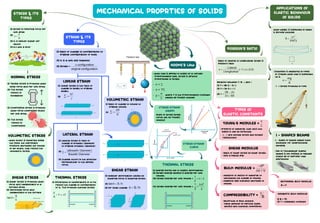
STRESS & ITS
TYPES
(1) Stress is restoring force per
unit area
(2)
(3) It is neither scalar nor
vector,
(4) It’s unit is N/m2
Ratio of lateral to longitudinal strain is
Poisson’s ratio
POISSON'S RATIO
HOOKE'S LAW
STRAIN & ITS
TYPES
LINEAR STRAIN
NORMAL STRESS
VOLUMETRIC STRESS
SHEAR STRESS THERMAL STRESS
THERMAL STRESS
VOLUMETRIC STRAIN
LATERAL STRAIN
SHEAR STRAIN
lateral
( 1 0.5)
longitudnal
− Σ
σ = − ≤σ≤
Σ
Relation between Y, B, η and Σ
(1) Y = 3B (1 - 2σ ),
(2) Y = 2n (1 + σ )
(3)
3B 2n
2n 6B
−
+
σ =
YOUNG’S MODULES =
I - SHAPED BEAMS
SHEAR MODULUS
BULK MODULUS =
COMPRESSIBILITY =
σ
Σ
• property of material, that tells how
easily it can be stretched.
• σ , E are normal stress and strains
respectively
• Ratio of shear stress by shear strain.
• Unit is Pascal (Pa)
• measure of ability of material to
withstands the change in volume.
• negative sign indicates decrease in
volume
P
V / V
−∆
∆
1
B
• Reciprocal of Bulk modulus
• Value depends on particle shape,
density and chemical composition.
• When load is applied to bodies up to certain
proportionality limit, stress is directly
proportional to strain.
•
•
•
σ ∝ Σ
Y
σ ∝ Σ
y ,
σ
=
Σ
where Y is the proportionality Constant
named as Young’s modules
(1) Ratio of change in configuration to
original configuration of body.
(2) It is a unit less quantity
(3) Strain =
configuration
original configuration
∆
(1) Linear strain is the ratio of
change in length to original
length.
(2)
∆
∑ =


(i) Ratio of change in volume to
original volume,
(ii)
V
V
∆
∑ =
(1) Lateral strain is ratio of
change in breadth/ diameter
to original breadth/ diameter,
(2) (Breadth / Diameter)
Breadth /Diameter
∆
∑ =
(3) Change occurs in the direction
perpendicular to the applied
force.
(1) Angular deformation caused by
shearing force is shearing strain.
(2) tan S / h
θ =
(3) For small change S / h
θ =
• I – shape of beams makes them
excellent for unidirectional
bending.
• Use of rectangular shaped
beams is not possible in railway
tracks as of improper load
distribution
• Extension is measured in ropes
of Cranes while load is suspended
`on it
mg
A
σ =
σ = stress produced in rope
When weight is suspended in beam,
it Strouse buckling
3
3
S
4bd y
ω
=

MECHANICAL PROPRTIES OF SOLIDS
(1) Tensile stress is produced when
axial force acts per unit Area.
(2) This stress
results in
Elongation;
(1) Compressive stress is produced
when force compresses object
per unit area.
(2) This stress
results in
Compression
• When object is immersed inside
the liquid, the hydrostatic
pressure decreases the volume
of an object, that results the
`volumetric stress.
(1) Shear stress is produced when
force acts tangentially to a
surface area.
(2) Deforming force acts
tangentially to the surface
S
tan
h
θ=
(I) Difference in temperature of a rod
results the change in configuration
of it. This produces thermal stress.
F
Y T
A
= ∝ ∆
(i) energy stored due to elastic deformation.
(ii) Strain Energy density is energy per unit
volume.
(iii) strain Energy per unit Volume =
(iv) strain Energy per unit Volume =
1
2
× σ × Σ
2
1 ( )
2 y
σ
×
ADIABATIC BULK MODULUS
ISOTHERMAL BULK MODULUS
(I) B = YP,
(2) Y = Adiabatic constant
B = P
Slope of stress strain
curve will be Young’s
modulus
W
d
l
L
L F
Stress
Strain
A
B
φ1
φ2
Stress
O Strain
A B
Limit of
Proportionality
H
o
o
k
e
’
s
L
a
w
Elastic Limit
h
h
F
Bi
F F
Bf
F F
L
F F
Lf
Li
F F
Shearing Area
Shear Force
APPLICATIONS OF
ELASTIC BEHAVIOUR
OF SOLIDS
TYPES OF
ELASTIC CONSTANTS
sTRESS-STRAIN
GRAPH
sTRESS-STRAIN
CURVE
L
L F
F
A
σ =
MECHANICAL PROPERTIES
OF FLUIDS
INTRODUCTION
Anything which can
flow like liquid &
Gases Known as
Fluids.
Pressure
P = F
Force acting per unit
Area.
Atmospheric
Pressure
Force exerted by
Atmospheric Column
on Unit area at
mean sea level.
[P0
= 1.013 × 10⁵
N/m2
]
Gauge Pressure
Exass Pressure over
the Atmospheric
Pressure (Po - Patm
Measured with
instrument.
Pgauge
= P – P0
= rgh
Hydraulic Paradax
water is filled to a
height H behind a
dam of width w. The
resultant Pressure
on dam will be –
Pnet
= rgH
A
HYDRODYNAMICS
Equation of
Continuity
A1
V1
= A2
V2
Characteristics of
Ideal Fluids
Pascal Law
Whenever external
Pressure is applied
on any part of Fluid
Contained in a Vessel,
it is transmitted
undiminished and
equally in all direction
is known as Pascal Law.
Hydraulic lift
1 2
1 2
1 2
F F
P P
A A
= = = 1 2
2
1
FA
F
A
=
,
Hydraulic Brakes
A1
d1
= A2
d2
Hydraulic Machine
PA
= PB
= PC
= PO
C
A B D
F
F F F
A B C D
F1
A2
A1
F2
Master
cylinder
Brake
pedal
Brake
shoe
Lever system
P
Tube T
To other
wheels
Wheel
cylinder
P1 P2
S 1 S 2
Hydraulic Brakes
D
C
B
A
Archimedes Principle
“Whenever a body is immersed
inside a liquid then an up thrust
forces states acting on it,
whose magnitude is Equal to the
weight of the liquid displaced”.
Upthrust Force - FB
= (∫e × g × Vd) = weight of liquid
displaced.
∫l = density of liquid.
g = gravity ; Vd = volume of
liquid displaced.
Law of Floating
b S
l
V
V
=
V = Volume of body
Vs
= Volume of
submerged part.
∫b
= density of body.
∫e
= density of liquid.
Case – I
Case – 2
Case – 3
[Vs
< V ∫b
< ∫l
]
[Vs
= V ∫b
= ∫l
]
[Vs
> V ∫b
> ∫l
]
Incompressible
. Non – Viscous
. Irrotational
. Steady (Liminas)
Bernoulli Theorem
P + ∫gh + ∫V2 = Constant
P = Pressure; V = Volume
∫ = density ; h = height
g = gravity
Applications
Magnus Effect:
speed of air flow decreases
pressure increased
force on ball
speed of air flow
increases
pressure
reduces
Spin
Blowing off of thin Roof in
storm:
wind
p0
v large so
p<p0
p
Speed of Efflux: B
V 2g H
=
H
H –h
h
V
B
A
P0
H = Height from the Top
Venturi meter:
V2
V1
A1
A2
p0
p0
h
H
The entering
Velocity of fluids is given by
1 2 2 2
1 2
2gh
V A
A A
=
SURFACE TANSION
ANGLE OF CONTACT
Angle between tangent Plane at the liquid surface and tangent plane
at point of contact of solid.
Surface energy
Additional potential
energy exhibited by
liquid molecules present
at the surface of the
molecules.
Excess Pressure Inside a Curved Liquid Surface
Excess pressure inside
the drop
ex i 0
2
( )
S
P P P
r
P0
P1
dr
r
= +
Excess pressure inside a
cavity or air bubble in liquid
ex
inside atm
2
2
S
P gh
r
S
P P gh
r
Pout
= Patm
h
Pin
=
=
+ +
+ ρ
ρ
Excess pressure inside a
soap bubble
ex i 0
4S
P P P
r
P0
Pi
P
r
= =
-
Relation between
cohesive and
adhesive force
C
A
2
F
F >
glass
water
concave surface
FR
FC
FA
C
A
2
F
F =
silver
FR
FC
FA horizontal surface
water
C
A
2
F
F <
glass
mercury
convex surface
FR
FC
FA
Angle of contact 90
(Acute angle)
90
(Right angle)
90
(Obtuse angle)
Shape of meniscus Concave Plane Convex
Wetting property Liquid wets the solid
surface
Liquid does not wet
the solid surface
Liquid does not wet the
solid surface
Level of Liquid Liquid rises up Liquid neither rises
nor falls
Liquid does not wet the
solid surface
Example Glass-Water Silver-Water Glass-Mercury
θ >
θ < θ =
ο ο ο
Cohesive Force and Adhesive Force
Cohesive Force:- Attractive Force between the molecules of same
materials.
Adhesive Force:- A Hr active Force between the molecules of
different Materials.
Capillarity
It is Property due to which liquid elevates & depressed in a
capillary Tube. The Rise in height of liquid in
25 Cos
r g
capillary tube is given by – h =
Shape of Meniscus
VISCOSITY
Newton’s Law of Viscosity:-
Viscous Force
A = Area
velocity Gradient=
Stoke’s Law:-
When a small sphere of radius
r is moving with velocity v
through a homogeneous Fluid,
then viscous force acting on
sphere – FV
= 6 πnrv;
Where n = Coefficient of
viscosity; Unit of n = Poise.
Terminal Velocity
Constant Velocity achieved Before net force on a body
becomes Zero.
Reynold number
It tell us about the nature of fluid flow Re =
Vd
n
Where ∫ = density; V = velocity; d = pipe parameter.
Critical speed:- Maximum Value of speed for which fluid will
remain laminar. [VC = Re
n/∫d]
dv
nA
dx
F =
dv
dx
h2
h1
A
L
F1
F2
A
P0
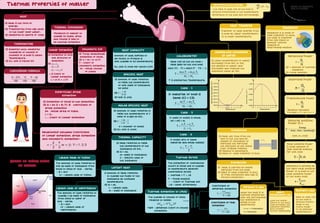
HEAT
(1) Heat is the form of
energy.
(2) Transferred from high temp.
to the lower temp water.
(3) measured in calorie or joule.
TEMPERATURE
(1) Quantity which measured
thedegree of hotness or
coldness of a body is called
Temperature.
(2) S.I. unit is Kelvin (K)
CONVERSION FORMULA
o o
K 273 C F 32
100 100 180
− −
= =
THERMAL EXPANSION
Tendency of matter to
change its shape, area
and volume is said to
be thermal expansion
Linear Expansion
(1) Expansion in only
one direction or
dimension,
(2) O
L L
∆ ∝
L T
∆ ∝ ∆
O
L L T
∆ = ∝ ∆
α is Coeff of
Linear expansion
L = Lo (1 + α∆T)
Volumetric Exp
(1) Three dimensional
expansion of solids.
(2) V = Vo ( 1+ y∆T)
Y - Coeff of
volumetric expansion,
Vo - initial volume
of cuboid
Superficial/ Areal
expansion
(1) Expansion of solids in two dimension.
(2) A = Ao (1 + B∆T), B - coefficient of
areal expansion,
Ao - initial area of plate.
β = 2α
α = Coeff of Linear expension
Relationship between Coefficient
of Linear expansion, areal expansion
and volumetric expansion:-
Y
or : : Y 1: 2:3
2 3
β
∝ = = ∝ β =
HEAT CAPACITY
Amount of heat supplied to
an object to produce a
unit change in its temperature.
S.I. unit is joule per kelvin (j/K)
SPECIFIC HEAT
(1) Amount of heat required
to raise the temperature
of unit mass of substance
by unity
1 d
C
m dt
θ
=
(2)
(3) Unit is J/kg
MOLAR SPECIFIC HEAT
(1) Amount of heat required to
raise the temperature of 1
mole of a gas by 1oC.
1 1 d c
C
n dt n
θ
= =
(2)
n = number of moles,
(3) S.I. unit is J/mol
THERMAL CAPACITY
(1) Heat required to raise
the temperature of the
substance by 1oC.
(2) Q = mc,
m- mass of substance,
C - specific heat of
the substance
LATENT HEAT
1) Amount of Heat required
to change the phase of the
substance at constant
temperature.
(2) Q = mL,
L - Latent heat,
m - mass of substance
Latent Heat of fusion
The amount of heat required to
one kg mass of substance from
solids to liquid or vice – versa.
- Q = mLf
Lf - Latent heat of fusion.
Graph of triple point
of water
Latent heat of vaporisation
The amount of heat required to
change 1 kg mass of substance
From liquid to vapor or
vice – versa.
- Q = mLV,
LV - Latent heat of
vaporization.
CALORIUMETRY
Heat loss by the hot body =
Heat gain by the cold body
. m1c1 (T1 – T) = m2c2 (T – T2¬¬¬),
1 1 1 2 2 2
1 2
m c T m c T
T
m m
+
=
+
T is equilibrium Temperature.
Case – 1
If material of body is
same (C1 = C2),
1 1 2 2
1 2
m T m T
T
m m
+
=
+
Case – 2
If mass of bodies is equal.
m1 = m2 = m,
1 1 2 2
1 2
c T c T
T
c c
+
=
+
Case – 3
if bodies are of same
material and equal masses
1 2
T T
T
2
+
=
Thermal Stress
The expansion or contraction
occurs in solids due to change
in temperature develops
compressive stress
 thermal = Y α ∆Q
Y - Young modulus,
 - Coeff of Thermal exp,
Q - temp. difference.
Thermal expansion in Liquid
The change in volume of liquid
relative to vessel;
app app
V V Y T
∆ = ∆
Yapp - apparent Coeff of volume
expansion.
Coefficient of
apparent expansion
apparent
a
v
V Q
∆
ϒ =
× ∆
Coefficient of real
expansion
r
v
V Q
∆
ϒ =
× ∆
Volumetric
Coefficients
in
Liquids
(1) When temperature of water
increases from 0oC to 4oC,
the density of water also
increases and reaches the
maximum value at 4oC
ANOMALOUS EXPANSION
OF WATER
HEAT TRANSFER
Transfer of heat energy from
a body at higher temperature
to a lower temperature.
Radiation
Radiation is a mode of
heat transfer in which
the heat is transfer
From one place to
another without
heating of
intervening medium
Conduction
(1) Heat will flow from hot
end to the cold end by
means of oscillation of
particles but particles
but particles do not leave
their original position.
(2) Medium is necessary.
(3) Rate of heat transfer is slow
Convection
(1) Heat is carried by mobile
particles From the body.
(2) Rate of heat transfer is slow
in free convection and high in
Forced Convection
Reflecting Power
r
Q
r
Q
=
Qr = amount of thermal
radiation,
Q = total amount.
Absorbing Power
a
Q
a
Q
=
Transmitting power
t
Q
t
Q
=
Relation between
r,a and t, r + a + t = 1
Spectral emission
Power (Eλ),
Energy
E
Area time wavelength
λ
=
× ×
Unit is J/m2
Total emissive Power
is total amount of
heat energy emitted
per unit time
o
E E d
∞
λ
= λ
∫
Emissivity is defined as
the ratio total emissive
Power of a body to the
total emissive power
of the black body.
practical
block
E
e
E
=
When the body is in
thermal equilibrium
with the surrounding
the emissivity is
equal to the
absorptivity
. ∝= e, ∝ → absorp�vity
, e → emissivity
When the tempe-
rature of the black
body increases, the
maximum intensity
shift towards
shorter wavelength.
“ Rate of heat loss
by the body is
directly proport-
ional to the
fourth power
of its absolute
temperature.”
NEWTON’S LAW OF COOLING
“ The rate of heat loss by the body is
directly proportional to the temperature
difference of the body and surroundings.
O
dQ
(T T )
dT
∝ − Graph of Newton's
law of cooling
Kirchoff’s Law
Wien’s
displacement Law
Stefan’s Law
A
T2
T1
T1
> T2
T(°C)
Time (minute)
1000.35
1000.30
1000.25
1000.20
1000.15
1000.10
1000.05
1000.00
0 1 2 3 4 5 6 7 9 10
8
y
x
Temperature⁰c
Volume
of
1
kg
of
water
(
cm³)
Temperature⁰c
1,0000
0,9999
0,9998
0,9997
0,9996
0 1 2 3 4 5 6 7 8 9 10
x
y
Density
of
water
(
g
cm
-
³
)
Thermal properties of matter
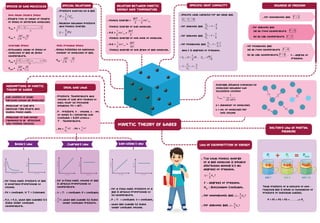
KINETIC THEORY OF GASES
ASSUMPTIONS IN KINETIC
THEORY OF GASES
Gas consists of small
particles known as Molecules.
Molecular of Gas are
identical rigid sphere and
elastic points mass.
Molecular of Gas moves
randomly in al directions
with possible velocity.
IDEAL GAS LAWs
. Pressure, Temperature and
volume of Gas are related to
each other by following
equation, PV = nRT.
. P – pressure, V – volume, n – no.
of moles; R = Universal Gas
Constant = 8.314 J/mol.k ;
T – Temperature.
. PV =
A
m
RT
m
; PV =
A
n
KT
n
Boyle’s Law
. For Fixed mass, pressure of gas
is inversely proportional to
volume.
. PV = constant, if T = Cosntant
. P1
V1
= P2
V2
When gas changes it’s
state under constant
temperature.
Charlee’s Law
. For a Fixed mass, volume of gas
is directly proportional to
temperature.
. V α T; = constant; P = constant.
,When gas change its state
under constant pressure.
3
PV
2
.
Gay lussac’s law
. For a fixed mass, pressure of a
gas is directly proportional to
its temperature.
. P α T; = constant; V = constant.
. When gas change its state
under constant Volume.
SPEEDS OF GAS MOLECULES
Root Mean square speed:
. Square root of mean of square
of speed of different molecules,
Vrms
=
Vrms
=
Vavg
=
Vavg
=
2 2 2
1 2 n
V V ............... V
n
+ + +
3RT 3P
M ∫
8RT 8P
πM π∫
=
=
Average Speed:
. Arithmatic mean of speed of
molecules of gas at given
temperature.
n
I V1
I + I V2
I + ....... + I Vn
I
Most probable speed:
. Speed possessed by maximum
number of molecules of gas.
o
2RT 2P
vmp
M
= =
∫
SPECIAL RELATIONS
. Pressure exerted by a gas,
2
rms
1
P V
3
= ∫
. Relation between pressure
and Kinetic Energy.
E =
3
PV
2
RELATION BETWEEN KINETIC
ENERGY AND TEMPERATURE
. Kinetic Energy =
2
rms
3KT 1
mv
2 2
=
Kinetic Energy of Gas molecule.
. K.E =
. K.E =
2
rms
1
mv
2
2
rms
1
mv
2
=
=
3RT
2
3RT
2m
Kinetic energy of one mole of molecule.
Kinetic energy of one gram of gas molecule.
SPECIFIC HEAT CAPACITY
. Specific heat capacity for an ideal gas,
P V
C C R
− =
. For diatomic gas, P
V
C 5
Y
C 3
= =
. For diatomic gas, P
V
C 7
Y
C 5
= =
. For polyatomic gas, P
V
C 4 f
Y
C 3 f
+
= =
+
and f is degrees of freedom.
. P
f
C (1 ) R
2
= + V
R
C f
2
=
,
,
. p
V
C 2
Y 1
C f
= = +
DEGREES OF FREEDOM
. For monoatomic gas, F 3
=
. For diatomic gas,
(a) at room temperature, F 5
=
(b) at high temperature, F 7
=
. For polyatomic gas,
(a) at room temperature , F 6
=
(b) at high temperature, F 8
= f degree of
freedom.
Average distance travelled by
molecules between two
successive collision
mean 2
1
2 d n
λ =
π
d = diameter of molecules.
n = no. of molecules per
unit volume
DALTON’S LAW OF PARTIAL
PRESSURE
Total pressure of a mixture of non –
reacting gas is equal to summation of
pressure of individual Gasses.
P = P1 + P2 + P3 +………..+ Pn
LAW OF EQUIPARTITION OF ENERGY
. The total Kinetic energy
of a gas molecule is equally
distributed among it’s all
degrees of freedom.
B
f
U K T
2
=
F = degrees of freedom.
KB
= Boltzmann Constant.
. For monoatomic gas, B
3
U K T
2
=
. For diatomic gas, B
5
U K T
2
=
P PV
V V
V V/T
T V
P P/T
T P
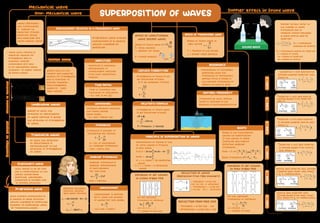
SUPERPOSITION OF WAVES
Doppler effect refer to
the change in wave
frequency due to
relative motion between
a wave source and its
observer.
fs = frequency
emitted by source
→ o
o s
s
f f ,
 
ν ± ν
=  
ν ± ν
 
fo = Frequency heared by observer
V = Speed of sound
Vo = Speed of observer
Vs = Speed of source
- V0observe= o m/s and Source
moving towards observer with
speed vs,
o s
s
f f
 
ν
=  
ν − ν
 
Vobserve= o m/s and Source
moving away From observer
with Vs
o s
s
f f
 
ν
=  
ν + ν
 
Vobserve= o m/s and observe
is moving towards source with
speed Vo O
o s
f f
ν + ν
 
=  
ν
 
Vobserve= o m/s and observe
is moving away From source
with speed Vo.
O
o s
f f
ν − ν
 
=  
ν
 
Source and observe both moving
towards each other with speed
Vs & Vo respectively.
O
o s
s
f f
 
ν + ν
=  
ν − ν
 
Source and observer both
moving away From each other
with speed Vs & Vo respectively.
O
o s
f f
 
ν − ν
=  
ν + ν
 
Case
-
1
Case
-
2
Case
-
3
Case
-
4
Case
-
5
Case
-
6
→ Wave which require a
material medium For
propagation and to
transfer energy
continually are said
to be mechanised wave.
→ Example:- (1) Water waves,
(2) Sound Waves
Waves in which the
direction of disturbance
of wave particle is along
the direction of propagation
of wave.
In which the direction
of disturbance is
perpendicular to the
direction of propagation
of wave.
Which seems to be at rest
due to superposition of two
waves having same
amplitude, wavelength
travelling in straight line
in opposite direction.
Which travels continuously in
a medium in same direction
without changing its amplitude.
Example: (1) longitudinal wave,
(2) Transverse Waves
Waves which do not
require any material
medium For propagation
and to transfer of
energy. Example:-
Electromagnetic
waves (X – rays,
radio waves)
Waves associated
with Constituents
of matter i.e,
electrons, protons,
neutrons, atoms
and molecular are
called matter waves
Progressive wave travels
continuously in a medium
without changing its
amplitude.
Amplitude is maximum
displacement of
constituident particles
from their equilibrium
position.
Time to Complete one
revolution of oscillation,
- S.I. unit is sec (&)
minimum distance between
two points having
same phase.
- S.I. unit = Meter (m)
n
f
T 2
ω
= =
π
Frequency is number of
oscillations per second.
n = no. of oscillations
w = Angular Frequency.
- Unit = Hertz (Hz)
Angular frequency is
angular displacement
of any element
per unit time
2
2 f
T
π
ω = = π
Unit = rad/sec.
Wavenumber is defined
as 2π times the number
of waves per unit length
2
K
π
=
λ
- S.I. unit = rad/m
Relation between
particle velocity
and wave velocity
p
aw cos(wt kx )
υ = − + φ
w
k
ω
υ =
w p
tan .
υ = − θ ν
SPEED OF LONGITUDINAL
WAVE (SOUND WAVE)
Speed of sound wave
B
C
p
υ =
B = Bulk modulus,
ι = density, For solids,
y = young modulus.
Propagation of sound is not
an isothermal process.
- It is an adiabatic process
y.p
ν =
∫
P
V
C
y
C
=
-
-
propagation of sound wave
is an isothermal process
∆T = O,
P
228 m/s
ν =
∫

P = Pressure, ∫= density
Speed of sound wave in
tight string T
ν =
µ
T = Tension in the string
µ = linear mass density.
Phenomenon of increased
amplitude when the
Frequency of periodically
applied force is equal to
the natural frequency of
system on which it acts.
Frequency at which system
tends to oscillate in the
absence of any damping Force.
Beats is the phenomenon
caused by superposition
of two waves of same
amplitude and slightly
different angular
frequency.
Ynet = 2 cos 1 2 1 2
w w W w
cos
2 2
− +
   
   
   
Beat frequency max min
f F F
∆ = −
Phenomenon of mixing of two
or more waves to produce
a new wave.
y (x,t) = 2a cos sin (kx wt )
2 2
φ φ
− +
Anet = 2a cos
2
φ
If φ = o, Anet = 2a (amplified
wave)
If φ = π, Anet = O (Standing
wave)
REFLECTION OF WAVES
((Reflection From rigid boundary)
- Yincident = a sin (wt –
kx) ( in +ve x- direction)
- Yreflected = - a sin (wt
+ kx) (in – ve x – direction)
REFLECTION FROM FREE END
- Yincident = a sin (wt – kx)
- yreflected = a sin (wt + kx)
Vibration of air column
in closed organ pipe
For nth harmonic,
frequency of vibration
n
(2n 1)
f
4L
ν + ν
= =
λ
(n = 0, 1, 2,……)
L = Length of the tube
Vibration of air column
in open organ pipe
For nth harmonic,
frequency of vibration
n
(n 1)
f
2L
ν + ν
= =
λ
n = (0,1,2,3,….)
L = Length of tube
Mechanical Wave
Non- Mechanical Wave
Wave length, L
Progressive Waves
Amplitude
h h
Direction of progress
Wave
Height
H
H
Matter Wave
Transfer
of
energy
Vibration
of
Particles
+
A1
A2
A1 A
+ 2
A
Fundamental
1
4
N
(i) (ii) (iii)
N
A
N
A
Overtone
Ist
IInd Overtone
5l 3
4
3 2
4
A
N
A
N
A
N
(i) (ii) (iii)
N
A
A
N
N
A
N
A
N
A
A
A
N
A
Fundamental Overtone Overtone
Ist
IInd
1
2
2l 2
2
3l 3
2
DISPLACEMENT RELATIOn IN A PROGRESSIVE WAVE
AMPLITUDE
Time Period
Wavelength
Frequency
Angular Frequency
Wavenumber
Transverse Waves
Longitudinal waves
Stationary Wave
Progressive Wave
SPEED OF TRANSVERSE WAVE
RESONANCE
NATURAL FREQUENCY
BEATS
PRINCIPLE OF SUPERPOSITION OF WAVES
NEWTON’S FORMULA
LAPLACE CORRECTION
S O
VS
n
(moving)
nÅ
( )
rest
S O
VS
n
(moving)
nÅ
( )
rest
S O
VO
n
( )
rest
nÅ
( )
moving
S O
VO
n
( )
rest
nÅ
( oving)
m
S O
VO
n
(m )
oving
nÅ
( oving)
m
VS
S O
VS
n
(m )
oving
nÅ
( oving)
m
VO
Doppler effect in sound wave
CHARACTERISTICS OF LINEAR SHM
- Differential Equation of S.H.M
2
2
x
2
d x
0
dt
+ ω =
- Displacement - x =
- Velocity -V = dx
dt
= ω A Cos(ωt + φ)
A sin (ωt + φ)
- Acceleration - a = A sin(wt + ) = -ω2x
2
acceleration
(a)
ω2
A
T
T
t
–
0
Displacement
A
A
X
t
T t
T
2
)
v
(
y
t
i
c
o
l
e
v
Graph of v - t
Graph of X - t Graph of a - t
ENERGY OF LINEAR S.H.M
→ P.E → U = 2
1
Kx
2
K.E → K = 2 2
1
K(A x )
2
−
→ P.E → U = 2 2
1
K A sin ( t )
2
ω + φ
K.E → K = 2 2
1
K A cos ( t )
2
ω + φ
TIME PERIOD CALCULATION
(1) Force → 2
x
F m or F k x
= − ω = −
  
;
k
m
 
ω =
 
 
 
Time period T =
2π
ω
=
m
2
k
π
K → spring Constant
Spring Block System
Time Period → T =
eq
m
2
k
π
T =
eq
m
2
k
π ;
(i) keq = K1 + K2
T =
1 2
m
2
k k
π
+
(ii) Keq = 1 2
1 2
K K
K K
+
;
T =
eq
m
2
k
π
T = 1 2
1 2
m(k k )
2
K K
+
π
TWO BLOCKS SPRING SYSTEM
Reduced Mass: µ = 1 2
1 2
m m
m m
+
T = 1 2
1 2
m m
2 2
K(m m ) k
µ
π = π
+
DAMPED
AND
FORCE
OSCILLATIONS
DAMPED OSCILLATION
(1) Amplitude → A1 = Ae-bt/2m
(2) Angular Frequency → w1 =
2
2
k b
m 4m
− ,
Where – b = damping
Constant
FORCED OSCILLATION
(1) Amplitude (For → wd >> ω) → A1 = o
2 2
d
F
m(w w )
−
(2) Amplitude → A1 = Fo/wdb
ωd → Driving Frequency
ω → Natural Frequency
ANGULAR S.H.M
(i) Different Equation →
2
2
2
d
t 0
dt
θ
ω θ =
⇒ Displacement → θ = θo sin (ωt + S)
⇒ Torque → T = Kθ
⇒ Angular Velocity → W =
K K
; Angular accelartion
I 1
− θ
→ ∝ =
⇒ Time period – T =
I
2
K
π
PENDULUM
Simple Pendulum
F ∝ -θ;
F = -Kθ;
Time period → = 2
g
π

Physical Pendulum
:- Time period → T =
I
2
mgd
π
I : MoI of system
M : Mass of System
d: distance between com and hinge
Torsional Pendulum
T ∝ θ
T = -Cθ [C = Torsional Constant]
Time period – T =
I
2
C
π
I : Moment of Inertia
SIMPLE HARMONIC MOTION
m
k2
k1 m
k1 k2
m2
m1
k
ωt
P.E.
P.E.
Kmax
or Umax
or ET
K,
U
m
0.6 0.8 1.0 1.2 1.4
oscillator as a function of the angular
frequency of the driving force
Amplitude
1
2
3
Energy
T.E
K.E
P.E
-A A
X
mg
mg
sinθ
θ

Class 11th Physics NEET formula sheet pdf

  • 1.
    Units and Measurements Physical Quantity - Quantitieswhich can be measured by an instrument and used to describe Laws of physics are physical quantities - Physical quantity = Numerical value (N) × Unit (U) TYPES Fundamental quantities do not depend upon other quantities: (1) Length (2) Mass (3) Time (4) Temperature (5) Amount of Substance (6) Electric current (7) Luminous Intensity - Derived quantities are formed by combining more than one fundamental physical quantities - Area, Volume, velocity and acceleration are some Derived quantities Two supplementary S.I units are:- (1) Radian(plane angle) , Q= , arc radius (2) Steradian (solid angle), Ω = 2 arc (radius) Dimensional Analysis Dimension formula is the expression for the unit of a physical quantity in terms of the fundamental quantities Dimensional formula is expressed in terms of power of M, L and T. Primary or fundamental Dimensional Formula Secondary or derived dimensional Formula (i) Other than Fundame- ntal formula all other are derived dimensional Formula (ii) example: (1) [speed] = [MoL1T-1], (2) [Acceleration] = [MoL1T2] There are seven fundamental dimensional formulas: (1) Mass = [M], (2) Length = [L], (3) Time = [T], (4) Temperature = [K] or [Q], (5) Electric Current = [I], (6) Luminous intensity = [cd], (7) amount of matter = [mol] PRINCIPLE OF HOMOGENITY Principle of homogeneity states that the dimension of each term on both sides of dimensional equation should be same. Conversion of Units From are system to another N1 = numerical part of one system N2 = numerical part of another system a b 1 1 1 2 1 2 2 2 M L T N N M L T       =             UNITS (1) Unit is defined as the reference standard used for measurements. (2) Measurements consists of a numerical value along with a relevant unit. (3) Example: meter, newton, joule, seconds etc. MKS (m, kg, s) CGS (m, gm, s) FPS (Ft, pound, s) - The system of units accepted internationally - S.I units of time is ‘sec’ is the example of S.I system S.I Units SOME OTHER UNITS (1) mass:- 1 quintal = 100 kg, 1 ton = 1000 kg (2) length:- 1 light year = 9.46 × 10¹⁵ m 1 au = 1.496 × 10¹¹ m (3) Temperature: Oo C = 273 K 1o F = 255.928 K KNOW YOUR LCROS (SIGNIFICANT FIGURES) The number of digits in the measured values about the correctness are known as significant figures. 4.125 - 4 sf; 123 - 3 sf All non – zero digits are significant Leading zeroes i.e , are never significant placed to the left of the number 0.0403 - 3 sf; 0.04030 - 4 sf 10.9 - 3 sf; 400.001 - 4 sf All zero lie in between the non – zero digits are significant 38.3 × 10⁴ - 3 sf; 38.30 × 10⁻⁹ - 4 sf Order of magnitud e is not considered Constants and pure numbers have infinite significant figures; Trailing zero digits are significant only when they appear after decimal 4.00 - 3 sf; 0.043010 - 5 sf RULE OF ROUNDING OFF - Rules of Rounding off the uncertain digits (up to 3 Significant Figures) If digit > 5 then, preceding digit +1 If digit <5 then, preceding digit remain same If insignificant digit = 5; (a) Preceding digit remain same when rounded off digit is even.; (b) Preceding digit +1 when rounded off digit is odd ORDER OF MAGNITUDE It is defined as the power of 10 which is closest to its magnitude N = n × 10x; x = order of magnitude. ERRORS The uncertainty in measurement is called errors - Error = true value – measured Value TYPES OF ERROR Absolute Error, = true value – measured value Mean absolute errors 1 2 n mean ............. n ∆α + ∆α + + ∆α ∆α = Relative error mean mean ∆α α Percentage error, is difference the measured value and the true value as a percentage of true value Percentage error mean mean 100 ∆α × α ACCURACY PRECCISION Precision is the range of variation of true value during several observation Accuracy is degree of closeness of measured value to the true value; - shows that how closely the results with the standard value. VERNIER CALLIPERS Least Count (L.C) = 1 MSD – 1 VSD; MSD = main scale division; VSD = Vernier scale division Total reading = Main scale Reading +(Vernier Coincidence × least Count) Zero error = N × L.C; N = no. of coinciding division; L.C = Least count of an instrunment. displacement of screw no. of rotations Pitch = L.C. = Pitch total no. of divisions Unit 45 kg Numerical Value coefficient 6.022 x 10²³ exponent base Vernier scale Main scale Zero error = N × L.C N = no. of circular scale division that coincides with the reference line L.C = Least Count Positive Zero Error 10 0 5 0 Positive Zero Error Negaitive Zero Error 0 0 95 90 Negative Zero Error Positive zero error 0 1 0 5 10 Main Scale Vernier scale Negative zero error 0 1 0 5 10 Main Scale Vernier scale Measurments Units And r r ‘A’ is Area r2 Equivalent in area r r 1
  • 2.
    MOTION IN ASTRAIGHT LINE RELATIVE MOTION • The Comparison between the motion of single object with respect to another inertial or non – inertial frame. • This Analysis is of relative motion of an object. UNIFORM MOTION & GRAPHS UNIFORM ACCELERATED MOTION • when a moving object cover equal distance in equal time intervals. IT is said to be in uniform motion. • speed is constant. • Acceleration is zero Average speed = Average speed = Average speed = CASE.2 CASE.1 1 2 V V 2 + When object travels distance ‘d’ with velocity V1 and next distance ‘d’ with velocity v2 When object travels ‘t’ interval with V1 and next ‘t’ with v2 1 2 1 2 2V V V V + 1 n 1 n d .......... d t ........... t + + + + 1 n 1 1 n n d .......... d d V ........... d v + + = + + 1 1 n n 1 n V t .......... V t t ........... t + + = + + ACCELERATION AVERAGE VELOCITY VELOCITY SPEED DISPLACEMENT DISTANCE MOTION PARAMETERS AVERAGE SPEED Measure of change in velocity of an object per unit time x a = t ∆ ∆ Change in position or displacement divided by time intervals in which displacement occurs x Average Velocity = t ∆ ∆ Average speed is defined as total distance travelled in total time Total distance Average speed = Total time • The rate of change of distance of body with respect to time is defined as velocity • Can be positive, negative or zero • Ratio of path length to the corresponding time by an object • Always positive • Shortest distance between the initial position and find position of moving object in a given interval of time. • can be positive, negative or Zero • Actual path length covered by a moving object in a given interval of time. • Always positive when a body moves along a straight line and velocity changes by equal amount in equal interval of time, motion is uniformly accelerated motion MOTION EQUATIONS CALCULUS METHOD (1) V = u + at (2) (3) v2 – u2 = 2as If acceleration is constant 2 1 S ut at 2 = + dx v dt = dv a v dt = dv a dt = (i) (ii) (iii) When ball is dropped from a height then it accelerates towards earth with constant acceleration. Analysis of this motion of an object is motion under gravity • ay = g = 9.8 m/s2 • v = u + ayt • • V2 – u2 = 2ays 2 1 s ut ayt 2 = + Taking downward direction as ‘positive’ 2u T g = Time of flight 2 max u H 2g = Maximum Height 2h T g = Time to drop V 2gh = Velocity after dropping Relative Uniform Motion Relative Uniformly Accelerated Motion (1) a12 = 0 (2) In this case 12 12 S V t = V12 = Relative Velocity S12 = Relative displacement (1) (2) In this case 12 a 0 ≠ 12 12 12 V u a t = + 2 12 12 12 1 S u t a t 2 = + 2 2 12 12 12 12 V u 2a S − = MOTION & FRAME OF REFERENCE Change in position of an object with respect to time is defined as Motion FRAME OF REFERENCE The point from which observer takes it’s observation is called frame of reference. Example:- Analysing lift moving upwards From ground. Observer on ground is inertial frame. Image of Inertial frame Displacement Time o Velocity Time o Acceleration Time o a = 0 x x0 t Parabolic nature v ux 0 T t axT a t a > 0 x (u2 /2g) (u/g) t O (u/g) (2u/g) v u O –u t O a t -g • If net external force on system is non – zero frame is non – inertial • It is Accelerating Frame. • Frame velocity increases or decreases • If net external force on system is non – zero frame is non – inertial • It is Accelerating Frame. • Frame velocity increases or decreases INERTIAL FRAME NON-INERTIAL FRAME 40 30 20 10 0 0 1 2 3 4 TIME Displacement MOTION
  • 3.
    Vector (magnitude +Direction) Basic Terminologies . Null vector: . Unit vector: . Equal vector: . Axial vector: used in rotation . Orthogonal vector Angle b/w . Parallel Vector : . Anti-Parallel Vector : A  = 0  A A A = =   1 } A B A B → → =         r W V r x V W = A & B ( θ = 900 ) A & B ( θ = 00 ) A & B ( θ = 1800 ) θ = 900 A A B B B A Angel b/w Angel b/w I A I = n I B I I A I = - n I B I Mathematical operations A  B  ( 9g = (a1 + b1 + c1 ) = (a1 + b1 + c1 ) i  Lorem ipsum j  K v i  Lorem ipsum j  K v & Resolution of vector θ Px = PCOSθ Py = PSinθ P Addition Subtraction  1 2 1 2 1 2 A B (a a )i (b b )j (c c )k + = + + + + +       1 2 1 2 1 2 A B (a a )i (b b )j (c c )k + = − + − + −      Multiplication Dot product (Scalar product) Cross product (vector product) A B A B Cos + = θ       1 2 1 2 1 2 A .B a a b b c c = + +    i. i 1 =   i. j 0 =    i . k 0etc =  1) 1) 2) 2) 3) 3) A B A B sin + = θ        1 1 1 2 2 2 i j k A B a b c a b c × =      i (b1 c2 - c1 b2 ) + j (a1 c2 - c1 a2 ) + k (a1 b2 - b1 a2 ) v v v  i i 0 i j 1 1 i k × = × = = − ×      Arithmetic operations Vector law’s Triangle law: R A B θ α By = Bsinθ Bx = Bcosθ − − − R   = ( A + Bcos θ ) i + Bsin θ j 2 2 R A B 2 A B Cos = + + θ      tanα B sin A B cos θ + θ      = = A A B B θ α α α Parallelogram law: Lammis Theorem: 3 1 2 F F F sin sin sin = = ∝ β γ β β γ γ F1 F1 F3 F3 F2 F2 MOTION IN A PLANE Circular motion r r L θ Final position initial position Angular displacement ( θ ): Angular velocity ( w ): R = θ  Angular displacement (rad.) Radius (m) Arc length (m) 1 d 2 W 2 f (rads ) dt T − θ π = = = π T= Time period if = frequency V RW = linear velocity (ms-1 ) Angular Acceleration ( α ): 2 dw (rads ) dt − ∝= a R = ∝ linear acceleration (ms-1 ) Equation of motion on Circular track: wf = Wi + αt θ = Wit + ½ nαt2 2 2 f i W W 2 - = ∝ θ Types of Circular motion: Uniform circular motion Non – uniform Circular motion V V V V r V3 V2 V4 V1 r 1) aτ (Tangential acceleration) = oms-2 2) ar (Radial acceleration) = 2 V R 3) anet = 2 2 T 0 a a + = ar 1 2 3 4 V V V V ≠ ≠ ≠ 1) 2) 3) 4) 2 T a oms− ≠ 2 r ins V a R = 2 2 net T r a a a = + Projectile motion oblique projectile H y y t2 t1 θ u ux uy R x – component y – component y – components . ux = uCos θ . ax = 0 . ug = usin θ . ag = -g Equation of Trajectory (parabolic track) y = xtanθ - 1 2 2 2 2 gx u Cos θ x x(1 ) tan R − θ = Time of f hight (T), T = 2usinθ/g Range (R) = ux T, = 2 2 sin g µ θ Height (H) 2 2 sin 2g µ θ = Projectile passing same height at two different times t1 and t2 respectively 1 2 1 gt t 2 1) y= 2) 2 sin 2 gy 1 1 g sin     µ θ   − −     µ θ     t1 = 3) 2 sin 2 gy 1 1 g sin     µ θ   + −     µ θ     t2 = Projective with complimentary angles, If θ1 = θ then θ2 = 90 - θ 1) R = Hcosθ 2) 90 T T − θ θ = tanθ Horizontal projectile ux = u uy = 0, H vy vx v x β x=ux t =ut, t = x/u Equation of Trajectory 2 2 2 X 1 1 Y gt g 2 2 = = µ Range (R) = ux t = 2H g u Time of flight 2H g (T) = 2 2 2 v u g t 2 2 x y vins v v = u2 +2gy tanφ = = vy vx gt u PROJECTILE ON INCLINED PLANE B O y u A X g gsin gcos X – Components ux = u cosθ ax = g sinθ ug = usinθ ay = g cosθ Time of flight (T) Height (H) Range (R) 2 2 2u sin cos( ) g cos θ ∝+ θ ∝ = 2usin gcos θ ∝ = 2 2 u sin 2gcos θ ∝ = for Rmax = θ = 4 2 π ∝ + for Hmax = θ = 90o or α= 0o RELATIVE MOTION ON 2 D – PLANE motion of one body w.r.t. other: P/Q P Q V V V = −    VP/Q = velocity of P w.e.t.Q Umbrella problem: VmG = (Vm – VG ) = Vm 1) Vrm = velocity of rain w.r.t man 2) Vrm = Vr – Vm 3) tanθ = m r V V River Boat Problem Shortest distance Vr = Vbr Cosα & Vb = Vbr sinα Vbr sinα = = dmin = (Vbr sinα)t d t Shortest time Vbr = 2 2 b r V V + tmin = 2 2 2 2 b b r X d d V V V + = + Drift (x) = r min V t   tanθ = r m V x V d = θ Vb Vbr Vbr Vbg Vbr Vr Vr Vr = river velocity x d θ α d = width of river
  • 4.
    NEWTON’S LAWS OFMOTION Newton’s 1st law A body Continues its sate of rest or motion until unless an external force is acted on it. If ext F o =  ; a o =  INERTIA OF REST The property of a body due to which it cannot change its state of rest by it self. The property due to which a body cannot change its direction of motion by itself. The tendency of a body to remain in a state of uniform motion in a straight Line. INERTIA OF DIRECTION INERTIA OF MOTION FORCES (i) Normal Contact force (1) always acts along the common Normal of two surface in contact. (2) Always directed towards the system. (3) It is an electromagnetic type of force. Normal force on block is N. N = mg (ii) Tension Force (1) Acts along the string and away from the system on which it acts. (2) Tension in a massless string remains constant throughout the string if no tangential force acts along the string. (3) This is force applied by a string on an object or force applied by one part of string on the remaining part of string. (4) It is an electromagnetic type of force. (iii) Friction Force (1) Rolling friction:- The force of friction which comes into play when one body Ralls or tends to roll on the surface of a norther body. (iV) Sliding friction Resistance offered to the relative motion between the surface of two bodies in contact. The frictional force f is directly proportional to the Normal force N exerted by the surface on the body. (F ∝ N or f/N = Constant = µ). The friction force depends upon the nature of surfaces in Contact and independent of the area of Contact. Types of friction fs = µsN. acts when a body is just at the verge of movement acts when a body is at rest on application of a force Fl = µsN. acts when a body is actually sliding fk = µKN Newton’s 2nd Law The rate of change of linear momentum of a body is directly proportional to the external force applied on the body in the direction of force. dp F ma dt = =    S.I . Unit of force = Newton (W) dimensional formula = [M1L1T-2] if m = const mdv F ma dt = =    ⇒ if V Cost =  = dm F V dt =   convey or belt & rocket propulsion Conservation of linear momentum:- if there is no external force acting on it, total momentum of an isolated system of interacting particles is conserved ext initial final dp F o or P P dt = = =   Impulse avg I F t P = ∆ = ∆     ⇒ I = P F.dt ∆ = ∫ = area under f – t curve Newton’s 3rd law To every action there is always on equal and opposite reaction. AB BA F F = −   Action & Reaction act on different bodies and not on the same body. - action – reaction forces are of same type. We cannot produce a single isolated force in nature force are always produce in action – reaction pair. due to no time gap, any one force can be action, and other reaction. applicable for all the interactive forces eg. Gravitational, electrostatic, electromagnetic, Tension, friction, viscous forces, etc. For Non – inertial frame ext Pseudo F F ma + =    pseudo frame F Ma = −   • Draw FBD of bodies in the system. • Choose a convenient part of the assembly as one system. • Identify the unknown force and accelerations. • Resolve forces into their Components. • Apply F ma = ∑   in the direc�on of mo�on. • Apply F O = ∑  in the direc�on of equilibrium • Write constraint rela�on if exists. • Solve the equa�on F ma & F O = = ∑ ∑    . Horizontal Circular motion (Conical Pendulum):- 2 Sin cos mv T & T mg r θ θ = = V rgtan = θ Angular Speed, w = v gtan W r r θ = = 2 T w π = r Lcos 2 2 gtan g θ π = π θ Time Period Vertical Circular motion Particle ossillates in lower half circle. Condition of ossillation (O u 2gR) < ≤ 1. 2. 3. Particles moves to upper half circle but not able to complete the loop. Condition of leaving the circle: ( ) 2gR u 5gR < < particle completes loop. Condition of looping the loop ( ) u 5gR ≥ MOTION OF A CAR M LEVEL ROAD (by friction only):- Vmax S Rg ≤ µ MOTION OF A CAR ON BANKED ROAD (i) Optimum speed of a vehicle on a banked road. V rgtan = θ maximum safe speed on a banked frictional road. max rg( tan ) V 1 tan µ + θ = −µ θ minimum safe speed on a banked frictional road min Rg(tan ) V (1 tan ) θ − µ = +µ θ Kinematics of Uniform Circular motion 1.A particle moves in a circle at a constant speed 2. Angular displacement (θ) SI Unit: rad or degree. 3. Angular Velocity (W): avg W [Unit . rad / sec] t ∆θ = ∆ ins d W dt θ = Centripetal Force Fc = mac = 2 mv r = mrw2 S r O ∆ = ∆ v = wr V w r = ×     V  is linear velocity (tangential vector) w   (axial vector) r  = radius vector Speed of the particle in a horizontal circular motion changes with respect to time. f N mg R Speed = v a = v² / R O Tangential acceleration: t a r = α ×      Centripetal force Fc = mac = 2 2 mv mrw r = Tangential force Ft = mat Net force Fnet = 2 2 c t m a a + C a  responsible for change in direc�on of movement of particle Static friction Limiting friction Kinetic friction Circular motion N f mg Kinematics of non – Uniform circular motion SOLVING PROBLEMS IN MECHANICS T O     P L mg cos mg sin mg F Cosθ F sinθ θ θ h r l F mg
  • 5.
    WORK,ENERGY AND pOWER •An instance of one moving body striking with another • Collision of car with truck, collision of balls in snooker are examples. NATURE OF COLLISIONS CONSERVATION OF MOMENTUM SPECIAL CASES 2 - D COLLISION 1 - D COLLISION • Value of coefficient of restitution defines nature of collision, seperation approach V e V = • e = O, e = 1, O < e< 1 Defines nature of collisions 2n n h e ho = (1) e = coefficient of restitution. n = nth collision, ho = initial height, hn = height after nth collision (2) Vn = enVo, n = nth collision, Vo = initial velocity, vn = velocity after nth collision. (3) H = ho 2 2 1 e 1 e   +   −   H = total distance travelled before it stops (4) T = 2 o 2 2h 1 e 1 e g   +   −   T = time taken by ball to stope bounding. (1) Bodies moving in a plane results in arbitrary collision in different directions is 2 – D. (2) P O ∆ =   x P O ∆ = 1 1 2 2 1 1 2 2 m x m x m v x m v x µ + µ = + y P O ∆ = 1 1 2 2 1 1 2 2 m y m m v y m v y µ + µ = + ( )sys P O ∆ = (1) (2) e = (3) V1 = (4) V2 = (5) Change in Kinetic energy, 2 1 1 2 V V − µ − µ 1 2 2 1 2 1 2 1 2 m em (1 e)m m m m m   − + µ + µ   + +   velocity of first particle after collision. 1 2 1 2 1 2 1 2 m (1 e) m em m m m m − + − µ + µ + + velocity of second particle after collision K ∆ 2 1 2 1 2 1 2 m m 1 K ( ) (1 e) 2 m m ∆ = µ − µ − +     • In elastic collision, momentum and K.E of system are conserved • e = 1 • Bodies do not stick together after collision • In inelastic collision, momentum is conserved • o<e<I • Bodies do not stick together after collision • In perfectly inelastic Collison momentum is conserved • e = O • Bodies sticks together after collision COLLISIONS TYPES OF COLLISIONS ENERGY • Capacity to do work is defined as Energy • It is a scalar quantity • S.I. unit is Joule (J) (1) Heat energy (2) Chemical energy (3) Electrical energy (4) Nuclear energy (5) Mass – Energy equivalence VARIOUS FORMS WORK-ENERGY THEOREM AVERAGE POWER FORMULAE SPECIAL UNITS INSTANTANEOUS POWER (1) Net Work done on an object by all forces will change in Kinetic energy of an object (2) (3) W = net W K = ∆ Wconservative + Wnon–conservative + Wext = K ∆ F(x).dx, F(x).dx K V ∫ ∫ = ∆ + ∆ if variable force does work . MECHANICAL ENERGY IS CONSERVED TYPES OF ENERGY (1) In absence of dissipative forces, mechanical energy is conserved (2) (3) V = (4) (5) Tension at any point on circle, (6) Velocity at any point on circle, V 5gl = at bottom to reach top V 3gl = at bottom to cross quarter CIrcle V gl = to reach quatre circle 2 m T mg (2 3cos ) r µ = − − θ 2 2 V 2gl (1 cos ) = µ − − θ MOTION IN VERTICLE CIRCLE ENERGY IN SPRING MASS SYSTEM (1) Total mechanical energy at each point is Constant. (2) (3) maximum Velocity K V ∆ + ∆ =0 ( Kinitial +Vinitial ) = ( Kfinal + Vfinal` ) max m k V x m = WORK • Work is said to be done when Force produces displacement. mg Friction Tension Normal Pseudo Spring force WORK DONE BY ALL FORCES POWER (1) Time rate at which work is done. (2) It is a scalar quantity (3) S.I. Unit is watt. POTENTIAL ENERGY KINETIC ENERGY MECHANICAL ENERGY • By virtue of Position, height, stresses within its & Electrostatic Factors; • Gravitational Potential Energy = mgh • Elastic Potential energy = • Electrostatic Potential energy = 2 1 kx 2 1 2 kq q r Sum of kinetic energy and potential energy • By Virtue of velocity 2 1 K mv 2 = Total Work done in time t is average power avg w P t = Scalar product of force and instantaneous velocity (v) is instantaneous Power. inst ds P F . F. V dt = =       (1) dW = (2) P = F .dr   dw dt For small amount of work • 1 hp = 746 W • 1 KWH = 3.6 × 10⁶ J (1) Kx, mg and electrostatic forces are conservative forces, (2) Work For these forces is stored in the form of Potential energy. (3) They are path independent. (1) Non – conservative forces are path dependent. (2) Friction is an example of non – conservative forces. NON – CONSERVATIVE FORCES CONSERVATIVE FORCES NEGATIVE WORK ZERO WORK POSITIVE WORK (1) If both force & displacement are ‘+’or ‘-‘ and θ is between 90o to 180o . (2) If either of force or displacement is positive and θ is acute. (1) W = O, if Force is perpendicular or to the displacement. (2) Either Force or displacement is zero. (1) If force and displacement both are ‘+’ or ‘-‘ and θ is acute. (2) If either of force or displacement is negative and θ is between 90o to 180o . WORK CAN BE POSITIVE, NEGATIVE OR ZERO WORK DONE BY CONSERVATIVE & NON- CONSERVATIVE FORCES WORK DONE FOR CONSTANT FORCE & VARIABLE FORCE • Area under F.S graph gives work done • work done = Area under ABCD • If work is done by variable force, then 2 1 r r W F. dr = ∫   • W = F d cosθ, • S.I. unit is J (joule) (1) If netexternal force on system is zero then Linear momentum of system is conserved (2) (3) (4) P O ∆ =   i f P P =    1 1 1 n m ........ m µ + + µ     1 1 1 n m ......... m = υ + + υ    
  • 6.
    System of particlesand rotational motion CENTRE OF MASS The point where whole mass of system is supposed to be concentrated 1. Position of centre of mass depends upon shaped, size and distribution of mass of body 2. Position of centre of mass of an object changes in translation motion. 3. For bodies of normal dimensions centre of mass & center of gravity coincide. 4. Centre of mass of rigid bodies is independent of the state i.e rest or motion of the body. Position of Centre of mass of system i i cm i m r r m = ∑ ∑   Velocity of centre of mass of system i i cm i m v V m = ∑ ∑   Acceleration of Centre of mass of system i i cm i m a a m = ∑ ∑   RIGID BODY A body with perfectly definite and unchanging shape. Rotational Equilibrium ext ext r F O τ = ε × =    Translational Equilibrium ext F O = ∑  PRINCIPLE OF MOMENTS FOR A LEVER According to this principle;- Load × Load arm = effort × effort arm Analogy between linear & Rotational motion Linear motion Velocity ds V dt = acceleration ds a dt = Force mdv F ma dt = = work done W F.S = linear K.E 2 1 mv 2 Power P = F.V, Linear momentum P = mv Impulse F t mv mu ∆ = − Rotational Motion Angular velocity dQ W dt = angular acceleration dw dt α = torque d I (Iw) dt τ = ∝ = Work – done w .Q = τ rotational K.E 2 1 Iw 2 Power P = .w τ , angular momentum L = Iw angular Impulse f i pt Iw Iw τ = − MOMENT OF INERTIA Inertia of Rotational motion n 2 2 i i i 1 mr MK = = ∑ M.I. I = where r is distance perpendicular to the axis of Rotation. Radius of gyration 2 2 2 1 2 n r r ..........r K n + = I K M = Factors & radius of gyration depends (1) Position & configuration of the axis of rotation (2) distribution of mass about the axis of Rotation. Perpendicular axis theorem Theorem of moment of Inertia Parallel – axis theorem IZ = IX + Iy , Itanget = Idia + MR2 Hollow sphere, radius R (9) Diameter 2 2 mR 3 Shape of area Distance x Distance y Area Square a/2 a/2 a2 Rectangle a/2 b/2 ab Circle r r r2 Semi-circle 4r/3 r r2 /2 Right-angled triangle b/3 h/3 bh/2 MOTION OF SYSTEM OF PARTICLES & RIGID BODY Pure Rotational Motion:- (1) Since distance between two particles of a rigid body remains constant, So the relative motion of one particle w.r.t other particle is circular motion. (2) Angular velocity of all the particles about a given point of a Rigid body is same S = RQ, V Rw = ; (3) If α = Constant (angular acceleration), ), Wf = wi + α t , Qf = wit + 2 1 t 2 α 2 f w = 2 i w + 2αθ, θ = i f w w t 2 +       θ = wft - 2 1 t 2 α → K.Erolling = 2 2 1 1 mv Iw 2 2 + , 2 2 2 2 1 1 V mv mk 2 2 r   +     2 2 2 1 K mv 1 2 R   +     Combined Rotation + translation Motion (CRTM):- CRTM pure rotation translational V V V = +    CRTM pure rotation translational a a a = +    Dynamics of CRTM for analysing its motion we apply two equation ext cm Ma τ = ∑   ext ext I r F τ = α = × ∑      Newton’s laws of motion is valid in inertial frame. To apply second equation of Newton about Non – inertial Point, Pseudo – force is applied at Com of body Σ of pseudo force is also taken into account. → K.ECRTM = K.Erotation + K.Etranslation; K.E = 2 2 cm cmw 1 1 I MV 2 2 + ; K.E = 2 2 2 cm 1 1 MK w MV 2 2 + → angular momentum of Rigid body per forming CRTM; Pure Rotational as a Rigid body about C.O.M; Translation as a particle (EK)r = rota�onal K.E (EK)t = transla�on K.E (a) for solid sphere, (Ek)r = 40% of (Ek)t, (b) For snell (Ek)r = 66% of (Ek)t, (c) For disc, (Ek)r = 50% of (Ek)t of (Ek)t, (d) For ring, (Ek)r = (Ek)t (1) ROLLING ON INCLINED PLANE (2) VELOCITY AT LOWEST POINT 2 2 2gh V K 1 R = + (3) ACCELERATION ALONG INCLINED PLANE a = 2 2 gsin K 1 R θ + (4) Time taken to reach the bottom of the inclined plane is. 2 2 K 2n (1 1 R t sin g + = θ ANGULAR MOMENTUM CONSERVATION O OA L r P (angular momentumabout point O) = ×     OA = r (mv) ×   OA mr v = ×   O OA OA L r P r Psin = × = θ     OA r mv sin = θ ANGULAR MOMENTUM CONSERVATION net d dt τ τ =  if net τ  = O ⇒ L =constant  n system i i 1 L L = =∑  Angular momentum of rigid body performing pure rotation about fixed axis (Lsys)AOR = IAOR w Relation between Torque & Angular momentum: • net dt dt τ =   • Unit of Torque = N.m • Dimensional formula = [m1 L2 T-2 ] Valid in only iner�al frame. Angular Impulse:- J .dt = ∫ τ   , f i net J L L = −    , J r I = ×    , Unit → NmS Linear Impulse:- I F dt = ∫   , net f i I P P = −      , Unit → N.S
  • 7.
    GRAVITATION • Energy requiredto bring a mass from an infinite position to point under gravitational field of earth with constant velocity • Generally, infinite is reference point = 1 2 Gm m u r Every planet revolves around the sun in an elliptical orbit and sun is at it’s one of the foci points. LAW OF ORBIT KEPLER's LAW OF PLANETARY MOTION LAW OF AREA (i) The line joins any planet to the sun sweeps equal area in equal intervals of time (ii] LAW OF PERIODS (i) The square of time period of revolution of a planet is proportional to cube of semi – major axis of an ellipse THE gravitational Force acting between two bodies separated by distance ‘r’ is directly proportional to product of their masses and inversely proportional to square of distance between them (1) During Free fall under gravity in side a spacecraft or satellite, body is weightless. (2) Effective weight of body becomes Zero. WEIGHTLESSNESS Minimum speed required by an object to escape Gravitational Field of Earth e 2GM V 2gR R = = Ve = 11.2 Km/s (iii) Areal velocity is constant dA L dt 2m = (ii) (iii) 2 3 T R ∝ 2 3 2 4 R T Gm π = (1) GEOSTATIONARY SATELLITE Height from earth’s surface = 36,000 km RADIUS = 42,400 Km Time Period = 24 hours. (2) POLAR SATELLITE Height from earth’s surface = 330 Km Time Period = 84 Min Orbital Velocity = 7.92 Km/s GEOSTATIONARY & POLAR SATELLITE GM r GMM GMM 2r r = GMM 2r = − (i) orbital velocity = (ii) Total energy of satellite = Constant K.E + P.E = constant (iii) Total energy = Relation between Gravitational potential & Intensity dv E dr = V E . dr ∆ = ∫    (i) (ii) (i) (ii) (iii) (i) (ii) (iii) Strength of Gravitational field applied per unit test mass is defined as Gravitational Field Intensity 2 GM E r r − =    2 2 3 (3R r ) r R v GM 2R − < → = − GM r R v R = → = − GM r R v r > → = − Amount of work done in moving a unit test mass from  - position to point under gravitational field of earth Gm U V r M = = Variation of ‘g’ from equator to pole 2 2 g g Rw cos = − Variation of ‘g’ with depth d s d g g (1 ) Rc = − 2 n s 1 h g g ( ) Rc − + = if h <<<< Rc h s 2h g g (1 ) Rc = − At surface of earth, Fgravitational = Weight 2 c GmMe Mg R = 2 c Gme gs R = GRAVITATIONAL ACCELERATION 1 12 13 1n F F F ....... F = + + +     Resultant force acting on a particle due to other particles is vector sum of forces exerted by individual particle in it F1 = F12 + F13 + ……. + F1n 12 21 F F = −   1 2 1 2 12 3 1 2 Gm m (r r ) F r r − = −        1 2 12 12 2 1 2 Gm m F r r r = −      12 r Force between them. =   2 r position of second particle =   1 r position of first particle =  1 2 2 Gm m F r = 2 11 2 Nm G 6.67 10 Kg − ⇒ = × Y m1 m2 F12 r21 F21 O r1 r2 X F02 F0n rn r3 F03 r1 r2 F01 SUPERPOSITION PRINCIPLE IN SCALAR FORM SUPERPOSITION PRINCIPLE IN VECTOR FORM h R R+h m v0 POLAR ORBIT T = 2-3 ROTATION OF EARTH T = 24 hours ESCAPE SPEED & ENERGY CONSERVATION GRAVITATIONAL POTENTIAL & GRAVIATATION POTENTIAL M r Ms ME NEWTON'S LAW OF GRAVITATION
  • 8.
    STRESS & ITS TYPES (1)Stress is restoring force per unit area (2) (3) It is neither scalar nor vector, (4) It’s unit is N/m2 Ratio of lateral to longitudinal strain is Poisson’s ratio POISSON'S RATIO HOOKE'S LAW STRAIN & ITS TYPES LINEAR STRAIN NORMAL STRESS VOLUMETRIC STRESS SHEAR STRESS THERMAL STRESS THERMAL STRESS VOLUMETRIC STRAIN LATERAL STRAIN SHEAR STRAIN lateral ( 1 0.5) longitudnal − Σ σ = − ≤σ≤ Σ Relation between Y, B, η and Σ (1) Y = 3B (1 - 2σ ), (2) Y = 2n (1 + σ ) (3) 3B 2n 2n 6B − + σ = YOUNG’S MODULES = I - SHAPED BEAMS SHEAR MODULUS BULK MODULUS = COMPRESSIBILITY = σ Σ • property of material, that tells how easily it can be stretched. • σ , E are normal stress and strains respectively • Ratio of shear stress by shear strain. • Unit is Pascal (Pa) • measure of ability of material to withstands the change in volume. • negative sign indicates decrease in volume P V / V −∆ ∆ 1 B • Reciprocal of Bulk modulus • Value depends on particle shape, density and chemical composition. • When load is applied to bodies up to certain proportionality limit, stress is directly proportional to strain. • • • σ ∝ Σ Y σ ∝ Σ y , σ = Σ where Y is the proportionality Constant named as Young’s modules (1) Ratio of change in configuration to original configuration of body. (2) It is a unit less quantity (3) Strain = configuration original configuration ∆ (1) Linear strain is the ratio of change in length to original length. (2) ∆ ∑ =   (i) Ratio of change in volume to original volume, (ii) V V ∆ ∑ = (1) Lateral strain is ratio of change in breadth/ diameter to original breadth/ diameter, (2) (Breadth / Diameter) Breadth /Diameter ∆ ∑ = (3) Change occurs in the direction perpendicular to the applied force. (1) Angular deformation caused by shearing force is shearing strain. (2) tan S / h θ = (3) For small change S / h θ = • I – shape of beams makes them excellent for unidirectional bending. • Use of rectangular shaped beams is not possible in railway tracks as of improper load distribution • Extension is measured in ropes of Cranes while load is suspended `on it mg A σ = σ = stress produced in rope When weight is suspended in beam, it Strouse buckling 3 3 S 4bd y ω =  MECHANICAL PROPRTIES OF SOLIDS (1) Tensile stress is produced when axial force acts per unit Area. (2) This stress results in Elongation; (1) Compressive stress is produced when force compresses object per unit area. (2) This stress results in Compression • When object is immersed inside the liquid, the hydrostatic pressure decreases the volume of an object, that results the `volumetric stress. (1) Shear stress is produced when force acts tangentially to a surface area. (2) Deforming force acts tangentially to the surface S tan h θ= (I) Difference in temperature of a rod results the change in configuration of it. This produces thermal stress. F Y T A = ∝ ∆ (i) energy stored due to elastic deformation. (ii) Strain Energy density is energy per unit volume. (iii) strain Energy per unit Volume = (iv) strain Energy per unit Volume = 1 2 × σ × Σ 2 1 ( ) 2 y σ × ADIABATIC BULK MODULUS ISOTHERMAL BULK MODULUS (I) B = YP, (2) Y = Adiabatic constant B = P Slope of stress strain curve will be Young’s modulus W d l L L F Stress Strain A B φ1 φ2 Stress O Strain A B Limit of Proportionality H o o k e ’ s L a w Elastic Limit h h F Bi F F Bf F F L F F Lf Li F F Shearing Area Shear Force APPLICATIONS OF ELASTIC BEHAVIOUR OF SOLIDS TYPES OF ELASTIC CONSTANTS sTRESS-STRAIN GRAPH sTRESS-STRAIN CURVE L L F F A σ =
  • 9.
    MECHANICAL PROPERTIES OF FLUIDS INTRODUCTION Anythingwhich can flow like liquid & Gases Known as Fluids. Pressure P = F Force acting per unit Area. Atmospheric Pressure Force exerted by Atmospheric Column on Unit area at mean sea level. [P0 = 1.013 × 10⁵ N/m2 ] Gauge Pressure Exass Pressure over the Atmospheric Pressure (Po - Patm Measured with instrument. Pgauge = P – P0 = rgh Hydraulic Paradax water is filled to a height H behind a dam of width w. The resultant Pressure on dam will be – Pnet = rgH A HYDRODYNAMICS Equation of Continuity A1 V1 = A2 V2 Characteristics of Ideal Fluids Pascal Law Whenever external Pressure is applied on any part of Fluid Contained in a Vessel, it is transmitted undiminished and equally in all direction is known as Pascal Law. Hydraulic lift 1 2 1 2 1 2 F F P P A A = = = 1 2 2 1 FA F A = , Hydraulic Brakes A1 d1 = A2 d2 Hydraulic Machine PA = PB = PC = PO C A B D F F F F A B C D F1 A2 A1 F2 Master cylinder Brake pedal Brake shoe Lever system P Tube T To other wheels Wheel cylinder P1 P2 S 1 S 2 Hydraulic Brakes D C B A Archimedes Principle “Whenever a body is immersed inside a liquid then an up thrust forces states acting on it, whose magnitude is Equal to the weight of the liquid displaced”. Upthrust Force - FB = (∫e × g × Vd) = weight of liquid displaced. ∫l = density of liquid. g = gravity ; Vd = volume of liquid displaced. Law of Floating b S l V V = V = Volume of body Vs = Volume of submerged part. ∫b = density of body. ∫e = density of liquid. Case – I Case – 2 Case – 3 [Vs < V ∫b < ∫l ] [Vs = V ∫b = ∫l ] [Vs > V ∫b > ∫l ] Incompressible . Non – Viscous . Irrotational . Steady (Liminas) Bernoulli Theorem P + ∫gh + ∫V2 = Constant P = Pressure; V = Volume ∫ = density ; h = height g = gravity Applications Magnus Effect: speed of air flow decreases pressure increased force on ball speed of air flow increases pressure reduces Spin Blowing off of thin Roof in storm: wind p0 v large so p<p0 p Speed of Efflux: B V 2g H = H H –h h V B A P0 H = Height from the Top Venturi meter: V2 V1 A1 A2 p0 p0 h H The entering Velocity of fluids is given by 1 2 2 2 1 2 2gh V A A A = SURFACE TANSION ANGLE OF CONTACT Angle between tangent Plane at the liquid surface and tangent plane at point of contact of solid. Surface energy Additional potential energy exhibited by liquid molecules present at the surface of the molecules. Excess Pressure Inside a Curved Liquid Surface Excess pressure inside the drop ex i 0 2 ( ) S P P P r P0 P1 dr r = + Excess pressure inside a cavity or air bubble in liquid ex inside atm 2 2 S P gh r S P P gh r Pout = Patm h Pin = = + + + ρ ρ Excess pressure inside a soap bubble ex i 0 4S P P P r P0 Pi P r = = - Relation between cohesive and adhesive force C A 2 F F > glass water concave surface FR FC FA C A 2 F F = silver FR FC FA horizontal surface water C A 2 F F < glass mercury convex surface FR FC FA Angle of contact 90 (Acute angle) 90 (Right angle) 90 (Obtuse angle) Shape of meniscus Concave Plane Convex Wetting property Liquid wets the solid surface Liquid does not wet the solid surface Liquid does not wet the solid surface Level of Liquid Liquid rises up Liquid neither rises nor falls Liquid does not wet the solid surface Example Glass-Water Silver-Water Glass-Mercury θ > θ < θ = ο ο ο Cohesive Force and Adhesive Force Cohesive Force:- Attractive Force between the molecules of same materials. Adhesive Force:- A Hr active Force between the molecules of different Materials. Capillarity It is Property due to which liquid elevates & depressed in a capillary Tube. The Rise in height of liquid in 25 Cos r g capillary tube is given by – h = Shape of Meniscus VISCOSITY Newton’s Law of Viscosity:- Viscous Force A = Area velocity Gradient= Stoke’s Law:- When a small sphere of radius r is moving with velocity v through a homogeneous Fluid, then viscous force acting on sphere – FV = 6 πnrv; Where n = Coefficient of viscosity; Unit of n = Poise. Terminal Velocity Constant Velocity achieved Before net force on a body becomes Zero. Reynold number It tell us about the nature of fluid flow Re = Vd n Where ∫ = density; V = velocity; d = pipe parameter. Critical speed:- Maximum Value of speed for which fluid will remain laminar. [VC = Re n/∫d] dv nA dx F = dv dx h2 h1 A L F1 F2 A P0
  • 10.
    HEAT (1) Heat isthe form of energy. (2) Transferred from high temp. to the lower temp water. (3) measured in calorie or joule. TEMPERATURE (1) Quantity which measured thedegree of hotness or coldness of a body is called Temperature. (2) S.I. unit is Kelvin (K) CONVERSION FORMULA o o K 273 C F 32 100 100 180 − − = = THERMAL EXPANSION Tendency of matter to change its shape, area and volume is said to be thermal expansion Linear Expansion (1) Expansion in only one direction or dimension, (2) O L L ∆ ∝ L T ∆ ∝ ∆ O L L T ∆ = ∝ ∆ α is Coeff of Linear expansion L = Lo (1 + α∆T) Volumetric Exp (1) Three dimensional expansion of solids. (2) V = Vo ( 1+ y∆T) Y - Coeff of volumetric expansion, Vo - initial volume of cuboid Superficial/ Areal expansion (1) Expansion of solids in two dimension. (2) A = Ao (1 + B∆T), B - coefficient of areal expansion, Ao - initial area of plate. β = 2α α = Coeff of Linear expension Relationship between Coefficient of Linear expansion, areal expansion and volumetric expansion:- Y or : : Y 1: 2:3 2 3 β ∝ = = ∝ β = HEAT CAPACITY Amount of heat supplied to an object to produce a unit change in its temperature. S.I. unit is joule per kelvin (j/K) SPECIFIC HEAT (1) Amount of heat required to raise the temperature of unit mass of substance by unity 1 d C m dt θ = (2) (3) Unit is J/kg MOLAR SPECIFIC HEAT (1) Amount of heat required to raise the temperature of 1 mole of a gas by 1oC. 1 1 d c C n dt n θ = = (2) n = number of moles, (3) S.I. unit is J/mol THERMAL CAPACITY (1) Heat required to raise the temperature of the substance by 1oC. (2) Q = mc, m- mass of substance, C - specific heat of the substance LATENT HEAT 1) Amount of Heat required to change the phase of the substance at constant temperature. (2) Q = mL, L - Latent heat, m - mass of substance Latent Heat of fusion The amount of heat required to one kg mass of substance from solids to liquid or vice – versa. - Q = mLf Lf - Latent heat of fusion. Graph of triple point of water Latent heat of vaporisation The amount of heat required to change 1 kg mass of substance From liquid to vapor or vice – versa. - Q = mLV, LV - Latent heat of vaporization. CALORIUMETRY Heat loss by the hot body = Heat gain by the cold body . m1c1 (T1 – T) = m2c2 (T – T2¬¬¬), 1 1 1 2 2 2 1 2 m c T m c T T m m + = + T is equilibrium Temperature. Case – 1 If material of body is same (C1 = C2), 1 1 2 2 1 2 m T m T T m m + = + Case – 2 If mass of bodies is equal. m1 = m2 = m, 1 1 2 2 1 2 c T c T T c c + = + Case – 3 if bodies are of same material and equal masses 1 2 T T T 2 + = Thermal Stress The expansion or contraction occurs in solids due to change in temperature develops compressive stress  thermal = Y α ∆Q Y - Young modulus,  - Coeff of Thermal exp, Q - temp. difference. Thermal expansion in Liquid The change in volume of liquid relative to vessel; app app V V Y T ∆ = ∆ Yapp - apparent Coeff of volume expansion. Coefficient of apparent expansion apparent a v V Q ∆ ϒ = × ∆ Coefficient of real expansion r v V Q ∆ ϒ = × ∆ Volumetric Coefficients in Liquids (1) When temperature of water increases from 0oC to 4oC, the density of water also increases and reaches the maximum value at 4oC ANOMALOUS EXPANSION OF WATER HEAT TRANSFER Transfer of heat energy from a body at higher temperature to a lower temperature. Radiation Radiation is a mode of heat transfer in which the heat is transfer From one place to another without heating of intervening medium Conduction (1) Heat will flow from hot end to the cold end by means of oscillation of particles but particles but particles do not leave their original position. (2) Medium is necessary. (3) Rate of heat transfer is slow Convection (1) Heat is carried by mobile particles From the body. (2) Rate of heat transfer is slow in free convection and high in Forced Convection Reflecting Power r Q r Q = Qr = amount of thermal radiation, Q = total amount. Absorbing Power a Q a Q = Transmitting power t Q t Q = Relation between r,a and t, r + a + t = 1 Spectral emission Power (Eλ), Energy E Area time wavelength λ = × × Unit is J/m2 Total emissive Power is total amount of heat energy emitted per unit time o E E d ∞ λ = λ ∫ Emissivity is defined as the ratio total emissive Power of a body to the total emissive power of the black body. practical block E e E = When the body is in thermal equilibrium with the surrounding the emissivity is equal to the absorptivity . ∝= e, ∝ → absorp�vity , e → emissivity When the tempe- rature of the black body increases, the maximum intensity shift towards shorter wavelength. “ Rate of heat loss by the body is directly proport- ional to the fourth power of its absolute temperature.” NEWTON’S LAW OF COOLING “ The rate of heat loss by the body is directly proportional to the temperature difference of the body and surroundings. O dQ (T T ) dT ∝ − Graph of Newton's law of cooling Kirchoff’s Law Wien’s displacement Law Stefan’s Law A T2 T1 T1 > T2 T(°C) Time (minute) 1000.35 1000.30 1000.25 1000.20 1000.15 1000.10 1000.05 1000.00 0 1 2 3 4 5 6 7 9 10 8 y x Temperature⁰c Volume of 1 kg of water ( cm³) Temperature⁰c 1,0000 0,9999 0,9998 0,9997 0,9996 0 1 2 3 4 5 6 7 8 9 10 x y Density of water ( g cm - ³ ) Thermal properties of matter
  • 11.
    KINETIC THEORY OFGASES ASSUMPTIONS IN KINETIC THEORY OF GASES Gas consists of small particles known as Molecules. Molecular of Gas are identical rigid sphere and elastic points mass. Molecular of Gas moves randomly in al directions with possible velocity. IDEAL GAS LAWs . Pressure, Temperature and volume of Gas are related to each other by following equation, PV = nRT. . P – pressure, V – volume, n – no. of moles; R = Universal Gas Constant = 8.314 J/mol.k ; T – Temperature. . PV = A m RT m ; PV = A n KT n Boyle’s Law . For Fixed mass, pressure of gas is inversely proportional to volume. . PV = constant, if T = Cosntant . P1 V1 = P2 V2 When gas changes it’s state under constant temperature. Charlee’s Law . For a Fixed mass, volume of gas is directly proportional to temperature. . V α T; = constant; P = constant. ,When gas change its state under constant pressure. 3 PV 2 . Gay lussac’s law . For a fixed mass, pressure of a gas is directly proportional to its temperature. . P α T; = constant; V = constant. . When gas change its state under constant Volume. SPEEDS OF GAS MOLECULES Root Mean square speed: . Square root of mean of square of speed of different molecules, Vrms = Vrms = Vavg = Vavg = 2 2 2 1 2 n V V ............... V n + + + 3RT 3P M ∫ 8RT 8P πM π∫ = = Average Speed: . Arithmatic mean of speed of molecules of gas at given temperature. n I V1 I + I V2 I + ....... + I Vn I Most probable speed: . Speed possessed by maximum number of molecules of gas. o 2RT 2P vmp M = = ∫ SPECIAL RELATIONS . Pressure exerted by a gas, 2 rms 1 P V 3 = ∫ . Relation between pressure and Kinetic Energy. E = 3 PV 2 RELATION BETWEEN KINETIC ENERGY AND TEMPERATURE . Kinetic Energy = 2 rms 3KT 1 mv 2 2 = Kinetic Energy of Gas molecule. . K.E = . K.E = 2 rms 1 mv 2 2 rms 1 mv 2 = = 3RT 2 3RT 2m Kinetic energy of one mole of molecule. Kinetic energy of one gram of gas molecule. SPECIFIC HEAT CAPACITY . Specific heat capacity for an ideal gas, P V C C R − = . For diatomic gas, P V C 5 Y C 3 = = . For diatomic gas, P V C 7 Y C 5 = = . For polyatomic gas, P V C 4 f Y C 3 f + = = + and f is degrees of freedom. . P f C (1 ) R 2 = + V R C f 2 = , , . p V C 2 Y 1 C f = = + DEGREES OF FREEDOM . For monoatomic gas, F 3 = . For diatomic gas, (a) at room temperature, F 5 = (b) at high temperature, F 7 = . For polyatomic gas, (a) at room temperature , F 6 = (b) at high temperature, F 8 = f degree of freedom. Average distance travelled by molecules between two successive collision mean 2 1 2 d n λ = π d = diameter of molecules. n = no. of molecules per unit volume DALTON’S LAW OF PARTIAL PRESSURE Total pressure of a mixture of non – reacting gas is equal to summation of pressure of individual Gasses. P = P1 + P2 + P3 +………..+ Pn LAW OF EQUIPARTITION OF ENERGY . The total Kinetic energy of a gas molecule is equally distributed among it’s all degrees of freedom. B f U K T 2 = F = degrees of freedom. KB = Boltzmann Constant. . For monoatomic gas, B 3 U K T 2 = . For diatomic gas, B 5 U K T 2 = P PV V V V V/T T V P P/T T P
  • 12.
    SUPERPOSITION OF WAVES Dopplereffect refer to the change in wave frequency due to relative motion between a wave source and its observer. fs = frequency emitted by source → o o s s f f ,   ν ± ν =   ν ± ν   fo = Frequency heared by observer V = Speed of sound Vo = Speed of observer Vs = Speed of source - V0observe= o m/s and Source moving towards observer with speed vs, o s s f f   ν =   ν − ν   Vobserve= o m/s and Source moving away From observer with Vs o s s f f   ν =   ν + ν   Vobserve= o m/s and observe is moving towards source with speed Vo O o s f f ν + ν   =   ν   Vobserve= o m/s and observe is moving away From source with speed Vo. O o s f f ν − ν   =   ν   Source and observe both moving towards each other with speed Vs & Vo respectively. O o s s f f   ν + ν =   ν − ν   Source and observer both moving away From each other with speed Vs & Vo respectively. O o s f f   ν − ν =   ν + ν   Case - 1 Case - 2 Case - 3 Case - 4 Case - 5 Case - 6 → Wave which require a material medium For propagation and to transfer energy continually are said to be mechanised wave. → Example:- (1) Water waves, (2) Sound Waves Waves in which the direction of disturbance of wave particle is along the direction of propagation of wave. In which the direction of disturbance is perpendicular to the direction of propagation of wave. Which seems to be at rest due to superposition of two waves having same amplitude, wavelength travelling in straight line in opposite direction. Which travels continuously in a medium in same direction without changing its amplitude. Example: (1) longitudinal wave, (2) Transverse Waves Waves which do not require any material medium For propagation and to transfer of energy. Example:- Electromagnetic waves (X – rays, radio waves) Waves associated with Constituents of matter i.e, electrons, protons, neutrons, atoms and molecular are called matter waves Progressive wave travels continuously in a medium without changing its amplitude. Amplitude is maximum displacement of constituident particles from their equilibrium position. Time to Complete one revolution of oscillation, - S.I. unit is sec (&) minimum distance between two points having same phase. - S.I. unit = Meter (m) n f T 2 ω = = π Frequency is number of oscillations per second. n = no. of oscillations w = Angular Frequency. - Unit = Hertz (Hz) Angular frequency is angular displacement of any element per unit time 2 2 f T π ω = = π Unit = rad/sec. Wavenumber is defined as 2π times the number of waves per unit length 2 K π = λ - S.I. unit = rad/m Relation between particle velocity and wave velocity p aw cos(wt kx ) υ = − + φ w k ω υ = w p tan . υ = − θ ν SPEED OF LONGITUDINAL WAVE (SOUND WAVE) Speed of sound wave B C p υ = B = Bulk modulus, ι = density, For solids, y = young modulus. Propagation of sound is not an isothermal process. - It is an adiabatic process y.p ν = ∫ P V C y C = - - propagation of sound wave is an isothermal process ∆T = O, P 228 m/s ν = ∫  P = Pressure, ∫= density Speed of sound wave in tight string T ν = µ T = Tension in the string µ = linear mass density. Phenomenon of increased amplitude when the Frequency of periodically applied force is equal to the natural frequency of system on which it acts. Frequency at which system tends to oscillate in the absence of any damping Force. Beats is the phenomenon caused by superposition of two waves of same amplitude and slightly different angular frequency. Ynet = 2 cos 1 2 1 2 w w W w cos 2 2 − +             Beat frequency max min f F F ∆ = − Phenomenon of mixing of two or more waves to produce a new wave. y (x,t) = 2a cos sin (kx wt ) 2 2 φ φ − + Anet = 2a cos 2 φ If φ = o, Anet = 2a (amplified wave) If φ = π, Anet = O (Standing wave) REFLECTION OF WAVES ((Reflection From rigid boundary) - Yincident = a sin (wt – kx) ( in +ve x- direction) - Yreflected = - a sin (wt + kx) (in – ve x – direction) REFLECTION FROM FREE END - Yincident = a sin (wt – kx) - yreflected = a sin (wt + kx) Vibration of air column in closed organ pipe For nth harmonic, frequency of vibration n (2n 1) f 4L ν + ν = = λ (n = 0, 1, 2,……) L = Length of the tube Vibration of air column in open organ pipe For nth harmonic, frequency of vibration n (n 1) f 2L ν + ν = = λ n = (0,1,2,3,….) L = Length of tube Mechanical Wave Non- Mechanical Wave Wave length, L Progressive Waves Amplitude h h Direction of progress Wave Height H H Matter Wave Transfer of energy Vibration of Particles + A1 A2 A1 A + 2 A Fundamental 1 4 N (i) (ii) (iii) N A N A Overtone Ist IInd Overtone 5l 3 4 3 2 4 A N A N A N (i) (ii) (iii) N A A N N A N A N A A A N A Fundamental Overtone Overtone Ist IInd 1 2 2l 2 2 3l 3 2 DISPLACEMENT RELATIOn IN A PROGRESSIVE WAVE AMPLITUDE Time Period Wavelength Frequency Angular Frequency Wavenumber Transverse Waves Longitudinal waves Stationary Wave Progressive Wave SPEED OF TRANSVERSE WAVE RESONANCE NATURAL FREQUENCY BEATS PRINCIPLE OF SUPERPOSITION OF WAVES NEWTON’S FORMULA LAPLACE CORRECTION S O VS n (moving) nÅ ( ) rest S O VS n (moving) nÅ ( ) rest S O VO n ( ) rest nÅ ( ) moving S O VO n ( ) rest nÅ ( oving) m S O VO n (m ) oving nÅ ( oving) m VS S O VS n (m ) oving nÅ ( oving) m VO Doppler effect in sound wave
  • 13.
    CHARACTERISTICS OF LINEARSHM - Differential Equation of S.H.M 2 2 x 2 d x 0 dt + ω = - Displacement - x = - Velocity -V = dx dt = ω A Cos(ωt + φ) A sin (ωt + φ) - Acceleration - a = A sin(wt + ) = -ω2x 2 acceleration (a) ω2 A T T t – 0 Displacement A A X t T t T 2 ) v ( y t i c o l e v Graph of v - t Graph of X - t Graph of a - t ENERGY OF LINEAR S.H.M → P.E → U = 2 1 Kx 2 K.E → K = 2 2 1 K(A x ) 2 − → P.E → U = 2 2 1 K A sin ( t ) 2 ω + φ K.E → K = 2 2 1 K A cos ( t ) 2 ω + φ TIME PERIOD CALCULATION (1) Force → 2 x F m or F k x = − ω = −    ; k m   ω =       Time period T = 2π ω = m 2 k π K → spring Constant Spring Block System Time Period → T = eq m 2 k π T = eq m 2 k π ; (i) keq = K1 + K2 T = 1 2 m 2 k k π + (ii) Keq = 1 2 1 2 K K K K + ; T = eq m 2 k π T = 1 2 1 2 m(k k ) 2 K K + π TWO BLOCKS SPRING SYSTEM Reduced Mass: µ = 1 2 1 2 m m m m + T = 1 2 1 2 m m 2 2 K(m m ) k µ π = π + DAMPED AND FORCE OSCILLATIONS DAMPED OSCILLATION (1) Amplitude → A1 = Ae-bt/2m (2) Angular Frequency → w1 = 2 2 k b m 4m − , Where – b = damping Constant FORCED OSCILLATION (1) Amplitude (For → wd >> ω) → A1 = o 2 2 d F m(w w ) − (2) Amplitude → A1 = Fo/wdb ωd → Driving Frequency ω → Natural Frequency ANGULAR S.H.M (i) Different Equation → 2 2 2 d t 0 dt θ ω θ = ⇒ Displacement → θ = θo sin (ωt + S) ⇒ Torque → T = Kθ ⇒ Angular Velocity → W = K K ; Angular accelartion I 1 − θ → ∝ = ⇒ Time period – T = I 2 K π PENDULUM Simple Pendulum F ∝ -θ; F = -Kθ; Time period → = 2 g π  Physical Pendulum :- Time period → T = I 2 mgd π I : MoI of system M : Mass of System d: distance between com and hinge Torsional Pendulum T ∝ θ T = -Cθ [C = Torsional Constant] Time period – T = I 2 C π I : Moment of Inertia SIMPLE HARMONIC MOTION m k2 k1 m k1 k2 m2 m1 k ωt P.E. P.E. Kmax or Umax or ET K, U m 0.6 0.8 1.0 1.2 1.4 oscillator as a function of the angular frequency of the driving force Amplitude 1 2 3 Energy T.E K.E P.E -A A X mg mg sinθ θ