COMPUTER
FUNDAMENTALS
Submitted By :
Pias kumar
Student
1
**What is Computer?
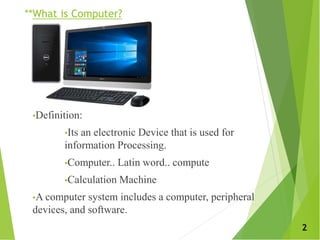
•Definition:
•Its an electronic Device that is used for
information Processing.
•Computer.. Latin word.. compute
•Calculation Machine
•A computer system includes a computer, peripheral
devices, and software.
2
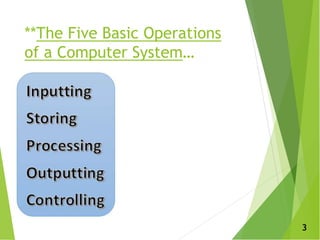
**The Five Basic Operations
of a Computer System…
3
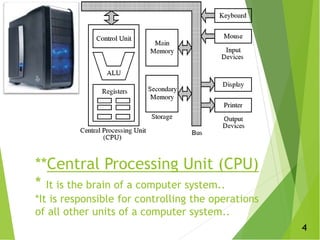
**Central Processing Unit (CPU)
* It is the brain of a computer system..
*It is responsible for controlling the operations
of all other units of a computer system..
4
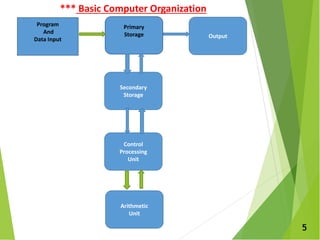
Program
And
Data Input
Primary
Storage
Secondary
Storage
Control
Processing
Unit
Arithmetic
Unit
Output
*** Basic Computer Organization
5
***Two Types of Storage
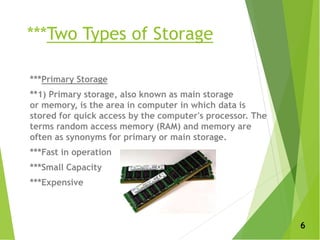
***Primary Storage
**1) Primary storage, also known as main storage
or memory, is the area in computer in which data is
stored for quick access by the computer's processor. The
terms random access memory (RAM) and memory are
often as synonyms for primary or main storage.
***Fast in operation
***Small Capacity
***Expensive
6
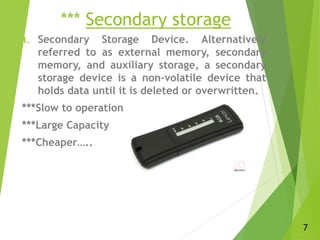
*** Secondary storage
1. Secondary Storage Device. Alternatively
referred to as external memory, secondary
memory, and auxiliary storage, a secondary
storage device is a non-volatile device that
holds data until it is deleted or overwritten.
***Slow to operation
***Large Capacity
***Cheaper…..
7
***Arithmetic Logic Unit
(ALU)
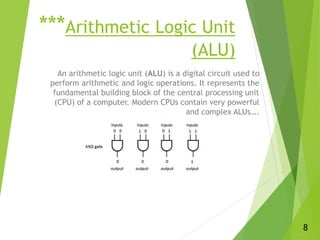
An arithmetic logic unit (ALU) is a digital circuit used to
perform arithmetic and logic operations. It represents the
fundamental building block of the central processing unit
(CPU) of a computer. Modern CPUs contain very powerful
and complex ALUs….
8
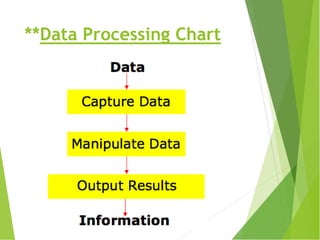
***Data Processing
Data processing is, generally, "the collection and
manipulation of items of data to
produce meaningful information."[1] In this sense it can
be considered a subset of information processing, "the
change (processing) of information in any manner
detectable by an observer."
9
**Data Processing Chart
10
11
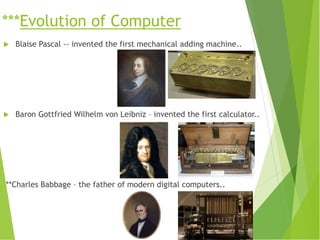
***Evolution of Computer
 Blaise Pascal -- invented the first mechanical adding machine..
 Baron Gottfried Wilhelm von Leibniz – invented the first calculator..
**Charles Babbage – the father of modern digital computers..
12
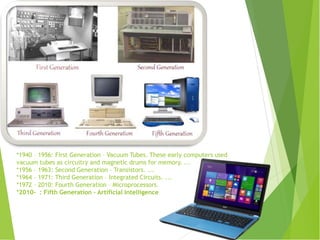
*1940 – 1956: First Generation – Vacuum Tubes. These early computers used
vacuum tubes as circuitry and magnetic drums for memory. ...
*1956 – 1963: Second Generation – Transistors. ...
*1964 – 1971: Third Generation – Integrated Circuits. ...
*1972 – 2010: Fourth Generation – Microprocessors.
*2010- : Fifth Generation – Artificial Intelligence
13
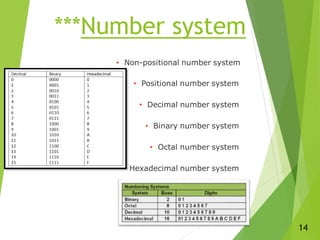
***Number system
• Non-positional number system
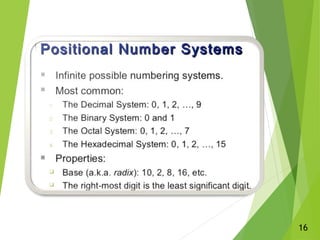
• Positional number system
• Decimal number system
• Binary number system
• Octal number system
• Hexadecimal number system
14
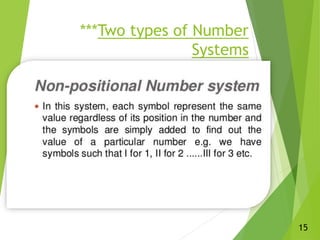
***Two types of Number
Systems
15
16
17

Computer Fundamentals.

  • 1.
  • 2.
    **What is Computer? •Definition: •Itsan electronic Device that is used for information Processing. •Computer.. Latin word.. compute •Calculation Machine •A computer system includes a computer, peripheral devices, and software. 2
  • 3.
    **The Five BasicOperations of a Computer System… 3
  • 4.
    **Central Processing Unit(CPU) * It is the brain of a computer system.. *It is responsible for controlling the operations of all other units of a computer system.. 4
  • 5.
  • 6.
    ***Two Types ofStorage ***Primary Storage **1) Primary storage, also known as main storage or memory, is the area in computer in which data is stored for quick access by the computer's processor. The terms random access memory (RAM) and memory are often as synonyms for primary or main storage. ***Fast in operation ***Small Capacity ***Expensive 6
  • 7.
    *** Secondary storage 1.Secondary Storage Device. Alternatively referred to as external memory, secondary memory, and auxiliary storage, a secondary storage device is a non-volatile device that holds data until it is deleted or overwritten. ***Slow to operation ***Large Capacity ***Cheaper….. 7
  • 8.
    ***Arithmetic Logic Unit (ALU) Anarithmetic logic unit (ALU) is a digital circuit used to perform arithmetic and logic operations. It represents the fundamental building block of the central processing unit (CPU) of a computer. Modern CPUs contain very powerful and complex ALUs…. 8
  • 9.
    ***Data Processing Data processingis, generally, "the collection and manipulation of items of data to produce meaningful information."[1] In this sense it can be considered a subset of information processing, "the change (processing) of information in any manner detectable by an observer." 9
  • 10.
  • 11.
  • 12.
    ***Evolution of Computer Blaise Pascal -- invented the first mechanical adding machine..  Baron Gottfried Wilhelm von Leibniz – invented the first calculator.. **Charles Babbage – the father of modern digital computers.. 12
  • 13.
    *1940 – 1956:First Generation – Vacuum Tubes. These early computers used vacuum tubes as circuitry and magnetic drums for memory. ... *1956 – 1963: Second Generation – Transistors. ... *1964 – 1971: Third Generation – Integrated Circuits. ... *1972 – 2010: Fourth Generation – Microprocessors. *2010- : Fifth Generation – Artificial Intelligence 13
  • 14.
    ***Number system • Non-positionalnumber system • Positional number system • Decimal number system • Binary number system • Octal number system • Hexadecimal number system 14
  • 15.
    ***Two types ofNumber Systems 15
  • 16.
  • 17.