LOGO
Cancer Immunotherapy
www.bocsci.com
LOGO
www.bocsci.com
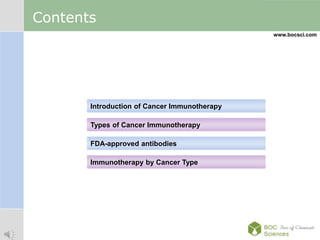
Contents
Introduction of Cancer Immunotherapy
Types of Cancer Immunotherapy
FDA-approved antibodies
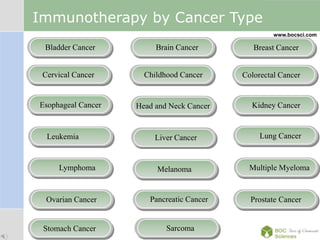
Immunotherapy by Cancer Type
LOGO
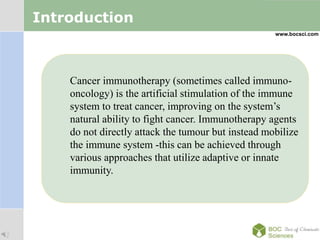
Introduction
Cancer immunotherapy (sometimes called immuno-
oncology) is the artificial stimulation of the immune
system to treat cancer, improving on the system’s
natural ability to fight cancer. Immunotherapy agents
do not directly attack the tumour but instead mobilize
the immune system -this can be achieved through
various approaches that utilize adaptive or innate
immunity.
www.bocsci.com
LOGO
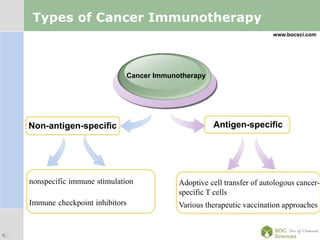
Types of Cancer Immunotherapy
Non-antigen-specific
Cancer Immunotherapy
Antigen-specific
www.bocsci.com
nonspecific immune stimulation
Immune checkpoint inhibitors
Adoptive cell transfer of autologous cancer-
specific T cells
Various therapeutic vaccination approaches.
LOGO
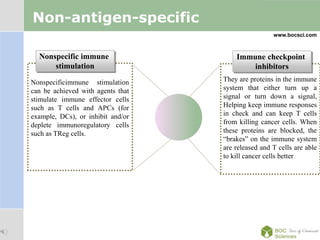
Nonspecific immune
stimulation
Non-antigen-specific
www.bocsci.com
Immune checkpoint
inhibitors
They are proteins in the immune
system that either turn up a
signal or turn down a signal,
Helping keep immune responses
in check and can keep T cells
from killing cancer cells. When
these proteins are blocked, the
“brakes” on the immune system
are released and T cells are able
to kill cancer cells better.
Nonspecificimmune stimulation
can be achieved with agents that
stimulate immune effector cells
such as T cells and APCs (for
example, DCs), or inhibit and/or
deplete immunoregulatory cells
such as TReg cells.
LOGO
Adoptive T-cell therapy
www.bocsci.com
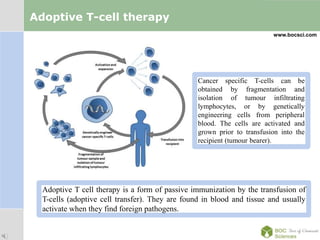
Adoptive T cell therapy is a form of passive immunization by the transfusion of
T-cells (adoptive cell transfer). They are found in blood and tissue and usually
activate when they find foreign pathogens.
Cancer specific T-cells can be
obtained by fragmentation and
isolation of tumour infiltrating
lymphocytes, or by genetically
engineering cells from peripheral
blood. The cells are activated and
grown prior to transfusion into the
recipient (tumour bearer).
LOGO
Cancer, Immunity, and Adoptive
Cell Therapy
www.bocsci.com
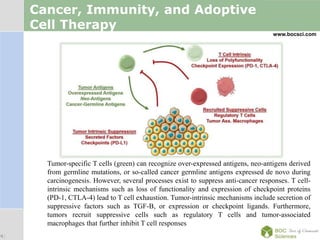
Tumor-specific T cells (green) can recognize over-expressed antigens, neo-antigens derived
from germline mutations, or so-called cancer germline antigens expressed de novo during
carcinogenesis. However, several processes exist to suppress anti-cancer responses. T cell-
intrinsic mechanisms such as loss of functionality and expression of checkpoint proteins
(PD-1, CTLA-4) lead to T cell exhaustion. Tumor-intrinsic mechanisms include secretion of
suppressive factors such as TGF-B, or expression or checkpoint ligands. Furthermore,
tumors recruit suppressive cells such as regulatory T cells and tumor-associated
macrophages that further inhibit T cell responses
LOGO
How therapeutic cancer vaccines work
www.bocsci.com
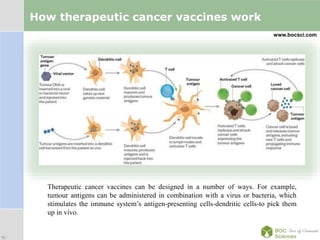
Therapeutic cancer vaccines can be designed in a number of ways. For example,
tumour antigens can be administered in combination with a virus or bacteria, which
stimulates the immune system’s antigen-presenting cells-dendritic cells-to pick them
up in vivo.
LOGO
FDA-approved antibodies
www.bocsci.com
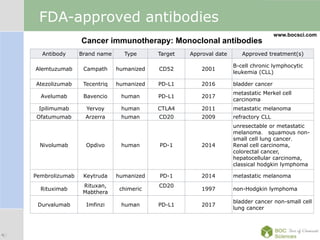
Antibody Brand name Type Target Approval date Approved treatment(s)
Alemtuzumab Campath humanized CD52 2001
B-cell chronic lymphocytic
leukemia (CLL)
Atezolizumab Tecentriq humanized PD-L1 2016 bladder cancer
Avelumab Bavencio human PD-L1 2017
metastatic Merkel cell
carcinoma
Ipilimumab Yervoy human CTLA4 2011 metastatic melanoma
Ofatumumab Arzerra human CD20 2009 refractory CLL
Nivolumab Opdivo human PD-1 2014
unresectable or metastatic
melanoma, squamous non-
small cell lung cancer,
Renal cell carcinoma,
colorectal cancer,
hepatocellular carcinoma,
classical hodgkin lymphoma
Pembrolizumab Keytruda humanized PD-1 2014 metastatic melanoma
Rituximab
Rituxan,
Mabthera
chimeric
CD20
1997 non-Hodgkin lymphoma
Durvalumab Imfinzi human PD-L1 2017
bladder cancer non-small cell
lung cancer
Cancer immunotherapy: Monoclonal antibodies
LOGO
Immunotherapy by Cancer Type
Brain CancerBladder Cancer
Cervical Cancer
Esophageal Cancer
Leukemia
Pancreatic Cancer
Breast Cancer
Childhood Cancer Colorectal Cancer
Kidney CancerHead and Neck Cancer
Lung CancerLiver Cancer
Multiple Myeloma
Prostate Cancer
Melanoma
Ovarian Cancer
Lymphoma
SarcomaStomach Cancer
www.bocsci.com
LOGO
BOC
Sciences
Quality
assurance
Technical
support
Overnight
shipping GMP grade
available
Additional
analyses
BOC Sciences offers the design
and synthesis of multipurpose
compounds to meet your exact
screening requirements.
BOC Sciences
www.bocsci.com
LOGO
www.bocsci.com
Address: 45-16 Ramsey Road, Shirley, NY 11967, USA
Tel: 1-631-624-4882
Fax: 1-631-504-6093
E-Mail: info@bocsci.com

Cancer immunotherapy boc sciences

  • 1.
  • 2.
    LOGO www.bocsci.com Contents Introduction of CancerImmunotherapy Types of Cancer Immunotherapy FDA-approved antibodies Immunotherapy by Cancer Type
  • 3.
    LOGO Introduction Cancer immunotherapy (sometimescalled immuno- oncology) is the artificial stimulation of the immune system to treat cancer, improving on the system’s natural ability to fight cancer. Immunotherapy agents do not directly attack the tumour but instead mobilize the immune system -this can be achieved through various approaches that utilize adaptive or innate immunity. www.bocsci.com
  • 4.
    LOGO Types of CancerImmunotherapy Non-antigen-specific Cancer Immunotherapy Antigen-specific www.bocsci.com nonspecific immune stimulation Immune checkpoint inhibitors Adoptive cell transfer of autologous cancer- specific T cells Various therapeutic vaccination approaches.
  • 5.
    LOGO Nonspecific immune stimulation Non-antigen-specific www.bocsci.com Immune checkpoint inhibitors Theyare proteins in the immune system that either turn up a signal or turn down a signal, Helping keep immune responses in check and can keep T cells from killing cancer cells. When these proteins are blocked, the “brakes” on the immune system are released and T cells are able to kill cancer cells better. Nonspecificimmune stimulation can be achieved with agents that stimulate immune effector cells such as T cells and APCs (for example, DCs), or inhibit and/or deplete immunoregulatory cells such as TReg cells.
  • 6.
    LOGO Adoptive T-cell therapy www.bocsci.com AdoptiveT cell therapy is a form of passive immunization by the transfusion of T-cells (adoptive cell transfer). They are found in blood and tissue and usually activate when they find foreign pathogens. Cancer specific T-cells can be obtained by fragmentation and isolation of tumour infiltrating lymphocytes, or by genetically engineering cells from peripheral blood. The cells are activated and grown prior to transfusion into the recipient (tumour bearer).
  • 7.
    LOGO Cancer, Immunity, andAdoptive Cell Therapy www.bocsci.com Tumor-specific T cells (green) can recognize over-expressed antigens, neo-antigens derived from germline mutations, or so-called cancer germline antigens expressed de novo during carcinogenesis. However, several processes exist to suppress anti-cancer responses. T cell- intrinsic mechanisms such as loss of functionality and expression of checkpoint proteins (PD-1, CTLA-4) lead to T cell exhaustion. Tumor-intrinsic mechanisms include secretion of suppressive factors such as TGF-B, or expression or checkpoint ligands. Furthermore, tumors recruit suppressive cells such as regulatory T cells and tumor-associated macrophages that further inhibit T cell responses
  • 8.
    LOGO How therapeutic cancervaccines work www.bocsci.com Therapeutic cancer vaccines can be designed in a number of ways. For example, tumour antigens can be administered in combination with a virus or bacteria, which stimulates the immune system’s antigen-presenting cells-dendritic cells-to pick them up in vivo.
  • 9.
    LOGO FDA-approved antibodies www.bocsci.com Antibody Brandname Type Target Approval date Approved treatment(s) Alemtuzumab Campath humanized CD52 2001 B-cell chronic lymphocytic leukemia (CLL) Atezolizumab Tecentriq humanized PD-L1 2016 bladder cancer Avelumab Bavencio human PD-L1 2017 metastatic Merkel cell carcinoma Ipilimumab Yervoy human CTLA4 2011 metastatic melanoma Ofatumumab Arzerra human CD20 2009 refractory CLL Nivolumab Opdivo human PD-1 2014 unresectable or metastatic melanoma, squamous non- small cell lung cancer, Renal cell carcinoma, colorectal cancer, hepatocellular carcinoma, classical hodgkin lymphoma Pembrolizumab Keytruda humanized PD-1 2014 metastatic melanoma Rituximab Rituxan, Mabthera chimeric CD20 1997 non-Hodgkin lymphoma Durvalumab Imfinzi human PD-L1 2017 bladder cancer non-small cell lung cancer Cancer immunotherapy: Monoclonal antibodies
  • 10.
    LOGO Immunotherapy by CancerType Brain CancerBladder Cancer Cervical Cancer Esophageal Cancer Leukemia Pancreatic Cancer Breast Cancer Childhood Cancer Colorectal Cancer Kidney CancerHead and Neck Cancer Lung CancerLiver Cancer Multiple Myeloma Prostate Cancer Melanoma Ovarian Cancer Lymphoma SarcomaStomach Cancer www.bocsci.com
  • 11.
    LOGO BOC Sciences Quality assurance Technical support Overnight shipping GMP grade available Additional analyses BOCSciences offers the design and synthesis of multipurpose compounds to meet your exact screening requirements. BOC Sciences www.bocsci.com
  • 12.
    LOGO www.bocsci.com Address: 45-16 RamseyRoad, Shirley, NY 11967, USA Tel: 1-631-624-4882 Fax: 1-631-504-6093 E-Mail: info@bocsci.com