PRESENTATION
ON
THE TOPIC
COMPUTER AIDED DRUG DESIGN
PRESENTED BY UNDER SUPERVISION OF
SHIVAMYADAV MISS. SHWETA TIWARI
M.PHARM ASSISTANT PROFESSOR
SECOND SEMESTER (GIPS)
(2023-2024)
GOEL INSTITUTE OF PHARMACY AND SCIENCES,LUCKNOW
DR.A.P.J. ABDUL KALAM TECHNICAL UNIVERSITY,UP
 INTRODUCTION
 HISTORY
 MODERN DRUG DESIGN
 STEP INVOLVED IN CADD
 CADD
 TYPES OF DRUG DESIGN
 OBJECTIVE OF CADD
 TOOLS FOR DRUG DESIGNING
 ADVANTAGES
 APPLICATION
 REFERENCES
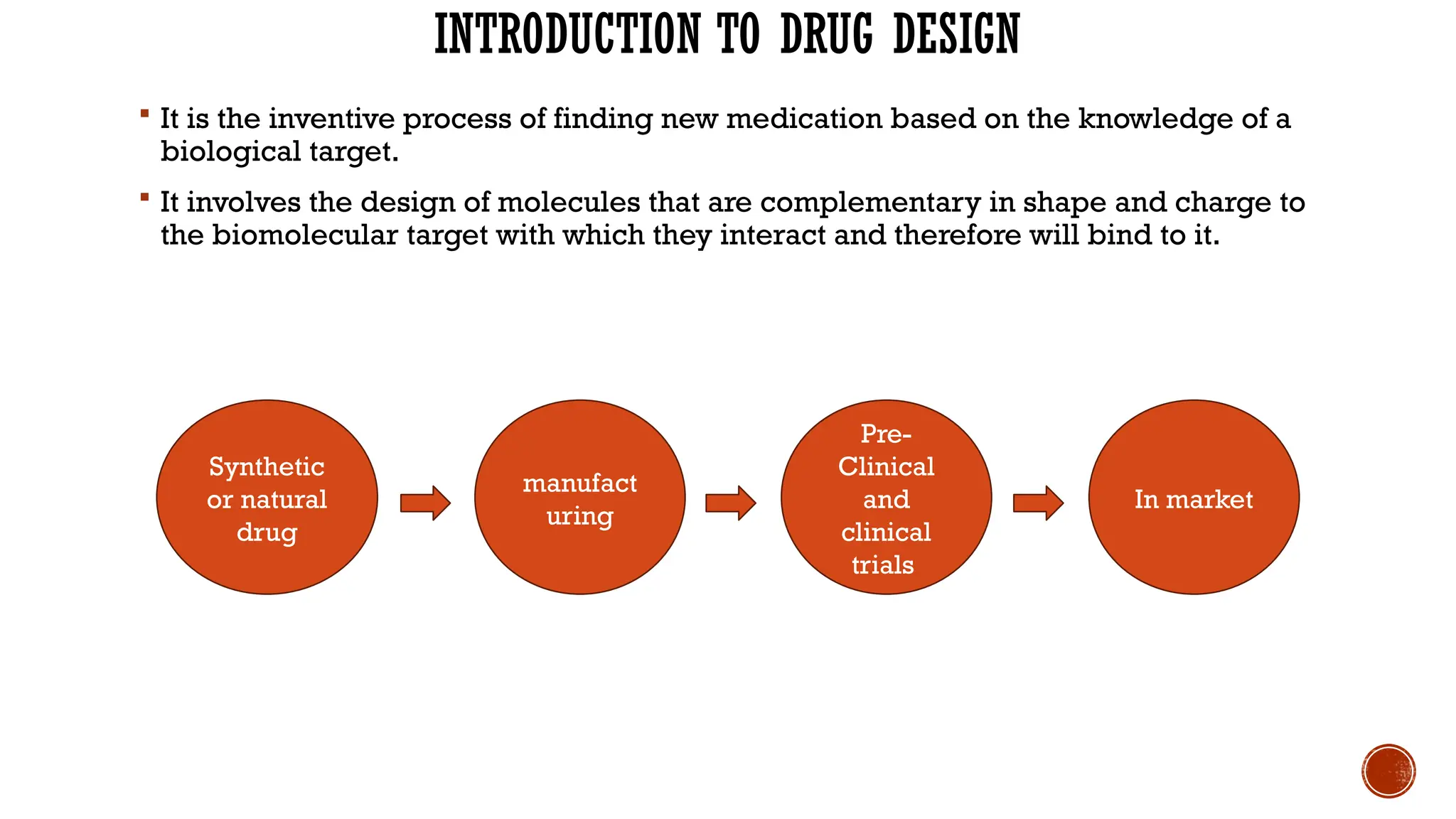
INTRODUCTION TO DRUG DESIGN
 It is the inventive process of finding new medication based on the knowledge of a
biological target.
 It involves the design of molecules that are complementary in shape and charge to
the biomolecular target with which they interact and therefore will bind to it.
Synthetic
or natural
drug
manufact
uring
Pre-
Clinical
and
clinical
trials
In market
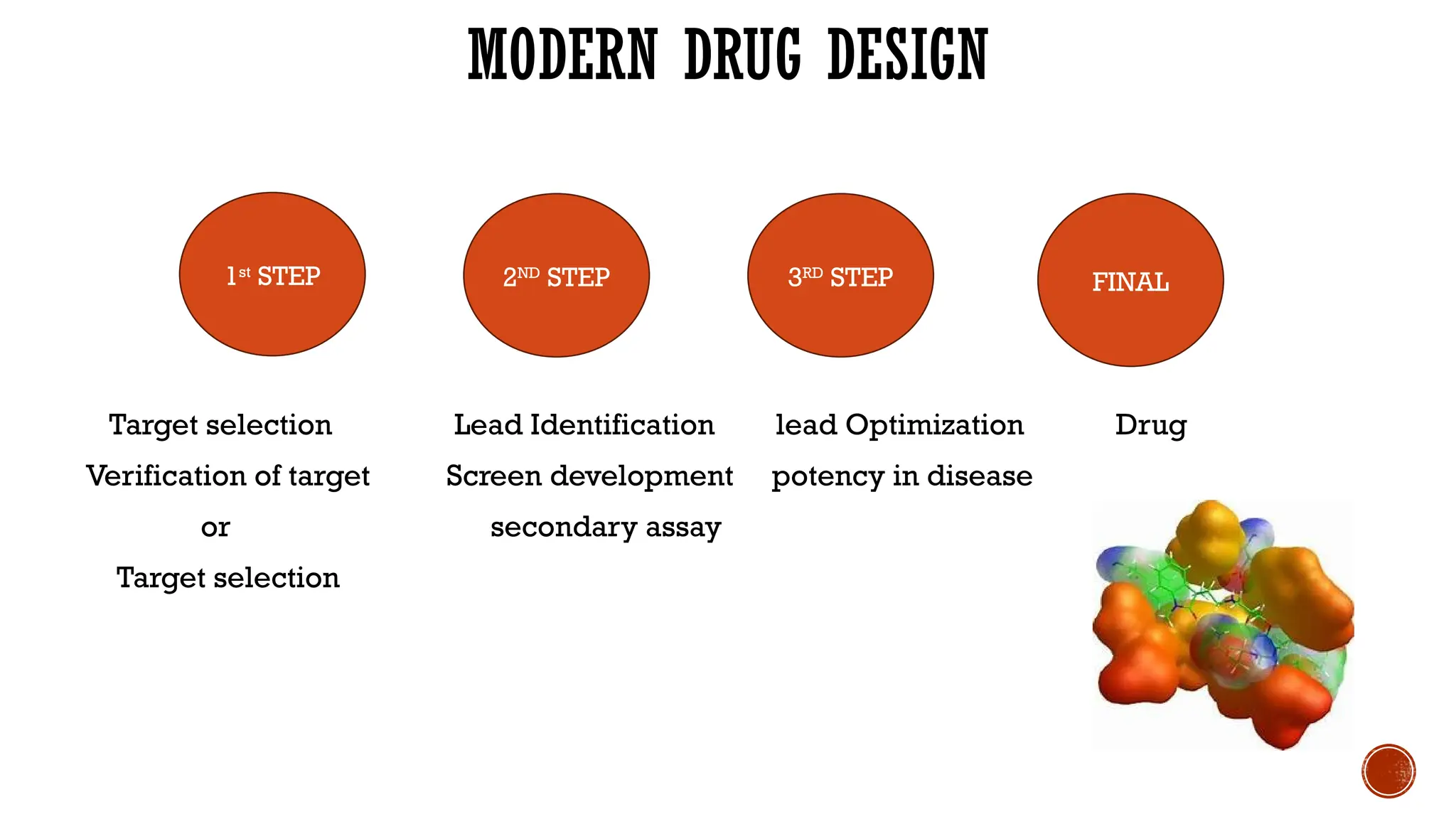
MODERN DRUG DESIGN
Target selection Lead Identification lead Optimization Drug
Verification of target Screen development potency in disease
or secondary assay
Target selection
1st
STEP 2ND
STEP 3RD
STEP FINAL
Designed molecule should be-
 Organic small molecule
 Complementary in shape to the target
 Oppositely charge to the biomolecular target.
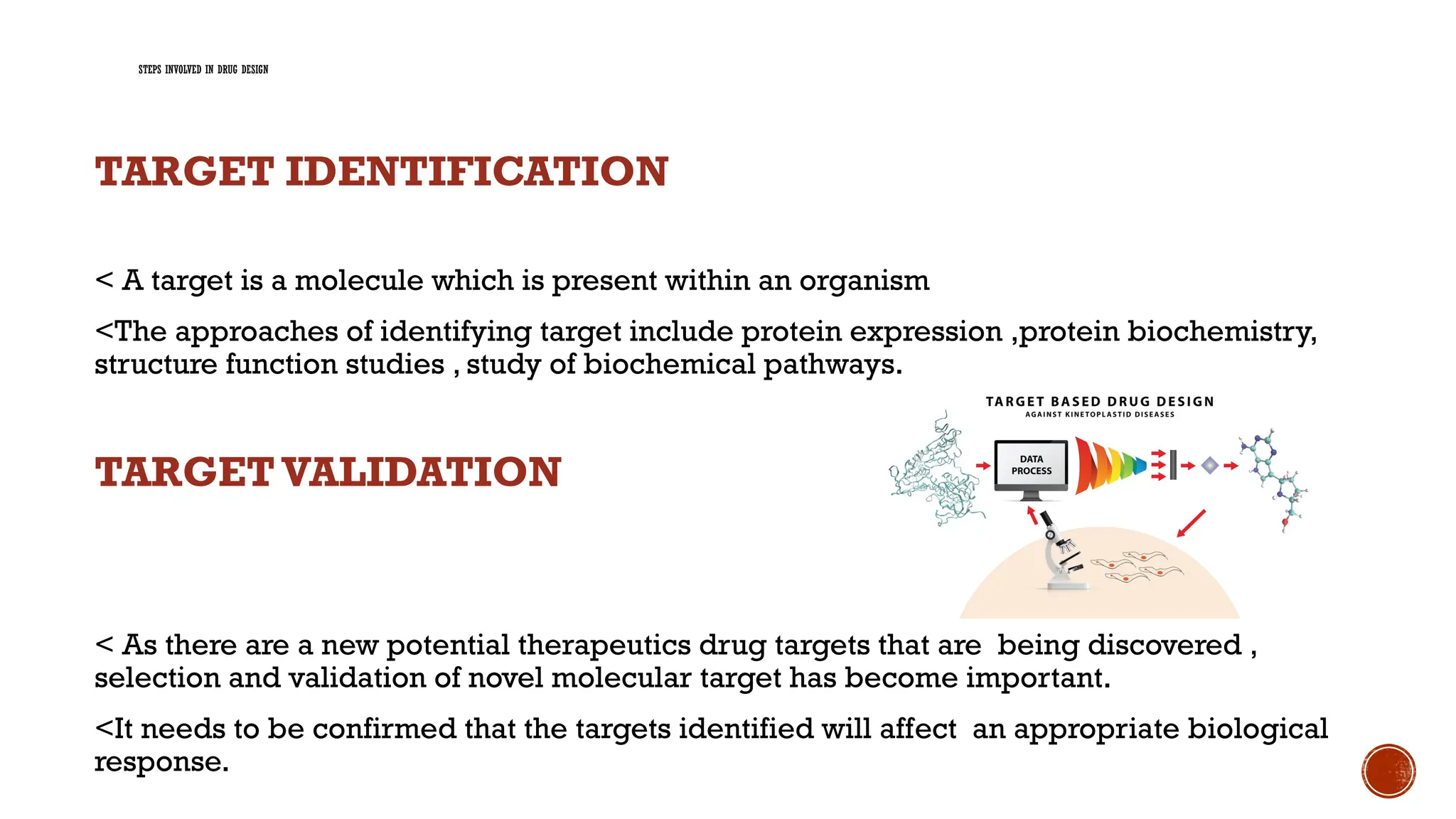
STEPS INVOLVED IN DRUG DESIGN
TARGET IDENTIFICATION
< A target is a molecule which is present within an organism
<The approaches of identifying target include protein expression ,protein biochemistry,
structure function studies , study of biochemical pathways.
TARGET VALIDATION
< As there are a new potential therapeutics drug targets that are being discovered ,
selection and validation of novel molecular target has become important.
<It needs to be confirmed that the targets identified will affect an appropriate biological
response.
TYPES OF DRUG DESIGN
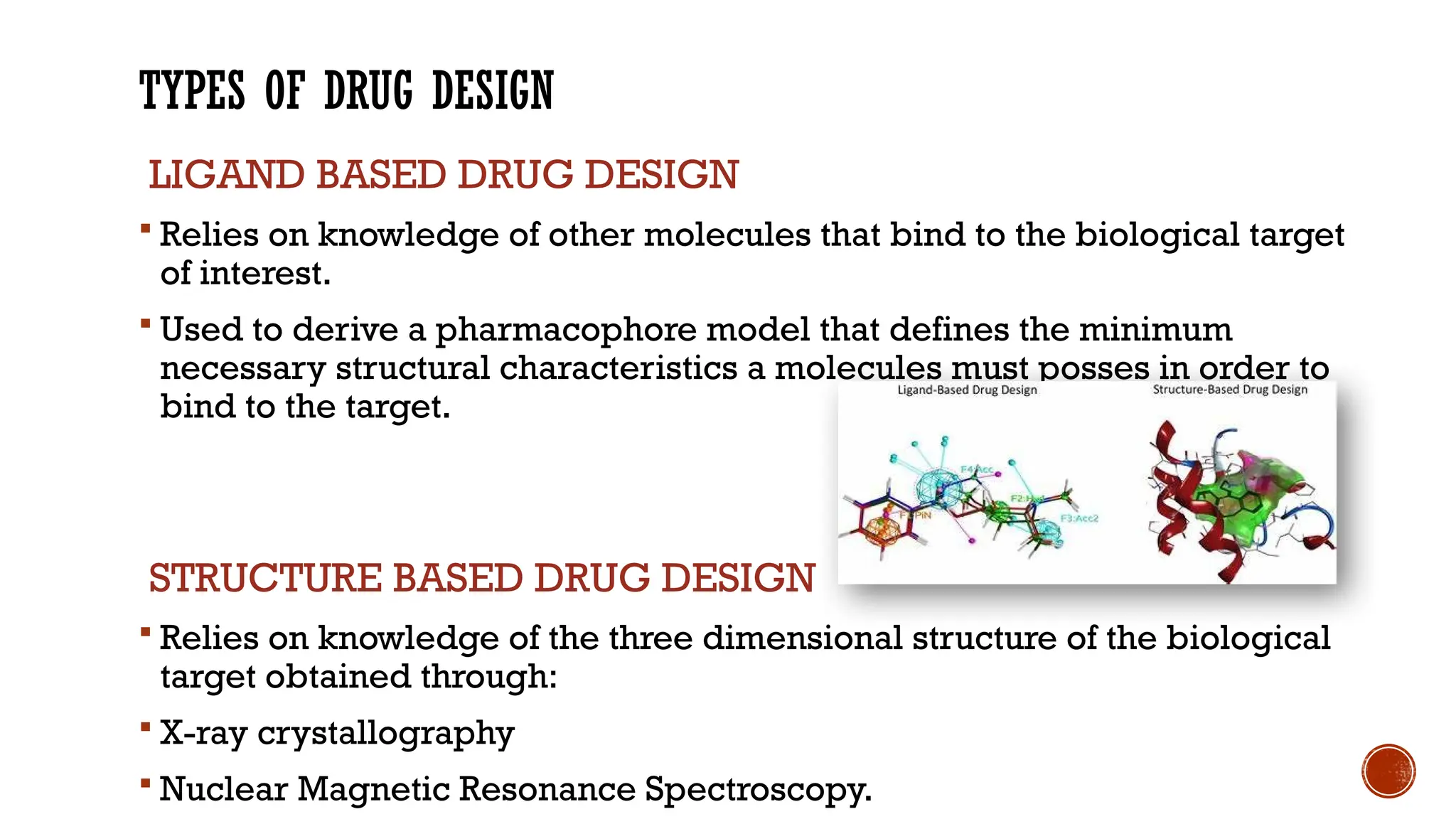
LIGAND BASED DRUG DESIGN
 Relies on knowledge of other molecules that bind to the biological target
of interest.
 Used to derive a pharmacophore model that defines the minimum
necessary structural characteristics a molecules must posses in order to
bind to the target.
STRUCTURE BASED DRUG DESIGN
 Relies on knowledge of the three dimensional structure of the biological
target obtained through:
 X-ray crystallography
 Nuclear Magnetic Resonance Spectroscopy.
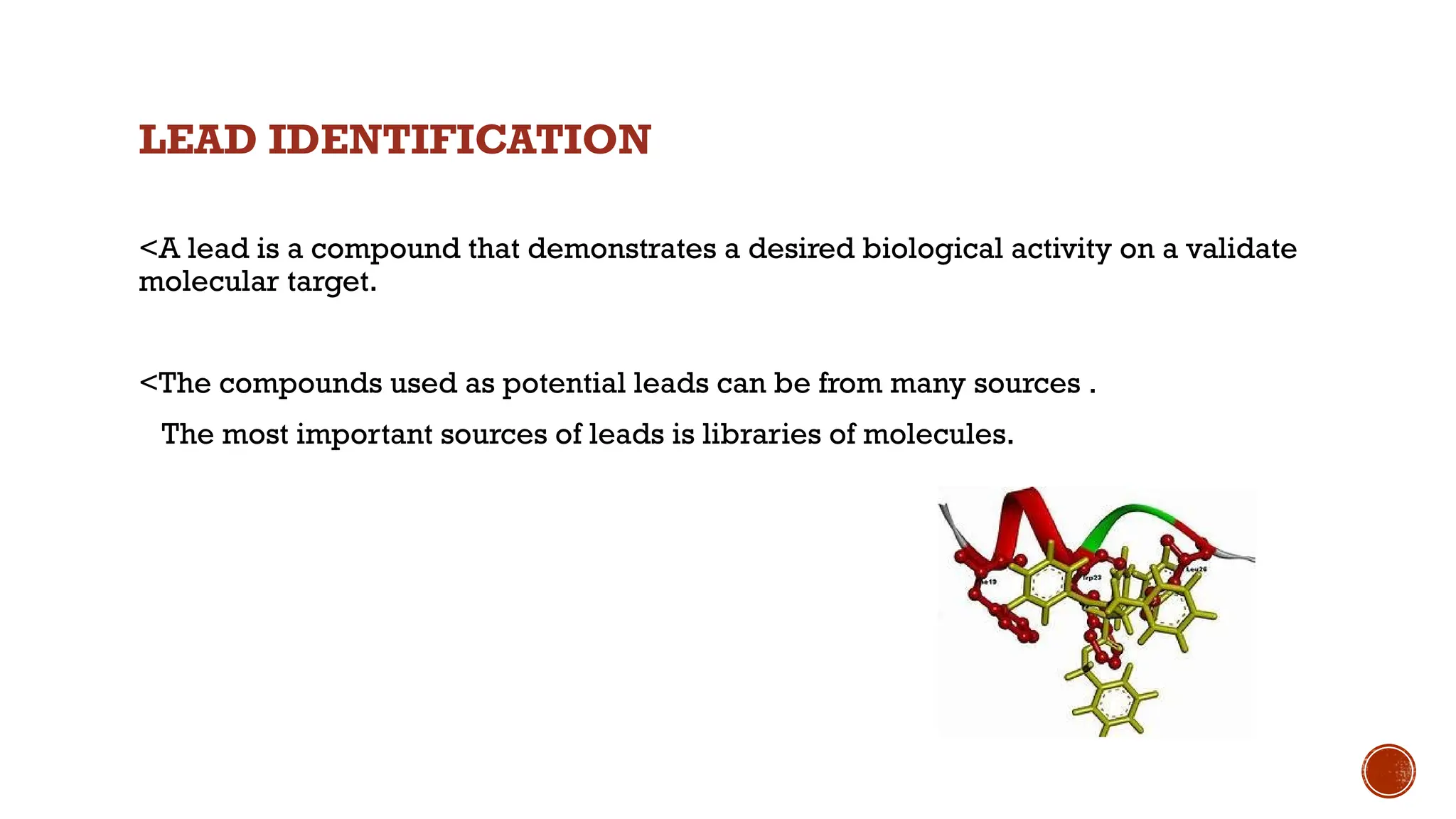
LEAD IDENTIFICATION
<A lead is a compound that demonstrates a desired biological activity on a validate
molecular target.
<The compounds used as potential leads can be from many sources .
The most important sources of leads is libraries of molecules.
HISTORY
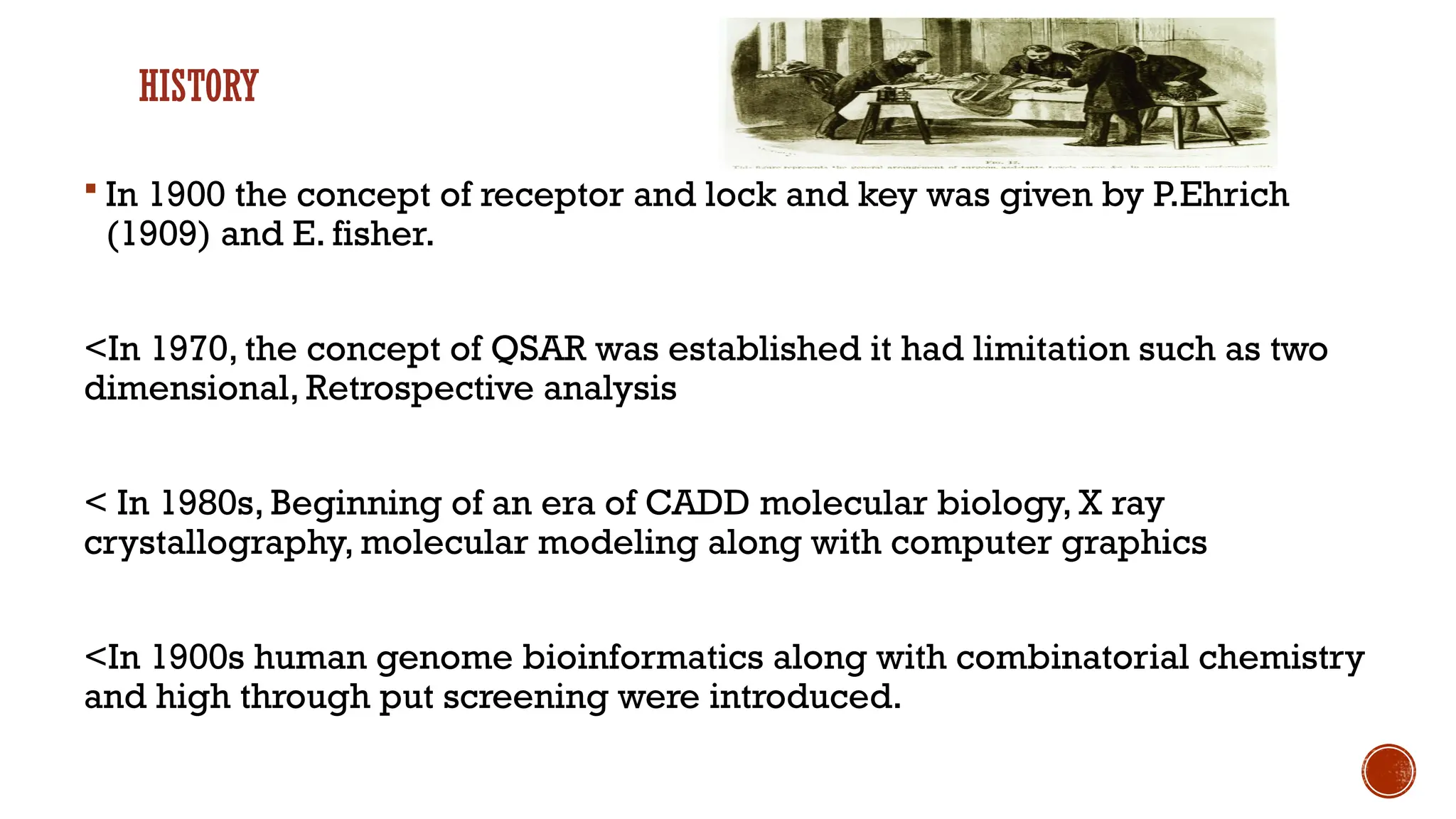
 In 1900 the concept of receptor and lock and key was given by P.Ehrich
(1909) and E. fisher.
<In 1970, the concept of QSAR was established it had limitation such as two
dimensional, Retrospective analysis
< In 1980s, Beginning of an era of CADD molecular biology, X ray
crystallography, molecular modeling along with computer graphics
<In 1900s human genome bioinformatics along with combinatorial chemistry
and high through put screening were introduced.
INTRODUCTION TO CADD
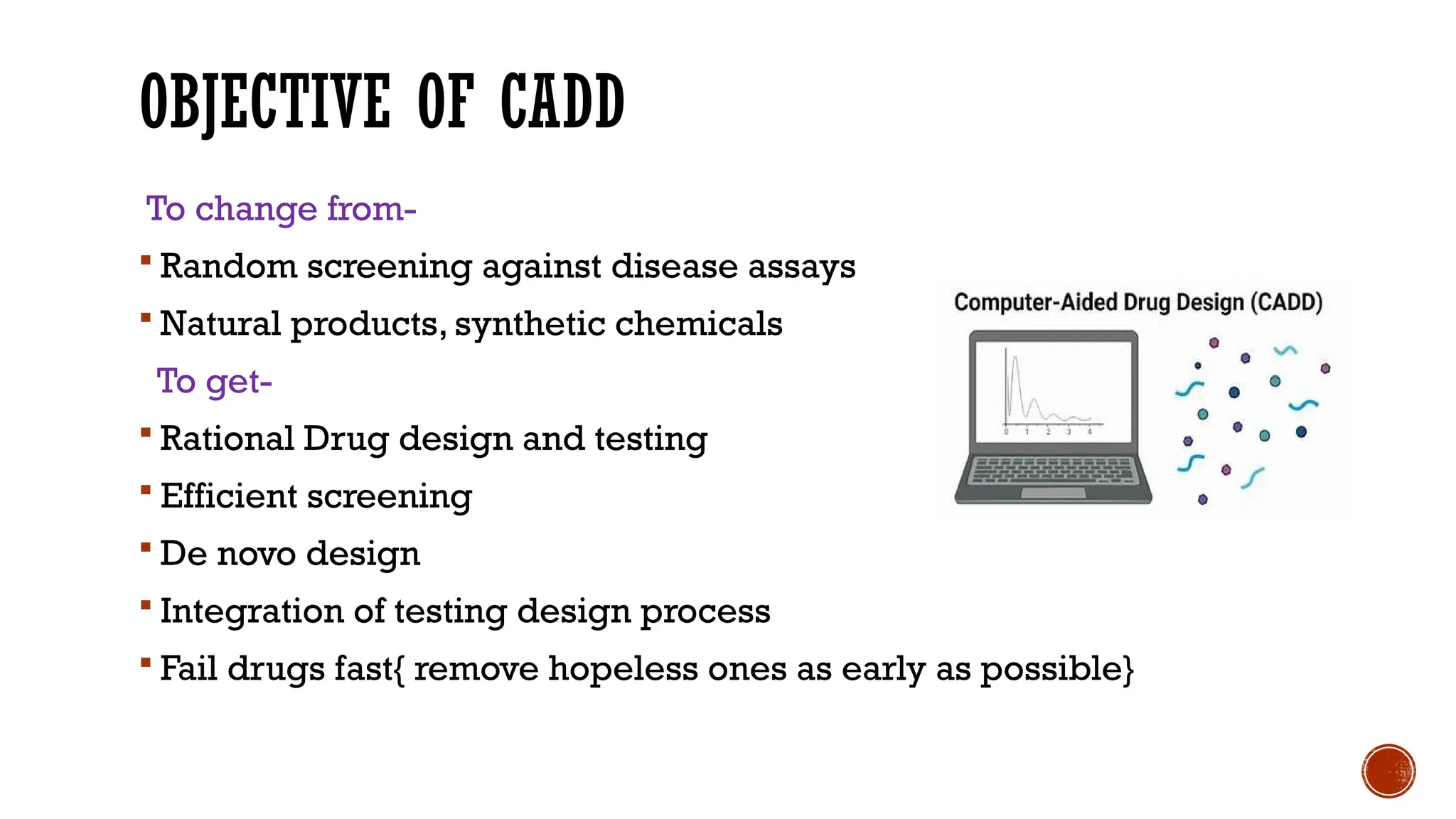
 It is recent and emerging discipline that uses several bioinformatics
tools and related fields like chemical informatics and combinatorial
chemistry.
Drug design with the help of computers may be used at any of the following stage of
drug discovery
 Hit identification using virtual screening { structure or ligand based design}
 Hit to Lead optimization of affinity and selectivity {structure based design, QSAR,
etc.}
 Lead optimization of the pharmaceutical properties while maintaining affinity.
OBJECTIVE OF CADD
To change from-
 Random screening against disease assays
 Natural products, synthetic chemicals
To get-
 Rational Drug design and testing
 Efficient screening
 De novo design
 Integration of testing design process
 Fail drugs fast{ remove hopeless ones as early as possible}
METHODS
 VIRTUAL SCREENING
The first method is identification of new ligand for a given receptor by searching large
database of 3D structure of small molecule to find fitting the binding pocket of the
receptor using fast docking programs.
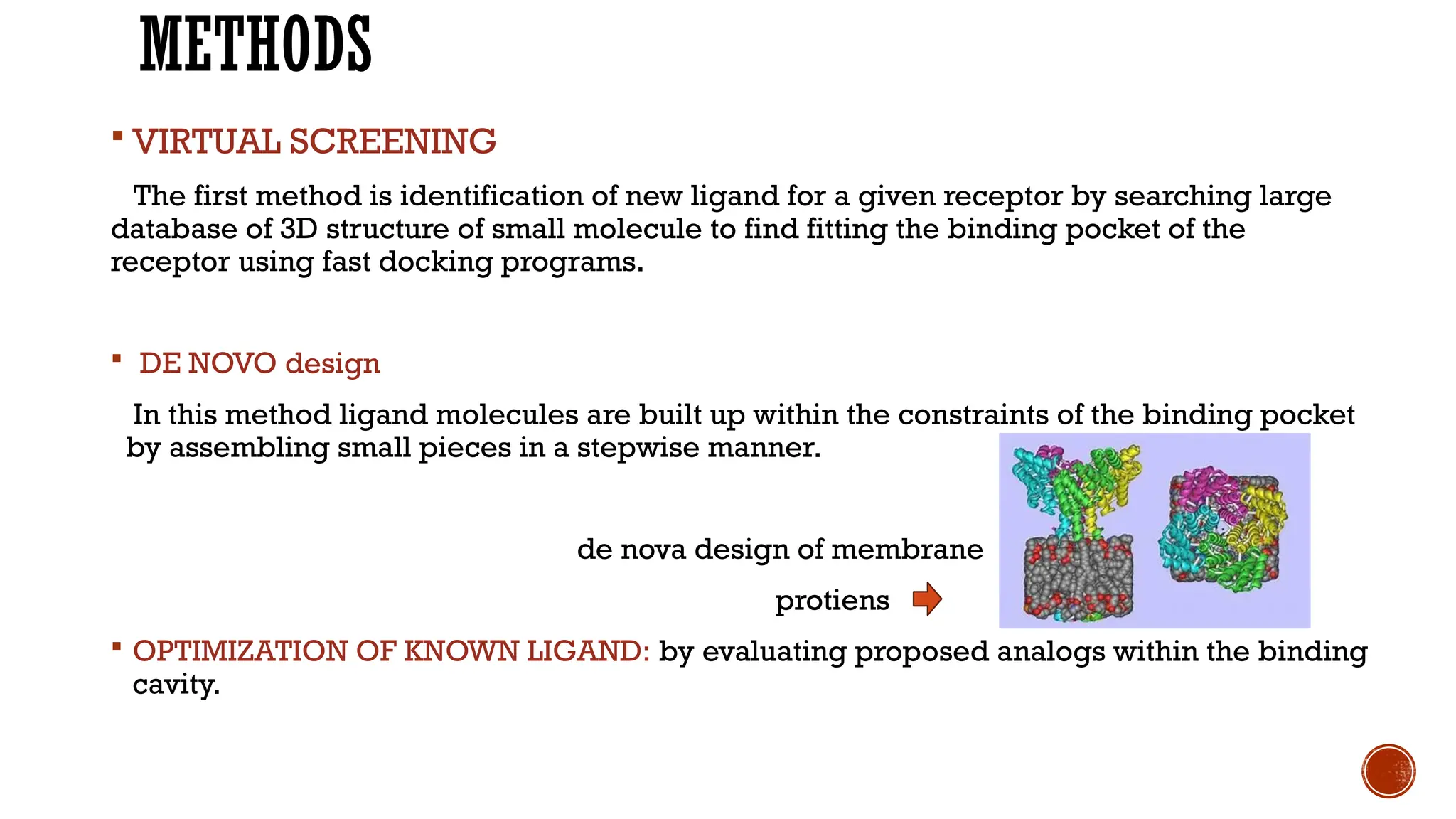
 DE NOVO design
In this method ligand molecules are built up within the constraints of the binding pocket
by assembling small pieces in a stepwise manner.
de nova design of membrane
protiens
 OPTIMIZATION OF KNOWN LIGAND: by evaluating proposed analogs within the binding
cavity.
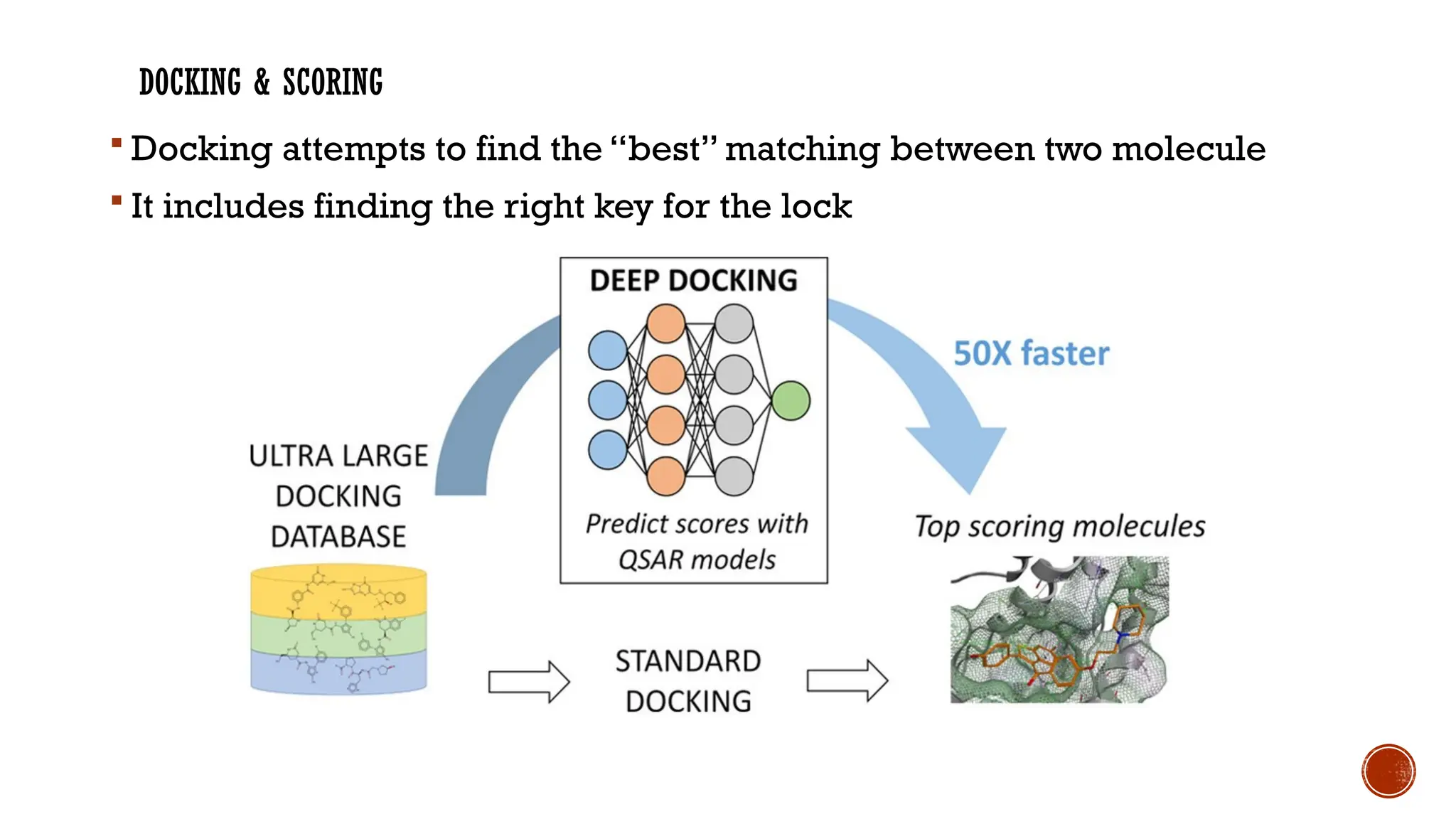
DOCKING & SCORING
 Docking attempts to find the “best” matching between two molecule
 It includes finding the right key for the lock
COMPONENTS OF DOCKING
1- pre and during docking:
• Representation of receptor binding site and ligand.
2- During docking
• Sample of configuration space of the ligand receptor complex
3- Docking and scoring
• Evaluation of ligand receptor interactions
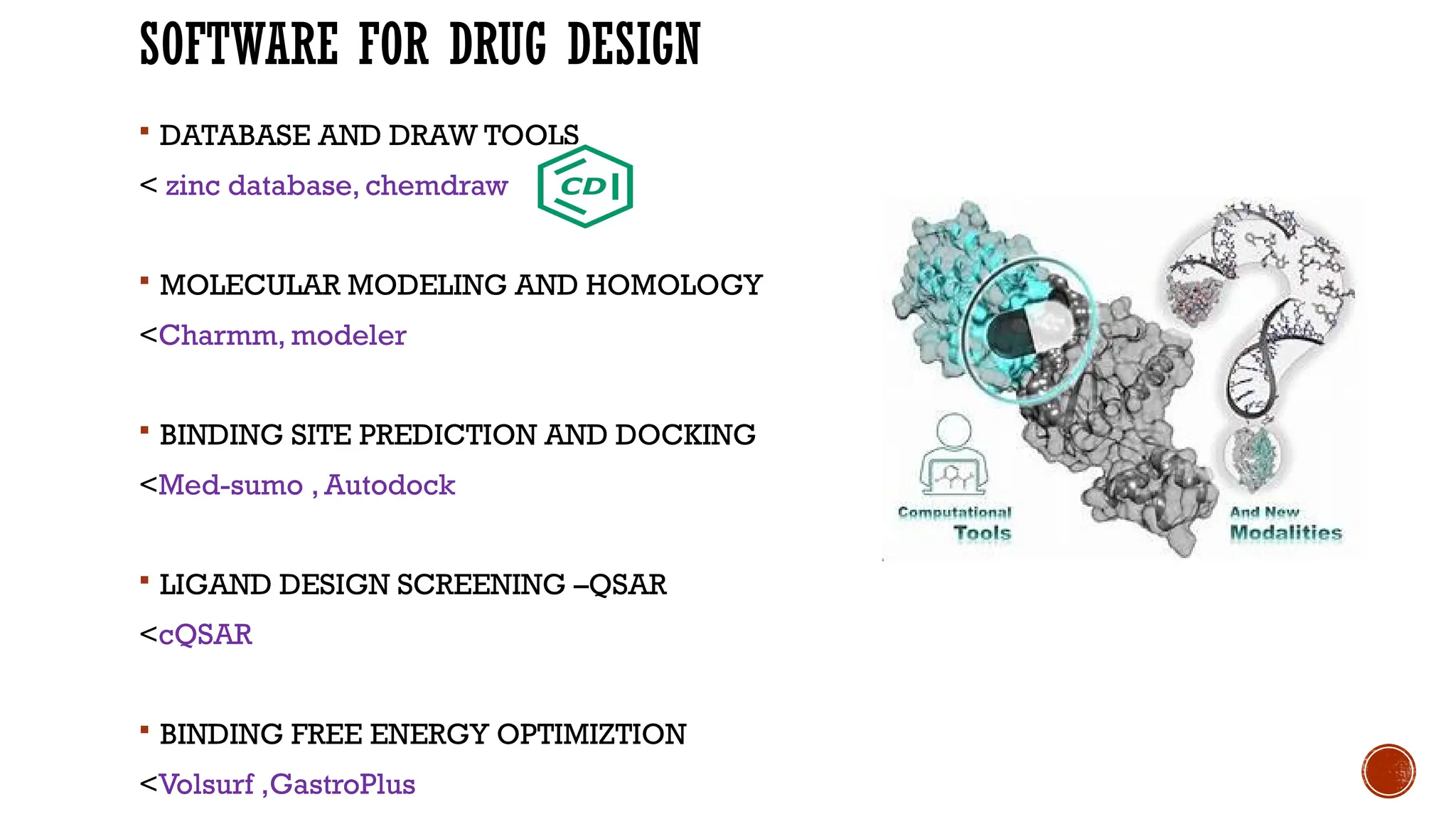
SOFTWARE FOR DRUG DESIGN
 DATABASE AND DRAW TOOLS
< zinc database, chemdraw
 MOLECULAR MODELING AND HOMOLOGY
<Charmm, modeler
 BINDING SITE PREDICTION AND DOCKING
<Med-sumo , Autodock
 LIGAND DESIGN SCREENING –QSAR
<cQSAR
 BINDING FREE ENERGY OPTIMIZTION
<Volsurf ,GastroPlus
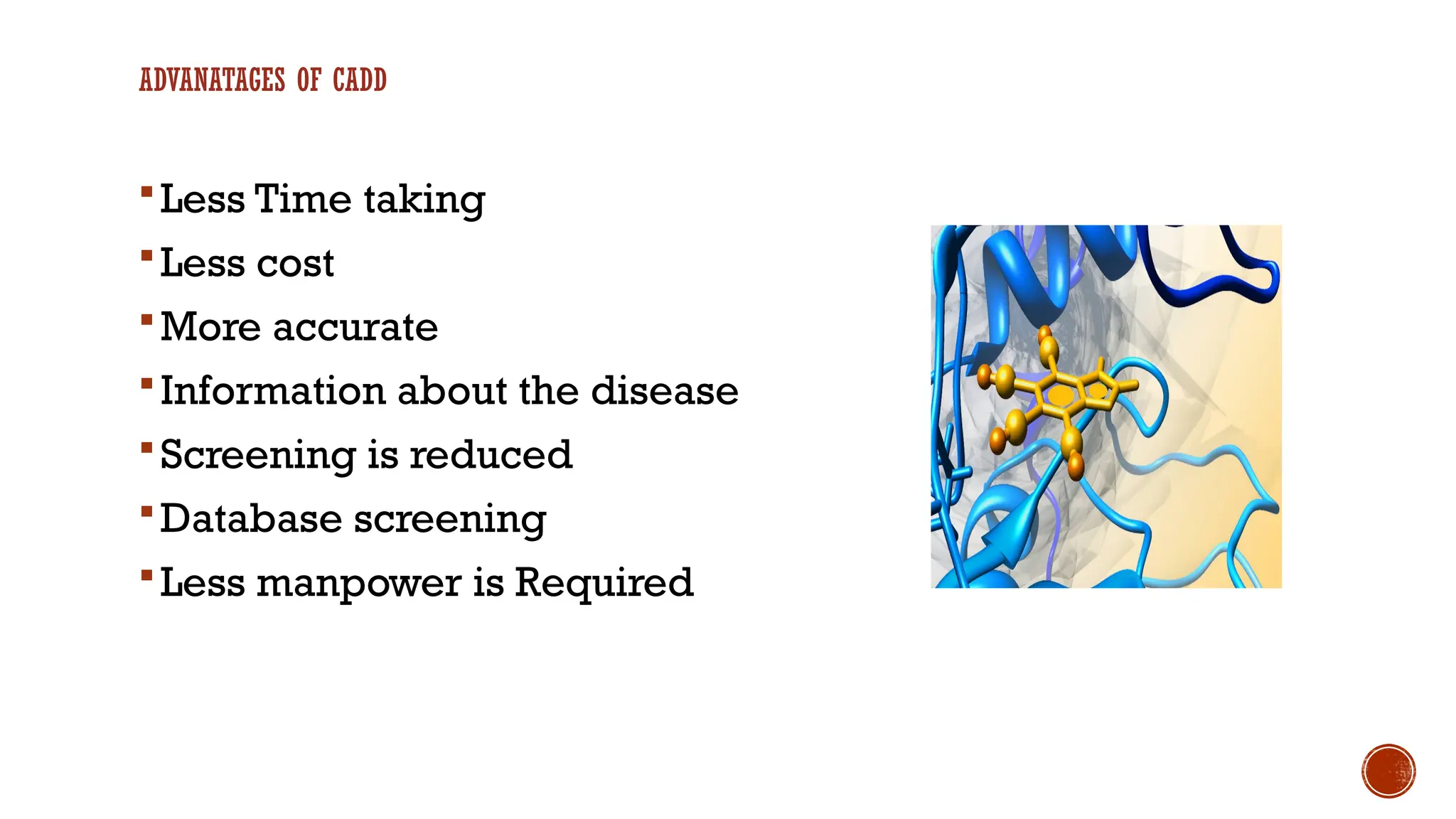
ADVANATAGES OF CADD
Less Time taking
Less cost
More accurate
Information about the disease
Screening is reduced
Database screening
Less manpower is Required
APPLICATION
 Determine the lowest free energy structure for the receptor – ligand
complex.
 Search database and rank hits for lead generation.
 Calculate the differential binding of a ligand to two different
macromolecules receptors.
 Study the geometry of particular complex.
 Propose modification of a lead molecules to optimize potency or other
properties.
 De novo Design for lead generation
 Used for Docking study
REFERENCES
 Burger’s Medicinal chemistry and Drug discovery -6th
edition,Volume 1, page no;
417-420.
 International journal of creative research throughts computer aided drug design –
An overview ,jasmeen Jahangir naikwadi et al. volume 9 issue 10,oct-2021.
THANK YOU

COMPUTER AIDED DRUG DESIGN COMPUTER AIDED DRUG DESIG

  • 1.
    PRESENTATION ON THE TOPIC COMPUTER AIDEDDRUG DESIGN PRESENTED BY UNDER SUPERVISION OF SHIVAMYADAV MISS. SHWETA TIWARI M.PHARM ASSISTANT PROFESSOR SECOND SEMESTER (GIPS) (2023-2024) GOEL INSTITUTE OF PHARMACY AND SCIENCES,LUCKNOW DR.A.P.J. ABDUL KALAM TECHNICAL UNIVERSITY,UP
  • 2.
     INTRODUCTION  HISTORY MODERN DRUG DESIGN  STEP INVOLVED IN CADD  CADD  TYPES OF DRUG DESIGN  OBJECTIVE OF CADD  TOOLS FOR DRUG DESIGNING  ADVANTAGES  APPLICATION  REFERENCES
  • 3.
    INTRODUCTION TO DRUGDESIGN  It is the inventive process of finding new medication based on the knowledge of a biological target.  It involves the design of molecules that are complementary in shape and charge to the biomolecular target with which they interact and therefore will bind to it. Synthetic or natural drug manufact uring Pre- Clinical and clinical trials In market
  • 4.
    MODERN DRUG DESIGN Targetselection Lead Identification lead Optimization Drug Verification of target Screen development potency in disease or secondary assay Target selection 1st STEP 2ND STEP 3RD STEP FINAL
  • 5.
    Designed molecule shouldbe-  Organic small molecule  Complementary in shape to the target  Oppositely charge to the biomolecular target.
  • 6.
    STEPS INVOLVED INDRUG DESIGN TARGET IDENTIFICATION < A target is a molecule which is present within an organism <The approaches of identifying target include protein expression ,protein biochemistry, structure function studies , study of biochemical pathways. TARGET VALIDATION < As there are a new potential therapeutics drug targets that are being discovered , selection and validation of novel molecular target has become important. <It needs to be confirmed that the targets identified will affect an appropriate biological response.
  • 7.
    TYPES OF DRUGDESIGN LIGAND BASED DRUG DESIGN  Relies on knowledge of other molecules that bind to the biological target of interest.  Used to derive a pharmacophore model that defines the minimum necessary structural characteristics a molecules must posses in order to bind to the target. STRUCTURE BASED DRUG DESIGN  Relies on knowledge of the three dimensional structure of the biological target obtained through:  X-ray crystallography  Nuclear Magnetic Resonance Spectroscopy.
  • 8.
    LEAD IDENTIFICATION <A leadis a compound that demonstrates a desired biological activity on a validate molecular target. <The compounds used as potential leads can be from many sources . The most important sources of leads is libraries of molecules.
  • 9.
    HISTORY  In 1900the concept of receptor and lock and key was given by P.Ehrich (1909) and E. fisher. <In 1970, the concept of QSAR was established it had limitation such as two dimensional, Retrospective analysis < In 1980s, Beginning of an era of CADD molecular biology, X ray crystallography, molecular modeling along with computer graphics <In 1900s human genome bioinformatics along with combinatorial chemistry and high through put screening were introduced.
  • 10.
    INTRODUCTION TO CADD It is recent and emerging discipline that uses several bioinformatics tools and related fields like chemical informatics and combinatorial chemistry. Drug design with the help of computers may be used at any of the following stage of drug discovery  Hit identification using virtual screening { structure or ligand based design}  Hit to Lead optimization of affinity and selectivity {structure based design, QSAR, etc.}  Lead optimization of the pharmaceutical properties while maintaining affinity.
  • 11.
    OBJECTIVE OF CADD Tochange from-  Random screening against disease assays  Natural products, synthetic chemicals To get-  Rational Drug design and testing  Efficient screening  De novo design  Integration of testing design process  Fail drugs fast{ remove hopeless ones as early as possible}
  • 12.
    METHODS  VIRTUAL SCREENING Thefirst method is identification of new ligand for a given receptor by searching large database of 3D structure of small molecule to find fitting the binding pocket of the receptor using fast docking programs.  DE NOVO design In this method ligand molecules are built up within the constraints of the binding pocket by assembling small pieces in a stepwise manner. de nova design of membrane protiens  OPTIMIZATION OF KNOWN LIGAND: by evaluating proposed analogs within the binding cavity.
  • 13.
    DOCKING & SCORING Docking attempts to find the “best” matching between two molecule  It includes finding the right key for the lock
  • 14.
    COMPONENTS OF DOCKING 1-pre and during docking: • Representation of receptor binding site and ligand. 2- During docking • Sample of configuration space of the ligand receptor complex 3- Docking and scoring • Evaluation of ligand receptor interactions
  • 15.
    SOFTWARE FOR DRUGDESIGN  DATABASE AND DRAW TOOLS < zinc database, chemdraw  MOLECULAR MODELING AND HOMOLOGY <Charmm, modeler  BINDING SITE PREDICTION AND DOCKING <Med-sumo , Autodock  LIGAND DESIGN SCREENING –QSAR <cQSAR  BINDING FREE ENERGY OPTIMIZTION <Volsurf ,GastroPlus
  • 16.
    ADVANATAGES OF CADD LessTime taking Less cost More accurate Information about the disease Screening is reduced Database screening Less manpower is Required
  • 17.
    APPLICATION  Determine thelowest free energy structure for the receptor – ligand complex.  Search database and rank hits for lead generation.  Calculate the differential binding of a ligand to two different macromolecules receptors.  Study the geometry of particular complex.  Propose modification of a lead molecules to optimize potency or other properties.  De novo Design for lead generation  Used for Docking study
  • 18.
    REFERENCES  Burger’s Medicinalchemistry and Drug discovery -6th edition,Volume 1, page no; 417-420.  International journal of creative research throughts computer aided drug design – An overview ,jasmeen Jahangir naikwadi et al. volume 9 issue 10,oct-2021.
  • 19.