Computer aided drug designing for targeted drug
delivery System.
Presented by:
Mahmudur Rahman Saad
Rafiul Bashar Rabby
Mehedi Hasan Presented to:
Fatema Dr. Khondker Ayesha
Akter
Jemin Kabir Purno
Department of Pharmaceutical Sciences
North South University
Drug
A chemical substance that affects the processes of the mind or body which
is used in-
 Diagnosis
 Medication
 Treatment
 Prevention
of disease or other abnormal condition.
Drug design
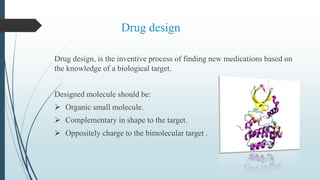
Drug design, is the inventive process of finding new medications based on
the knowledge of a biological target.
Designed molecule should be:
 Organic small molecule.
 Complementary in shape to the target.
 Oppositely charge to the bimolecular target .
Types of drug design
1) Ligand Based Drug Design
 Relies on knowledge of other molecules that bind to the biological target of interest.
 Used to derive a pharmacophore model that defines the minimum necessary structural characteristics a molecule
must possess in order to bind to the target.
2) Structure-based drug design
Relies on knowledge of the three dimensional structure of the biological target obtained through :
1) X-ray crystallography
2) Nuclear Magnetic Resonance (NMR) spectroscopy.
Life cycle of drug design
 Traditional Life Cycle
Synthetic or Natural compound
Preclinical Trials
Clinical Trial
Modern drug design
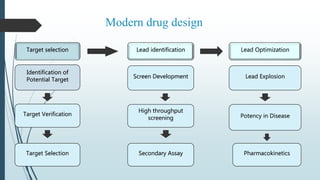
Target selection Lead identification Lead Optimization
Identification of
Potential Target
Target Verification
Target Selection
Screen Development
High throughput
screening
Secondary Assay
Lead Explosion
Potency in Disease
Pharmacokinetics
Introduction to CADD
 CADD stands for Computer Aided drug design
 Lies In the hand of computational scientists, who are able to manipulate
molecule on the screen.
 Rather it is a complex process involving many scientist from various stream
working together.
Drug design with the help of computers using:
 Molecular docking
 virtual screening
 QSAR
Objective of CADD
 To change from:
 Random screening against disease assays
 Natural products, synthetic chemicals
 To:
 Rational drug design and testing
 Speed-up screening process
 Efficient screening
 De novo design
 Integration of testing into design process
 Fail drugs fast.
Steps involved in drug designing
1) Target Identification
 A target is a molecule (protein) which is present within an organism.
 The approaches of identifying targets include protein expression, protein biochemistry, structure
function studies, study of biochemical pathways.
2) Target Validation
 As there are a plethora of new potential therapeutics drug targets that are being discovered ,
selection and validation of novel molecular targets has become important.
 It needs to be confirmed that the targets identified will affect an appropriate biological response
 Targeted gene disruption is a term that refers to several different methods of target validation.
3) Lead identification:
 A lead is a compound that demonstrates a desired biological activity on a validated
molecular target.
 To be termed as a lead, the compound must exceed a specific potency threshold against the
target.
 The compounds used as potential leads can be from many sources. The most important
sources of leads is libraries of molecules.
4) Lead optimization:
 Once a lead compound is established in the identification process we need to optimize the
desirable targets of the lead.
 To be considered for further development lead should be amenable for chemistry
optimization.
Important Techniques of Drug Design
1. X-ray crystallography
 X-ray crystallography is often the starting point for
gathering information from mechanistic drug design.
 This technology has the potential to determine total
structural information about a molecule.
 Furthermore it provides the critically important
coordinates needed for the handling of data by
computer modeling system.
2) NMR Spectroscopy
 NMR uses much softer radiation which
can examine molecules in the more
mobile liquid phase, so the three-
dimensional information obtained may
be more representative of the molecule
in its biological environment.
 Another advantage of NMR is its ability
to examine small molecule-
macromolecule complexes, such as an
enzyme inhibitor in the active site of the
enzyme.
Software for drug designing
Categories of software:
1. Databases & Draw Tools
Example: Zinc database , Chem draw
2. Molecular Modeling & Homology
Example: CHARMM, Modeller
3. Binding site prediction & Docking
Example: MED-Sumo, Autodock
4. Ligand design Screening –QSAR
Example: cQSAR
5. Binding free energy estimation
Example: Hyde, X-score
6. ADME Toxicity
Example: VolSurf, GastroPLus
Advantages of CADD
 Time
 Cost
 Accuracy
 Information about the disease
 Screening is reduced
 Database screening
 Less manpower is required.
Success stories of CADD
 K+ ion channel blocker
* Structural based discovery
Example: Sotalol is indicated for the treatment of atrial or ventricular tachyarrhythmia.
 Ca2+ antagonist / T-channel blocker
* Chemical descriptor based discovery
Example: Amlodipine is used to treat high blood pressure and coronary artery disease.
 Thrombin inhibitor
*Docking, de-novo design
Example: Hirudin has a blood anticoagulant property.
Targeted drug delivery System.
What Do we understand by Drug
Target??
Targeted drug delivery system is based on a method that delivers a certain
amount of a therapeutic agent for a prolonged period of time to a targeted
diseased area within the body. This helps maintain the required plasma and
tissue drug levels in the body; therefore avoiding any damage to the
healthy tissue via the drug.
Targeted drug delivery implies for selective and effective localization of
pharmacologically active moiety at preselected targets in therapeutic
concentration, while restricting its access to non-target normal cellular
linings, thus minimizing toxic effects and maximizing therapeutic index”.
Reasons for drug targeting:
 In the treatment or prevention or diseases.
Pharmaceutical Reason:
• Drug instability
• Low solubility
Pharmacokinetic Reason:
• Poor absorption,
• Short half life,
• Large volume of distribution
Pharmacodynamics Reason:
• Low specificity,
• Low therapeutic index.
Biochemically inert (non-toxic),
Non-immunogenic,
Physically and chemically stable in vivo and in
vitro conditions,
Should have restricted drug distribution to target
cells or tissues or organs
Uniform capillary distribution.
Controllable and predictable rate of drug release
Drug release should not affect the drug action.
Should have therapeutic amount of drug release
Should have minimal drug leakage during transit
Ideal
Characteristics
Advantages-
 Drug administration protocols may be simplified .
 Toxicity is reduced by delivering a drug to its target site .
 Reduction of drug side effects
 Reduced frequency of drug intake
 Reduced dose of drug
 Uniform blood level of drug
 Maximize the therapeutic index
 Avoidance of hepatic first pass metabolism .
 No peak and valley plasma concentration .
Disadvantages
 Rapid clearance of targeted systems.
 Immune reactions against intravenous administered carrier systems.
 Insufficient localization of targeted systems into tumour cells.
 Diffusion and redistribution of released drugs.
 Requires highly sophisticated technology for the formulation.
 Requires skill for manufacturing storage, administration.
 Drug deposition at the target site may produce toxicity symptoms.
 Difficult to maintain stability of dosage form. E.g.: Resealed erythrocytes
have to be stored at 40 C.
 Drug loading is usually law. E.g. As in micelles. Therefore it is difficult to
predict /fix the dosage regimen.
Drug target
strategies
Passive
Active
Physical
Double
Inverse
Combina
tion-ion
Ligand-
mediated
Dual
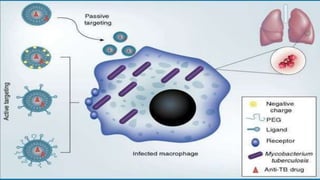
Passive Targeting:
 It utilizes the natural course of bio distribution of the carrier.
 The colloids which are taken up by the reticulo-endothelial system (RES) can be ideal vectors
for passive targeting of drugs to RES predominant compartments.
 Passive capture of colloidal carriers by macrophages offers therapeutic opportunities for the
delivery of anti-infective agents.
Few examples of passive targeting
1. The colloids which are taken up by the reticulo-endothelial system (RES)
can be ideal vector for passive targeting of drugs to RES predominant
compartments.
2. In case of cancer treatment the drug carrier complex can be targeted to
the tumor site by employing the Enhanced permeability retention
(EPS) effect.
3. Passive targeting may also be directed to lymphoid organs, as these organs
are finely structured and nanoparticles may easily penetrate into lymphatic
vessels.
Active Targeting
It involves the modification or functionalization of the drug carriers so that the contents
are delivered exclusively to the site corresponding to which the carrier is architected.
Active targeting can be affected at different
levels –
 First order targeting (organ compartmentalization)
 Second order targeting (cellular targeting)
 Third order targeting (intercellular organelles targeting)
First
Order
Second
Order
Third
Order
2. Second order targeting (cellular targeting) :
When the drug delivery system releases the drug into a
particular cell within an organ or tissue, it is called cellular
targeting.
• Ex- Selective drug delivery to kuppfer cells in the liver.
1. First order targeting (organ compartmentalization):
Restricted distribution of drug carrier system to the capillary
bed of a predetermined target site, organ.
• Ex- Compartmental targeting in lymphatic, peritoneal cavity,
plural cavity, cerebral ventricles etc.
3. Third order targeting (intercellular organelles targeting):
When the delivery system can enter specific cells and leave
the drug intracellular, then it is called third order or sub
cellular targeting process.
• Ex- Receptor based ligand mediated entry of a drug
complex into a cell by endocytosis.
Different Carriers used in drug targeting
References
 Structural biology and drug discovery” Miles Congreve,Christopher W.Murray and Tom
L.Blundell, Volume 10, Number 13 • July 2005
 Bioorganic and Medicinal chemistry “Drug Guru: A computer software program for drug
design using medicinal chemistry rules” , Kent D. Stewart, Melisa Shirodaa and Craig A.
James, 14, 7011–7022, 2010.
 Drug Discovery Today “Shape Signatures: speeding up computer-aided drug discovery”,
Peter J. Meek et al. , Volume 11, Numbers 19/20 October 2006.
 Drug Discovery Today: Technologies, “ New technologies in computer-aided drug
design: Toward target identification and new chemical entity discovery”, Yun Tang,
Weiliang Zhu, Kaixian Chen, Hualiang Jiang, Vol. 3, No. 3 2006.
 www.sciencedirect.com
Computer Aided drug Design and its discovery process

Computer Aided drug Design and its discovery process

  • 1.
    Computer aided drugdesigning for targeted drug delivery System. Presented by: Mahmudur Rahman Saad Rafiul Bashar Rabby Mehedi Hasan Presented to: Fatema Dr. Khondker Ayesha Akter Jemin Kabir Purno Department of Pharmaceutical Sciences North South University
  • 2.
    Drug A chemical substancethat affects the processes of the mind or body which is used in-  Diagnosis  Medication  Treatment  Prevention of disease or other abnormal condition.
  • 3.
    Drug design Drug design,is the inventive process of finding new medications based on the knowledge of a biological target. Designed molecule should be:  Organic small molecule.  Complementary in shape to the target.  Oppositely charge to the bimolecular target .
  • 4.
    Types of drugdesign 1) Ligand Based Drug Design  Relies on knowledge of other molecules that bind to the biological target of interest.  Used to derive a pharmacophore model that defines the minimum necessary structural characteristics a molecule must possess in order to bind to the target. 2) Structure-based drug design Relies on knowledge of the three dimensional structure of the biological target obtained through : 1) X-ray crystallography 2) Nuclear Magnetic Resonance (NMR) spectroscopy.
  • 5.
    Life cycle ofdrug design  Traditional Life Cycle Synthetic or Natural compound Preclinical Trials Clinical Trial
  • 6.
    Modern drug design Targetselection Lead identification Lead Optimization Identification of Potential Target Target Verification Target Selection Screen Development High throughput screening Secondary Assay Lead Explosion Potency in Disease Pharmacokinetics
  • 7.
    Introduction to CADD CADD stands for Computer Aided drug design  Lies In the hand of computational scientists, who are able to manipulate molecule on the screen.  Rather it is a complex process involving many scientist from various stream working together. Drug design with the help of computers using:  Molecular docking  virtual screening  QSAR
  • 8.
    Objective of CADD To change from:  Random screening against disease assays  Natural products, synthetic chemicals  To:  Rational drug design and testing  Speed-up screening process  Efficient screening  De novo design  Integration of testing into design process  Fail drugs fast.
  • 9.
    Steps involved indrug designing 1) Target Identification  A target is a molecule (protein) which is present within an organism.  The approaches of identifying targets include protein expression, protein biochemistry, structure function studies, study of biochemical pathways. 2) Target Validation  As there are a plethora of new potential therapeutics drug targets that are being discovered , selection and validation of novel molecular targets has become important.  It needs to be confirmed that the targets identified will affect an appropriate biological response  Targeted gene disruption is a term that refers to several different methods of target validation.
  • 10.
    3) Lead identification: A lead is a compound that demonstrates a desired biological activity on a validated molecular target.  To be termed as a lead, the compound must exceed a specific potency threshold against the target.  The compounds used as potential leads can be from many sources. The most important sources of leads is libraries of molecules. 4) Lead optimization:  Once a lead compound is established in the identification process we need to optimize the desirable targets of the lead.  To be considered for further development lead should be amenable for chemistry optimization.
  • 11.
    Important Techniques ofDrug Design 1. X-ray crystallography  X-ray crystallography is often the starting point for gathering information from mechanistic drug design.  This technology has the potential to determine total structural information about a molecule.  Furthermore it provides the critically important coordinates needed for the handling of data by computer modeling system.
  • 12.
    2) NMR Spectroscopy NMR uses much softer radiation which can examine molecules in the more mobile liquid phase, so the three- dimensional information obtained may be more representative of the molecule in its biological environment.  Another advantage of NMR is its ability to examine small molecule- macromolecule complexes, such as an enzyme inhibitor in the active site of the enzyme.
  • 13.
    Software for drugdesigning Categories of software: 1. Databases & Draw Tools Example: Zinc database , Chem draw 2. Molecular Modeling & Homology Example: CHARMM, Modeller 3. Binding site prediction & Docking Example: MED-Sumo, Autodock 4. Ligand design Screening –QSAR Example: cQSAR 5. Binding free energy estimation Example: Hyde, X-score 6. ADME Toxicity Example: VolSurf, GastroPLus
  • 14.
    Advantages of CADD Time  Cost  Accuracy  Information about the disease  Screening is reduced  Database screening  Less manpower is required.
  • 15.
    Success stories ofCADD  K+ ion channel blocker * Structural based discovery Example: Sotalol is indicated for the treatment of atrial or ventricular tachyarrhythmia.  Ca2+ antagonist / T-channel blocker * Chemical descriptor based discovery Example: Amlodipine is used to treat high blood pressure and coronary artery disease.  Thrombin inhibitor *Docking, de-novo design Example: Hirudin has a blood anticoagulant property.
  • 16.
  • 17.
    What Do weunderstand by Drug Target?? Targeted drug delivery system is based on a method that delivers a certain amount of a therapeutic agent for a prolonged period of time to a targeted diseased area within the body. This helps maintain the required plasma and tissue drug levels in the body; therefore avoiding any damage to the healthy tissue via the drug. Targeted drug delivery implies for selective and effective localization of pharmacologically active moiety at preselected targets in therapeutic concentration, while restricting its access to non-target normal cellular linings, thus minimizing toxic effects and maximizing therapeutic index”.
  • 18.
    Reasons for drugtargeting:  In the treatment or prevention or diseases. Pharmaceutical Reason: • Drug instability • Low solubility Pharmacokinetic Reason: • Poor absorption, • Short half life, • Large volume of distribution Pharmacodynamics Reason: • Low specificity, • Low therapeutic index.
  • 19.
    Biochemically inert (non-toxic), Non-immunogenic, Physicallyand chemically stable in vivo and in vitro conditions, Should have restricted drug distribution to target cells or tissues or organs Uniform capillary distribution. Controllable and predictable rate of drug release Drug release should not affect the drug action. Should have therapeutic amount of drug release Should have minimal drug leakage during transit Ideal Characteristics
  • 20.
    Advantages-  Drug administrationprotocols may be simplified .  Toxicity is reduced by delivering a drug to its target site .  Reduction of drug side effects  Reduced frequency of drug intake  Reduced dose of drug  Uniform blood level of drug  Maximize the therapeutic index  Avoidance of hepatic first pass metabolism .  No peak and valley plasma concentration .
  • 21.
    Disadvantages  Rapid clearanceof targeted systems.  Immune reactions against intravenous administered carrier systems.  Insufficient localization of targeted systems into tumour cells.  Diffusion and redistribution of released drugs.  Requires highly sophisticated technology for the formulation.  Requires skill for manufacturing storage, administration.  Drug deposition at the target site may produce toxicity symptoms.  Difficult to maintain stability of dosage form. E.g.: Resealed erythrocytes have to be stored at 40 C.  Drug loading is usually law. E.g. As in micelles. Therefore it is difficult to predict /fix the dosage regimen.
  • 22.
  • 23.
    Passive Targeting:  Itutilizes the natural course of bio distribution of the carrier.  The colloids which are taken up by the reticulo-endothelial system (RES) can be ideal vectors for passive targeting of drugs to RES predominant compartments.  Passive capture of colloidal carriers by macrophages offers therapeutic opportunities for the delivery of anti-infective agents. Few examples of passive targeting 1. The colloids which are taken up by the reticulo-endothelial system (RES) can be ideal vector for passive targeting of drugs to RES predominant compartments. 2. In case of cancer treatment the drug carrier complex can be targeted to the tumor site by employing the Enhanced permeability retention (EPS) effect. 3. Passive targeting may also be directed to lymphoid organs, as these organs are finely structured and nanoparticles may easily penetrate into lymphatic vessels.
  • 25.
    Active Targeting It involvesthe modification or functionalization of the drug carriers so that the contents are delivered exclusively to the site corresponding to which the carrier is architected. Active targeting can be affected at different levels –  First order targeting (organ compartmentalization)  Second order targeting (cellular targeting)  Third order targeting (intercellular organelles targeting)
  • 26.
    First Order Second Order Third Order 2. Second ordertargeting (cellular targeting) : When the drug delivery system releases the drug into a particular cell within an organ or tissue, it is called cellular targeting. • Ex- Selective drug delivery to kuppfer cells in the liver. 1. First order targeting (organ compartmentalization): Restricted distribution of drug carrier system to the capillary bed of a predetermined target site, organ. • Ex- Compartmental targeting in lymphatic, peritoneal cavity, plural cavity, cerebral ventricles etc. 3. Third order targeting (intercellular organelles targeting): When the delivery system can enter specific cells and leave the drug intracellular, then it is called third order or sub cellular targeting process. • Ex- Receptor based ligand mediated entry of a drug complex into a cell by endocytosis.
  • 27.
    Different Carriers usedin drug targeting
  • 28.
    References  Structural biologyand drug discovery” Miles Congreve,Christopher W.Murray and Tom L.Blundell, Volume 10, Number 13 • July 2005  Bioorganic and Medicinal chemistry “Drug Guru: A computer software program for drug design using medicinal chemistry rules” , Kent D. Stewart, Melisa Shirodaa and Craig A. James, 14, 7011–7022, 2010.  Drug Discovery Today “Shape Signatures: speeding up computer-aided drug discovery”, Peter J. Meek et al. , Volume 11, Numbers 19/20 October 2006.  Drug Discovery Today: Technologies, “ New technologies in computer-aided drug design: Toward target identification and new chemical entity discovery”, Yun Tang, Weiliang Zhu, Kaixian Chen, Hualiang Jiang, Vol. 3, No. 3 2006.  www.sciencedirect.com