Statistical Description of
Turbulence
Khusro Kamaluddin
Introduction
Detailed behavior of random flow turbulence are unpredictable
Statistical Characteristics are largely reproducible
Navier Stokes Equations are Deterministic
Solutions are random
Randomness is a result of unavoidable perturbations in the:
1. Initial Conditions
2. Boundary Conditions
3. Material Properties
Introduction
Turbulent flow displays an acute sensitivity to such
perturbations.
Butterfly Effect.
Probability
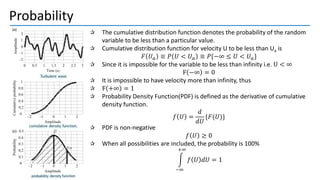
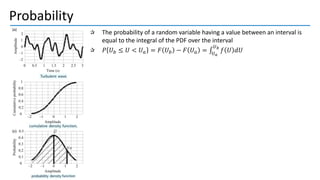
The cumulative distribution function denotes the probability of the random
variable to be less than a particular value.
Cumulative distribution function for velocity U to be less than Ua is
𝐹 𝑈𝑎 ≡ 𝑃 𝑈 < 𝑈𝑎 ≡ 𝑃{−∞ ≤ 𝑈 < 𝑈𝑎}
Since it is impossible for the variable to be less than infinity i.e. U < ∞
F −∞ = 0
It is impossible to have velocity more than infinity, thus
F +∞ = 1
Probability Density Function(PDF) is defined as the derivative of cumulative
density function.
𝑓 𝑈 =
𝑑
𝑑𝑈
{𝐹(𝑈)}
PDF is non-negative
𝑓 𝑈 ≥ 0
When all possibilities are included, the probability is 100%
න
−∞
+∞
𝑓 𝑈 𝑑𝑈 = 1
Probability
The probability of a random variable having a value between an interval is
equal to the integral of the PDF over the interval
𝑃 𝑈𝑏 ≤ 𝑈 < 𝑈𝑎 = 𝐹 𝑈𝑏 − 𝐹 𝑈𝑎 = ‫׬‬
𝑈𝑎
𝑈𝑏
𝑓 𝑈 𝑑𝑈
Moments
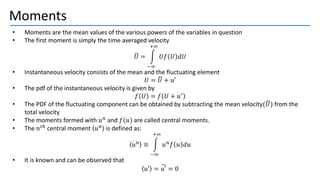
• Moments are the mean values of the various powers of the variables in question
• The first moment is simply the time averaged velocity
ഥ
𝑈 = න
−∞
+∞
𝑈𝑓 𝑈 𝑑𝑈
• Instantaneous velocity consists of the mean and the fluctuating element
𝑈 = ഥ
𝑈 + u′
• The pdf of the instantaneous velocity is given by
𝑓 𝑈 = 𝑓 𝑈 + 𝑢′
• The PDF of the fluctuating component can be obtained by subtracting the mean velocity(ഥ
𝑈) from the
total velocity
• The moments formed with 𝑢𝑛
and 𝑓(𝑢) are called central moments.
• The 𝑛𝑡ℎ
central moment 𝑢𝑛
is defined as:
𝑢𝑛
≡ න
−∞
+∞
𝑢𝑛
𝑓 𝑢 𝑑𝑢
• It is known and can be observed that
𝑢′ = ഥ
𝑢′ = 0
Moments
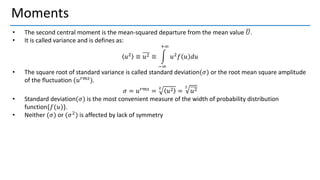
• The second central moment is the mean-squared departure from the mean value ഥ
𝑈.
• It is called variance and is defines as:
𝑢2 ≡ 𝑢2 ≡ න
−∞
+∞
𝑢2𝑓 𝑢 𝑑𝑢
• The square root of standard variance is called standard deviation(𝜎) or the root mean square amplitude
of the fluctuation (𝑢𝑟𝑚𝑠
).
𝜎 = 𝑢𝑟𝑚𝑠
=
2
𝑢2 =
2
𝑢2
• Standard deviation(𝜎) is the most convenient measure of the width of probability distribution
function{𝑓(𝑢)}.
• Neither (𝜎) or (𝜎2) is affected by lack of symmetry
Moments
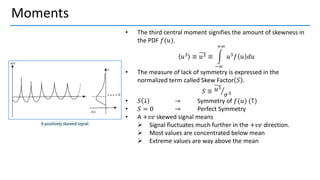
• The third central moment signifies the amount of skewness in
the PDF 𝑓(𝑢).
𝑢3 ≡ 𝑢3 ≡ න
−∞
+∞
𝑢3𝑓 𝑢 𝑑𝑢
• The measure of lack of symmetry is expressed in the
normalized term called Skew Factor 𝑆 .
𝑆 ≡ ൗ
𝑢3
𝜎3
• 𝑆 ↓ → Symmetry of 𝑓(𝑢) (↑)
• 𝑆 = 0 → Perfect Symmetry
• A +𝑣𝑒 skewed signal means
➢ Signal fluctuates much further in the +𝑣𝑒 direction.
➢ Most values are concentrated below mean
➢ Extreme values are way above the mean
Moments
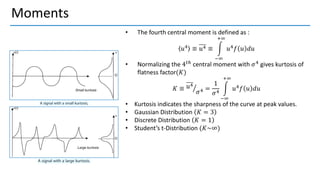
• The fourth central moment is defined as :
𝑢4 ≡ 𝑢4 ≡ න
−∞
+∞
𝑢4𝑓 𝑢 𝑑𝑢
• Normalizing the 4𝑡ℎ central moment with 𝜎4 gives kurtosis of
flatness factor(𝐾)
𝐾 ≡ ൗ
𝑢4
𝜎4 =
1
𝜎4
න
−∞
+∞
𝑢4𝑓 𝑢 𝑑𝑢
• Kurtosis indicates the sharpness of the curve at peak values.
• Gaussian Distribution 𝐾 = 3
• Discrete Distribution 𝐾 = 1
• Student’s t-Distribution (𝐾~∞)
Joint Statistics and Correlation Functions
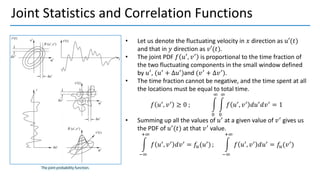
• Let us denote the fluctuating velocity in 𝑥 direction as 𝑢′(𝑡)
and that in 𝑦 direction as 𝑣′(𝑡).
• The joint PDF 𝑓 𝑢′, 𝑣′ is proportional to the time fraction of
the two fluctuating components in the small window defined
by 𝑢′, (𝑢′ + ∆𝑢′)and (𝑣′ + ∆𝑣′).
• The time fraction cannot be negative, and the time spent at all
the locations must be equal to total time.
𝑓 𝑢′, 𝑣′ ≥ 0 ; න
0
∞
න
0
∞
𝑓 𝑢′, 𝑣′ 𝑑𝑢′𝑑𝑣′ = 1
• Summing up all the values of 𝑢′
at a given value of 𝑣′
gives us
the PDF of 𝑢′
(𝑡) at that 𝑣′
value.
න
−∞
+∞
𝑓 𝑢′
, 𝑣′
𝑑𝑣′
= 𝑓𝑢(𝑢′
) ; න
−∞
+∞
𝑓 𝑢′
, 𝑣′
𝑑𝑢′
= 𝑓𝑢(𝑣′
)
Joint Statistics and Correlation Functions
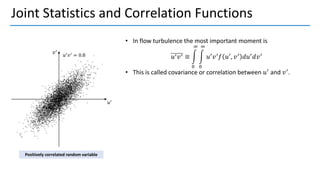
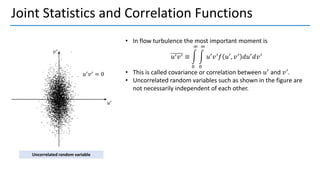
• In flow turbulence the most important moment is
𝑢′𝑣′ ≡ න
0
∞
න
0
∞
𝑢′
𝑣′
𝑓 𝑢′
, 𝑣′
𝑑𝑢′
𝑑𝑣′
• This is called covariance or correlation between 𝑢′
and 𝑣′
.
Positively correlated random variable
Joint Statistics and Correlation Functions
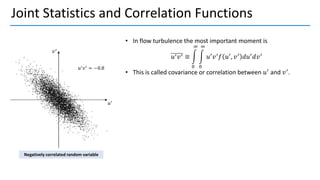
• In flow turbulence the most important moment is
𝑢′𝑣′ ≡ න
0
∞
න
0
∞
𝑢′
𝑣′
𝑓 𝑢′
, 𝑣′
𝑑𝑢′
𝑑𝑣′
• This is called covariance or correlation between 𝑢′
and 𝑣′
.
Negatively correlated random variable
Joint Statistics and Correlation Functions
• In flow turbulence the most important moment is
𝑢′𝑣′ ≡ න
0
∞
න
0
∞
𝑢′
𝑣′
𝑓 𝑢′
, 𝑣′
𝑑𝑢′
𝑑𝑣′
• This is called covariance or correlation between 𝑢′
and 𝑣′
.
• Uncorrelated random variables such as shown in the figure are
not necessarily independent of each other.
Uncorrelated random variable
Joint Statistics and Correlation Functions
• In flow turbulence the most important moment is
𝑢′𝑣′ ≡ න
0
∞
න
0
∞
𝑢′
𝑣′
𝑓 𝑢′
, 𝑣′
𝑑𝑢′
𝑑𝑣′
• This is called covariance or correlation between 𝑢′
and 𝑣′
.
• Uncorrelated random variables such as shown in the figure are
not necessarily independent of each other.
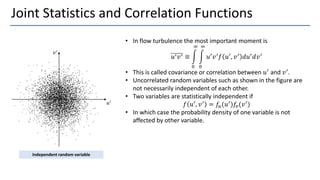
• Two variables are statistically independent if
𝑓 𝑢′
, 𝑣′
= 𝑓𝑢(𝑢′
)𝑓𝑣(𝑣′
)
• In which case the probability density of one variable is not
affected by other variable.
Independent random variable
Temporal and Spatial Variations
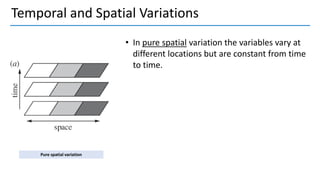
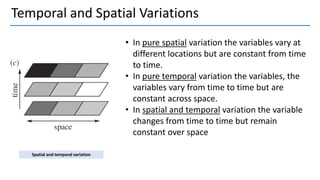
• In pure spatial variation the variables vary at
different locations but are constant from time
to time.
Pure spatial variation
Temporal and Spatial Variations
• In pure spatial variation the variables vary at
different locations but are constant from time
to time.
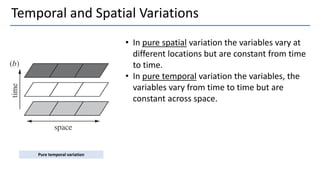
• In pure temporal variation the variables, the
variables vary from time to time but are
constant across space.
Pure temporal variation
Temporal and Spatial Variations
• In pure spatial variation the variables vary at
different locations but are constant from time
to time.
• In pure temporal variation the variables, the
variables vary from time to time but are
constant across space.
• In spatial and temporal variation the variable
changes from time to time but remain
constant over space
Spatial and temporal variation
Temporal and Spatial Variations
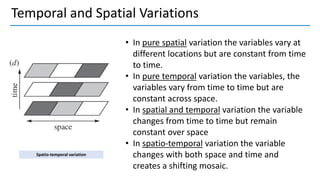
• In pure spatial variation the variables vary at
different locations but are constant from time
to time.
• In pure temporal variation the variables, the
variables vary from time to time but are
constant across space.
• In spatial and temporal variation the variable
changes from time to time but remain
constant over space
• In spatio-temporal variation the variable
changes with both space and time and
creates a shifting mosaic.
Spatio-temporal variation
Types of Turbulence
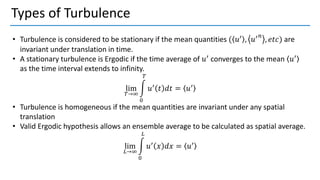
• Turbulence is considered to be stationary if the mean quantities ( 𝑢′ , 𝑢′𝑛
, 𝑒𝑡𝑐) are
invariant under translation in time.
• A stationary turbulence is Ergodic if the time average of 𝑢′ converges to the mean 𝑢′
as the time interval extends to infinity.
lim
𝑇→∞
න
0
𝑇
𝑢′
𝑡 𝑑𝑡 = 𝑢′
• Turbulence is homogeneous if the mean quantities are invariant under any spatial
translation
• Valid Ergodic hypothesis allows an ensemble average to be calculated as spatial average.
lim
𝐿→∞
න
0
𝐿
𝑢′
𝑥 𝑑𝑥 = 𝑢′
Types of Turbulence
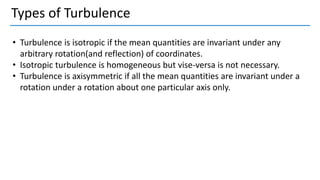
• Turbulence is isotropic if the mean quantities are invariant under any
arbitrary rotation(and reflection) of coordinates.
• Isotropic turbulence is homogeneous but vise-versa is not necessary.
• Turbulence is axisymmetric if all the mean quantities are invariant under a
rotation under a rotation about one particular axis only.
Types of Turbulence
• Turbulence is isotropic if the mean quantities are invariant under any
arbitrary rotation(and reflection) of coordinates.
• Isotropic turbulence is homogeneous but vise-versa is not necessary.
• Turbulence is axisymmetric if all the mean quantities are invariant under a
rotation under a rotation about one particular axis only.
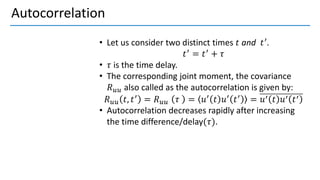
Autocorrelation
• Let us consider two distinct times 𝑡 and 𝑡′.
𝑡′ = 𝑡′ + 𝜏
• 𝜏 is the time delay.
• The corresponding joint moment, the covariance
𝑅𝑢𝑢 also called as the autocorrelation is given by:
𝑅𝑢𝑢 𝑡, 𝑡′
= 𝑅𝑢𝑢 𝜏 = 𝑢′
𝑡 𝑢′
𝑡′
= 𝑢′ 𝑡 𝑢′ 𝑡′
• Autocorrelation decreases rapidly after increasing
the time difference/delay(𝜏).
Autocorrelation
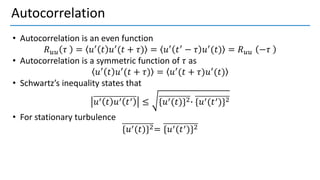
• Autocorrelation is an even function
𝑅𝑢𝑢 𝜏 = 𝑢′ 𝑡 𝑢′(𝑡 + 𝜏) = 𝑢′ 𝑡′ − 𝜏 𝑢′(𝑡) = 𝑅𝑢𝑢 −𝜏
• Autocorrelation is a symmetric function of 𝜏 as
𝑢′ 𝑡 𝑢′(𝑡 + 𝜏) = 𝑢′(𝑡 + 𝜏)𝑢′(𝑡)
• Schwartz’s inequality states that
ห ห
𝑢′ 𝑡 𝑢′ 𝑡′ ≤ {𝑢′(𝑡)}2∙ {𝑢′(𝑡′)}2
• For stationary turbulence
{𝑢′(𝑡)}2= {𝑢′(𝑡′)}2
Autocorrelation
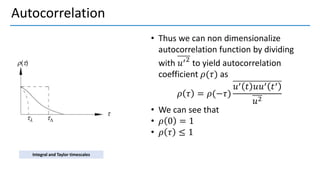
• Thus we can non dimensionalize
autocorrelation function by dividing
with 𝑢′2
to yield autocorrelation
coefficient 𝜌(𝜏) as
𝜌 𝜏 = 𝜌(−𝜏)
𝑢′ 𝑡 𝑢𝑢′ 𝑡′
𝑢2
• We can see that
• 𝜌 0 = 1
• 𝜌 𝜏 ≤ 1
Integral and Taylor timescales
Timescales
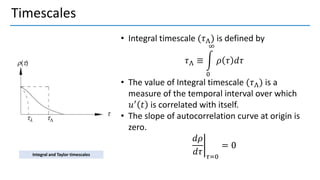
• Integral timescale (𝜏Λ) is defined by
𝜏Λ ≡ න
0
∞
𝜌 𝜏 𝑑𝜏
• The value of Integral timescale (𝜏Λ) is a
measure of the temporal interval over which
𝑢′ 𝑡 is correlated with itself.
• The slope of autocorrelation curve at origin is
zero.
ቤ
𝑑𝜌
𝑑𝜏 𝜏=0
= 0
Integral and Taylor timescales
Timescales
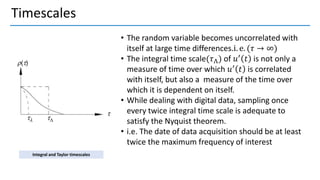
• The random variable becomes uncorrelated with
itself at large time differences.i. e. (𝜏 → ∞)
• The integral time scale(𝜏Λ) of 𝑢′
𝑡 is not only a
measure of time over which 𝑢′
𝑡 is correlated
with itself, but also a measure of the time over
which it is dependent on itself.
• While dealing with digital data, sampling once
every twice integral time scale is adequate to
satisfy the Nyquist theorem.
• i.e. The date of data acquisition should be at least
twice the maximum frequency of interest
Integral and Taylor timescales
Timescales
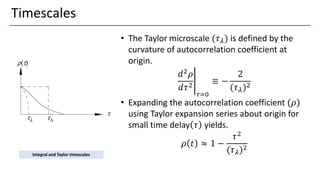
• The Taylor microscale (𝜏𝜆) is defined by the
curvature of autocorrelation coefficient at
origin.
อ
𝑑2𝜌
𝑑𝜏2
𝜏=0
≡ −
2
(𝜏𝜆)2
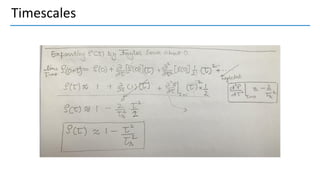
• Expanding the autocorrelation coefficient (𝜌)
using Taylor expansion series about origin for
small time delay 𝜏 yields.
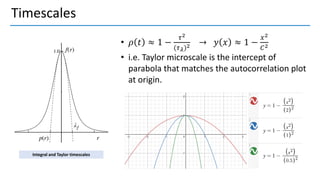
𝜌 𝑡 ≈ 1 −
𝜏2
(𝜏𝜆)2
Integral and Taylor timescales
Timescales
Timescales
• 𝜌 𝑡 ≈ 1 −
𝜏2
(𝜏𝜆)2 → 𝑦 𝑥 ≈ 1 −
𝑥2
𝐶2
• i.e. Taylor microscale is the intercept of
parabola that matches the autocorrelation plot
at origin.
Integral and Taylor timescales
Timescales
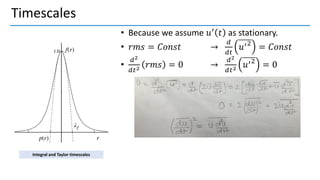
• Because we assume 𝑢′ 𝑡 as stationary.
• 𝑟𝑚𝑠 = 𝐶𝑜𝑛𝑠𝑡 →
𝑑
𝑑𝑡
𝑢′2
= 𝐶𝑜𝑛𝑠𝑡
•
𝑑2
𝑑𝑡2 𝑟𝑚𝑠 = 0 →
𝑑2
𝑑𝑡2 𝑢′2
= 0
Integral and Taylor timescales
Timescales
• Because we assume 𝑢′ 𝑡 as stationary.
• 𝑟𝑚𝑠 = 𝐶𝑜𝑛𝑠𝑡 →
𝑑
𝑑𝑡
𝑢′2
= 𝐶𝑜𝑛𝑠𝑡
•
𝑑2
𝑑𝑡2 𝑟𝑚𝑠 = 0 →
𝑑2
𝑑𝑡2 𝑢′2
= 0
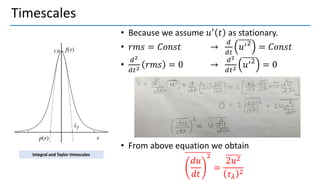
• From above equation we obtain
𝑑𝑢
𝑑𝑡
2
=
2𝑢2
𝜏𝜆
2
Integral and Taylor timescales
Timescales
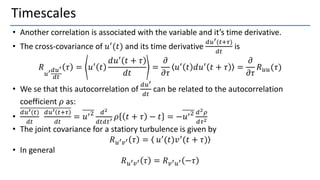
• Another correlation is associated with the variable and it’s time derivative.
• The cross-covariance of 𝑢′
(𝑡) and its time derivative
𝑑𝑢′(𝑡+𝜏)
𝑑𝑡
is
𝑅
𝑢′𝑑𝑢′
𝑑𝑡
𝜏 = 𝑢′
𝑡
𝑑𝑢′ 𝑡 + 𝜏
𝑑𝑡
=
𝜕
𝜕𝜏
𝑢′
𝑡 𝑑𝑢′
𝑡 + 𝜏 =
𝜕
𝜕𝜏
𝑅𝑢𝑢(𝜏)
• We se that this autocorrelation of
𝑑𝑢′
𝑑𝑡
can be related to the autocorrelation
coefficient 𝜌 as:
•
𝑑𝑢′(𝑡)
𝑑𝑡
𝑑𝑢′ 𝑡+𝜏
𝑑𝑡
= 𝑢′2 𝑑2
𝑑𝑡𝑑𝑡′ 𝜌 𝑡 + 𝜏 − 𝑡 = −𝑢′2 𝑑2𝜌
𝑑𝜏2
• The joint covariance for a statiory turbulence is given by
𝑅𝑢′𝑣′ 𝜏 = 𝑢′
(𝑡)𝑣′
(𝑡 + 𝜏)
• In general
𝑅𝑢′𝑣′ 𝜏 = 𝑅𝑣′𝑢′ −𝜏
Timescales
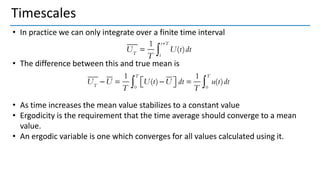
• In practice we can only integrate over a finite time interval
• The difference between this and true mean is
• As time increases the mean value stabilizes to a constant value
• Ergodicity is the requirement that the time average should converge to a mean
value.
• An ergodic variable is one which converges for all values calculated using it.
Fourier Series

Statistical Description of Turbulent Flow

  • 1.
  • 2.
    Introduction Detailed behavior ofrandom flow turbulence are unpredictable Statistical Characteristics are largely reproducible Navier Stokes Equations are Deterministic Solutions are random Randomness is a result of unavoidable perturbations in the: 1. Initial Conditions 2. Boundary Conditions 3. Material Properties
  • 3.
    Introduction Turbulent flow displaysan acute sensitivity to such perturbations. Butterfly Effect.
  • 4.
    Probability The cumulative distributionfunction denotes the probability of the random variable to be less than a particular value. Cumulative distribution function for velocity U to be less than Ua is 𝐹 𝑈𝑎 ≡ 𝑃 𝑈 < 𝑈𝑎 ≡ 𝑃{−∞ ≤ 𝑈 < 𝑈𝑎} Since it is impossible for the variable to be less than infinity i.e. U < ∞ F −∞ = 0 It is impossible to have velocity more than infinity, thus F +∞ = 1 Probability Density Function(PDF) is defined as the derivative of cumulative density function. 𝑓 𝑈 = 𝑑 𝑑𝑈 {𝐹(𝑈)} PDF is non-negative 𝑓 𝑈 ≥ 0 When all possibilities are included, the probability is 100% න −∞ +∞ 𝑓 𝑈 𝑑𝑈 = 1
  • 5.
    Probability The probability ofa random variable having a value between an interval is equal to the integral of the PDF over the interval 𝑃 𝑈𝑏 ≤ 𝑈 < 𝑈𝑎 = 𝐹 𝑈𝑏 − 𝐹 𝑈𝑎 = ‫׬‬ 𝑈𝑎 𝑈𝑏 𝑓 𝑈 𝑑𝑈
  • 6.
    Moments • Moments arethe mean values of the various powers of the variables in question • The first moment is simply the time averaged velocity ഥ 𝑈 = න −∞ +∞ 𝑈𝑓 𝑈 𝑑𝑈 • Instantaneous velocity consists of the mean and the fluctuating element 𝑈 = ഥ 𝑈 + u′ • The pdf of the instantaneous velocity is given by 𝑓 𝑈 = 𝑓 𝑈 + 𝑢′ • The PDF of the fluctuating component can be obtained by subtracting the mean velocity(ഥ 𝑈) from the total velocity • The moments formed with 𝑢𝑛 and 𝑓(𝑢) are called central moments. • The 𝑛𝑡ℎ central moment 𝑢𝑛 is defined as: 𝑢𝑛 ≡ න −∞ +∞ 𝑢𝑛 𝑓 𝑢 𝑑𝑢 • It is known and can be observed that 𝑢′ = ഥ 𝑢′ = 0
  • 7.
    Moments • The secondcentral moment is the mean-squared departure from the mean value ഥ 𝑈. • It is called variance and is defines as: 𝑢2 ≡ 𝑢2 ≡ න −∞ +∞ 𝑢2𝑓 𝑢 𝑑𝑢 • The square root of standard variance is called standard deviation(𝜎) or the root mean square amplitude of the fluctuation (𝑢𝑟𝑚𝑠 ). 𝜎 = 𝑢𝑟𝑚𝑠 = 2 𝑢2 = 2 𝑢2 • Standard deviation(𝜎) is the most convenient measure of the width of probability distribution function{𝑓(𝑢)}. • Neither (𝜎) or (𝜎2) is affected by lack of symmetry
  • 8.
    Moments • The thirdcentral moment signifies the amount of skewness in the PDF 𝑓(𝑢). 𝑢3 ≡ 𝑢3 ≡ න −∞ +∞ 𝑢3𝑓 𝑢 𝑑𝑢 • The measure of lack of symmetry is expressed in the normalized term called Skew Factor 𝑆 . 𝑆 ≡ ൗ 𝑢3 𝜎3 • 𝑆 ↓ → Symmetry of 𝑓(𝑢) (↑) • 𝑆 = 0 → Perfect Symmetry • A +𝑣𝑒 skewed signal means ➢ Signal fluctuates much further in the +𝑣𝑒 direction. ➢ Most values are concentrated below mean ➢ Extreme values are way above the mean
  • 9.
    Moments • The fourthcentral moment is defined as : 𝑢4 ≡ 𝑢4 ≡ න −∞ +∞ 𝑢4𝑓 𝑢 𝑑𝑢 • Normalizing the 4𝑡ℎ central moment with 𝜎4 gives kurtosis of flatness factor(𝐾) 𝐾 ≡ ൗ 𝑢4 𝜎4 = 1 𝜎4 න −∞ +∞ 𝑢4𝑓 𝑢 𝑑𝑢 • Kurtosis indicates the sharpness of the curve at peak values. • Gaussian Distribution 𝐾 = 3 • Discrete Distribution 𝐾 = 1 • Student’s t-Distribution (𝐾~∞)
  • 10.
    Joint Statistics andCorrelation Functions • Let us denote the fluctuating velocity in 𝑥 direction as 𝑢′(𝑡) and that in 𝑦 direction as 𝑣′(𝑡). • The joint PDF 𝑓 𝑢′, 𝑣′ is proportional to the time fraction of the two fluctuating components in the small window defined by 𝑢′, (𝑢′ + ∆𝑢′)and (𝑣′ + ∆𝑣′). • The time fraction cannot be negative, and the time spent at all the locations must be equal to total time. 𝑓 𝑢′, 𝑣′ ≥ 0 ; න 0 ∞ න 0 ∞ 𝑓 𝑢′, 𝑣′ 𝑑𝑢′𝑑𝑣′ = 1 • Summing up all the values of 𝑢′ at a given value of 𝑣′ gives us the PDF of 𝑢′ (𝑡) at that 𝑣′ value. න −∞ +∞ 𝑓 𝑢′ , 𝑣′ 𝑑𝑣′ = 𝑓𝑢(𝑢′ ) ; න −∞ +∞ 𝑓 𝑢′ , 𝑣′ 𝑑𝑢′ = 𝑓𝑢(𝑣′ )
  • 11.
    Joint Statistics andCorrelation Functions • In flow turbulence the most important moment is 𝑢′𝑣′ ≡ න 0 ∞ න 0 ∞ 𝑢′ 𝑣′ 𝑓 𝑢′ , 𝑣′ 𝑑𝑢′ 𝑑𝑣′ • This is called covariance or correlation between 𝑢′ and 𝑣′ . Positively correlated random variable
  • 12.
    Joint Statistics andCorrelation Functions • In flow turbulence the most important moment is 𝑢′𝑣′ ≡ න 0 ∞ න 0 ∞ 𝑢′ 𝑣′ 𝑓 𝑢′ , 𝑣′ 𝑑𝑢′ 𝑑𝑣′ • This is called covariance or correlation between 𝑢′ and 𝑣′ . Negatively correlated random variable
  • 13.
    Joint Statistics andCorrelation Functions • In flow turbulence the most important moment is 𝑢′𝑣′ ≡ න 0 ∞ න 0 ∞ 𝑢′ 𝑣′ 𝑓 𝑢′ , 𝑣′ 𝑑𝑢′ 𝑑𝑣′ • This is called covariance or correlation between 𝑢′ and 𝑣′ . • Uncorrelated random variables such as shown in the figure are not necessarily independent of each other. Uncorrelated random variable
  • 14.
    Joint Statistics andCorrelation Functions • In flow turbulence the most important moment is 𝑢′𝑣′ ≡ න 0 ∞ න 0 ∞ 𝑢′ 𝑣′ 𝑓 𝑢′ , 𝑣′ 𝑑𝑢′ 𝑑𝑣′ • This is called covariance or correlation between 𝑢′ and 𝑣′ . • Uncorrelated random variables such as shown in the figure are not necessarily independent of each other. • Two variables are statistically independent if 𝑓 𝑢′ , 𝑣′ = 𝑓𝑢(𝑢′ )𝑓𝑣(𝑣′ ) • In which case the probability density of one variable is not affected by other variable. Independent random variable
  • 15.
    Temporal and SpatialVariations • In pure spatial variation the variables vary at different locations but are constant from time to time. Pure spatial variation
  • 16.
    Temporal and SpatialVariations • In pure spatial variation the variables vary at different locations but are constant from time to time. • In pure temporal variation the variables, the variables vary from time to time but are constant across space. Pure temporal variation
  • 17.
    Temporal and SpatialVariations • In pure spatial variation the variables vary at different locations but are constant from time to time. • In pure temporal variation the variables, the variables vary from time to time but are constant across space. • In spatial and temporal variation the variable changes from time to time but remain constant over space Spatial and temporal variation
  • 18.
    Temporal and SpatialVariations • In pure spatial variation the variables vary at different locations but are constant from time to time. • In pure temporal variation the variables, the variables vary from time to time but are constant across space. • In spatial and temporal variation the variable changes from time to time but remain constant over space • In spatio-temporal variation the variable changes with both space and time and creates a shifting mosaic. Spatio-temporal variation
  • 19.
    Types of Turbulence •Turbulence is considered to be stationary if the mean quantities ( 𝑢′ , 𝑢′𝑛 , 𝑒𝑡𝑐) are invariant under translation in time. • A stationary turbulence is Ergodic if the time average of 𝑢′ converges to the mean 𝑢′ as the time interval extends to infinity. lim 𝑇→∞ න 0 𝑇 𝑢′ 𝑡 𝑑𝑡 = 𝑢′ • Turbulence is homogeneous if the mean quantities are invariant under any spatial translation • Valid Ergodic hypothesis allows an ensemble average to be calculated as spatial average. lim 𝐿→∞ න 0 𝐿 𝑢′ 𝑥 𝑑𝑥 = 𝑢′
  • 20.
    Types of Turbulence •Turbulence is isotropic if the mean quantities are invariant under any arbitrary rotation(and reflection) of coordinates. • Isotropic turbulence is homogeneous but vise-versa is not necessary. • Turbulence is axisymmetric if all the mean quantities are invariant under a rotation under a rotation about one particular axis only.
  • 21.
    Types of Turbulence •Turbulence is isotropic if the mean quantities are invariant under any arbitrary rotation(and reflection) of coordinates. • Isotropic turbulence is homogeneous but vise-versa is not necessary. • Turbulence is axisymmetric if all the mean quantities are invariant under a rotation under a rotation about one particular axis only.
  • 22.
    Autocorrelation • Let usconsider two distinct times 𝑡 and 𝑡′. 𝑡′ = 𝑡′ + 𝜏 • 𝜏 is the time delay. • The corresponding joint moment, the covariance 𝑅𝑢𝑢 also called as the autocorrelation is given by: 𝑅𝑢𝑢 𝑡, 𝑡′ = 𝑅𝑢𝑢 𝜏 = 𝑢′ 𝑡 𝑢′ 𝑡′ = 𝑢′ 𝑡 𝑢′ 𝑡′ • Autocorrelation decreases rapidly after increasing the time difference/delay(𝜏).
  • 23.
    Autocorrelation • Autocorrelation isan even function 𝑅𝑢𝑢 𝜏 = 𝑢′ 𝑡 𝑢′(𝑡 + 𝜏) = 𝑢′ 𝑡′ − 𝜏 𝑢′(𝑡) = 𝑅𝑢𝑢 −𝜏 • Autocorrelation is a symmetric function of 𝜏 as 𝑢′ 𝑡 𝑢′(𝑡 + 𝜏) = 𝑢′(𝑡 + 𝜏)𝑢′(𝑡) • Schwartz’s inequality states that ห ห 𝑢′ 𝑡 𝑢′ 𝑡′ ≤ {𝑢′(𝑡)}2∙ {𝑢′(𝑡′)}2 • For stationary turbulence {𝑢′(𝑡)}2= {𝑢′(𝑡′)}2
  • 24.
    Autocorrelation • Thus wecan non dimensionalize autocorrelation function by dividing with 𝑢′2 to yield autocorrelation coefficient 𝜌(𝜏) as 𝜌 𝜏 = 𝜌(−𝜏) 𝑢′ 𝑡 𝑢𝑢′ 𝑡′ 𝑢2 • We can see that • 𝜌 0 = 1 • 𝜌 𝜏 ≤ 1 Integral and Taylor timescales
  • 25.
    Timescales • Integral timescale(𝜏Λ) is defined by 𝜏Λ ≡ න 0 ∞ 𝜌 𝜏 𝑑𝜏 • The value of Integral timescale (𝜏Λ) is a measure of the temporal interval over which 𝑢′ 𝑡 is correlated with itself. • The slope of autocorrelation curve at origin is zero. ቤ 𝑑𝜌 𝑑𝜏 𝜏=0 = 0 Integral and Taylor timescales
  • 26.
    Timescales • The randomvariable becomes uncorrelated with itself at large time differences.i. e. (𝜏 → ∞) • The integral time scale(𝜏Λ) of 𝑢′ 𝑡 is not only a measure of time over which 𝑢′ 𝑡 is correlated with itself, but also a measure of the time over which it is dependent on itself. • While dealing with digital data, sampling once every twice integral time scale is adequate to satisfy the Nyquist theorem. • i.e. The date of data acquisition should be at least twice the maximum frequency of interest Integral and Taylor timescales
  • 27.
    Timescales • The Taylormicroscale (𝜏𝜆) is defined by the curvature of autocorrelation coefficient at origin. อ 𝑑2𝜌 𝑑𝜏2 𝜏=0 ≡ − 2 (𝜏𝜆)2 • Expanding the autocorrelation coefficient (𝜌) using Taylor expansion series about origin for small time delay 𝜏 yields. 𝜌 𝑡 ≈ 1 − 𝜏2 (𝜏𝜆)2 Integral and Taylor timescales
  • 28.
  • 29.
    Timescales • 𝜌 𝑡≈ 1 − 𝜏2 (𝜏𝜆)2 → 𝑦 𝑥 ≈ 1 − 𝑥2 𝐶2 • i.e. Taylor microscale is the intercept of parabola that matches the autocorrelation plot at origin. Integral and Taylor timescales
  • 30.
    Timescales • Because weassume 𝑢′ 𝑡 as stationary. • 𝑟𝑚𝑠 = 𝐶𝑜𝑛𝑠𝑡 → 𝑑 𝑑𝑡 𝑢′2 = 𝐶𝑜𝑛𝑠𝑡 • 𝑑2 𝑑𝑡2 𝑟𝑚𝑠 = 0 → 𝑑2 𝑑𝑡2 𝑢′2 = 0 Integral and Taylor timescales
  • 31.
    Timescales • Because weassume 𝑢′ 𝑡 as stationary. • 𝑟𝑚𝑠 = 𝐶𝑜𝑛𝑠𝑡 → 𝑑 𝑑𝑡 𝑢′2 = 𝐶𝑜𝑛𝑠𝑡 • 𝑑2 𝑑𝑡2 𝑟𝑚𝑠 = 0 → 𝑑2 𝑑𝑡2 𝑢′2 = 0 • From above equation we obtain 𝑑𝑢 𝑑𝑡 2 = 2𝑢2 𝜏𝜆 2 Integral and Taylor timescales
  • 32.
    Timescales • Another correlationis associated with the variable and it’s time derivative. • The cross-covariance of 𝑢′ (𝑡) and its time derivative 𝑑𝑢′(𝑡+𝜏) 𝑑𝑡 is 𝑅 𝑢′𝑑𝑢′ 𝑑𝑡 𝜏 = 𝑢′ 𝑡 𝑑𝑢′ 𝑡 + 𝜏 𝑑𝑡 = 𝜕 𝜕𝜏 𝑢′ 𝑡 𝑑𝑢′ 𝑡 + 𝜏 = 𝜕 𝜕𝜏 𝑅𝑢𝑢(𝜏) • We se that this autocorrelation of 𝑑𝑢′ 𝑑𝑡 can be related to the autocorrelation coefficient 𝜌 as: • 𝑑𝑢′(𝑡) 𝑑𝑡 𝑑𝑢′ 𝑡+𝜏 𝑑𝑡 = 𝑢′2 𝑑2 𝑑𝑡𝑑𝑡′ 𝜌 𝑡 + 𝜏 − 𝑡 = −𝑢′2 𝑑2𝜌 𝑑𝜏2 • The joint covariance for a statiory turbulence is given by 𝑅𝑢′𝑣′ 𝜏 = 𝑢′ (𝑡)𝑣′ (𝑡 + 𝜏) • In general 𝑅𝑢′𝑣′ 𝜏 = 𝑅𝑣′𝑢′ −𝜏
  • 33.
    Timescales • In practicewe can only integrate over a finite time interval • The difference between this and true mean is • As time increases the mean value stabilizes to a constant value • Ergodicity is the requirement that the time average should converge to a mean value. • An ergodic variable is one which converges for all values calculated using it.
  • 34.