INTRODUCTION
Computational
Fluid
Dynamics

S.K.VENU
CFD is the process of solving the fluid flow equation of
mass, moment and energy on a computer as applied to a
particular geometry and flow conditions.
The basic flow variables such as velocity, pressure and
temperature are computed at thousands of location.
The CFD solution is based on the first-principle of
conservation of mass, moment and energy
 A tool for solving PDE’s

3 fundamental principles:

Mass is conserved (Continuity equation);

Newton’s second law (Navier-Stokes Eqn);

Energy is conserved (Bernoulli’s Equation)

           S.K.VENU
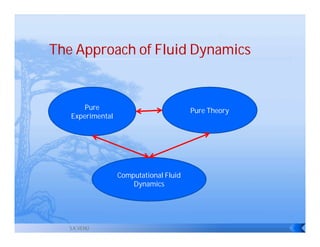
The Approach of Fluid Dynamics


       Pure                             Pure Theory
   Experimental


                  Computational Fluid
                      Dynamics


   S.K.VENU
“A theory is something nobody believes except the person proposing the
theory and an experiment is something everybody believes except the
person doing the experiment”
                                                             --Albert Einstein
Experimental Investigation
• Involve full-scale equipment
•Full scale test are, in most cases, prohibitively expensive and often
impossible.
•Perform experiment on small-scale models. Information must be
extrapolated to full scale, and general rules for doing this are often
unavailable.
• Small scale models do not always simulate all the features of the full-
scale equipment.
• There are serious difficulties of measurement in many situations.
 Theoretical Calculation
 • Consequences of a mathematical model, rather than those of an actual
 physical model.
 • Consists of set of differential equations.
 • A tiny fraction of the range of practical problems can be solved.

              S.K.VENU
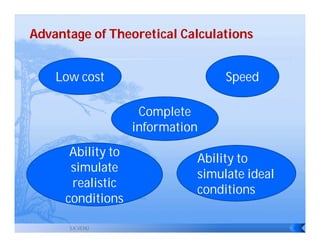
Advantage of Theoretical Calculations


    Low cost                      Speed

                    Complete
                   information
      Ability to
                             Ability to
      simulate
                             simulate ideal
      realistic
                             conditions
     conditions

      S.K.VENU
Why CFD?
Growth in complexity of unsolved engineering
problems
Need for quick solutions of moderate accuracy
Absence of analytical solutions
The prohibitive costs involved in performing even
scaled laboratory experiments
Efficient solution algorithms
Developments in computers in terms of speed and
storage
Sophisticated pre and post processing facilities


       S.K.VENU
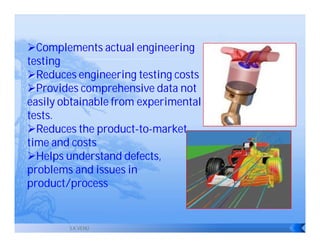
Complements actual engineering
testing
Reduces engineering testing costs
Provides comprehensive data not
easily obtainable from experimental
tests.
Reduces the product-to-market
time and costs
Helps understand defects,
problems and issues in
product/process


        S.K.VENU
Advantages of CFD
It complements experimental and theoretical fluid
dynamics by providing an alternative cost effective
means of simulating real flows.
Insight
Better visualization and enhanced understanding of
designs.
Foresight
Testing many variations until you arrive at an optimal
result before physical prototyping and testing.
Practically unlimited level of detail of results at virtually
no added expense.
Efficiency
Compression of design and development cycle.
          S.K.VENU
The simulation results in prediction of the flow fields
and engineering parameters, which are very useful in the
Design and Optimization of processes and equipments.
Substantial reduction of lead times and costs of new
designs
Ability to study systems where controlled experiments
are difficult or impossible to perform (e.g. very large
systems)
Ability to study systems under hazardous conditions at
and beyond their normal performance limits (e.g. safety
studies and accident scenarios)
CFD is slowly becoming part and parcel of Computer
Aided Engineering(CAE)

        S.K.VENU
Applications of CFD
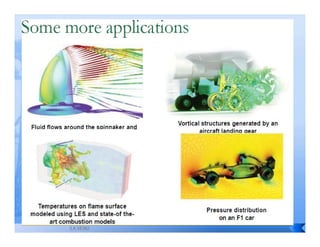
Aerodynamics of aircraft : lift and drag
Automotive : External flow over the body of a vehicle
or internal flow through the engine, combustion,
Engine cooling
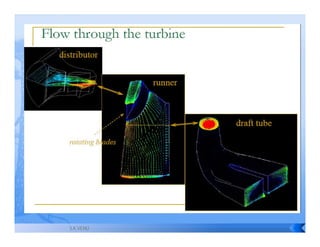
Turbo machinery: Turbines, pumps , compressors
etc.
Flow and heat transfer in thermal power plants and
nuclear power reactors
HVAC
Manufacturing–Casting simulation, injection
moulding of plastics
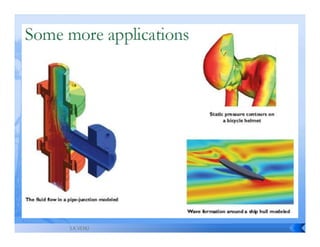
Marine engineering: loads on off-shore structures
Hydrodynamics of ships, submarines, torpedo etc.
         S.K.VENU
Applications of CFD
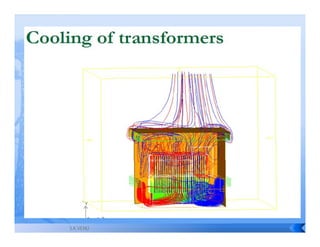
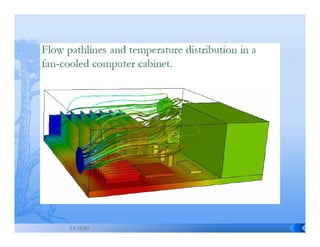
Electrical and electronic engineering: cooling of equipment like
transformers, Computers, microcircuits, Semiconductor processing,
Optical fibre manufacturing
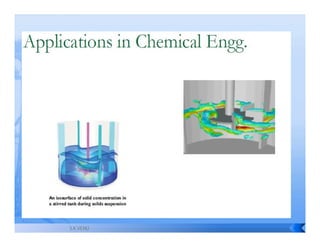
Chemical process engineering: mixing and separation, chemical
reactors, polymer molding
Transport of slurries in process industries
Environmental engineering: External and internal environment of
buildings, wind loading, Investigating the effects of fire and smoke,
distribution of pollutants and effluents in air or water,
Hydrology and oceanography: flows in rivers, oceans
Meteorology: weather prediction
Enhanced oil recovery from rock formations
Geophysical flows: atmospheric convection and ground water
movement
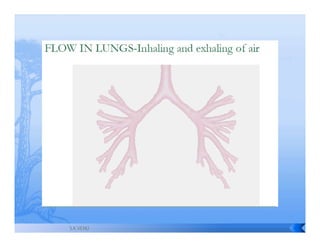
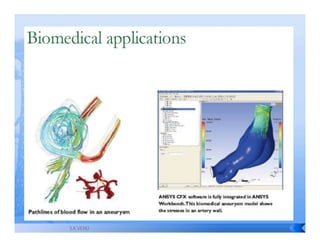
Biomedical engineering: Flow in arteries, blood vessels, heart,
nasal cavity, Inhalers
            S.K.VENU
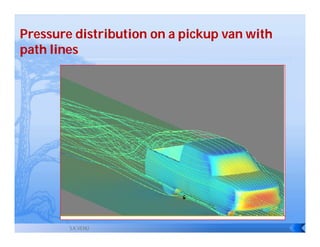
Pressure distribution on a pickup van with
path lines


        S.K.VENU
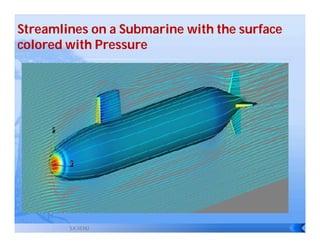
Streamlines on a Submarine with the surface
colored with Pressure


        S.K.VENU
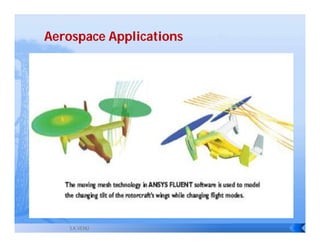
Aerospace Applications


    S.K.VENU
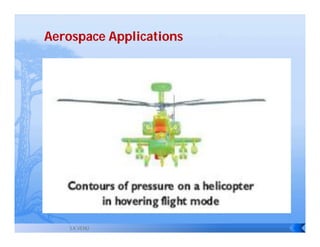
Aerospace Applications


    S.K.VENU
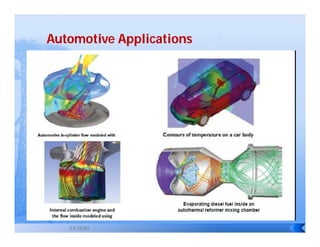
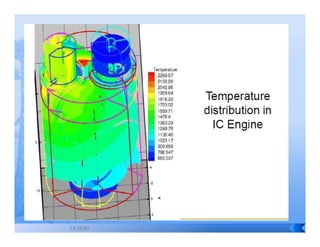
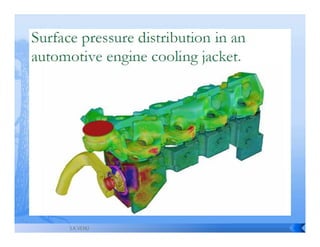
Automotive Applications


   S.K.VENU
S.K.VENU
S.K.VENU
S.K.VENU
S.K.VENU
S.K.VENU
S.K.VENU
S.K.VENU
S.K.VENU
S.K.VENU
S.K.VENU
S.K.VENU
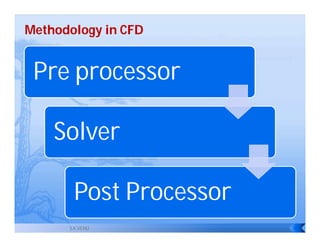
Methodology in CFD


 Pre processor

    Solver

       Post Processor
      S.K.VENU
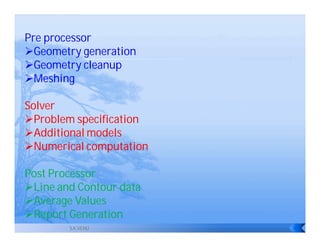
Pre processor
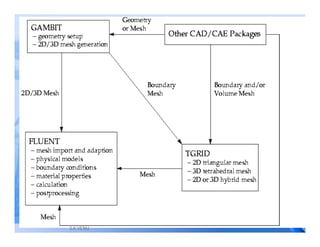
Geometry generation
Geometry cleanup
Meshing

Solver
Problem specification
Additional models
Numerical computation

Post Processor
Line and Contour data
Average Values
Report Generation
        S.K.VENU
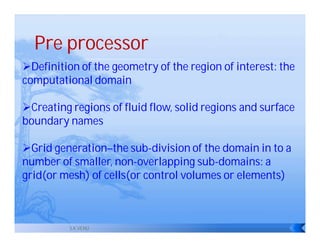
Pre processor
Definition of the geometry of the region of interest: the
computational domain

Creating regions of fluid flow, solid regions and surface
boundary names

Grid generation–the sub-division of the domain in to a
number of smaller, non-overlapping sub-domains: a
grid(or mesh) of cells(or control volumes or elements)


          S.K.VENU
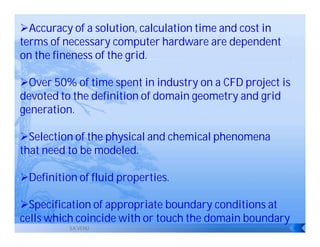
Accuracy of a solution, calculation time and cost in
terms of necessary computer hardware are dependent
on the fineness of the grid.

Over 50% of time spent in industry on a CFD project is
devoted to the definition of domain geometry and grid
generation.

Selection of the physical and chemical phenomena
that need to be modeled.

Definition of fluid properties.

Specification of appropriate boundary conditions at
cells which coincide with or touch the domain boundary
          S.K.VENU
Solver
CFD is the art of replacing the differential equation
governing the Fluid Flow, with a set of algebraic
equations (the process is called discretization), which
in turn can be solved with the aid of a digital computer
to get an approximate solution

 Finite difference method
 Finite Element Method
  Finite volume method

        S.K.VENU
Post-processor
Versatile data visualization tools.
Domain geometry and grid display
Vector plots showing the direction and magnitude of the flow.
Line and shaded contour plots
2D and 3D surface plots
Particle tracking
View manipulation(translation, rotation, scalingetc.)
Visualization of the variation of scalar variables(variables which
have only magnitude, not direction, such as temperature, pressure
and speed) through the domain.
Quantitative numerical calculations.
Charts showing graphical plots of variables
Hard copy out put
Animation for dynamic result display
Data export facilities for further manipulation external to the
code
           S.K.VENU
S.K.VENU

Cfd introduction

  • 1.
  • 2.
    CFD is theprocess of solving the fluid flow equation of mass, moment and energy on a computer as applied to a particular geometry and flow conditions. The basic flow variables such as velocity, pressure and temperature are computed at thousands of location. The CFD solution is based on the first-principle of conservation of mass, moment and energy A tool for solving PDE’s 3 fundamental principles: Mass is conserved (Continuity equation); Newton’s second law (Navier-Stokes Eqn); Energy is conserved (Bernoulli’s Equation) S.K.VENU
  • 3.
    The Approach ofFluid Dynamics Pure Pure Theory Experimental Computational Fluid Dynamics S.K.VENU
  • 4.
    “A theory issomething nobody believes except the person proposing the theory and an experiment is something everybody believes except the person doing the experiment” --Albert Einstein Experimental Investigation • Involve full-scale equipment •Full scale test are, in most cases, prohibitively expensive and often impossible. •Perform experiment on small-scale models. Information must be extrapolated to full scale, and general rules for doing this are often unavailable. • Small scale models do not always simulate all the features of the full- scale equipment. • There are serious difficulties of measurement in many situations. Theoretical Calculation • Consequences of a mathematical model, rather than those of an actual physical model. • Consists of set of differential equations. • A tiny fraction of the range of practical problems can be solved. S.K.VENU
  • 5.
    Advantage of TheoreticalCalculations Low cost Speed Complete information Ability to Ability to simulate simulate ideal realistic conditions conditions S.K.VENU
  • 6.
    Why CFD? Growth incomplexity of unsolved engineering problems Need for quick solutions of moderate accuracy Absence of analytical solutions The prohibitive costs involved in performing even scaled laboratory experiments Efficient solution algorithms Developments in computers in terms of speed and storage Sophisticated pre and post processing facilities S.K.VENU
  • 7.
    Complements actual engineering testing Reducesengineering testing costs Provides comprehensive data not easily obtainable from experimental tests. Reduces the product-to-market time and costs Helps understand defects, problems and issues in product/process S.K.VENU
  • 8.
    Advantages of CFD Itcomplements experimental and theoretical fluid dynamics by providing an alternative cost effective means of simulating real flows. Insight Better visualization and enhanced understanding of designs. Foresight Testing many variations until you arrive at an optimal result before physical prototyping and testing. Practically unlimited level of detail of results at virtually no added expense. Efficiency Compression of design and development cycle. S.K.VENU
  • 9.
    The simulation resultsin prediction of the flow fields and engineering parameters, which are very useful in the Design and Optimization of processes and equipments. Substantial reduction of lead times and costs of new designs Ability to study systems where controlled experiments are difficult or impossible to perform (e.g. very large systems) Ability to study systems under hazardous conditions at and beyond their normal performance limits (e.g. safety studies and accident scenarios) CFD is slowly becoming part and parcel of Computer Aided Engineering(CAE) S.K.VENU
  • 10.
    Applications of CFD Aerodynamicsof aircraft : lift and drag Automotive : External flow over the body of a vehicle or internal flow through the engine, combustion, Engine cooling Turbo machinery: Turbines, pumps , compressors etc. Flow and heat transfer in thermal power plants and nuclear power reactors HVAC Manufacturing–Casting simulation, injection moulding of plastics Marine engineering: loads on off-shore structures Hydrodynamics of ships, submarines, torpedo etc. S.K.VENU
  • 11.
    Applications of CFD Electricaland electronic engineering: cooling of equipment like transformers, Computers, microcircuits, Semiconductor processing, Optical fibre manufacturing Chemical process engineering: mixing and separation, chemical reactors, polymer molding Transport of slurries in process industries Environmental engineering: External and internal environment of buildings, wind loading, Investigating the effects of fire and smoke, distribution of pollutants and effluents in air or water, Hydrology and oceanography: flows in rivers, oceans Meteorology: weather prediction Enhanced oil recovery from rock formations Geophysical flows: atmospheric convection and ground water movement Biomedical engineering: Flow in arteries, blood vessels, heart, nasal cavity, Inhalers S.K.VENU
  • 12.
    Pressure distribution ona pickup van with path lines S.K.VENU
  • 13.
    Streamlines on aSubmarine with the surface colored with Pressure S.K.VENU
  • 14.
  • 15.
  • 16.
  • 17.
  • 18.
  • 19.
  • 20.
  • 21.
  • 22.
  • 23.
  • 24.
  • 25.
  • 26.
  • 27.
  • 28.
    Methodology in CFD Pre processor Solver Post Processor S.K.VENU
  • 29.
    Pre processor Geometry generation Geometrycleanup Meshing Solver Problem specification Additional models Numerical computation Post Processor Line and Contour data Average Values Report Generation S.K.VENU
  • 30.
    Pre processor Definition ofthe geometry of the region of interest: the computational domain Creating regions of fluid flow, solid regions and surface boundary names Grid generation–the sub-division of the domain in to a number of smaller, non-overlapping sub-domains: a grid(or mesh) of cells(or control volumes or elements) S.K.VENU
  • 31.
    Accuracy of asolution, calculation time and cost in terms of necessary computer hardware are dependent on the fineness of the grid. Over 50% of time spent in industry on a CFD project is devoted to the definition of domain geometry and grid generation. Selection of the physical and chemical phenomena that need to be modeled. Definition of fluid properties. Specification of appropriate boundary conditions at cells which coincide with or touch the domain boundary S.K.VENU
  • 32.
    Solver CFD is theart of replacing the differential equation governing the Fluid Flow, with a set of algebraic equations (the process is called discretization), which in turn can be solved with the aid of a digital computer to get an approximate solution Finite difference method Finite Element Method Finite volume method S.K.VENU
  • 33.
    Post-processor Versatile data visualizationtools. Domain geometry and grid display Vector plots showing the direction and magnitude of the flow. Line and shaded contour plots 2D and 3D surface plots Particle tracking View manipulation(translation, rotation, scalingetc.) Visualization of the variation of scalar variables(variables which have only magnitude, not direction, such as temperature, pressure and speed) through the domain. Quantitative numerical calculations. Charts showing graphical plots of variables Hard copy out put Animation for dynamic result display Data export facilities for further manipulation external to the code S.K.VENU
  • 34.