What is particle density ?
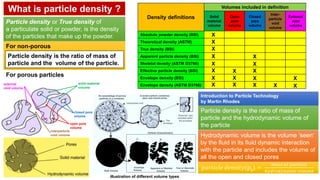
For non-porous
particlesParticle density is the ratio of mass of
particle and the volume of the particle.
solid material
volume
closed pore
volume
external
void volume
interparticle
void volume
open pore
volume
For porous particles
Particle density or True density of
a particulate solid or powder, is the density
of the particles that make up the powder.
Density definitions
Volumes included in definition
Solid
material
volume
Open
pore
volume
Closed
pore
volume
Inter-
particle
void
volume
External
void
volume
Absolute powder density (BSI)
Theoretical density (ASTM)
True density (BSI)
Apparent particle density (BSI)
Skeletal density (ASTM D3766)
Effective particle density (BSI)
Envelope density (BSI)
Envelope density (ASTM D3766)
illustration of different volume types
𝑝𝑎𝑟𝑡𝑖𝑐𝑙𝑒 𝑑𝑒𝑛𝑠𝑖𝑡𝑦(ρp) =
𝑚𝑎𝑠𝑠 𝑜𝑓 𝑝𝑎𝑟𝑡𝑖𝑐𝑙𝑒
ℎ𝑦𝑑𝑟𝑜𝑑𝑦𝑛𝑎𝑚𝑖𝑐 𝑣𝑜𝑙𝑢𝑚𝑒
Hydrodynamic volume is the volume ’seen‘
by the fluid in its fluid dynamic interaction
with the particle and includes the volume of
all the open and closed pores
Particle density is the ratio of mass of
particle and the hydrodynamic volume of
the particle
Introduction to Particle Technology
by Martin Rhodes
X
X
X
X
X
X
X
X
X
X
X
X
X
X
X
X X X
X
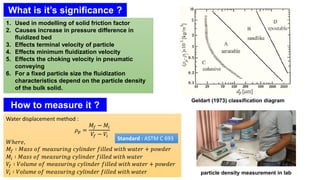
What is it’s significance ?
1. Used in modelling of solid friction factor
2. Causes increase in pressure difference in
fluidized bed
3. Effects terminal velocity of particle
4. Effects minimum fluidization velocity
5. Effects the choking velocity in pneumatic
conveying
6. For a fixed particle size the fluidization
characteristics depend on the particle density
of the bulk solid.
Geldart (1973) classification diagram
How to measure it ?
Water displacement method :
𝜌 𝑝 =
𝑀𝑓 − 𝑀𝑖
𝑉𝑓 − 𝑉𝑖
𝑊ℎ𝑒𝑟𝑒,
𝑀𝑓 ∶ 𝑀𝑎𝑠𝑠 𝑜𝑓 𝑚𝑒𝑎𝑠𝑢𝑟𝑖𝑛𝑔 𝑐𝑦𝑙𝑖𝑛𝑑𝑒𝑟 𝑓𝑖𝑙𝑙𝑒𝑑 𝑤𝑖𝑡ℎ 𝑤𝑎𝑡𝑒𝑟 + 𝑝𝑜𝑤𝑑𝑒𝑟
𝑀𝑖 ∶ 𝑀𝑎𝑠𝑠 𝑜𝑓 𝑚𝑒𝑎𝑠𝑢𝑟𝑖𝑛𝑔 𝑐𝑦𝑙𝑖𝑛𝑑𝑒𝑟 𝑓𝑖𝑙𝑙𝑒𝑑 𝑤𝑖𝑡ℎ 𝑤𝑎𝑡𝑒𝑟
𝑉𝑓 ∶ 𝑉𝑜𝑙𝑢𝑚𝑒 𝑜𝑓 𝑚𝑒𝑎𝑠𝑢𝑟𝑖𝑛𝑔 𝑐𝑦𝑙𝑖𝑛𝑑𝑒𝑟 𝑓𝑖𝑙𝑙𝑒𝑑 𝑤𝑖𝑡ℎ 𝑤𝑎𝑡𝑒𝑟 + 𝑝𝑜𝑤𝑑𝑒𝑟
𝑉𝑖 ∶ 𝑉𝑜𝑙𝑢𝑚𝑒 𝑜𝑓 𝑚𝑒𝑎𝑠𝑢𝑟𝑖𝑛𝑔 𝑐𝑦𝑙𝑖𝑛𝑑𝑒𝑟 𝑓𝑖𝑙𝑙𝑒𝑑 𝑤𝑖𝑡ℎ 𝑤𝑎𝑡𝑒𝑟
Standard : ASTM C 693
particle density measurement in lab
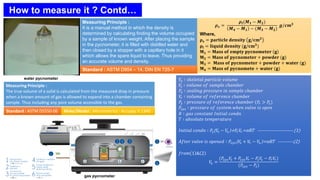
Measuring Principle :
It is a manual method in which the density is
determined by calculating finding the volume occupied
by a sample of known weight. After placing the sample
in the pycnometer, it is filled with distilled water and
then closed by a stopper with a capillary hole in it
which allows the spare liquid to leave. Thus providing
an accurate volume and density.
water pycnometer
Standard : ASTM D854 – 14, DIN EN 725-7
How to measure it ? Contd…
𝝆 𝒔 =
𝝆𝒍(𝑴 𝟏 − 𝑴 𝟐)
𝑴 𝟒 − 𝑴 𝟏 − (𝑴 𝟑 − 𝑴 𝟐)
𝒈/𝒄𝒎 𝟑
Where,
𝛒 𝐬 = 𝐩𝐚𝐫𝐭𝐢𝐜𝐥𝐞 𝐝𝐞𝐧𝐬𝐢𝐭𝐲 𝐠/𝐜𝐦 𝟑
𝛒𝐥 = 𝐥𝐢𝐪𝐮𝐢𝐝 𝐝𝐞𝐧𝐬𝐢𝐭𝐲 (𝐠/𝐜𝐦 𝟑
)
𝐌 𝟏 = 𝐌𝐚𝐬𝐬 𝐨𝐟 𝐞𝐦𝐩𝐭𝐲 𝐩𝐲𝐜𝐧𝐨𝐦𝐞𝐭𝐞𝐫 𝐠
𝐌 𝟐 = 𝐌𝐚𝐬𝐬 𝐨𝐟 𝐩𝐲𝐜𝐧𝐨𝐦𝐞𝐭𝐞𝐫 + 𝐩𝐨𝐰𝐝𝐞𝐫 (𝐠)
𝐌 𝟑 = 𝐌𝐚𝐬𝐬 𝐨𝐟 𝐩𝐲𝐜𝐧𝐨𝐦𝐞𝐭𝐞𝐫 + 𝐩𝐨𝐰𝐝𝐞𝐫 + 𝐰𝐚𝐭𝐞𝐫 (𝐠)
𝐌 𝟒 = 𝐌𝐚𝐬𝐬 𝐨𝐟 𝐩𝐲𝐜𝐧𝐨𝐦𝐞𝐭𝐞 + 𝐰𝐚𝐭𝐞𝐫 (𝐠)
Measuring Principle :
The true volume of a solid is calculated from the measured drop in pressure
when a known amount of gas is allowed to expand into a chamber containing
sample. Thus including any pore volume accessible to the gas.
Standard : ASTM D5550-06 Make/Model : Micrometrics : Accupyc II 1340
𝑉𝑥 ∶ 𝑠𝑘𝑒𝑙𝑒𝑡𝑎𝑙 𝑝𝑎𝑟𝑡𝑖𝑐𝑙𝑒 𝑣𝑜𝑙𝑢𝑚𝑒
𝑉𝑠 ∶ 𝑣𝑜𝑙𝑢𝑚𝑒 𝑜𝑓 𝑠𝑎𝑚𝑝𝑙𝑒 𝑐ℎ𝑎𝑚𝑏𝑒𝑟
𝑃𝑥 ∶ 𝑠𝑒𝑎𝑙𝑖𝑛𝑔 𝑝𝑟𝑒𝑠𝑠𝑢𝑟𝑒 𝑖𝑛 𝑠𝑎𝑚𝑝𝑙𝑒 𝑐ℎ𝑎𝑚𝑏𝑒𝑟
𝑉𝑟 ∶ 𝑣𝑜𝑙𝑢𝑚𝑒 𝑜𝑓 𝑟𝑒𝑓𝑒𝑟𝑒𝑛𝑐𝑒 𝑐ℎ𝑎𝑚𝑏𝑒𝑟
𝑃𝑥 ∶ 𝑝𝑟𝑒𝑠𝑠𝑢𝑟𝑒 𝑜𝑓 𝑟𝑒𝑓𝑒𝑟𝑒𝑛𝑐𝑒 𝑐ℎ𝑎𝑚𝑏𝑒𝑟 (𝑃𝑟 > 𝑃𝑠)
𝑃𝑠𝑦𝑠 ∶ 𝑝𝑟𝑒𝑠𝑠𝑢𝑟𝑒 𝑜𝑓 𝑠𝑦𝑠𝑡𝑒𝑚 𝑤ℎ𝑒𝑛 𝑣𝑎𝑙𝑣𝑒 𝑖𝑠 𝑜𝑝𝑒𝑛
𝑅 ∶ 𝑔𝑎𝑠 𝑐𝑜𝑛𝑠𝑡𝑎𝑛𝑡 𝐼𝑛𝑖𝑡𝑖𝑎𝑙 𝑐𝑜𝑛𝑑𝑛
𝑇 ∶ 𝑎𝑏𝑠𝑜𝑙𝑢𝑡𝑒 𝑡𝑒𝑚𝑝𝑒𝑟𝑎𝑡𝑢𝑟𝑒
𝐼𝑛𝑖𝑡𝑖𝑎𝑙 𝑐𝑜𝑛𝑑𝑛 ∶ 𝑃𝑠( 𝑉𝑠 − 𝑉𝑥)+ 𝑃𝑟 𝑉𝑟=nRT ----------------------- (1)
𝐴𝑓𝑡𝑒𝑟 𝑣𝑎𝑙𝑣𝑒 𝑖𝑠 𝑜𝑝𝑒𝑛𝑒𝑑 ∶ 𝑃𝑠𝑦𝑠( 𝑉𝑠 + 𝑉𝑟 − 𝑉𝑥)=nRT ----------(2)
𝑓𝑟𝑜𝑚 1 & 2
𝑉𝑥 =
(𝑃𝑠𝑦𝑠 𝑉𝑠 + 𝑃𝑠𝑦𝑠 𝑉𝑟 − 𝑃𝑠 𝑉𝑠 − 𝑃𝑟 𝑉𝑟)
(𝑃𝑠𝑦𝑠 − 𝑃𝑠)
gas pycnometer
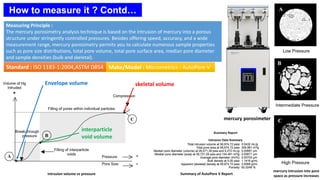
mercury porosimeter
Measuring Principle :
The mercury porosimetry analysis technique is based on the intrusion of mercury into a porous
structure under stringently controlled pressures. Besides offering speed, accuracy, and a wide
measurement range, mercury porosimetry permits you to calculate numerous sample properties
such as pore size distributions, total pore volume, total pore surface area, median pore diameter
and sample densities (bulk and skeletal).
Standard : ISO 1183-1:2004,ASTM D854 Make/Model : Micrometrics : AutoPore V
How to measure it ? Contd…
mercury intrusion into pore
space as pressure increasesintrusion volume vs pressure Summary of AutoPore V Report
Envelope volume
interparticle
void volume
skeletal volume

Particle Density

  • 1.
    What is particledensity ? For non-porous particlesParticle density is the ratio of mass of particle and the volume of the particle. solid material volume closed pore volume external void volume interparticle void volume open pore volume For porous particles Particle density or True density of a particulate solid or powder, is the density of the particles that make up the powder. Density definitions Volumes included in definition Solid material volume Open pore volume Closed pore volume Inter- particle void volume External void volume Absolute powder density (BSI) Theoretical density (ASTM) True density (BSI) Apparent particle density (BSI) Skeletal density (ASTM D3766) Effective particle density (BSI) Envelope density (BSI) Envelope density (ASTM D3766) illustration of different volume types 𝑝𝑎𝑟𝑡𝑖𝑐𝑙𝑒 𝑑𝑒𝑛𝑠𝑖𝑡𝑦(ρp) = 𝑚𝑎𝑠𝑠 𝑜𝑓 𝑝𝑎𝑟𝑡𝑖𝑐𝑙𝑒 ℎ𝑦𝑑𝑟𝑜𝑑𝑦𝑛𝑎𝑚𝑖𝑐 𝑣𝑜𝑙𝑢𝑚𝑒 Hydrodynamic volume is the volume ’seen‘ by the fluid in its fluid dynamic interaction with the particle and includes the volume of all the open and closed pores Particle density is the ratio of mass of particle and the hydrodynamic volume of the particle Introduction to Particle Technology by Martin Rhodes X X X X X X X X X X X X X X X X X X X
  • 2.
    What is it’ssignificance ? 1. Used in modelling of solid friction factor 2. Causes increase in pressure difference in fluidized bed 3. Effects terminal velocity of particle 4. Effects minimum fluidization velocity 5. Effects the choking velocity in pneumatic conveying 6. For a fixed particle size the fluidization characteristics depend on the particle density of the bulk solid. Geldart (1973) classification diagram How to measure it ? Water displacement method : 𝜌 𝑝 = 𝑀𝑓 − 𝑀𝑖 𝑉𝑓 − 𝑉𝑖 𝑊ℎ𝑒𝑟𝑒, 𝑀𝑓 ∶ 𝑀𝑎𝑠𝑠 𝑜𝑓 𝑚𝑒𝑎𝑠𝑢𝑟𝑖𝑛𝑔 𝑐𝑦𝑙𝑖𝑛𝑑𝑒𝑟 𝑓𝑖𝑙𝑙𝑒𝑑 𝑤𝑖𝑡ℎ 𝑤𝑎𝑡𝑒𝑟 + 𝑝𝑜𝑤𝑑𝑒𝑟 𝑀𝑖 ∶ 𝑀𝑎𝑠𝑠 𝑜𝑓 𝑚𝑒𝑎𝑠𝑢𝑟𝑖𝑛𝑔 𝑐𝑦𝑙𝑖𝑛𝑑𝑒𝑟 𝑓𝑖𝑙𝑙𝑒𝑑 𝑤𝑖𝑡ℎ 𝑤𝑎𝑡𝑒𝑟 𝑉𝑓 ∶ 𝑉𝑜𝑙𝑢𝑚𝑒 𝑜𝑓 𝑚𝑒𝑎𝑠𝑢𝑟𝑖𝑛𝑔 𝑐𝑦𝑙𝑖𝑛𝑑𝑒𝑟 𝑓𝑖𝑙𝑙𝑒𝑑 𝑤𝑖𝑡ℎ 𝑤𝑎𝑡𝑒𝑟 + 𝑝𝑜𝑤𝑑𝑒𝑟 𝑉𝑖 ∶ 𝑉𝑜𝑙𝑢𝑚𝑒 𝑜𝑓 𝑚𝑒𝑎𝑠𝑢𝑟𝑖𝑛𝑔 𝑐𝑦𝑙𝑖𝑛𝑑𝑒𝑟 𝑓𝑖𝑙𝑙𝑒𝑑 𝑤𝑖𝑡ℎ 𝑤𝑎𝑡𝑒𝑟 Standard : ASTM C 693 particle density measurement in lab
  • 3.
    Measuring Principle : Itis a manual method in which the density is determined by calculating finding the volume occupied by a sample of known weight. After placing the sample in the pycnometer, it is filled with distilled water and then closed by a stopper with a capillary hole in it which allows the spare liquid to leave. Thus providing an accurate volume and density. water pycnometer Standard : ASTM D854 – 14, DIN EN 725-7 How to measure it ? Contd… 𝝆 𝒔 = 𝝆𝒍(𝑴 𝟏 − 𝑴 𝟐) 𝑴 𝟒 − 𝑴 𝟏 − (𝑴 𝟑 − 𝑴 𝟐) 𝒈/𝒄𝒎 𝟑 Where, 𝛒 𝐬 = 𝐩𝐚𝐫𝐭𝐢𝐜𝐥𝐞 𝐝𝐞𝐧𝐬𝐢𝐭𝐲 𝐠/𝐜𝐦 𝟑 𝛒𝐥 = 𝐥𝐢𝐪𝐮𝐢𝐝 𝐝𝐞𝐧𝐬𝐢𝐭𝐲 (𝐠/𝐜𝐦 𝟑 ) 𝐌 𝟏 = 𝐌𝐚𝐬𝐬 𝐨𝐟 𝐞𝐦𝐩𝐭𝐲 𝐩𝐲𝐜𝐧𝐨𝐦𝐞𝐭𝐞𝐫 𝐠 𝐌 𝟐 = 𝐌𝐚𝐬𝐬 𝐨𝐟 𝐩𝐲𝐜𝐧𝐨𝐦𝐞𝐭𝐞𝐫 + 𝐩𝐨𝐰𝐝𝐞𝐫 (𝐠) 𝐌 𝟑 = 𝐌𝐚𝐬𝐬 𝐨𝐟 𝐩𝐲𝐜𝐧𝐨𝐦𝐞𝐭𝐞𝐫 + 𝐩𝐨𝐰𝐝𝐞𝐫 + 𝐰𝐚𝐭𝐞𝐫 (𝐠) 𝐌 𝟒 = 𝐌𝐚𝐬𝐬 𝐨𝐟 𝐩𝐲𝐜𝐧𝐨𝐦𝐞𝐭𝐞 + 𝐰𝐚𝐭𝐞𝐫 (𝐠) Measuring Principle : The true volume of a solid is calculated from the measured drop in pressure when a known amount of gas is allowed to expand into a chamber containing sample. Thus including any pore volume accessible to the gas. Standard : ASTM D5550-06 Make/Model : Micrometrics : Accupyc II 1340 𝑉𝑥 ∶ 𝑠𝑘𝑒𝑙𝑒𝑡𝑎𝑙 𝑝𝑎𝑟𝑡𝑖𝑐𝑙𝑒 𝑣𝑜𝑙𝑢𝑚𝑒 𝑉𝑠 ∶ 𝑣𝑜𝑙𝑢𝑚𝑒 𝑜𝑓 𝑠𝑎𝑚𝑝𝑙𝑒 𝑐ℎ𝑎𝑚𝑏𝑒𝑟 𝑃𝑥 ∶ 𝑠𝑒𝑎𝑙𝑖𝑛𝑔 𝑝𝑟𝑒𝑠𝑠𝑢𝑟𝑒 𝑖𝑛 𝑠𝑎𝑚𝑝𝑙𝑒 𝑐ℎ𝑎𝑚𝑏𝑒𝑟 𝑉𝑟 ∶ 𝑣𝑜𝑙𝑢𝑚𝑒 𝑜𝑓 𝑟𝑒𝑓𝑒𝑟𝑒𝑛𝑐𝑒 𝑐ℎ𝑎𝑚𝑏𝑒𝑟 𝑃𝑥 ∶ 𝑝𝑟𝑒𝑠𝑠𝑢𝑟𝑒 𝑜𝑓 𝑟𝑒𝑓𝑒𝑟𝑒𝑛𝑐𝑒 𝑐ℎ𝑎𝑚𝑏𝑒𝑟 (𝑃𝑟 > 𝑃𝑠) 𝑃𝑠𝑦𝑠 ∶ 𝑝𝑟𝑒𝑠𝑠𝑢𝑟𝑒 𝑜𝑓 𝑠𝑦𝑠𝑡𝑒𝑚 𝑤ℎ𝑒𝑛 𝑣𝑎𝑙𝑣𝑒 𝑖𝑠 𝑜𝑝𝑒𝑛 𝑅 ∶ 𝑔𝑎𝑠 𝑐𝑜𝑛𝑠𝑡𝑎𝑛𝑡 𝐼𝑛𝑖𝑡𝑖𝑎𝑙 𝑐𝑜𝑛𝑑𝑛 𝑇 ∶ 𝑎𝑏𝑠𝑜𝑙𝑢𝑡𝑒 𝑡𝑒𝑚𝑝𝑒𝑟𝑎𝑡𝑢𝑟𝑒 𝐼𝑛𝑖𝑡𝑖𝑎𝑙 𝑐𝑜𝑛𝑑𝑛 ∶ 𝑃𝑠( 𝑉𝑠 − 𝑉𝑥)+ 𝑃𝑟 𝑉𝑟=nRT ----------------------- (1) 𝐴𝑓𝑡𝑒𝑟 𝑣𝑎𝑙𝑣𝑒 𝑖𝑠 𝑜𝑝𝑒𝑛𝑒𝑑 ∶ 𝑃𝑠𝑦𝑠( 𝑉𝑠 + 𝑉𝑟 − 𝑉𝑥)=nRT ----------(2) 𝑓𝑟𝑜𝑚 1 & 2 𝑉𝑥 = (𝑃𝑠𝑦𝑠 𝑉𝑠 + 𝑃𝑠𝑦𝑠 𝑉𝑟 − 𝑃𝑠 𝑉𝑠 − 𝑃𝑟 𝑉𝑟) (𝑃𝑠𝑦𝑠 − 𝑃𝑠) gas pycnometer
  • 4.
    mercury porosimeter Measuring Principle: The mercury porosimetry analysis technique is based on the intrusion of mercury into a porous structure under stringently controlled pressures. Besides offering speed, accuracy, and a wide measurement range, mercury porosimetry permits you to calculate numerous sample properties such as pore size distributions, total pore volume, total pore surface area, median pore diameter and sample densities (bulk and skeletal). Standard : ISO 1183-1:2004,ASTM D854 Make/Model : Micrometrics : AutoPore V How to measure it ? Contd… mercury intrusion into pore space as pressure increasesintrusion volume vs pressure Summary of AutoPore V Report Envelope volume interparticle void volume skeletal volume