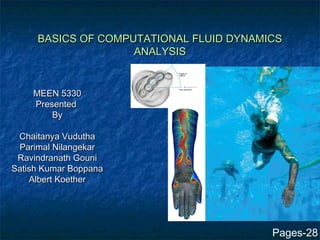
BASICS OF COMPUTATIONAL FLUID DYNAMICS
                    ANALYSIS


    MEEN 5330
    Presented
        By

 Chaitanya Vudutha
 Parimal Nilangekar
 Ravindranath Gouni
Satish Kumar Boppana
    Albert Koether


                                         Pages-28
Overview
   Introduction
   History of CFD
   Basic concepts
   CFD Process
   Derivation of Navier-Stokes Duhem Equation
   Example Problem
   Applications
   Conclusion
   References
Introduction
                           What is CFD?
    Prediction fluid flow with the complications of simultaneous
    flow of heat, mass transfer, phase change, chemical reaction,
    etc using computers
                             History of CFD
   Since 1940s analytical solution to most fluid dynamics problems was
    available for idealized solutions. Methods for solution of ODEs or PDEs
    were conceived only on paper due to absence of personal computer.

   Daimler Chrysler was the first company to use CFD in Automotive sector.

   Speedo was the first swimwear company to use CFD.

   There are number of companies and software's in CFD field in the world.
    Some software's by American companies are FLUENT, TIDAL, C-MOLD,
    GASP, FLOTRAN, SPLASH, Tetrex, ViGPLOT, VGRID, etc.
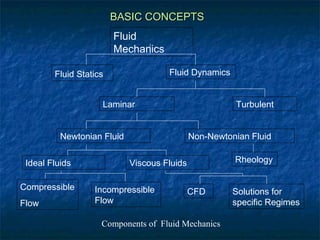
BASIC CONCEPTS
                        Fluid
                        Mechanics

        Fluid Statics                Fluid Dynamics


                    Laminar                            Turbulent


          Newtonian Fluid                    Non-Newtonian Fluid

 Ideal Fluids               Viscous Fluids             Rheology


Compressible      Incompressible             CFD       Solutions for
Flow              Flow                                 specific Regimes

                    Components of Fluid Mechanics
−6
                                 volumes no smaller than say (1*10    m3)


  Molecular Particles of Fluid

Basic fluid motion can be described as some combination of
1) Translation: [ motion of the center of mass ]

 2) Dilatation: [ volume change ]

3) Rotation: [About one, two or 3 axes ].

4) Shear Strain
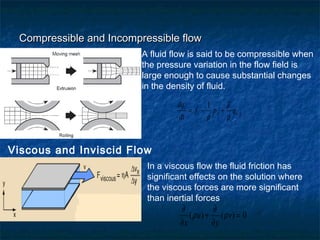
Compressible and Incompressible flow
                         A fluid flow is said to be compressible when
                         the pressure variation in the flow field is
                         large enough to cause substantial changes
                         in the density of fluid.

                                  dqi        1     ~
                                                   µ
                                      = f i − p,i + qi , jj
                                   dt        ρ     ρ


Viscous and Inviscid Flow
                          In a viscous flow the fluid friction has
                          significant effects on the solution where
                          the viscous forces are more significant
                          than inertial forces
                                   ∂           ∂
                                      ( ρ u ) + ( ρ v) = 0
                                   ∂x          ∂y
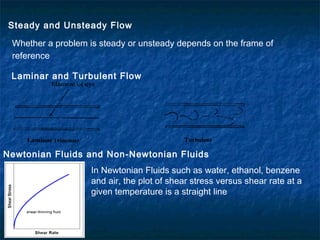
Steady and Unsteady Flow

 Whether a problem is steady or unsteady depends on the frame of
 reference

 Laminar and Turbulent Flow


Newtonian Fluids and Non-Newtonian Fluids
                    In Newtonian Fluids such as water, ethanol, benzene
                    and air, the plot of shear stress versus shear rate at a
                    given temperature is a straight line
Initial or Boundary Conditions

   Initial condition involves knowing the state of pressure
    (p) and initial velocity (u) at all points in the flow.
   Boundary conditions such as walls, inlets and outlets
    largely specify what the solution will be.
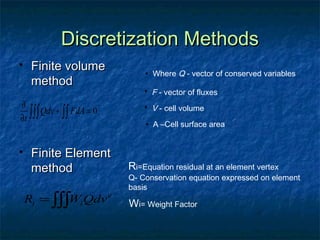
Discretization Methods
    Finite volume            • Where Q - vector of conserved variables
     method
                              • F - vector of fluxes
∂                             • V - cell volume
∂t ∫∫∫ Qdv + ∫∫ FdA = 0
                              • A –Cell surface area


    Finite Element
     method               Ri=Equation residual at an element vertex
                          Q- Conservation equation expressed on element
                          basis
    Ri = ∫∫∫Wi Qdv e      Wi= Weight Factor
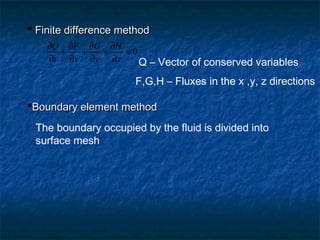
 Finite difference method
    ∂Q ∂F ∂G ∂H
      +  +  +   =0
    ∂t ∂x ∂y ∂z    Q – Vector of conserved variables
                      F,G,H – Fluxes in the x ,y, z directions

Boundary element method

 The boundary occupied by the fluid is divided into
 surface mesh
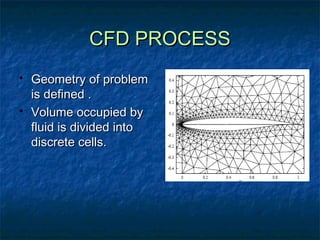
CFD PROCESS
   Geometry of problem
    is defined .
   Volume occupied by
    fluid is divided into
    discrete cells.
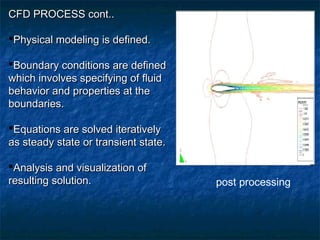
CFD PROCESS cont..

Physical modeling is defined.

Boundary conditions are defined
which involves specifying of fluid
behavior and properties at the
boundaries.

Equations are solved iteratively
as steady state or transient state.

Analysis and visualization of
resulting solution.                   post processing
DERIVATION OF NAVIER-STOKES-DUHEM
  EQUATION

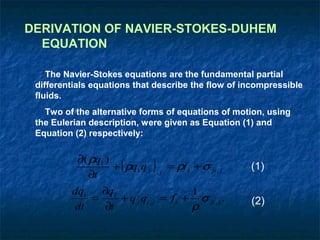
    The Navier-Stokes equations are the fundamental partial
 differentials equations that describe the flow of incompressible
 fluids.
   Two of the alternative forms of equations of motion, using
 the Eulerian description, were given as Equation (1) and
 Equation (2) respectively:

           ∂( ρqi )
                    + ( ρq i q j ) , j = ρf i + σ ji , j   (1)
              ∂t
         dq i   ∂q i                     1
              =      + q j qi , j = f i + σ ji , j .       (2)
          dt     ∂t                      ρ
DERIVATION                                            (Cont’d)


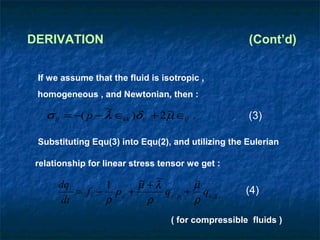
 If we assume that the fluid is isotropic ,
 homogeneous , and Newtonian, then :
                  ~              ~
   σ ij = −( p − λ ∈kk )δ ij + 2 µ ∈ij .              (3)

 Substituting Equ(3) into Equ(2), and utilizing the Eulerian

 relationship for linear stress tensor we get :

      dqi        1       ~ ~
                         µ +λ           ~
                                        µ
          = f i − p ,i +      q j , ji + qi , jj ,    (4)
       dt        ρ         ρ            ρ
                                    ( for compressible fluids )
DERIVATION
(Cont’d)
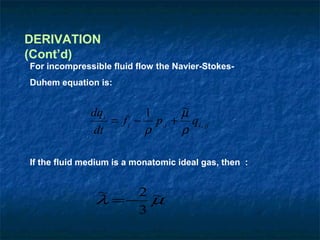
For incompressible fluid flow the Navier-Stokes-
Duhem equation is:


              dqi        1     ~
                               µ
                  = f i − p,i + qi , jj
               dt        ρ     ρ

If the fluid medium is a monatomic ideal gas, then :


                ~  2 ~
               λ =− µ
                   3
DERIVATION                                            (Cont’d)

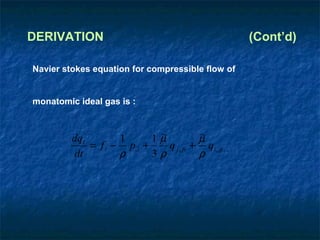
Navier stokes equation for compressible flow of


monatomic ideal gas is :


         dqi        1        ~
                            1µ           ~
                                         µ
             = f i − p ,i +    q j , ji + qi , jj ,
          dt        ρ       3ρ           ρ
EXAMPLE PROBLEM

Neglecting the gravity field, describe the steady two-
dimensional flow of an isotropic , homogeneous,
Newtonian fluid due to a constant pressure gradient
between two infinite, flat, parallel, plates. State the
necessary assumptions. Assume that the fluid has a
uniform density.
SOLUTION                                              (Cont’d)

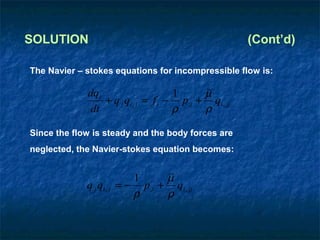
The Navier – stokes equations for incompressible flow is:

             dqi                     1     ~
                                           µ
                 + q j qi , j = f i − p,i + qi , jj
              dt                     ρ     ρ

Since the flow is steady and the body forces are
neglected, the Navier-stokes equation becomes:


                             1     ~
                                   µ
             q j qi , j   = − p,i + qi , jj
                             ρ     ρ
SOLUTION                                              (Cont’d)

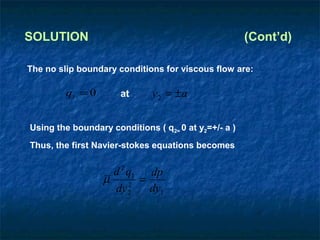
The no slip boundary conditions for viscous flow are:

         qi = 0       at      y2 = ±a

Using the boundary conditions ( q2= 0 at y2=+/- a )
Thus, the first Navier-stokes equations becomes


                    d 2 q1 dp
                  µ     2
                          =
                    dy 2    dy1
SOLUTION                                     (Cont’d)

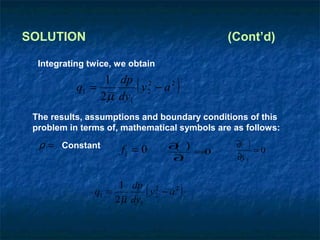
  Integrating twice, we obtain

           q1 =
                 1 dp 2
                2 µ dy1
                          (
                        y2 − a 2     )
 The results, assumptions and boundary conditions of this
 problem in terms of, mathematical symbols are as follows:
  ρ = Constant                     ∂ )
                                    ( =0        ∂( )
                      fi = 0                         =0
                                   ∂ t          ∂y 3


               q1 =
                     1 dp 2
                    2µ dy1
                           ( y2 − a 2 )
HOMEWORK PROBLEM

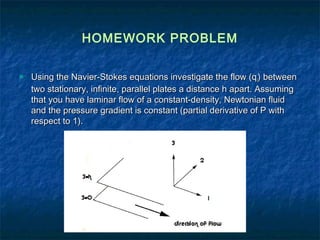
   Using the Navier-Stokes equations investigate the flow (q i) between
    two stationary, infinite, parallel plates a distance h apart. Assuming
    that you have laminar flow of a constant-density, Newtonian fluid
    and the pressure gradient is constant (partial derivative of P with
    respect to 1).
Types of Errors and Problems
Types of Errors:
    Modeling Error.
    Discretization Error.
    Convergence Error.

Reasons due to which Errors occur:
   Stability.
   Consistency.
   Conservedness and Boundedness.
Applications of CFD
1. Industrial Applications:
  CFD is used in wide variety of disciplines and industries,
  including aerospace, automotive, power generation, chemical
  manufacturing, polymer processing, petroleum exploration,
  pulp and paper operation, medical research, meteorology, and
  astrophysics.

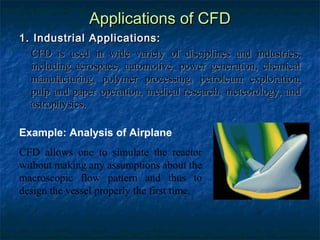
Example: Analysis of Airplane
CFD allows one to simulate the reactor
without making any assumptions about the
macroscopic flow pattern and thus to
design the vessel properly the first time.
Application (Contd..)
2. Two Dimensional Transfer Chute Analyses Using a
   Continuum Method:
  Fluent is used in chute designing tasks like predicting flow shape,
  stream velocity, wear index and location of flow recirculation
  zones.
3. Bio-Medical Engineering:
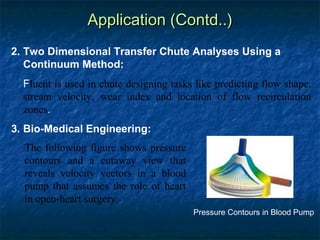
  The following figure shows pressure
  contours and a cutaway view that
  reveals velocity vectors in a blood
  pump that assumes the role of heart
  in open-heart surgery.
                                         Pressure Contours in Blood Pump
Application (Contd..)
4. Blast Interaction with a Generic Ship Hull

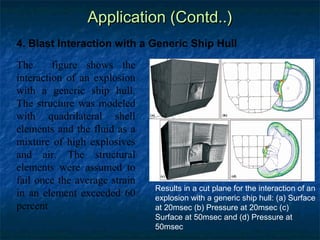
The      figure shows the
interaction of an explosion
with a generic ship hull.
The structure was modeled
with quadrilateral shell
elements and the fluid as a
mixture of high explosives
and air. The structural
elements were assumed to
fail once the average strain
                               Results in a cut plane for the interaction of an
in an element exceeded 60      explosion with a generic ship hull: (a) Surface
percent                        at 20msec (b) Pressure at 20msec (c)
                               Surface at 50msec and (d) Pressure at
                               50msec
Application (Contd..)
 5. Automotive Applications:


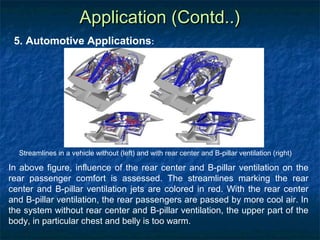
  Streamlines in a vehicle without (left) and with rear center and B-pillar ventilation (right)

In above figure, influence of the rear center and B-pillar ventilation on the
rear passenger comfort is assessed. The streamlines marking the rear
center and B-pillar ventilation jets are colored in red. With the rear center
and B-pillar ventilation, the rear passengers are passed by more cool air. In
the system without rear center and B-pillar ventilation, the upper part of the
body, in particular chest and belly is too warm.
Conclusion
   Nearer the conditions of the experiment to those which concern
    the user, more closely the predictions agree with those data, the
    greater is the reliance which can be prudently placed on the
    predictions.
   CFD iterative Methods like Jacobi and Gauss-Seidel Method are
    used because the cost of direct methods is too high and
    discretization error is larger than the accuracy of the computer
    arithmetic.
   Many software’s offer the possibility of solving fully nonlinear
    coupled equations in a production environment.
   In the future we can have a multidisciplinary, database linked
    framework accessed from anywhere on demand simulations with
    unprecedented detail and realism carried out in fast succession so
    that designers and engineers anywhere in the world can discuss
    and analyze new ideas and first principles driven virtual reality
References
1.    Hoffmann, Klaus A, and Chiang, Steve.T “Computational fluid dynamics
      for engineer’s” vol. I and vol. II
2.    Rajesh Bhaskaran, Lance Collins “Introduction to CFD Basics”
3.    http://www.cham.co.uk/website/new/cfdintro.htm accessed on 11/10/06.
4.    Adapted from notes by: Tao Xing and Fred Stern, The University of Iowa.
5.    http://www.cfd-online.com/Wiki/Historical_perspective accessed on
      11/12/06.
6.    Frederick and Chang,T.S.,”Continuum Mechanics”
7.    http://navier-stokes-equations.search.ipupdate.com/
8.    http://en.wikipedia.org/wiki/Computational_fluid_dynamics#Discretization_
      method s, ”Discretization Methods”
9.    McIlvenna P and Mossad R “Two Dimensional Transfer Chute Analysis
      Using a Continuum Method”, Third International Conference on CFD in
      the Minerals and Process Industries, Dec 2003.
10.   Subramanian R.S. “Non-Newtonian Flows”.
11.   Lohner R., Cebral J., Yand C., “Large Scale Fluid Structure Interaction
      Simulations, IEEE June 2004”.
12.   http://www.cd-
      adapco.com/press_room/dynamics/23/behr.html,“Predicting Passenger
      Comfort
13.   http://www.adl.gatech.edu/classes/lowspdaero/lospd2/lospd2.html,
      “Types of Fluid Motion”
Thank You


Questions are Welcome

CFD

  • 1.
    BASICS OF COMPUTATIONALFLUID DYNAMICS ANALYSIS MEEN 5330 Presented By Chaitanya Vudutha Parimal Nilangekar Ravindranath Gouni Satish Kumar Boppana Albert Koether Pages-28
  • 2.
    Overview  Introduction  History of CFD  Basic concepts  CFD Process  Derivation of Navier-Stokes Duhem Equation  Example Problem  Applications  Conclusion  References
  • 3.
    Introduction What is CFD? Prediction fluid flow with the complications of simultaneous flow of heat, mass transfer, phase change, chemical reaction, etc using computers History of CFD  Since 1940s analytical solution to most fluid dynamics problems was available for idealized solutions. Methods for solution of ODEs or PDEs were conceived only on paper due to absence of personal computer.  Daimler Chrysler was the first company to use CFD in Automotive sector.  Speedo was the first swimwear company to use CFD.  There are number of companies and software's in CFD field in the world. Some software's by American companies are FLUENT, TIDAL, C-MOLD, GASP, FLOTRAN, SPLASH, Tetrex, ViGPLOT, VGRID, etc.
  • 4.
    BASIC CONCEPTS Fluid Mechanics Fluid Statics Fluid Dynamics Laminar Turbulent Newtonian Fluid Non-Newtonian Fluid Ideal Fluids Viscous Fluids Rheology Compressible Incompressible CFD Solutions for Flow Flow specific Regimes Components of Fluid Mechanics
  • 5.
    −6 volumes no smaller than say (1*10 m3) Molecular Particles of Fluid Basic fluid motion can be described as some combination of 1) Translation: [ motion of the center of mass ] 2) Dilatation: [ volume change ] 3) Rotation: [About one, two or 3 axes ]. 4) Shear Strain
  • 6.
    Compressible and Incompressibleflow A fluid flow is said to be compressible when the pressure variation in the flow field is large enough to cause substantial changes in the density of fluid. dqi 1 ~ µ = f i − p,i + qi , jj dt ρ ρ Viscous and Inviscid Flow In a viscous flow the fluid friction has significant effects on the solution where the viscous forces are more significant than inertial forces ∂ ∂ ( ρ u ) + ( ρ v) = 0 ∂x ∂y
  • 7.
    Steady and UnsteadyFlow Whether a problem is steady or unsteady depends on the frame of reference Laminar and Turbulent Flow Newtonian Fluids and Non-Newtonian Fluids In Newtonian Fluids such as water, ethanol, benzene and air, the plot of shear stress versus shear rate at a given temperature is a straight line
  • 8.
    Initial or BoundaryConditions  Initial condition involves knowing the state of pressure (p) and initial velocity (u) at all points in the flow.  Boundary conditions such as walls, inlets and outlets largely specify what the solution will be.
  • 9.
    Discretization Methods  Finite volume • Where Q - vector of conserved variables method • F - vector of fluxes ∂ • V - cell volume ∂t ∫∫∫ Qdv + ∫∫ FdA = 0 • A –Cell surface area  Finite Element method Ri=Equation residual at an element vertex Q- Conservation equation expressed on element basis Ri = ∫∫∫Wi Qdv e Wi= Weight Factor
  • 10.
     Finite differencemethod ∂Q ∂F ∂G ∂H + + + =0 ∂t ∂x ∂y ∂z Q – Vector of conserved variables F,G,H – Fluxes in the x ,y, z directions Boundary element method The boundary occupied by the fluid is divided into surface mesh
  • 11.
    CFD PROCESS  Geometry of problem is defined .  Volume occupied by fluid is divided into discrete cells.
  • 12.
    CFD PROCESS cont.. Physicalmodeling is defined. Boundary conditions are defined which involves specifying of fluid behavior and properties at the boundaries. Equations are solved iteratively as steady state or transient state. Analysis and visualization of resulting solution. post processing
  • 13.
    DERIVATION OF NAVIER-STOKES-DUHEM EQUATION The Navier-Stokes equations are the fundamental partial differentials equations that describe the flow of incompressible fluids. Two of the alternative forms of equations of motion, using the Eulerian description, were given as Equation (1) and Equation (2) respectively: ∂( ρqi ) + ( ρq i q j ) , j = ρf i + σ ji , j (1) ∂t dq i ∂q i 1 = + q j qi , j = f i + σ ji , j . (2) dt ∂t ρ
  • 14.
    DERIVATION (Cont’d) If we assume that the fluid is isotropic , homogeneous , and Newtonian, then : ~ ~ σ ij = −( p − λ ∈kk )δ ij + 2 µ ∈ij . (3) Substituting Equ(3) into Equ(2), and utilizing the Eulerian relationship for linear stress tensor we get : dqi 1 ~ ~ µ +λ ~ µ = f i − p ,i + q j , ji + qi , jj , (4) dt ρ ρ ρ ( for compressible fluids )
  • 15.
    DERIVATION (Cont’d) For incompressible fluidflow the Navier-Stokes- Duhem equation is: dqi 1 ~ µ = f i − p,i + qi , jj dt ρ ρ If the fluid medium is a monatomic ideal gas, then : ~ 2 ~ λ =− µ 3
  • 16.
    DERIVATION (Cont’d) Navier stokes equation for compressible flow of monatomic ideal gas is : dqi 1 ~ 1µ ~ µ = f i − p ,i + q j , ji + qi , jj , dt ρ 3ρ ρ
  • 17.
    EXAMPLE PROBLEM Neglecting thegravity field, describe the steady two- dimensional flow of an isotropic , homogeneous, Newtonian fluid due to a constant pressure gradient between two infinite, flat, parallel, plates. State the necessary assumptions. Assume that the fluid has a uniform density.
  • 18.
    SOLUTION (Cont’d) The Navier – stokes equations for incompressible flow is: dqi 1 ~ µ + q j qi , j = f i − p,i + qi , jj dt ρ ρ Since the flow is steady and the body forces are neglected, the Navier-stokes equation becomes: 1 ~ µ q j qi , j = − p,i + qi , jj ρ ρ
  • 19.
    SOLUTION (Cont’d) The no slip boundary conditions for viscous flow are: qi = 0 at y2 = ±a Using the boundary conditions ( q2= 0 at y2=+/- a ) Thus, the first Navier-stokes equations becomes d 2 q1 dp µ 2 = dy 2 dy1
  • 20.
    SOLUTION (Cont’d) Integrating twice, we obtain q1 = 1 dp 2 2 µ dy1 ( y2 − a 2 ) The results, assumptions and boundary conditions of this problem in terms of, mathematical symbols are as follows: ρ = Constant ∂ ) ( =0 ∂( ) fi = 0 =0 ∂ t ∂y 3 q1 = 1 dp 2 2µ dy1 ( y2 − a 2 )
  • 21.
    HOMEWORK PROBLEM  Using the Navier-Stokes equations investigate the flow (q i) between two stationary, infinite, parallel plates a distance h apart. Assuming that you have laminar flow of a constant-density, Newtonian fluid and the pressure gradient is constant (partial derivative of P with respect to 1).
  • 22.
    Types of Errorsand Problems Types of Errors:  Modeling Error.  Discretization Error.  Convergence Error. Reasons due to which Errors occur:  Stability.  Consistency.  Conservedness and Boundedness.
  • 23.
    Applications of CFD 1.Industrial Applications: CFD is used in wide variety of disciplines and industries, including aerospace, automotive, power generation, chemical manufacturing, polymer processing, petroleum exploration, pulp and paper operation, medical research, meteorology, and astrophysics. Example: Analysis of Airplane CFD allows one to simulate the reactor without making any assumptions about the macroscopic flow pattern and thus to design the vessel properly the first time.
  • 24.
    Application (Contd..) 2. TwoDimensional Transfer Chute Analyses Using a Continuum Method: Fluent is used in chute designing tasks like predicting flow shape, stream velocity, wear index and location of flow recirculation zones. 3. Bio-Medical Engineering: The following figure shows pressure contours and a cutaway view that reveals velocity vectors in a blood pump that assumes the role of heart in open-heart surgery. Pressure Contours in Blood Pump
  • 25.
    Application (Contd..) 4. BlastInteraction with a Generic Ship Hull The figure shows the interaction of an explosion with a generic ship hull. The structure was modeled with quadrilateral shell elements and the fluid as a mixture of high explosives and air. The structural elements were assumed to fail once the average strain Results in a cut plane for the interaction of an in an element exceeded 60 explosion with a generic ship hull: (a) Surface percent at 20msec (b) Pressure at 20msec (c) Surface at 50msec and (d) Pressure at 50msec
  • 26.
    Application (Contd..) 5.Automotive Applications: Streamlines in a vehicle without (left) and with rear center and B-pillar ventilation (right) In above figure, influence of the rear center and B-pillar ventilation on the rear passenger comfort is assessed. The streamlines marking the rear center and B-pillar ventilation jets are colored in red. With the rear center and B-pillar ventilation, the rear passengers are passed by more cool air. In the system without rear center and B-pillar ventilation, the upper part of the body, in particular chest and belly is too warm.
  • 27.
    Conclusion  Nearer the conditions of the experiment to those which concern the user, more closely the predictions agree with those data, the greater is the reliance which can be prudently placed on the predictions.  CFD iterative Methods like Jacobi and Gauss-Seidel Method are used because the cost of direct methods is too high and discretization error is larger than the accuracy of the computer arithmetic.  Many software’s offer the possibility of solving fully nonlinear coupled equations in a production environment.  In the future we can have a multidisciplinary, database linked framework accessed from anywhere on demand simulations with unprecedented detail and realism carried out in fast succession so that designers and engineers anywhere in the world can discuss and analyze new ideas and first principles driven virtual reality
  • 28.
    References 1. Hoffmann, Klaus A, and Chiang, Steve.T “Computational fluid dynamics for engineer’s” vol. I and vol. II 2. Rajesh Bhaskaran, Lance Collins “Introduction to CFD Basics” 3. http://www.cham.co.uk/website/new/cfdintro.htm accessed on 11/10/06. 4. Adapted from notes by: Tao Xing and Fred Stern, The University of Iowa. 5. http://www.cfd-online.com/Wiki/Historical_perspective accessed on 11/12/06. 6. Frederick and Chang,T.S.,”Continuum Mechanics” 7. http://navier-stokes-equations.search.ipupdate.com/ 8. http://en.wikipedia.org/wiki/Computational_fluid_dynamics#Discretization_ method s, ”Discretization Methods” 9. McIlvenna P and Mossad R “Two Dimensional Transfer Chute Analysis Using a Continuum Method”, Third International Conference on CFD in the Minerals and Process Industries, Dec 2003. 10. Subramanian R.S. “Non-Newtonian Flows”. 11. Lohner R., Cebral J., Yand C., “Large Scale Fluid Structure Interaction Simulations, IEEE June 2004”. 12. http://www.cd- adapco.com/press_room/dynamics/23/behr.html,“Predicting Passenger Comfort 13. http://www.adl.gatech.edu/classes/lowspdaero/lospd2/lospd2.html, “Types of Fluid Motion”
  • 29.