Basics of Turbulent Flow
Khusro Kamaluddin
Introduction
It is the natural state of most of the fluids.
It is the underlying principle in:
Cloud Formation
Atmospheric Transport
Practical Droplet
Spray
Combustion Process
Wind Harvesting
Industrial Particle Production and Transport
Feature of Turbulent Flow
I. Irregular/Random
It is defined by its irregularity and randomness.
It is unsteady and fluctuates randomly throughout the domain of
space and time.
It has random velocity fluctuations with a wide range of length
and time scales.
II. Rich in Scales of Eddy Motion
A single turbulent flow will have a wide variation of length and
time scale.
Large scales of motion are:
➢ Influenced by geometry of flow.(Boundary Conditions)
Small scales of motion are:
➢ Influenced by rate of energy transfer from large scales
➢ Influenced by Viscosity of the fluid
➢ Universal in character
➢ Independent of flow geometry
II. Rich in Scales of Eddy Motion
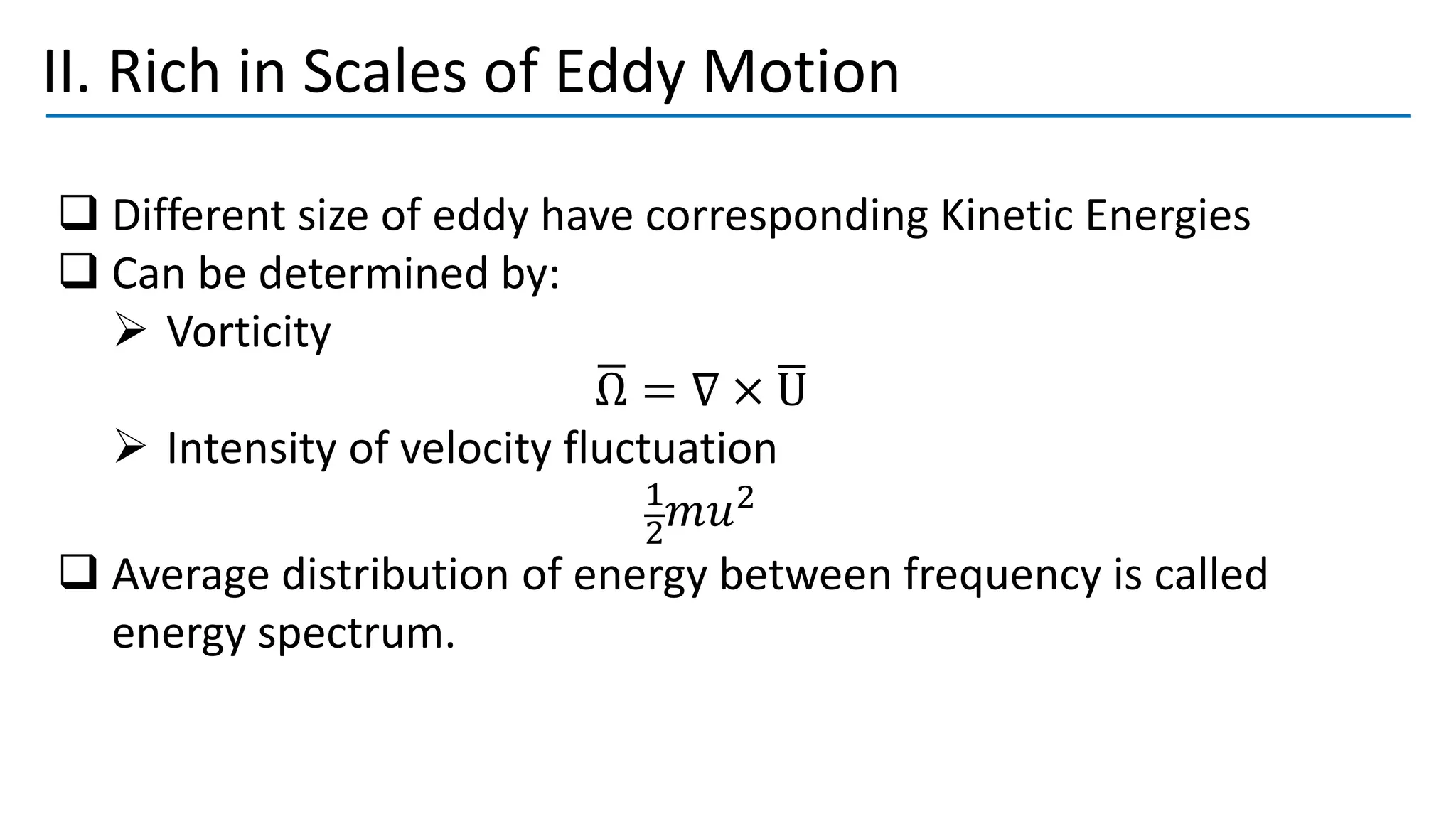
❑ Different size of eddy have corresponding Kinetic Energies
❑ Can be determined by:
➢ Vorticity
ഥ
Ω = ∇ × ഥ
U
➢ Intensity of velocity fluctuation
1
2
𝑚𝑢2
❑ Average distribution of energy between frequency is called
energy spectrum.
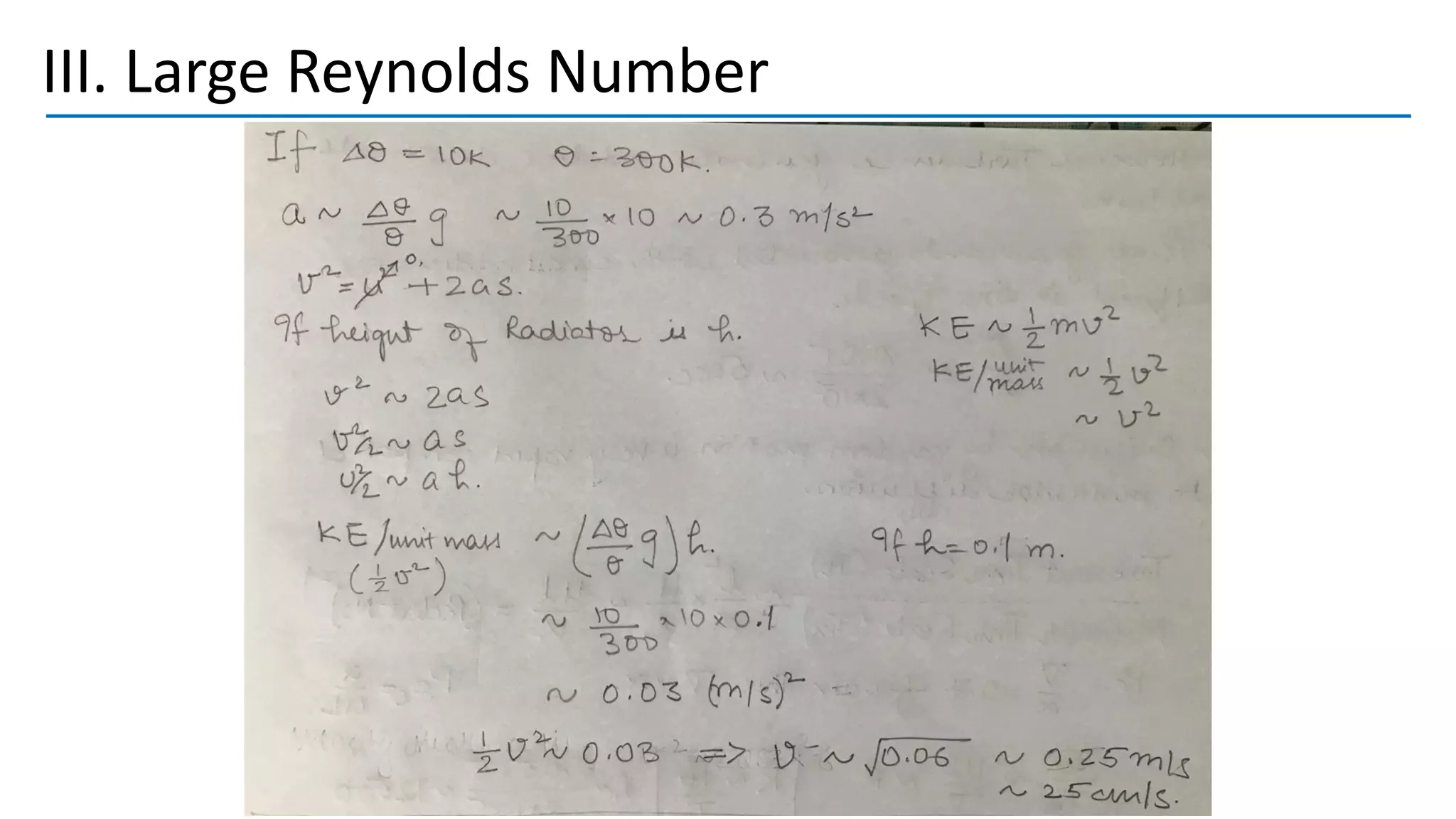
III. Large Reynolds Number
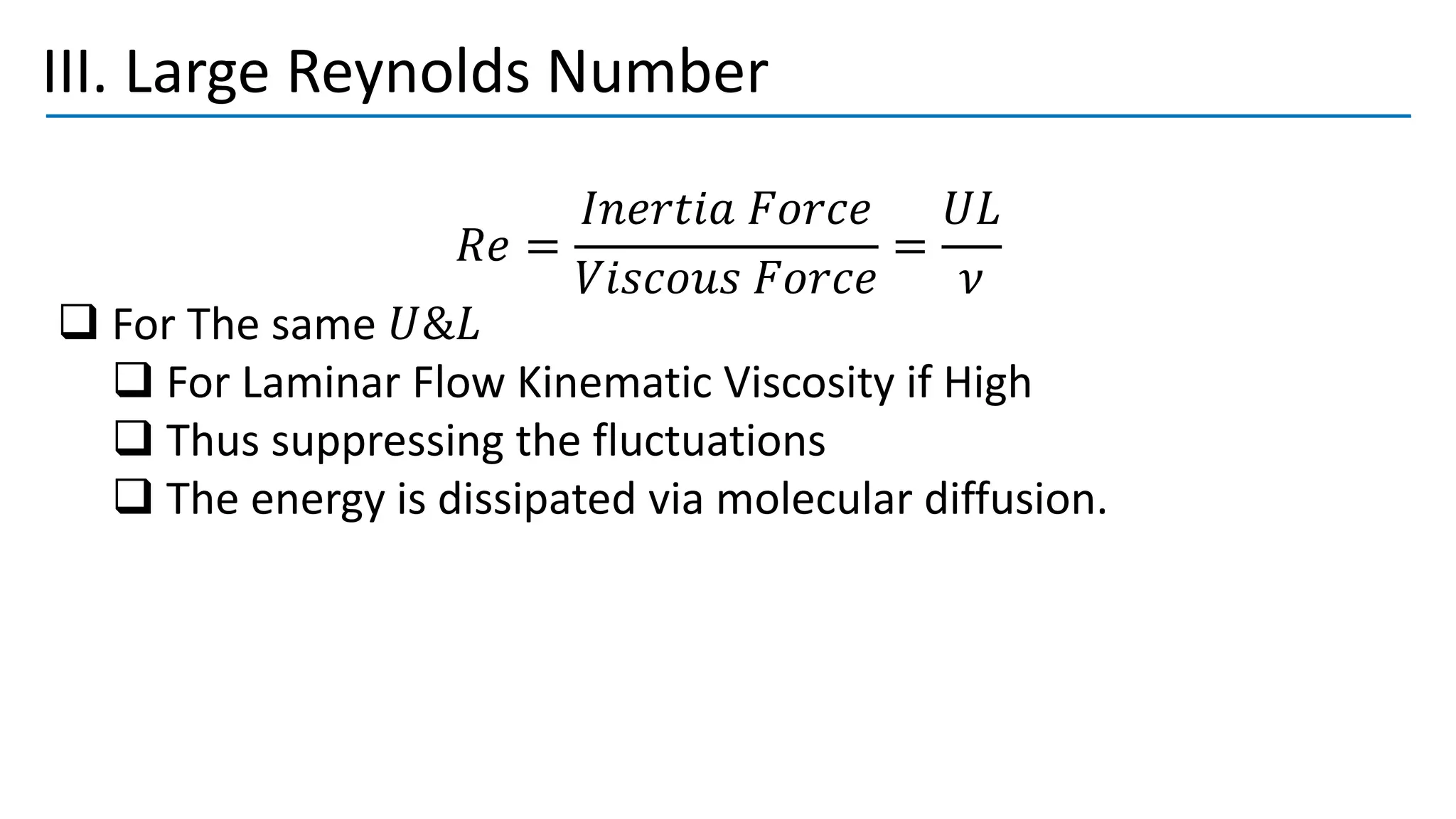
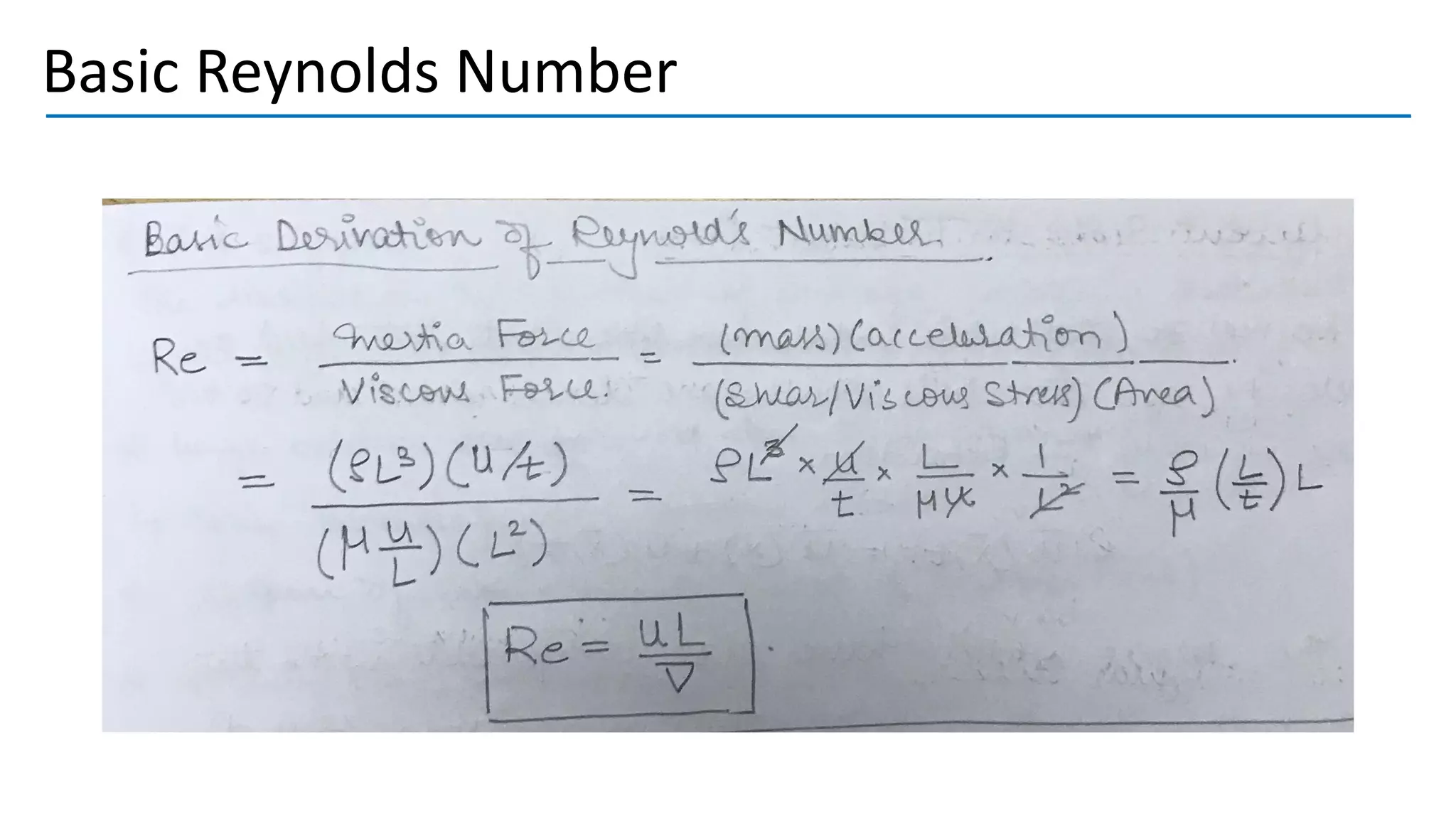
𝑅𝑒 =
𝐼𝑛𝑒𝑟𝑡𝑖𝑎 𝐹𝑜𝑟𝑐𝑒
𝑉𝑖𝑠𝑐𝑜𝑢𝑠 𝐹𝑜𝑟𝑐𝑒
=
𝑈𝐿
𝜈
❑ For The same 𝑈&𝐿
❑ For Laminar Flow Kinematic Viscosity if High
❑ Thus suppressing the fluctuations
❑ The energy is dissipated via molecular diffusion.
III. Large Reynolds Number
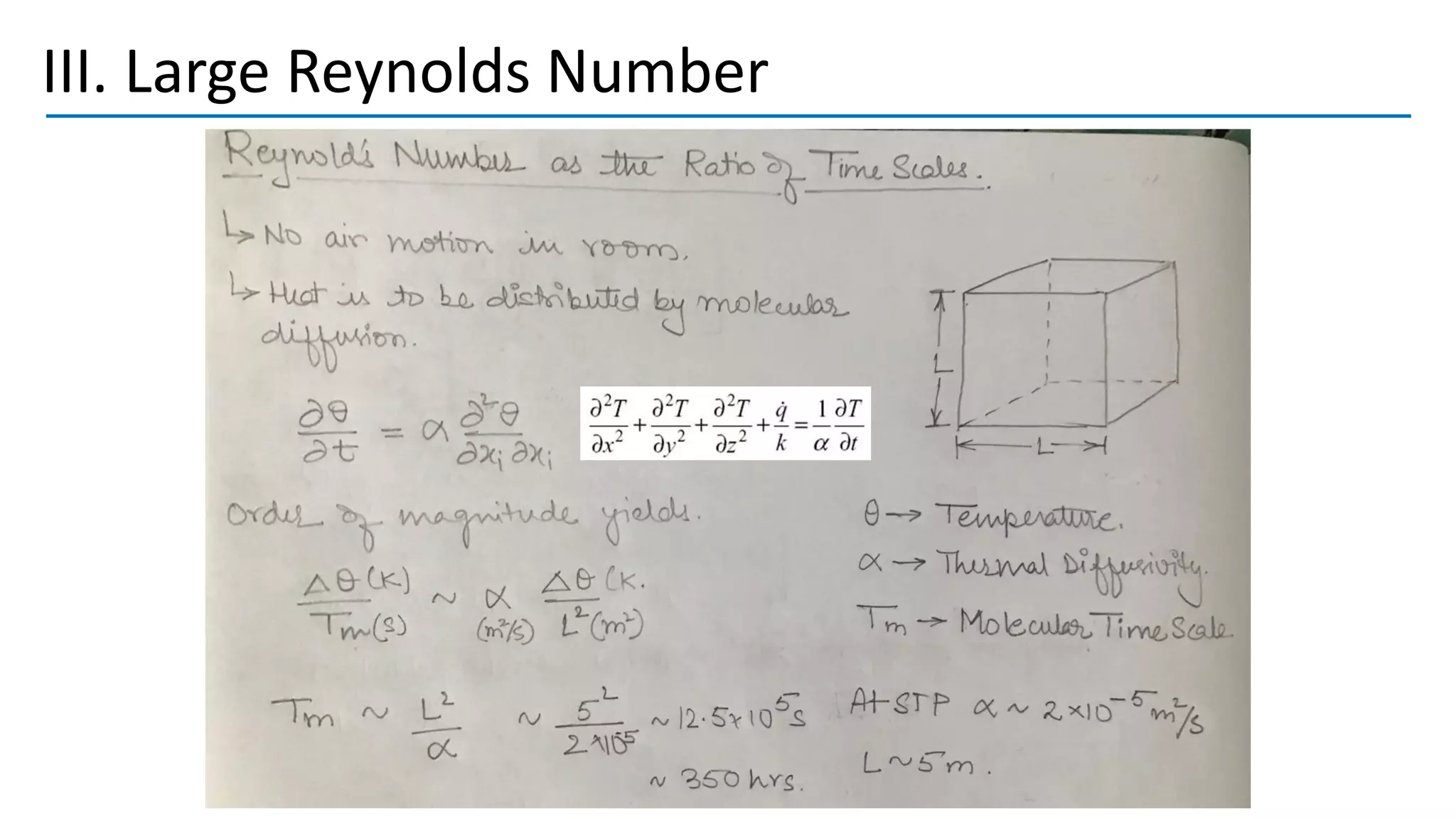
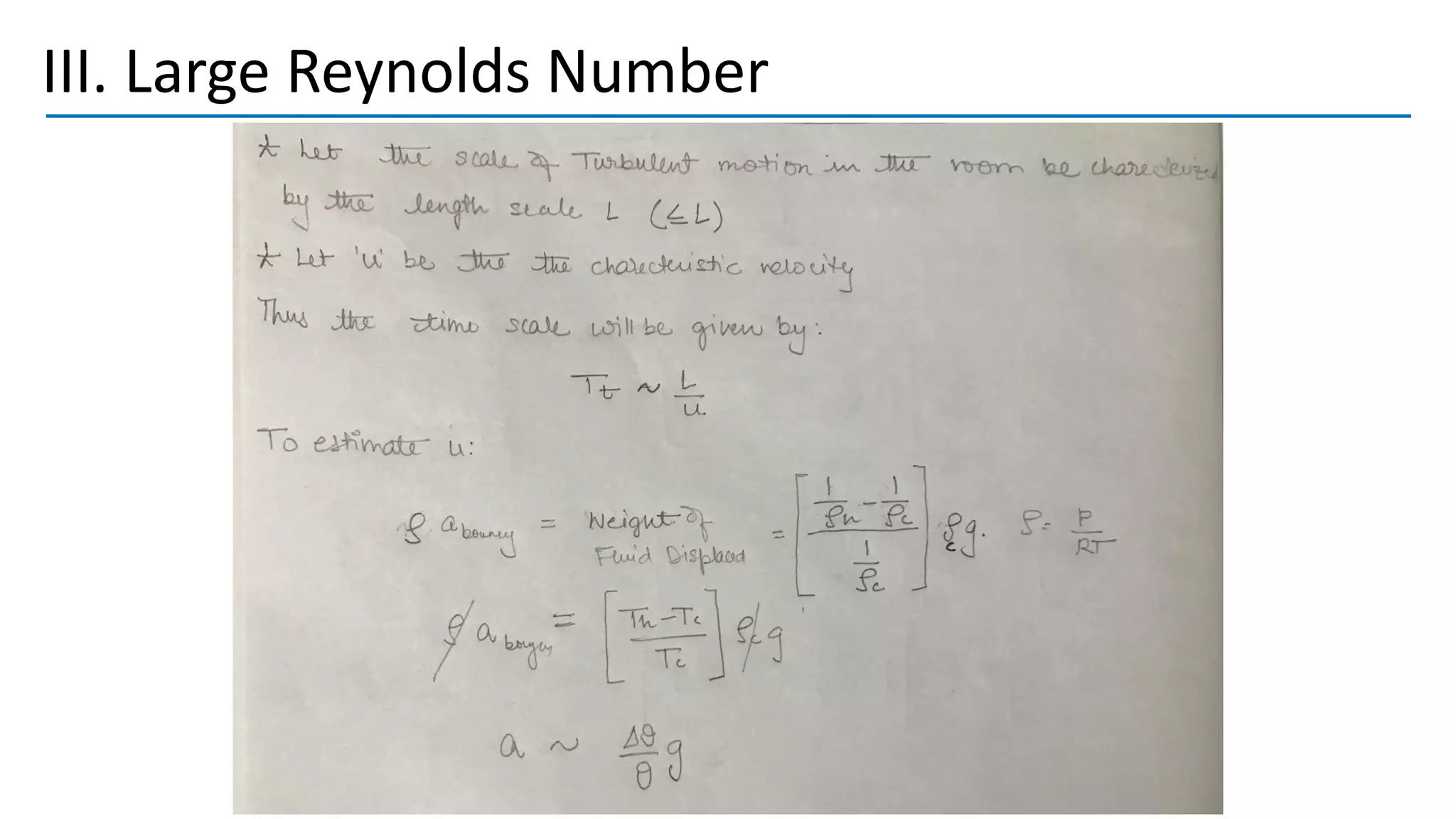
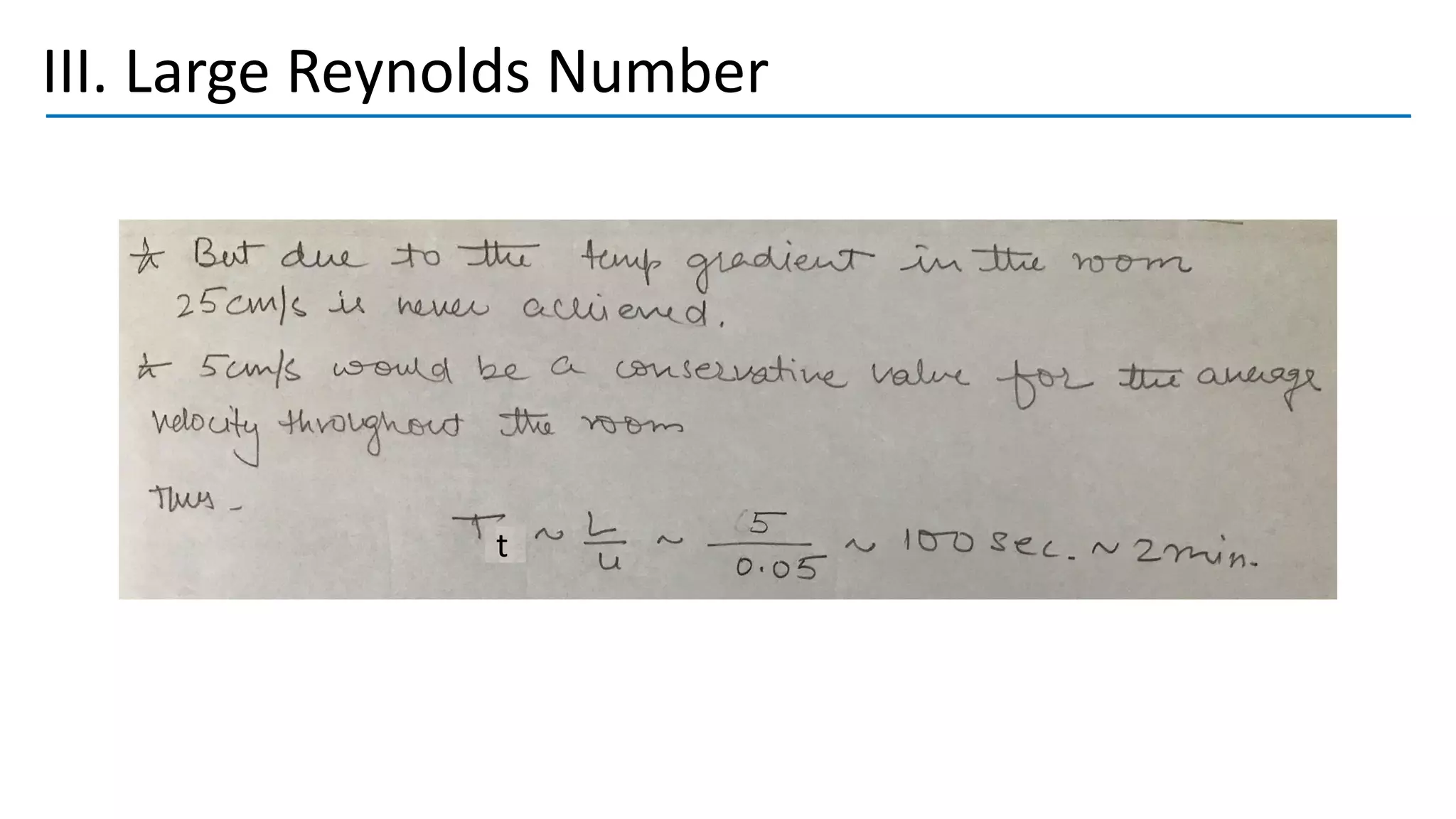
t
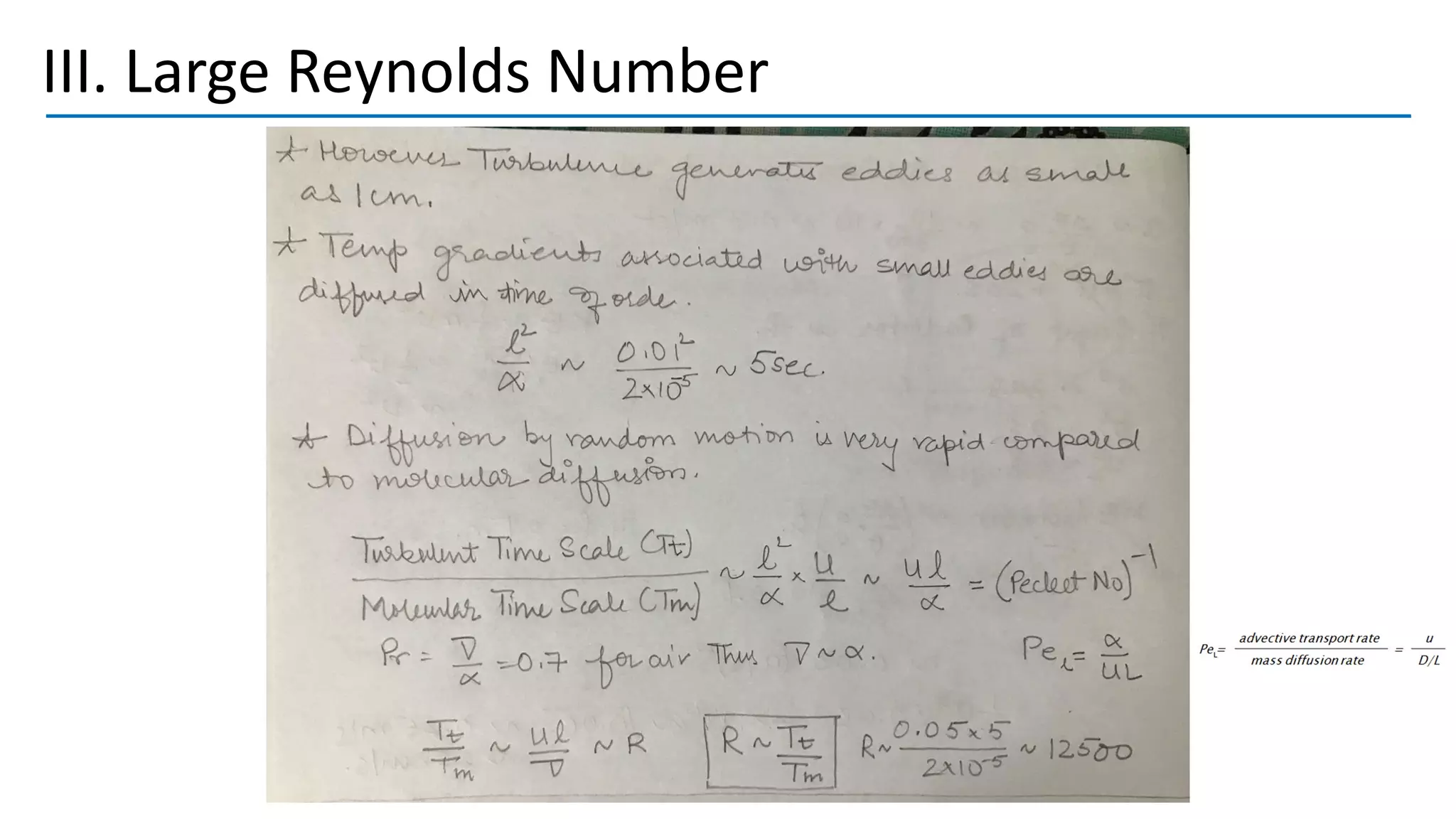
III. Large Reynolds Number
IV. Dissipative
❑ Viscosity removes flow fluctuations by converting the associated
Kinetic Energy into heat.
❑ Flow remains laminar when small perturbations are damped out
by viscosity.
❑ Re(↑) → Viscous Forces(↓)
❑ Damping derived from molecular diffusion of momentum is
unable to dissipate large perturbations.
❑ Turbulence often originates from instabilities in laminar
flow.(Related to interaction of viscous term and non-linear inertia
term in equation of motion)
IV. Dissipative
❑ Perturbations can occur from:
➢ Slight thermal current
➢ Surface Roughness
➢ Microscopic sources(Subcontinuum molecular motion like
Brownian Motion)
V. Highly Vortical
❑ It is rotational in nature.
❑ Characterized by high level of fluctuating Vorticity.
❑ Velocity derivatives are dominated by smallest scales of
turbulence.
VI. 3-Dimentional
❑ It is a 3-Dimentional phenomenon
❑ 2D Turbulence is used to describe simple cases where flow is
restricted to two dimensions.
❑ 2D Turbulence is not true Turbulence.
❑ Vorticity fluctuations cannot be 2-Dimentional.
❑ As “Vortex Stretching”, an important vorticity maintenance
mechanism is not present in 2-Dimentional flow.
VII. Highly Diffusive
❑ Its diffusivity is much higher than of laminar flow(Molecular
Diffusivity)
❑ This causes:
➢ Rapid Mixing
➢ Increased rate of momentum transfer
➢ Increased rate of heat transfer
➢ Increased rate of mass transfer
VIII. Not a Fluid Behavior
❑ It is a flow feature, not a fluid property.
❑ If is different for different flows.
➢ But some characteristics remain common.
IX. Holds Continuum Hypothesis
❑ Turbulence is a continuum phenomenon.
❑ It is governed by the equations of fluid mechanics.
❑ The smallest turbulent length scales are larger than the
molecular mean free path.
❑ An exception to this is Rarified Gas Medium.
Historic Account
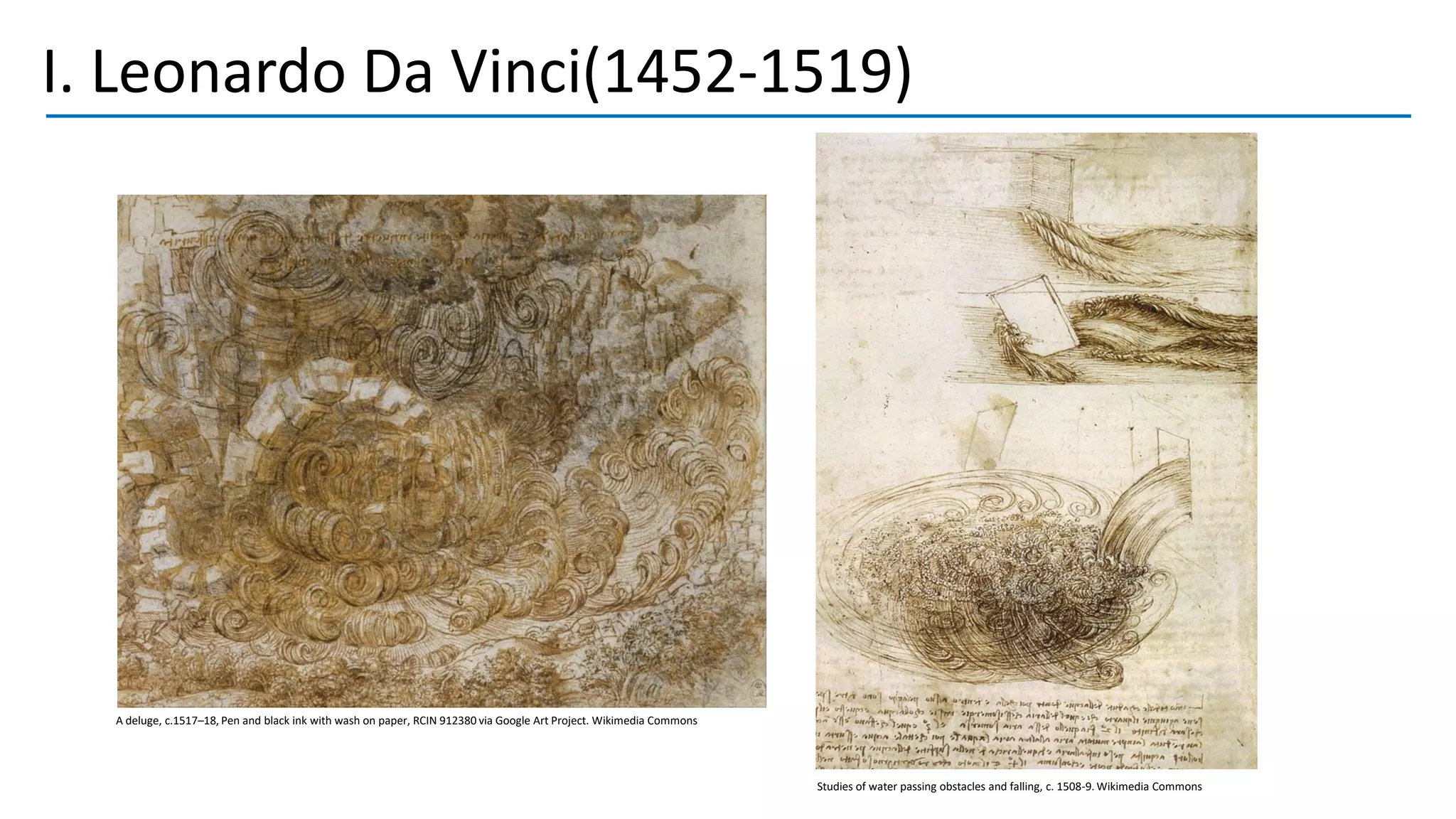
I. Leonardo Da Vinci(1452-1519)
A deluge, c.1517–18, Pen and black ink with wash on paper, RCIN 912380 via Google Art Project. Wikimedia Commons
Studies of water passing obstacles and falling, c. 1508-9. Wikimedia Commons
II. Lord Rayleigh(1842-1919)
❑ Worked on stability of parallel flow inviscid fluid.
❑ Found that presence of an inflection point was a necessary and
sufficient condition for an inviscid fluid to become unstable.
➢ Inflection point signifies that some sort of flow deceleration is
required for inviscid flow to become unstable.
❑ Suggested that presence of viscosity can promote initiation of
turbulence by enabling the creation of inflection point.
II. Lord Rayleigh(1842-1919)
❑ Indicated that viscosity is a double edged sword
➢ It is needed to kill turbulence.
➢ But simultaneously creates it.
III. Osborne Reynolds(1842-1912)
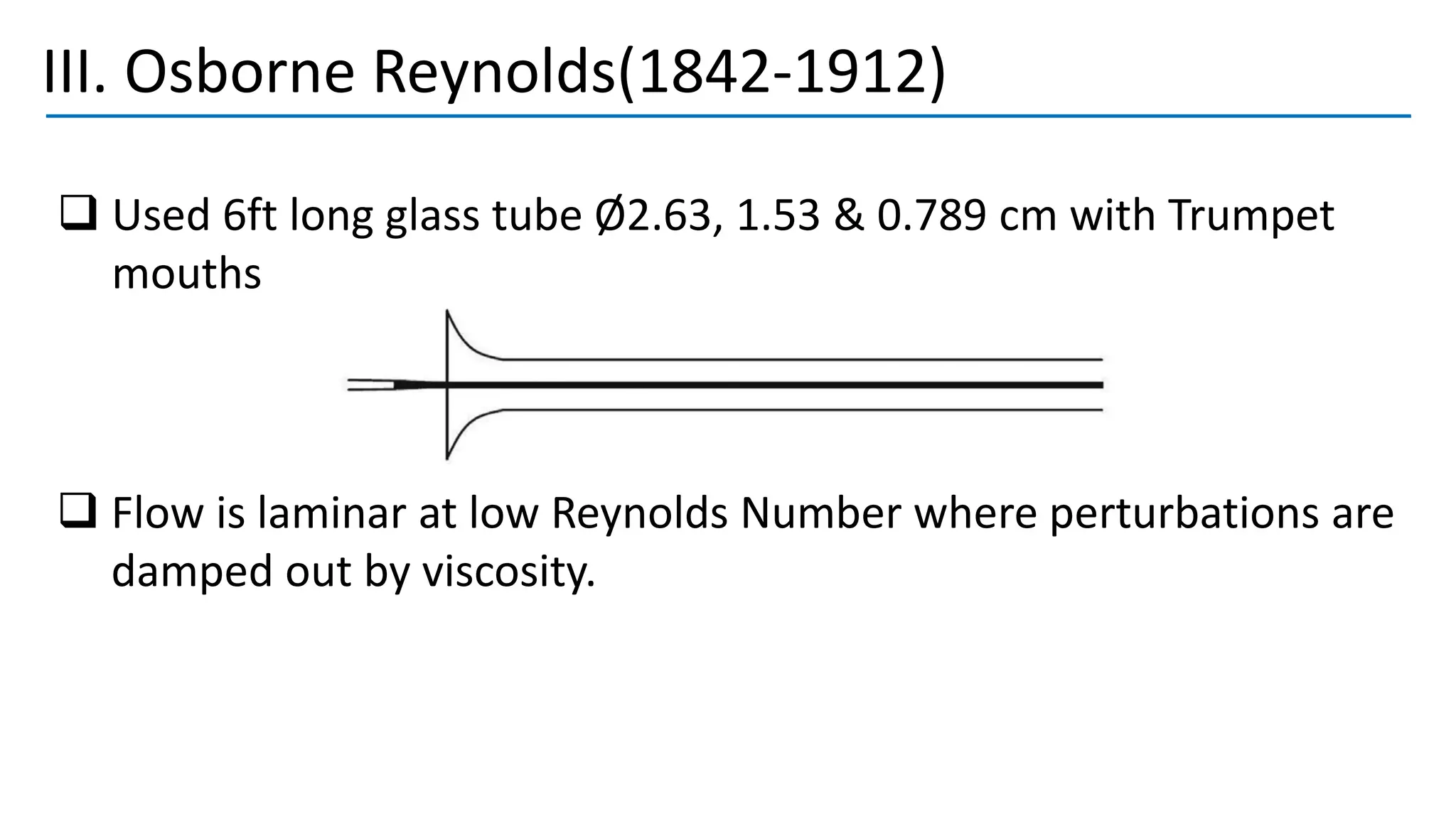
❑ Used 6ft long glass tube Ø2.63, 1.53 & 0.789 cm with Trumpet
mouths
❑ Flow is laminar at low Reynolds Number where perturbations are
damped out by viscosity.
III. Osborne Reynolds(1842-1912)
❑ At high flow rate the color band appears to expand and mix with
water.
❑ On viewing under electric spark the mass of the color resolves
into less distinct curls, in which eddies can be seen.
III. Osborne Reynolds(1842-1912)
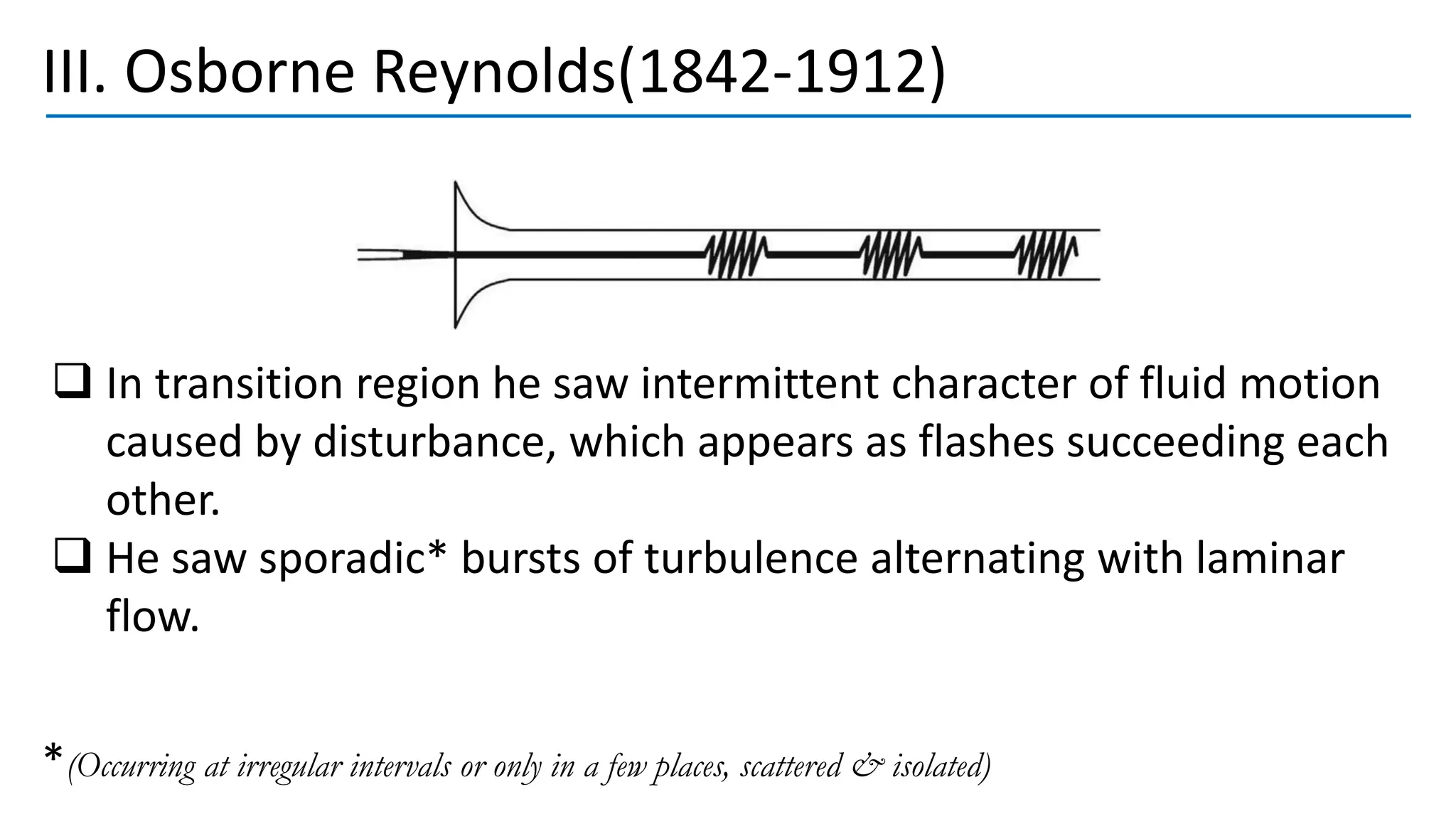
❑ In transition region he saw intermittent character of fluid motion
caused by disturbance, which appears as flashes succeeding each
other.
❑ He saw sporadic* bursts of turbulence alternating with laminar
flow.
*(Occurring at irregular intervals or only in a few places, scattered & isolated)
III. Osborne Reynolds(1842-1912)
❑ Poiseuille flow is stable to infinitesimal perturbations at all
Reynolds Number values.
❑ This implies that transition to turbulence is dependent on
perturbations, in addition to Reynolds Number.
❑ This is unlike flow over buff bodies, where instabilities can be
predicted using linearized perturbation theory with an
infinitesimal amplitude.
❑ Thus indicating presence of more than one way to create a
turbulent flow.
III. Osborne Reynolds(1842-1912)
❑ For practical pipe flows
❑ Transition occurs at Re~2000
❑ Fully Turbulent flow occurs at Re~2300
❑ These Reynolds Numbers are difficult to predict.
❑ They depend on:
❑ Upstream Flow Conditions.
❑ Boundary Roughness/Texture.
❑ With sufficient care, laminar flow in a pipe can be maintained to
atleast Re~105
III. Osborne Reynolds(1842-1912)
❑ Vortical structures are initially 2D
❑ Generated due to shear(no
slip) in boundary layer
❑ These vortical structures become
progressively unstable farther
downstream
❑ 3D interactions eventually
leading to turbulence
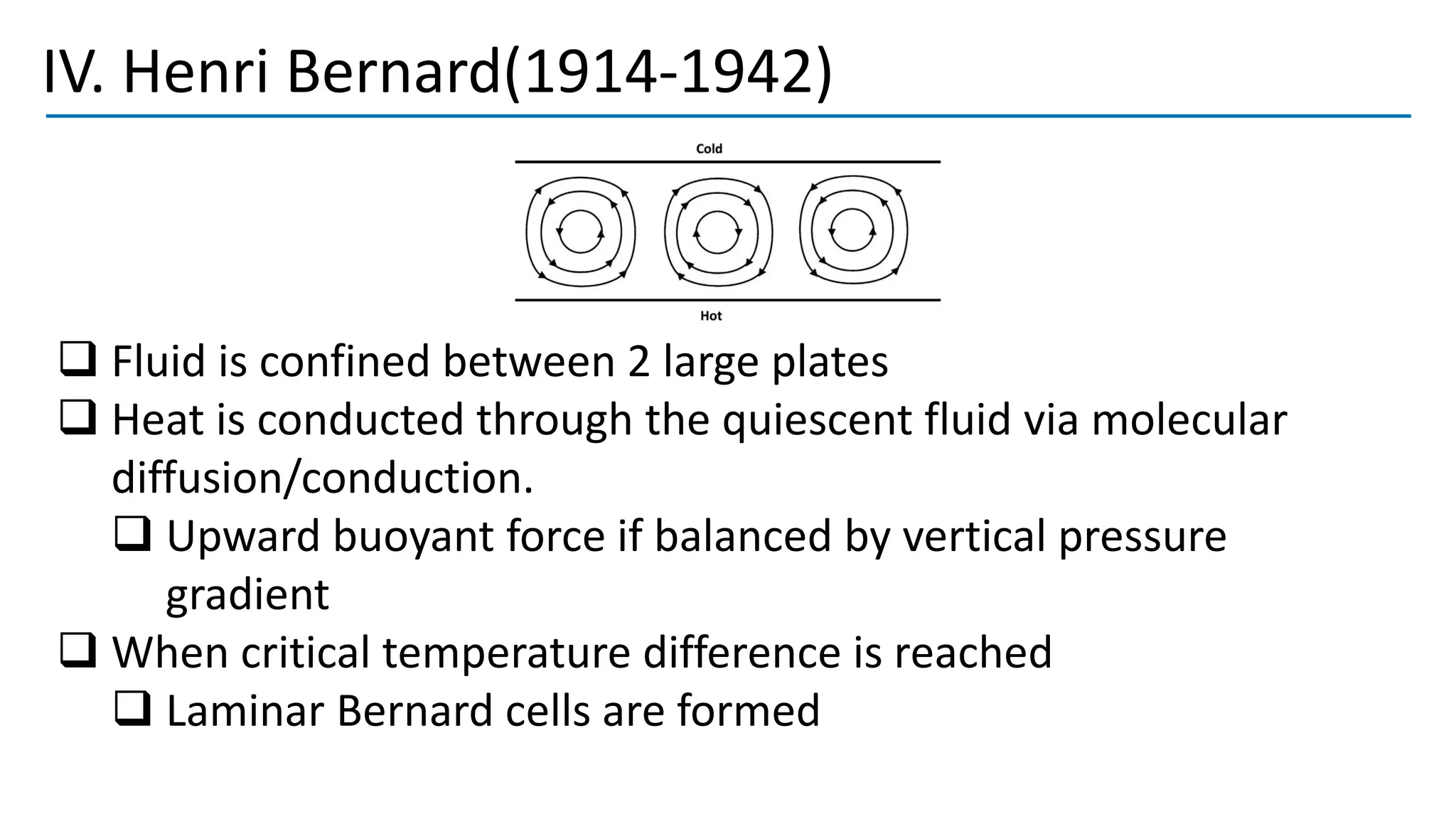
IV. Henri Bernard(1914-1942)
❑ Fluid is confined between 2 large plates
❑ Heat is conducted through the quiescent fluid via molecular
diffusion/conduction.
❑ Upward buoyant force if balanced by vertical pressure
gradient
❑ When critical temperature difference is reached
❑ Laminar Bernard cells are formed
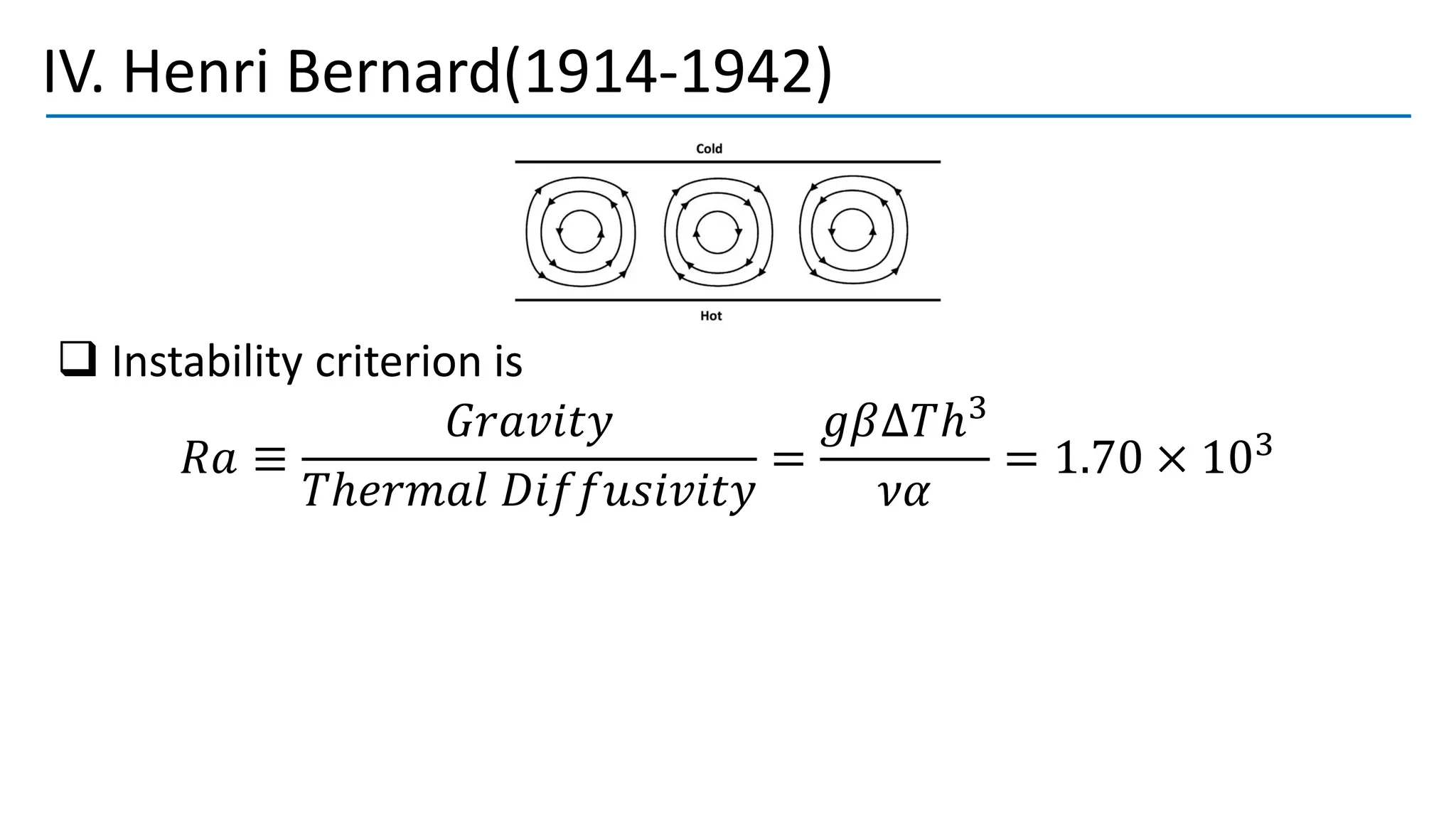
IV. Henri Bernard(1914-1942)
❑ Instability criterion is
𝑅𝑎 ≡
𝐺𝑟𝑎𝑣𝑖𝑡𝑦
𝑇ℎ𝑒𝑟𝑚𝑎𝑙 𝐷𝑖𝑓𝑓𝑢𝑠𝑖𝑣𝑖𝑡𝑦
=
𝑔𝛽∆𝑇ℎ3
𝜈𝛼
= 1.70 × 10³
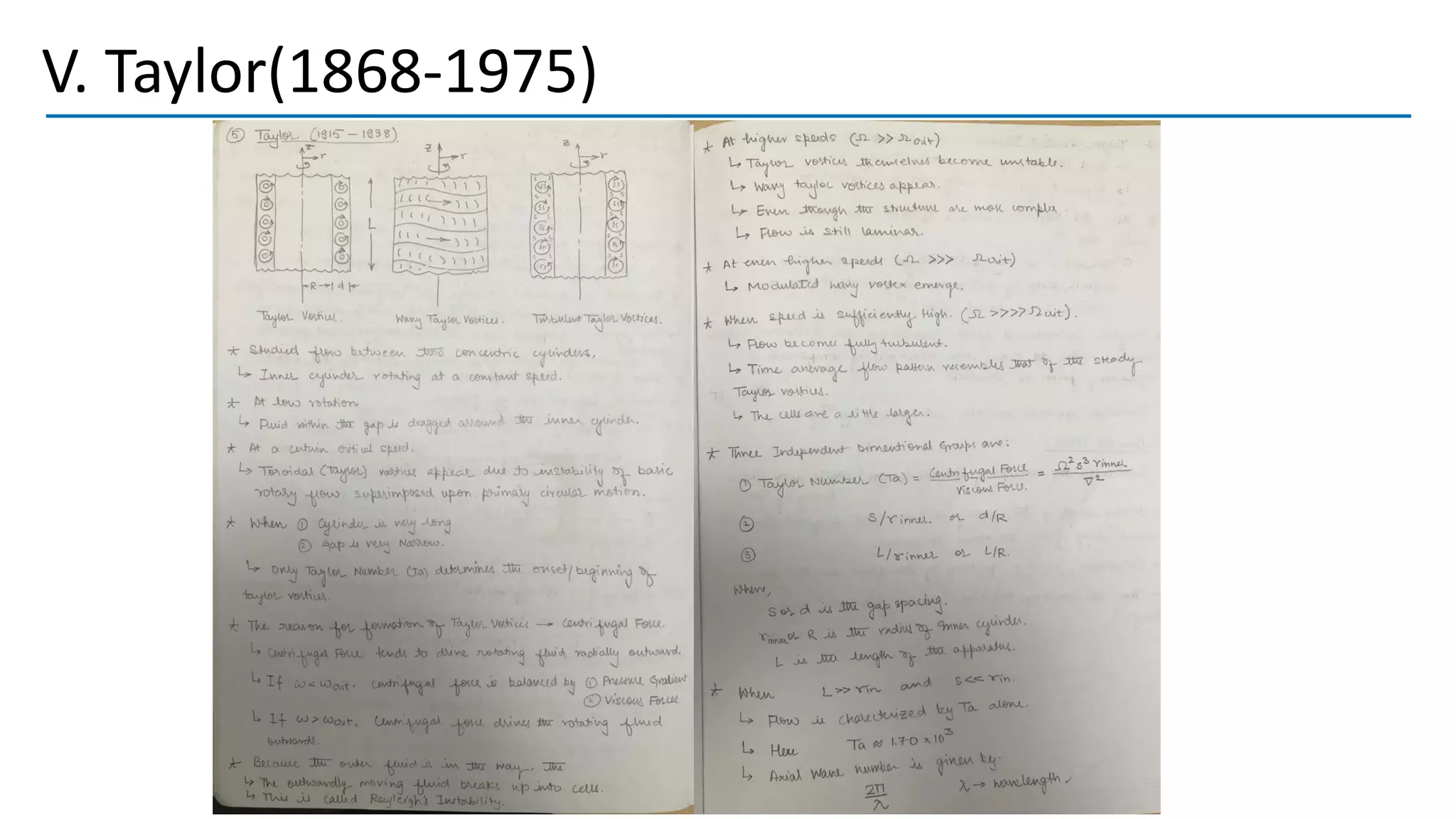
V. Taylor(1868-1975)
VI. Ludwig Prandtl(1875-1953)
❑ Introduced the concept of “Mixing Length”(Inline with the Kinetic
Theory of Gases )
❑ Mixing length is the average distance that a fluid element
would stray from the mean streamline.
❑ Turbulence is not a feature of the fluid but the flow
❑ Thus the anlogy between “Mean free path” and “Mixing Length”
Equations of Fluid Motion
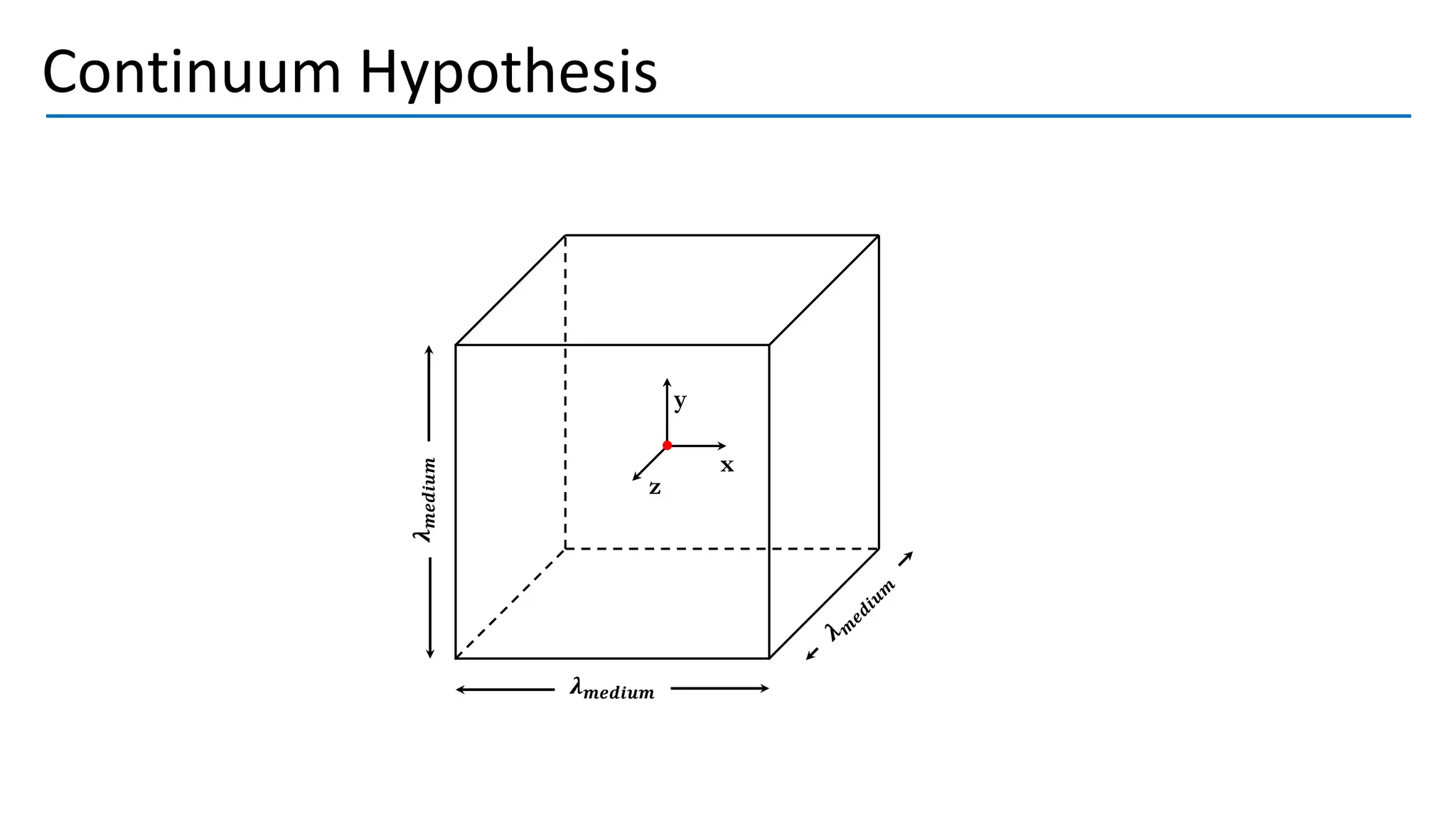
Continuum Hypothesis
❑ For continuum hypothesis to be valid the mean free path of the
molecule should be very small relative to system geometry.
𝐾𝑛𝑢𝑑𝑠𝑒𝑛 𝑁𝑜. (𝐾𝑛) ≡
𝜆𝑚𝑓𝑝
𝑙
❑ 𝜆𝑚𝑓𝑝 is the mean free path of the molecule
❑ 𝑙 is the smallest geometric scale of the flow
𝜆𝑚𝑓𝑝 < 𝑙𝑚𝑒𝑑𝑖𝑢𝑚 < 𝑙
❑ Under this condition the continuum fluid properties can be
averaged over the volume of size
Continuum Hypothesis
x
y
z
𝒅𝒙
𝒅𝒚
𝝀𝒎𝒆𝒅𝒊𝒖𝒎
𝝀
𝒎𝒆𝒅𝒊𝒖𝒎
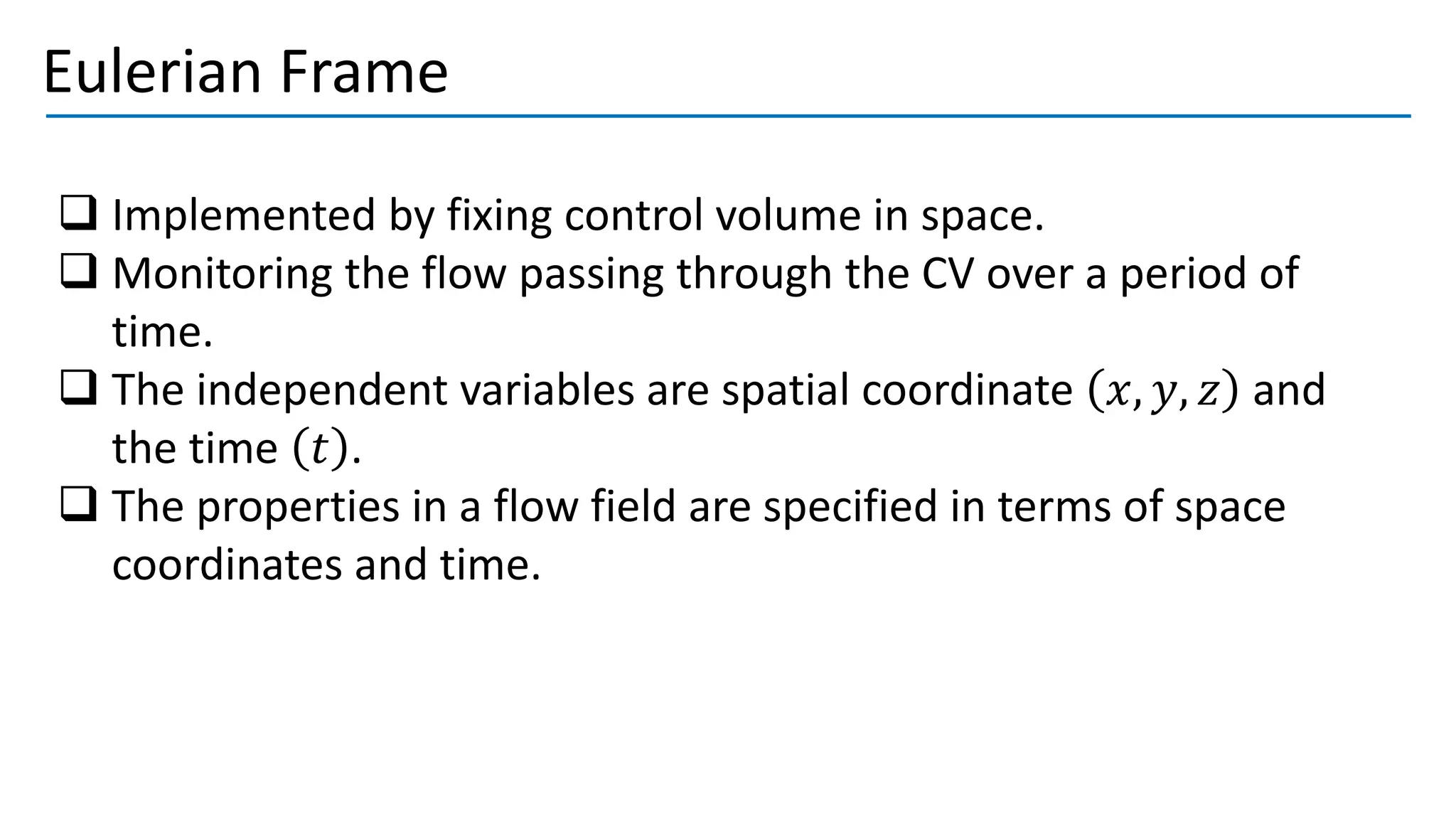
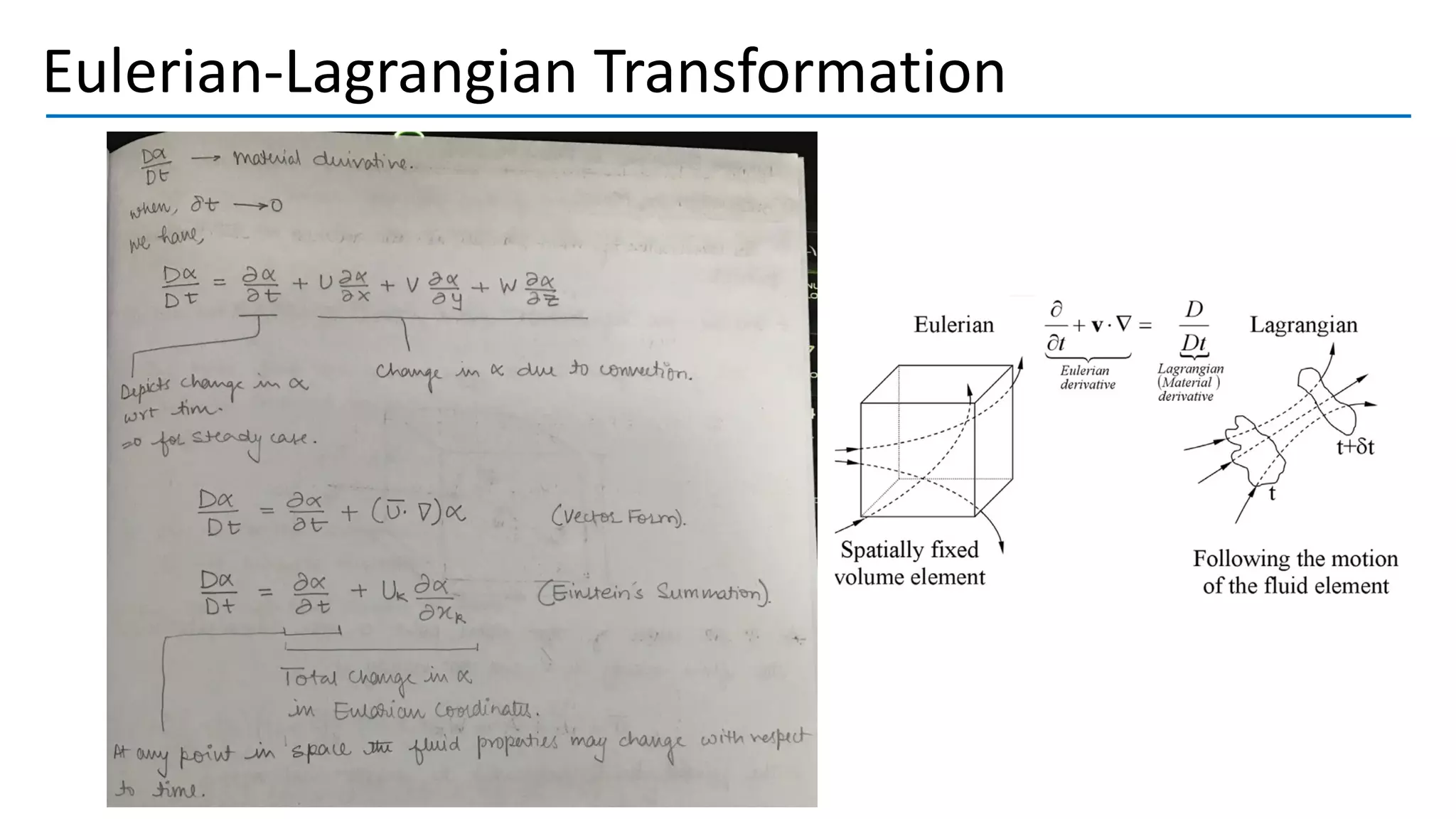
Eulerian Frame
❑ Implemented by fixing control volume in space.
❑ Monitoring the flow passing through the CV over a period of
time.
❑ The independent variables are spatial coordinate 𝑥, 𝑦, 𝑧 and
the time 𝑡 .
❑ The properties in a flow field are specified in terms of space
coordinates and time.
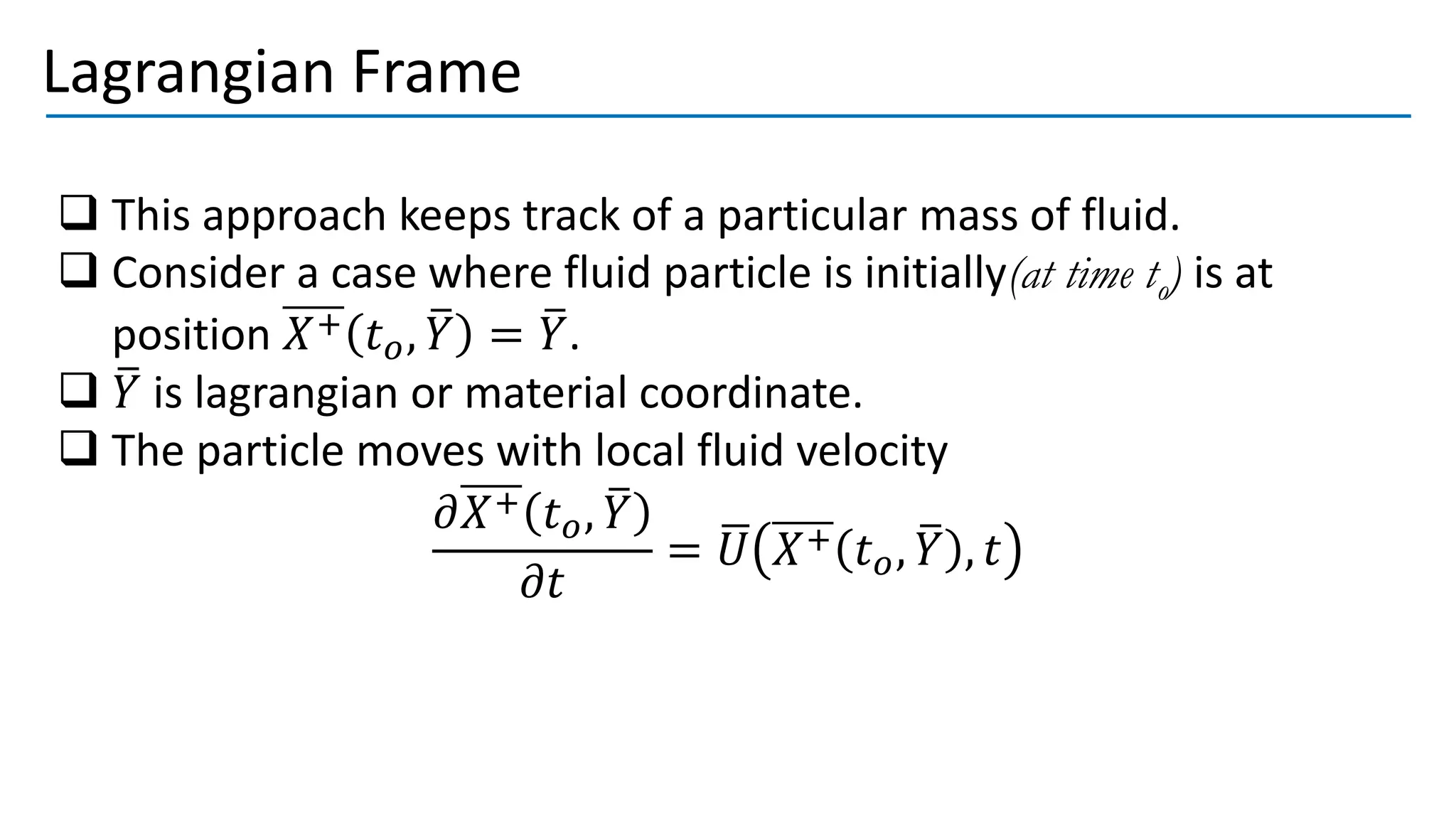
Lagrangian Frame
❑ This approach keeps track of a particular mass of fluid.
❑ Consider a case where fluid particle is initially(at time to) is at
position 𝑋+ 𝑡𝑜, ത
𝑌 = ത
𝑌.
❑ ത
𝑌 is lagrangian or material coordinate.
❑ The particle moves with local fluid velocity
𝜕𝑋+ 𝑡𝑜, ത
𝑌
𝜕𝑡
= ഥ
𝑈 𝑋+ 𝑡𝑜, ത
𝑌 , 𝑡
Eulerian Frame
www.youtube.com. (n.d.). YouTube. [online] Available at:https://www.youtube.com/watch?v=IxOt4ALui8k.
Lagrangian Frame
www.youtube.com. (n.d.). YouTube. [online] Available at:https://www.youtube.com/watch?v=SsnYoqdFGIY&t=1s.
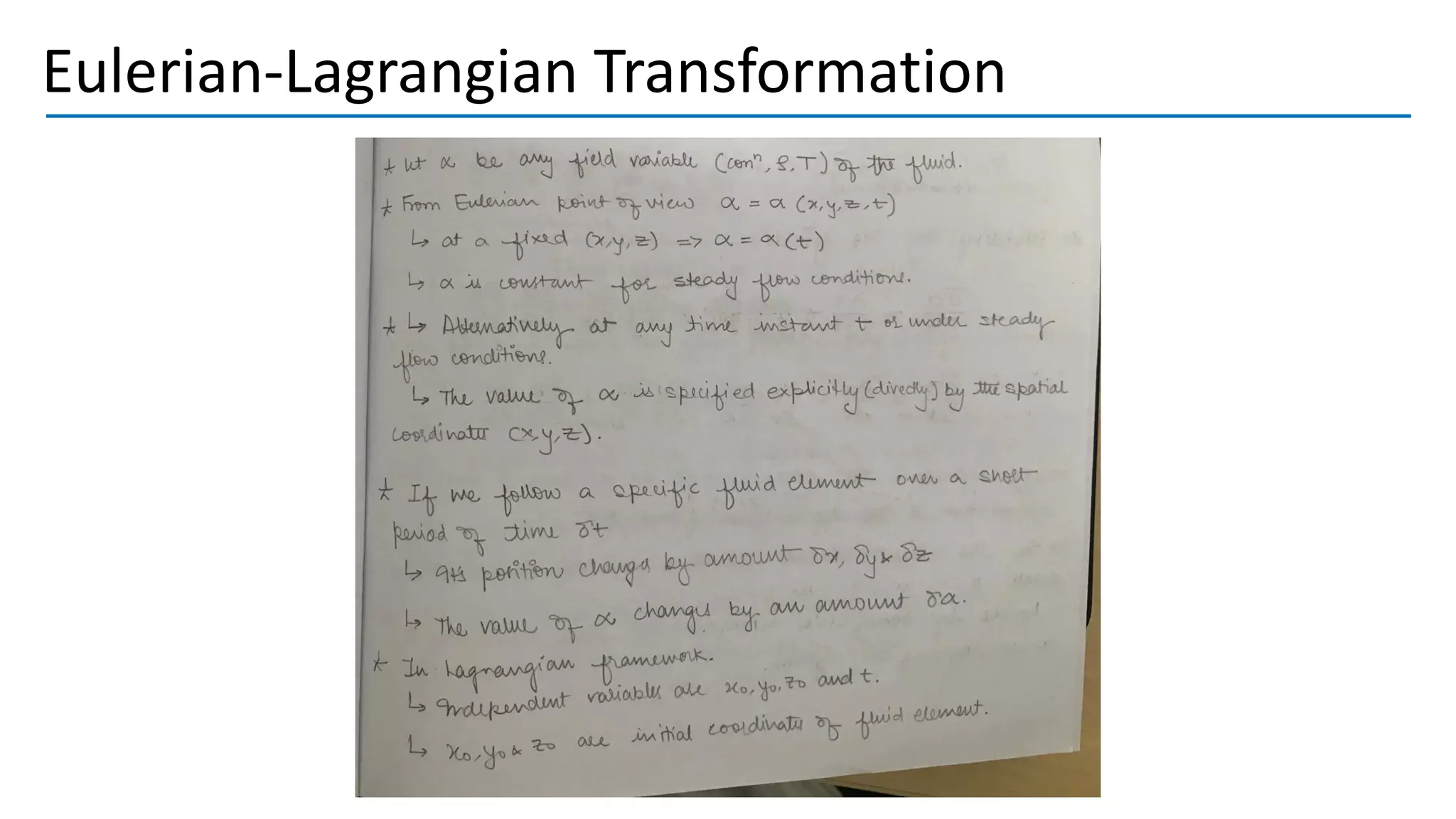
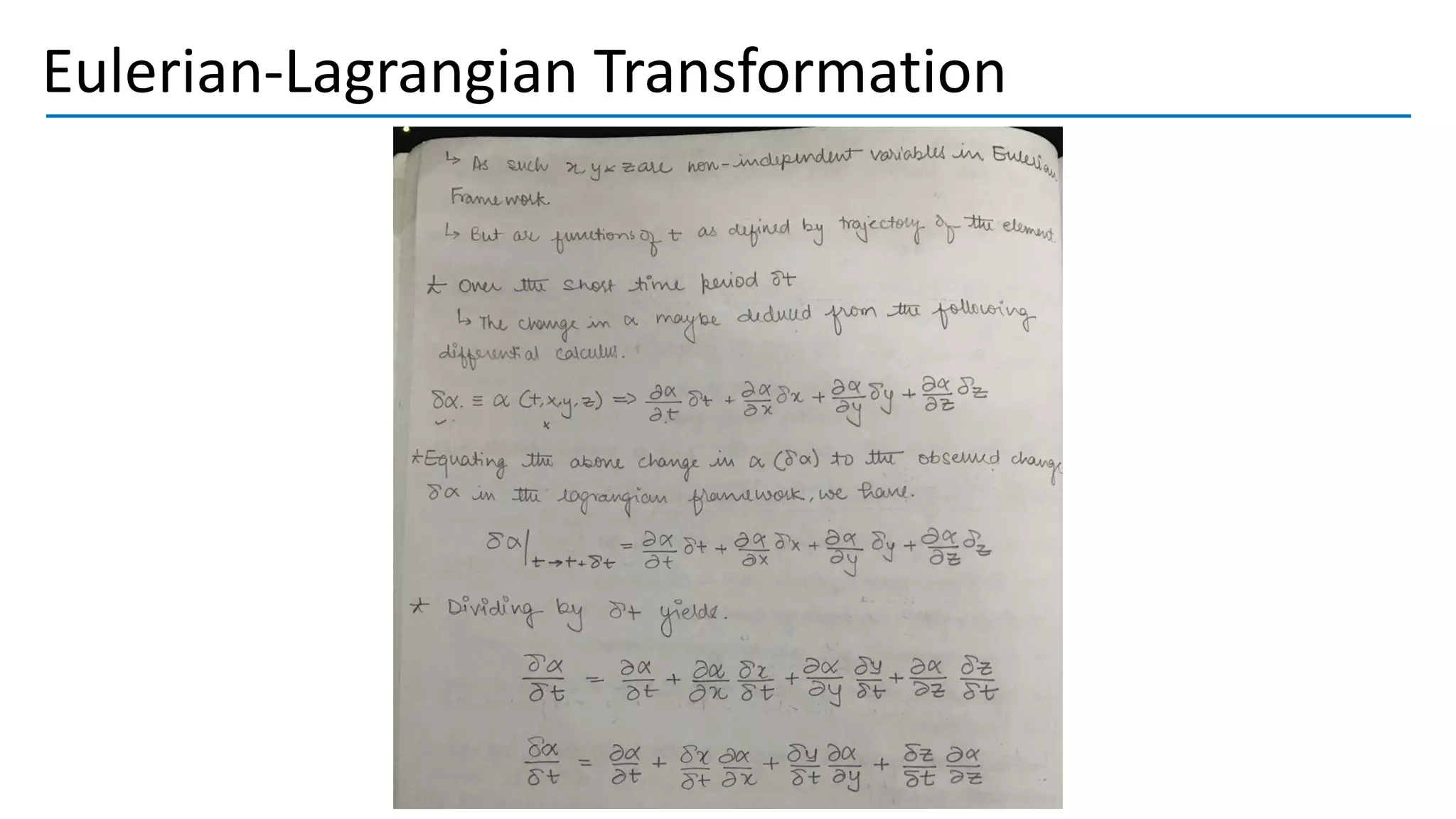
Eulerian-Lagrangian Transformation
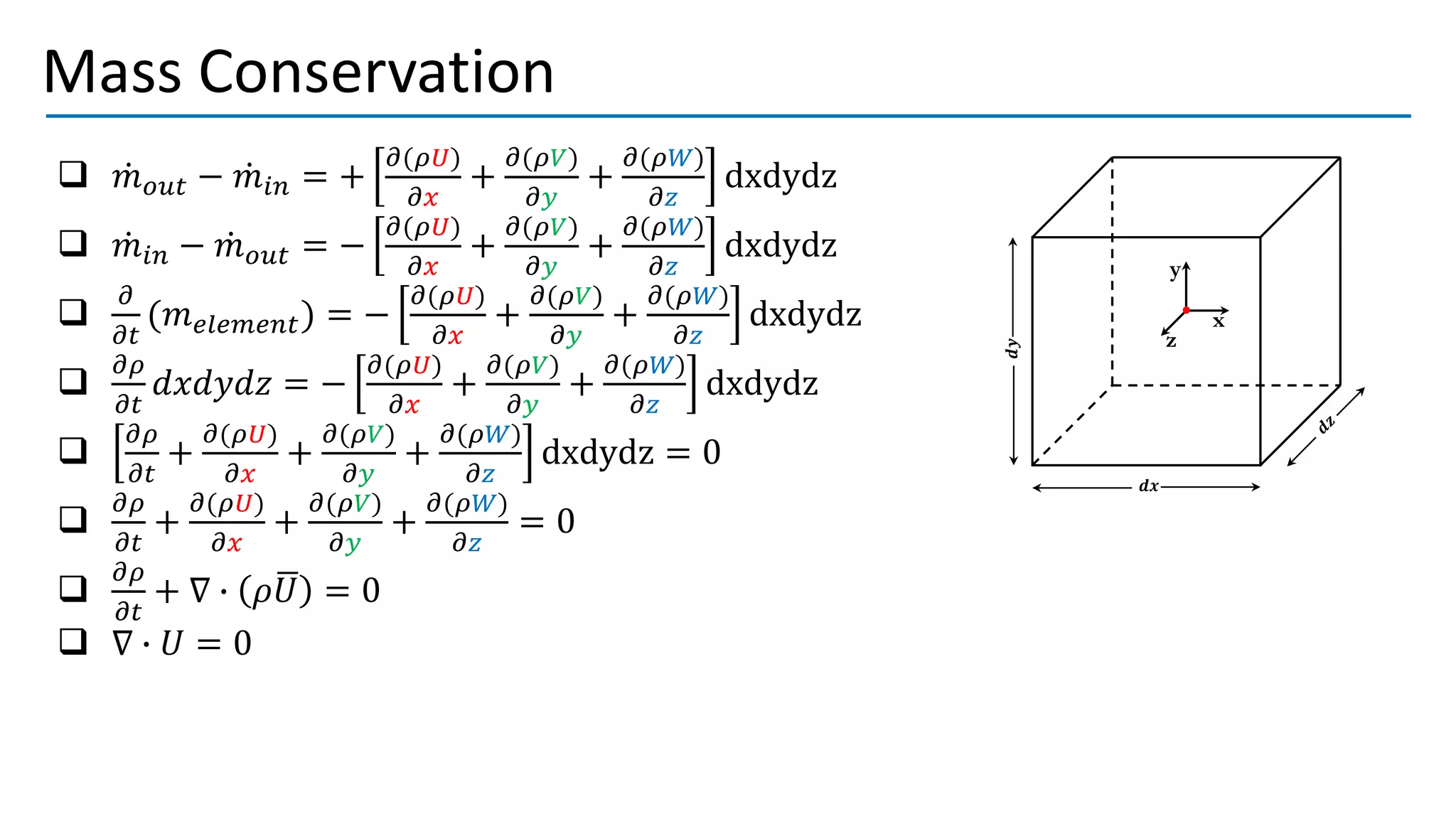
Mass Conservation
x
y
z
𝒅𝒙
𝒅𝒚
o
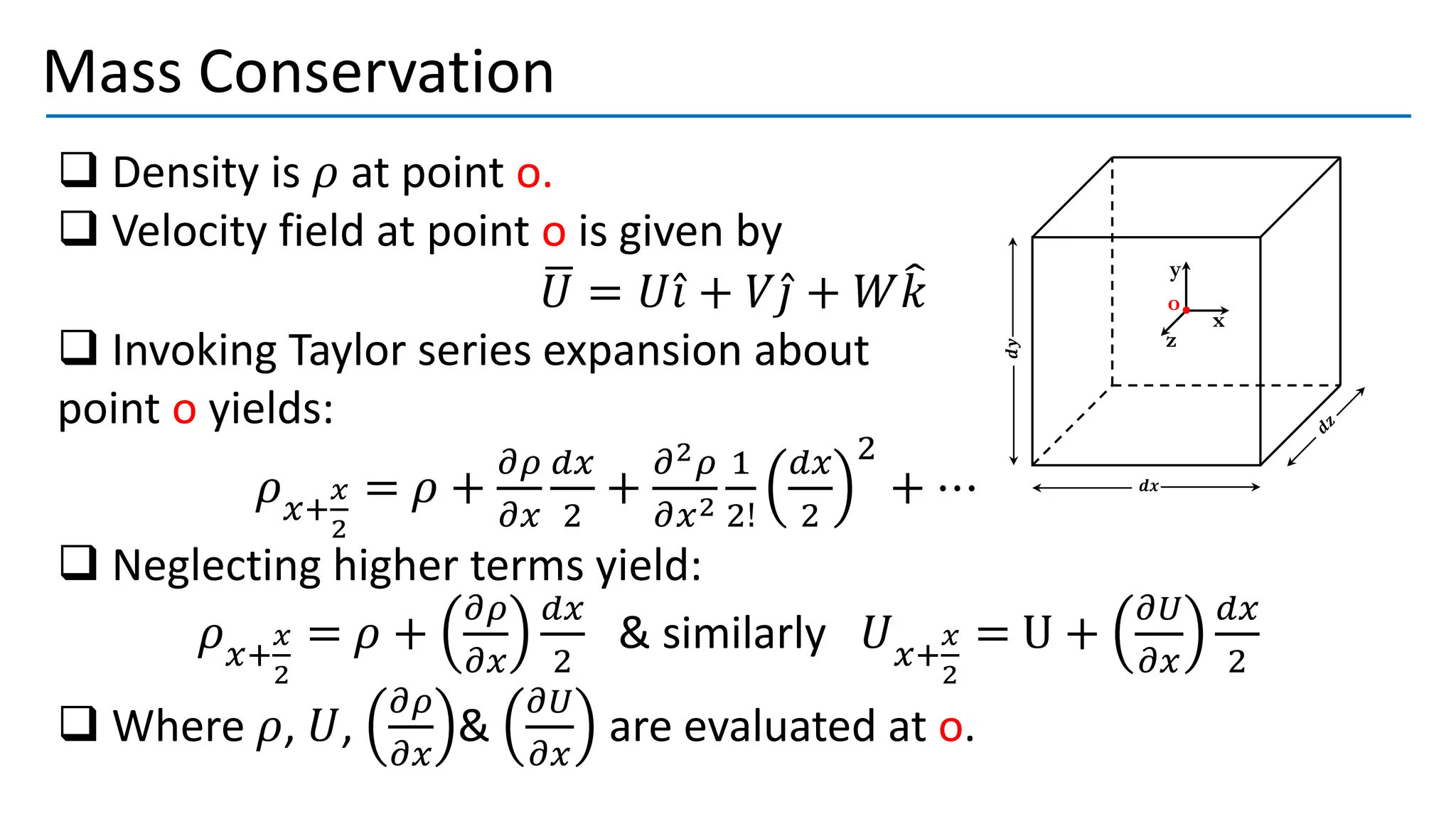
❑ Density is 𝜌 at point o.
❑ Velocity field at point o is given by
ഥ
𝑈 = 𝑈 Ƹ
𝑖 + 𝑉 Ƹ
𝑗 + 𝑊෠
𝑘
❑ Invoking Taylor series expansion about
point o yields:
𝜌𝑥+
𝑥
2
= 𝜌 +
𝜕𝜌
𝜕𝑥
𝑑𝑥
2
+
𝜕2𝜌
𝜕𝑥2
1
2!
𝑑𝑥
2
2
+ ⋯
❑ Neglecting higher terms yield:
𝜌𝑥+
𝑥
2
= 𝜌 +
𝜕𝜌
𝜕𝑥
𝑑𝑥
2
& similarly 𝑈𝑥+
𝑥
2
= U +
𝜕𝑈
𝜕𝑥
𝑑𝑥
2
❑ Where 𝜌, 𝑈,
𝜕𝜌
𝜕𝑥
&
𝜕𝑈
𝜕𝑥
are evaluated at o.
Mass Conservation
x
y
z
𝒅𝒙
𝒅𝒚
o
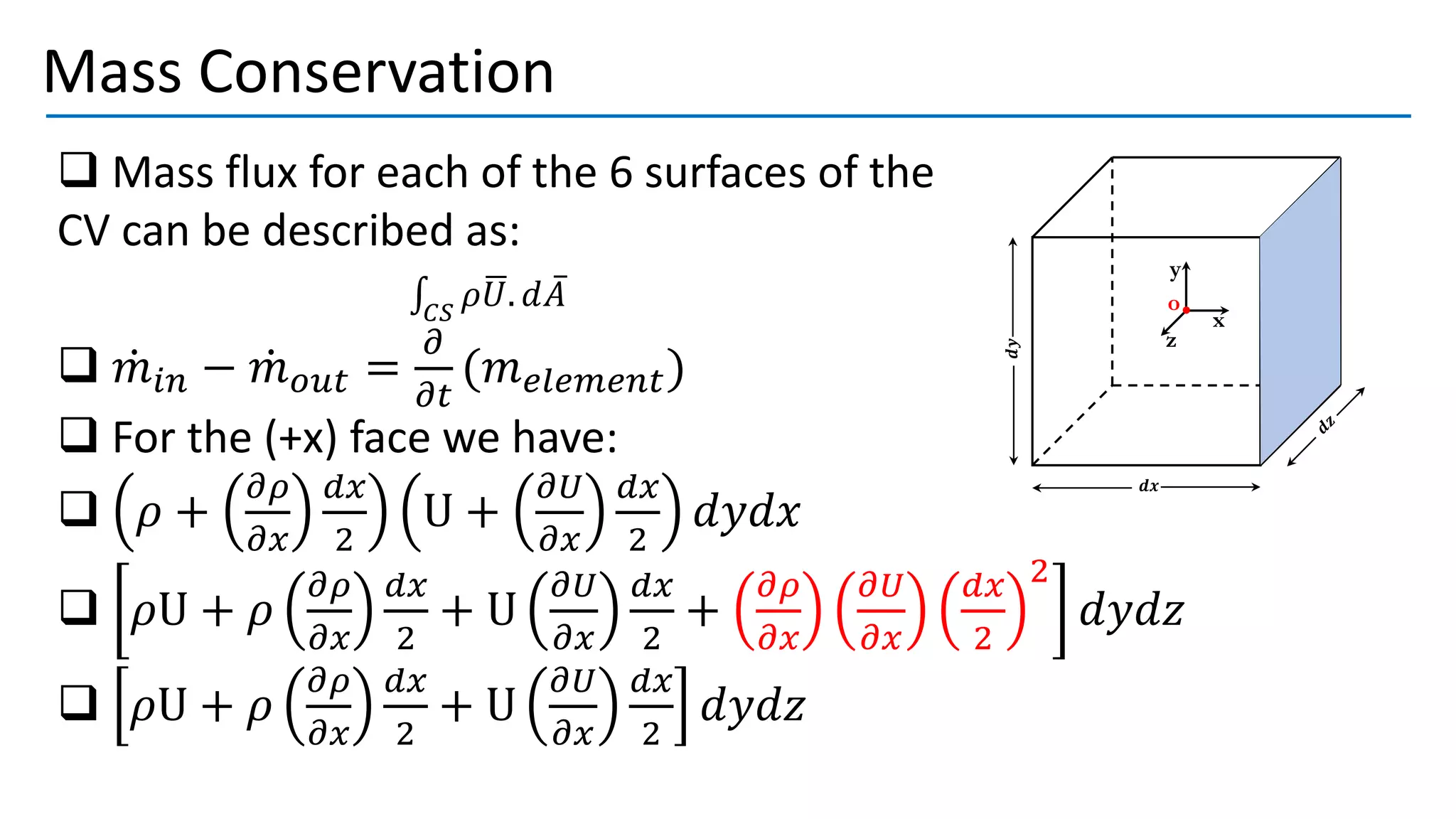
❑ Mass flux for each of the 6 surfaces of the
CV can be described as:
‫׬‬
𝐶𝑆
𝜌ഥ
𝑈. 𝑑 ҧ
𝐴
❑ ሶ
𝑚𝑖𝑛 − ሶ
𝑚𝑜𝑢𝑡 =
𝜕
𝜕𝑡
(𝑚𝑒𝑙𝑒𝑚𝑒𝑛𝑡)
❑ For the (+x) face we have:
❑ 𝜌 +
𝜕𝜌
𝜕𝑥
𝑑𝑥
2
U +
𝜕𝑈
𝜕𝑥
𝑑𝑥
2
𝑑𝑦𝑑𝑥
❑ 𝜌U + 𝜌
𝜕𝜌
𝜕𝑥
𝑑𝑥
2
+ U
𝜕𝑈
𝜕𝑥
𝑑𝑥
2
+
𝜕𝜌
𝜕𝑥
𝜕𝑈
𝜕𝑥
𝑑𝑥
2
2
𝑑𝑦𝑑𝑧
❑ 𝜌U + 𝜌
𝜕𝜌
𝜕𝑥
𝑑𝑥
2
+ U
𝜕𝑈
𝜕𝑥
𝑑𝑥
2
𝑑𝑦𝑑𝑧
Mass Conservation
x
y
z
𝒅𝒙
𝒅𝒚
o
❑ 𝜌U + 𝜌
𝜕𝜌
𝜕𝑥
𝑑𝑥
2
+ U
𝜕𝑈
𝜕𝑥
𝑑𝑥
2
𝑑𝑦𝑑𝑧
❑ 𝜌Udxdydz +
𝜌
2
𝜕𝜌
𝜕𝑥
dxdydz +
𝑈
2
𝜕𝑈
𝜕𝑥
dxdydz
❑ +x: +𝜌Udxdydz +
1
2
𝜕(𝜌𝑈)
𝜕𝑥
dxdydz
❑ -x: −𝜌Udxdydz +
1
2
𝜕(𝜌𝑈)
𝜕𝑥
dxdydz
❑ +y: +𝜌Vdxdydz +
1
2
𝜕(𝜌𝑉)
𝜕𝑦
dxdydz
❑ -y: −𝜌Vdxdydz +
1
2
𝜕 𝜌𝑉
𝜕𝑦
dxdydz
❑ +z: +𝜌Wdxdydz +
1
2
𝜕(𝜌𝑊)
𝜕𝑧
dxdydz
❑ -z: −𝜌Wdxdydz +
1
2
𝜕 𝜌𝑊
𝜕𝑧
dxdydz
❑
𝜕(𝜌𝑈)
𝜕𝑥
+
𝜕(𝜌𝑉)
𝜕𝑦
+
𝜕(𝜌𝑊)
𝜕𝑧
dxdydz ≡ 𝑁𝑒𝑡 𝑅𝑎𝑡𝑒 𝑜𝑓 𝑀𝑎𝑠𝑠 𝐹𝑙𝑢𝑥 𝑇ℎ𝑟𝑜𝑢𝑔ℎ 𝐶𝑉
𝜕(𝜌𝑈)
𝜕𝑥
dxdydz
𝜕(𝜌𝑉)
𝜕𝑦
dxdydz
𝜕(𝜌𝑊)
𝜕𝑧
dxdydz
+
+
Mass Conservation
x
y
z
𝒅𝒙
𝒅𝒚
❑ ሶ
𝑚𝑜𝑢𝑡 − ሶ
𝑚𝑖𝑛 = +
𝜕(𝜌𝑈)
𝜕𝑥
+
𝜕(𝜌𝑉)
𝜕𝑦
+
𝜕(𝜌𝑊)
𝜕𝑧
dxdydz
❑ ሶ
𝑚𝑖𝑛 − ሶ
𝑚𝑜𝑢𝑡 = −
𝜕(𝜌𝑈)
𝜕𝑥
+
𝜕(𝜌𝑉)
𝜕𝑦
+
𝜕(𝜌𝑊)
𝜕𝑧
dxdydz
❑
𝜕
𝜕𝑡
(𝑚𝑒𝑙𝑒𝑚𝑒𝑛𝑡) = −
𝜕(𝜌𝑈)
𝜕𝑥
+
𝜕(𝜌𝑉)
𝜕𝑦
+
𝜕(𝜌𝑊)
𝜕𝑧
dxdydz
❑
𝜕𝜌
𝜕𝑡
𝑑𝑥𝑑𝑦𝑑𝑧 = −
𝜕(𝜌𝑈)
𝜕𝑥
+
𝜕(𝜌𝑉)
𝜕𝑦
+
𝜕(𝜌𝑊)
𝜕𝑧
dxdydz
❑
𝜕𝜌
𝜕𝑡
+
𝜕(𝜌𝑈)
𝜕𝑥
+
𝜕(𝜌𝑉)
𝜕𝑦
+
𝜕(𝜌𝑊)
𝜕𝑧
dxdydz = 0
❑
𝜕𝜌
𝜕𝑡
+
𝜕(𝜌𝑈)
𝜕𝑥
+
𝜕(𝜌𝑉)
𝜕𝑦
+
𝜕(𝜌𝑊)
𝜕𝑧
= 0
❑
𝜕𝜌
𝜕𝑡
+ ∇ ∙ 𝜌ഥ
𝑈 = 0
❑ ∇ ∙ 𝑈 = 0
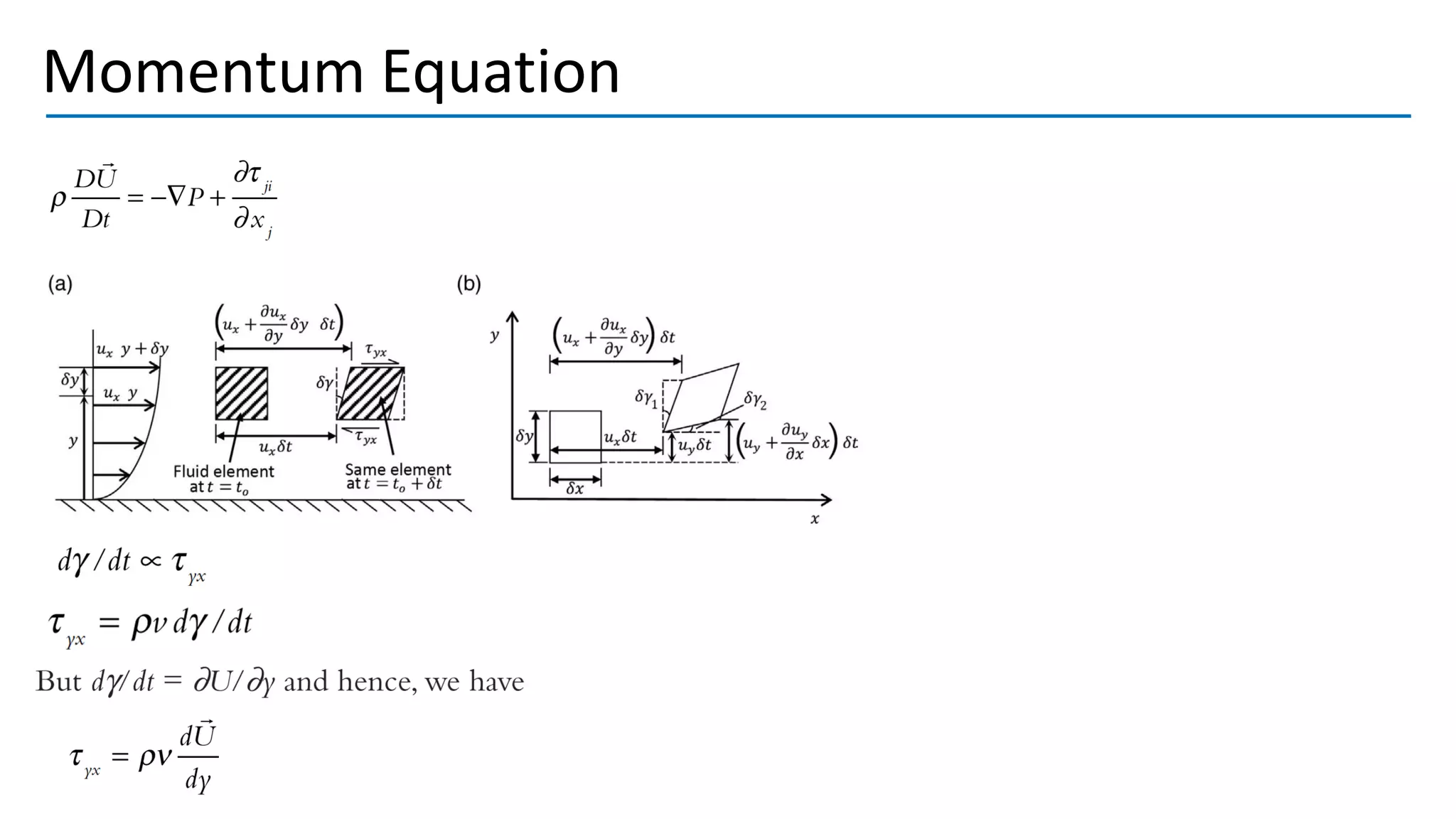
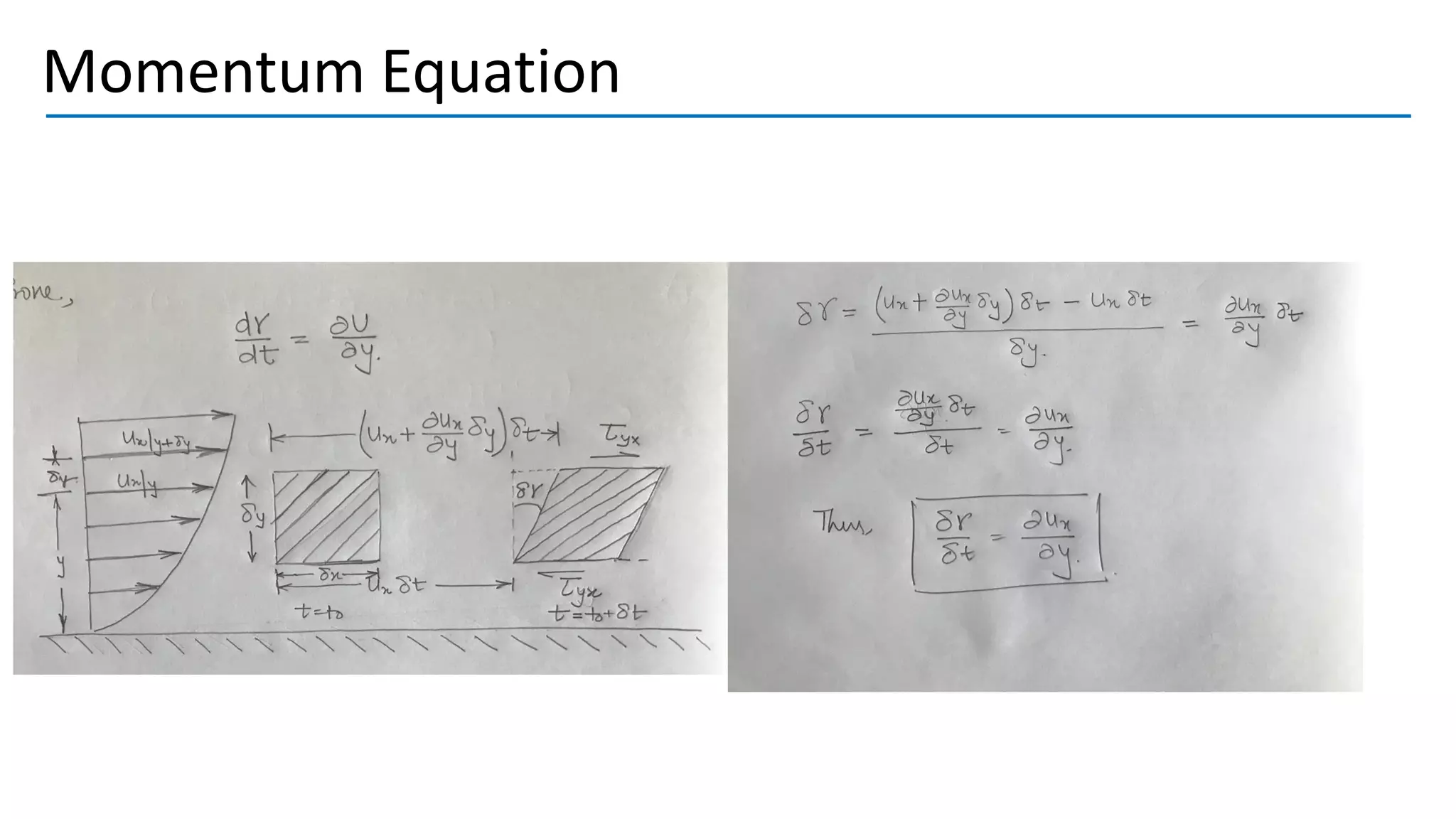
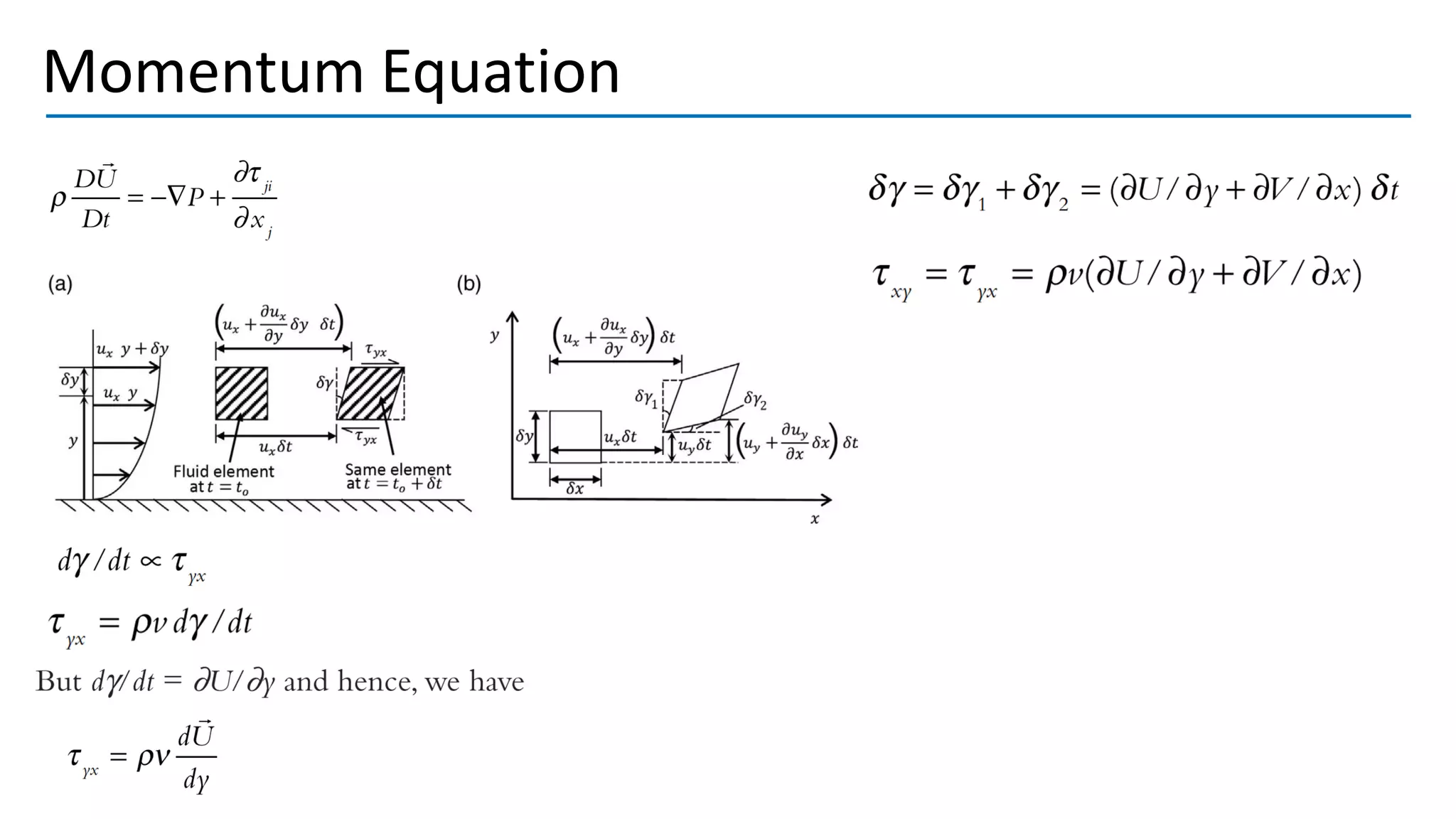
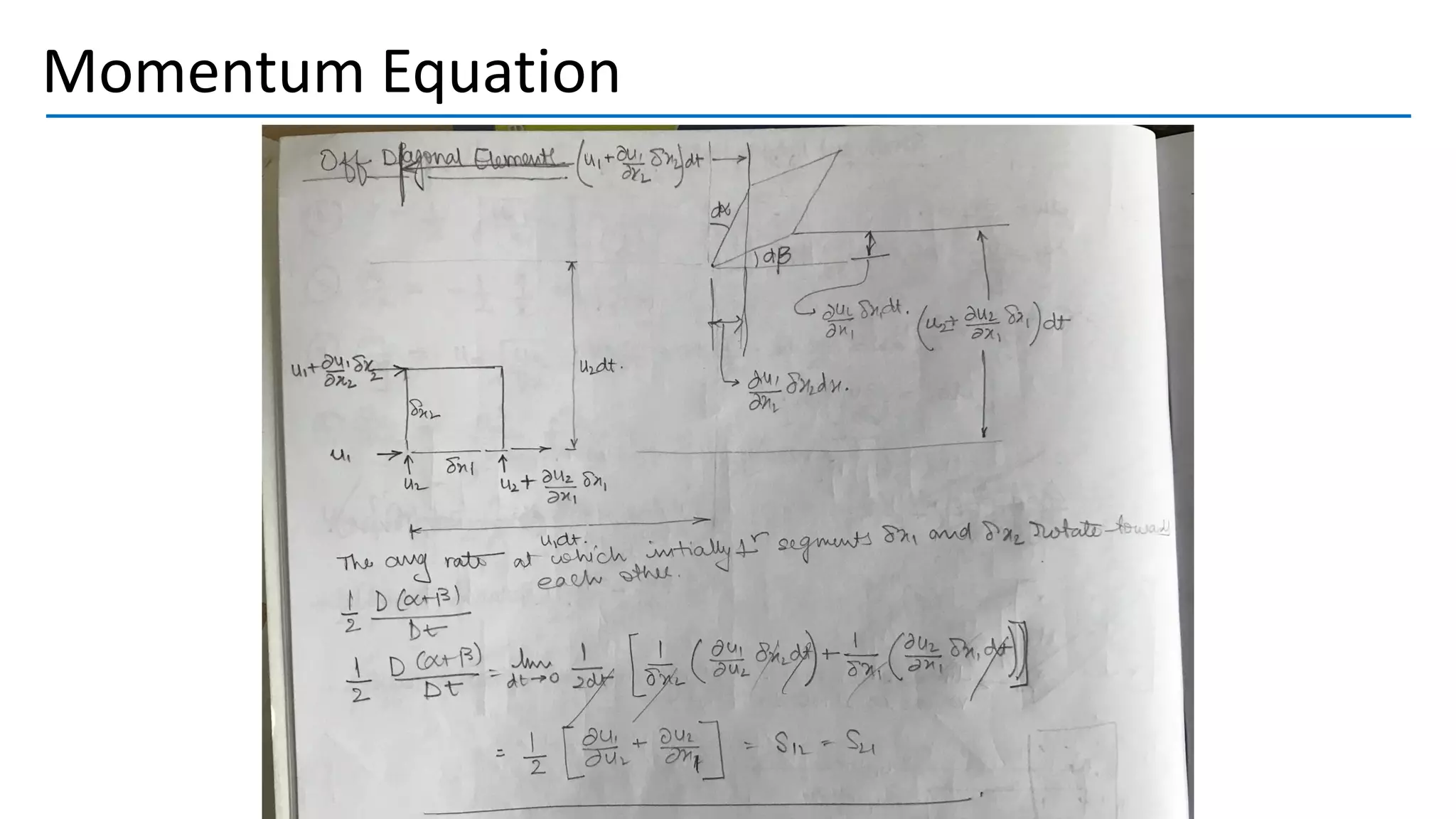
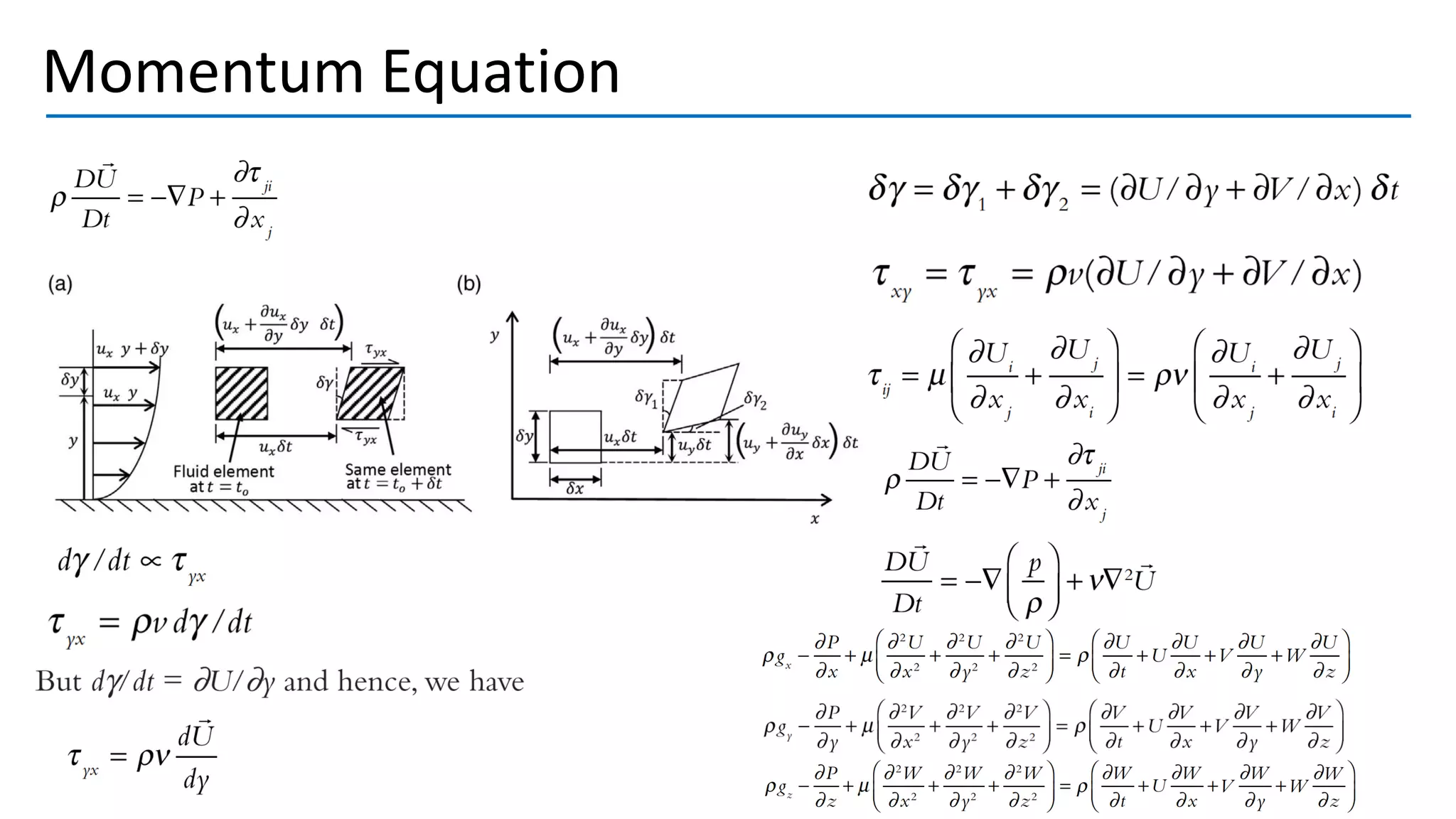
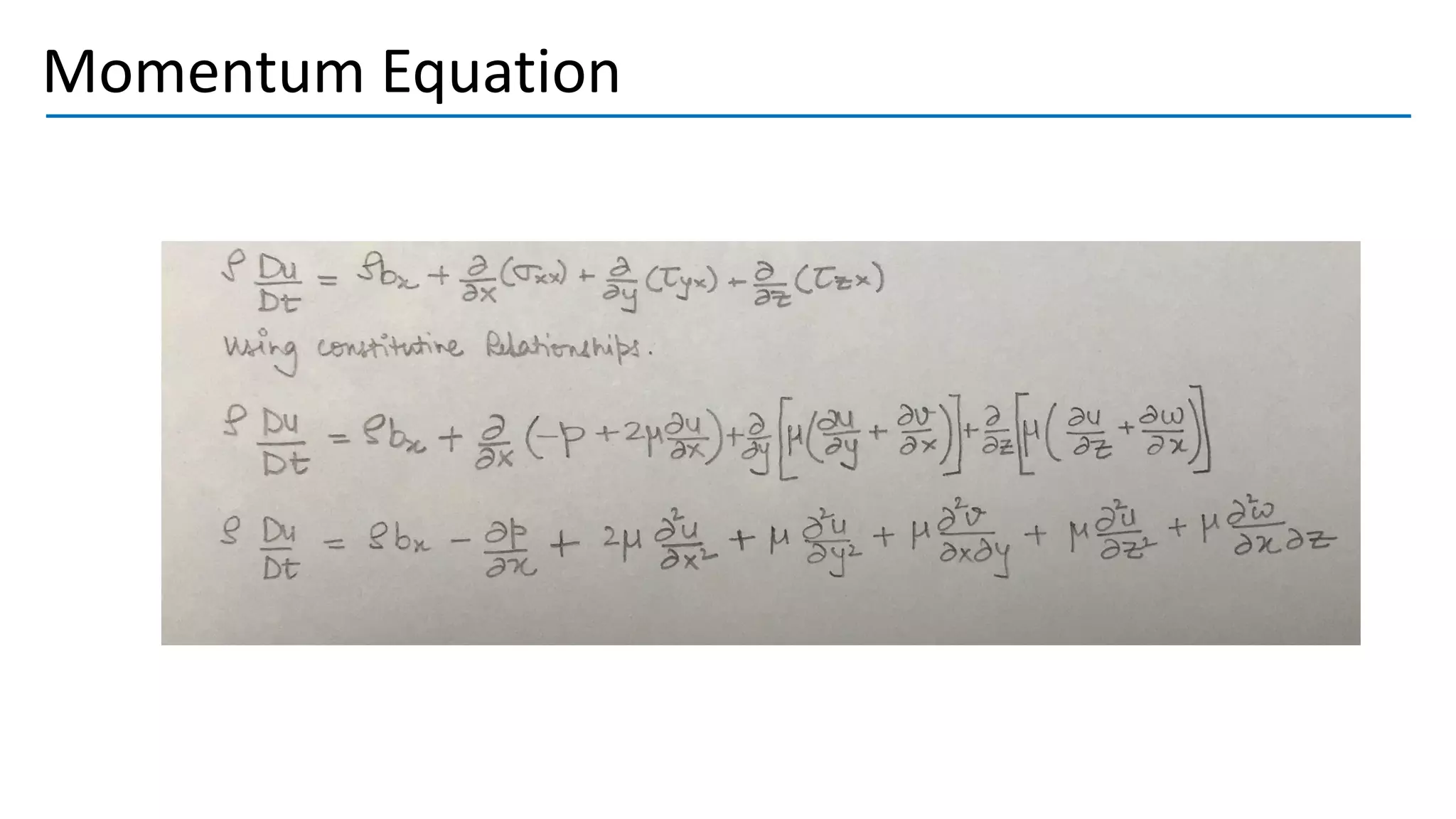
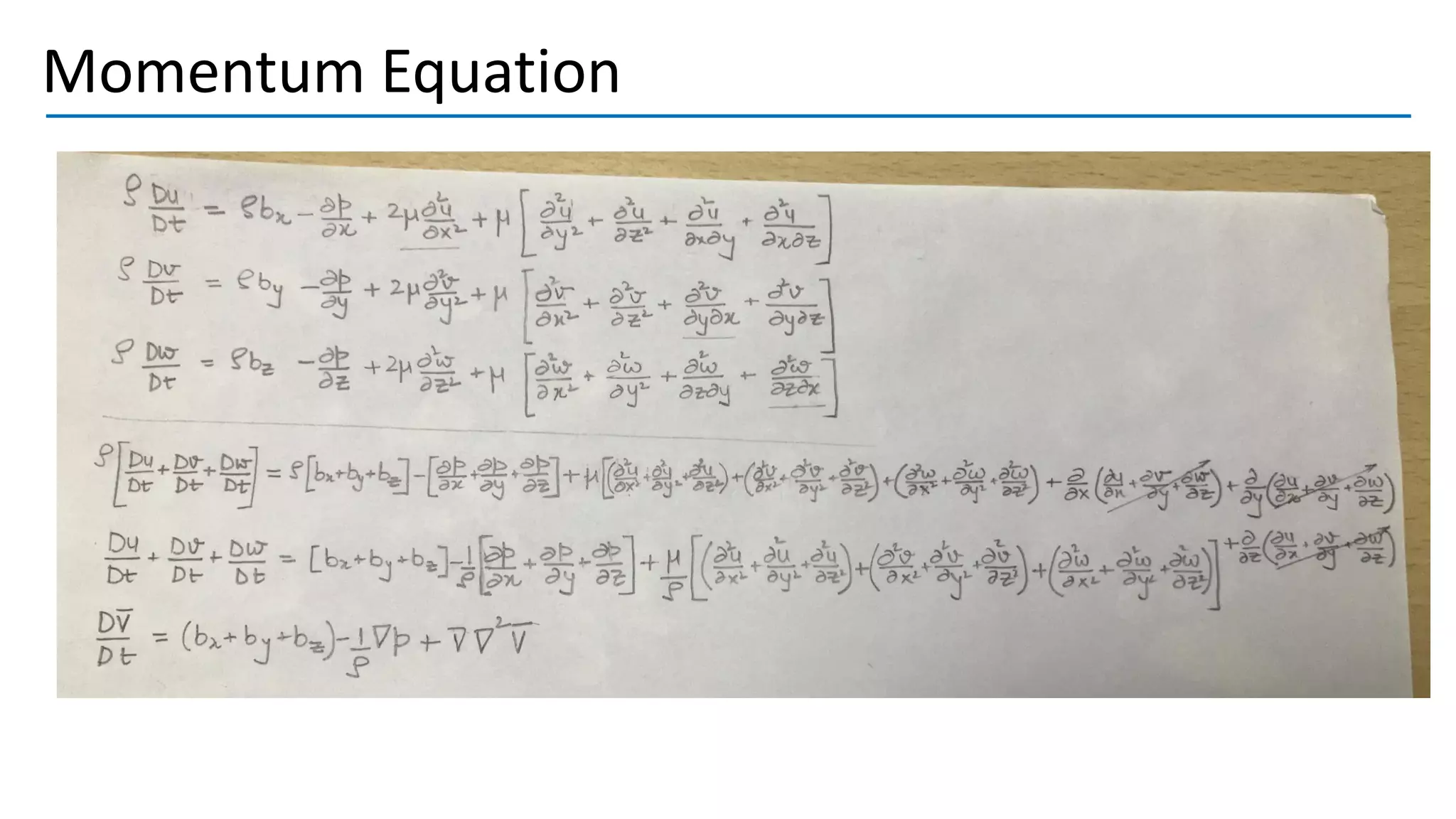
Momentum Equation
Momentum Equation
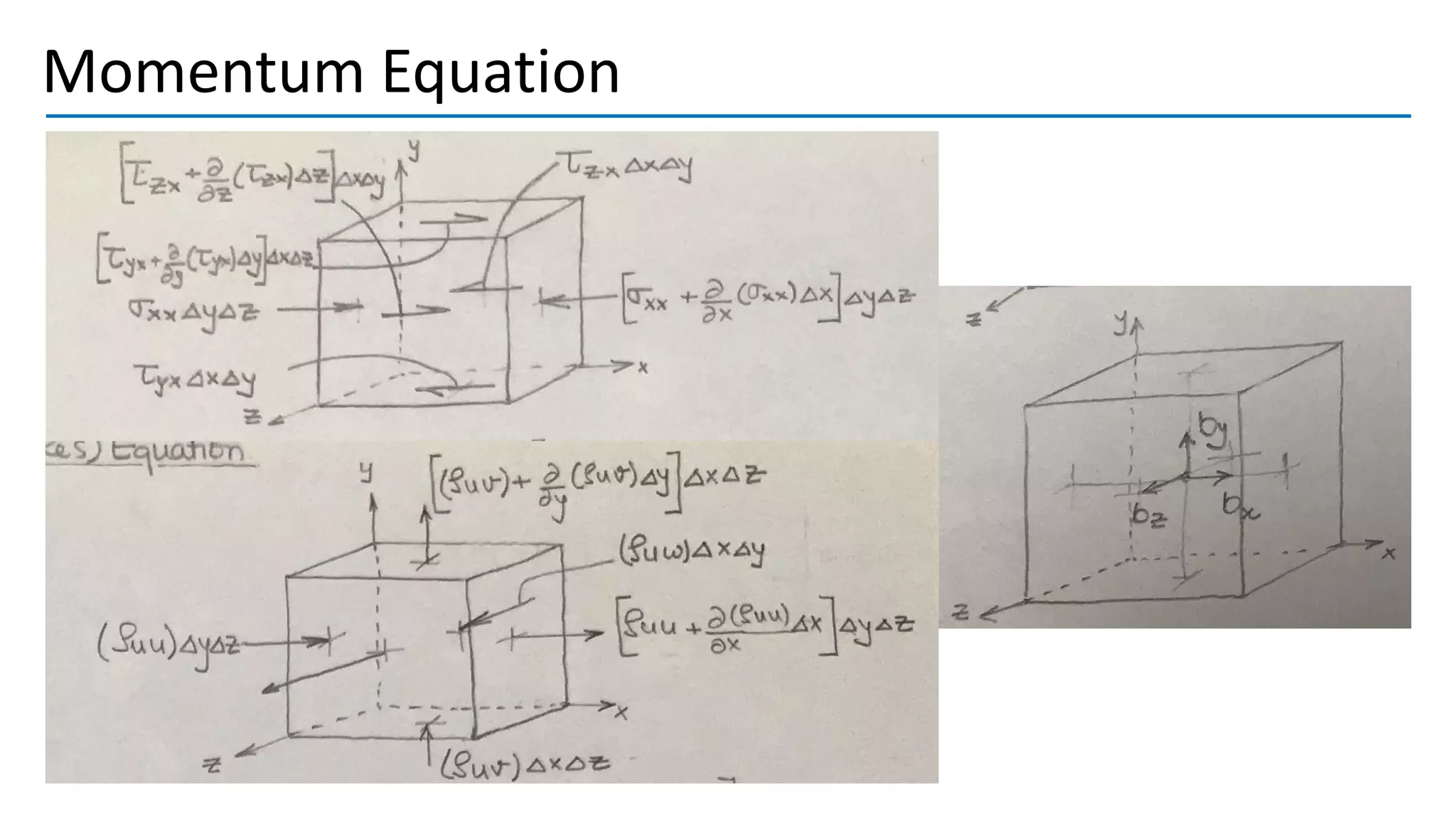
Momentum Equation
Momentum Equation
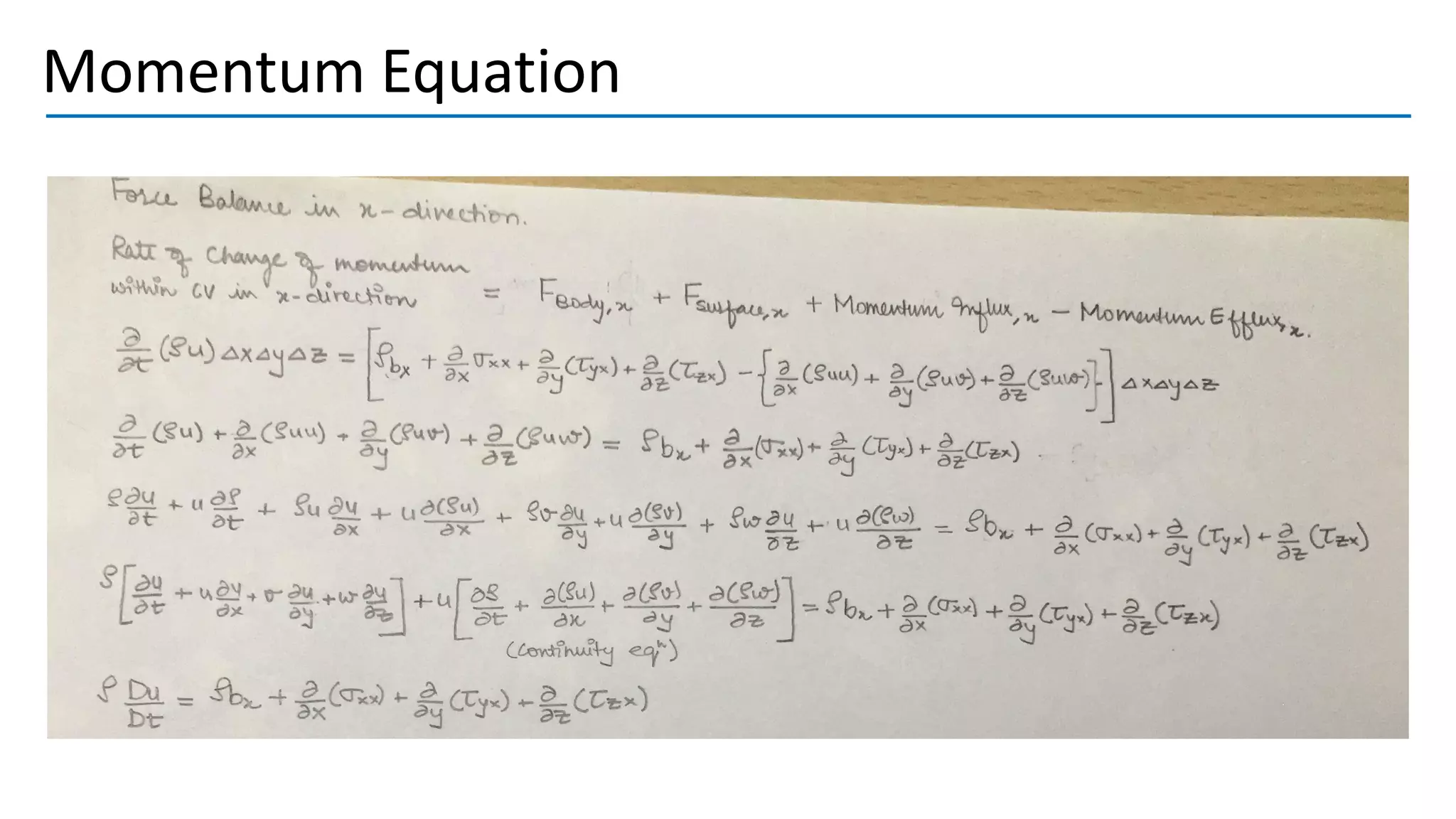
Momentum Equation
Momentum Equation
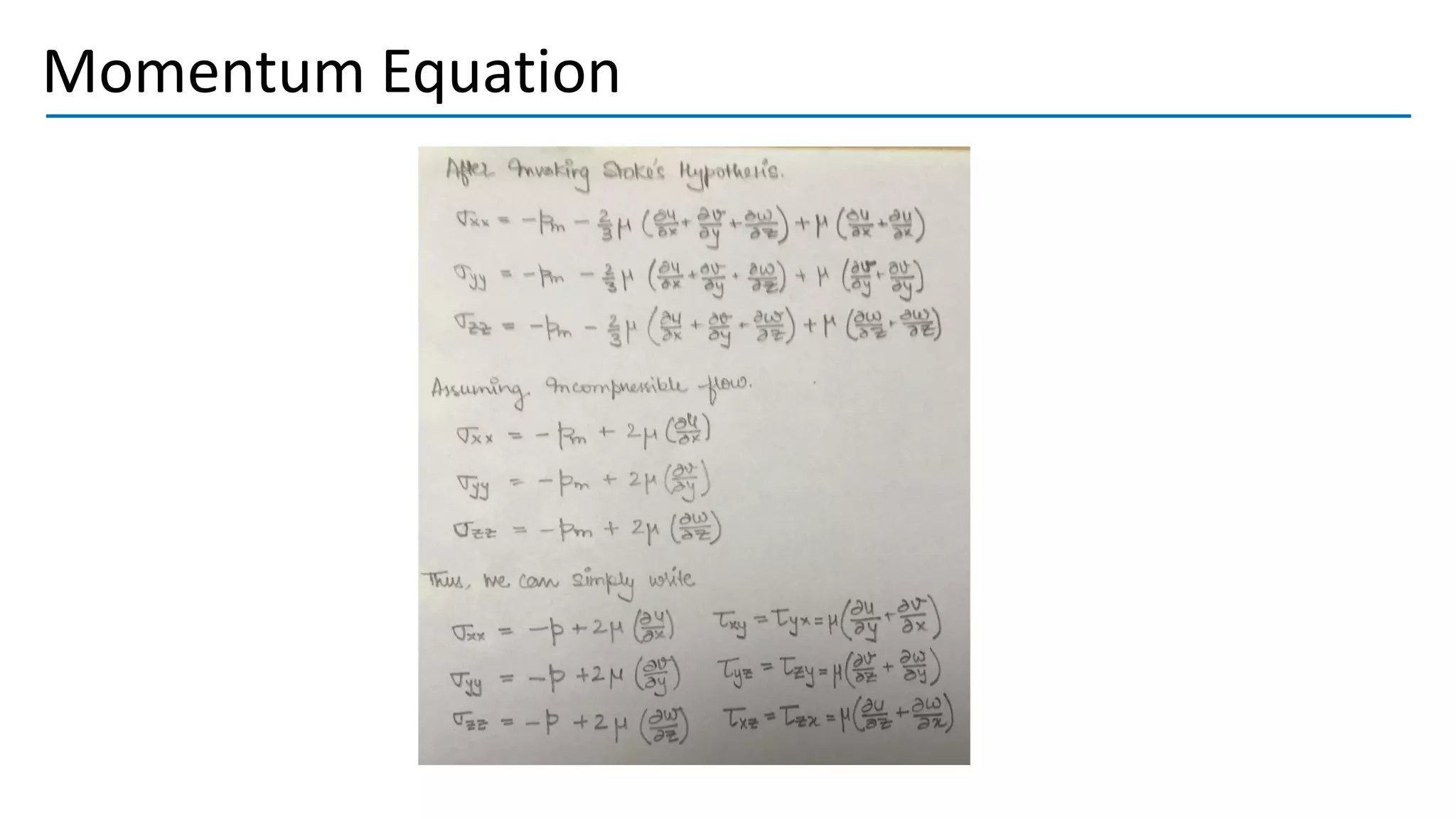
Momentum Equation
Momentum Equation
Momentum Equation
Momentum Equation
Momentum Equation
Momentum Equation
Momentum Equation
Momentum Equation
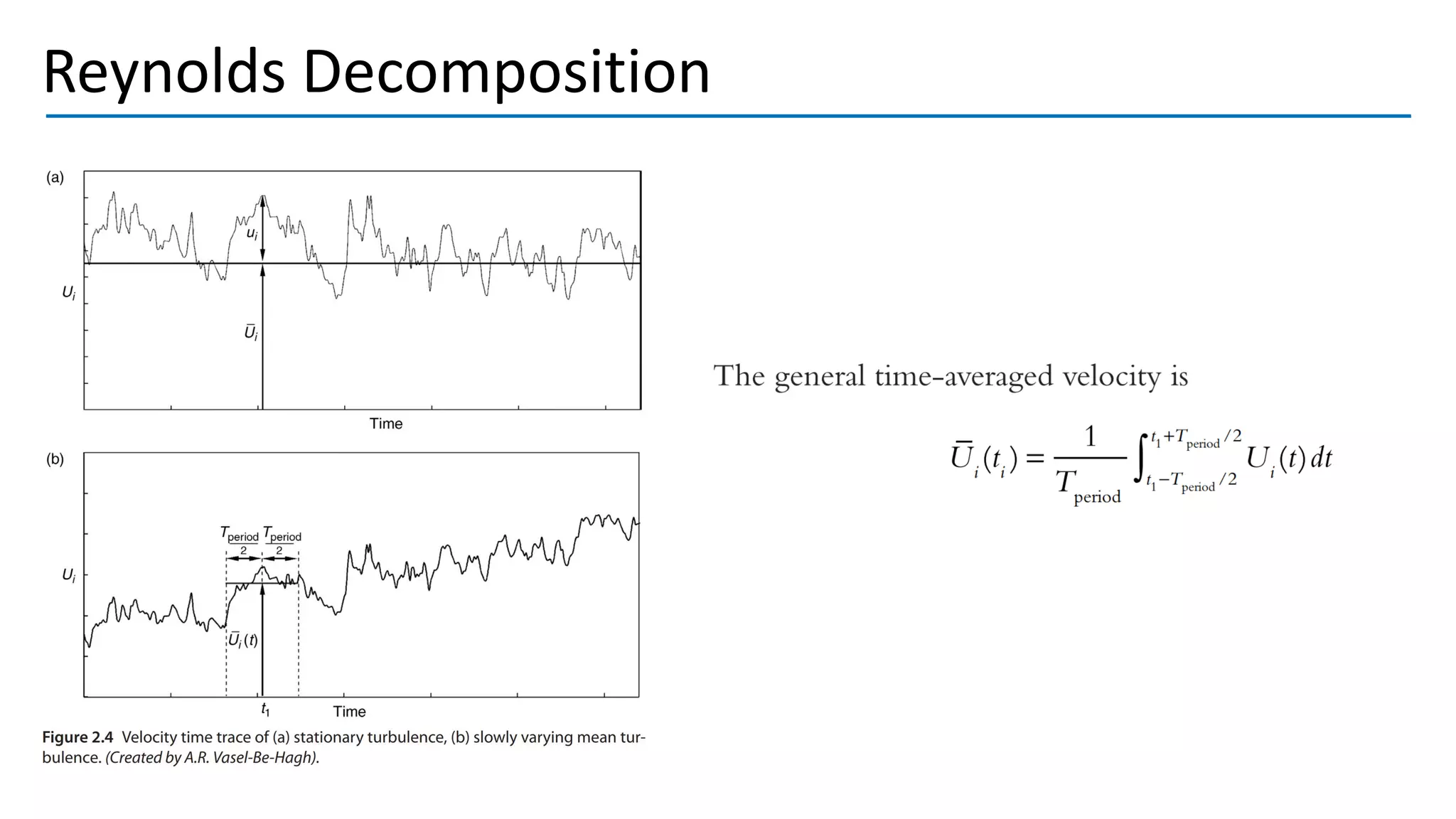
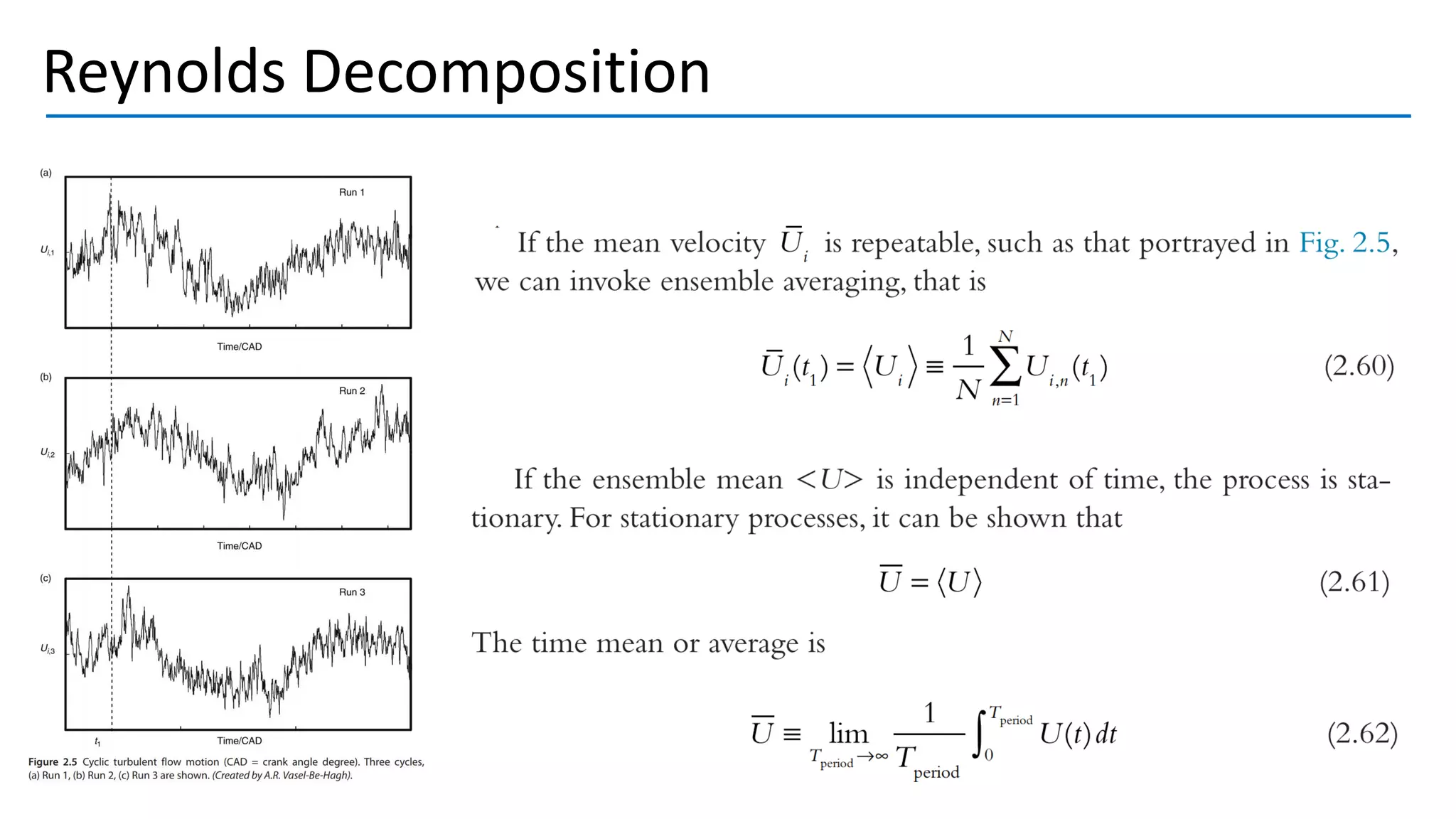
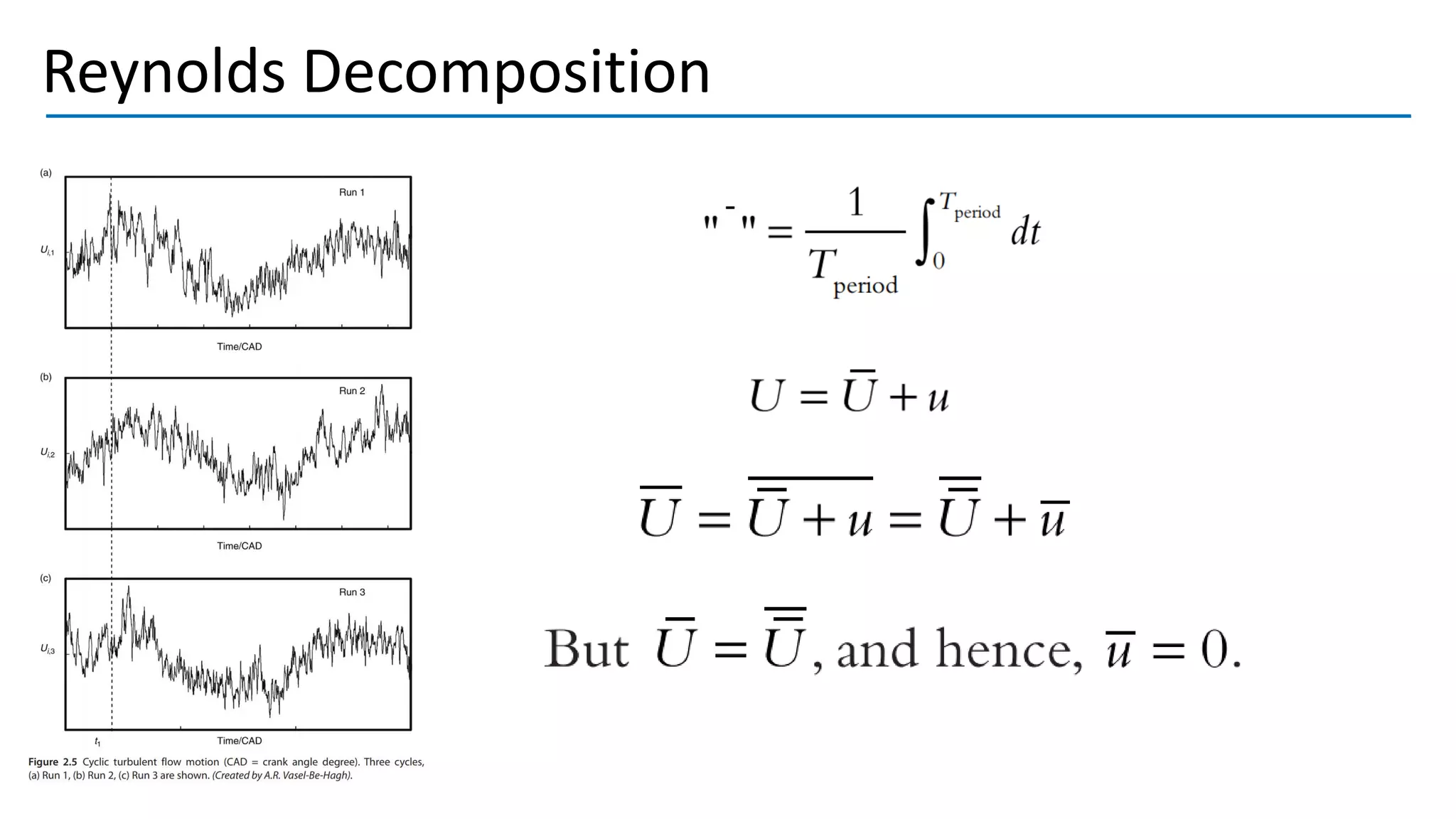
Reynolds Decomposition
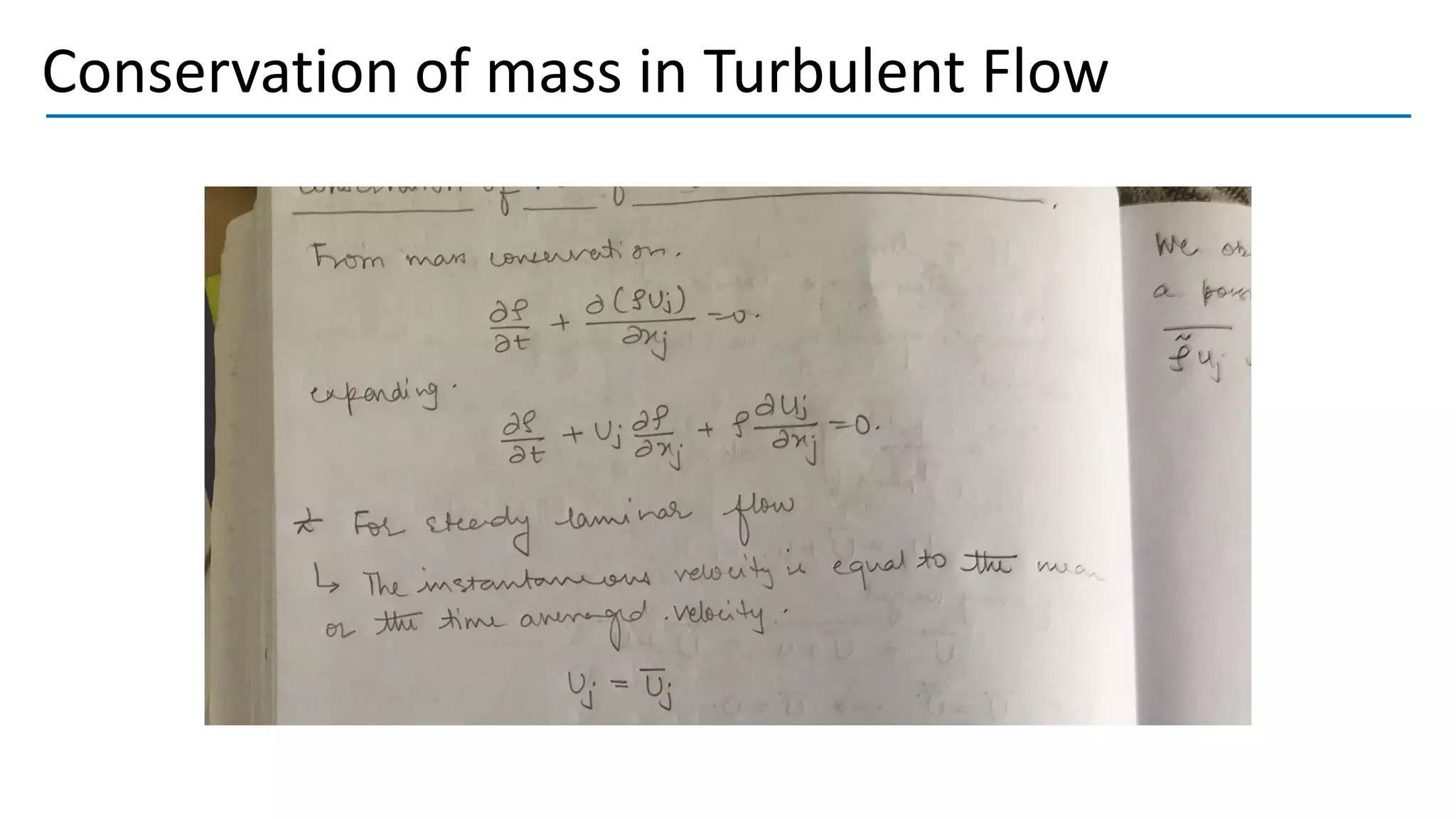
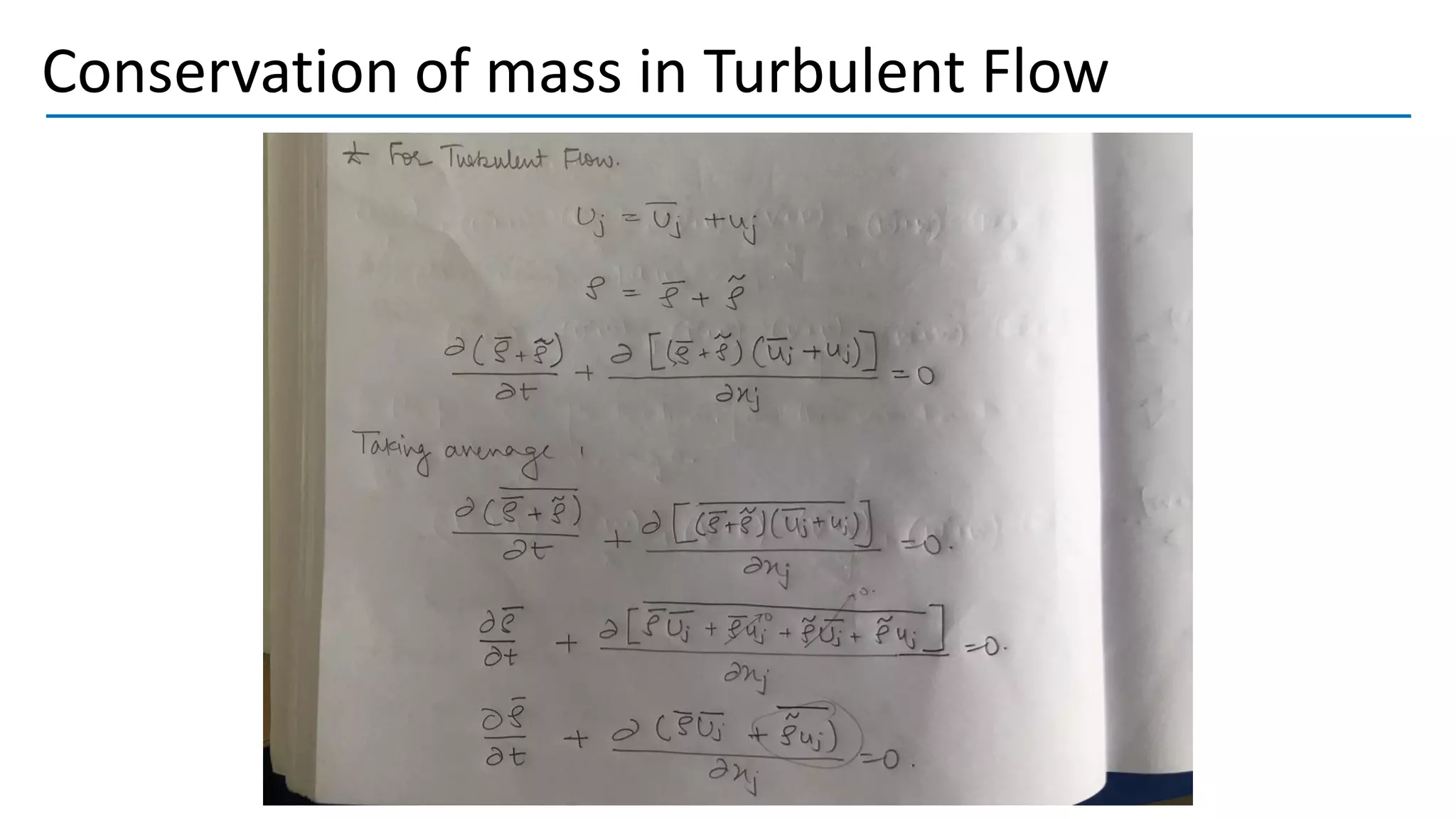
Conservation of mass in Turbulent Flow
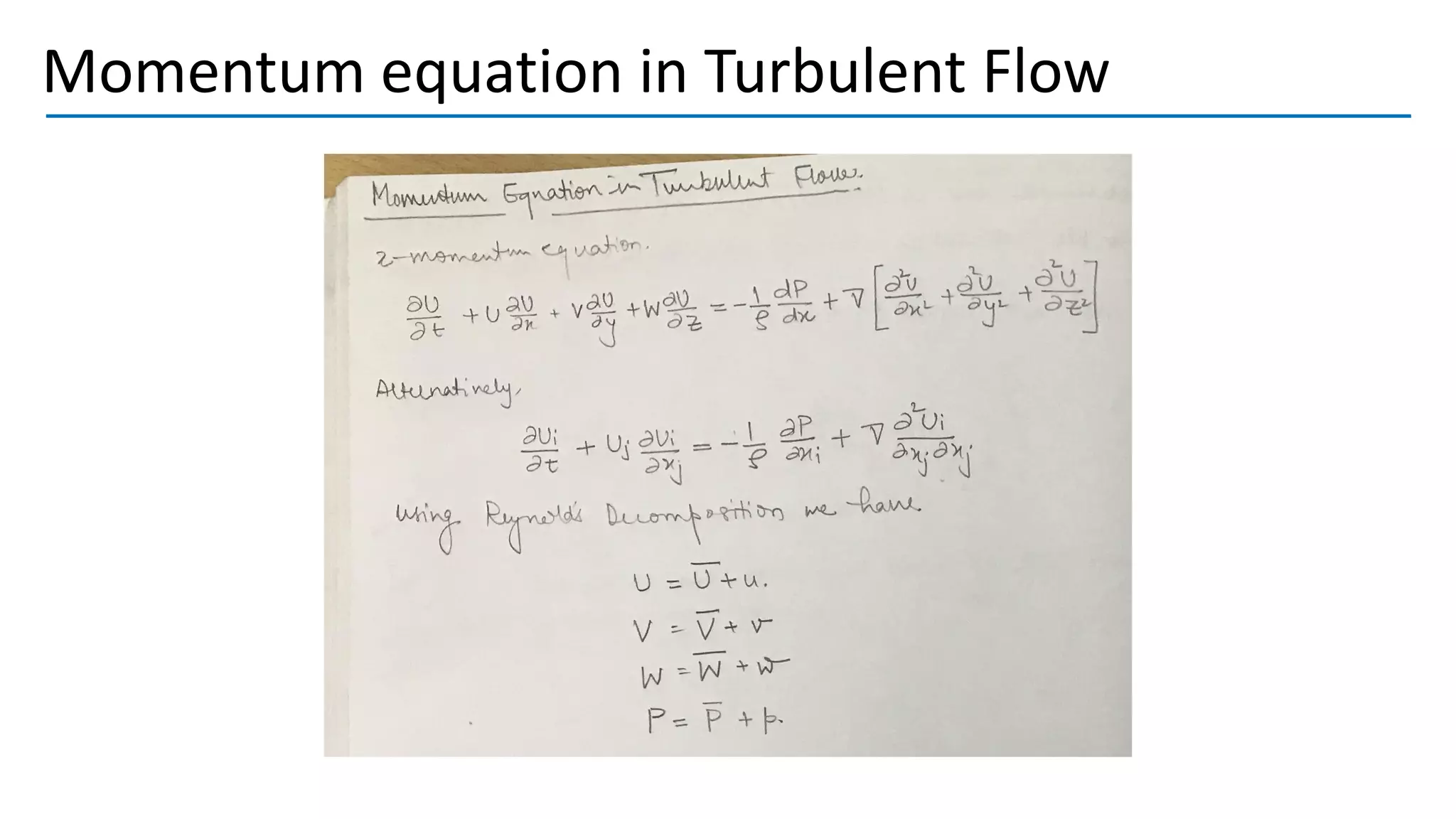
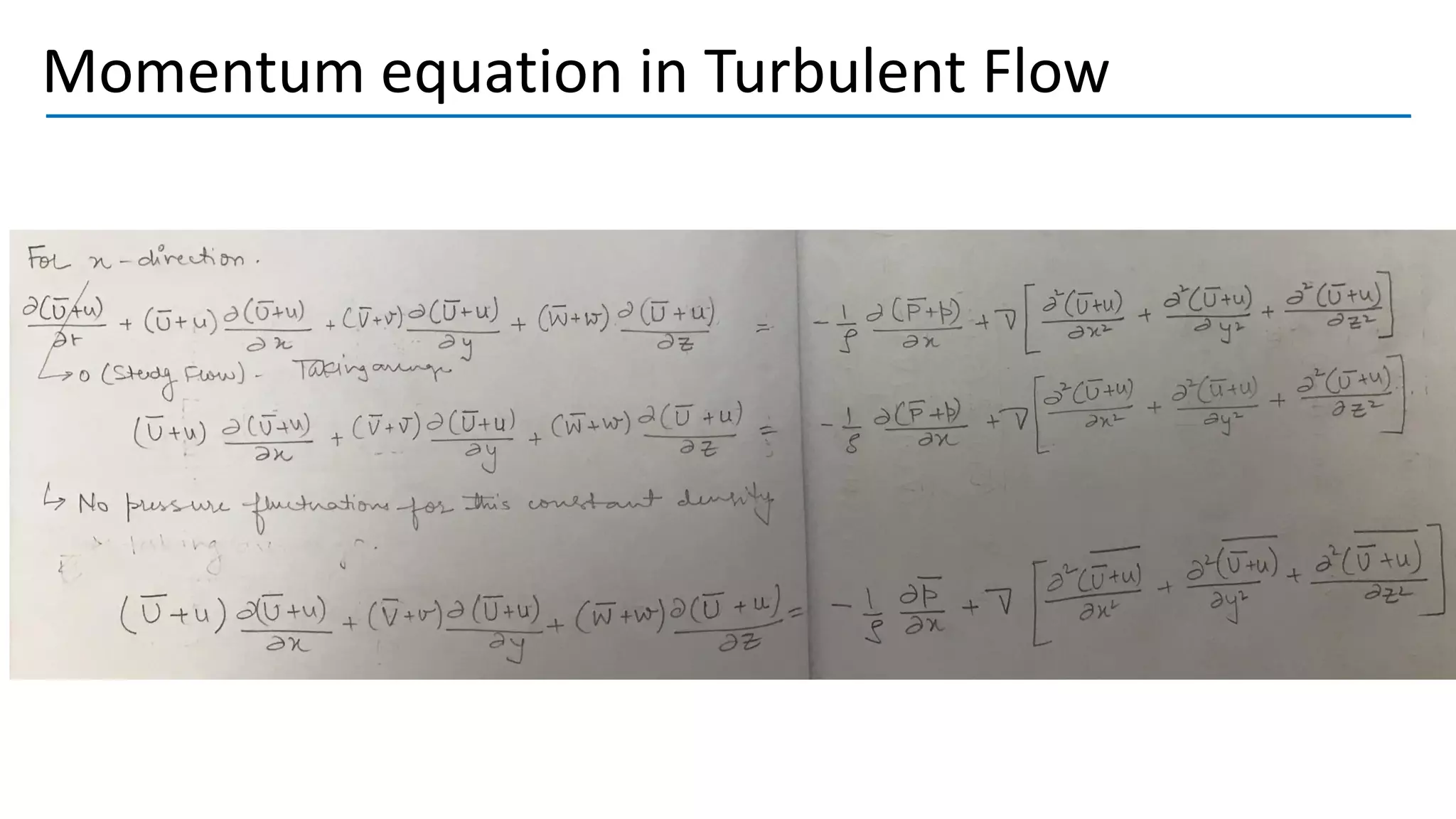
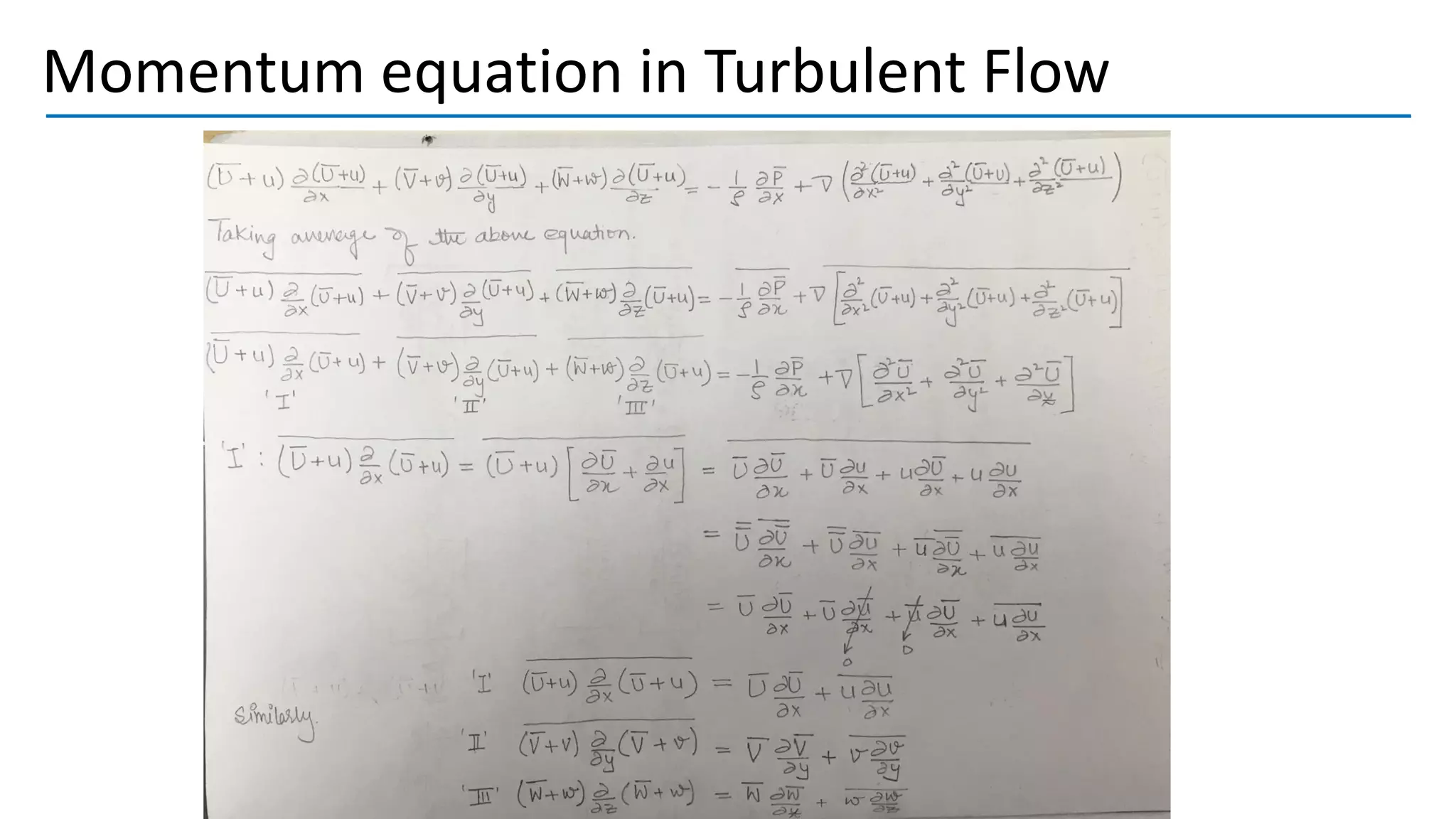
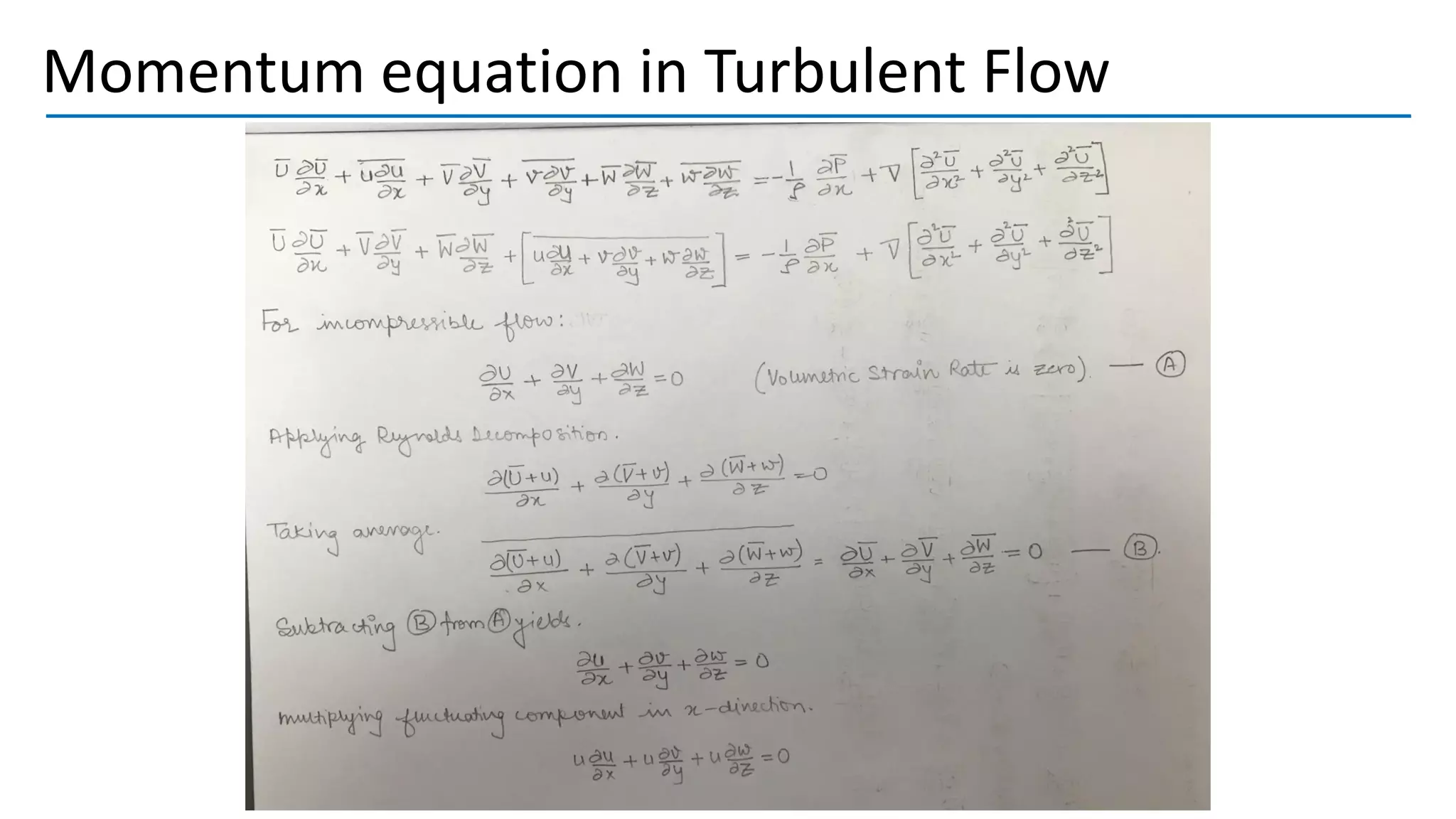
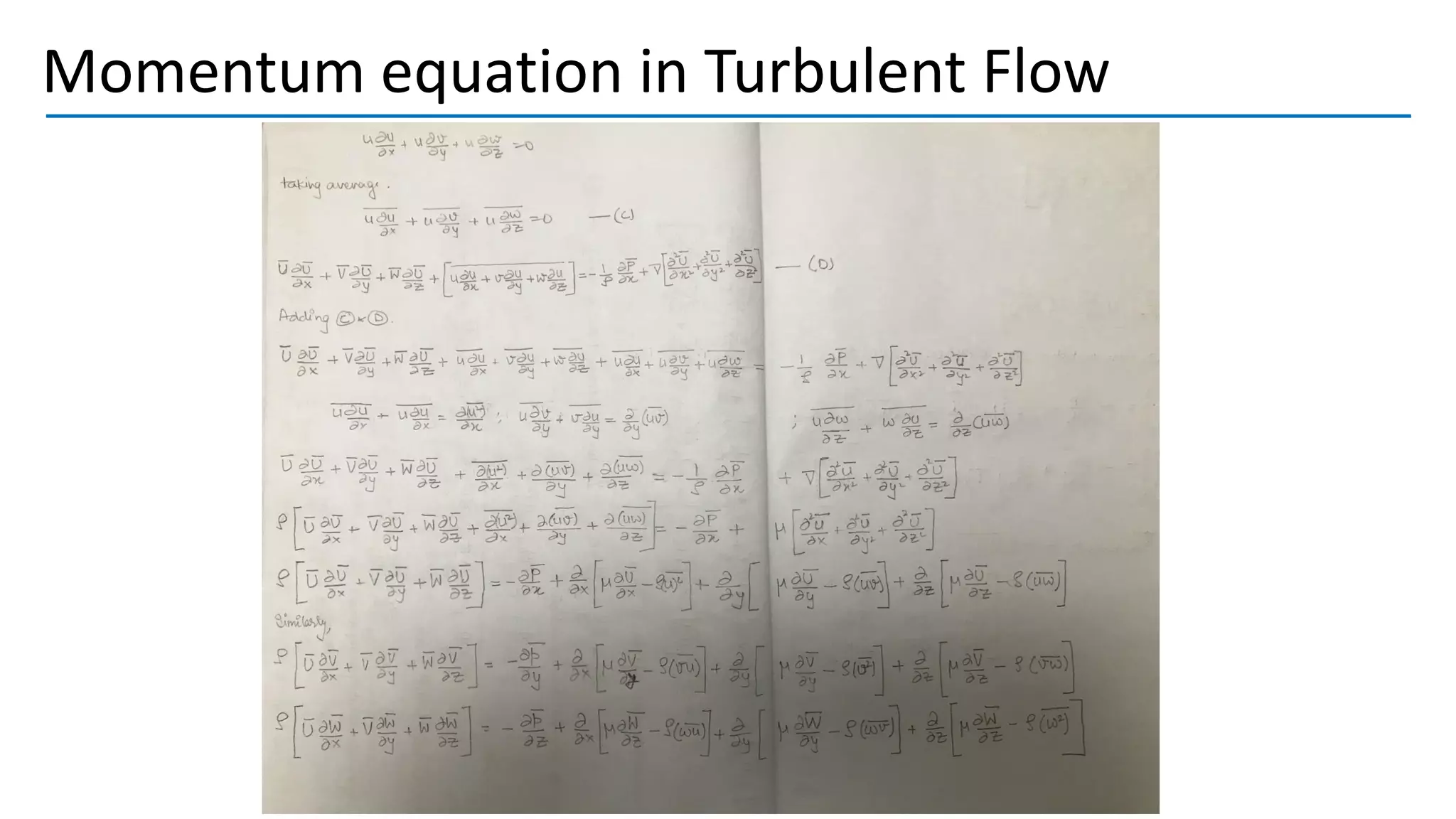
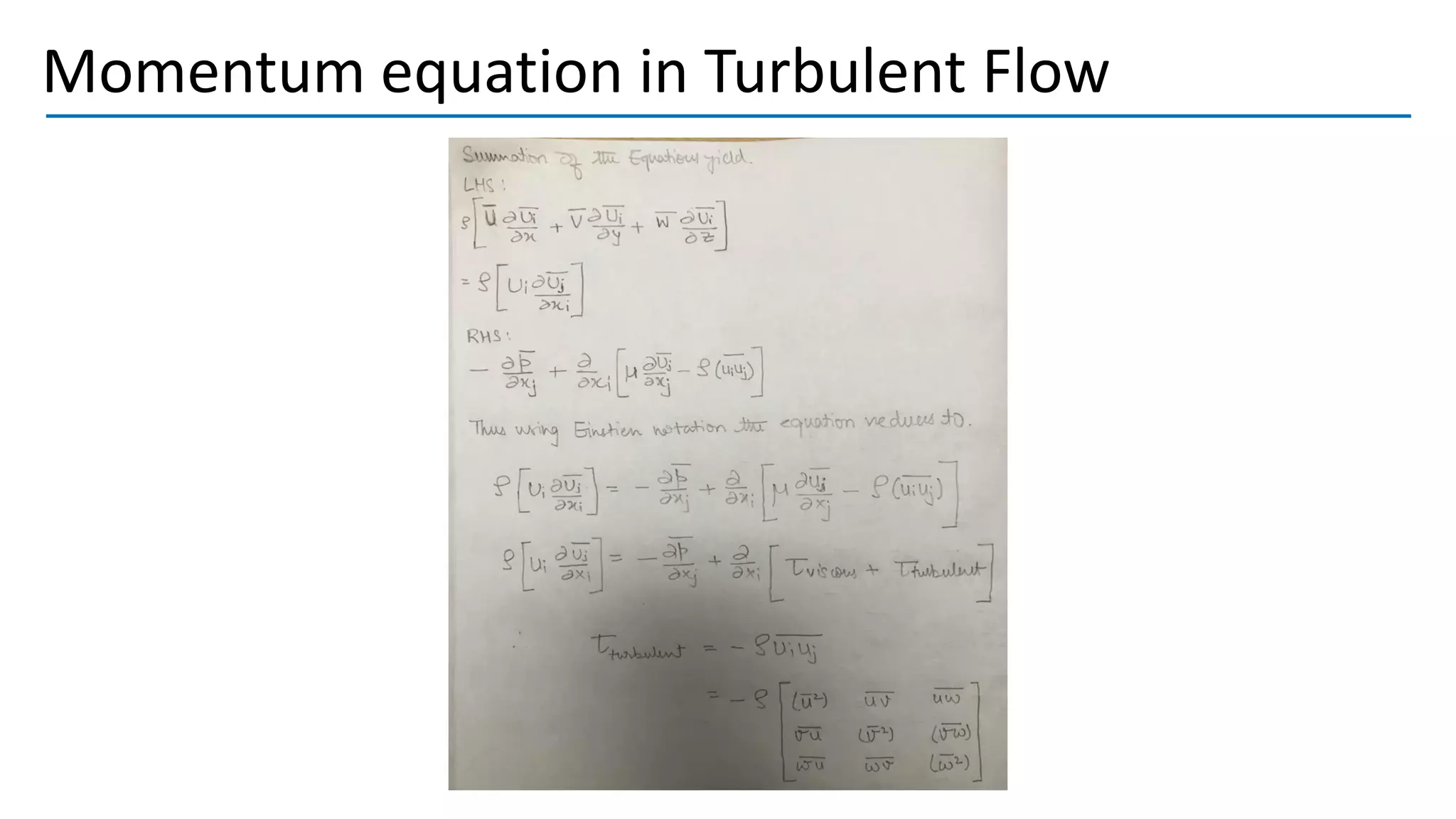
Momentum equation in Turbulent Flow
Basic Reynolds Number
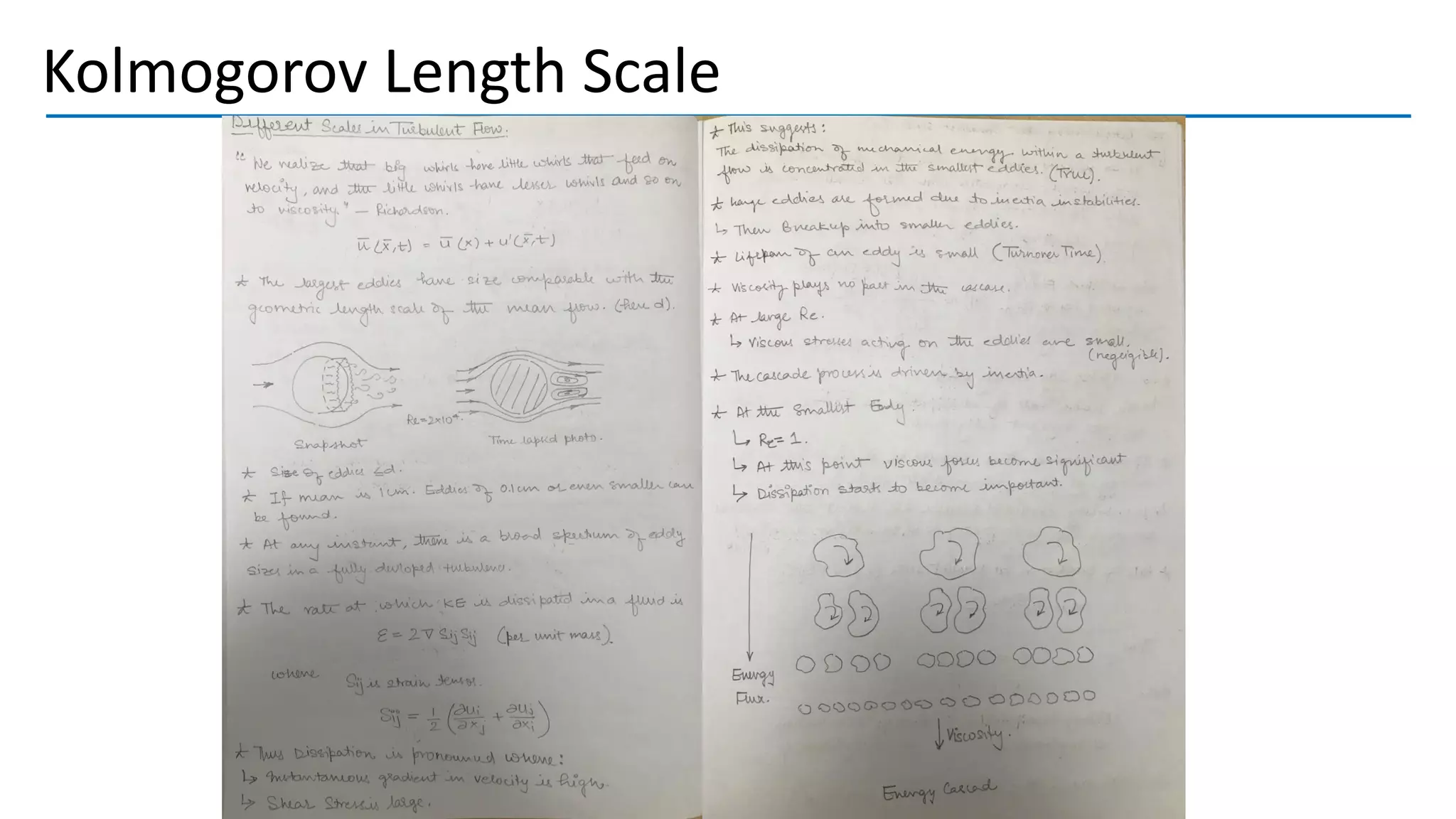
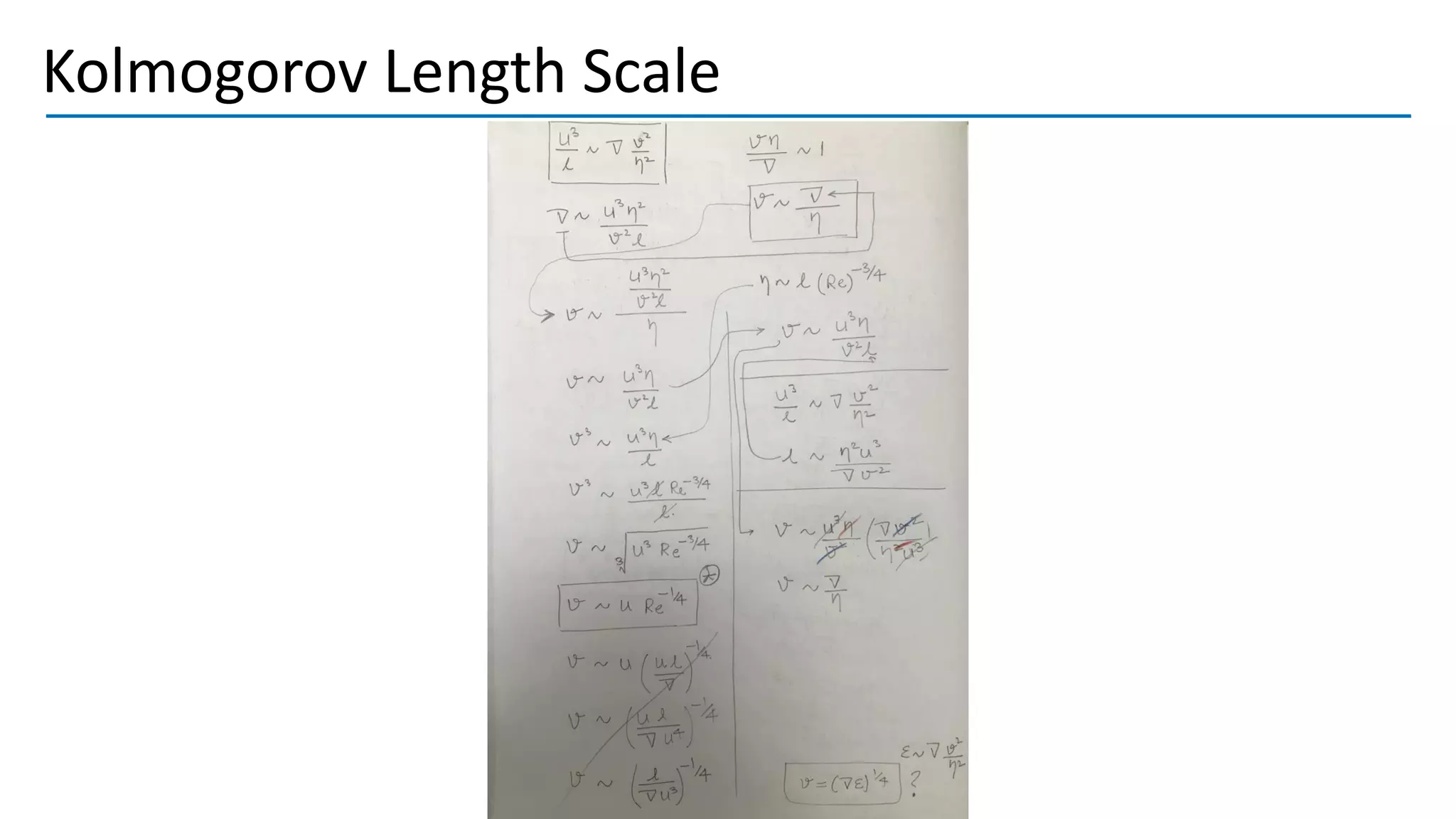
Kolmogorov Length Scale

Basics of Turbulent Flow

  • 1.
    Basics of TurbulentFlow Khusro Kamaluddin
  • 2.
    Introduction It is thenatural state of most of the fluids. It is the underlying principle in: Cloud Formation Atmospheric Transport Practical Droplet Spray Combustion Process Wind Harvesting Industrial Particle Production and Transport
  • 3.
  • 4.
    I. Irregular/Random It isdefined by its irregularity and randomness. It is unsteady and fluctuates randomly throughout the domain of space and time. It has random velocity fluctuations with a wide range of length and time scales.
  • 5.
    II. Rich inScales of Eddy Motion A single turbulent flow will have a wide variation of length and time scale. Large scales of motion are: ➢ Influenced by geometry of flow.(Boundary Conditions) Small scales of motion are: ➢ Influenced by rate of energy transfer from large scales ➢ Influenced by Viscosity of the fluid ➢ Universal in character ➢ Independent of flow geometry
  • 6.
    II. Rich inScales of Eddy Motion ❑ Different size of eddy have corresponding Kinetic Energies ❑ Can be determined by: ➢ Vorticity ഥ Ω = ∇ × ഥ U ➢ Intensity of velocity fluctuation 1 2 𝑚𝑢2 ❑ Average distribution of energy between frequency is called energy spectrum.
  • 7.
    III. Large ReynoldsNumber 𝑅𝑒 = 𝐼𝑛𝑒𝑟𝑡𝑖𝑎 𝐹𝑜𝑟𝑐𝑒 𝑉𝑖𝑠𝑐𝑜𝑢𝑠 𝐹𝑜𝑟𝑐𝑒 = 𝑈𝐿 𝜈 ❑ For The same 𝑈&𝐿 ❑ For Laminar Flow Kinematic Viscosity if High ❑ Thus suppressing the fluctuations ❑ The energy is dissipated via molecular diffusion.
  • 8.
  • 9.
  • 10.
  • 11.
  • 12.
  • 13.
    IV. Dissipative ❑ Viscosityremoves flow fluctuations by converting the associated Kinetic Energy into heat. ❑ Flow remains laminar when small perturbations are damped out by viscosity. ❑ Re(↑) → Viscous Forces(↓) ❑ Damping derived from molecular diffusion of momentum is unable to dissipate large perturbations. ❑ Turbulence often originates from instabilities in laminar flow.(Related to interaction of viscous term and non-linear inertia term in equation of motion)
  • 14.
    IV. Dissipative ❑ Perturbationscan occur from: ➢ Slight thermal current ➢ Surface Roughness ➢ Microscopic sources(Subcontinuum molecular motion like Brownian Motion)
  • 15.
    V. Highly Vortical ❑It is rotational in nature. ❑ Characterized by high level of fluctuating Vorticity. ❑ Velocity derivatives are dominated by smallest scales of turbulence.
  • 16.
    VI. 3-Dimentional ❑ Itis a 3-Dimentional phenomenon ❑ 2D Turbulence is used to describe simple cases where flow is restricted to two dimensions. ❑ 2D Turbulence is not true Turbulence. ❑ Vorticity fluctuations cannot be 2-Dimentional. ❑ As “Vortex Stretching”, an important vorticity maintenance mechanism is not present in 2-Dimentional flow.
  • 17.
    VII. Highly Diffusive ❑Its diffusivity is much higher than of laminar flow(Molecular Diffusivity) ❑ This causes: ➢ Rapid Mixing ➢ Increased rate of momentum transfer ➢ Increased rate of heat transfer ➢ Increased rate of mass transfer
  • 18.
    VIII. Not aFluid Behavior ❑ It is a flow feature, not a fluid property. ❑ If is different for different flows. ➢ But some characteristics remain common.
  • 19.
    IX. Holds ContinuumHypothesis ❑ Turbulence is a continuum phenomenon. ❑ It is governed by the equations of fluid mechanics. ❑ The smallest turbulent length scales are larger than the molecular mean free path. ❑ An exception to this is Rarified Gas Medium.
  • 20.
  • 21.
    I. Leonardo DaVinci(1452-1519) A deluge, c.1517–18, Pen and black ink with wash on paper, RCIN 912380 via Google Art Project. Wikimedia Commons Studies of water passing obstacles and falling, c. 1508-9. Wikimedia Commons
  • 22.
    II. Lord Rayleigh(1842-1919) ❑Worked on stability of parallel flow inviscid fluid. ❑ Found that presence of an inflection point was a necessary and sufficient condition for an inviscid fluid to become unstable. ➢ Inflection point signifies that some sort of flow deceleration is required for inviscid flow to become unstable. ❑ Suggested that presence of viscosity can promote initiation of turbulence by enabling the creation of inflection point.
  • 23.
    II. Lord Rayleigh(1842-1919) ❑Indicated that viscosity is a double edged sword ➢ It is needed to kill turbulence. ➢ But simultaneously creates it.
  • 24.
    III. Osborne Reynolds(1842-1912) ❑Used 6ft long glass tube Ø2.63, 1.53 & 0.789 cm with Trumpet mouths ❑ Flow is laminar at low Reynolds Number where perturbations are damped out by viscosity.
  • 25.
    III. Osborne Reynolds(1842-1912) ❑At high flow rate the color band appears to expand and mix with water. ❑ On viewing under electric spark the mass of the color resolves into less distinct curls, in which eddies can be seen.
  • 26.
    III. Osborne Reynolds(1842-1912) ❑In transition region he saw intermittent character of fluid motion caused by disturbance, which appears as flashes succeeding each other. ❑ He saw sporadic* bursts of turbulence alternating with laminar flow. *(Occurring at irregular intervals or only in a few places, scattered & isolated)
  • 27.
    III. Osborne Reynolds(1842-1912) ❑Poiseuille flow is stable to infinitesimal perturbations at all Reynolds Number values. ❑ This implies that transition to turbulence is dependent on perturbations, in addition to Reynolds Number. ❑ This is unlike flow over buff bodies, where instabilities can be predicted using linearized perturbation theory with an infinitesimal amplitude. ❑ Thus indicating presence of more than one way to create a turbulent flow.
  • 28.
    III. Osborne Reynolds(1842-1912) ❑For practical pipe flows ❑ Transition occurs at Re~2000 ❑ Fully Turbulent flow occurs at Re~2300 ❑ These Reynolds Numbers are difficult to predict. ❑ They depend on: ❑ Upstream Flow Conditions. ❑ Boundary Roughness/Texture. ❑ With sufficient care, laminar flow in a pipe can be maintained to atleast Re~105
  • 29.
    III. Osborne Reynolds(1842-1912) ❑Vortical structures are initially 2D ❑ Generated due to shear(no slip) in boundary layer ❑ These vortical structures become progressively unstable farther downstream ❑ 3D interactions eventually leading to turbulence
  • 30.
    IV. Henri Bernard(1914-1942) ❑Fluid is confined between 2 large plates ❑ Heat is conducted through the quiescent fluid via molecular diffusion/conduction. ❑ Upward buoyant force if balanced by vertical pressure gradient ❑ When critical temperature difference is reached ❑ Laminar Bernard cells are formed
  • 31.
    IV. Henri Bernard(1914-1942) ❑Instability criterion is 𝑅𝑎 ≡ 𝐺𝑟𝑎𝑣𝑖𝑡𝑦 𝑇ℎ𝑒𝑟𝑚𝑎𝑙 𝐷𝑖𝑓𝑓𝑢𝑠𝑖𝑣𝑖𝑡𝑦 = 𝑔𝛽∆𝑇ℎ3 𝜈𝛼 = 1.70 × 10³
  • 32.
  • 33.
    VI. Ludwig Prandtl(1875-1953) ❑Introduced the concept of “Mixing Length”(Inline with the Kinetic Theory of Gases ) ❑ Mixing length is the average distance that a fluid element would stray from the mean streamline. ❑ Turbulence is not a feature of the fluid but the flow ❑ Thus the anlogy between “Mean free path” and “Mixing Length”
  • 34.
  • 35.
    Continuum Hypothesis ❑ Forcontinuum hypothesis to be valid the mean free path of the molecule should be very small relative to system geometry. 𝐾𝑛𝑢𝑑𝑠𝑒𝑛 𝑁𝑜. (𝐾𝑛) ≡ 𝜆𝑚𝑓𝑝 𝑙 ❑ 𝜆𝑚𝑓𝑝 is the mean free path of the molecule ❑ 𝑙 is the smallest geometric scale of the flow 𝜆𝑚𝑓𝑝 < 𝑙𝑚𝑒𝑑𝑖𝑢𝑚 < 𝑙 ❑ Under this condition the continuum fluid properties can be averaged over the volume of size
  • 36.
  • 37.
    Eulerian Frame ❑ Implementedby fixing control volume in space. ❑ Monitoring the flow passing through the CV over a period of time. ❑ The independent variables are spatial coordinate 𝑥, 𝑦, 𝑧 and the time 𝑡 . ❑ The properties in a flow field are specified in terms of space coordinates and time.
  • 38.
    Lagrangian Frame ❑ Thisapproach keeps track of a particular mass of fluid. ❑ Consider a case where fluid particle is initially(at time to) is at position 𝑋+ 𝑡𝑜, ത 𝑌 = ത 𝑌. ❑ ത 𝑌 is lagrangian or material coordinate. ❑ The particle moves with local fluid velocity 𝜕𝑋+ 𝑡𝑜, ത 𝑌 𝜕𝑡 = ഥ 𝑈 𝑋+ 𝑡𝑜, ത 𝑌 , 𝑡
  • 39.
    Eulerian Frame www.youtube.com. (n.d.).YouTube. [online] Available at:https://www.youtube.com/watch?v=IxOt4ALui8k.
  • 40.
    Lagrangian Frame www.youtube.com. (n.d.).YouTube. [online] Available at:https://www.youtube.com/watch?v=SsnYoqdFGIY&t=1s.
  • 41.
  • 42.
  • 43.
  • 44.
    Mass Conservation x y z 𝒅𝒙 𝒅𝒚 o ❑ Densityis 𝜌 at point o. ❑ Velocity field at point o is given by ഥ 𝑈 = 𝑈 Ƹ 𝑖 + 𝑉 Ƹ 𝑗 + 𝑊෠ 𝑘 ❑ Invoking Taylor series expansion about point o yields: 𝜌𝑥+ 𝑥 2 = 𝜌 + 𝜕𝜌 𝜕𝑥 𝑑𝑥 2 + 𝜕2𝜌 𝜕𝑥2 1 2! 𝑑𝑥 2 2 + ⋯ ❑ Neglecting higher terms yield: 𝜌𝑥+ 𝑥 2 = 𝜌 + 𝜕𝜌 𝜕𝑥 𝑑𝑥 2 & similarly 𝑈𝑥+ 𝑥 2 = U + 𝜕𝑈 𝜕𝑥 𝑑𝑥 2 ❑ Where 𝜌, 𝑈, 𝜕𝜌 𝜕𝑥 & 𝜕𝑈 𝜕𝑥 are evaluated at o.
  • 45.
    Mass Conservation x y z 𝒅𝒙 𝒅𝒚 o ❑ Massflux for each of the 6 surfaces of the CV can be described as: ‫׬‬ 𝐶𝑆 𝜌ഥ 𝑈. 𝑑 ҧ 𝐴 ❑ ሶ 𝑚𝑖𝑛 − ሶ 𝑚𝑜𝑢𝑡 = 𝜕 𝜕𝑡 (𝑚𝑒𝑙𝑒𝑚𝑒𝑛𝑡) ❑ For the (+x) face we have: ❑ 𝜌 + 𝜕𝜌 𝜕𝑥 𝑑𝑥 2 U + 𝜕𝑈 𝜕𝑥 𝑑𝑥 2 𝑑𝑦𝑑𝑥 ❑ 𝜌U + 𝜌 𝜕𝜌 𝜕𝑥 𝑑𝑥 2 + U 𝜕𝑈 𝜕𝑥 𝑑𝑥 2 + 𝜕𝜌 𝜕𝑥 𝜕𝑈 𝜕𝑥 𝑑𝑥 2 2 𝑑𝑦𝑑𝑧 ❑ 𝜌U + 𝜌 𝜕𝜌 𝜕𝑥 𝑑𝑥 2 + U 𝜕𝑈 𝜕𝑥 𝑑𝑥 2 𝑑𝑦𝑑𝑧
  • 46.
    Mass Conservation x y z 𝒅𝒙 𝒅𝒚 o ❑ 𝜌U+ 𝜌 𝜕𝜌 𝜕𝑥 𝑑𝑥 2 + U 𝜕𝑈 𝜕𝑥 𝑑𝑥 2 𝑑𝑦𝑑𝑧 ❑ 𝜌Udxdydz + 𝜌 2 𝜕𝜌 𝜕𝑥 dxdydz + 𝑈 2 𝜕𝑈 𝜕𝑥 dxdydz ❑ +x: +𝜌Udxdydz + 1 2 𝜕(𝜌𝑈) 𝜕𝑥 dxdydz ❑ -x: −𝜌Udxdydz + 1 2 𝜕(𝜌𝑈) 𝜕𝑥 dxdydz ❑ +y: +𝜌Vdxdydz + 1 2 𝜕(𝜌𝑉) 𝜕𝑦 dxdydz ❑ -y: −𝜌Vdxdydz + 1 2 𝜕 𝜌𝑉 𝜕𝑦 dxdydz ❑ +z: +𝜌Wdxdydz + 1 2 𝜕(𝜌𝑊) 𝜕𝑧 dxdydz ❑ -z: −𝜌Wdxdydz + 1 2 𝜕 𝜌𝑊 𝜕𝑧 dxdydz ❑ 𝜕(𝜌𝑈) 𝜕𝑥 + 𝜕(𝜌𝑉) 𝜕𝑦 + 𝜕(𝜌𝑊) 𝜕𝑧 dxdydz ≡ 𝑁𝑒𝑡 𝑅𝑎𝑡𝑒 𝑜𝑓 𝑀𝑎𝑠𝑠 𝐹𝑙𝑢𝑥 𝑇ℎ𝑟𝑜𝑢𝑔ℎ 𝐶𝑉 𝜕(𝜌𝑈) 𝜕𝑥 dxdydz 𝜕(𝜌𝑉) 𝜕𝑦 dxdydz 𝜕(𝜌𝑊) 𝜕𝑧 dxdydz + +
  • 47.
    Mass Conservation x y z 𝒅𝒙 𝒅𝒚 ❑ ሶ 𝑚𝑜𝑢𝑡− ሶ 𝑚𝑖𝑛 = + 𝜕(𝜌𝑈) 𝜕𝑥 + 𝜕(𝜌𝑉) 𝜕𝑦 + 𝜕(𝜌𝑊) 𝜕𝑧 dxdydz ❑ ሶ 𝑚𝑖𝑛 − ሶ 𝑚𝑜𝑢𝑡 = − 𝜕(𝜌𝑈) 𝜕𝑥 + 𝜕(𝜌𝑉) 𝜕𝑦 + 𝜕(𝜌𝑊) 𝜕𝑧 dxdydz ❑ 𝜕 𝜕𝑡 (𝑚𝑒𝑙𝑒𝑚𝑒𝑛𝑡) = − 𝜕(𝜌𝑈) 𝜕𝑥 + 𝜕(𝜌𝑉) 𝜕𝑦 + 𝜕(𝜌𝑊) 𝜕𝑧 dxdydz ❑ 𝜕𝜌 𝜕𝑡 𝑑𝑥𝑑𝑦𝑑𝑧 = − 𝜕(𝜌𝑈) 𝜕𝑥 + 𝜕(𝜌𝑉) 𝜕𝑦 + 𝜕(𝜌𝑊) 𝜕𝑧 dxdydz ❑ 𝜕𝜌 𝜕𝑡 + 𝜕(𝜌𝑈) 𝜕𝑥 + 𝜕(𝜌𝑉) 𝜕𝑦 + 𝜕(𝜌𝑊) 𝜕𝑧 dxdydz = 0 ❑ 𝜕𝜌 𝜕𝑡 + 𝜕(𝜌𝑈) 𝜕𝑥 + 𝜕(𝜌𝑉) 𝜕𝑦 + 𝜕(𝜌𝑊) 𝜕𝑧 = 0 ❑ 𝜕𝜌 𝜕𝑡 + ∇ ∙ 𝜌ഥ 𝑈 = 0 ❑ ∇ ∙ 𝑈 = 0
  • 48.
  • 49.
  • 50.
  • 51.
  • 52.
  • 53.
  • 54.
  • 55.
  • 56.
  • 57.
  • 58.
  • 59.
  • 60.
  • 61.
  • 62.
  • 63.
  • 64.
  • 65.
    Conservation of massin Turbulent Flow
  • 66.
    Conservation of massin Turbulent Flow
  • 67.
    Momentum equation inTurbulent Flow
  • 68.
    Momentum equation inTurbulent Flow
  • 69.
    Momentum equation inTurbulent Flow
  • 70.
    Momentum equation inTurbulent Flow
  • 71.
    Momentum equation inTurbulent Flow
  • 72.
    Momentum equation inTurbulent Flow
  • 73.
  • 74.
  • 75.
  • 76.