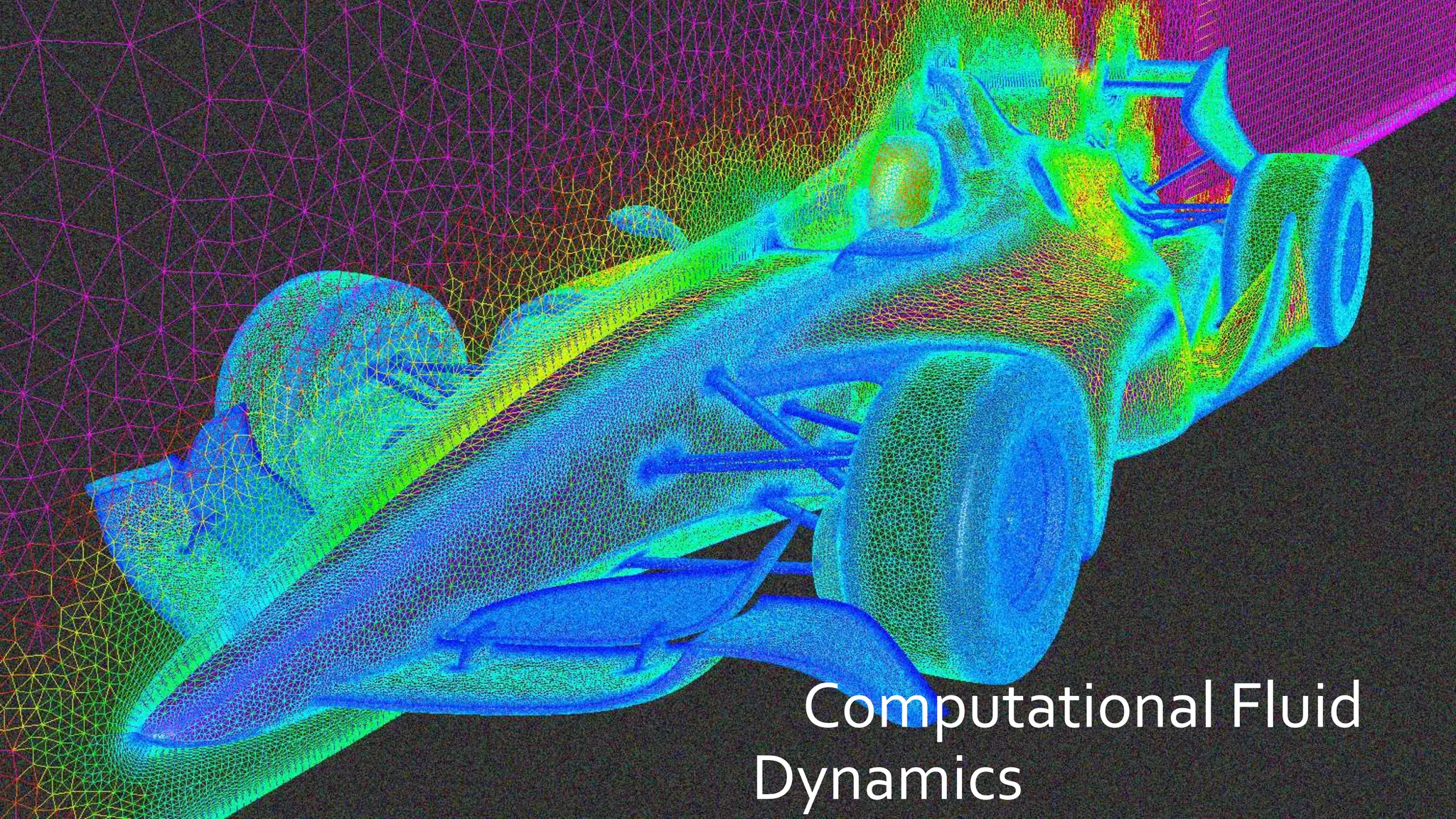
Computational Fluid
Dynamics
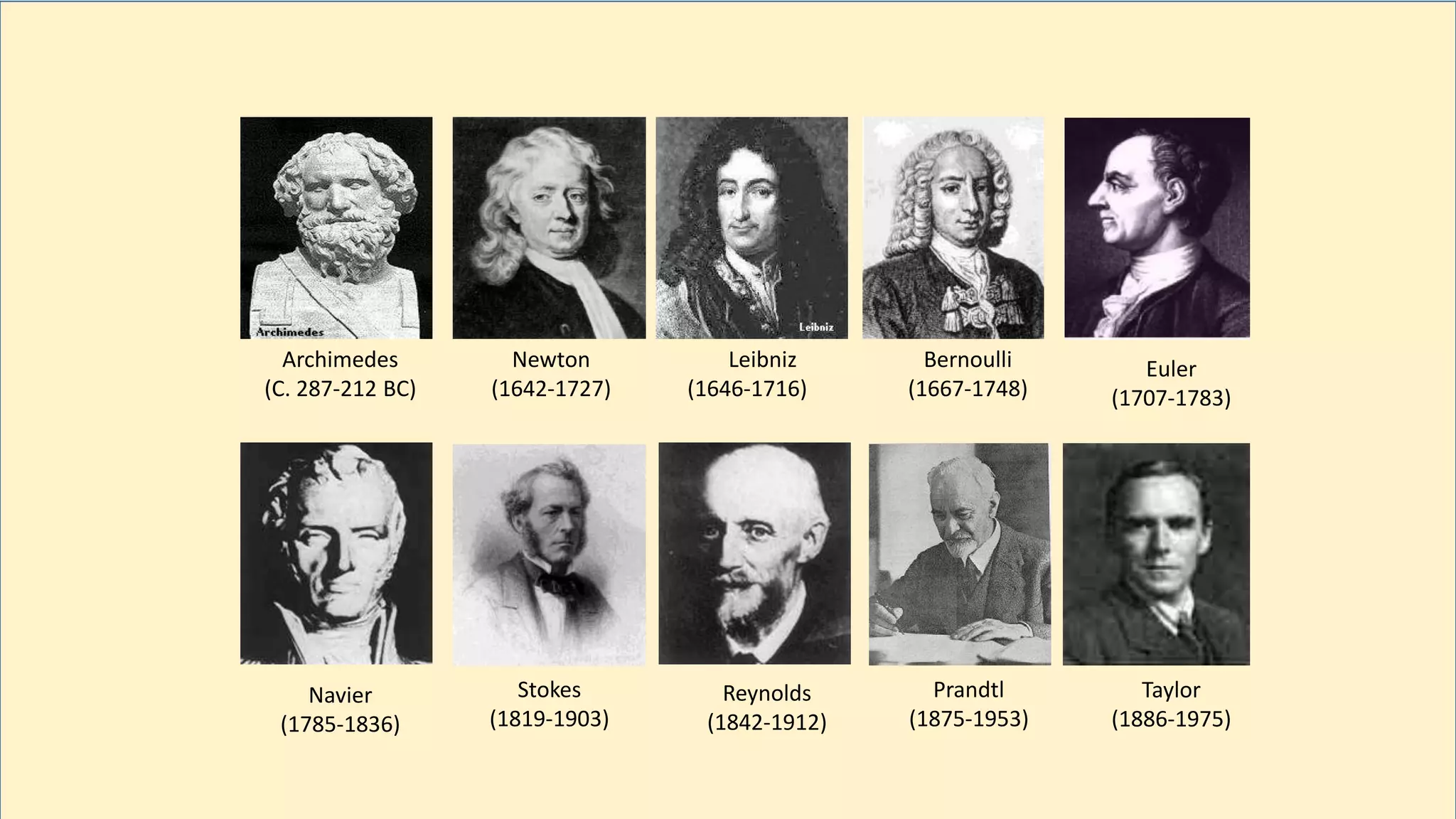
Archimedes
(C. 287-212 BC)
Newton
(1642-1727)
Leibniz
(1646-1716)
Euler
(1707-1783)
Navier
(1785-1836)
Stokes
(1819-1903)
Reynolds
(1842-1912)
Prandtl
(1875-1953)
Bernoulli
(1667-1748)
Taylor
(1886-1975)
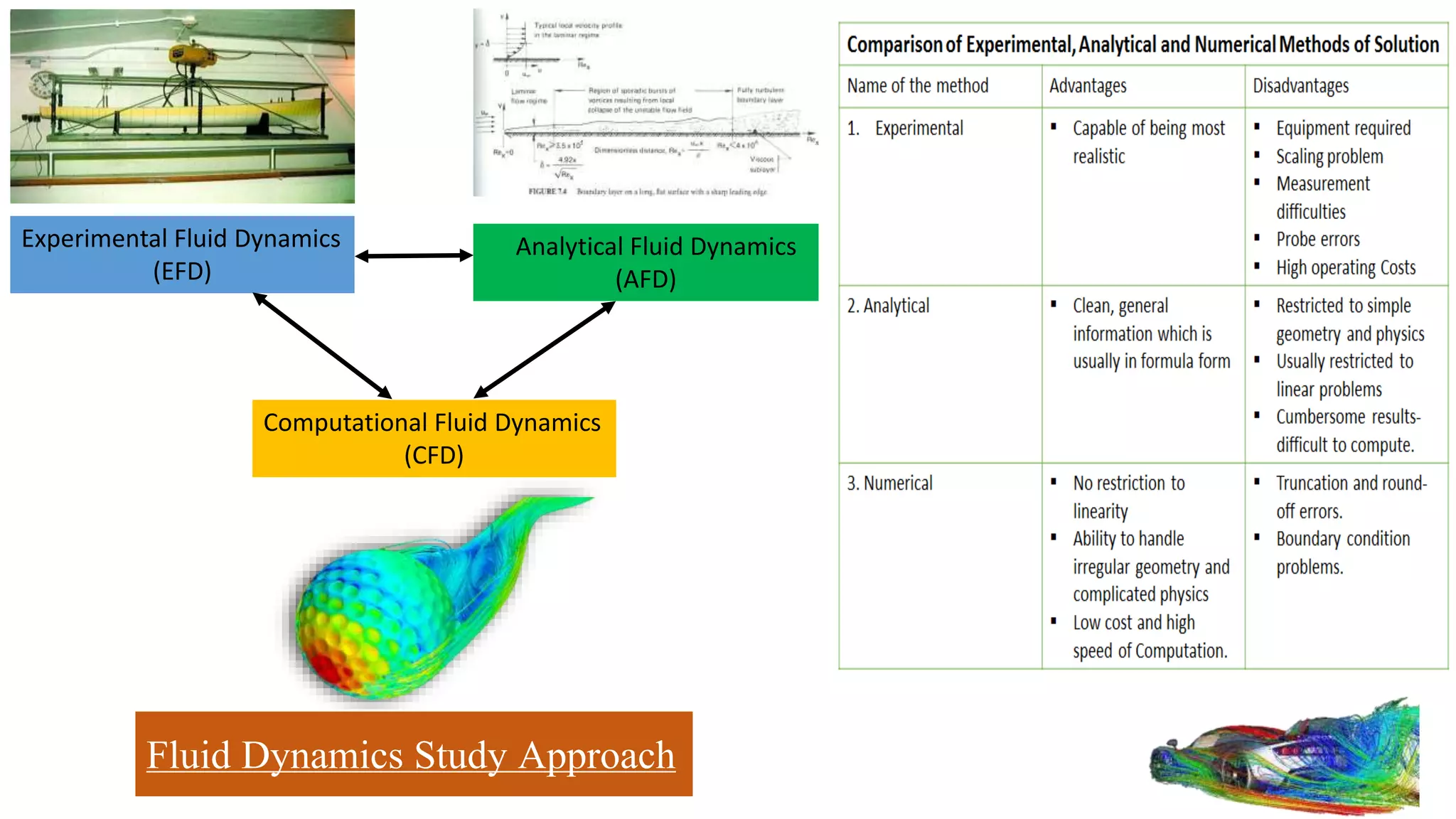
Experimental Fluid Dynamics
(EFD)
Analytical Fluid Dynamics
(AFD)
Computational Fluid Dynamics
(CFD)
Fluid Dynamics Study Approach
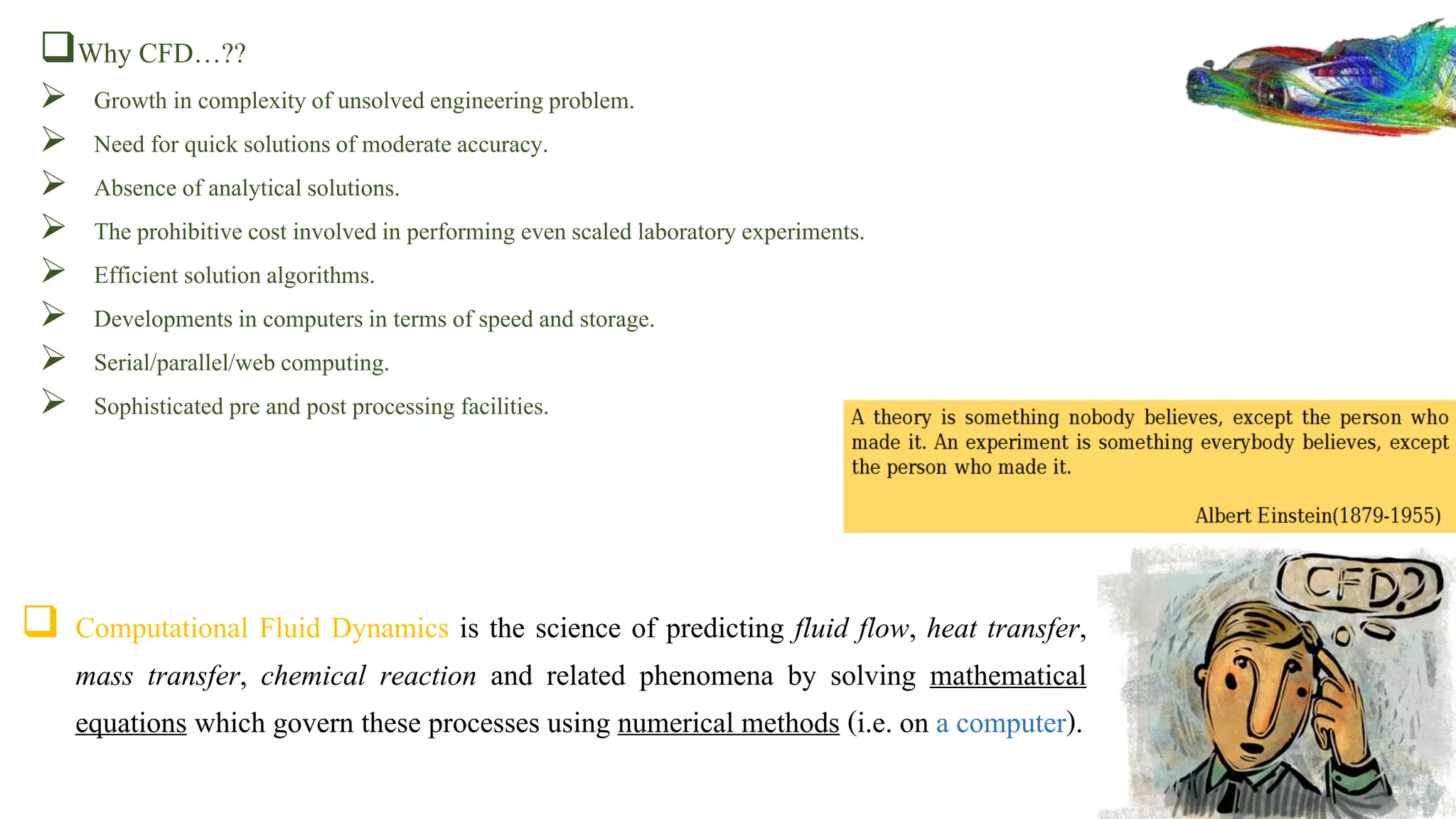
 Computational Fluid Dynamics is the science of predicting fluid flow, heat transfer,
mass transfer, chemical reaction and related phenomena by solving mathematical
equations which govern these processes using numerical methods (i.e. on a computer).
Why CFD…??
 Growth in complexity of unsolved engineeringproblem.
 Need for quick solutionsof moderate accuracy.
 Absence of analytical solutions.
 The prohibitive cost involvedin performing evenscaled laboratoryexperiments.
 Efficient solutionalgorithms.
 Developments in computersin terms of speed and storage.
 Serial/parallel/web computing.
 Sophisticated pre and post processing facilities.
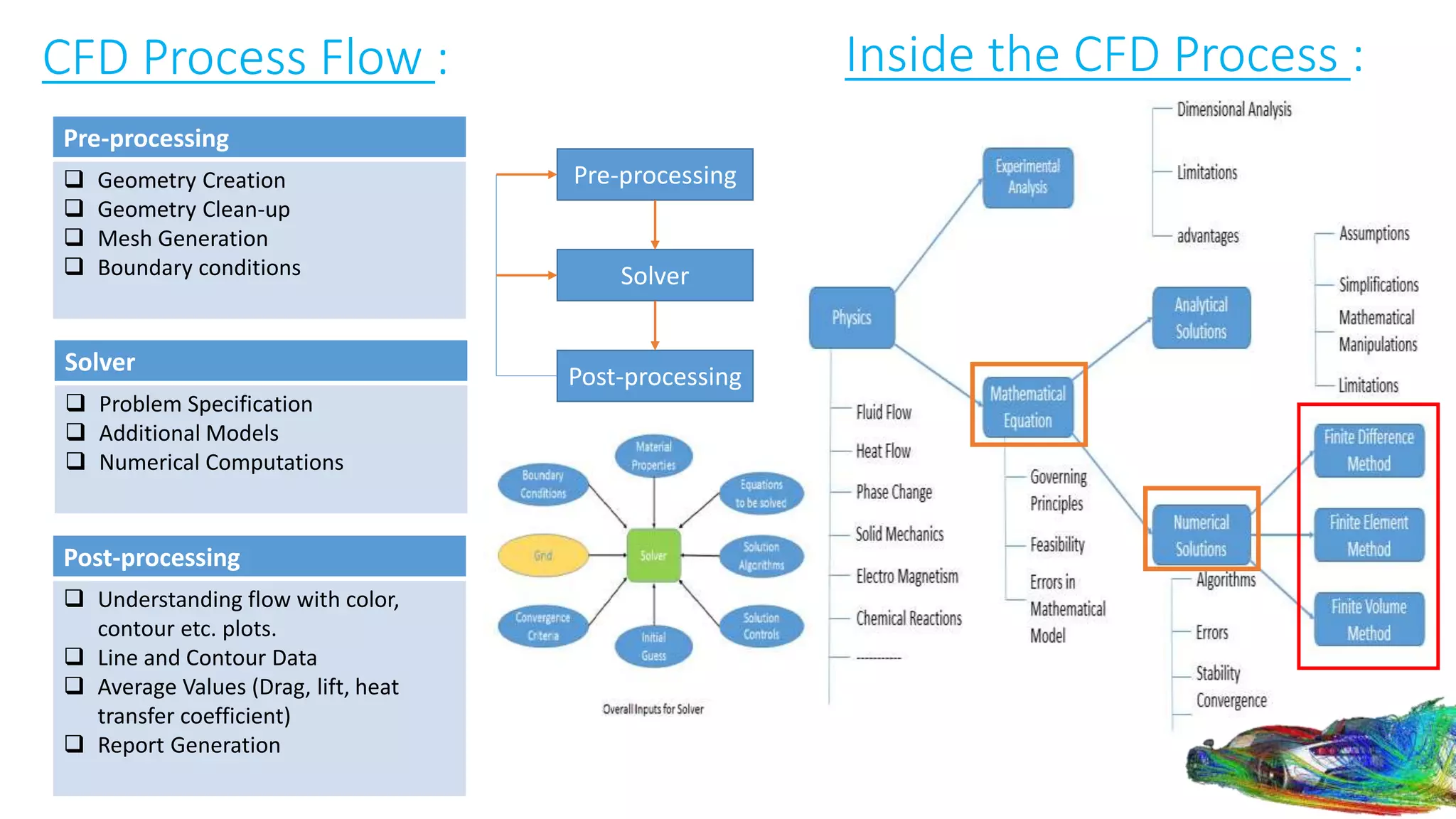
Inside the CFD Process :CFD Process Flow :
Pre-processing
 Geometry Creation
 Geometry Clean-up
 Mesh Generation
 Boundary conditions
Solver
 Problem Specification
 Additional Models
 Numerical Computations
Post-processing
 Understanding flow with color,
contour etc. plots.
 Line and Contour Data
 Average Values (Drag, lift, heat
transfer coefficient)
 Report Generation
Pre-processing
Solver
Post-processing
Inside the CFD process
…
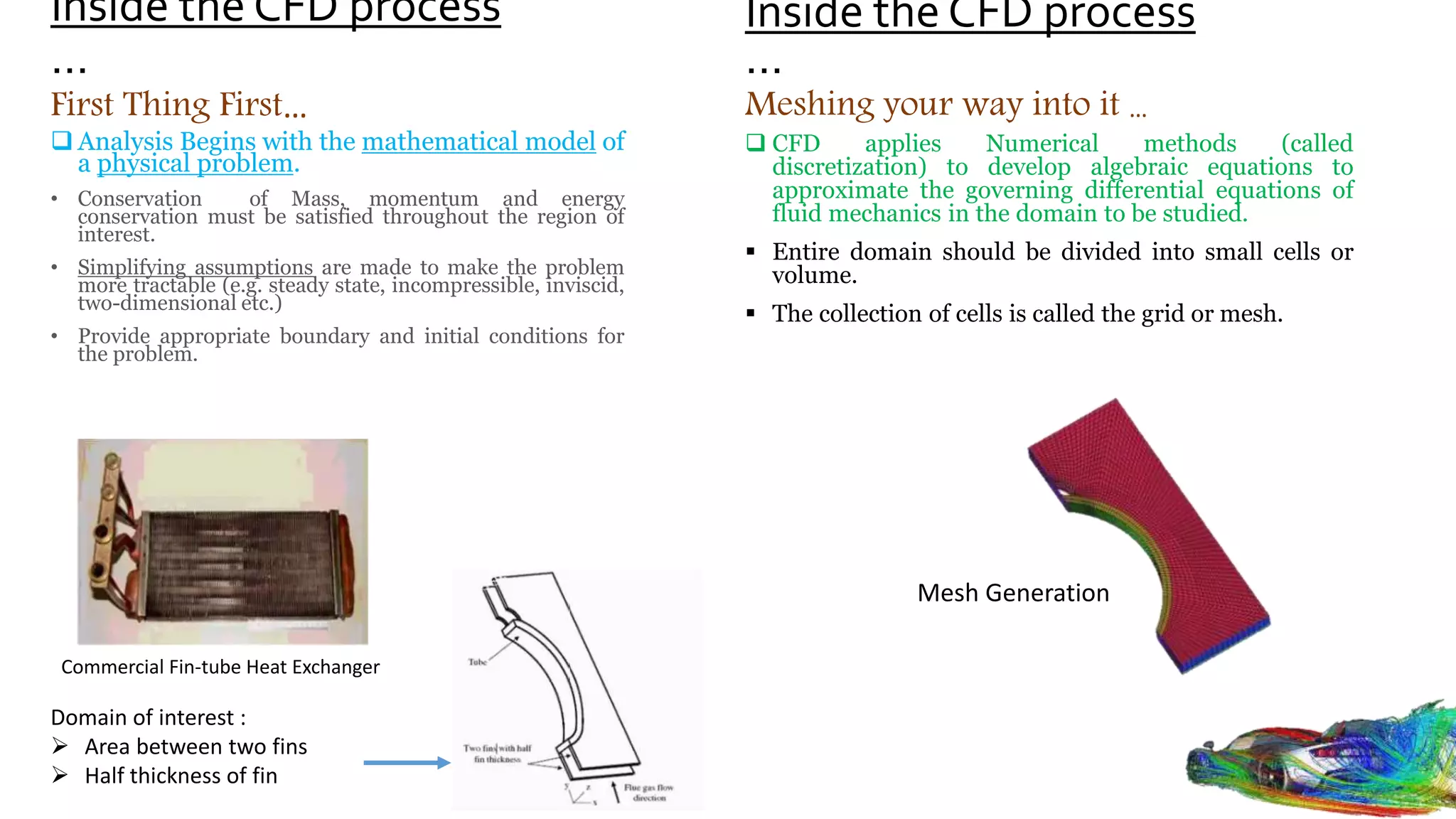
 Analysis Begins with the mathematical model of
a physical problem.
• Conservation of Mass, momentum and energy
conservation must be satisfied throughout the region of
interest.
• Simplifying assumptions are made to make the problem
more tractable (e.g. steady state, incompressible, inviscid,
two-dimensional etc.)
• Provide appropriate boundary and initial conditions for
the problem.
Domain of interest :
 Area between two fins
 Half thickness of fin
First Thing First…
Commercial Fin-tube Heat Exchanger
 CFD applies Numerical methods (called
discretization) to develop algebraic equations to
approximate the governing differential equations of
fluid mechanics in the domain to be studied.
 Entire domain should be divided into small cells or
volume.
 The collection of cells is called the grid or mesh.
Meshing your way into it …
Inside the CFD process
…
Mesh Generation
Inside the CFD process …
Solver …
Inside the CFD process …
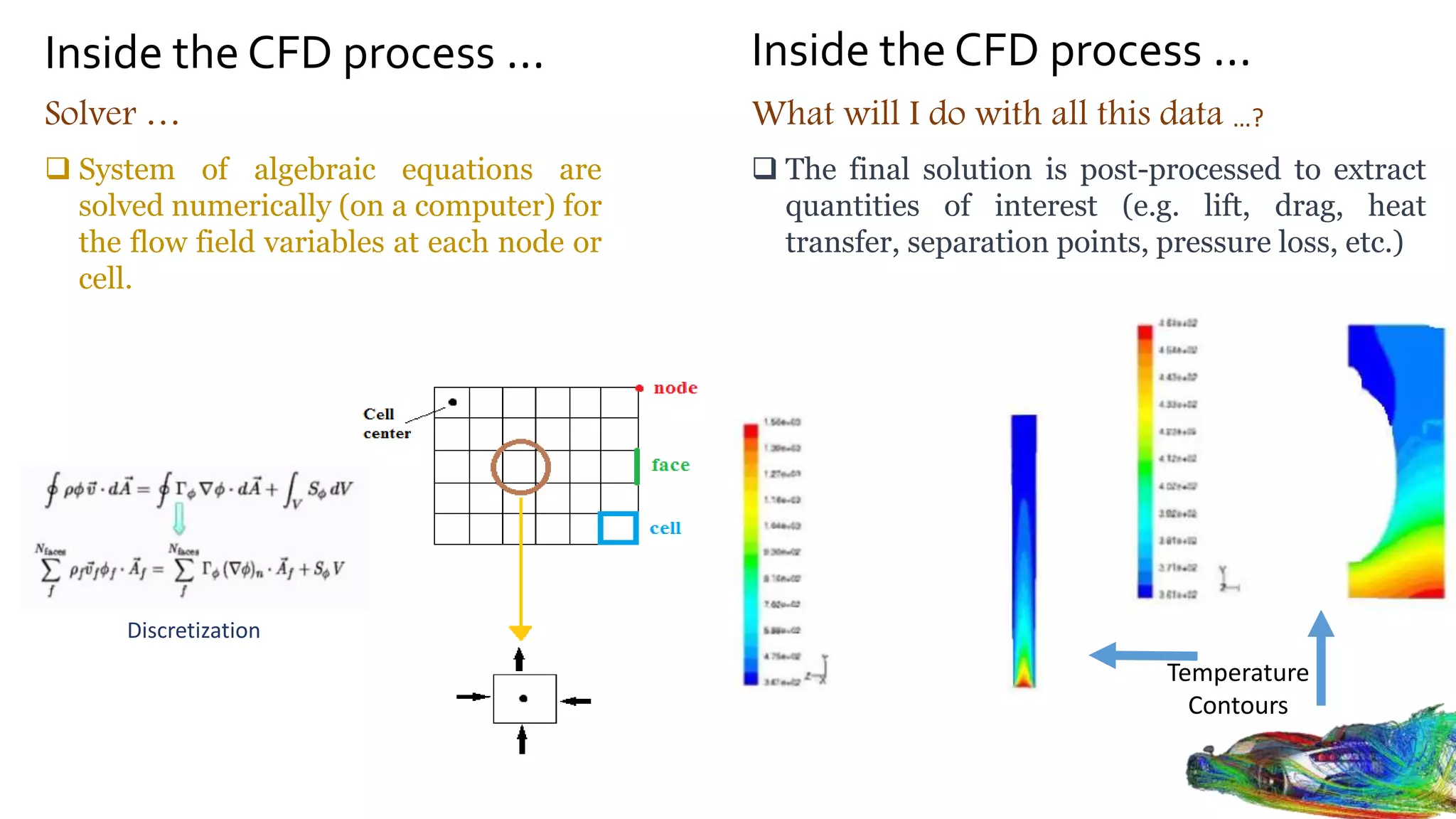
 System of algebraic equations are
solved numerically (on a computer) for
the flow field variables at each node or
cell.
 The final solution is post-processed to extract
quantities of interest (e.g. lift, drag, heat
transfer, separation points, pressure loss, etc.)
What will I do with all this data …?
Temperature
Contours
Discretization
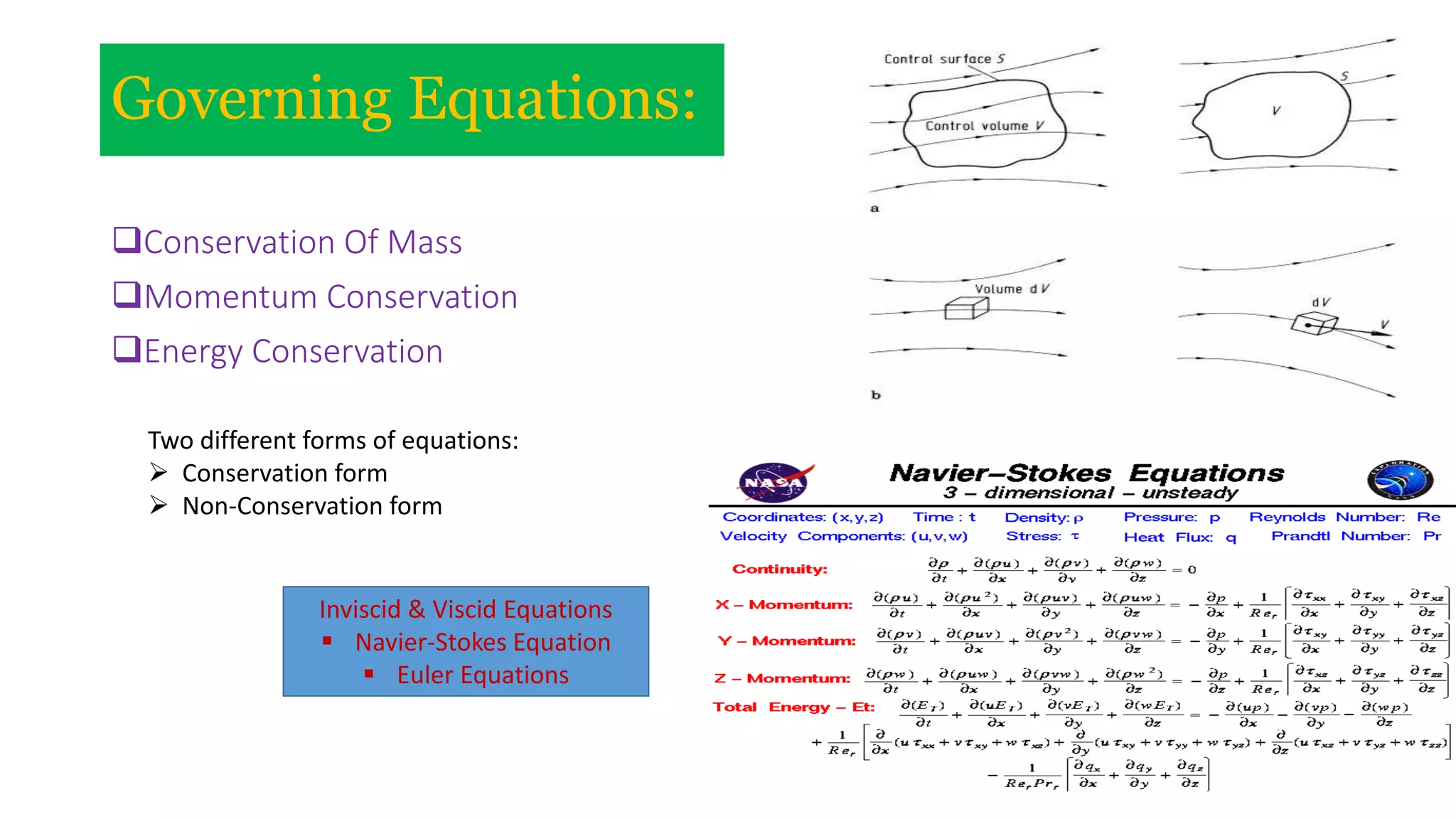
Governing Equations:
Conservation Of Mass
Momentum Conservation
Energy Conservation
Two different forms of equations:
 Conservation form
 Non-Conservation form
Inviscid & Viscid Equations
 Navier-Stokes Equation
 Euler Equations
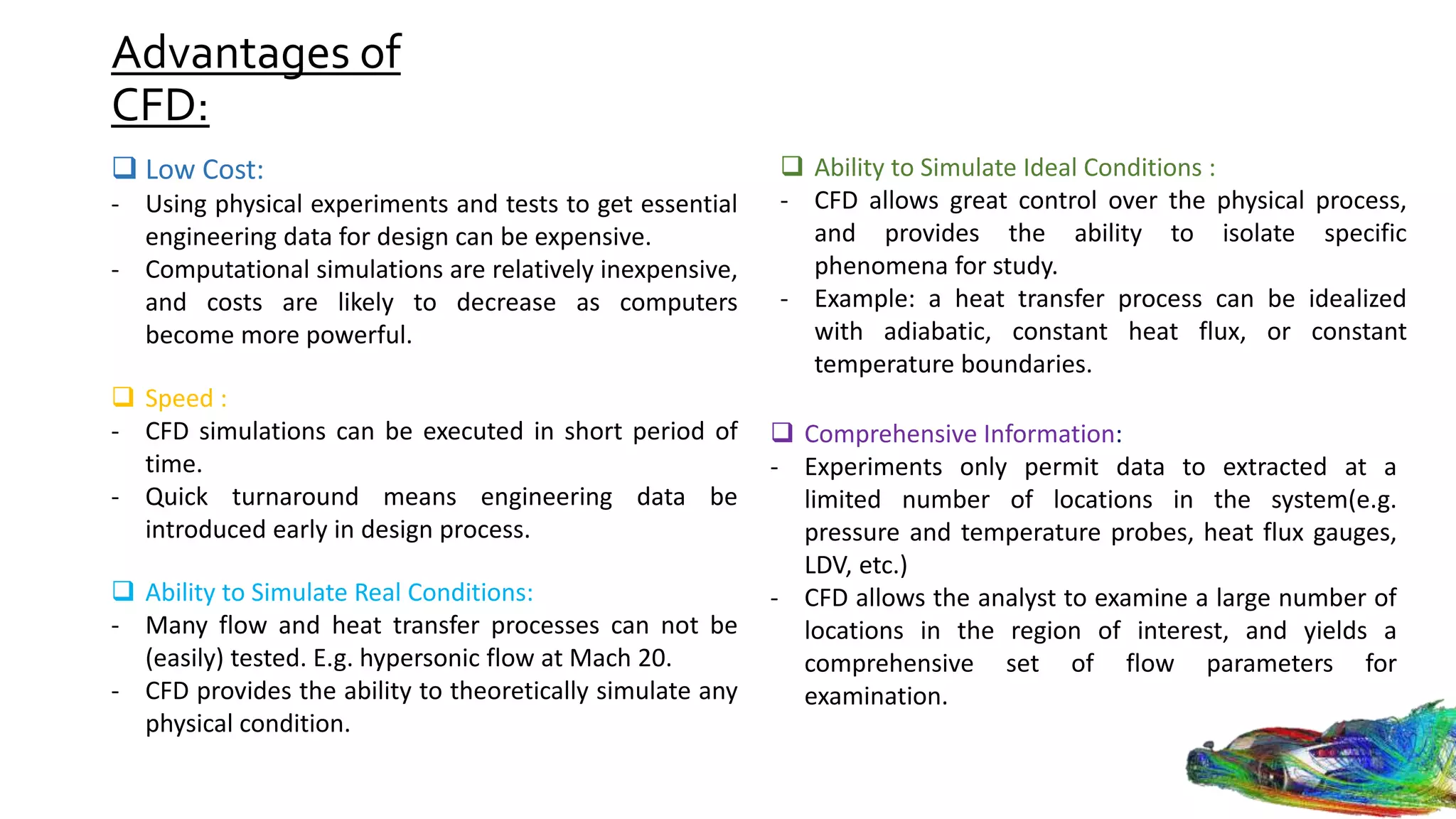
Advantages of
CFD:
 Low Cost:
- Using physical experiments and tests to get essential
engineering data for design can be expensive.
- Computational simulations are relatively inexpensive,
and costs are likely to decrease as computers
become more powerful.
 Speed :
- CFD simulations can be executed in short period of
time.
- Quick turnaround means engineering data be
introduced early in design process.
 Ability to Simulate Real Conditions:
- Many flow and heat transfer processes can not be
(easily) tested. E.g. hypersonic flow at Mach 20.
- CFD provides the ability to theoretically simulate any
physical condition.
 Ability to Simulate Ideal Conditions :
- CFD allows great control over the physical process,
and provides the ability to isolate specific
phenomena for study.
- Example: a heat transfer process can be idealized
with adiabatic, constant heat flux, or constant
temperature boundaries.
 Comprehensive Information:
- Experiments only permit data to extracted at a
limited number of locations in the system(e.g.
pressure and temperature probes, heat flux gauges,
LDV, etc.)
- CFD allows the analyst to examine a large number of
locations in the region of interest, and yields a
comprehensive set of flow parameters for
examination.
Limitations of CFD:
 Physical Models:
- CFD solutions rely upon physical models of real
processes (e.g. turbulence, compressibility,
chemistry, multiphase flow etc.)
- The solutions that are obtained through CFD can
only be as accurate as the physical models on which
they are based.
 Numerical Errors:
- Solving equations on a computer invariably
introduces numerical errors.
 Round-off error - errors due to finite word size available on the
computer.
 Truncation error - error due to approximates in the numerical
models.
- Round-off errors will always exist( though they
should be small in most cases).
- Truncation errors will go to zero as the grid is refined
– so mesh refinement is one way to deal with
truncation error.
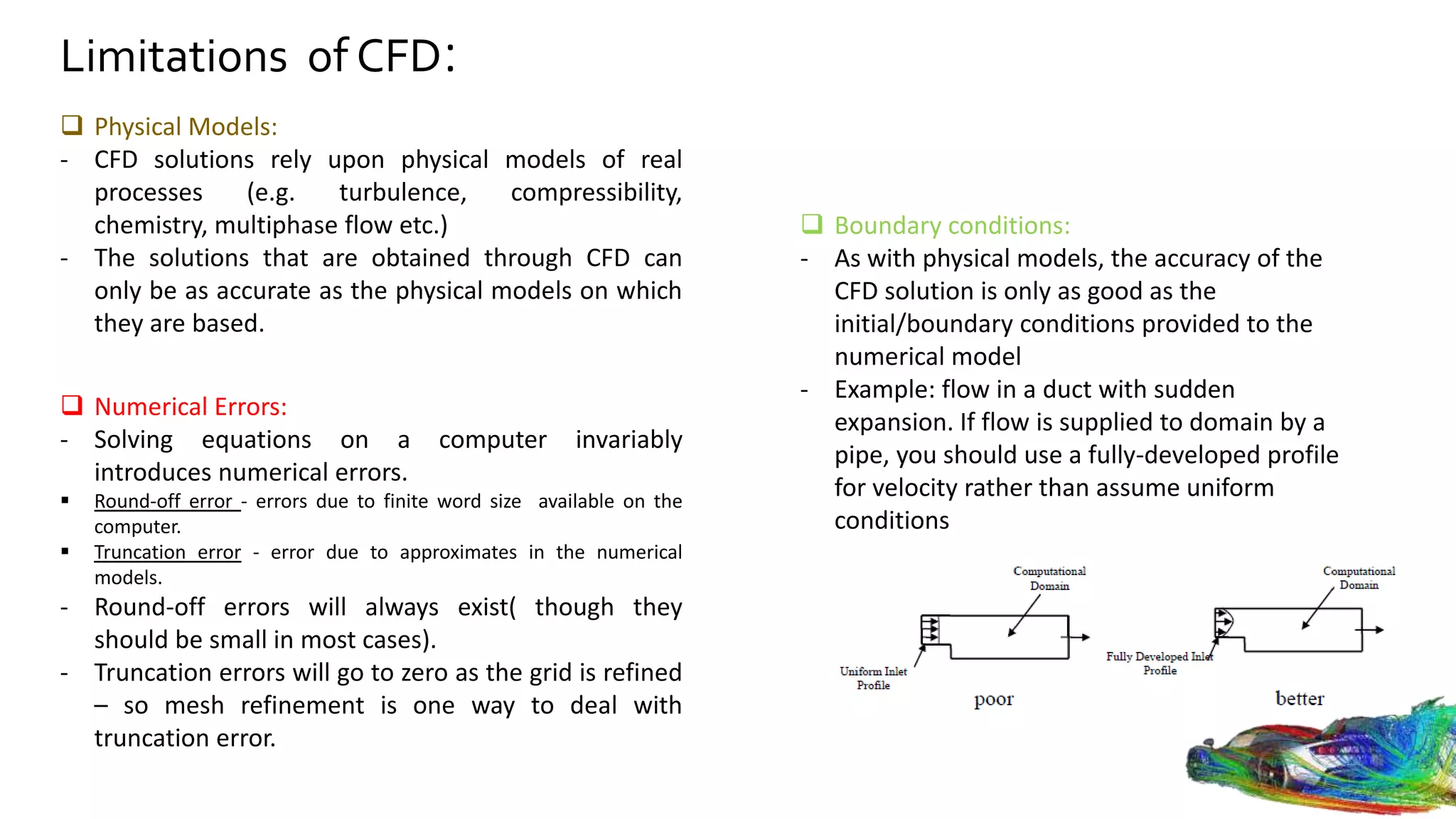
 Boundary conditions:
- As with physical models, the accuracy of the
CFD solution is only as good as the
initial/boundary conditions provided to the
numerical model
- Example: flow in a duct with sudden
expansion. If flow is supplied to domain by a
pipe, you should use a fully-developed profile
for velocity rather than assume uniform
conditions
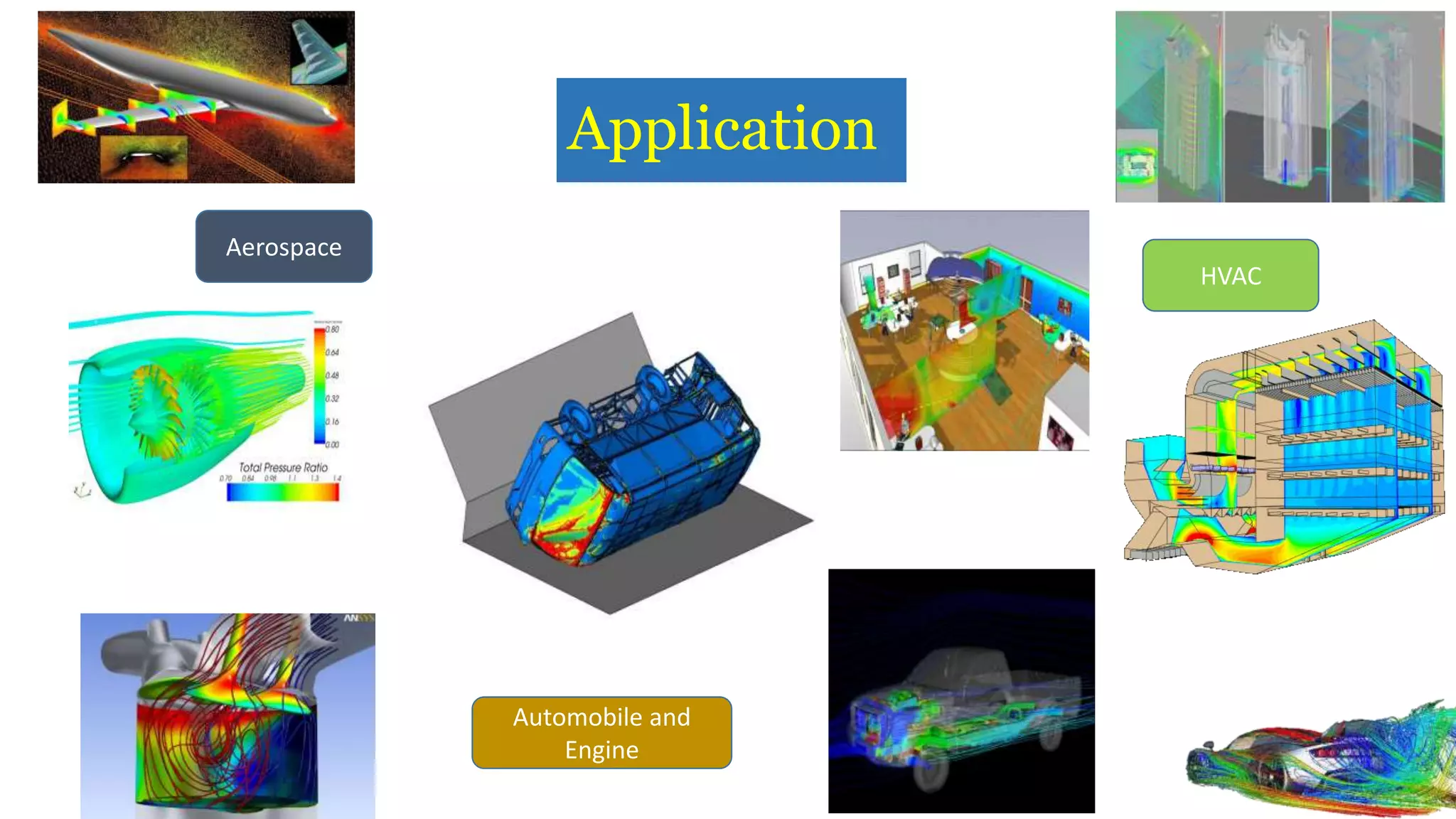
Application
Aerospace
Automobile and
Engine
HVAC
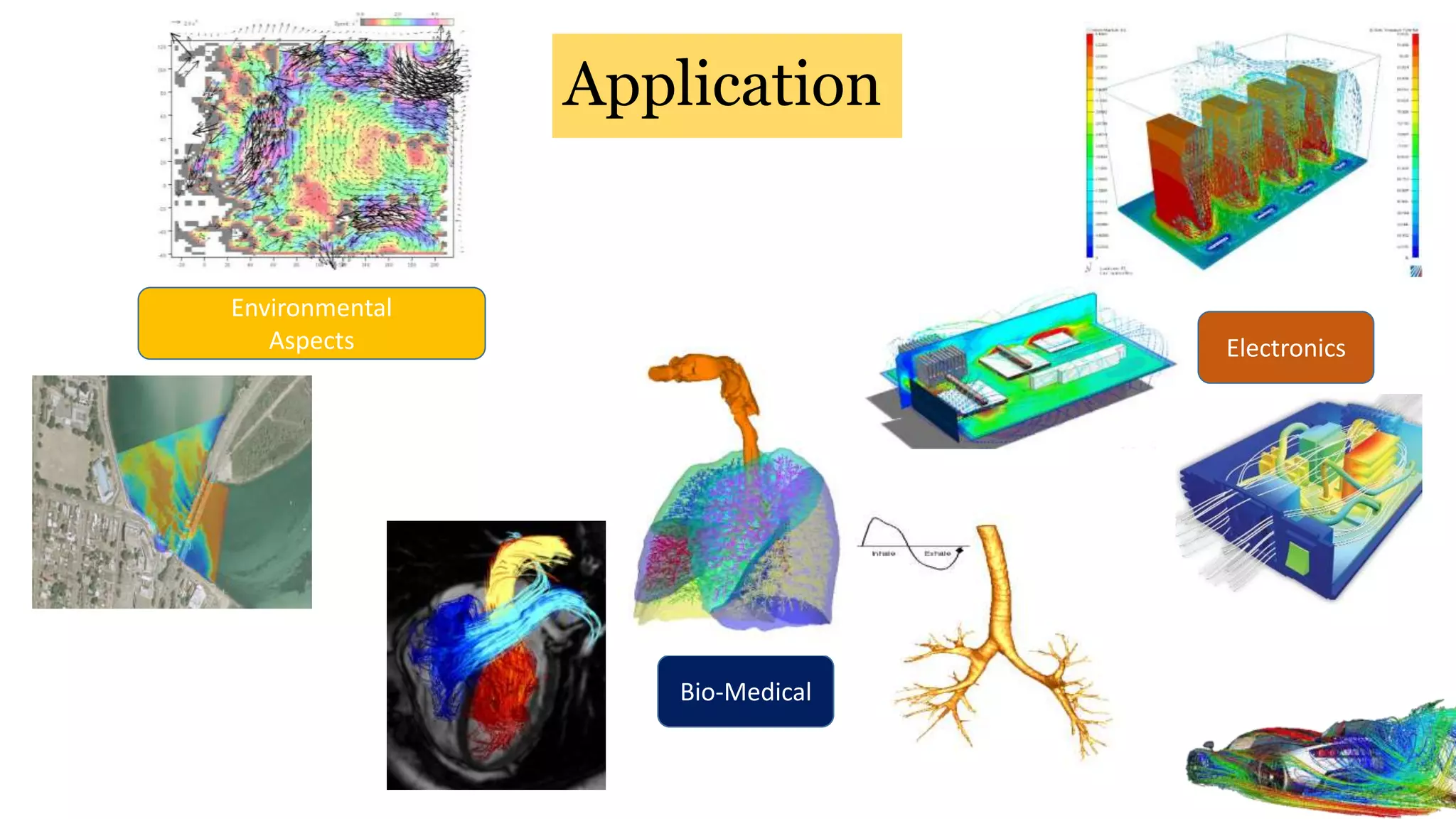
Application
Environmental
Aspects
Bio-Medical
Electronics
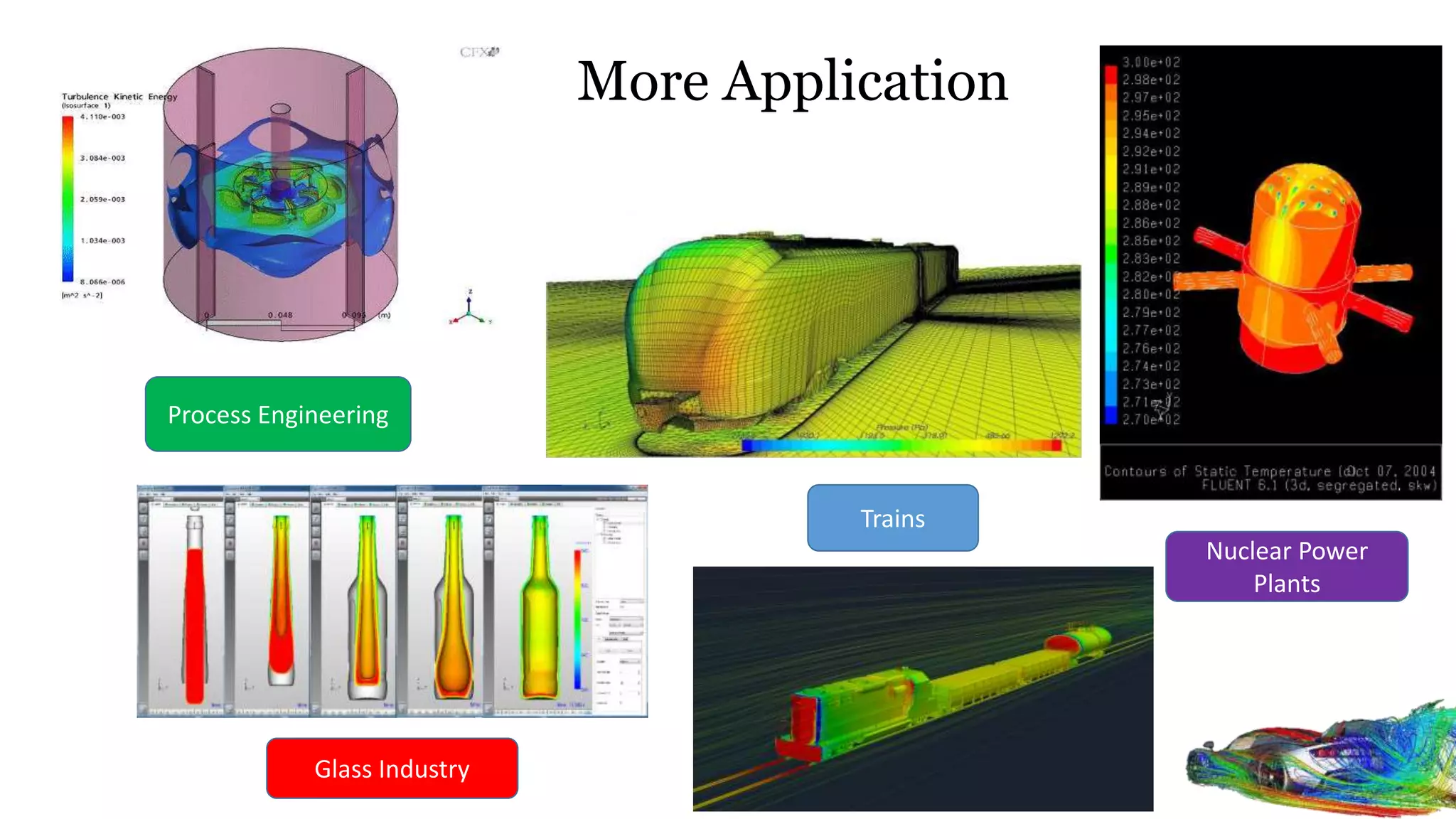
More Application
Process Engineering
Glass Industry
Nuclear Power
Plants
Trains
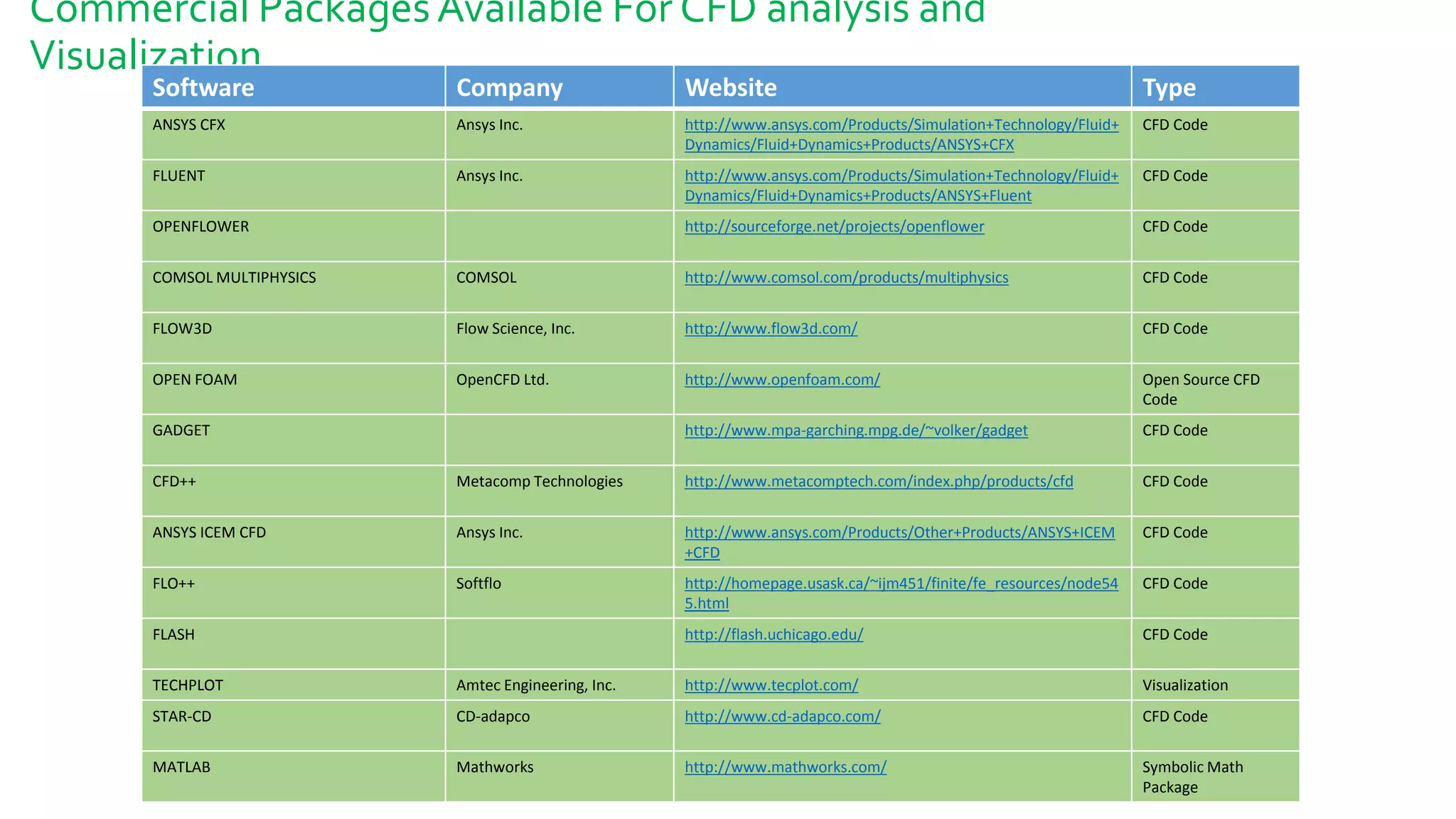
Commercial PackagesAvailable For CFD analysis and
Visualization
Software Company Website Type
ANSYS CFX Ansys Inc. http://www.ansys.com/Products/Simulation+Technology/Fluid+
Dynamics/Fluid+Dynamics+Products/ANSYS+CFX
CFD Code
FLUENT Ansys Inc. http://www.ansys.com/Products/Simulation+Technology/Fluid+
Dynamics/Fluid+Dynamics+Products/ANSYS+Fluent
CFD Code
OPENFLOWER http://sourceforge.net/projects/openflower CFD Code
COMSOL MULTIPHYSICS COMSOL http://www.comsol.com/products/multiphysics CFD Code
FLOW3D Flow Science, Inc. http://www.flow3d.com/ CFD Code
OPEN FOAM OpenCFD Ltd. http://www.openfoam.com/ Open Source CFD
Code
GADGET http://www.mpa-garching.mpg.de/~volker/gadget CFD Code
CFD++ Metacomp Technologies http://www.metacomptech.com/index.php/products/cfd CFD Code
ANSYS ICEM CFD Ansys Inc. http://www.ansys.com/Products/Other+Products/ANSYS+ICEM
+CFD
CFD Code
FLO++ Softflo http://homepage.usask.ca/~ijm451/finite/fe_resources/node54
5.html
CFD Code
FLASH http://flash.uchicago.edu/ CFD Code
TECHPLOT Amtec Engineering, Inc. http://www.tecplot.com/ Visualization
STAR-CD CD-adapco http://www.cd-adapco.com/ CFD Code
MATLAB Mathworks http://www.mathworks.com/ Symbolic Math
Package
Ravi Choudhary,
Mechanical, 3rdYear
Roll: 120970104037
E-mail:
ravi4582@outlook.com
Contact: 7895121440
TOPIC: Introduction to
CFD and its application

Computational fluid dynamics

  • 1.
  • 2.
  • 3.
    Experimental Fluid Dynamics (EFD) AnalyticalFluid Dynamics (AFD) Computational Fluid Dynamics (CFD) Fluid Dynamics Study Approach
  • 4.
     Computational FluidDynamics is the science of predicting fluid flow, heat transfer, mass transfer, chemical reaction and related phenomena by solving mathematical equations which govern these processes using numerical methods (i.e. on a computer). Why CFD…??  Growth in complexity of unsolved engineeringproblem.  Need for quick solutionsof moderate accuracy.  Absence of analytical solutions.  The prohibitive cost involvedin performing evenscaled laboratoryexperiments.  Efficient solutionalgorithms.  Developments in computersin terms of speed and storage.  Serial/parallel/web computing.  Sophisticated pre and post processing facilities.
  • 5.
    Inside the CFDProcess :CFD Process Flow : Pre-processing  Geometry Creation  Geometry Clean-up  Mesh Generation  Boundary conditions Solver  Problem Specification  Additional Models  Numerical Computations Post-processing  Understanding flow with color, contour etc. plots.  Line and Contour Data  Average Values (Drag, lift, heat transfer coefficient)  Report Generation Pre-processing Solver Post-processing
  • 6.
    Inside the CFDprocess …  Analysis Begins with the mathematical model of a physical problem. • Conservation of Mass, momentum and energy conservation must be satisfied throughout the region of interest. • Simplifying assumptions are made to make the problem more tractable (e.g. steady state, incompressible, inviscid, two-dimensional etc.) • Provide appropriate boundary and initial conditions for the problem. Domain of interest :  Area between two fins  Half thickness of fin First Thing First… Commercial Fin-tube Heat Exchanger  CFD applies Numerical methods (called discretization) to develop algebraic equations to approximate the governing differential equations of fluid mechanics in the domain to be studied.  Entire domain should be divided into small cells or volume.  The collection of cells is called the grid or mesh. Meshing your way into it … Inside the CFD process … Mesh Generation
  • 7.
    Inside the CFDprocess … Solver … Inside the CFD process …  System of algebraic equations are solved numerically (on a computer) for the flow field variables at each node or cell.  The final solution is post-processed to extract quantities of interest (e.g. lift, drag, heat transfer, separation points, pressure loss, etc.) What will I do with all this data …? Temperature Contours Discretization
  • 8.
    Governing Equations: Conservation OfMass Momentum Conservation Energy Conservation Two different forms of equations:  Conservation form  Non-Conservation form Inviscid & Viscid Equations  Navier-Stokes Equation  Euler Equations
  • 9.
    Advantages of CFD:  LowCost: - Using physical experiments and tests to get essential engineering data for design can be expensive. - Computational simulations are relatively inexpensive, and costs are likely to decrease as computers become more powerful.  Speed : - CFD simulations can be executed in short period of time. - Quick turnaround means engineering data be introduced early in design process.  Ability to Simulate Real Conditions: - Many flow and heat transfer processes can not be (easily) tested. E.g. hypersonic flow at Mach 20. - CFD provides the ability to theoretically simulate any physical condition.  Ability to Simulate Ideal Conditions : - CFD allows great control over the physical process, and provides the ability to isolate specific phenomena for study. - Example: a heat transfer process can be idealized with adiabatic, constant heat flux, or constant temperature boundaries.  Comprehensive Information: - Experiments only permit data to extracted at a limited number of locations in the system(e.g. pressure and temperature probes, heat flux gauges, LDV, etc.) - CFD allows the analyst to examine a large number of locations in the region of interest, and yields a comprehensive set of flow parameters for examination.
  • 10.
    Limitations of CFD: Physical Models: - CFD solutions rely upon physical models of real processes (e.g. turbulence, compressibility, chemistry, multiphase flow etc.) - The solutions that are obtained through CFD can only be as accurate as the physical models on which they are based.  Numerical Errors: - Solving equations on a computer invariably introduces numerical errors.  Round-off error - errors due to finite word size available on the computer.  Truncation error - error due to approximates in the numerical models. - Round-off errors will always exist( though they should be small in most cases). - Truncation errors will go to zero as the grid is refined – so mesh refinement is one way to deal with truncation error.  Boundary conditions: - As with physical models, the accuracy of the CFD solution is only as good as the initial/boundary conditions provided to the numerical model - Example: flow in a duct with sudden expansion. If flow is supplied to domain by a pipe, you should use a fully-developed profile for velocity rather than assume uniform conditions
  • 11.
  • 12.
  • 13.
    More Application Process Engineering GlassIndustry Nuclear Power Plants Trains
  • 14.
    Commercial PackagesAvailable ForCFD analysis and Visualization Software Company Website Type ANSYS CFX Ansys Inc. http://www.ansys.com/Products/Simulation+Technology/Fluid+ Dynamics/Fluid+Dynamics+Products/ANSYS+CFX CFD Code FLUENT Ansys Inc. http://www.ansys.com/Products/Simulation+Technology/Fluid+ Dynamics/Fluid+Dynamics+Products/ANSYS+Fluent CFD Code OPENFLOWER http://sourceforge.net/projects/openflower CFD Code COMSOL MULTIPHYSICS COMSOL http://www.comsol.com/products/multiphysics CFD Code FLOW3D Flow Science, Inc. http://www.flow3d.com/ CFD Code OPEN FOAM OpenCFD Ltd. http://www.openfoam.com/ Open Source CFD Code GADGET http://www.mpa-garching.mpg.de/~volker/gadget CFD Code CFD++ Metacomp Technologies http://www.metacomptech.com/index.php/products/cfd CFD Code ANSYS ICEM CFD Ansys Inc. http://www.ansys.com/Products/Other+Products/ANSYS+ICEM +CFD CFD Code FLO++ Softflo http://homepage.usask.ca/~ijm451/finite/fe_resources/node54 5.html CFD Code FLASH http://flash.uchicago.edu/ CFD Code TECHPLOT Amtec Engineering, Inc. http://www.tecplot.com/ Visualization STAR-CD CD-adapco http://www.cd-adapco.com/ CFD Code MATLAB Mathworks http://www.mathworks.com/ Symbolic Math Package
  • 15.
    Ravi Choudhary, Mechanical, 3rdYear Roll:120970104037 E-mail: ravi4582@outlook.com Contact: 7895121440 TOPIC: Introduction to CFD and its application