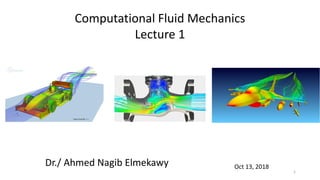
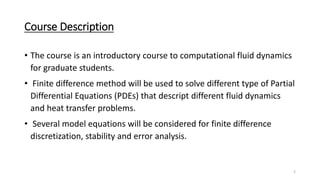
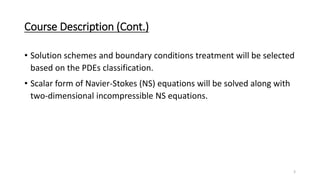
Computational Fluid Mechanics
Lecture 1
Dr./ Ahmed Nagib Elmekawy Oct 13, 2018
1
Course Description
• The course is an introductory course to computational fluid dynamics
for graduate students.
• Finite difference method will be used to solve different type of Partial
Differential Equations (PDEs) that descript different fluid dynamics
and heat transfer problems.
• Several model equations will be considered for finite difference
discretization, stability and error analysis.
2
Course Description (Cont.)
• Solution schemes and boundary conditions treatment will be selected
based on the PDEs classification.
• Scalar form of Navier-Stokes (NS) equations will be solved along with
two-dimensional incompressible NS equations.
3
Course Contents
• Introduction (What is CFD?, Physical classifications of fluid dynamics
problems, governing equations)
• Classification of PDEs (Characteristics lines and boundary conditions)
• Finite Difference Method (Taylor series, truncation error, consistency,
stability, and convergence)
• Stability analysis
• Parabolic PDEs
4
Course Contents (Cont.)
• Elliptic PDEs
• Hyperbolic PDEs
• Scalar NS equation
• Introduction to Finite Volume
5
Course Contents (Cont.)
Introduction to Ansys Fluent
• Intoduction to CFD by using ANSYS
• Introduction to Meshing
• CFD: Setting up Domain and Physics
• CFD: Turbulence Modeling and Transient
6
References
• Hoffmann, A., Chiang, S., Computational Fluid Dynamics for Engineers, Vol. I, 1st
ed., Engineering Education System, 1993
• Lecture PowerPoint notes
• Hirsch, C., Numerical Computation of Internal and External Flows, 2nd ed.,
Butterworth-Heinemann, 2007
• Anderson, J. D., Computational Fluid Dynamics – The Basics with Applications,
McGraw-Hill, 1995.
• Pletcher, R. H., Tannehill, J. C., Anderson, D., Computational Fluid Mechanics and
Heat Tranfer, 3rd ed., CRC Press, 2011
• Ferziger, J. H., Numerical Methods for Engineering Application, 2nd ed., Wiley,
1998.
• Chung, T.J., Computational Fluid Mechanics, 2nd edition, Cambridge University
Press, 2010.
7
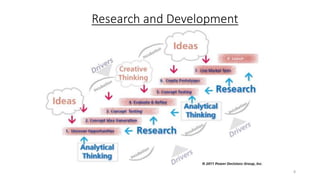
Research and Development
8
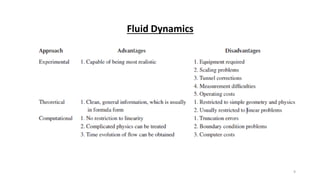
Fluid Dynamics
9
Introduction to Experimental Fluid
Dynamics
11
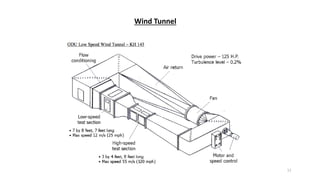
Wind Tunnel
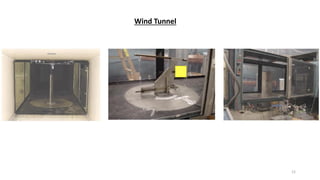
Wind Tunnel
12
13
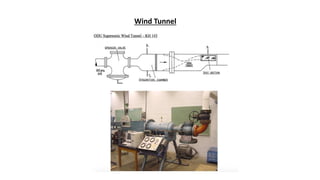
Wind Tunnel
14
Wind Tunnel
15
Wind Tunnel
16
Wind Tunnel
17
Wind Tunnel
18
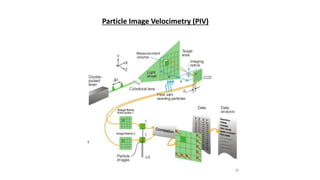
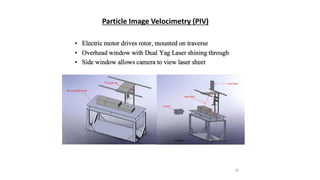
Particle Image Velocimetry (PIV)
19
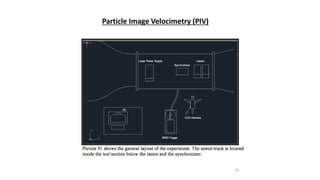
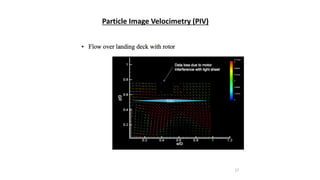
Particle Image Velocimetry (PIV)
20
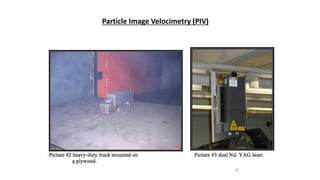
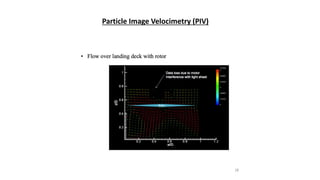
Particle Image Velocimetry (PIV)
21
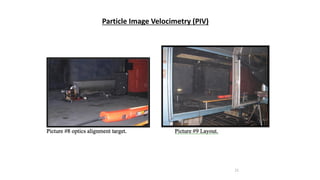
Particle Image Velocimetry (PIV)
22
Particle Image Velocimetry (PIV)
23
Particle Image Velocimetry (PIV)
24
Particle Image Velocimetry (PIV)
25
Particle Image Velocimetry (PIV)
26
Particle Image Velocimetry (PIV)
27
Particle Image Velocimetry (PIV)
28
Particle Image Velocimetry (PIV)
29
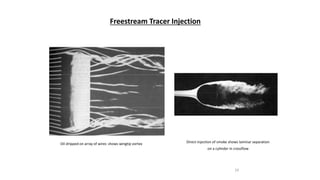
Freestream Tracer Injection
Oil dripped on array of wires shows wingtip vortex Direct injection of smoke shows laminar separation
on a cylinder in crossflow
30
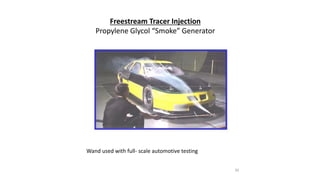
Freestream Tracer Injection
Propylene Glycol “Smoke” Generator
Wand used with full- scale automotive testing
31
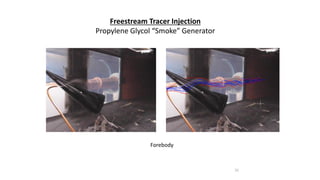
Freestream Tracer Injection
Propylene Glycol “Smoke” Generator
Forebody
32
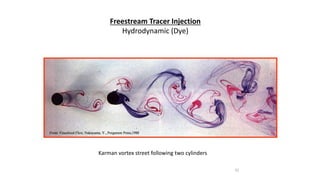
Freestream Tracer Injection
Hydrodynamic (Dye)
Karman vortex street following two cylinders
33
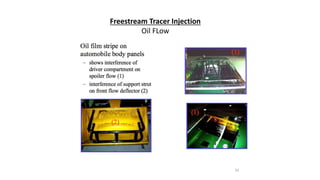
Freestream Tracer Injection
Oil FLow
34
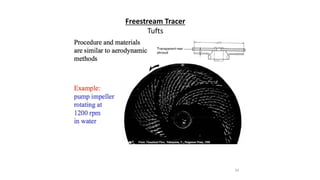
Freestream Tracer
Tufts
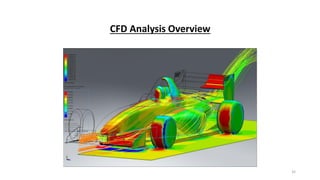
CFD Analysis Overview
35
Commercial CFD codes
• Fluent (UK and US).
• CFX (UK and Canada).
• Openfoam (US)
• Fidap (US).
• Polyflow (Belgium).
• Phoenix (UK).
• Star CD (UK).
• Flow 3d (US).
• ESI/CFDRC (US).
• SCRYU (Japan).
• and more, see www.cfdreview.com.
36
All CFD simulations follow the same key stages. This lecture will explain how to
go from the original planning stage to analyzing the end results
Learning Aims:
You will learn:
• The basics of what CFD is and how it works
• The different steps involved in a successful CFD project
Learning Objectives:
When you begin your own CFD project, you will know what each of the steps
requires and be able to plan accordingly
Introduction
37
Introduction CFD Approach Pre-Processing Solution Post-Processing Summary
What is CFD?
38
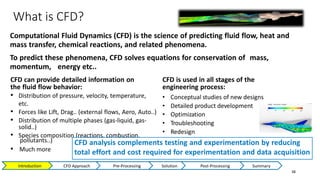
Computational Fluid Dynamics (CFD) is the science of predicting fluid flow, heat and
mass transfer, chemical reactions, and related phenomena.
To predict these phenomena, CFD solves equations for conservation of mass,
momentum, energy etc..
CFD can provide detailed information on
the fluid flow behavior:
• Distribution of pressure, velocity, temperature,
etc.
• Forces like Lift, Drag.. (external flows, Aero, Auto..)
• Distribution of multiple phases (gas-liquid, gas-
solid..)
• Species composition (reactions, combustion,
• Much more
pollutants..)
CFD is used in all stages of the
engineering process:
• Conceptual studies of new designs
• Detailed product development
• Optimization
• Troubleshooting
• Redesign
CFD analysis complements testing and experimentation by reducing
total effort and cost required for experimentation and data acquisition
Introduction CFD Approach Pre-Processing Solution Post-Processing Summary
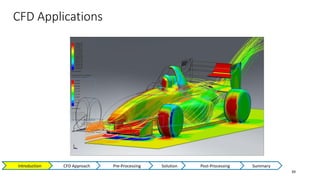
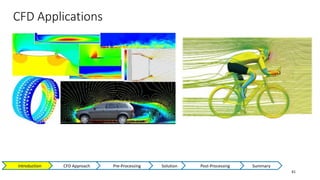
CFD Applications
39
Introduction CFD Approach Pre-Processing Solution Post-Processing Summary
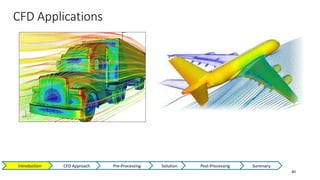
CFD Applications
40
Introduction CFD Approach Pre-Processing Solution Post-Processing Summary
CFD Applications
41
Introduction CFD Approach Pre-Processing Solution Post-Processing Summary
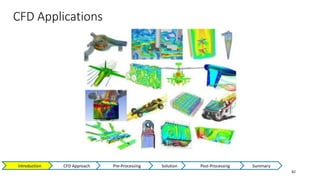
CFD Applications
42
Introduction CFD Approach Pre-Processing Solution Post-Processing Summary
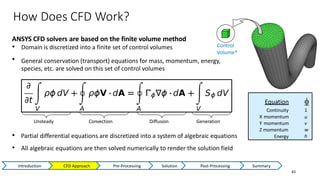
How Does CFD Work?
43
ANSYS CFD solvers are based on the finite volume method
• Domain is discretized into a finite set of control volumes
• General conservation (transport) equations for mass, momentum, energy,
species, etc. are solved on this set of control volumes
Unsteady Convection Diffusion Generation
• Partial differential equations are discretized into a system of algebraic equations
• All algebraic equations are then solved numerically to render the solution field
Control
Volume*
Equation
Continuity
X momentum
Y momentum
Z momentum
Energy

1
u
v
w
h
Introduction CFD Approach Pre-Processing Solution Post-Processing Summary
Step 1. Define Your Modeling Goals
44
• What results are you looking for (i.e. pressure drop, mass flow rate),
and how will they be used?
• What are your modeling options?
• What simplifying assumptions can you make (i.e. symmetry, periodicity)?
• What simplifying assumptions do you have to make?
• What physical models will need to be included in your analysis
• What degree of accuracy is required?
• How quickly do you need the results?
• Is CFD an appropriate tool?
Introduction CFD Approach Pre-Processing Solution Post-Processing Summary
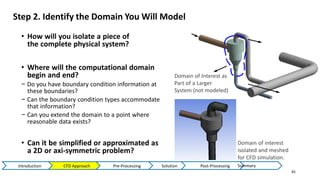
Step 2. Identify the Domain You Will Model
45
• How will you isolate a piece of
the complete physical system?
• Where will the computational domain
begin and end?
− Do you have boundary condition information at
these boundaries?
− Can the boundary condition types accommodate
that information?
− Can you extend the domain to a point where
reasonable data exists?
• Can it be simplified or approximated as
a 2D or axi-symmetric problem?
Domain of Interest as
Part of a Larger
System (not modeled)
Domain of interest
isolated and meshed
for CFD simulation.
Summary
Introduction CFD Approach Pre-Processing Solution Post-Processing
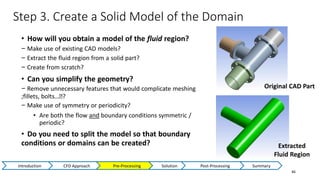
Step 3. Create a Solid Model of the Domain
46
• How will you obtain a model of the fluid region?
− Make use of existing CAD models?
− Extract the fluid region from a solid part?
− Create from scratch?
• Can you simplify the geometry?
− Remove unnecessary features that would complicate meshing
;fillets, bolts…Ϳ?
− Make use of symmetry or periodicity?
• Are both the flow and boundary conditions symmetric /
periodic?
• Do you need to split the model so that boundary
conditions or domains can be created?
Original CAD Part
Extracted
Fluid Region
Introduction CFD Approach Pre-Processing Solution Post-Processing Summary
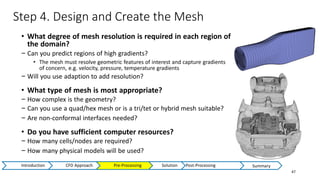
Step 4. Design and Create the Mesh
47
• What degree of mesh resolution is required in each region of
the domain?
− Can you predict regions of high gradients?
• The mesh must resolve geometric features of interest and capture gradients
of concern, e.g. velocity, pressure, temperature gradients
− Will you use adaption to add resolution?
• What type of mesh is most appropriate?
− How complex is the geometry?
− Can you use a quad/hex mesh or is a tri/tet or hybrid mesh suitable?
− Are non-conformal interfaces needed?
• Do you have sufficient computer resources?
− How many cells/nodes are required?
− How many physical models will be used?
Introduction CFD Approach Pre-Processing Solution Post-Processing Summary
48
Design and create the grid
• Should you use a quad/hex grid, a tri/tet grid, a hybrid grid, or a non-
conformal grid?
• What degree of grid resolution is required in each region of the
domain?
• How many cells are required for the problem?
• Will you use adaption to add resolution?
• Do you have sufficient computer memory?
triangle
quadrilateral
tetrahedron pyramid
prism or wedge
hexahedron
arbitrary polyhedron
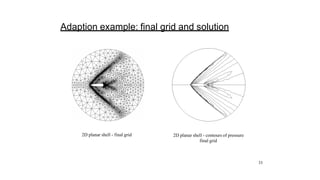
Adaption example: final grid and solution
2D planar shell - final grid 2D planar shell - contours of pressure
final grid
33
Step 5. Set Up the Solver
50
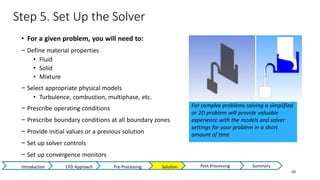
• For a given problem, you will need to:
− Define material properties
• Fluid
• Solid
• Mixture
− Select appropriate physical models
• Turbulence, combustion, multiphase, etc.
− Prescribe operating conditions
− Prescribe boundary conditions at all boundary zones
− Provide initial values or a previous solution
− Set up solver controls
− Set up convergence monitors
Introduction CFD Approach Pre-Processing Solution
For complex problems solving a simplified
or 2D problem will provide valuable
experience with the models and solver
settings for your problem in a short
amount of time
Post-Processing Summary
Step 6. Compute the Solution
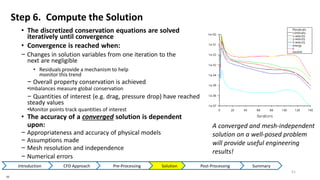
• The discretized conservation equations are solved
iteratively until convergence
• Convergence is reached when:
− Changes in solution variables from one iteration to the
next are negligible
• Residuals provide a mechanism to help
monitor this trend
− Overall property conservation is achieved
•Imbalances measure global conservation
− Quantities of interest (e.g. drag, pressure drop) have reached
steady values
•Monitor points track quantities of interest
• The accuracy of a converged solution is dependent
upon:
− Appropriateness and accuracy of physical models
− Assumptions made
− Mesh resolution and independence
− Numerical errors
A converged and mesh-independent
solution on a well-posed problem
will provide useful engineering
results!
Introduction CFD Approach Pre-Processing Solution Post-Processing Summary
10
51
Step 7. Examine the Results
52
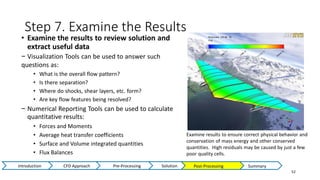
• Examine the results to review solution and
extract useful data
− Visualization Tools can be used to answer such
questions as:
• What is the overall flow pattern?
• Is there separation?
• Where do shocks, shear layers, etc. form?
• Are key flow features being resolved?
− Numerical Reporting Tools can be used to calculate
quantitative results:
• Forces and Moments
• Average heat transfer coefficients
• Surface and Volume integrated quantities
• Flux Balances
Examine results to ensure correct physical behavior and
conservation of mass energy and other conserved
quantities. High residuals may be caused by just a few
poor quality cells.
Post-Processing Summary
Introduction CFD Approach Pre-Processing Solution
Step 8. Consider Revisions to the Model
53
• Are the physical models appropriate?
− Is the flow turbulent?
− Is the flow unsteady?
− Are there compressibility effects?
− Are there 3D effects?
• Are the boundary conditions correct?
− Is the computational domain large enough?
− Are boundary conditions appropriate?
− Are boundary values reasonable?
• Is the mesh adequate?
− Does the solution change significantly with a refined mesh, or
is the solution mesh independent?
− Does the mesh resolution of the geometry need to be
improved?
− Does the model contain poor quality cells?
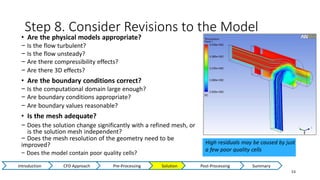
High residuals may be caused by just
a few poor quality cells
Introduction CFD Approach Pre-Processing Solution Post-Processing Summary
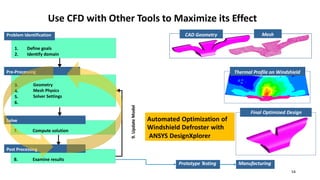
Use CFD with Other Tools to Maximize its Effect
Prototype Testing Manufacturing
9.
Update
Model
1. Define goals
2. Identify domain
Pre-Processing
Problem Identification
3.
4.
5.
6.
Geometry
Mesh Physics
Solver Settings
7. Compute solution
Solve
8. Examine results
Post Processing
Mesh
CAD Geometry
Thermal Profile on Windshield
Final Optimized Design
Automated Optimization of
Windshield Defroster with
ANSYS DesignXplorer
54
Summary and Conclusions
55
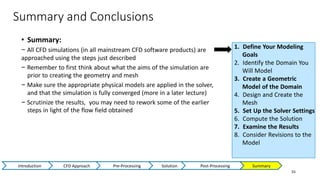
• Summary:
− All CFD simulations (in all mainstream CFD software products) are
approached using the steps just described
− Remember to first think about what the aims of the simulation are
prior to creating the geometry and mesh
− Make sure the appropriate physical models are applied in the solver,
and that the simulation is fully converged (more in a later lecture)
− Scrutinize the results, you may need to rework some of the earlier
steps in light of the flow field obtained
1. Define Your Modeling
Goals
2. Identify the Domain You
Will Model
3. Create a Geometric
Model of the Domain
4. Design and Create the
Mesh
5. Set Up the Solver Settings
6. Compute the Solution
7. Examine the Results
8. Consider Revisions to the
Model
Introduction CFD Approach Pre-Processing Solution Post-Processing Summary
56
Applications of CFD
• Applications of CFD are numerous!
• Flow and heat transfer in industrial processes (boilers, heat exchangers,
combustion equipment, pumps, blowers, piping, etc.).
• Aerodynamics of ground vehicles, aircraft, missiles.
• Film coating, thermoforming in material processing applications.
• Flow and heat transfer in propulsion and power generation systems.
• Ventilation, heating, and cooling flows in buildings.
• Chemical vapor deposition (CVD) for integrated circuit manufacturing.
• Heat transfer for electronics packaging applications.
• And many, many more!
57
Advantages of CFD
• Relatively low cost.
• Using physical experiments and tests to get essential engineering data for design can
be expensive.
• CFD simulations are relatively inexpensive, and costs are likely to decrease as
computers become more powerful.
• Speed.
• CFD simulations can be executed in a short period of time.
• Quick turnaround means engineering data can be introduced early in the design
process.
• Ability to simulate real conditions.
• Many flow and heat transfer processes can not be (easily) tested, e.g. hypersonic
flow.
• CFD provides the ability to theoretically simulate any physical condition.
58
Advantages of CFD (2)
• Ability to simulate ideal conditions.
• CFD allows great control over the physical process, and provides the ability to
isolate specific phenomena for study.
• Example: a heat transfer process can be idealized with adiabatic, constant
heat flux, or constant temperature boundaries.
• Comprehensive information.
• Experiments only permit data to be extracted at a limited number of locations
in the system (e.g. pressure and temperature probes, heat flux gauges, LDV,
etc.).
• CFD allows the analyst to examine a large number of locations in the region of
interest, and yields a comprehensive set of flow parameters for examination.
59
Limitations of CFD
• Physical models.
• CFD solutions rely upon physical models of real world processes (e.g.
turbulence, compressibility, chemistry, multiphase flow, etc.).
• The CFD solutions can only be as accurate as the physical models on which
they are based.
• Numerical errors.
• Solving equations on a computer invariably introduces numerical errors.
• Round-off error: due to finite word size available on the computer. Round-off
errors will always exist (though they can be small in most cases).
• Truncation error: due to approximations in the numerical models. Truncation
errors will go to zero as the grid is refined. Mesh refinement is one way to
deal with truncation error.
60
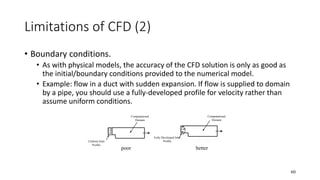
poor better
Fully Developed Inlet
Profile
Computational
Domain
Computational
Domain
Uniform Inlet
Profile
Limitations of CFD (2)
• Boundary conditions.
• As with physical models, the accuracy of the CFD solution is only as good as
the initial/boundary conditions provided to the numerical model.
• Example: flow in a duct with sudden expansion. If flow is supplied to domain
by a pipe, you should use a fully-developed profile for velocity rather than
assume uniform conditions.
61
Summary
• CFD is a method to numerically calculate heat transfer and fluid flow.
• Currently, its main application is as an engineering method, to provide
data that is complementary to theoretical and experimental data. This
is mainly the domain of commercially available codes and in-house
codes at large companies.
• CFD can also be used for purely scientific studies, e.g. into the
fundamentals of turbulence. This is more common in academic
institutions and government research laboratories. Codes are usually
developed to specifically study a certain problem.

CFD_Lecture_1.pdf

  • 1.
    Computational Fluid Mechanics Lecture1 Dr./ Ahmed Nagib Elmekawy Oct 13, 2018 1
  • 2.
    Course Description • Thecourse is an introductory course to computational fluid dynamics for graduate students. • Finite difference method will be used to solve different type of Partial Differential Equations (PDEs) that descript different fluid dynamics and heat transfer problems. • Several model equations will be considered for finite difference discretization, stability and error analysis. 2
  • 3.
    Course Description (Cont.) •Solution schemes and boundary conditions treatment will be selected based on the PDEs classification. • Scalar form of Navier-Stokes (NS) equations will be solved along with two-dimensional incompressible NS equations. 3
  • 4.
    Course Contents • Introduction(What is CFD?, Physical classifications of fluid dynamics problems, governing equations) • Classification of PDEs (Characteristics lines and boundary conditions) • Finite Difference Method (Taylor series, truncation error, consistency, stability, and convergence) • Stability analysis • Parabolic PDEs 4
  • 5.
    Course Contents (Cont.) •Elliptic PDEs • Hyperbolic PDEs • Scalar NS equation • Introduction to Finite Volume 5
  • 6.
    Course Contents (Cont.) Introductionto Ansys Fluent • Intoduction to CFD by using ANSYS • Introduction to Meshing • CFD: Setting up Domain and Physics • CFD: Turbulence Modeling and Transient 6
  • 7.
    References • Hoffmann, A.,Chiang, S., Computational Fluid Dynamics for Engineers, Vol. I, 1st ed., Engineering Education System, 1993 • Lecture PowerPoint notes • Hirsch, C., Numerical Computation of Internal and External Flows, 2nd ed., Butterworth-Heinemann, 2007 • Anderson, J. D., Computational Fluid Dynamics – The Basics with Applications, McGraw-Hill, 1995. • Pletcher, R. H., Tannehill, J. C., Anderson, D., Computational Fluid Mechanics and Heat Tranfer, 3rd ed., CRC Press, 2011 • Ferziger, J. H., Numerical Methods for Engineering Application, 2nd ed., Wiley, 1998. • Chung, T.J., Computational Fluid Mechanics, 2nd edition, Cambridge University Press, 2010. 7
  • 8.
  • 9.
  • 10.
  • 11.
  • 12.
  • 13.
  • 14.
  • 15.
  • 16.
  • 17.
  • 18.
  • 19.
  • 20.
  • 21.
  • 22.
  • 23.
  • 24.
  • 25.
  • 26.
  • 27.
  • 28.
  • 29.
    29 Freestream Tracer Injection Oildripped on array of wires shows wingtip vortex Direct injection of smoke shows laminar separation on a cylinder in crossflow
  • 30.
    30 Freestream Tracer Injection PropyleneGlycol “Smoke” Generator Wand used with full- scale automotive testing
  • 31.
    31 Freestream Tracer Injection PropyleneGlycol “Smoke” Generator Forebody
  • 32.
    32 Freestream Tracer Injection Hydrodynamic(Dye) Karman vortex street following two cylinders
  • 33.
  • 34.
  • 35.
  • 36.
    Commercial CFD codes •Fluent (UK and US). • CFX (UK and Canada). • Openfoam (US) • Fidap (US). • Polyflow (Belgium). • Phoenix (UK). • Star CD (UK). • Flow 3d (US). • ESI/CFDRC (US). • SCRYU (Japan). • and more, see www.cfdreview.com. 36
  • 37.
    All CFD simulationsfollow the same key stages. This lecture will explain how to go from the original planning stage to analyzing the end results Learning Aims: You will learn: • The basics of what CFD is and how it works • The different steps involved in a successful CFD project Learning Objectives: When you begin your own CFD project, you will know what each of the steps requires and be able to plan accordingly Introduction 37 Introduction CFD Approach Pre-Processing Solution Post-Processing Summary
  • 38.
    What is CFD? 38 ComputationalFluid Dynamics (CFD) is the science of predicting fluid flow, heat and mass transfer, chemical reactions, and related phenomena. To predict these phenomena, CFD solves equations for conservation of mass, momentum, energy etc.. CFD can provide detailed information on the fluid flow behavior: • Distribution of pressure, velocity, temperature, etc. • Forces like Lift, Drag.. (external flows, Aero, Auto..) • Distribution of multiple phases (gas-liquid, gas- solid..) • Species composition (reactions, combustion, • Much more pollutants..) CFD is used in all stages of the engineering process: • Conceptual studies of new designs • Detailed product development • Optimization • Troubleshooting • Redesign CFD analysis complements testing and experimentation by reducing total effort and cost required for experimentation and data acquisition Introduction CFD Approach Pre-Processing Solution Post-Processing Summary
  • 39.
    CFD Applications 39 Introduction CFDApproach Pre-Processing Solution Post-Processing Summary
  • 40.
    CFD Applications 40 Introduction CFDApproach Pre-Processing Solution Post-Processing Summary
  • 41.
    CFD Applications 41 Introduction CFDApproach Pre-Processing Solution Post-Processing Summary
  • 42.
    CFD Applications 42 Introduction CFDApproach Pre-Processing Solution Post-Processing Summary
  • 43.
    How Does CFDWork? 43 ANSYS CFD solvers are based on the finite volume method • Domain is discretized into a finite set of control volumes • General conservation (transport) equations for mass, momentum, energy, species, etc. are solved on this set of control volumes Unsteady Convection Diffusion Generation • Partial differential equations are discretized into a system of algebraic equations • All algebraic equations are then solved numerically to render the solution field Control Volume* Equation Continuity X momentum Y momentum Z momentum Energy  1 u v w h Introduction CFD Approach Pre-Processing Solution Post-Processing Summary
  • 44.
    Step 1. DefineYour Modeling Goals 44 • What results are you looking for (i.e. pressure drop, mass flow rate), and how will they be used? • What are your modeling options? • What simplifying assumptions can you make (i.e. symmetry, periodicity)? • What simplifying assumptions do you have to make? • What physical models will need to be included in your analysis • What degree of accuracy is required? • How quickly do you need the results? • Is CFD an appropriate tool? Introduction CFD Approach Pre-Processing Solution Post-Processing Summary
  • 45.
    Step 2. Identifythe Domain You Will Model 45 • How will you isolate a piece of the complete physical system? • Where will the computational domain begin and end? − Do you have boundary condition information at these boundaries? − Can the boundary condition types accommodate that information? − Can you extend the domain to a point where reasonable data exists? • Can it be simplified or approximated as a 2D or axi-symmetric problem? Domain of Interest as Part of a Larger System (not modeled) Domain of interest isolated and meshed for CFD simulation. Summary Introduction CFD Approach Pre-Processing Solution Post-Processing
  • 46.
    Step 3. Createa Solid Model of the Domain 46 • How will you obtain a model of the fluid region? − Make use of existing CAD models? − Extract the fluid region from a solid part? − Create from scratch? • Can you simplify the geometry? − Remove unnecessary features that would complicate meshing ;fillets, bolts…Ϳ? − Make use of symmetry or periodicity? • Are both the flow and boundary conditions symmetric / periodic? • Do you need to split the model so that boundary conditions or domains can be created? Original CAD Part Extracted Fluid Region Introduction CFD Approach Pre-Processing Solution Post-Processing Summary
  • 47.
    Step 4. Designand Create the Mesh 47 • What degree of mesh resolution is required in each region of the domain? − Can you predict regions of high gradients? • The mesh must resolve geometric features of interest and capture gradients of concern, e.g. velocity, pressure, temperature gradients − Will you use adaption to add resolution? • What type of mesh is most appropriate? − How complex is the geometry? − Can you use a quad/hex mesh or is a tri/tet or hybrid mesh suitable? − Are non-conformal interfaces needed? • Do you have sufficient computer resources? − How many cells/nodes are required? − How many physical models will be used? Introduction CFD Approach Pre-Processing Solution Post-Processing Summary
  • 48.
    48 Design and createthe grid • Should you use a quad/hex grid, a tri/tet grid, a hybrid grid, or a non- conformal grid? • What degree of grid resolution is required in each region of the domain? • How many cells are required for the problem? • Will you use adaption to add resolution? • Do you have sufficient computer memory? triangle quadrilateral tetrahedron pyramid prism or wedge hexahedron arbitrary polyhedron
  • 49.
    Adaption example: finalgrid and solution 2D planar shell - final grid 2D planar shell - contours of pressure final grid 33
  • 50.
    Step 5. SetUp the Solver 50 • For a given problem, you will need to: − Define material properties • Fluid • Solid • Mixture − Select appropriate physical models • Turbulence, combustion, multiphase, etc. − Prescribe operating conditions − Prescribe boundary conditions at all boundary zones − Provide initial values or a previous solution − Set up solver controls − Set up convergence monitors Introduction CFD Approach Pre-Processing Solution For complex problems solving a simplified or 2D problem will provide valuable experience with the models and solver settings for your problem in a short amount of time Post-Processing Summary
  • 51.
    Step 6. Computethe Solution • The discretized conservation equations are solved iteratively until convergence • Convergence is reached when: − Changes in solution variables from one iteration to the next are negligible • Residuals provide a mechanism to help monitor this trend − Overall property conservation is achieved •Imbalances measure global conservation − Quantities of interest (e.g. drag, pressure drop) have reached steady values •Monitor points track quantities of interest • The accuracy of a converged solution is dependent upon: − Appropriateness and accuracy of physical models − Assumptions made − Mesh resolution and independence − Numerical errors A converged and mesh-independent solution on a well-posed problem will provide useful engineering results! Introduction CFD Approach Pre-Processing Solution Post-Processing Summary 10 51
  • 52.
    Step 7. Examinethe Results 52 • Examine the results to review solution and extract useful data − Visualization Tools can be used to answer such questions as: • What is the overall flow pattern? • Is there separation? • Where do shocks, shear layers, etc. form? • Are key flow features being resolved? − Numerical Reporting Tools can be used to calculate quantitative results: • Forces and Moments • Average heat transfer coefficients • Surface and Volume integrated quantities • Flux Balances Examine results to ensure correct physical behavior and conservation of mass energy and other conserved quantities. High residuals may be caused by just a few poor quality cells. Post-Processing Summary Introduction CFD Approach Pre-Processing Solution
  • 53.
    Step 8. ConsiderRevisions to the Model 53 • Are the physical models appropriate? − Is the flow turbulent? − Is the flow unsteady? − Are there compressibility effects? − Are there 3D effects? • Are the boundary conditions correct? − Is the computational domain large enough? − Are boundary conditions appropriate? − Are boundary values reasonable? • Is the mesh adequate? − Does the solution change significantly with a refined mesh, or is the solution mesh independent? − Does the mesh resolution of the geometry need to be improved? − Does the model contain poor quality cells? High residuals may be caused by just a few poor quality cells Introduction CFD Approach Pre-Processing Solution Post-Processing Summary
  • 54.
    Use CFD withOther Tools to Maximize its Effect Prototype Testing Manufacturing 9. Update Model 1. Define goals 2. Identify domain Pre-Processing Problem Identification 3. 4. 5. 6. Geometry Mesh Physics Solver Settings 7. Compute solution Solve 8. Examine results Post Processing Mesh CAD Geometry Thermal Profile on Windshield Final Optimized Design Automated Optimization of Windshield Defroster with ANSYS DesignXplorer 54
  • 55.
    Summary and Conclusions 55 •Summary: − All CFD simulations (in all mainstream CFD software products) are approached using the steps just described − Remember to first think about what the aims of the simulation are prior to creating the geometry and mesh − Make sure the appropriate physical models are applied in the solver, and that the simulation is fully converged (more in a later lecture) − Scrutinize the results, you may need to rework some of the earlier steps in light of the flow field obtained 1. Define Your Modeling Goals 2. Identify the Domain You Will Model 3. Create a Geometric Model of the Domain 4. Design and Create the Mesh 5. Set Up the Solver Settings 6. Compute the Solution 7. Examine the Results 8. Consider Revisions to the Model Introduction CFD Approach Pre-Processing Solution Post-Processing Summary
  • 56.
    56 Applications of CFD •Applications of CFD are numerous! • Flow and heat transfer in industrial processes (boilers, heat exchangers, combustion equipment, pumps, blowers, piping, etc.). • Aerodynamics of ground vehicles, aircraft, missiles. • Film coating, thermoforming in material processing applications. • Flow and heat transfer in propulsion and power generation systems. • Ventilation, heating, and cooling flows in buildings. • Chemical vapor deposition (CVD) for integrated circuit manufacturing. • Heat transfer for electronics packaging applications. • And many, many more!
  • 57.
    57 Advantages of CFD •Relatively low cost. • Using physical experiments and tests to get essential engineering data for design can be expensive. • CFD simulations are relatively inexpensive, and costs are likely to decrease as computers become more powerful. • Speed. • CFD simulations can be executed in a short period of time. • Quick turnaround means engineering data can be introduced early in the design process. • Ability to simulate real conditions. • Many flow and heat transfer processes can not be (easily) tested, e.g. hypersonic flow. • CFD provides the ability to theoretically simulate any physical condition.
  • 58.
    58 Advantages of CFD(2) • Ability to simulate ideal conditions. • CFD allows great control over the physical process, and provides the ability to isolate specific phenomena for study. • Example: a heat transfer process can be idealized with adiabatic, constant heat flux, or constant temperature boundaries. • Comprehensive information. • Experiments only permit data to be extracted at a limited number of locations in the system (e.g. pressure and temperature probes, heat flux gauges, LDV, etc.). • CFD allows the analyst to examine a large number of locations in the region of interest, and yields a comprehensive set of flow parameters for examination.
  • 59.
    59 Limitations of CFD •Physical models. • CFD solutions rely upon physical models of real world processes (e.g. turbulence, compressibility, chemistry, multiphase flow, etc.). • The CFD solutions can only be as accurate as the physical models on which they are based. • Numerical errors. • Solving equations on a computer invariably introduces numerical errors. • Round-off error: due to finite word size available on the computer. Round-off errors will always exist (though they can be small in most cases). • Truncation error: due to approximations in the numerical models. Truncation errors will go to zero as the grid is refined. Mesh refinement is one way to deal with truncation error.
  • 60.
    60 poor better Fully DevelopedInlet Profile Computational Domain Computational Domain Uniform Inlet Profile Limitations of CFD (2) • Boundary conditions. • As with physical models, the accuracy of the CFD solution is only as good as the initial/boundary conditions provided to the numerical model. • Example: flow in a duct with sudden expansion. If flow is supplied to domain by a pipe, you should use a fully-developed profile for velocity rather than assume uniform conditions.
  • 61.
    61 Summary • CFD isa method to numerically calculate heat transfer and fluid flow. • Currently, its main application is as an engineering method, to provide data that is complementary to theoretical and experimental data. This is mainly the domain of commercially available codes and in-house codes at large companies. • CFD can also be used for purely scientific studies, e.g. into the fundamentals of turbulence. This is more common in academic institutions and government research laboratories. Codes are usually developed to specifically study a certain problem.