COMPRESSORS-
TRAINING SESSION
WHAT IS A COMPRESSOR?
A device used for pumping compressible fluids.
i.e. Air , gas and Steam
Compressor is a mechanical device that increases the pressure
by reducing volume.
Compressors are similar to pumps: both increase the pressure

on a fluid and both can transport the fluid through a pipe. As
gases are compressible, the compressor also reduces the volume
of a gas. Liquids are relatively incompressible, the main action
of a pump is to pressurize and transport liquids
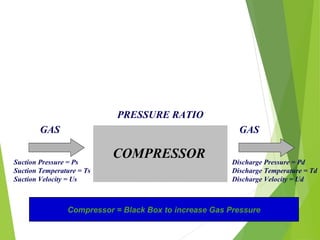
COMPRESSOR
PRESSURE RATIO
GAS
Suction Pressure = Ps
Suction Temperature = Ts
Suction Velocity = Us
GAS
Discharge Pressure = Pd
Discharge Temperature = Td
Discharge Velocity = Ud
Compressor = Black Box to increase Gas Pressure
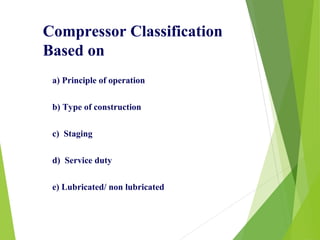
a) Principle of operation
b) Type of construction
c) Staging
d) Service duty
e) Lubricated/ non lubricated
Compressor Classification
Based on
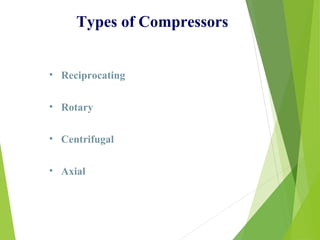
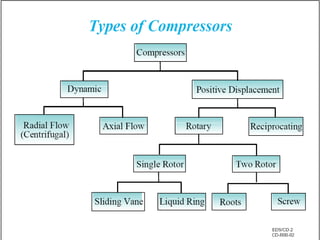
Types of Compressors
• Reciprocating
• Rotary
• Centrifugal
• Axial
Rotary Compressors
 Screw
 Sliding Vane
 Twin Lobe
 Liquid Ring
Selection of compressors
Parameters for selection of
compressor- Application:
 Gas handled:
 Gas analysis:
 Flow rate:
 Suction Pressure :
 Suction Temperature:
 Mol wt. of Gas:
 Compressibility
 Discharge Pressure:
 Drive System:
NOCL Private & confidential
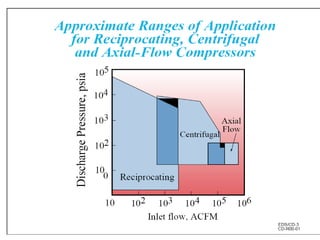
Selection of compressor
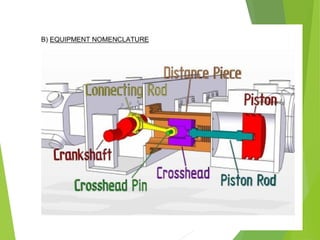
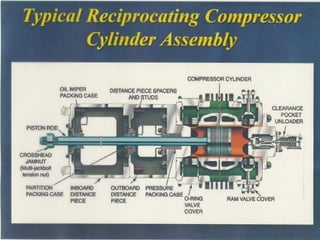
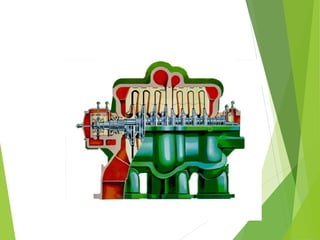
Typical Reciprocating Compressor
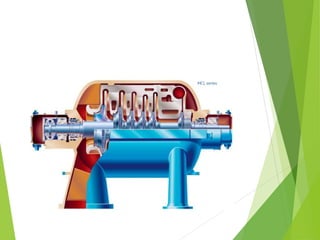
Centrifugal Compressor
AXIAL COMPRESSORS
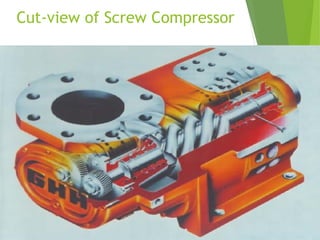
Cut-view of Screw Compressor
HOW
COMPRESSORS
WORK?
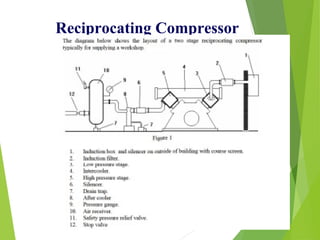
Reciprocating Compressor
NOCL Private & confidential
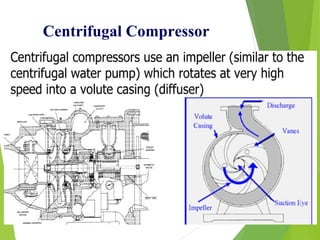
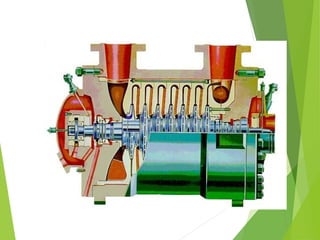
Centrifugal Compressor
NOCL Private & confidential
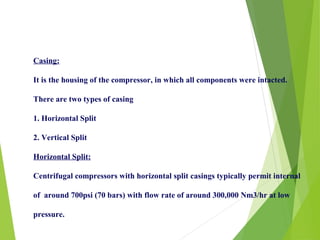
Casing
Diaphragm
Impellers
Sealing Elements
Balancing drum
Bearings
Parts of centrifugal compressor
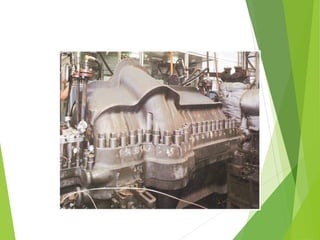
Casing:
It is the housing of the compressor, in which all components were intacted.
There are two types of casing
1. Horizontal Split
2. Vertical Split
Horizontal Split:
Centrifugal compressors with horizontal split casings typically permit internal
of around 700psi (70 bars) with flow rate of around 300,000 Nm3/hr at low
pressure.
Vertical split or Barrel type compressor
Above 700psi horizontal split casing lose their sealing capability, resulting in an
increased in potential for the escape of process gas. Hence vertical casing is more
preferred for high pressure application.
Based on the nozzle arrangement:
Straight through:
It is the general arrangement of compressor. In which the casing consisting of two
nozzles, one is inlet and the other one is outlet. gas enters at the inlet nozzle passes
through one or more stages of compression and leave through the discharge nozzle in
to the piping system.
NOCL Private & confidential
Impeller:
Impeller is the heart of the compressor. In which the mechanical energy (rotary motion)
of the rotor is converted in to kinetic energy of the process fluid (compressing fluid
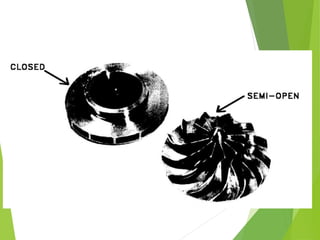
There are three types of impellers
Open impeller
Semi open impeller
Closed impeller
Open impellers have the vanes positioned radial direction and have no enclosing covers
on either front or back side.
Semi open impellers have the vanes positioned in a radial or backward leaning direction
and have a cover on the back side with extended to the periphery of the vanes.
Closed impellers have enclosed cover on both front and back side. this is the most
common type in large processing compressors. The blades are usually backward leaning
and in some special cases radial curved vanes
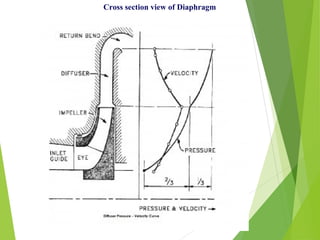
Diaphragm:
It is the stationary component of the centrifugal compressor. It consisting of two
parts one is the diffuser and the return guide vanes. Normally around 2/3 of
kinetic of gas is converted in to pressure energy in the impeller itself and the
remaining 1/3 of energy conversion is takes place in the diffuser as shown below.
Cross section view of Diaphragm
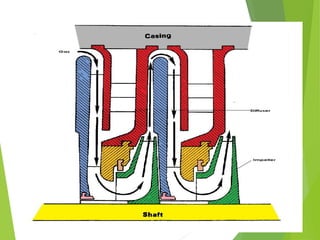
After conversion of kinetic energy in to pressure energy in the
diffuser the gas pass through the return guide vanes. The function
of return guide vanes is to guide the gas to the next stage of
impeller with laminar flow.
NOCL Private & confidential
Radial Bearing:
Radial bearing of the centrifugal compressor are force lubricated. For the
ease of maintenance the bearing are horizontal split with replaceable
Babbitt lined pads. Number of pad in the radial bearing is depending
upon the speed and load condition of the compressor.
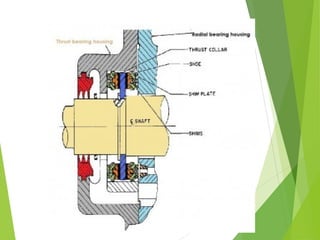
Thrust bearing:
The main purpose of the bearing is to take the thrust load produced in
the rotor. Tilting pad is the most common type of bearing used in
centrifugal compressor. Flat land, tapper land , kingsbury and Michel
bearings are used by most of the manufacture , the selection of bearing
is depend up the thrust load produced by the rotor.
Sealing system
Types
1.Liquid film seals
2.Labyrinth Type seals
3.Mechanical seals
4.Injection &Extraction seals
5.Dry gas seals
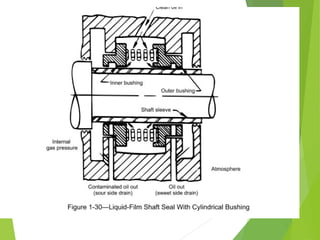
1. Liquid film seals:
This system is used when the gas medium is poisonous,
inflammable and expensive and no external leakage is
permitted. The principle of this sealing is that high
pressure oil is injected in between a set of close
clearance seal rings mounted on shaft ends. The seal
rings are free floating type with white metalled bore.
The oil leakage through LP side is recirculated through
the oil system and HP leakage is recovered by automatic
traps are re-used after separating dissolved gases.
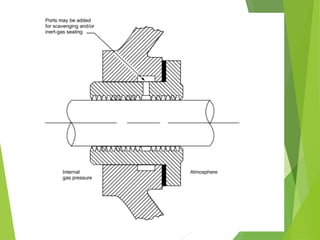
This system is employed for gases like Air, Nitrogen. The amount of gas
leaking to ambient is reduced by selecting adequate number of
labyrinth fins. Some of the developments in a labyrinth type seals are
stepped type seals, honey comb type and turbine type.
LABYRINTH SEALS
In this type of seals the carbon-rings forming part of stator part
is kept in continuous contact with a rotating collar. The contact
surfaces are lubricated either by a cool buffer gas or
lubricating oil. These seals are very effective means of
providing shaft sealings.
Mechanical Seals
For gases like oxygen, raw gas and other explosive, corrosive, media the
sealing has to be perfect and where sealing medium like oil cannot be
used, the above sealing system is selected. The principle of this sealing is
that vacuum is created by a ejector at the shaft ends which sucks the
gases and thus prevents any outward leakage of the contained gas.
INJECTION EXTRACTION
SEALS
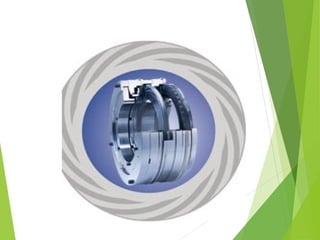
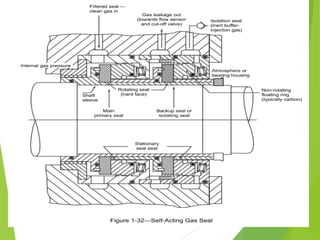
Today the preferred choice is the dry-running, gas-lubricated seal over
conventional seals. A gas-lubricated mechanical seal necessarily needs a
gas supply system to ensure pressurizations of the seal with clean process
gas or external gas.
Dry gas seals
NOCL Private & confidential
Single seal arrangement
Single seal is used for the compressors, which have lower sealing pressures
and where a small leakage of gas medium can be tolerated. The single seal is
particularly advantageous as they occupy less space at compressor ends.
Double arrangement
A double arrangement is a sealing system, which reliably prevents product gas
escaping to the surroundings. It involves feeding a buffer gas, e.g. nitrogen,
between the seals at a higher pressure than the product pressure.
Any questions?
THANK YOU
ALL THE BEST

Compressors - Training sessions

  • 1.
  • 2.
    WHAT IS ACOMPRESSOR? A device used for pumping compressible fluids. i.e. Air , gas and Steam
  • 3.
    Compressor is amechanical device that increases the pressure by reducing volume. Compressors are similar to pumps: both increase the pressure on a fluid and both can transport the fluid through a pipe. As gases are compressible, the compressor also reduces the volume of a gas. Liquids are relatively incompressible, the main action of a pump is to pressurize and transport liquids
  • 4.
    COMPRESSOR PRESSURE RATIO GAS Suction Pressure= Ps Suction Temperature = Ts Suction Velocity = Us GAS Discharge Pressure = Pd Discharge Temperature = Td Discharge Velocity = Ud Compressor = Black Box to increase Gas Pressure
  • 5.
    a) Principle ofoperation b) Type of construction c) Staging d) Service duty e) Lubricated/ non lubricated Compressor Classification Based on
  • 6.
    Types of Compressors •Reciprocating • Rotary • Centrifugal • Axial
  • 8.
    Rotary Compressors  Screw Sliding Vane  Twin Lobe  Liquid Ring
  • 9.
  • 10.
    Parameters for selectionof compressor- Application:  Gas handled:  Gas analysis:  Flow rate:  Suction Pressure :  Suction Temperature:  Mol wt. of Gas:  Compressibility  Discharge Pressure:  Drive System:
  • 11.
    NOCL Private &confidential Selection of compressor
  • 12.
  • 15.
  • 18.
  • 20.
  • 21.
  • 22.
  • 23.
    NOCL Private &confidential Centrifugal Compressor
  • 24.
    NOCL Private &confidential
  • 25.
  • 26.
    Casing: It is thehousing of the compressor, in which all components were intacted. There are two types of casing 1. Horizontal Split 2. Vertical Split Horizontal Split: Centrifugal compressors with horizontal split casings typically permit internal of around 700psi (70 bars) with flow rate of around 300,000 Nm3/hr at low pressure.
  • 28.
    Vertical split orBarrel type compressor Above 700psi horizontal split casing lose their sealing capability, resulting in an increased in potential for the escape of process gas. Hence vertical casing is more preferred for high pressure application. Based on the nozzle arrangement: Straight through: It is the general arrangement of compressor. In which the casing consisting of two nozzles, one is inlet and the other one is outlet. gas enters at the inlet nozzle passes through one or more stages of compression and leave through the discharge nozzle in to the piping system.
  • 30.
    NOCL Private &confidential
  • 32.
    Impeller: Impeller is theheart of the compressor. In which the mechanical energy (rotary motion) of the rotor is converted in to kinetic energy of the process fluid (compressing fluid There are three types of impellers Open impeller Semi open impeller Closed impeller Open impellers have the vanes positioned radial direction and have no enclosing covers on either front or back side. Semi open impellers have the vanes positioned in a radial or backward leaning direction and have a cover on the back side with extended to the periphery of the vanes. Closed impellers have enclosed cover on both front and back side. this is the most common type in large processing compressors. The blades are usually backward leaning and in some special cases radial curved vanes
  • 33.
    Diaphragm: It is thestationary component of the centrifugal compressor. It consisting of two parts one is the diffuser and the return guide vanes. Normally around 2/3 of kinetic of gas is converted in to pressure energy in the impeller itself and the remaining 1/3 of energy conversion is takes place in the diffuser as shown below.
  • 34.
    Cross section viewof Diaphragm
  • 35.
    After conversion ofkinetic energy in to pressure energy in the diffuser the gas pass through the return guide vanes. The function of return guide vanes is to guide the gas to the next stage of impeller with laminar flow.
  • 36.
    NOCL Private &confidential
  • 37.
    Radial Bearing: Radial bearingof the centrifugal compressor are force lubricated. For the ease of maintenance the bearing are horizontal split with replaceable Babbitt lined pads. Number of pad in the radial bearing is depending upon the speed and load condition of the compressor.
  • 38.
    Thrust bearing: The mainpurpose of the bearing is to take the thrust load produced in the rotor. Tilting pad is the most common type of bearing used in centrifugal compressor. Flat land, tapper land , kingsbury and Michel bearings are used by most of the manufacture , the selection of bearing is depend up the thrust load produced by the rotor.
  • 40.
    Sealing system Types 1.Liquid filmseals 2.Labyrinth Type seals 3.Mechanical seals 4.Injection &Extraction seals 5.Dry gas seals
  • 41.
    1. Liquid filmseals: This system is used when the gas medium is poisonous, inflammable and expensive and no external leakage is permitted. The principle of this sealing is that high pressure oil is injected in between a set of close clearance seal rings mounted on shaft ends. The seal rings are free floating type with white metalled bore. The oil leakage through LP side is recirculated through the oil system and HP leakage is recovered by automatic traps are re-used after separating dissolved gases.
  • 43.
    This system isemployed for gases like Air, Nitrogen. The amount of gas leaking to ambient is reduced by selecting adequate number of labyrinth fins. Some of the developments in a labyrinth type seals are stepped type seals, honey comb type and turbine type. LABYRINTH SEALS
  • 45.
    In this typeof seals the carbon-rings forming part of stator part is kept in continuous contact with a rotating collar. The contact surfaces are lubricated either by a cool buffer gas or lubricating oil. These seals are very effective means of providing shaft sealings. Mechanical Seals
  • 46.
    For gases likeoxygen, raw gas and other explosive, corrosive, media the sealing has to be perfect and where sealing medium like oil cannot be used, the above sealing system is selected. The principle of this sealing is that vacuum is created by a ejector at the shaft ends which sucks the gases and thus prevents any outward leakage of the contained gas. INJECTION EXTRACTION SEALS
  • 47.
    Today the preferredchoice is the dry-running, gas-lubricated seal over conventional seals. A gas-lubricated mechanical seal necessarily needs a gas supply system to ensure pressurizations of the seal with clean process gas or external gas. Dry gas seals
  • 49.
    NOCL Private &confidential
  • 50.
    Single seal arrangement Singleseal is used for the compressors, which have lower sealing pressures and where a small leakage of gas medium can be tolerated. The single seal is particularly advantageous as they occupy less space at compressor ends.
  • 51.
    Double arrangement A doublearrangement is a sealing system, which reliably prevents product gas escaping to the surroundings. It involves feeding a buffer gas, e.g. nitrogen, between the seals at a higher pressure than the product pressure.
  • 52.
  • 53.