Introduction to Positive
displacement compressors
Petroskill course
Hector Nguema Ondo Perez
Positive Displacement compressors
Table of contents
• Reciprocating compressors
 Basic parts of reciprocating compressors
 P-V Diagrams
 Controlling a compressor
• Type of clearance
 Overhead Stabilizer Compressor #5
• Rotary compressors
• Type of rotary compressors
• Design of rotary compressors
• Operation of rotary compressors
• Constructing Reciprocating compressors
 Valves
 Pistons
 Rod packing
• Lubrication
• Cooling and safety controls
• Operating Compressor Procedures
• Pre-start up
• Start up
• Shutdown
• Normal Operations
Reciprocating compressors
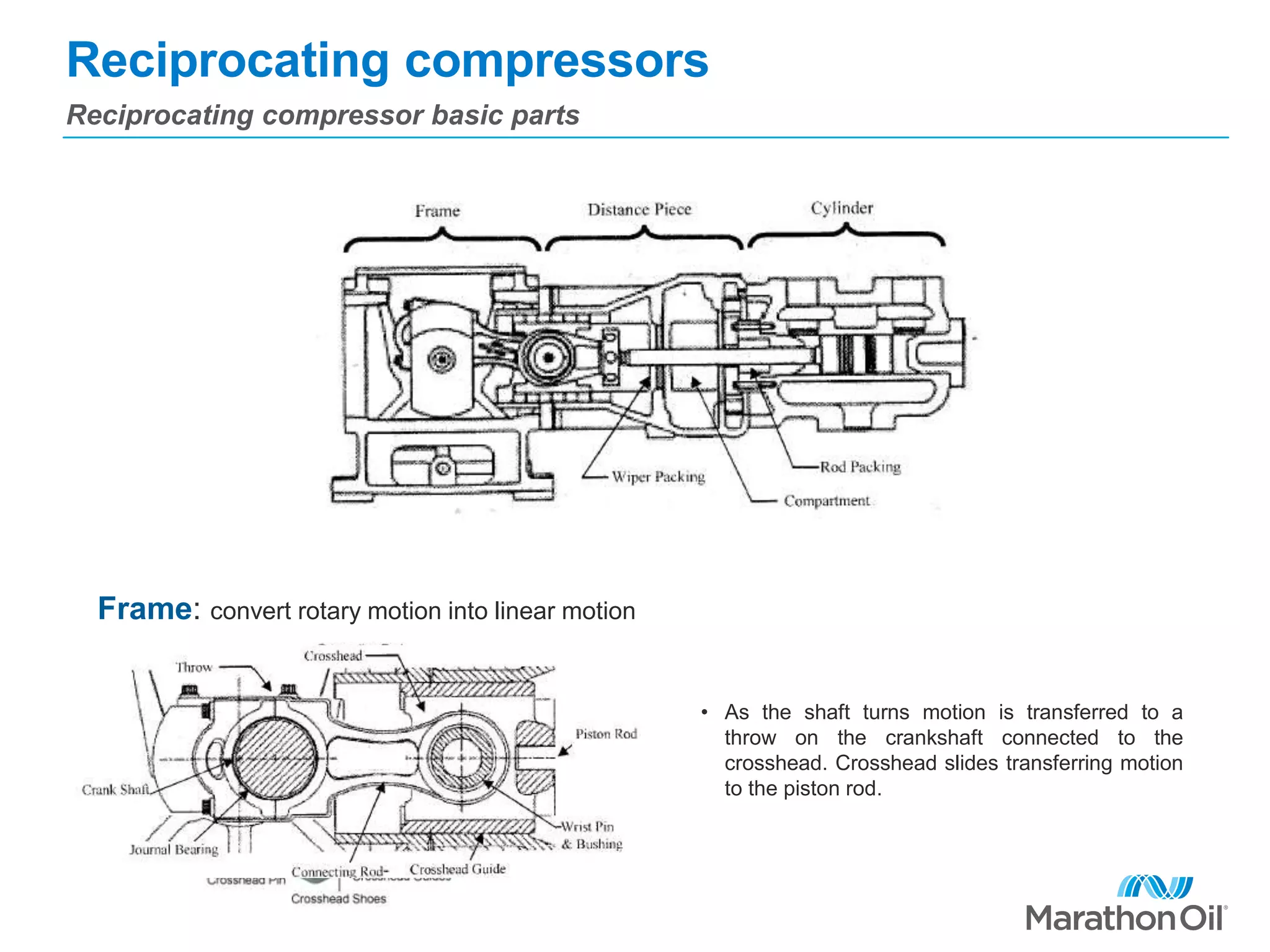
Reciprocating compressor basic parts
Frame: convert rotary motion into linear motion
• As the shaft turns motion is transferred to a
throw on the crankshaft connected to the
crosshead. Crosshead slides transferring motion
to the piston rod.
Reciprocating compressors
Reciprocating compressor basic parts
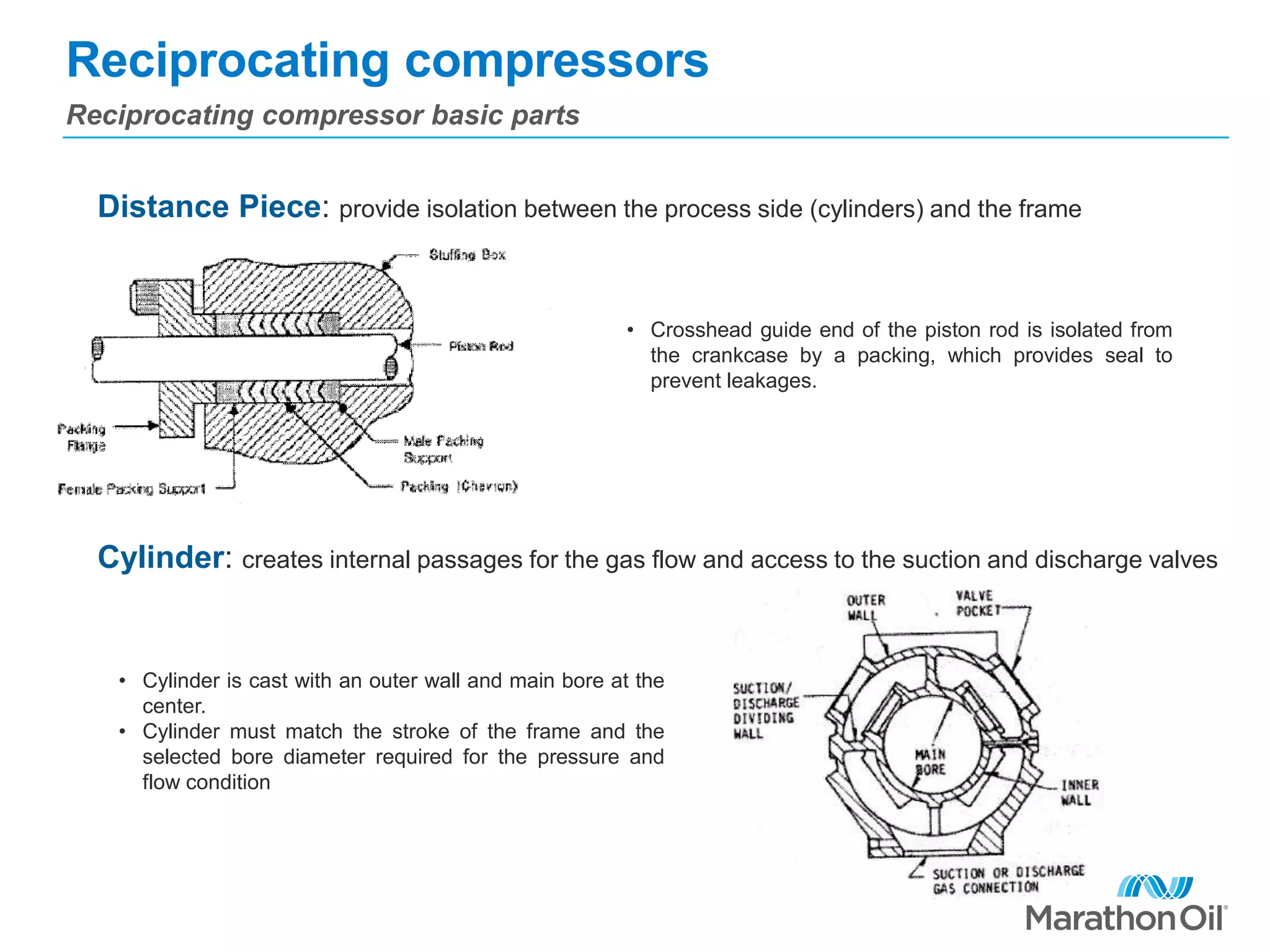
Distance Piece: provide isolation between the process side (cylinders) and the frame
• Crosshead guide end of the piston rod is isolated from
the crankcase by a packing, which provides seal to
prevent leakages.
Cylinder: creates internal passages for the gas flow and access to the suction and discharge valves
• Cylinder is cast with an outer wall and main bore at the
center.
• Cylinder must match the stroke of the frame and the
selected bore diameter required for the pressure and
flow condition
Reciprocating compressors
Single-acting
Double-acting
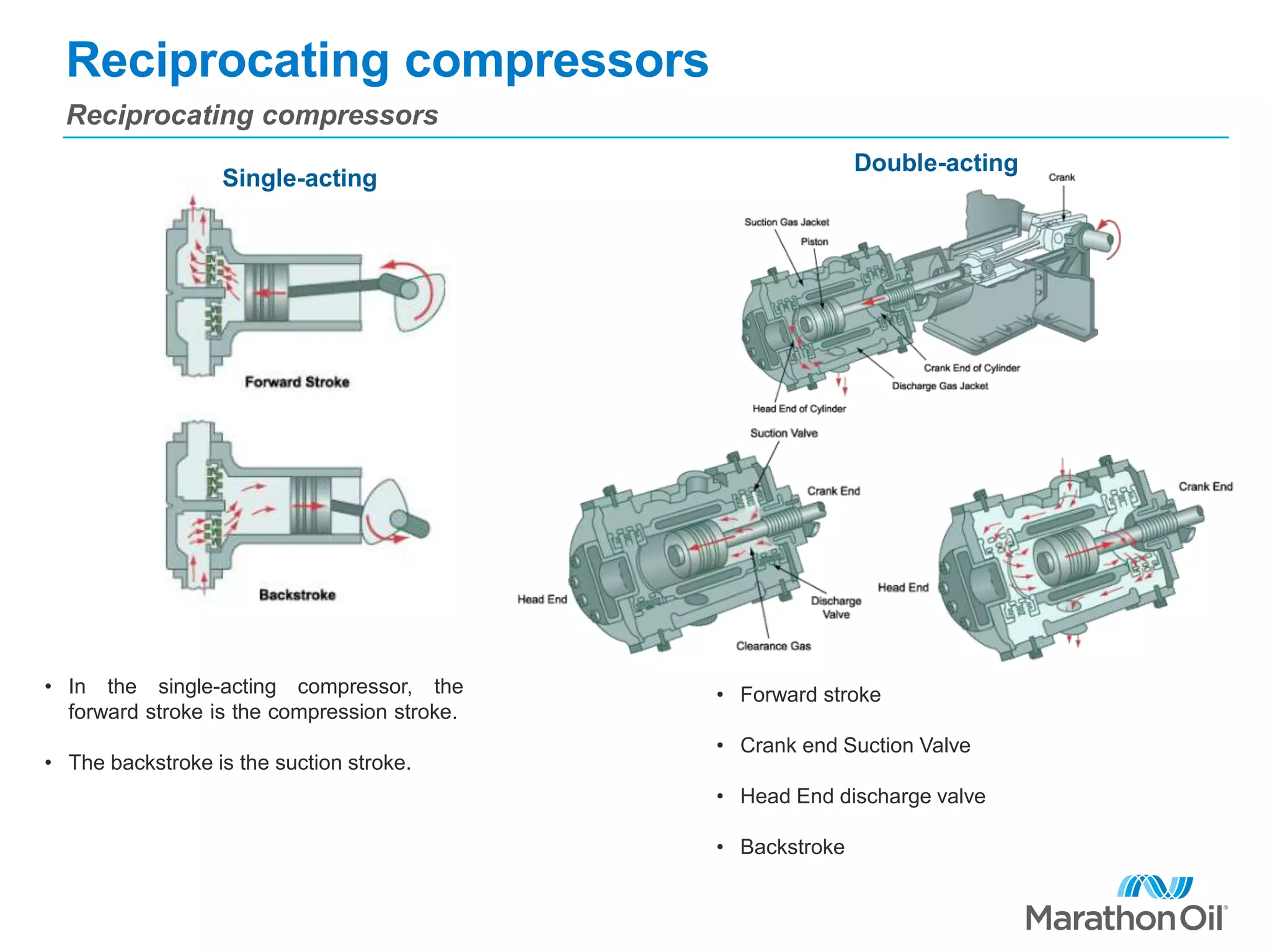
• In the single-acting compressor, the
forward stroke is the compression stroke.
• The backstroke is the suction stroke.
• Forward stroke
• Crank end Suction Valve
• Head End discharge valve
• Backstroke
Reciprocating compressors
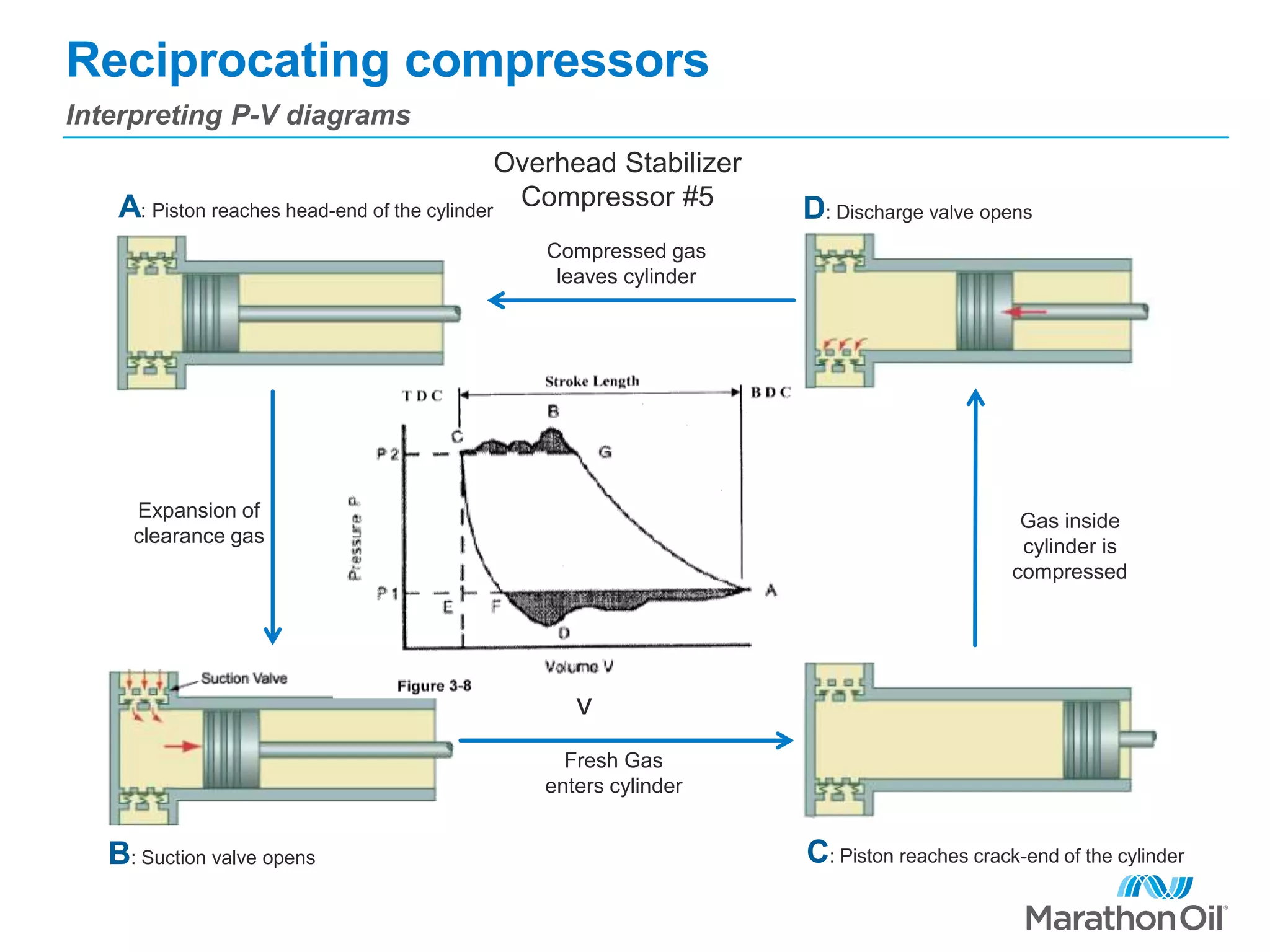
Interpreting P-V diagrams
P
V
Discharge
Suction
CompressionExpansion
A: Piston reaches head-end of the cylinder
B: Suction valve opens
D: Discharge valve opens
C: Piston reaches crack-end of the cylinder
Expansion of
clearance gas
Fresh Gas
enters cylinder
Gas inside
cylinder is
compressed
Compressed gas
leaves cylinder
Overhead Stabilizer
Compressor #5
Reciprocating compressors
Controlling a compressor
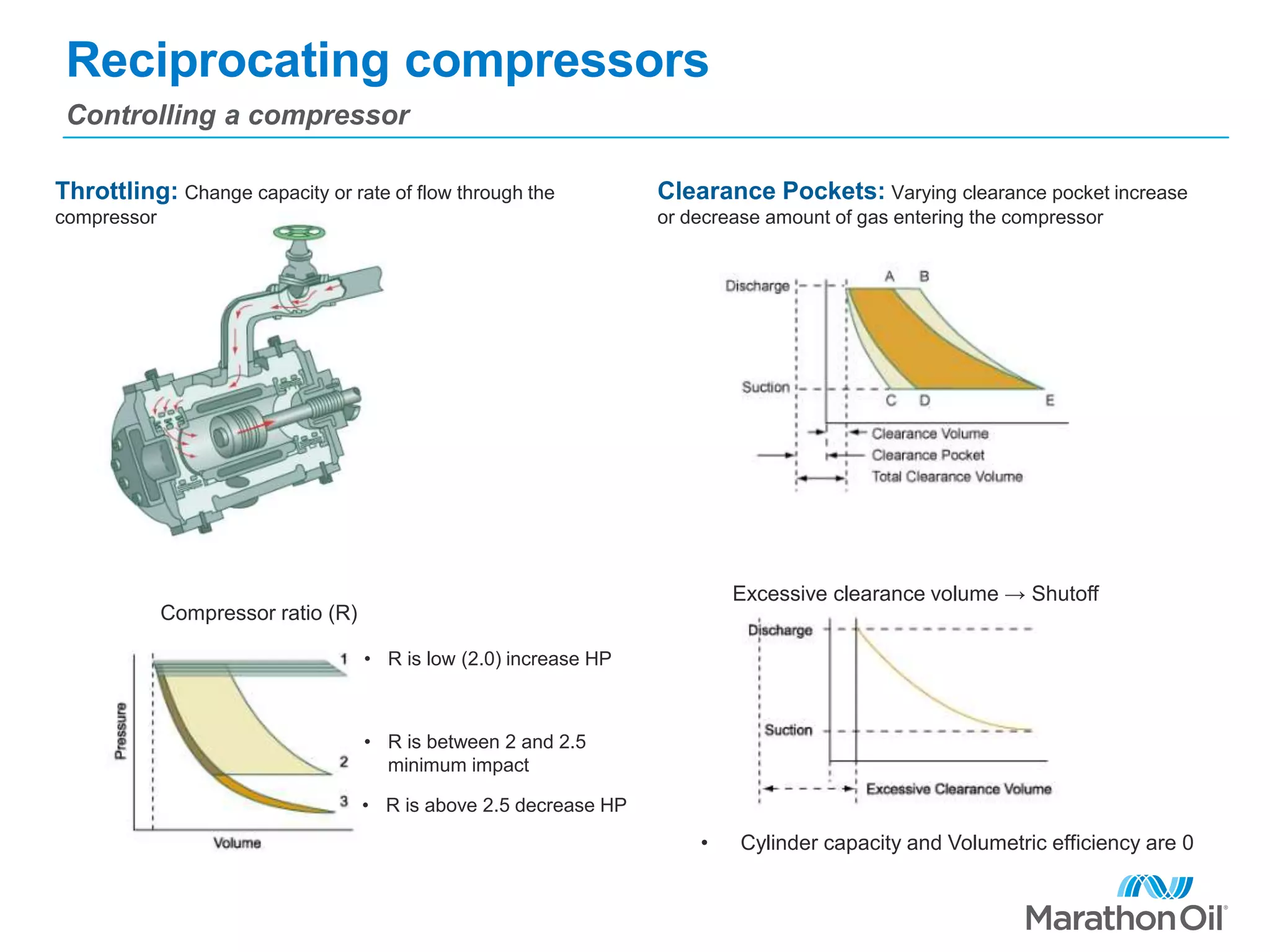
Throttling: Change capacity or rate of flow through the
compressor
Compressor ratio (R)
• R is low (2.0) increase HP
• R is between 2 and 2.5
minimum impact
• R is above 2.5 decrease HP
Clearance Pockets: Varying clearance pocket increase
or decrease amount of gas entering the compressor
Excessive clearance volume → Shutoff
• Cylinder capacity and Volumetric efficiency are 0
Reciprocating compressors
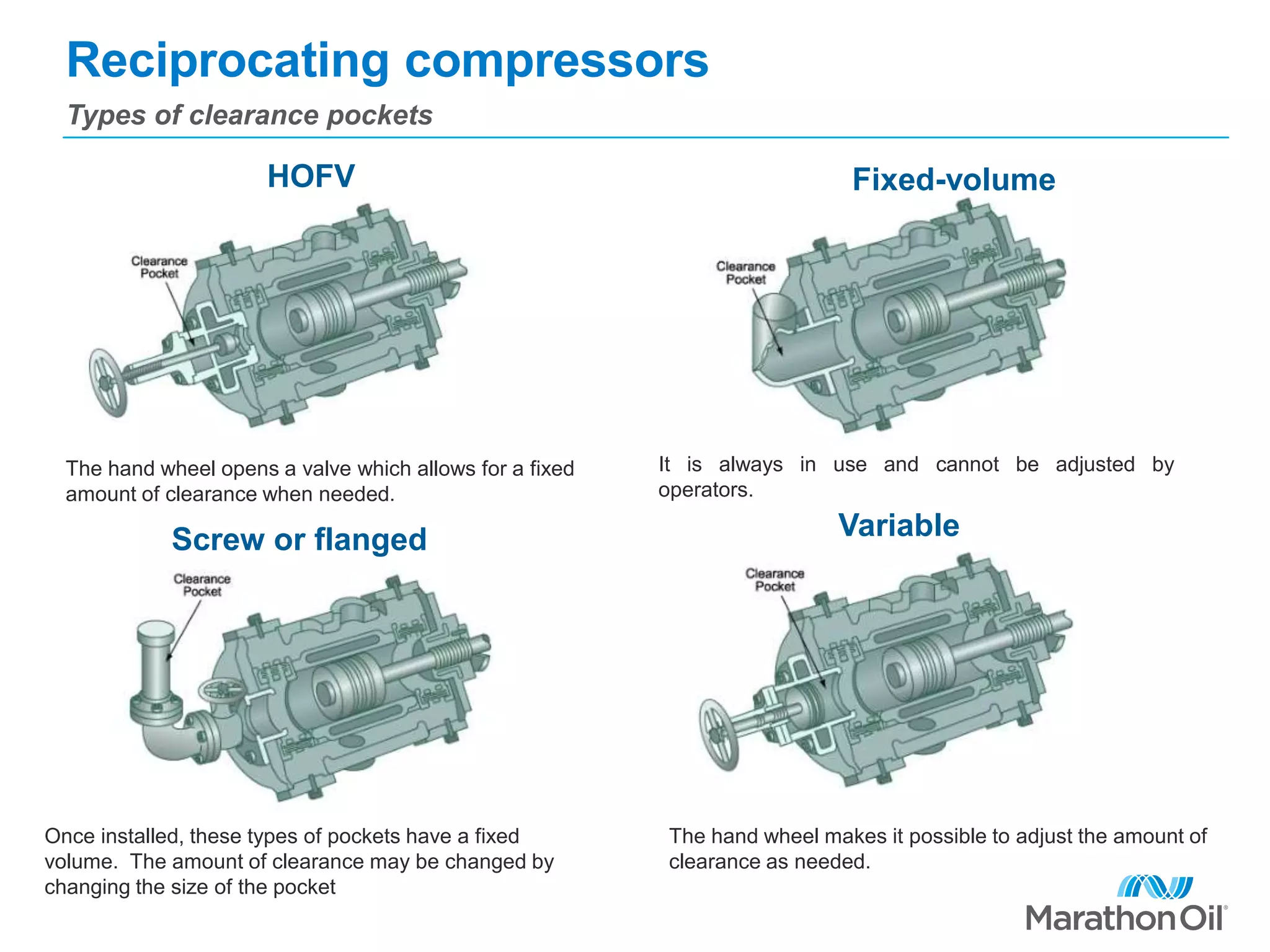
Types of clearance pockets
It is always in use and cannot be adjusted by
operators.
Fixed-volumeHOFV
The hand wheel opens a valve which allows for a fixed
amount of clearance when needed.
Once installed, these types of pockets have a fixed
volume. The amount of clearance may be changed by
changing the size of the pocket
Screw or flanged Variable
The hand wheel makes it possible to adjust the amount of
clearance as needed.
Reciprocating compressors
Controlling a compressor
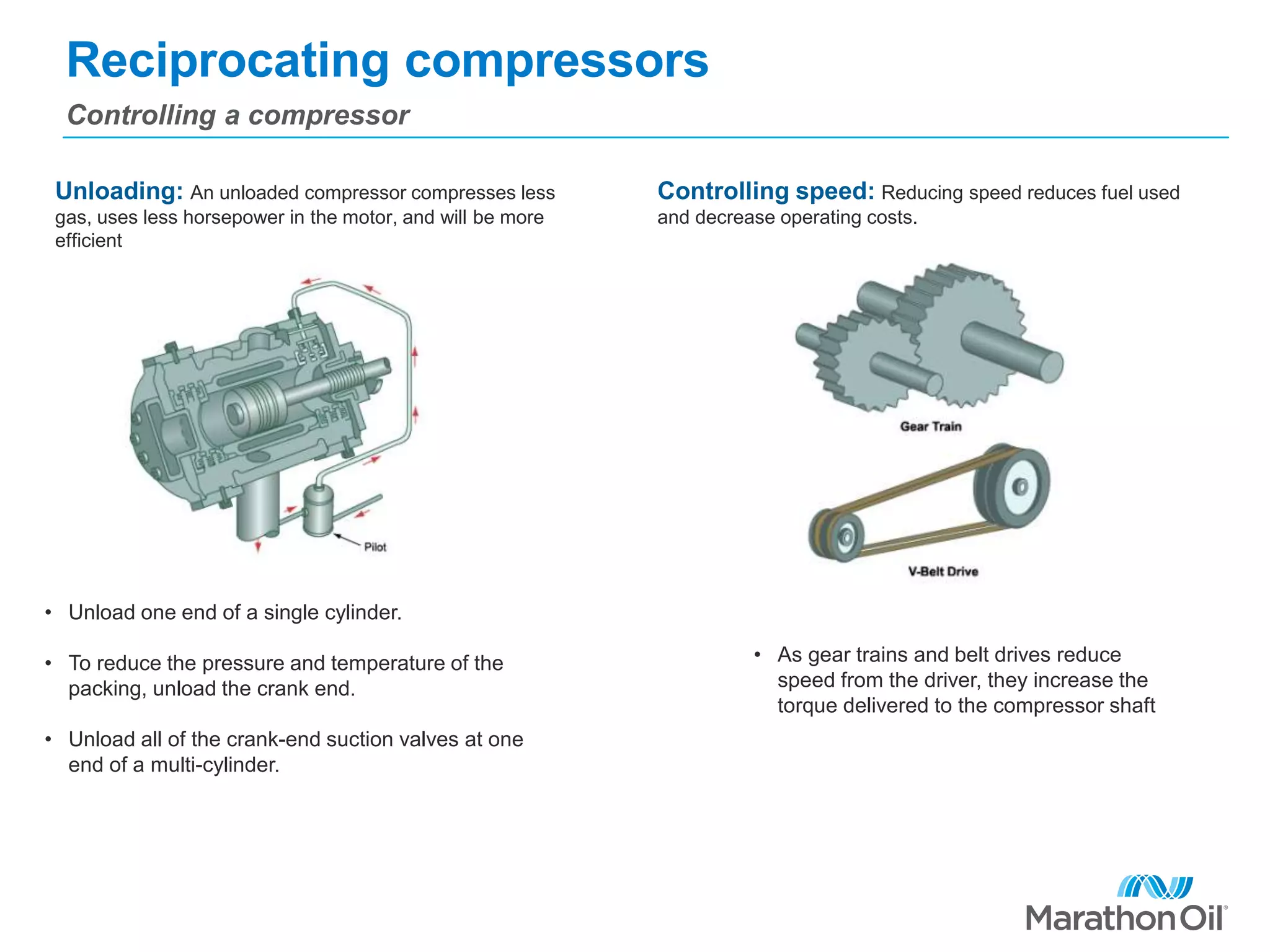
Unloading: An unloaded compressor compresses less
gas, uses less horsepower in the motor, and will be more
efficient
Controlling speed: Reducing speed reduces fuel used
and decrease operating costs.
• Unload one end of a single cylinder.
• To reduce the pressure and temperature of the
packing, unload the crank end.
• Unload all of the crank-end suction valves at one
end of a multi-cylinder.
• As gear trains and belt drives reduce
speed from the driver, they increase the
torque delivered to the compressor shaft
Rotary compressors
Rotary compressors
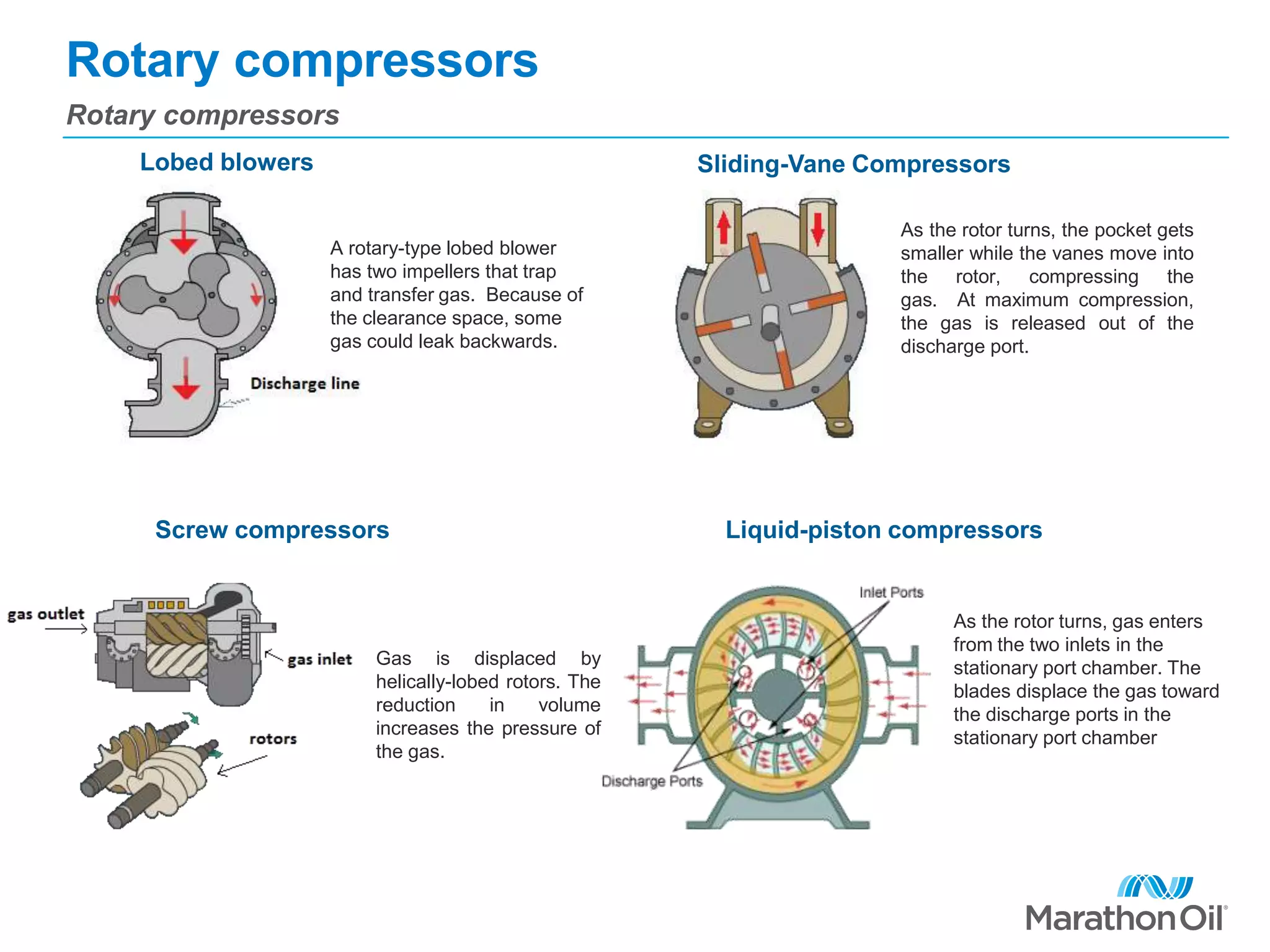
A rotary-type lobed blower
has two impellers that trap
and transfer gas. Because of
the clearance space, some
gas could leak backwards.
Lobed blowers Sliding-Vane Compressors
As the rotor turns, the pocket gets
smaller while the vanes move into
the rotor, compressing the
gas. At maximum compression,
the gas is released out of the
discharge port.
Screw compressors
Gas is displaced by
helically-lobed rotors. The
reduction in volume
increases the pressure of
the gas.
Liquid-piston compressors
As the rotor turns, gas enters
from the two inlets in the
stationary port chamber. The
blades displace the gas toward
the discharge ports in the
stationary port chamber
Rotary compressors
Operation of rotary compressors
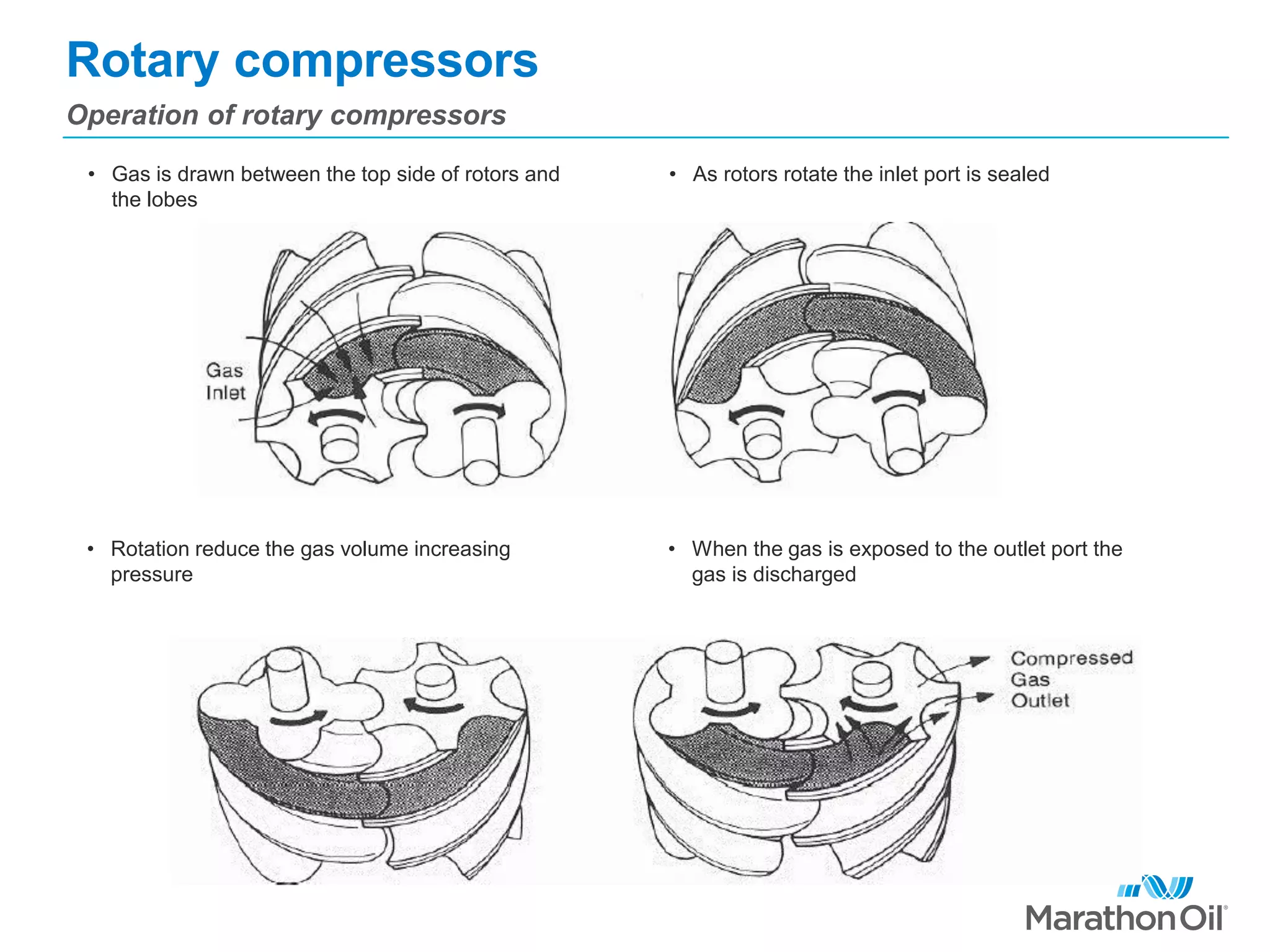
• Gas is drawn between the top side of rotors and
the lobes
• As rotors rotate the inlet port is sealed
• Rotation reduce the gas volume increasing
pressure
• When the gas is exposed to the outlet port the
gas is discharged
Rotary compressors
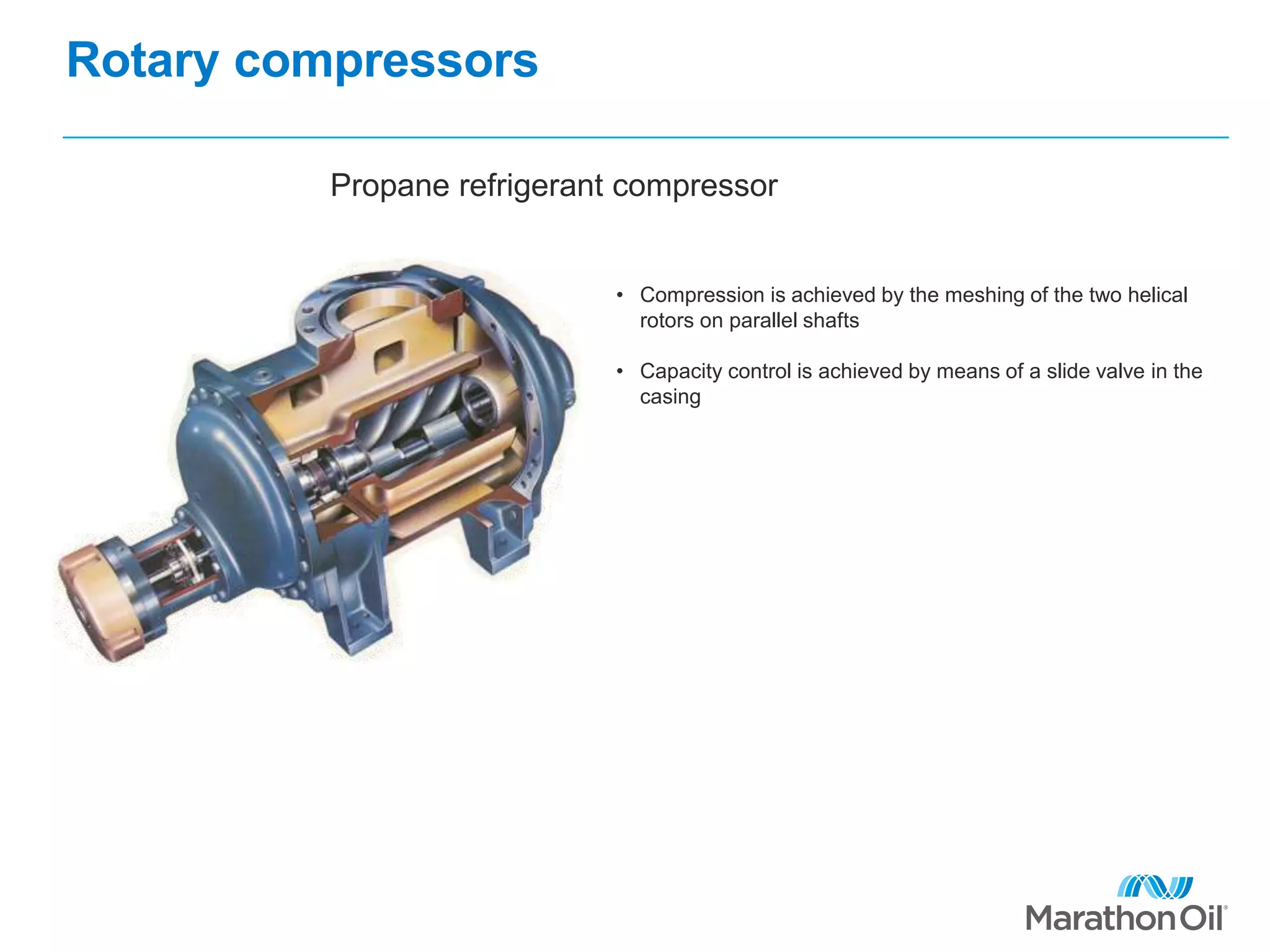
Propane refrigerant compressor
• Compression is achieved by the meshing of the two helical
rotors on parallel shafts
• Capacity control is achieved by means of a slide valve in the
casing
Positive Displacement Compressors
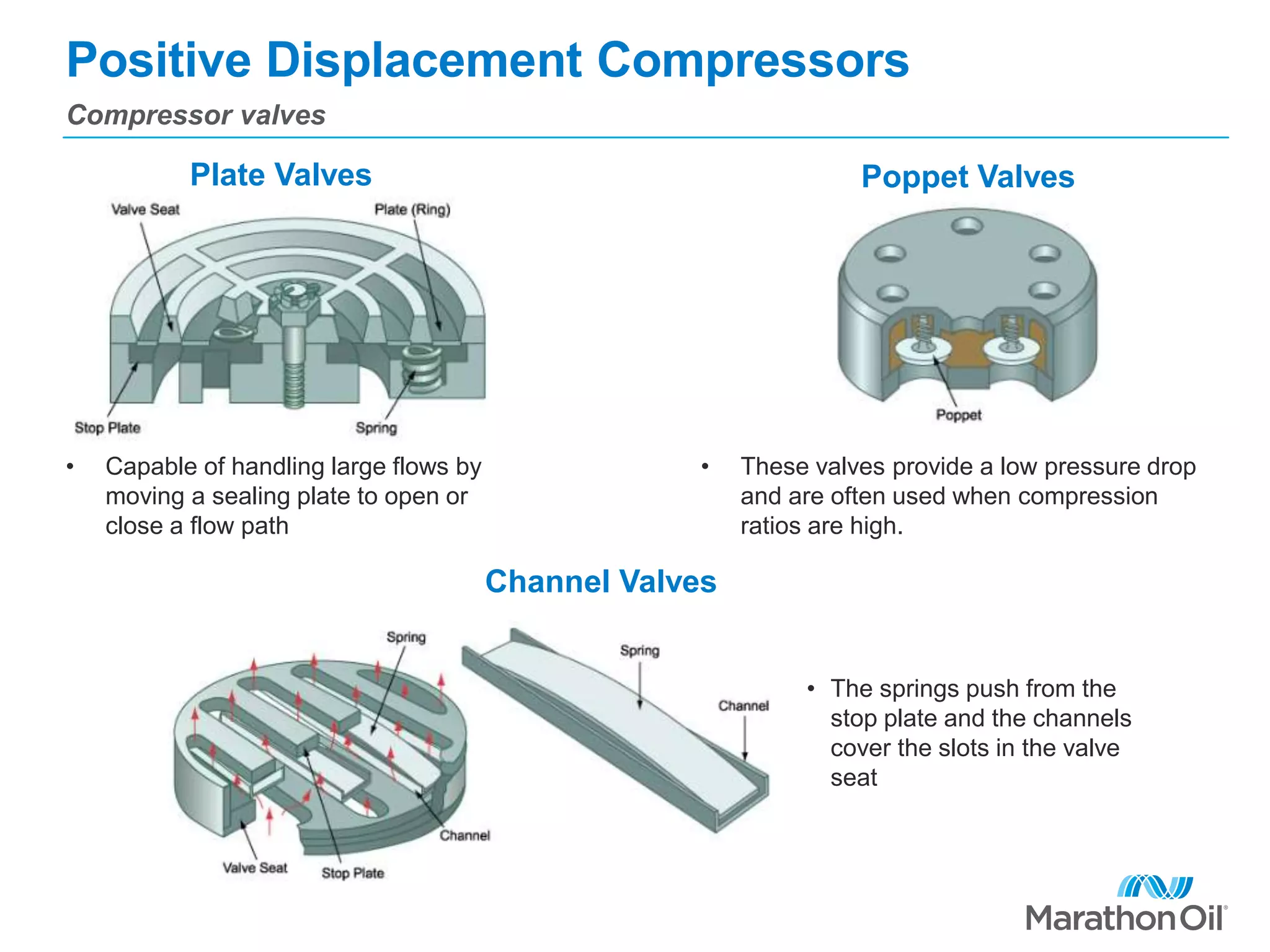
Compressor valves
Plate Valves Poppet Valves
Channel Valves
• Capable of handling large flows by
moving a sealing plate to open or
close a flow path
• The springs push from the
stop plate and the channels
cover the slots in the valve
seat
• These valves provide a low pressure drop
and are often used when compression
ratios are high.
Positive Displacement Compressors
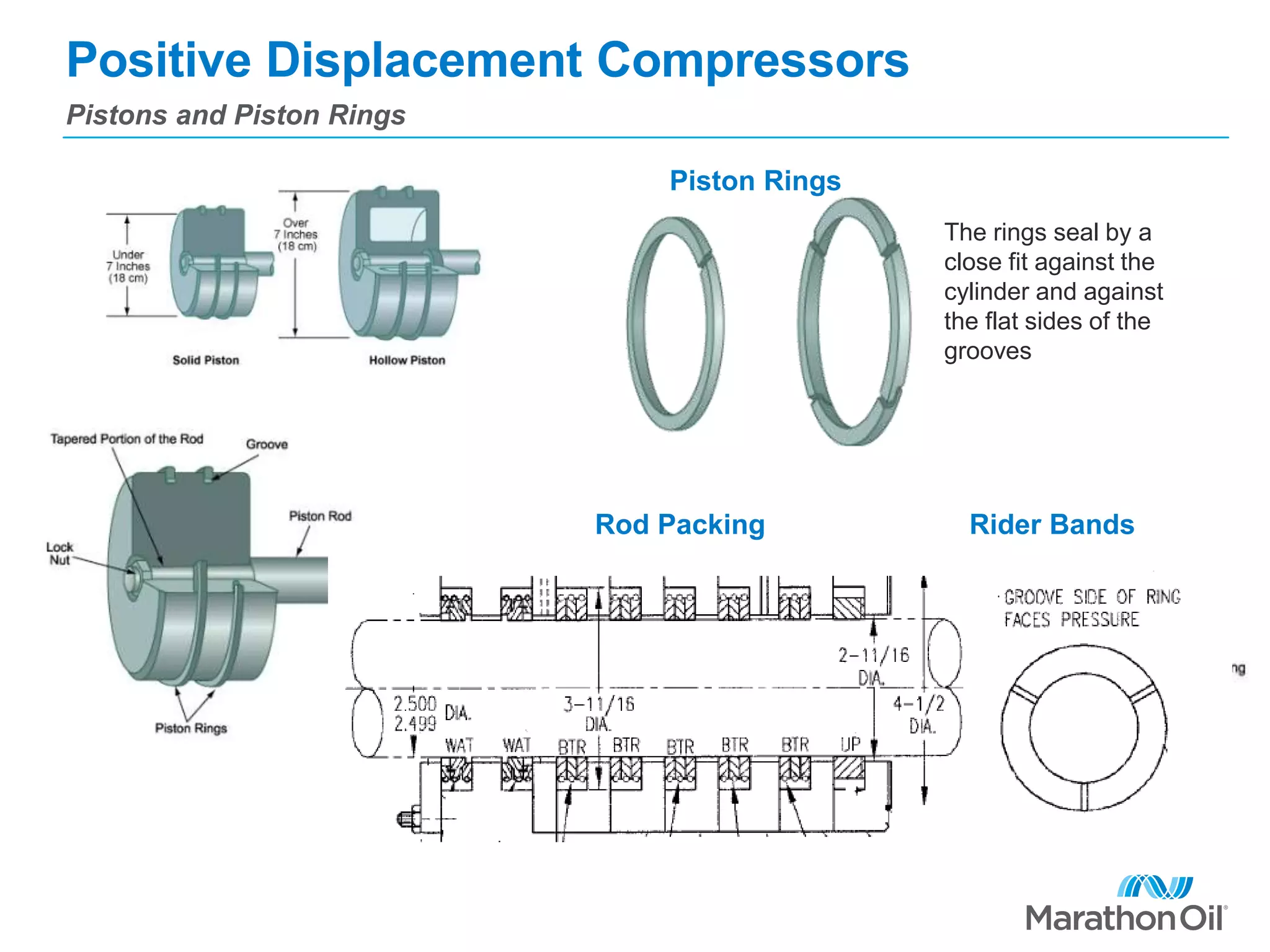
Pistons and Piston Rings
Piston Rings
The rings seal by a
close fit against the
cylinder and against
the flat sides of the
grooves
Rider BandsRod Packing
Positive Displacement Compressors
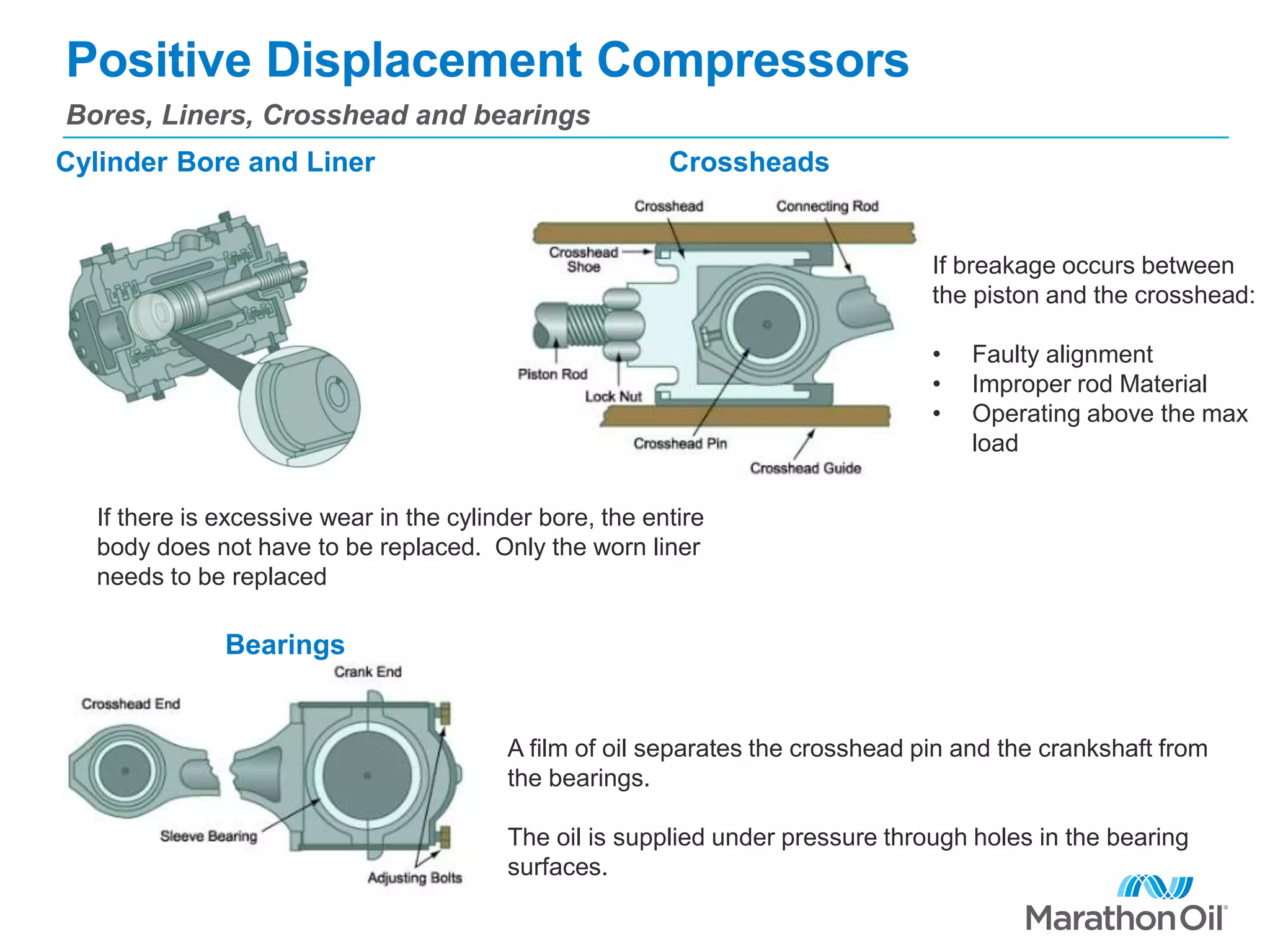
Bores, Liners, Crosshead and bearings
Cylinder Bore and Liner Crossheads
Bearings
A film of oil separates the crosshead pin and the crankshaft from
the bearings.
The oil is supplied under pressure through holes in the bearing
surfaces.
If breakage occurs between
the piston and the crosshead:
• Faulty alignment
• Improper rod Material
• Operating above the max
load
If there is excessive wear in the cylinder bore, the entire
body does not have to be replaced. Only the worn liner
needs to be replaced
Positive Displacement Compressors
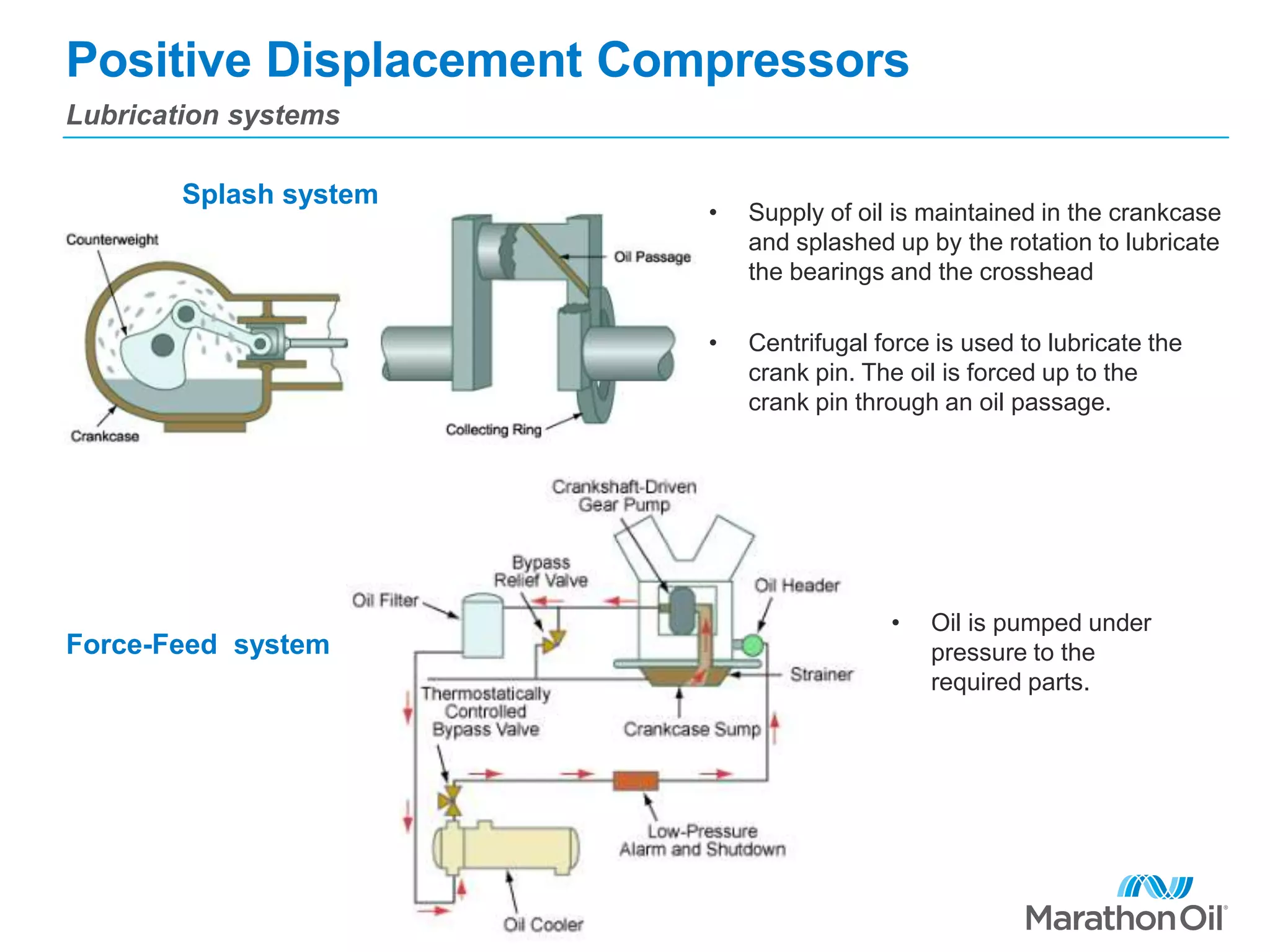
Lubrication systems
Splash system
• Supply of oil is maintained in the crankcase
and splashed up by the rotation to lubricate
the bearings and the crosshead
• Centrifugal force is used to lubricate the
crank pin. The oil is forced up to the
crank pin through an oil passage.
Force-Feed system
• Oil is pumped under
pressure to the
required parts.
Positive Displacement Compressors
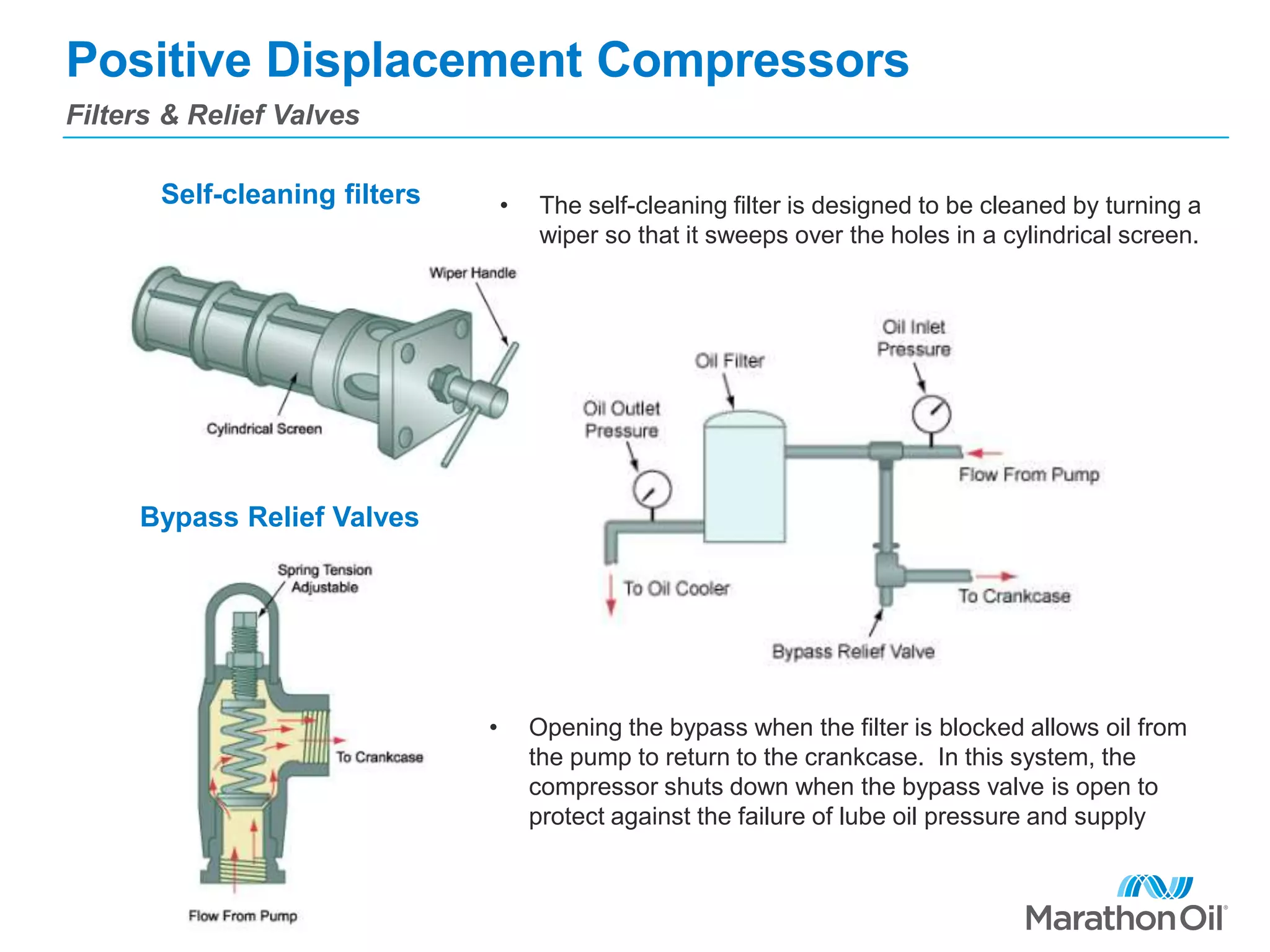
Filters & Relief Valves
Self-cleaning filters
Bypass Relief Valves
• Opening the bypass when the filter is blocked allows oil from
the pump to return to the crankcase. In this system, the
compressor shuts down when the bypass valve is open to
protect against the failure of lube oil pressure and supply
• The self-cleaning filter is designed to be cleaned by turning a
wiper so that it sweeps over the holes in a cylindrical screen.
Positive Displacement Compressors
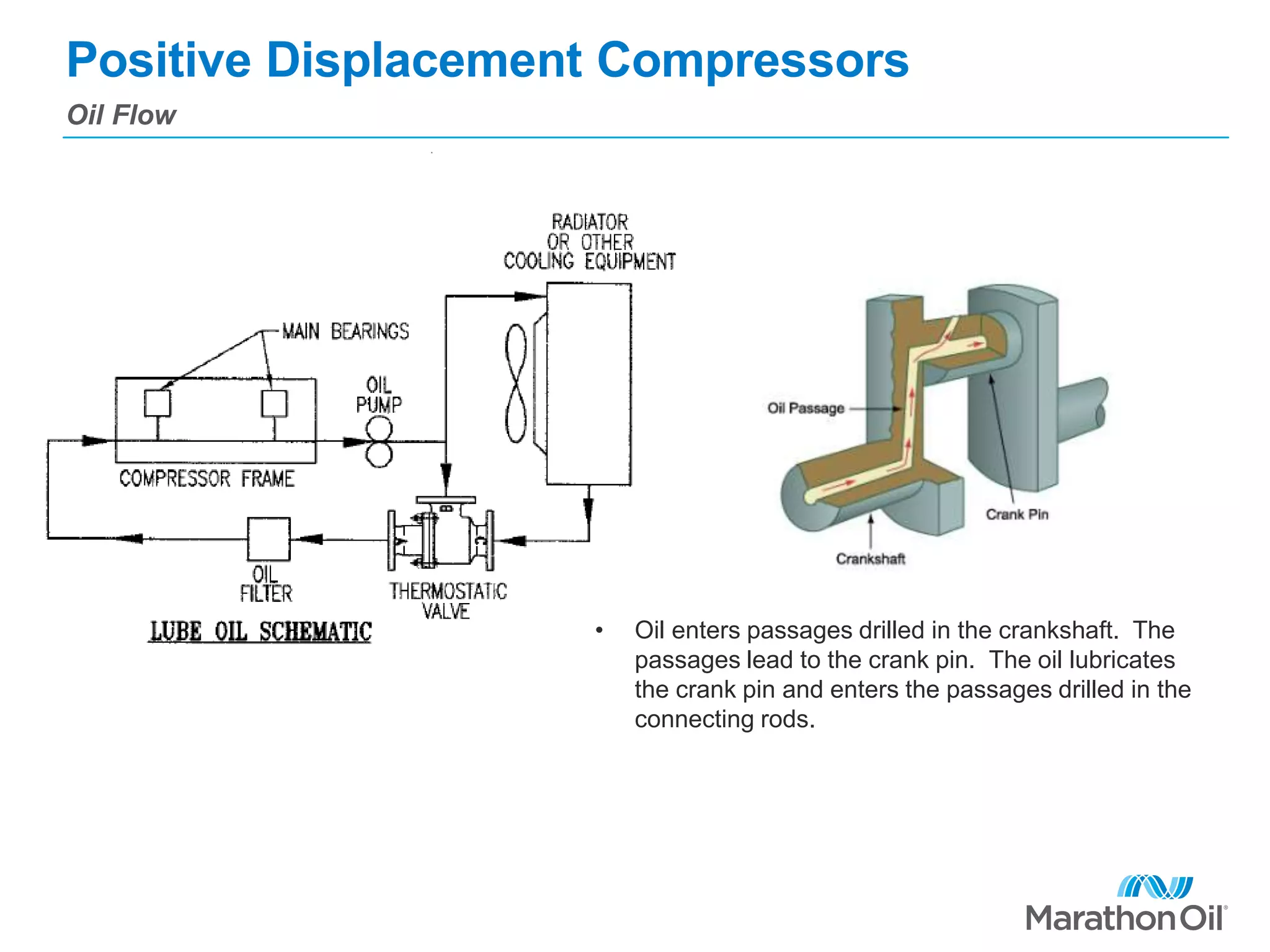
Oil Flow
• Oil enters passages drilled in the crankshaft. The
passages lead to the crank pin. The oil lubricates
the crank pin and enters the passages drilled in the
connecting rods.
Positive Displacement Compressors
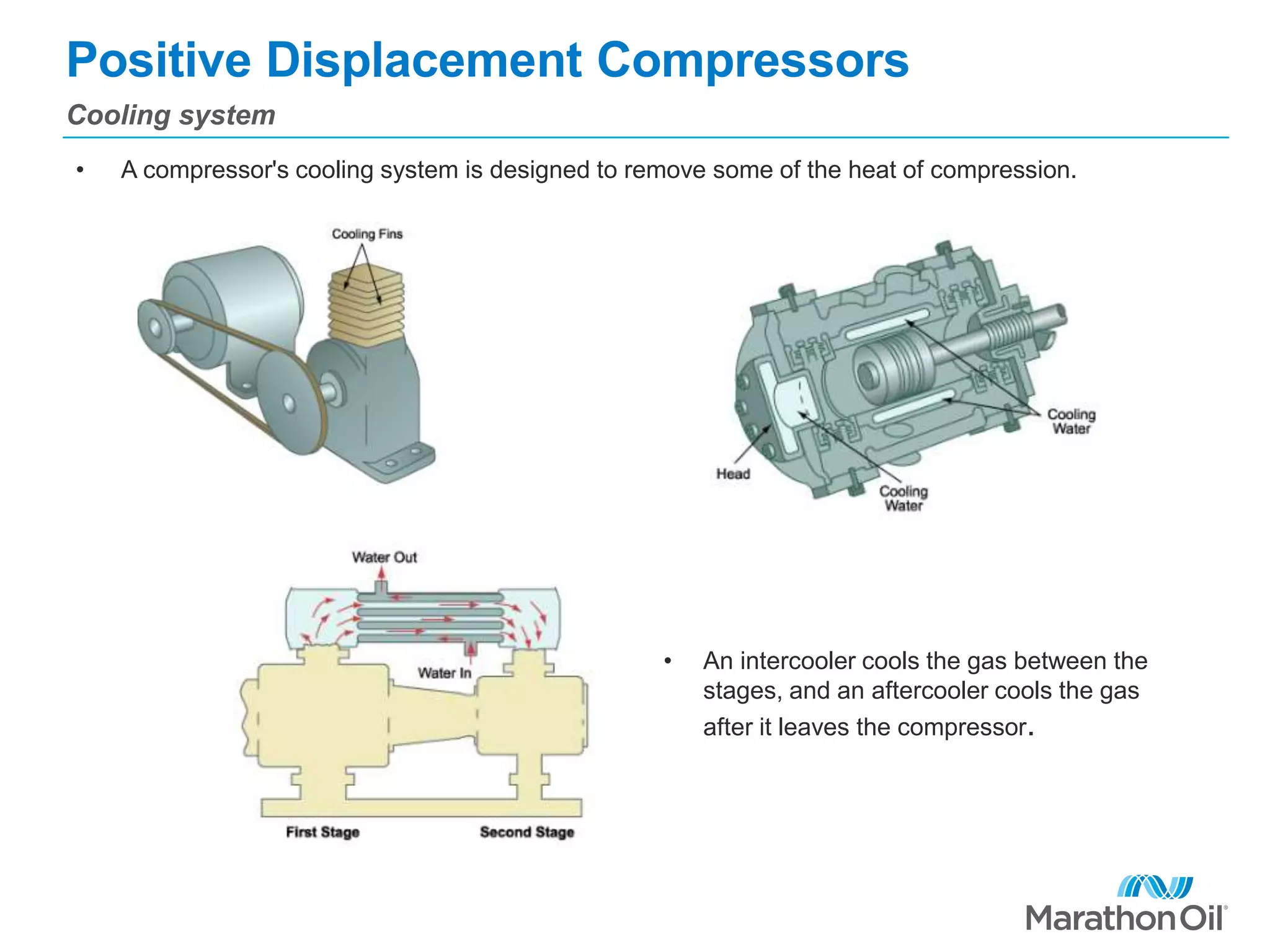
Cooling system
• A compressor's cooling system is designed to remove some of the heat of compression.
• An intercooler cools the gas between the
stages, and an aftercooler cools the gas
after it leaves the compressor.
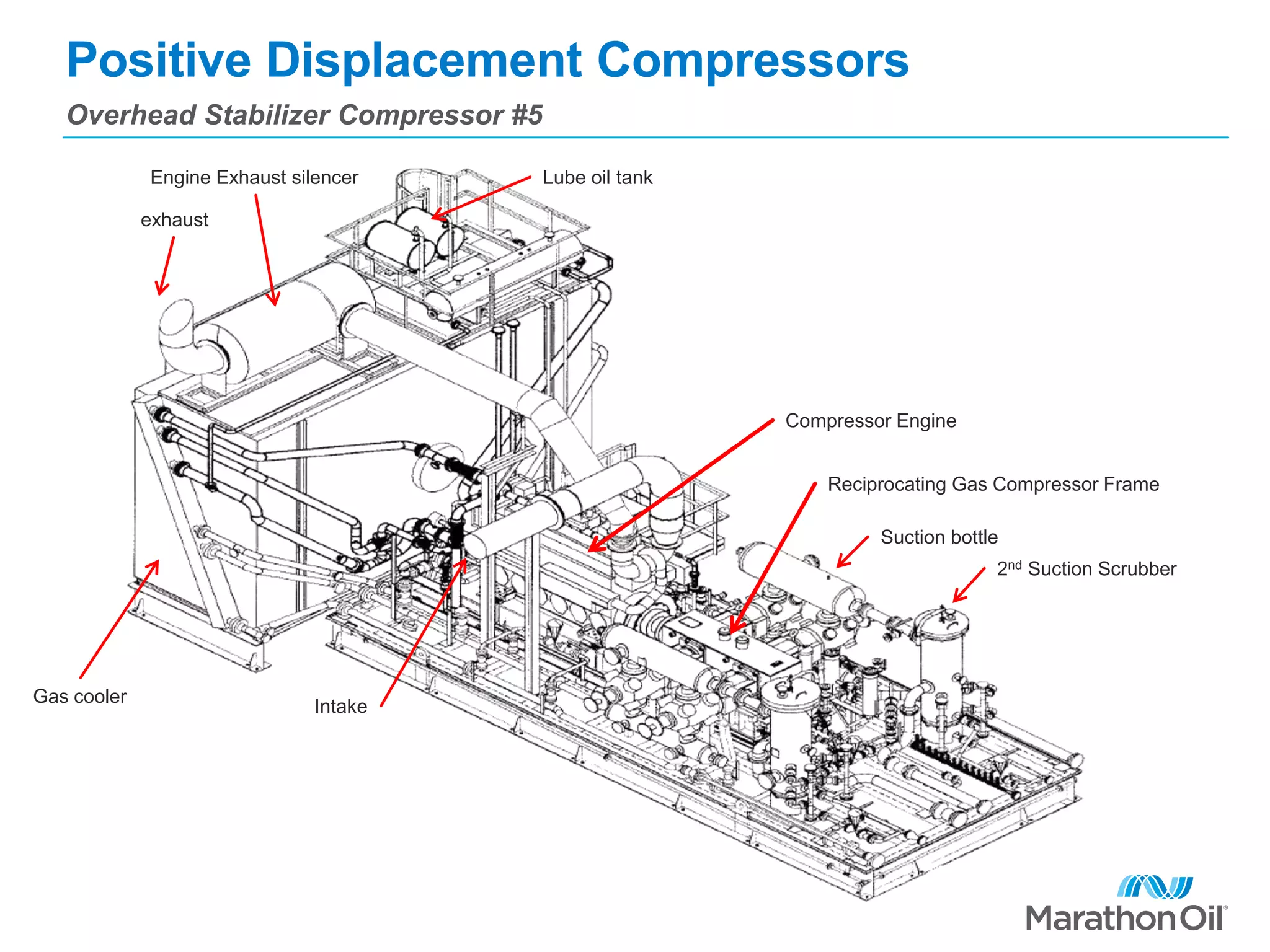
Positive Displacement Compressors
2nd Suction Scrubber
Suction bottle
Reciprocating Gas Compressor Frame
Compressor Engine
Intake
exhaust
Engine Exhaust silencer
Gas cooler
Lube oil tank
Overhead Stabilizer Compressor #5
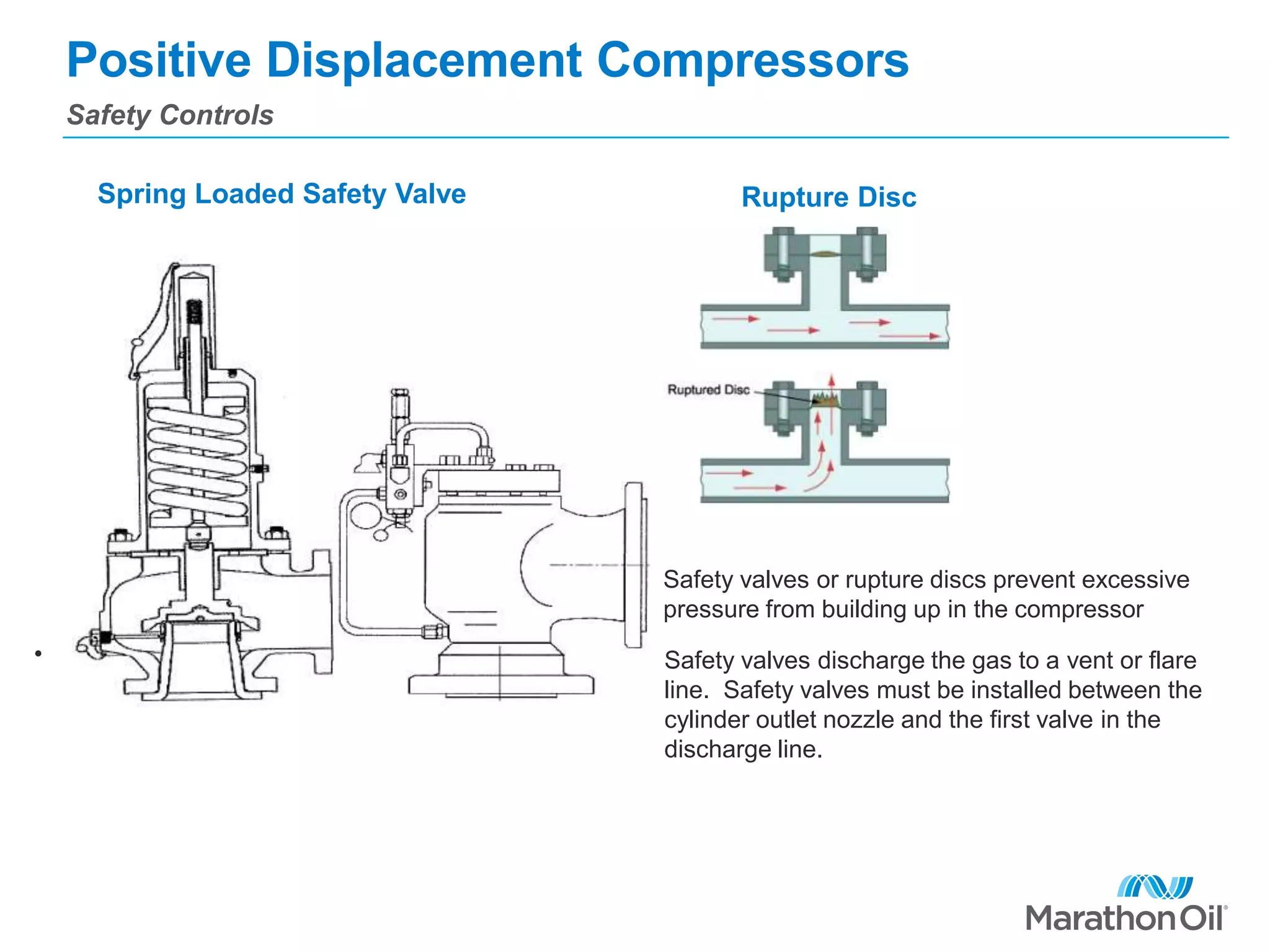
Positive Displacement Compressors
Safety Controls
Spring Loaded Safety Valve
• The pressure needed to open the valve
depends on the compression of the spring.
Rupture Disc
• Safety valves or rupture discs prevent excessive
pressure from building up in the compressor
• Safety valves discharge the gas to a vent or flare
line. Safety valves must be installed between the
cylinder outlet nozzle and the first valve in the
discharge line.
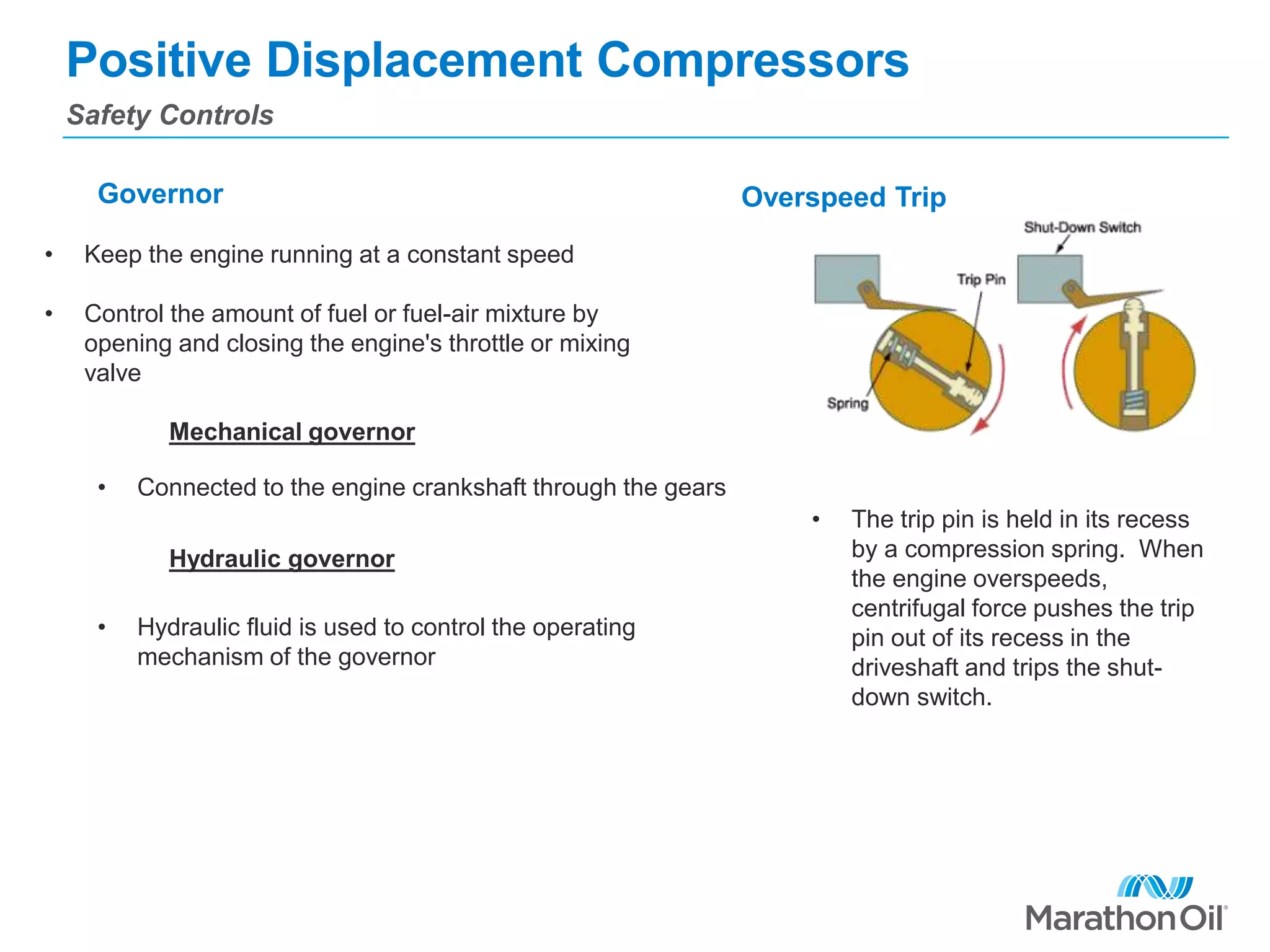
Positive Displacement Compressors
Safety Controls
Governor Overspeed Trip
Mechanical governor
Hydraulic governor
• Keep the engine running at a constant speed
• Control the amount of fuel or fuel-air mixture by
opening and closing the engine's throttle or mixing
valve
• Connected to the engine crankshaft through the gears
• Hydraulic fluid is used to control the operating
mechanism of the governor
• The trip pin is held in its recess
by a compression spring. When
the engine overspeeds,
centrifugal force pushes the trip
pin out of its recess in the
driveshaft and trips the shut-
down switch.
Positive Displacement Compressors
Safety control
Oil Pressure Control Water Temperature Control
• The low oil pressure shutdown device
shuts off the compressor when the oil
pressure is low.
• Some devices cut off the fuel supply and
also shut down the ignition
• Activate if the cooling water temperature
rises dangerously high.
• Monitor the engine jacket water pressure
Positive Displacement Compressors
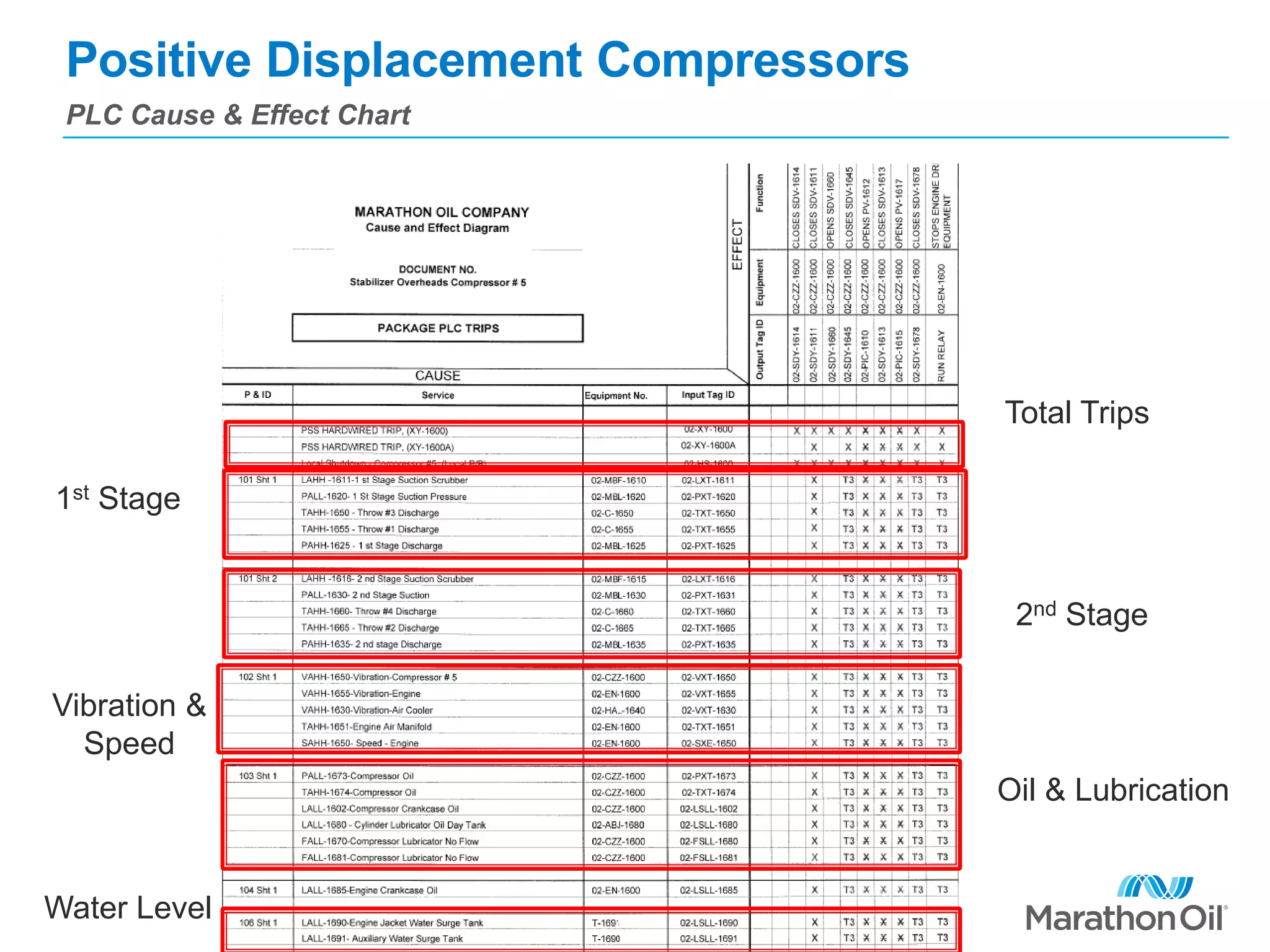
PLC Cause & Effect Chart
Water Level
Oil & Lubrication
Total Trips
Vibration &
Speed
1st Stage
2nd Stage
Positive Displacement Compressors
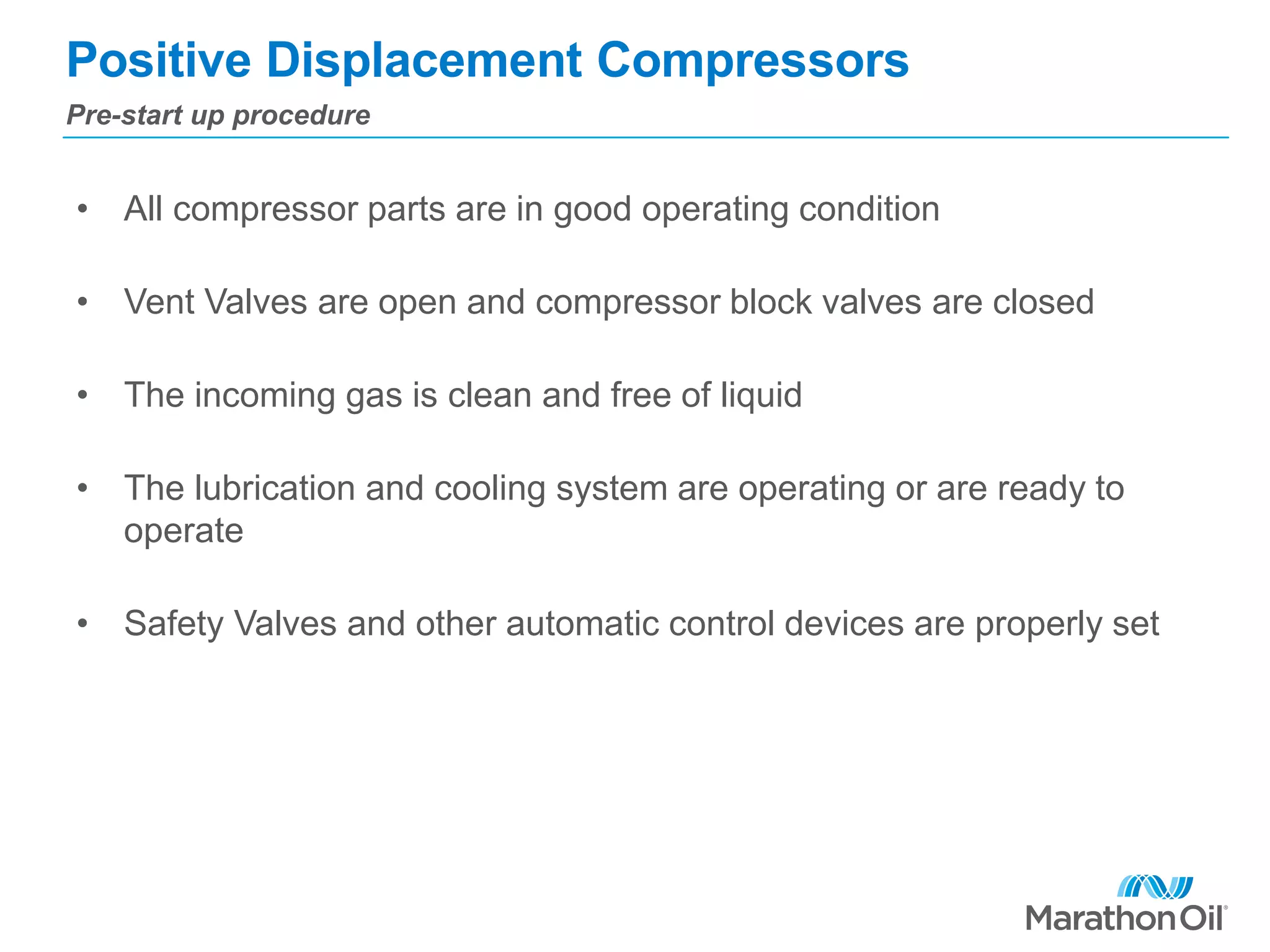
• All compressor parts are in good operating condition
• Vent Valves are open and compressor block valves are closed
• The incoming gas is clean and free of liquid
• The lubrication and cooling system are operating or are ready to
operate
• Safety Valves and other automatic control devices are properly set
Pre-start up procedure
Positive Displacement Compressors
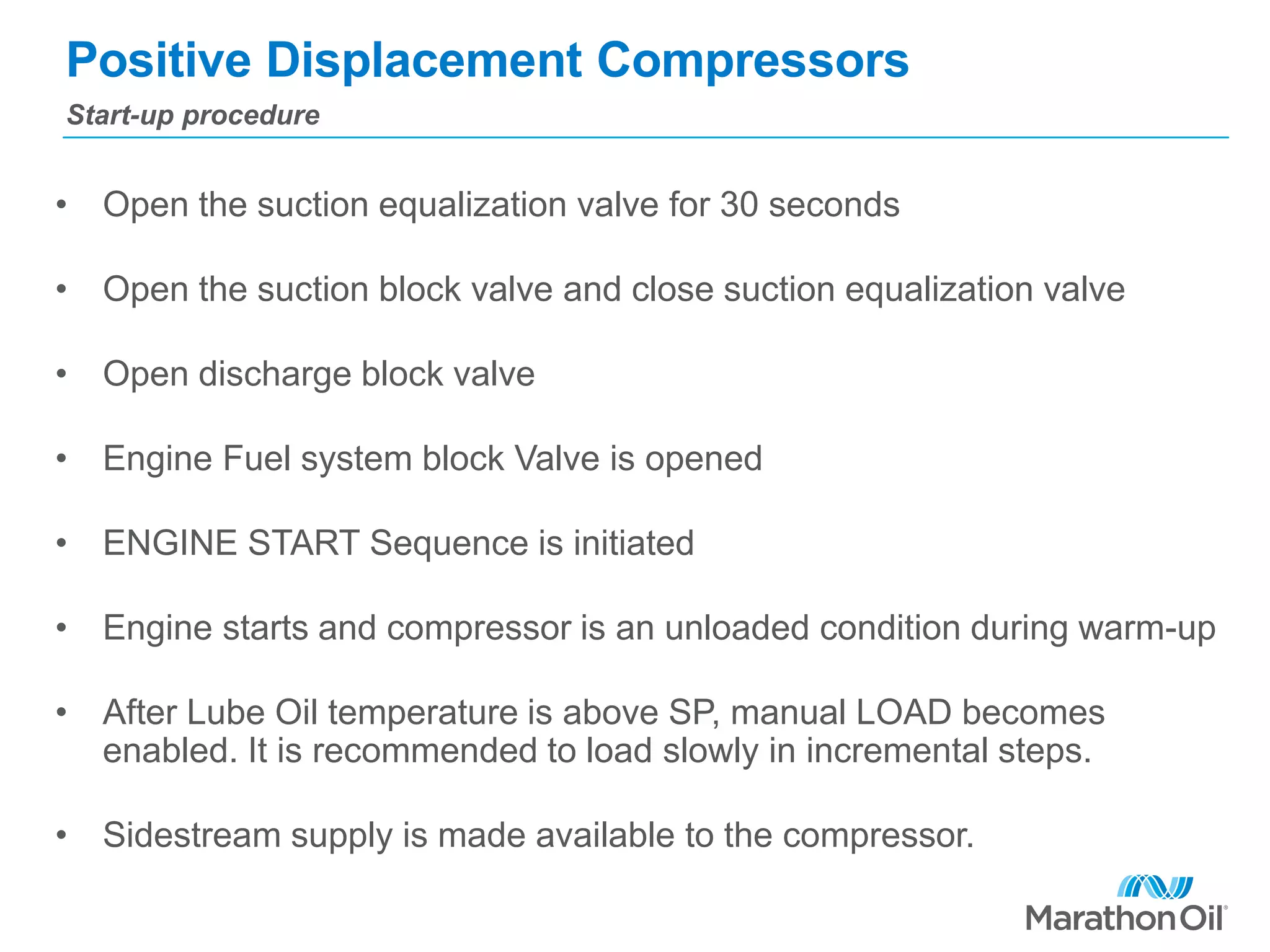
• Open the suction equalization valve for 30 seconds
• Open the suction block valve and close suction equalization valve
• Open discharge block valve
• Engine Fuel system block Valve is opened
• ENGINE START Sequence is initiated
• Engine starts and compressor is an unloaded condition during warm-up
• After Lube Oil temperature is above SP, manual LOAD becomes
enabled. It is recommended to load slowly in incremental steps.
• Sidestream supply is made available to the compressor.
Start-up procedure
Positive Displacement Compressors
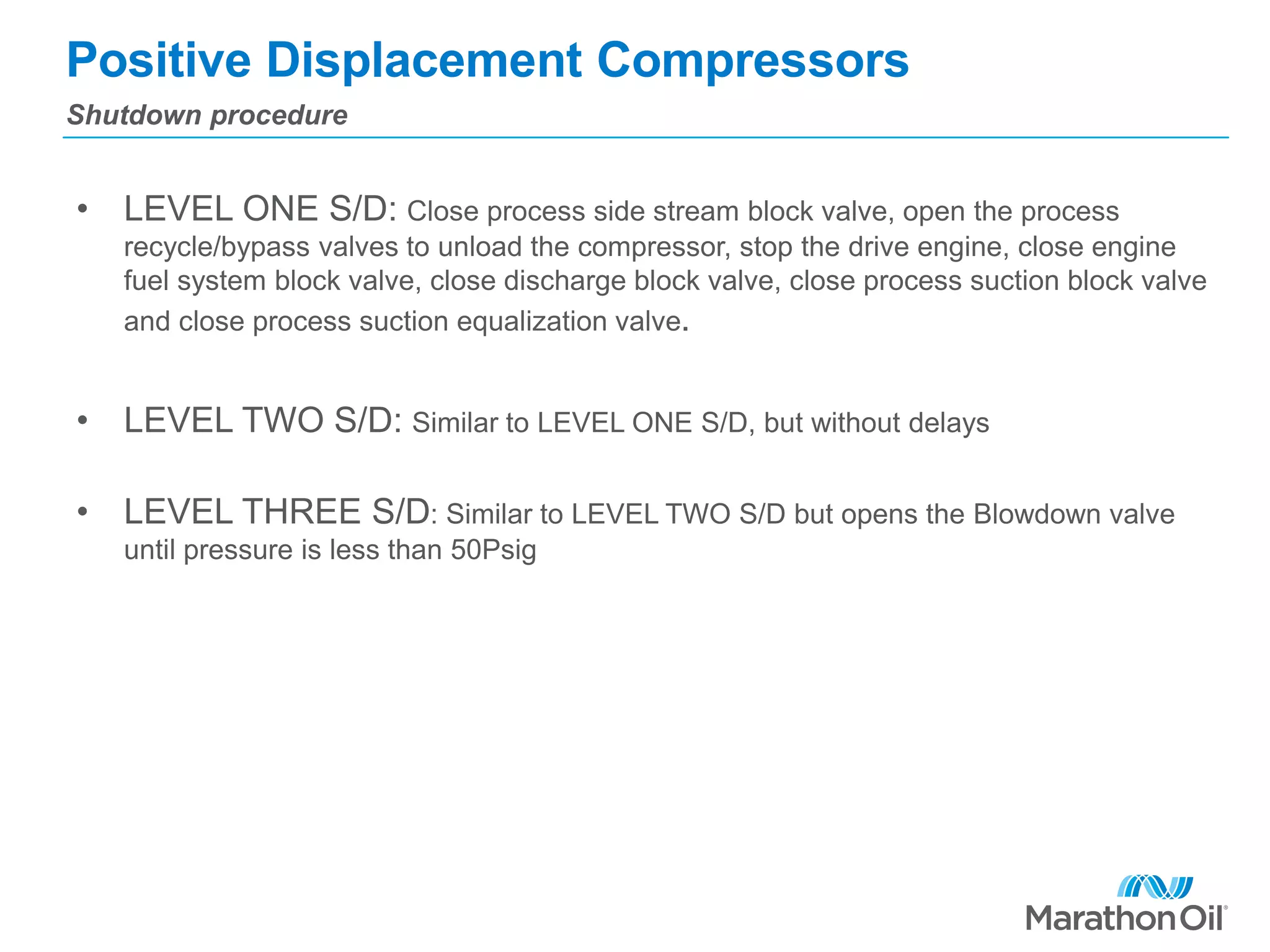
• LEVEL ONE S/D: Close process side stream block valve, open the process
recycle/bypass valves to unload the compressor, stop the drive engine, close engine
fuel system block valve, close discharge block valve, close process suction block valve
and close process suction equalization valve.
• LEVEL TWO S/D: Similar to LEVEL ONE S/D, but without delays
• LEVEL THREE S/D: Similar to LEVEL TWO S/D but opens the Blowdown valve
until pressure is less than 50Psig
Shutdown procedure
Positive Displacement Compressors
• Check Oil Levels Daily (Operator Rounds)
• Inspect lube oil for contaminants (MEGPL LAB)
• Check Lube oil Pumps ( Operator Rounds)
• Change Oil Filter cartridges (Maintenance)
• Calibrate instruments daily ( I&E PMR)
• Replace pneumatic filter regulator filters every 6 months
(Maintenance)
• Open drains on all pneumatic filter regulator for 10 sec every week
Maintenance Activities
ANY QUESTIONS??
Thanks for coming!
Hector Nguema Ondo Perez

Positive displacement compressors

  • 1.
    Introduction to Positive displacementcompressors Petroskill course Hector Nguema Ondo Perez
  • 2.
    Positive Displacement compressors Tableof contents • Reciprocating compressors  Basic parts of reciprocating compressors  P-V Diagrams  Controlling a compressor • Type of clearance  Overhead Stabilizer Compressor #5 • Rotary compressors • Type of rotary compressors • Design of rotary compressors • Operation of rotary compressors • Constructing Reciprocating compressors  Valves  Pistons  Rod packing • Lubrication • Cooling and safety controls • Operating Compressor Procedures • Pre-start up • Start up • Shutdown • Normal Operations
  • 3.
    Reciprocating compressors Reciprocating compressorbasic parts Frame: convert rotary motion into linear motion • As the shaft turns motion is transferred to a throw on the crankshaft connected to the crosshead. Crosshead slides transferring motion to the piston rod.
  • 4.
    Reciprocating compressors Reciprocating compressorbasic parts Distance Piece: provide isolation between the process side (cylinders) and the frame • Crosshead guide end of the piston rod is isolated from the crankcase by a packing, which provides seal to prevent leakages. Cylinder: creates internal passages for the gas flow and access to the suction and discharge valves • Cylinder is cast with an outer wall and main bore at the center. • Cylinder must match the stroke of the frame and the selected bore diameter required for the pressure and flow condition
  • 5.
    Reciprocating compressors Reciprocating compressors Single-acting Double-acting •In the single-acting compressor, the forward stroke is the compression stroke. • The backstroke is the suction stroke. • Forward stroke • Crank end Suction Valve • Head End discharge valve • Backstroke
  • 6.
    Reciprocating compressors Interpreting P-Vdiagrams P V Discharge Suction CompressionExpansion A: Piston reaches head-end of the cylinder B: Suction valve opens D: Discharge valve opens C: Piston reaches crack-end of the cylinder Expansion of clearance gas Fresh Gas enters cylinder Gas inside cylinder is compressed Compressed gas leaves cylinder Overhead Stabilizer Compressor #5
  • 7.
    Reciprocating compressors Controlling acompressor Throttling: Change capacity or rate of flow through the compressor Compressor ratio (R) • R is low (2.0) increase HP • R is between 2 and 2.5 minimum impact • R is above 2.5 decrease HP Clearance Pockets: Varying clearance pocket increase or decrease amount of gas entering the compressor Excessive clearance volume → Shutoff • Cylinder capacity and Volumetric efficiency are 0
  • 8.
    Reciprocating compressors Types ofclearance pockets It is always in use and cannot be adjusted by operators. Fixed-volumeHOFV The hand wheel opens a valve which allows for a fixed amount of clearance when needed. Once installed, these types of pockets have a fixed volume. The amount of clearance may be changed by changing the size of the pocket Screw or flanged Variable The hand wheel makes it possible to adjust the amount of clearance as needed.
  • 9.
    Reciprocating compressors Controlling acompressor Unloading: An unloaded compressor compresses less gas, uses less horsepower in the motor, and will be more efficient Controlling speed: Reducing speed reduces fuel used and decrease operating costs. • Unload one end of a single cylinder. • To reduce the pressure and temperature of the packing, unload the crank end. • Unload all of the crank-end suction valves at one end of a multi-cylinder. • As gear trains and belt drives reduce speed from the driver, they increase the torque delivered to the compressor shaft
  • 10.
    Rotary compressors Rotary compressors Arotary-type lobed blower has two impellers that trap and transfer gas. Because of the clearance space, some gas could leak backwards. Lobed blowers Sliding-Vane Compressors As the rotor turns, the pocket gets smaller while the vanes move into the rotor, compressing the gas. At maximum compression, the gas is released out of the discharge port. Screw compressors Gas is displaced by helically-lobed rotors. The reduction in volume increases the pressure of the gas. Liquid-piston compressors As the rotor turns, gas enters from the two inlets in the stationary port chamber. The blades displace the gas toward the discharge ports in the stationary port chamber
  • 11.
    Rotary compressors Operation ofrotary compressors • Gas is drawn between the top side of rotors and the lobes • As rotors rotate the inlet port is sealed • Rotation reduce the gas volume increasing pressure • When the gas is exposed to the outlet port the gas is discharged
  • 12.
    Rotary compressors Propane refrigerantcompressor • Compression is achieved by the meshing of the two helical rotors on parallel shafts • Capacity control is achieved by means of a slide valve in the casing
  • 13.
    Positive Displacement Compressors Compressorvalves Plate Valves Poppet Valves Channel Valves • Capable of handling large flows by moving a sealing plate to open or close a flow path • The springs push from the stop plate and the channels cover the slots in the valve seat • These valves provide a low pressure drop and are often used when compression ratios are high.
  • 14.
    Positive Displacement Compressors Pistonsand Piston Rings Piston Rings The rings seal by a close fit against the cylinder and against the flat sides of the grooves Rider BandsRod Packing
  • 15.
    Positive Displacement Compressors Bores,Liners, Crosshead and bearings Cylinder Bore and Liner Crossheads Bearings A film of oil separates the crosshead pin and the crankshaft from the bearings. The oil is supplied under pressure through holes in the bearing surfaces. If breakage occurs between the piston and the crosshead: • Faulty alignment • Improper rod Material • Operating above the max load If there is excessive wear in the cylinder bore, the entire body does not have to be replaced. Only the worn liner needs to be replaced
  • 16.
    Positive Displacement Compressors Lubricationsystems Splash system • Supply of oil is maintained in the crankcase and splashed up by the rotation to lubricate the bearings and the crosshead • Centrifugal force is used to lubricate the crank pin. The oil is forced up to the crank pin through an oil passage. Force-Feed system • Oil is pumped under pressure to the required parts.
  • 17.
    Positive Displacement Compressors Filters& Relief Valves Self-cleaning filters Bypass Relief Valves • Opening the bypass when the filter is blocked allows oil from the pump to return to the crankcase. In this system, the compressor shuts down when the bypass valve is open to protect against the failure of lube oil pressure and supply • The self-cleaning filter is designed to be cleaned by turning a wiper so that it sweeps over the holes in a cylindrical screen.
  • 18.
    Positive Displacement Compressors OilFlow • Oil enters passages drilled in the crankshaft. The passages lead to the crank pin. The oil lubricates the crank pin and enters the passages drilled in the connecting rods.
  • 19.
    Positive Displacement Compressors Coolingsystem • A compressor's cooling system is designed to remove some of the heat of compression. • An intercooler cools the gas between the stages, and an aftercooler cools the gas after it leaves the compressor.
  • 20.
  • 21.
    Positive Displacement Compressors 2ndSuction Scrubber Suction bottle Reciprocating Gas Compressor Frame Compressor Engine Intake exhaust Engine Exhaust silencer Gas cooler Lube oil tank Overhead Stabilizer Compressor #5
  • 22.
    Positive Displacement Compressors SafetyControls Spring Loaded Safety Valve • The pressure needed to open the valve depends on the compression of the spring. Rupture Disc • Safety valves or rupture discs prevent excessive pressure from building up in the compressor • Safety valves discharge the gas to a vent or flare line. Safety valves must be installed between the cylinder outlet nozzle and the first valve in the discharge line.
  • 23.
    Positive Displacement Compressors SafetyControls Governor Overspeed Trip Mechanical governor Hydraulic governor • Keep the engine running at a constant speed • Control the amount of fuel or fuel-air mixture by opening and closing the engine's throttle or mixing valve • Connected to the engine crankshaft through the gears • Hydraulic fluid is used to control the operating mechanism of the governor • The trip pin is held in its recess by a compression spring. When the engine overspeeds, centrifugal force pushes the trip pin out of its recess in the driveshaft and trips the shut- down switch.
  • 24.
    Positive Displacement Compressors Safetycontrol Oil Pressure Control Water Temperature Control • The low oil pressure shutdown device shuts off the compressor when the oil pressure is low. • Some devices cut off the fuel supply and also shut down the ignition • Activate if the cooling water temperature rises dangerously high. • Monitor the engine jacket water pressure
  • 25.
    Positive Displacement Compressors PLCCause & Effect Chart Water Level Oil & Lubrication Total Trips Vibration & Speed 1st Stage 2nd Stage
  • 26.
    Positive Displacement Compressors •All compressor parts are in good operating condition • Vent Valves are open and compressor block valves are closed • The incoming gas is clean and free of liquid • The lubrication and cooling system are operating or are ready to operate • Safety Valves and other automatic control devices are properly set Pre-start up procedure
  • 27.
    Positive Displacement Compressors •Open the suction equalization valve for 30 seconds • Open the suction block valve and close suction equalization valve • Open discharge block valve • Engine Fuel system block Valve is opened • ENGINE START Sequence is initiated • Engine starts and compressor is an unloaded condition during warm-up • After Lube Oil temperature is above SP, manual LOAD becomes enabled. It is recommended to load slowly in incremental steps. • Sidestream supply is made available to the compressor. Start-up procedure
  • 28.
    Positive Displacement Compressors •LEVEL ONE S/D: Close process side stream block valve, open the process recycle/bypass valves to unload the compressor, stop the drive engine, close engine fuel system block valve, close discharge block valve, close process suction block valve and close process suction equalization valve. • LEVEL TWO S/D: Similar to LEVEL ONE S/D, but without delays • LEVEL THREE S/D: Similar to LEVEL TWO S/D but opens the Blowdown valve until pressure is less than 50Psig Shutdown procedure
  • 29.
    Positive Displacement Compressors •Check Oil Levels Daily (Operator Rounds) • Inspect lube oil for contaminants (MEGPL LAB) • Check Lube oil Pumps ( Operator Rounds) • Change Oil Filter cartridges (Maintenance) • Calibrate instruments daily ( I&E PMR) • Replace pneumatic filter regulator filters every 6 months (Maintenance) • Open drains on all pneumatic filter regulator for 10 sec every week Maintenance Activities
  • 30.
    ANY QUESTIONS?? Thanks forcoming! Hector Nguema Ondo Perez

Editor's Notes

  • #15 Many pistons over 9 inches (23 centimeters) in diameter are made of aluminum.  Using hollow or aluminum pistons rather than cast iron reduces the weight of the piston.  Very large pistons are made of hollow, fabricated steel sprayed with bronze or babbitt.  The bronze or babbit provides a low-friction surface coating for the piston. Aluminum pistons use Teflon rings for compressing oxygen and other gases that must be kept free of lubricant This piston rod is tapered.  It extends through the piston and is drawn up tight against the shoulder by the lock nut.  The piston rings ride in grooves on the piston. As the compressor reaches operating temperature, the piston and the rod expand more than the cylinder does.  Piston-to-cylinder clearance must be great enough to prevent seizure if the compressor overheats during operation, but small enough to permit adequate support of the piston rings.  Manufacturers usually specify the amount of clearance required between the piston and the cylinder wall.