Lecture 1: Introduction to composite materials
At the end of this lecture you will have:
An understanding of what are composite materials
What the various types of composite materials
Why they are used
How they are designed
1/17/2014 1
Lecture 1: Introduction to composite materials
What are composites materials?
1/17/2014 2
Lecture 1: Introduction to composite materials
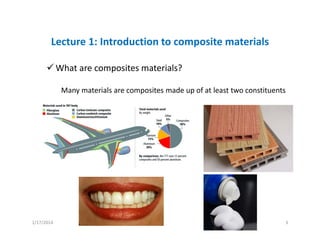
What are composites materials?
Many materials are composites made up of at least two constituents
1/17/2014 3
Lecture 1: Introduction to composite materials
What are the various types of composites materials?
1/17/2014 4
Lecture 1: Introduction to composite materials
What are the various types of composites materials?
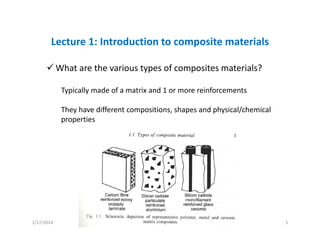
Typically made of a matrix and 1 or more reinforcements 
They have different compositions, shapes and physical/chemical 
properties
1/17/2014 5
Lecture 1: Introduction to composite materials
What are the various types of composites materials?
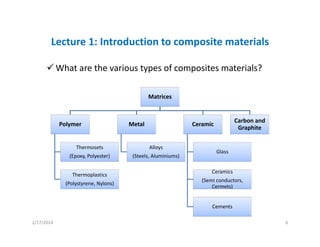
Matrices
Polymer
Thermosets
(Epoxy, Polyester)
Thermoplastics
(Polystyrene, Nylons)
Metal
Alloys
(Steels, Aluminiums)
Ceramic
Glass
Ceramics
(Semi conductors, 
Cermets)
Cements
Carbon and 
Graphite 
1/17/2014 6
Lecture 1: Introduction to composite materials
What are the various types of composites materials?
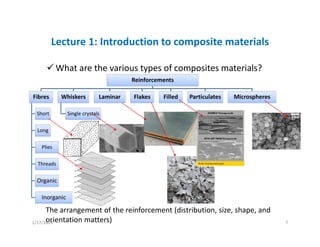
The arrangement of the reinforcement (distribution, size, shape, and 
orientation matters)
Reinforcements
Fibres
Short
Long
Plies
Threads
Organic
Inorganic
Whiskers
Single crystals
Laminar Flakes Filled Particulates Microspheres
1/17/2014 7
Lecture 1: Introduction to composite materials
What are the various types of composites materials?
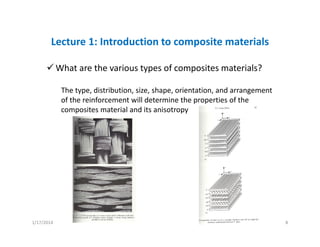
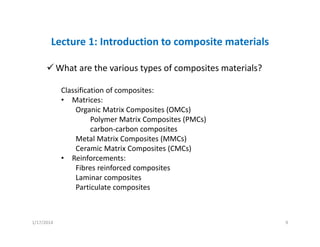
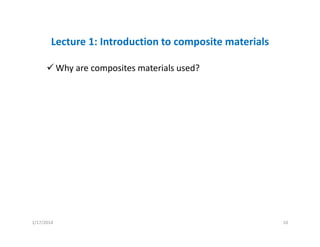
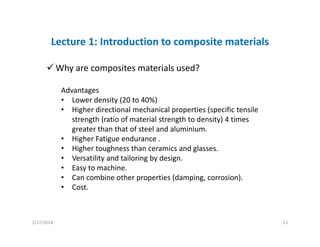
The type, distribution, size, shape, orientation, and arrangement 
of the reinforcement will determine the properties of the 
composites material and its anisotropy
1/17/2014 8
Lecture 1: Introduction to composite materials
What are the various types of composites materials?
Classification of composites:
• Matrices: 
Organic Matrix Composites (OMCs)
Polymer Matrix Composites (PMCs)
carbon‐carbon composites
Metal Matrix Composites (MMCs)
Ceramic Matrix Composites (CMCs)
• Reinforcements:
Fibres reinforced composites
Laminar composites
Particulate composites
1/17/2014 9
Lecture 1: Introduction to composite materials
Why are composites materials used?
1/17/2014 10
Lecture 1: Introduction to composite materials
Why are composites materials used?
Advantages
• Lower density (20 to 40%)
• Higher directional mechanical properties (specific tensile 
strength (ratio of material strength to density) 4 times 
greater than that of steel and aluminium.
• Higher Fatigue endurance .
• Higher toughness than ceramics and glasses.
• Versatility and tailoring by design.
• Easy to machine.
• Can combine other properties (damping, corrosion).
• Cost.
1/17/2014 11
Lecture 1: Introduction to composite materials
Why are composites materials used?
Disadvantages
• Not often environmentally friendly.
• Low recyclability.
• Cost can fluctuate.
• Can be damaged.
• Anisotropic properties.
• Matrix degrades.
• Low reusability.
1/17/2014 12
Lecture 1: Introduction to composite materials
Why are composites materials used?
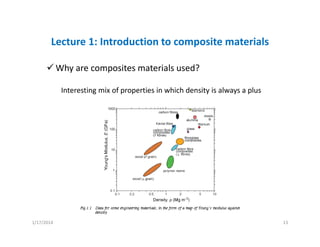
Interesting mix of properties in which density is always a plus
1/17/2014 13
Lecture 1: Introduction to composite materials
Why are composites materials used?
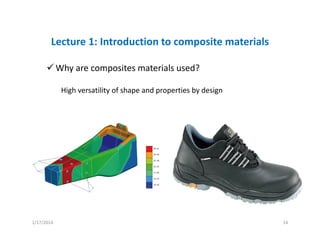
High versatility of shape and properties by design
1/17/2014 14
Lecture 1: Introduction to composite materials
How are composites materials designed?
1/17/2014 15
Lecture 1: Introduction to composite materials
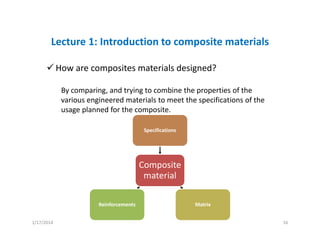
How are composites materials designed?
By comparing, and trying to combine the properties of the 
various engineered materials to meet the specifications of the 
usage planned for the composite.
Composite 
material
Specifications
MatrixReinforcements
1/17/2014 16
Lecture 1: Introduction to composite materials
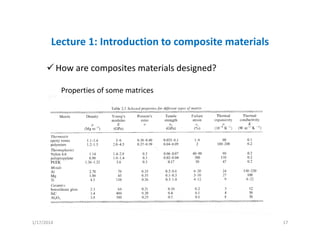
How are composites materials designed?
Properties of some matrices
1/17/2014 17
Lecture 1: Introduction to composite materials
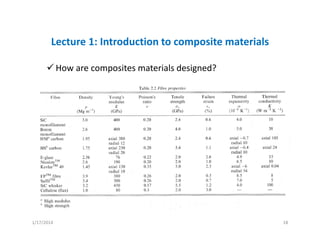
How are composites materials designed?
Properties of some reinforcements
1/17/2014 18

Composites lecture notes